Archive for RAS Club

Astronomy in Darkness

Posted in The Universe and Stuff with tags , , , , , , , , on January 14, 2012 by telescoper

Yesterday, being the second Friday of the month, was the day for the Ordinary Meeting of the Royal Astronomical Society (followed by dinner at the Athenaeum for members of the RAS Club). Living and working in Cardiff it’s difficult for me to get the specialist RAS Meetings earlier in the day, but if I get myself sufficiently organized I can usually get to Burlington House in time for the 4pm start of the Ordinary Meeting, which is open to the public.

The distressing news we learnt on Thursday about the events of Wednesday night cast a shadow over the proceedings. Given that I was going to dinner afterwards, for which a jacket and tie are obligatory, I went through my collection of (rarely worn) ties, and decided that a black one would be appropriate. When I arrived at Burlington House I was just in time to hear a warm tribute paid by a clearly upset Professor Roger Davies, President of the RAS and Oxford colleague of the late Steve Rawlings. There then followed a minute’s silence in his memory.

The principal reaction to this news amongst the astronomers present was one of disbelief and/or incomprehension. Some  friends and colleagues of Steve clearly knew much more about what had happened than has so far appeared in the press, but I don’t think it’s appropriate for me to make these public at this stage. We will know the facts soon enough. A colleague also pointed out to me that Steve had spent most of his recent working life as a central figure in the project to build the Square Kilometre Array, which will be the world’s largest radio telescope. He has died just a matter of days before the announcement will be made of where the SKA will actually be built. It’s sobering to think that one can spend so many years working on a project, only for something wholly unforeseen to prevent one seeing it through to completion.

Anyway, the meeting included an interesting talk by Tom Kitching of the University of Edinburgh who talked about recent results from the Canada-France-Hawaii Telescope Lensing Survey (CHFTLenS). The same project was the subject of a press release because the results were presented earlier in the week at the American Astronomical Society meeting in Austin, Texas. I haven’t got time to go into the technicalities of this study – which exploits the phenomenon of weak gravitational lensing to reconstruct the distribution of unseen (dark) matter in the Universe through its gravitational effect on light from background sources – but Tom Kitching actually contributed a guest post to this blog some time ago which will give you some background.

In the talk he presented one of the first dark matter maps obtained from this survey, in which the bright colours represent regions of high dark matter density

Getting maps like this is no easy process, so this is mightily impressive work, but what struck me is that it doesn’t look very filamentary. In other words, the dark matter appears to reside predominantly in isolated blobs with not much hint of the complicated network of filaments we call the Cosmic Web. That’s a very subjective judgement, of course, and it will be necessary to study the properties of maps like this in considerable detail in order to see whether they really match the predictions of cosmological theory.

After the meeting, and a glass of wine in Burlington House, I toddled off to the Athenaeum for an extremely nice dinner. It being the Parish meeting of the RAS Club, afterwards we went through a number of items of Club business, including the election of four new members.

Life  goes on, as does astronomy, even in darkness.

The Club Guest

Posted in Uncategorized with tags , , on May 15, 2010 by telescoper

Yesterday I went, as I do from time to time, to the Royal Astronomical Society’s monthly meeting and thence to the RAS Club for dinner. This was the last such meeting before the summer hiatus – they resume in October – and also incorporated the Society’s Annual General Meeting at which new officers are elected, amongst them the new President.  Andy Fabian was the outgoing President, having completed his two-year tour of duty, and he was replaced by Roger Davies.

It was also revealed at this meeting that next year’s National Astronomy Meeting would be in Llandudno. Usually this event is organized by a university and is held in a university town. This year it was in Glasgow, for example. However, the University of Sheffield has pulled out of organizing the 2011 NAM and no other was willing to take on the considerable task of organizing it at such short notice. It was therefore decided to break with tradition and hold the event not on a university campus but at a holiday resort. I’ve never been to Llandudno, but I think it could be great for us astronomers here in Wales to have the Principality host NAM. I suspect, however, that it wasn’t regional politics, but economics, that held sway in reaching the decision. Llandudno is perhaps a bit cheaper than most English seaside towns. I can already hear some of my English colleagues starting to whinge about how difficult it will be to get there, but we’ll see. I just hope I can persuade them to hold it outside Cardiff’s teaching term otherwise I won’t be able to  go even if it is in Wales.

It was interesting to learn about all these developments, and the subsequent Open Meeting was not without interest either. We had talks about volcanic ash (topical, that one), martian meteorites, high-altitude balloon flights and stellar disks. A mixed bag of talks, but all of them very enjoyable.

However, this meeting turned out to be remarkable for a completely different reason. At the end of one of the lectures in the open meeting, a strange woman entered the lecture theatre, walked down the aisle and took a seat in the front row. In fact she first tried to sit in Roger Davies’ seat – he was standing in order to supervise the question-and-answers at the end of the talk – but he asked her to move. Finding a free seat a bit further along,  she removed her hat and  proceeded to brush her hair ostentatiously. As the other talks went on she appeared to pay very little attention to them, preferring instead to look around the room.  I had never seen her before, but open meetings like this often attract visitors and in any case acting a bit strangely is by no means inconsistent with being an astronomer.

The Mystery Guest

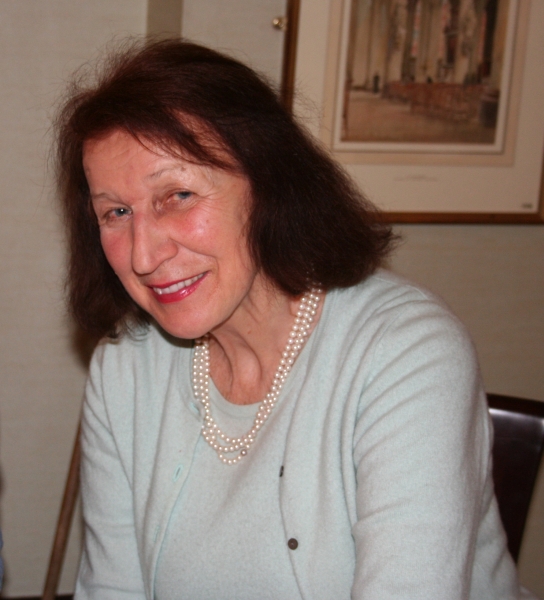
After the meeting closed I went for a glass of wine to Burlington House and then to the Athenaeum. There was quite a crowd there and as usual we all had a glass of wine before sitting down. It was only when we started to eat that I realised that this mysterious lady (left) was actually sitting at another table. Since the RAS Club is for members (and their guests) only, I assumed she was with one of the invited speakers at the meeting who, as is usual in such cases, had been invited to the club afterwards as a club guest.

I thought nothing more about this until I saw the Club Treasurer, Margaret Penston, looking a bit agitated,  go to her table and ask The Mystery Guest a question. I couldn’t hear what. Our visitor then stood up, announced she had to be going and left quickly before anyone could do anything about it. It turned out she wasn’t anyone’s guest at all, but had just latched onto a group of people leaving for the club, each of whom assumed one of the others knew her. It being England, nobody asked her who she was or what she was doing there. I have no idea who she was or why she had decided to attach herself to the RAS Club that evening.

All this was hilarious enough but, after she’d gone, it emerged that she had paid for her dinner by “borrowing” money from a genuine club guest, an American astronomer who happened to be sitting next to her and to whom she had introduced herself as the “Contessa” of something or other. Our American friend may have thought it was all an elaborate practical joke, but he was clearly completely dumbfounded by the episode. The Club had a whip round to pay him back the money he had lent her.

On top of all this, some other members of the Club  then pointed out that she had done something  similar on at least three  previous occasions, in locations ranging from Paris to London. Why none of her previous victims had identified her yesterday and drawn attention to her past history I have no idea. If they had she would have been removed earlier.

If the relatively small gathering we had on Friday could furnish three previous examples of this kind of behaviour, then it seems likely that it’s part of a pattern. However, it doesn’t seem likely that she makes her living doing this sort of thing because she’s only  “borrowed” amounts from £5 to £70. Perhaps astronomers aren’t the best choice of target.

I wonder if anyone reading this blog recognizes her and can shed light on her curious behaviour?

In the Club

Posted in Biographical with tags , on October 13, 2008 by telescoper

Earlier this year I was elected a member of the Royal Astronomical Society Club. This organization shouldn’t be confused with the Royal Astronomical Society (RAS) itself. I’ve been a Fellow of that for ages. The RAS Club is basically a dining club whose members are all Fellows of the Royal Astronomical Society. All you have to do to join the Royal Astronomical Society is to pay some money and sign your name in a book. To get into the RAS Club you have to be elected by the existing membership. I was elected at the January meeting this year, but this was the first time I’ve been able to dine owing to the long drawn-out affair of my move from Nottingham to Cardiff.

Curiously the RAS Club is actually older than the RAS itself, as the first dinner was held in 1820, before the RAS was actually formed. Nowadays, the RAS Club usually meets at the Athenaeum in Pall Mall, shortly after the end of the monthly “Ordinary” meetings of the RAS at Burlington House (referred to as “another place”) which happen on the second friday of each month. That is except when the RAS meeting is the annual National Astronomy Meeting (NAM) which is held at a different location each year, usually in April. On these occasions the club also meets, but at an appropriate alternative venue near the NAM location.

Although I knew several people already in the club I didn’t really know what it would be like, but my first time there turned out to be very pleasant. The food and wine were good and the conversation was extremely enjoyable. At the end of the dinner my health was drunk – as indeed was I – and I had to reply, which I did by telling the story of my encounter with the Kansas police. It seemed to go down quite well. After other speeches the dinner was declared “informal” which is just as well because by then I was as informal as a newt.

The club’s various little rituals are a bit bizarre, such as calling Burlington House (“another place”), but quaintly amusing in their own way and the proceedings are remarkably lacking in pomposity. I’m now actually looking forward to the “Naming of Names” next month.

I think the RAS Club (and even the RAS itself) is viewed with suspicion and perhaps even hostility by some astronomers, who seem to think the club is a kind of sinister secret society whose existence is intrinsically detrimental to the health of astronomy in the UK. Actually it’s just an excuse for a good nosh-up and some daft jokes, although I was initially disappointed to find out that there wasn’t after all a covert plan for world domination. Or if there is, nobody told me about it.

The other common complaint is that the club’s membership is just a bunch of old dinosaurs. Now it is true that your typical member of the RAS Club isn’t exactly in the first flush of youth, but age has its effect on all of us eventually and there is something very distasteful, if not offensive, about the widespread ageism with which some astronomers tend to regard the older generation. The recent Wakeham review of physics rightly pointed out that UK astronomy is in a very strong international position, second only to the United States. This strength hasn’t appeared overnight. It is founded just as much on the past achievements of older astronomers as it is sustained by the energy and creativity of the young.

So let’s have a bit more respect.

As for me, the age thing isn’t a great concern. I feel I’ve been on the fast track to fogeydom for some time anyway. I like to play Bridge and go to the Opera too. Although it wouldn’t be to everyone’s taste, I’m not at all ashamed to admit that I actually felt quite at home at the RAS club.

While a private dining club can have whatever image its members feel comfortable with, fogeyish or not, the image of a professional organization is much more crucial and it is important that the former doesn’t impact negatively on the latter. The “real” Royal Astronomical Society definitely has to find a way forward that is a bit more up-to-date and relevant than it is now. If the stuffy air puts off younger astronomers from joining then that can have a very bad effect on the future. Although UK astronomy is very strong, it does need to have better representation in the corridors of power. The Institute of Physics is a professional organization which can deliver much more effective campaigning on behalf of mainstream physics than the RAS is able to do for astronomy, at least at present. Part of the reason is the poor take-up of RAS fellowship by younger astronomers, no doubt at least partly because of its fogeyish image, which in turns prevents it from modernizing. The RAS understands this and is trying to recruit more younger members, but with only limited success.

It’s a difficult balancing act to weigh up the considerable political value of established tradition against the critical need to encourage innovation and change. I know some astronomers think a new professional organization is needed for UK astronomy, and that the RAS should be left to turn into a kind of museum. I think that would be a shame and that it would be better for more astronomers to abandon their antipathy, join the Society and put some effort into making it fit to face the challenges of the 21st Century.