Archive for Roger Penrose

Roger Penrose: Discoverer of Black Holes?

Posted in History, The Universe and Stuff with tags , , , , , , , , , on February 27, 2025 by telescoper

I got home from a busy day on campus to find the 21st February issue of the Times Literary Supplement had landed on my doormat having arrived today, 27th February. It used to take a couple of weeks for my subscription copy to reach Ireland but recently the service has improved. Intriguingly, the envelope it comes in is postmarked Bratislava…

But I digress. This is the cover:
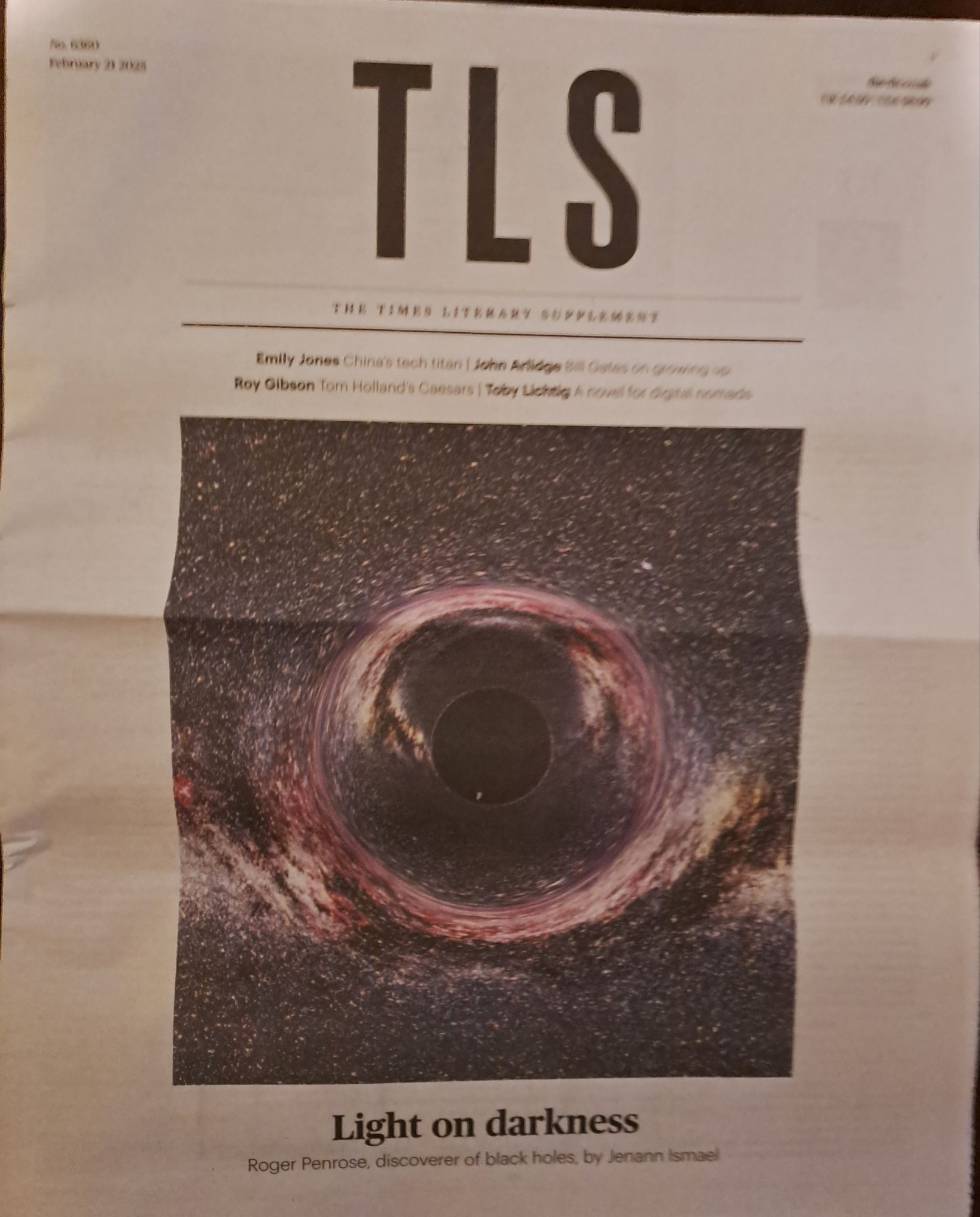
The text below the title “Light on darkness” under the graphic reads “Roger Penrose, discoverer of black holes, by Jennan Ismael”. Nice though it is to see science featured in the Times Literary Supplement for a change and much as I admire Roger Penrose, it is unreasonable to describe him as “the discoverer of black holes”.

A black hole represents a region of space-time where the action of gravity is sufficiently strong that light cannot escape. The idea that such a phenomenon might exist dates back to John Michell, an English clergyman, in 1783, and later by Pierre-Simon Laplace but black holes are most commonly associated with Einstein’s theory of general relativity.  Indeed, one of the first exact solutions of Einstein’s equations to be found describes such an object. The famous Schwarzschild solution was obtained in 1915 by Karl Schwarzschild, who died soon after on the Eastern front in the First World War. The solution corresponds to a spherically-symmetric distribution of matter, and it was originally intended that it could form the basis of a mathematical model for a star. It was soon realised, however that for an object of any mass M there is a critical radius (Rs, the Schwarzschild radius) such that if all the mass is squashed inside Rs then no light can escape.  In terms of the mass M, velocity of light c, and Newton’s constant G, the critical radius is given by Rs = 2GM/c2 . For the mass of the Earth, the critical radius is only 1cm, whereas for the Sun it is about 3km.

Since the pioneering work of Schwarzschild, research on black holes has been intense and other kinds of mathematical solutions have been obtained. For example, the Kerr solution describes a rotating black hole and  the Reissner -Nordstrom solution corresponds to  a black hole with an electric charge.  Various theorems have also been demonstrated relating to the so-called `no-hair’ conjecture: that black holes give very little outward sign of what is inside.

Some people felt that the Schwarzschild solution was physically unrealistic as it required a completely spherical object, but Roger Penrose showed mathematically that the existence of a trapped surface was a generic consequence of gravitational collapse, the result that won him the Nobel Prize in 2020. His work did much to convince scientists of the physical reality of black holes, and he deserved his Nobel Prize, but I don’t think it is fair to say he “discovered” them.

I would say that, as is the case for discoveries in many branches of science, there isn’t just one “discoverer” of black holes: there were important contributions by many people along the way.

P.S. If you want to limit the application of the word “discovery” to observations then I think that the discovery of black holes is down to Paul Murdin and Louise Webster who identified the first really plausible candidate for a black hole in Cygnus X-1, way back in 1971…

P.P.S. The term “Black Hole” was, as far as I know, coined by John Wheeler in 1967.

Roger Penrose is 93.

What is a Singularity?

Posted in Education, Maynooth, The Universe and Stuff with tags , , , , , , on November 24, 2022 by telescoper

Following last week’s Maynooth Astrophysics and Cosmology Masterclass, a student asked (in the context of the Big Bang or a black hole) what a singularity is. I thought I’d share my response here in case anyone else was wondering. The following is what I wrote back to my correspondent:

–oo–

In general, a singularity is pathological mathematical situation wherein the value of a particular variable becomes infinite. To give a very simple example, consider the calculation of the Newtonian force due  to gravity exerted by a massive body on a test particle at a distance r. This force is proportional to 1/r2,, so that if one tried to calculate the force for objects at zero separation (r=0), the result would be infinite.

Singularities are not always  signs of serious mathematical problems. Sometimes they are simply caused by an inappropriate choice of coordinates. For example, something strange and akin to a singularity happens in the standard maps one finds in an atlas. These maps look quite sensible until one looks very near the poles.  In a standard equatorial projection,  the North Pole does not appear as a point, as it should, but is spread along straight line along the top of the map. But if you were to travel to the North Pole you would not see anything strange or catastrophic there. The singularity that causes this point to appear is an example of a coordinate singularity, and it can be transformed away by using a different projection.

More serious singularities occur with depressing regularity in solutions of the equations of general relativity. Some of these are coordinate singularities like the one discussed above and are not particularly serious. However, Einstein’s theory is special in that it predicts the existence of real singularities where real physical quantities (such as the matter density) become infinite. The curvature of space-time can also become infinite in certain situations.

Probably the most famous example of a singularity lies at the core of a black hole. This appears in the original Schwarzschild interior solution corresponding to an object with perfect spherical symmetry. For many years, physicists thought that the existence of a singularity of this kind was merely due to the special and rather artificial nature of the exactly spherical solution. However, a series of mathematical investigations, culminating in the singularity theorems of Penrose, showed no special symmetry is required and that singularities arise in the generic gravitational collapse problem.

As if to apologize for predicting these singularities in the first place, general relativity does its best to hide them from us. A Schwarzschild black hole is surrounded by an event horizon that effectively protects outside observers from the singularity itself. It seems likely that all singularities in general relativity are protected in this way, and so-called naked singularities are not thought to be physically realistic.

There is also a singularity at the very beginning in the standard Big Bang theory. This again is expected to be a real singularity where the temperature and density become infinite. In this respect the Big Bang can be thought of as a kind of time-reverse of the gravitational collapse that forms a black hole. As was the case with the Schwarzschild solution, many physicists thought that the initial cosmologcal singularity could be a consequence of the special symmetry required by the Cosmological Principle. But this is now known not to be the case. Hawking and Penrose generalized Penrose’s original black hole theorems to show that a singularity invariably exists in the past of an expanding Universe in which certain very general conditions apply.

So is it possible to avoid this singularity? And if so, how?

It is clear that the initial cosmological singularity might well just be a consequence of extrapolating deductions based on the classical ttheory of general relativity into a situation where this theory is no longer valid.  Indeed, Einstein himself wrote:

The theory is based on a separation of the concepts of the gravitational field and matter. While this may be a valid approximation for weak fields, it may presumably be quite inadequate for very high densities of matter. One may not therefore assume the validity of the equations for very high densities and it is just possible that in a unified theory there would be no such singularity.

Einstein, A., 1950. The Meaning of Relativity, 3rd Edition, Princeton University Press.

We need new laws of physics to describe the behaviour of matter in the vicinity of the Big Bang, when the density and temperature are much higher than can be achieved in laboratory experiments. In particular, any theory of matter under such extreme conditions must take account of  quantum effects on a cosmological scale. The name given to the theory of gravity that replaces general relativity at ultra-high energies by taking these effects into account is quantum gravity, but no such theory has yet been constructed.

There are, however, ways of avoiding the initial singularity in classical general relativity without appealing to quantum effects. First, one can propose an equation of state for matter in the very early Universe that does not obey the conditions laid down by Hawking and Penrose. The most important of these conditions is called the strong energy condition: that r+3p/c2>0 where r is the matter density and p is the pressure. There are various ways in which this condition might indeed be violated. In particular, it is violated by a scalar field when its evolution is dominated by its vacuum energy, which is the condition necessary for driving inflationary Universe models into an accelerated expansion.  The vacuum energy of the scalar field may be regarded as an effective cosmological constant; models in which the cosmological constant is included generally have a bounce rather than a singularity: running the clock back, the Universe reaches a minimum size and then expands again.

Whether the singularity is avoidable or not remains an open question, and the issue of whether we can describe the very earliest phases of the Big Bang, before the Planck time, will remain open at least until a complete  theory of quantum gravity is constructed.

Astronomy Look-alikes No. 101

Posted in Astronomy Lookalikes, Television, The Universe and Stuff with tags , , , , , on October 6, 2020 by telescoper

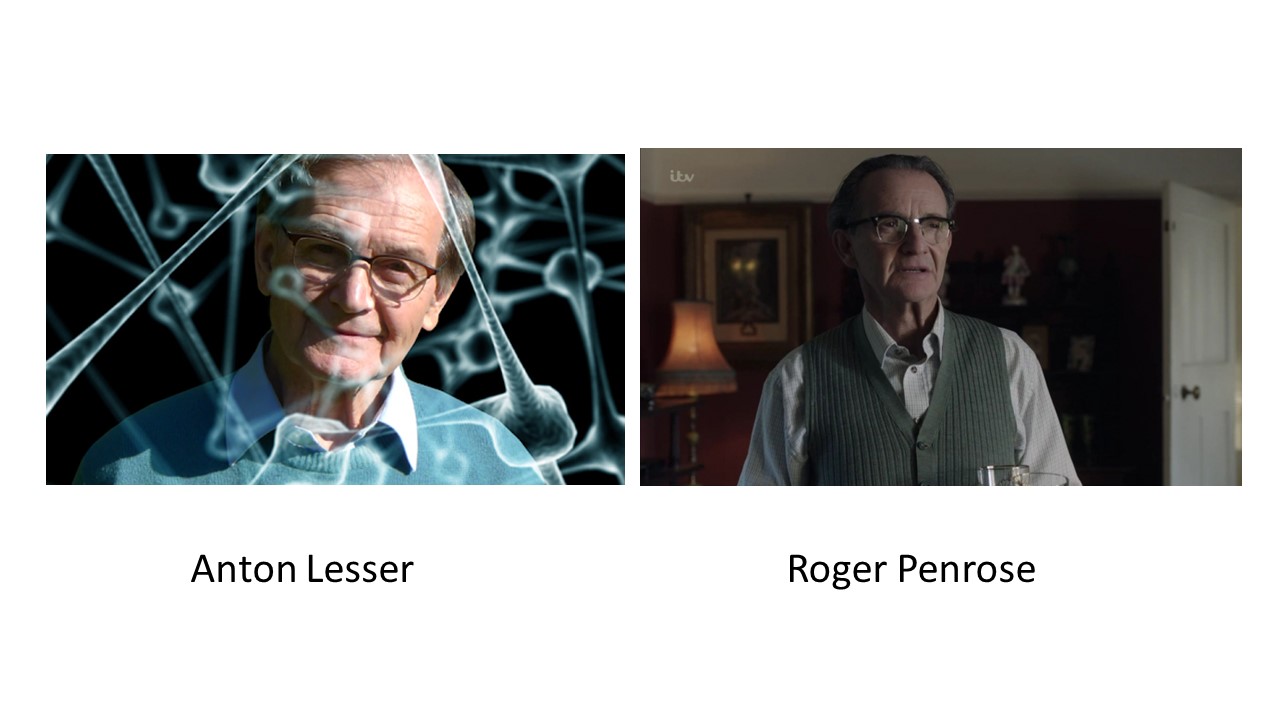
One winner of the 2020 Nobel Prize for Physics, Roger Penrose, is based in Oxford where he also plays Chief Superintendent Bright in the popular TV detective series Endeavour

The 2020 Nobel Prize for Physics

Posted in The Universe and Stuff with tags , , , on October 6, 2020 by telescoper

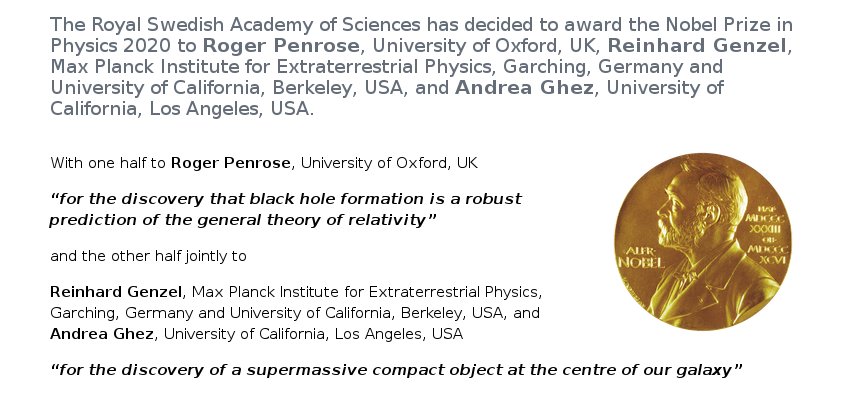
I don’t know about you but I was a bit surprised by this year’s announcement of the Physics Nobel Prize but that’s largely because it went to something cosmic last year and not because I disapprove in any way. Roger Penrose’s work in the 1960s on the black hole singularity theorems is rightly famous and the observational discovery of the supermassive black hole in the centre of the Milky Way is also more than worthy of recognition.

Congratulations to Roger Penrose, Reinhard Genzel and Andrea Ghez!

Hawking Points in the CMB Sky?

Posted in Astrohype, Bad Statistics, The Universe and Stuff with tags , on October 30, 2018 by telescoper

As I wait in Cardiff Airport for a flight back to civilization, I thought I’d briefly mention a paper that appeared on the arXiv this summer. The abstract of this paper (by Daniel An, Krzysztof A. Meissner and Roger Penrose) reads as follows:

This paper presents powerful observational evidence of anomalous individual points in the very early universe that appear to be sources of vast amounts of energy, revealed as specific signals found in the CMB sky. Though seemingly problematic for cosmic inflation, the existence of such anomalous points is an implication of conformal cyclic cosmology (CCC), as what could be the Hawking points of the theory, these being the effects of the final Hawking evaporation of supermassive black holes in the aeon prior to ours. Although of extremely low temperature at emission, in CCC this radiation is enormously concentrated by the conformal compression of the entire future of the black hole, resulting in a single point at the crossover into our current aeon, with the emission of vast numbers of particles, whose effects we appear to be seeing as the observed anomalous points. Remarkably, the B-mode location found by BICEP 2 is at one of these anomalous points.

The presence of Roger Penrose in the author list of this paper is no doubt a factor that contributed to the substantial amount of hype surrounding it, but although he is the originator of the Conformal Cyclic Cosmology I suspect he didn’t have anything to do with the data analysis presented in the paper as, great mathematician though he is, data analysis is not his forte.

I have to admit that I am very skeptical of the claims made in this paper – as I was in the previous case of claims of a evidence in favour of the Penrose model. In that case the analysis was flawed because it did not properly calculate the probability of the claimed anomalies in the standard model of cosmology. Moreover, the addition of a reference to BICEP2 at the end of the abstract doesn’t strengthen the case. The detection claimed by BICEP2 was (a) in polarization not in temperature and (b) is now known to be consistent with galactic foregrounds.

I will, however, hold my tongue on these claims, at least for the time being. I have an MSc student at Maynooth who is going to try to reproduce the analysis (which is not trivial, as the description in the paper is extremely vague). Watch this space.

Shooting at the Cosmic Circles

Posted in Astrohype, Bad Statistics, The Universe and Stuff with tags , , , , on May 11, 2011 by telescoper

Another brief update post of something that whizzed past while I was away and thought I’d mention now that I’m back.

Remember the (now infamous) paper by Gurzadyan and Penrose about evidence for the Conformal Cyclic Cosmology that I blogged about last year?

The original analysis was comprehensively dissected and refuted by a number of papers within a few days of its appearance – see here, here and here – only for Gurzadyan and Penrose to dig an even bigger hole for themselves with a nonsensical reply.

Undaunted, the dynamic duo of Gurzadyan and Penrose have produced yet another paper on the same subject which came out just as I was heading off on my hols.

There has subsequently been another riposte, by Eriksen and Wehus, although I suspect most cosmologists ceased to care about this whole story some time ago. Although it’s a pretty easy target, the Eriksen-Wehus reply does another comprehensive demolition job. The phrase “shooting fish in a barrel” sprang to my mind, but from facebook I learned that the equivalent idiomatic expression in Italian is sparare sulla Croce Rossa (i.e. shooting on the Red Cross). Perhaps we can add a brand new phrase for “taking aim at an easy target” – shooting at the cosmic circles!

I was struck, however, by the closing sentences of the abstract of Eriksen-Wehus reply:

Still, while this story is of little physical interest, it may have some important implications in terms of scienctific sociology: Looking back at the background papers leading up to the present series by Gurzadyan and Penrose, in particular one introducing the Kolmogorov statistic, we believe one can find evidence that a community based and open access referee process may be more efficient at rejecting incorrect results and claims than a traditional journal based approach.

I wholeheartedly agree. I’ve blogged already to the effect that academic journals are a waste of time and money and we’d be much better off with open access and vigorous internet scrutiny. It may be that this episode has just given us a glimpse of the future of scientific publishing.

Share/Bookmark

Doubts about the Evidence for Penrose’s Cyclic Universe

Posted in Bad Statistics, Cosmic Anomalies, The Universe and Stuff with tags , , , , , , on November 28, 2010 by telescoper

A strange paper by Gurzadyan and Penrose hit the Arxiv a week or so ago. It seems to have generated quite a lot of reaction in the blogosphere and has now made it onto the BBC News, so I think it merits a comment.

The authors claim to have found evidence that supports Roger Penrose‘s conformal cyclic cosmology in the form of a series of (concentric) rings of unexpectedly low variance in the pattern of fluctuations in the cosmic microwave background seen by the Wilkinson Microwave Anisotropy Probe (WMAP). There’s no doubt that a real discovery of such signals in the WMAP data would point towards something radically different from the standard Big Bang cosmology.

I haven’t tried to reproduce Gurzadyan & Penrose’s result in detail, as I haven’t had time to look at it, and I’m not going to rule it out without doing a careful analysis myself. However, what I will say here is that I think you should take the statistical part of their analysis with a huge pinch of salt.

Here’s why.

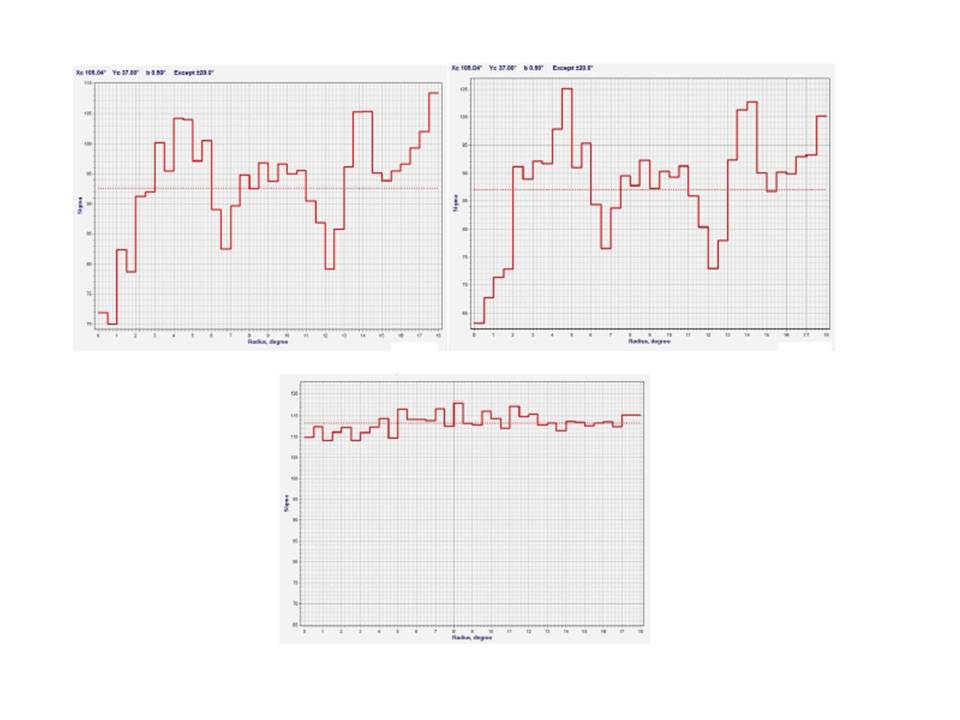
The authors report a hugely significant detection of their effect (they quote a “6-σ” result; in other words, the expected feature is expected to arise in the standard cosmological model with a probability of less than 10-7. The type of signal can be seen in their Figure 2, which I reproduce here:

Sorry they’re hard to read, but these show the variance measured on concentric rings (y-axis) of varying radius (x-axis) as seen in the WMAP W (94 Ghz) and V (54 Ghz) frequency channels (top two panels) compared with what is seen in a simulation with purely Gaussian fluctuations generated within the framework of the standard cosmological model (lower panel). The contrast looks superficially impressive, but there’s much less to it than meets the eye.

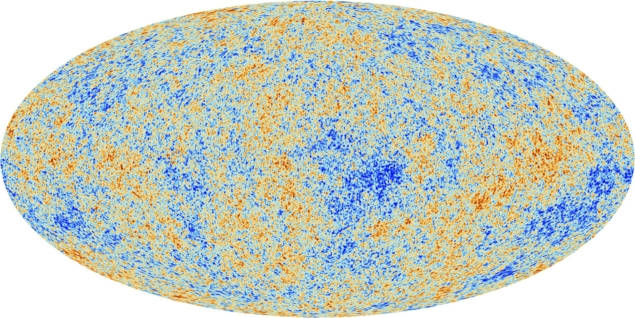
For a start, the separate WMAP W and V channels are not the same as the cosmic microwave background. There is a great deal of galactic foreground that has to be cleaned out of these maps before the pristine primordial radiation can be isolated. The fact similar patterns can be found in the BOOMERANG data by no means rules out a foreground contribution as a common explanation of anomalous variance. The authors have excluded the region at low galactic latitude (|b|<20°) in order to avoid the most heavily contaminated parts of the sky, but this is by no means guaranteed to eliminate foreground contributions entirely. Here is the all-sky WMAP W-band map for example:

Moreover, these maps also contain considerable systematic effects arising from the scanning strategy of the WMAP satellite. The most obvious of these is that the signal-to-noise varies across the sky, but there are others, such as the finite size of the beam of the WMAP telescope.

Neither galactic foregrounds nor correlated noise are present in the Gaussian simulation shown in the lower panel, and the authors do not say what kind of beam smoothing is used either. The comparison of WMAP single-channel data with simple Gaussian simulations is consequently deeply flawed and the significance level quoted for the result is certainly meaningless.

Having not looked looked at this in detail myself I’m not going to say that the authors’ conclusions are necessarily false, but I would be very surprised if an effect this large was real given the strenuous efforts so many people have made to probe the detailed statistics of the WMAP data; see, e.g., various items in my blog category on cosmic anomalies. Cosmologists have been wrong before, of course, but then so have even eminent physicists like Roger Penrose…

Another point that I’m not sure about at all is even if the rings of low variance are real – which I doubt – do they really provide evidence of a cyclic universe? It doesn’t seem obvious to me that the model Penrose advocates would actually produce a CMB sky that had such properties anyway.

Above all, I stress that this paper has not been subjected to proper peer review. If I were the referee I’d demand a much higher level of rigour in the analysis before I would allow it to be published in a scientific journal. Until the analysis is done satisfactorily, I suggest that serious students of cosmology shouldn’t get too excited by this result.

It occurs to me that other cosmologists out there might have looked at this result in more detail than I have had time to. If so, please feel free to add your comments in the box…

IMPORTANT UPDATE: 7th December. Two papers have now appeared on the arXiv (here and here) which refute the Gurzadyan-Penrose claim. Apparently, the data behave as Gurzadyan and Penrose claim, but so do proper simulations. In otherwords, it’s the bottom panel of the figure that’s wrong.

ANOTHER UPDATE: 8th December. Gurzadyan and Penrose have responded with a two-page paper which makes so little sense I had better not comment at all.


Share/Bookmark