Archive for scalar field

New Publication at the Open Journal of Astrophysics

Posted in OJAp Papers, Open Access, The Universe and Stuff with tags , , , , , , on September 28, 2021 by telescoper

Time to announce another publication in the Open Journal of Astrophysics. This one is the eleventh paper in Volume 4 (2021) and the 42nd in all.

The latest publication is entitled Squeezing the Axion – it’s about inflationary scalar field perturbations using the squeezed state formalism – and is by

Here is a screen grab of the overlay which includes the abstract:
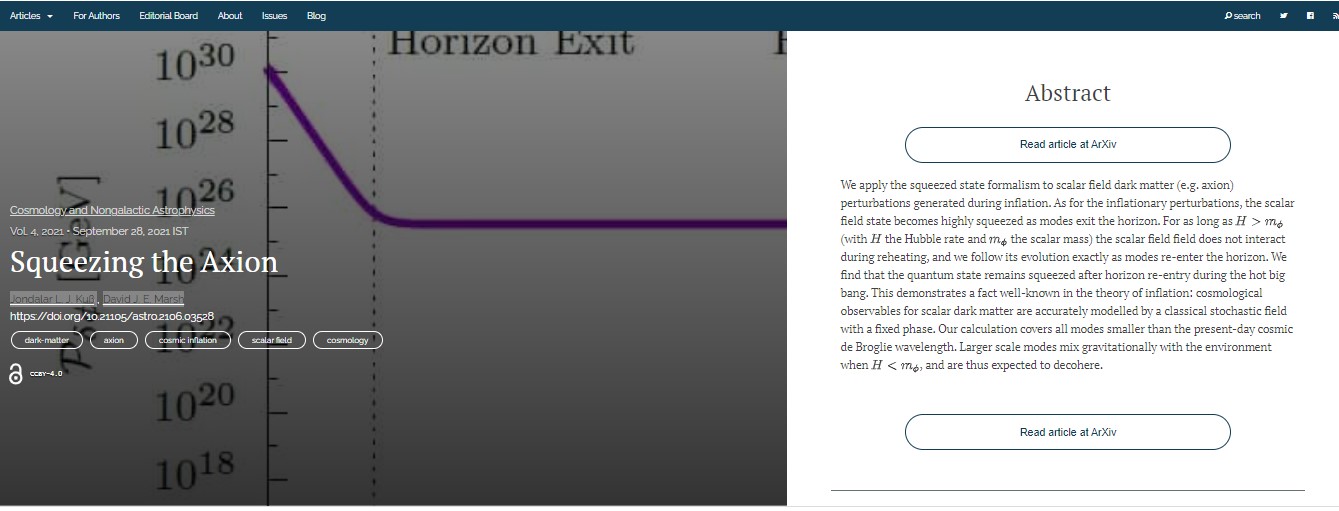
You can click on the image to make it larger should you wish to do so. You can find the arXiv version of the paper here. This one is also in the folder marked Cosmology and Non-Galactic Astrophysics.  

P.S. I hope to publish another paper tomorrow…

A First Author Paper

Posted in The Universe and Stuff with tags , , , , , on February 16, 2015 by telescoper

I thought I’d take a few minutes to celebrate the fact that the first first-author paper by my PhD student here at the University of Sussex, Mateja Gosenca, has just hit the arXiv. The abstract reads:

We explore the dynamical behaviour of cosmological models involving a scalar field (with an exponential potential and a canonical kinetic term) and a matter fluid with spatial curvature included in the equations of motion. Using appropriately defined parameters to describe the evolution of the scalar field energy in this situation, we find that there are two extra fixed points that are not present in the case without curvature. We also analyse the evolution of the effective equation-of-state parameter for different initial values of the curvature.

There has been a lot of interest recently in treating cosmological models as dynamical systems, and the class of models we studied has been analysed before (see the references in the paper) but this paper addresses them in a different (and perhaps slightly more elegant) way and in the context of quintessence models for dark energy. It also contains some very pretty multi-dimensional phase portraits, like this:

Mateja

Of course these figures are self-explanatory, so I’ll say no more about them…