Archive for Scholastica

Open Access Week 2024: Community over Commercialization

Posted in Open Access with tags , , , , , on October 22, 2024 by telescoper

This week is Open Access Week 2024, the theme of which is Community over Commercialization. In light of this, among with some other journal editors I was contacted by Scholastica to provide some comments for their blog, Scholastica being the provider of the platform used by The Open Journal of Astrophysics. I was happy to respond to a couple of questions about how to build engaged communities.

Here are the comments of mine that they used in the blog post:

We started with a small editorial board basically formed from people who read various blog posts I’d written about the idea of the journal and followed its germination. We were lucky to have an initial group of high-profile scientists based all around the globe, including the USA. We started to get some papers from very well-known authors from leading institutes, and large international consortia. Some of these papers have generated large numbers of citations and have attracted coverage in the mainstream media, which also helped raise our profile.

Last year I was on sabbatical, which gave me the opportunity to travel and give invited talks about open access publishing in astrophysics at institutions in France, Spain, the UK, and Australia, and to audiences around the world via the Internet. Other members of the editorial board have also done their bit in promoting the journal. Our submission rate increased only slowly at first but is now more than doubling each year and we are currently receiving several submissions a day.  It has taken a while to establish the reputation of the Open Journal of Astrophysics this way, (i.e., mainly by word of mouth), but that has been good for us because it has enabled us to scale up our processes without becoming overwhelmed by a deluge.

My advice to others trying to set up a new journal would be to have a strong editorial board and clear policies, and above all to be patient. It takes a while — in our case more than 5 years — to establish a reputation in the academic community. These days there are too many people talking about this sort of publishing and not enough actually doing it. It’s time for researchers and research institutions to claim back the original purpose of academic publishing, the free dissemination of research for the public good.

You can read comments from three other editors of open access journals in the original Scholastica blog post.


Open Journal of Astrophysics Update

Posted in OJAp Papers, Open Access with tags , , , , , on April 4, 2024 by telescoper

I’ve just noticed that my post earlier in the week about changes to the publication system at the Open Journal of Astrophysics is dated April 1st. I can assure you it wasn’t meant as a joke! Anyway, the integration with Crossref is now complete and I’ve started clearing the backlog of papers waiting to be published. I would say normal service has been resumed, but the idea is to make the process faster and more reliable than before so it’s hopefully a return but to better-than-normal service.

I want first of all to thank the people at Maynooth University Library, Crossref, and Scholastica for helping us figure out the issue and solve it. We would no doubt have got there faster were it not for the intervention of the Easter break, but in any case it has only required a pause of publication for a couple of weeks.

I’ll resume the regular weekly updates at the weekend. However, one paper got snarled up when we ran into a problem. Although published on 20th March, it was never properly registered with Crossref. The only way I could think of to sort out the issue with this one was to start it again, which I did this morning, and it is now published though I kept the publication date as 20th March.

This paper, by Yingtian Chen and Oleg Gnedin of the University of Michigan, is the 21st paper to be published in Volume 7 and the 136th altogether. It is a study of kinematic, chemical and age data of globular clusters from Gaia yielding clues to how the Milky Way Galaxy assembled. You can read the article on arXiv directly here.

You will note the new format of DOI on the overlay. Nothing else has changed that’s visible to the reader.

Open Peer Review Analytics

Posted in OJAp Papers, Open Access with tags , , , , on October 18, 2023 by telescoper
A Peer, Reviewing. Photo from Pexels.com

Quite a few people have contacted me to ask about the Peer Review Process at the Open Journal of Astrophysics so I thought I’d do a quick post here to explain a bit about it here.

When a paper is submitted it is up to the Editor-in-Chief – that’s me! – to assign it to a member of the Editorial Board. Who that is depends on the topic of the paper and on the current availability due to workload. I of course take on some papers myself. I also reject some papers without further Peer Review if they clearer don’t meet  the journal’s criteria of scientific quality, originality, relevance and comprehensibility. I usually run such papers past the Editorial Board before doing such a ‘Desk Reject’.

Once the paper has been assigned, the Editor takes control of the process, inviting referees (usually two) to comment and make recommendations. This is the rate-determining step, as potential referees are often busy. It can take as many as ten declined invitations before we get a referee to agree. Once accepted, a referee is asked to provide a report within three weeks. Sometimes they are quicker than that, sometimes they take longer. It depends on many factors, including the length of the manuscript.

Once all the referee reports are in the Editor can make a decision. Some papers are rejected upon refereeing, and some are accepted with only tiny changes. The most frequent decision is “Revise and Resubmit” – authors are requested to make changes in response to the referee comments. Sometimes these are minor, sometimes they are substantial. We never give a deadline for resubmission.

A resubmitted paper is usually sent to the same referee(s) who reviewed the original. The referees may be satisfied and recommend acceptance, or we go around again.

Once a paper is accepted, the authors are instructed to upload the final, accepted, version to arXiv. It normally takes a day or two to be announced. The article is then passed over from the Peer Review process to the Publication process. As Managing Editor, I make the overlay and prepare the metadata for the final version. This is usually done the same day as the final version appears on arXiv, but sometimes it takes a bit longer to put everything in order. It’s never more than a few days though.

Anyway, here are some “analytics” – it’s weird how anything that includes any quantitative information is called analytics these days to make it sound more sophisticated than it actually is – provided by the Scholastica platform:

These numbers need a little explanation.

The “average days to a decision” figure includes desk rejects as well as all submissions and resubmissions. Suppose a paper is submitted and it then takes 4 weeks to get referee reports and for the Editor to make a “Revise and Resubmit” request. That would count as 28 days. It might take the authors three months to make their revisions and resubmit the paper, but that does not count in the calculation of the “average days to decision” as during that period the manuscript is deemed to be inactive. If the revised version is accepted almost immediately, say after 2 days, then the average days to decision would be (28+2)/2 = 15 days. Also, being an average there are some shorter than 14 days and some much longer.

The acceptance rate is the percentage of papers eventually accepted (even after revision). The figure for ‘total submissions’ includes resubmissions, so the hypothetical paper in the preceding paragraph would add 2 to this total. That accounts for why the total number of papers accepted is not 50% of 388, which is 194; the actual figure is lower, at 105.

Finally, the number of manuscripts “in progress” is currently 23. That includes papers currently going through the peer review process. It does not include papers which are back with the authors for revisions (although it would be reasonable to count those as in progress in some sense).

There we are. I hope this clarifies the situation.

New Publication at the Open Journal of Astrophysics

Posted in OJAp Papers, Open Access, The Universe and Stuff with tags , , , , , , , on February 2, 2021 by telescoper

Time to announce the first publication of 2021 in the Open Journal of Astrophysics. This one was actually published a few days ago but  it took a bit of time to get the metadata and DOI registered so I held off announcing it until that was done.

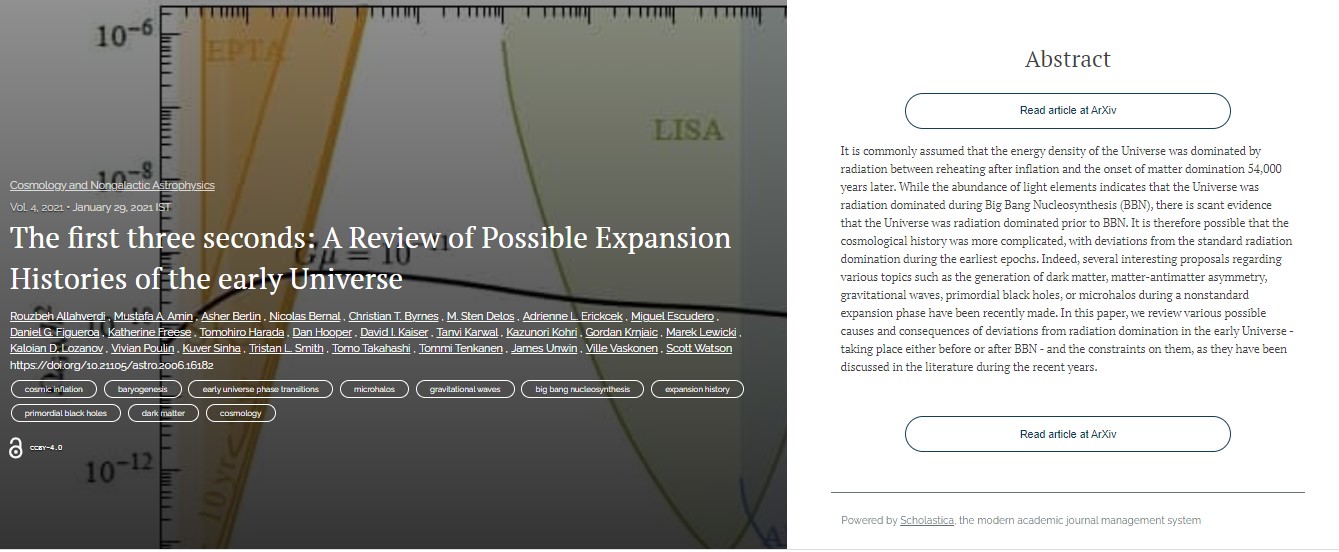
The latest publication is a lengthy and comprehensive review article (67 pages altogether) by Allahverdi et al. which has 26 authors from all round the world. It is entitled The First Three Seconds: a Review of Possible Expansion Histories of the Early Universe and is a study of the various possible evolutionary histories of cosmic expansion possible with a wide range of cosmological models with their implications for baryogenesis, nucleosynthesis, primordial gravitational wave production, and many other things besides.

Here is a screen grab of the overlay:

You can click on the image to make it larger should you wish to do so. You can find the arXiv version of the paper here. This is one for the Cosmology and Nongalactic Astrophysics folder.

And so Volume 4 begins. Volume 3 had 15 papers, Volume 2 had 12 , and Volume 1 just 4 so we’re growing slowly but surely! Let’s see how many we publish in 2021. I can tell you  we have some very exciting papers in the pipeline…

New Publication at the Open Journal of Astrophysics

Posted in OJAp Papers, Open Access, The Universe and Stuff with tags , , , , , , , , , , , , on December 24, 2020 by telescoper

Just time before Christmas to announce another paper in the Open Journal of Astrophysics. This one was actually published a few days ago but because of holiday delays it took some time to get the metadata and DOI registered so I held off announcing it until that was done.

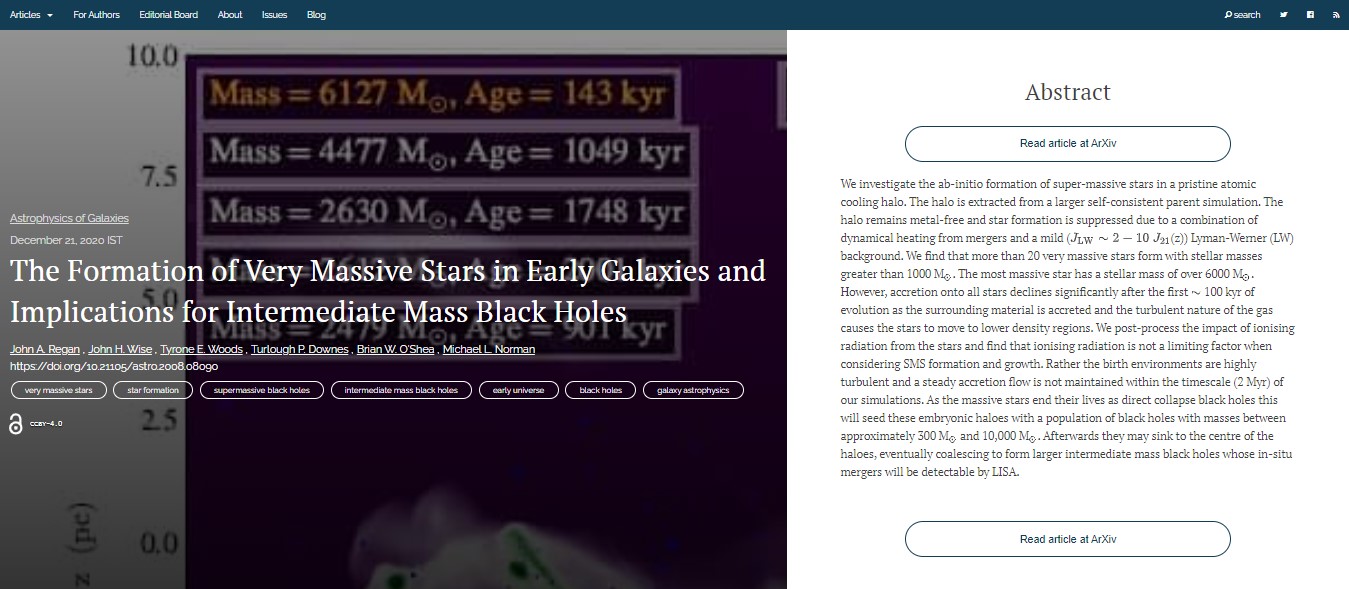
The latest publication is by my colleague* John Regan (of the Department of Theoretical Physics at Maynooth), John Wise (Georgia Tech), Tyrone Woods (NRC Canada), Turlough Downes (DCU), Brian O’Shea (Michigan State) and Michael Norman (UCSD). It is entitled The Formation of Very Massive Stars in Early Galaxies and Implications for Intermediate Mass Black Holes and appears in the Astrophysics of Galaxies section of the arXiv.

Here is a screen grab of the overlay:

You can click on the image to make it larger should you wish to do so. You can find the arXiv version of the paper here.

I think that will be that for for 2020 at the Open Journal of Astrophysics. We have published 15 papers this year, up 25% on last year. Growth is obviously modest, but there’s obviously a lot of inertia in the academic community. After the end of this year we will have two full consecutive years of publishing.

I’d like to take this opportunity to thank all our authors, readers, referees, and editors for supporting the Open Journal of Astrophysics and wish you all the very best for 2021!

*Obviously, owing to the institutional conflict I recused myself from the editorial process on this paper.

New Publication at the Open Journal of Astrophysics

Posted in OJAp Papers, Open Access, The Universe and Stuff with tags , , , , , , , on December 15, 2020 by telescoper

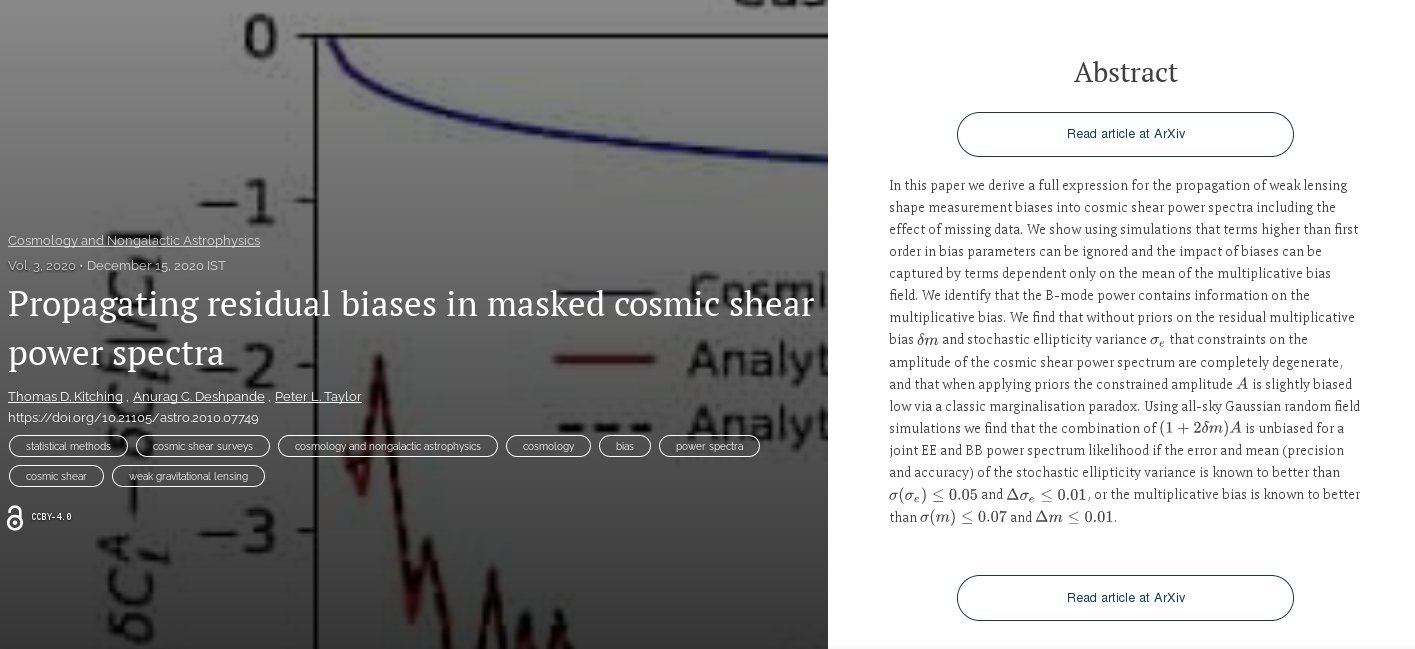
The Christmas rush is definitely upon us and papers are queuing up to be published in the Open Journal of Astrophysics. The latest publication is by Tom Kitching and Anurag Deshpande of MSSL (University College London) and Peter Taylor of JPL (Caltech). It is entitled Propagating residual biases in masked cosmic shear power spectra. This is another one for the folder marked Cosmology and Nongalactic Astrophysics.

Here is a screen grab of the overlay:

You can click on the image to make it larger should you wish to do so. You can find the arXiv version of the paper here.

When I last posted about a new OJA paper I mentioned that it seemed to be taking authors longer than usual to make revisions. There are signs now that some authors are trying to get papers off their desk before the Christmas break so we may have two or three more to publish before the year is out.

P.S. Last week I received an offer from a commercial organization to buy the Open Journal of Astrophysics. I replied politely that it is not for sale.

New Publication at the Open Journal of Astrophysics!

Posted in OJAp Papers, Open Access, The Universe and Stuff with tags , , , , , , on December 10, 2020 by telescoper

Time to announce another new paper in the Open Journal of Astrophysics. The latest publication is by Johan Comparat and 27 others – too numerous to list individually here –  and is entitled Full-sky photon simulation of clusters and active galactic nuclei in the soft X-rays for eROSITA. This is another one for the Cosmology and Nongalactic Astrophysics folder.

This paper is closely connected to the eROSITA instrument which is why it involves a considerable number of authors in different institutions – the current record length for an OJAp author list – though this is by no means a large collaboration by the standards of astrophysics and cosmology! It’s good to see some big names in there though!

Here is a screen grab of the overlay:

You can click on the image to make it larger should you wish to do so. You can find the arXiv version of the paper here.

With this paper we have exceeded the number of papers published last year. We do in fact have quite a few in the pipeline but owing to the ongoing pandemic there have been some refereeing delays and in some cases authors are taking more time than expected to do the “revise and resubmit” routine. I think there are plenty of other people around who are just as tired as I am! Perhaps we’ll see a clutch emerging in the New Year!

New Publication at the Open Journal of Astrophysics!

Posted in OJAp Papers, Open Access, The Universe and Stuff with tags , , , , , , on October 2, 2020 by telescoper

Time to announce another new paper in the Open Journal of Astrophysics. The latest publication is by Amy Louca and Elena Sellentin, both of the Sterrewacht Leiden in the The Netherlands, and is entitled The impact of signal-to-noise, redshift, and angular range on the bias of weak lensing 2-point functions. This is another one for the Cosmology and Nongalactic Astrophysics folder.

Here is a screen grab of the overlay:

You can click on the image to make it larger should you wish to do so. You can find the arXiv version of the paper here.

We actually published this one a few days ago but there was a slight delay registering the metadata and also I was very busy, so this post is a little late. With this paper, we have published as many papers so far in 2020 as we did in 2019 so with several more in the pipeline this looks like being our busiest year

Arguing the Case for Preprints

Posted in Open Access with tags , , , , on September 23, 2020 by telescoper

This is Peer Review Week 2020 as part of which I am participating tomorrow afternoon (Irish Time) in a live panel discussion/webinar called Increasing transparency and trust in preprints: Steps journals can take.

Working in a field like astrophysics, where the use of preprints as a means of disseminating information and ideas is well established, I’m always surprised that some people working in other disciplines don’t really approve of them at all. See for example, this Twitter thread. Still, even in the biosciences, preprints have their advocates and there are signs that attitudes may be changing.

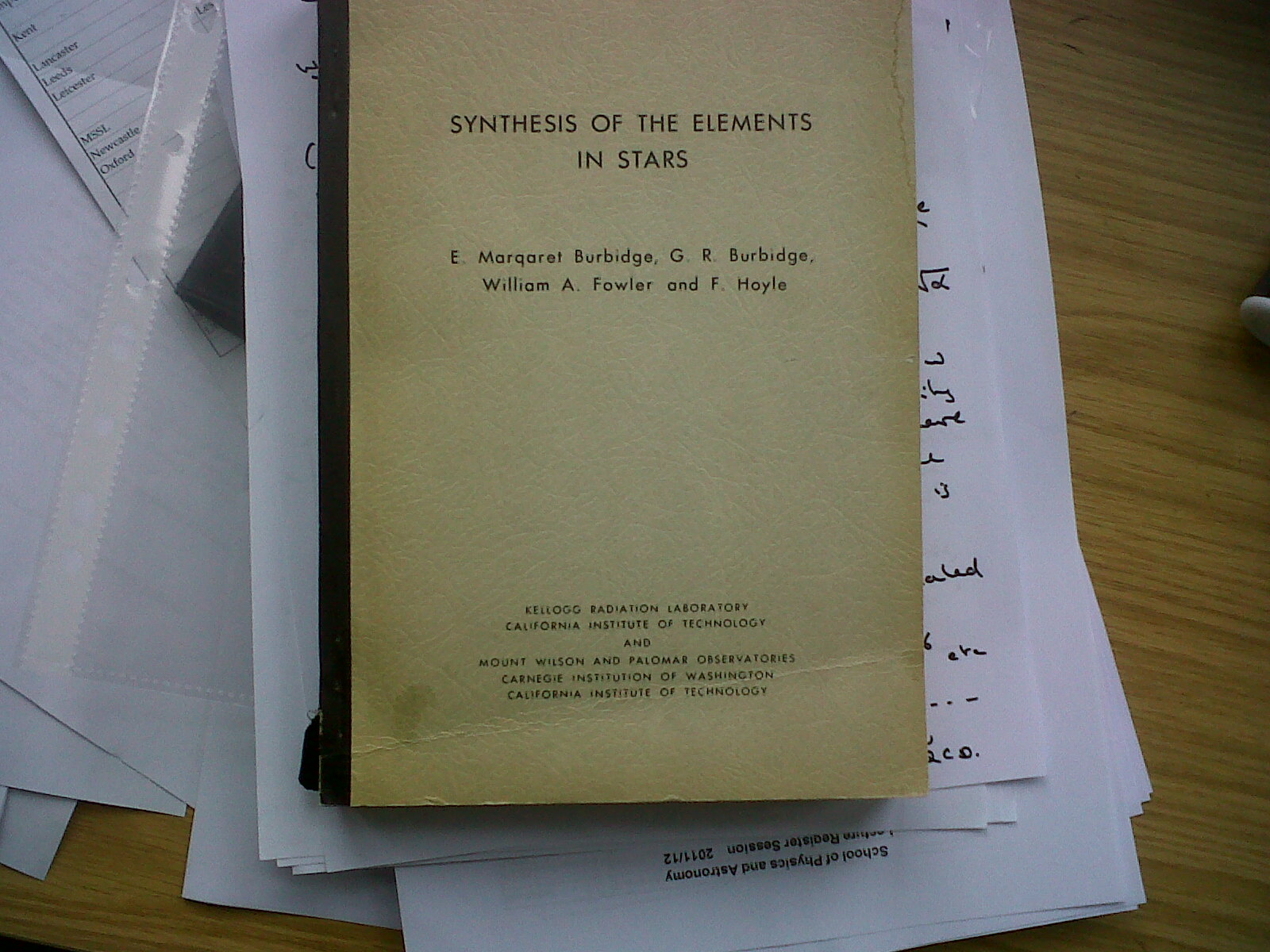
That is not to say that things aren’t changing in astrophysics too. One of the interesting astronomical curiosities I’ve acquired over the years is a preprint of the classic work of Burbidge, Burbidge, Fowler and Hoyle in 1957 (a paper usually referred to as B2FH after the initials of its authors). It’s such an important contribution, in fact, that it has its own wikipedia page.

Younger readers will probably not realize that preprints were not always produced in the electronic form they are today. We all used to make large numbers of these and post them at great expense to (potentially) interested colleagues before publication in order to get comments. That was extremely useful because a paper could take over a year to be published after being refereed for a journal: that’s too long a timescale when a PhD or PDRA position is only a few years in duration. The first papers I was given to read as a new graduate student in 1985 were all preprints that were not published until well into the following year. In some cases I had more or less figured out what they were about by the time they appeared in a journal!

The B2FH paper was published in 1957 but the practice of circulating preprints persisted well into the 1990s. Usually these were produced by institutions with a distinctive design, logo, etc which gave them a professional look, which made it easier to distinguish `serious’ papers from crank material (which was also in circulation). This also suggested that some internal refereeing inside an institution had taken place before an “official” preprint was produced and this lending it an air of trustworthiness. Smaller institutions couldn’t afford all this, so were somewhat excluded from the preprint business.

With the arrival of the arXiv the practice of circulating hard copies of preprints in astrophysics gradually died out, to be replaced by ever-increasing numbers of electronic articles. The arXiv does have some gatekeeping – in the sense there are some controls on who can deposit a preprint there – but it is far easier to circulate a preprint now than it was.

It is still the case that big institutions and collaborations insist on quite strict internal refereeing before publishing a preprint – and some even insist on waiting for a paper to be accepted by a journal before adding it to the arXiv – but there’s no denying that among the wheat there is quite a lot of chaff, some of which attracts media coverage that it does not deserve. It must be admittted, however, that the same can be said of some papers that have passed peer review and appeared in high-profile journals! No system that is operated by human beings will ever be flawless, and peer review is no different.

Nowadays, in astrophysics, the single most important point of access to scientific literature is through the arXiv, which is why the Open Journal of Astrophysics was set up as an overlay journal to provide a level of rigorous peer review for preprints, not only to provide a sort of quality mark but also to improve the paper through the editorial process.

As for increasing transparency and trust in preprints, I think I’ll save some suggestions for tomorrow’s webinar. A good start, however, would be for journals to admit their own limitations and start helping rather than hindering the dissemination of information and ideas.

New Publication at the Open Journal of Astrophysics!

Posted in OJAp Papers, Open Access, The Universe and Stuff with tags , , , , , , on September 15, 2020 by telescoper

A day may come when I don’t write a blog post every time we publish a new paper in the Open Journal of Astrophysics, but it is not this day…

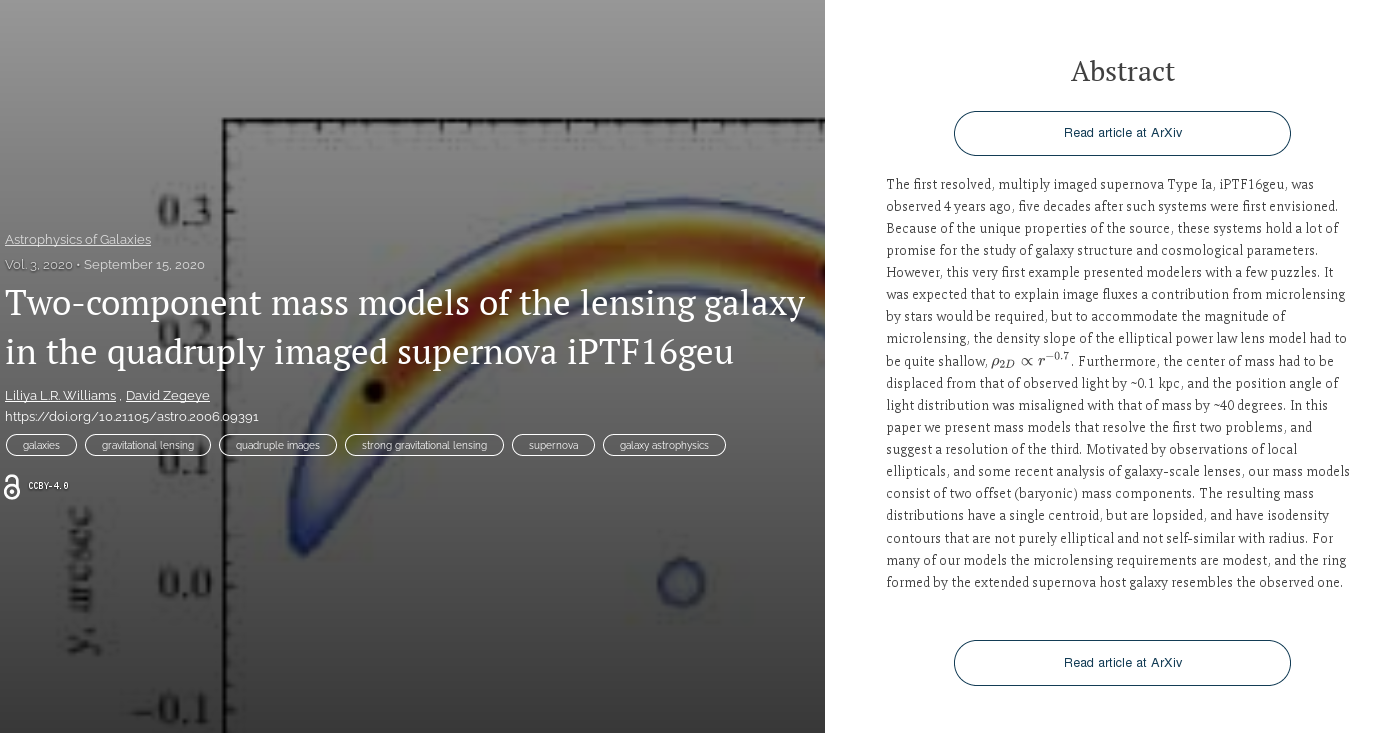
Today’s new publication is by Liliya Williams (of the University of Minnesota, Twin Cities) and David Zegeye of the University of Chicago and is entitled Two-component mass models of the lensing galaxy in the quadruply imaged supernova iPTF16geu.

Here is a screen grab of the overlay:

You can click on the image to make it larger should you wish to do so.

Incidentally, you may notice that Scholastica have added MathJax to the platform to render mathematical expressions in the abstract.

You can find the arXiv version of the paper here.