Archive for Science

Godless Uncertainty

Posted in Bad Statistics with tags , , , , , , on November 5, 2009 by telescoper

As usual I’m a bit slow to comment on something that’s been the topic of much twittering and blogging over the past few days. This one is the terrible article by A.N. Wilson in, inevitably, the Daily Mail. I’ve already fumed once at the Mail and didn’t really want to go off the deep end again so soon after that. But here goes anyway. The piece by Wilson is a half-baked pile of shit not worth wasting energy investigating too deeply, but there are a few points I think it might be worth making even if I am a bit late with my rant.

The article is a response to the (justifiable) outcry after the government sacked Professor David Nutt, an independent scientific adviser, for having the temerity to give independent scientific advice. His position was Chair of the Advisory Council on the Misuse of Drugs, and his sin was to have pointed out the ludicrous inconsistency of government policies on drug abuse compared to other harmful activities such as smoking and drinking. The issues have been aired, protests lodged and other members of the Advisory Council have resigned in protest. Except to say I think the government’s position is indefensible I can’t add much here that hasn’t been said.

This is the background to Wilson’s article which is basically a backlash against the backlash. The (verbose) headline states

Yes, scientists do much good. But a country run by these arrogant gods of certainty would truly be hell on earth.

Obviously he’s not afraid of generalisation. All scientists are arrogant; everyone knows it because it says so in the Daily Mail. There’s another irony too. Nutt’s argument was all about the proper way to assess risk arising from drug use, and was appropriately phrased  in language not of certainty but of probability. But the Mail never lets truth get in the way of a good story.

He goes on

The trouble with a ‘scientific’ argument, of course, is that it is not made in the real world, but in a laboratory by an unimaginative academic relying solely on empirical facts.

It’s desperately sad that there are people – even moderately intelligent ones like Wilson – who think that’s what science is like. Unimaginative? Nothing could be further from the truth. It takes a great deal of imagination (and hard work) to come up with a theory. Few scientists have the imagination of an Einstein or a Feynman, but at least most of us recognize the importance of creativity in advancing knowledge.  But even imagination is not enough for a scientist. Once we have a beautiful hypothesis we must then try to subject it to rigorous quantitative testing. Even if we have spent years nurturing it, we have to let it die if it doesn’t fit the data. That takes courage and integrity too.

Imagination. Courage. Integrity. Not qualities ever likely be associated with someone who writes for the Daily Mail.

That’s not to say that scientists are all perfect. We are human. Sometimes the process doesn’t work at all well. Mistakes are made. There is occasional misconduct. Researchers get too wedded to their pet theories. There can be measurement glitches. But the scientific method at least requires its practitioners to approach the subject rationally and objectively, taking into account all relevant factors and eschewing arguments based on sheer prejudice. You can see why Daily Mail writers don’t like scientists. Facts make them uncomfortable.

Wilson goes on to blame science for some of the atrocities perpetrated by Hitler:

Going back in time, some people think that Hitler invented the revolting experiments performed by Dr Mengele on human beings and animals.

But the Nazis did not invent these things. The only difference between Hitler and previous governments was that he believed, with babyish credulity, in science as the only truth. He allowed scientists freedoms which a civilised government would have checked.

Garbage. Hitler knew nothing about science. Had he done so he wouldn’t have driven out a huge proportion of the talented scientists in Germany’s universities and stuffed their departments full of ghoulish dolts who supported his prejudices.

It was only after reading the article that it was pointed out to be that this particularly offensive passage invoked Godwin’s Law: anyone who brings Hitler into an argument has already lost the debate.

Wilson’s piece seems to be a modern-day manifestation of old problem, famously expounded by C.P. Snow in his lecture on Two Cultures. The issue is that the overwhelming majority of people in positions of power and influence, including the media, are entirely illiterate from a scientific point of view. Science is viewed by most people with either incomprehension or suspicion (and sometimes both).

As society becomes more reliant on science and technology, the fewer people there are that seem to understand what science is or how it works. Moronic articles like Wilson’s indicate the depth of the problem.
Who needs scientific literacy when you can get paid a large amount of money for writing sheer drivel?

I’m sure a great many scientists would agree with most of what I’ve said but I’d like to end with a comment that might be a bit more controversial. I do agree to some extent with Wilson, in that I think some scientists insist on claiming things are facts when they don’t have that status at all. I remember being on a TV programme in which a prominent cosmologist said that he thought the Big Bang was as real to him as the fact that the Sun is shining. I think it’s quite irrational to be that certain. Time and time again scientists present their work to the public in a language that suggests unshakeable self-belief. Sometimes they are badgered into doing that by journalists who want to simplify everything to a level they (and the public) can understand. But some don’t need any encouragement. Too many scientists are too comfortable presenting their profession as some sort of priesthood even if they do stop short of playing God.

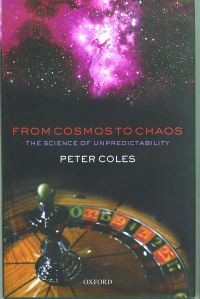
2006-11-09-1525-20The critical importance of dealing rationally with uncertainty in science, both within itself and in its relationship to society at large, was the principal issue I addressed in From Cosmos to Chaos, a paperback edition of which is about to be published by Oxford University Press..

From the jacket blurb:

Why do so many people think that science is about absolute certainty when, at its core, it is actually dominated by uncertainty?

I’ve blogged before about why I think scientists need to pay much more attention to the role of statistics and probability when they explain what they do to the wider world.

And to anyone who accuses me of using the occasion presented by Wilson’s article to engage in gratuitous marketing, I have only one answer:

BUY MY BOOK!

Medawar on Johnson on Milton on Science

Posted in Science Politics with tags , , , , on October 1, 2009 by telescoper

Have recent events left you with a sinking feeling that science isn’t valued in today’s modern world? Are you aggrieved that the great and the good nowadays seem to be so unimpressed by research for research’s sake and require us instead to divert our energies into “useful things” (whatever they are)?

Looking for something to optimistic to say I turned to Peter Medawar‘s book Advice to a Young Scientist and found, to my disappointment, that actually there’s nothing new about this attitude. For example, Medawar explains, no less a character than Dr Samuel Johnson, in his Life of Milton  offered the following rant about Milton’s daft idea of setting up an academy in which the scholars should learn astronomy physics and chemistry as well as the usual school subjects:

But the truth is that the knowledge of external nature, and the sciences which that knowledge requires or includes, are not the great or the frequent business of the human mind. Whether we provide for action or conversation, whether we wish to be useful or pleasing, the first requisite is the religious and moral knowledge of right and wrong; the next is an acquaintance with the history of mankind, and with those examples which may be said to embody truth and prove by events the reasonableness of opinions. Prudence and Justice are virtues and excellences of all times and of all places; we are perpetually moralists, but we are geometricians only by chance. Our intercourse with intellectual nature is necessary; our speculations upon matter are voluntary and at leisure. Physiological learning is of such rare emergence that one man may know another half his life without being able to estimate his skill in hydrostaticks or astronomy, but his moral and prudential character immediately appears.

Medawar attempts to cheer up his readers  by responding with the following feeble platitude

Scientists whose work is prospering and who find themselves deeply absorbed in and transported by their research feel quite sorry for those who do not share the same sense of delight; many artists feel the same, and it makes them indifferent to – and is certainly a fully adequate compensation for –  any respect they think owed to them by the general public.

Tripe. Delight doesn’t put your dinner on the table. It’s not enough to feel smug about how clever you are: we need to convince people that science is worth doing because it’s worth doing for its own sake, and worth funding by the taxpayer for the same reason. Feeling sorry for people who don’t get the message is a sickeningly patronising attitude to take.

I should point out that the rest of the book isn’t all as bad as this, but  the mood I’m in today the best advice I could offer a young scientist at the moment wouldn’t require a whole book anyway:

Don’t!

The Inductive Detective

Posted in Bad Statistics, Literature, The Universe and Stuff with tags , , , , , , , on September 4, 2009 by telescoper

I was watching an old episode of Sherlock Holmes last night – from the classic  Granada TV series featuring Jeremy Brett’s brilliant (and splendidly camp) portrayal of the eponymous detective. One of the  things that fascinates me about these and other detective stories is how often they use the word “deduction” to describe the logical methods involved in solving a crime.

As a matter of fact, what Holmes generally uses is not really deduction at all, but inference (a process which is predominantly inductive).

In deductive reasoning, one tries to tease out the logical consequences of a premise; the resulting conclusions are, generally speaking, more specific than the premise. “If these are the general rules, what are the consequences for this particular situation?” is the kind of question one can answer using deduction.

The kind of reasoning of reasoning Holmes employs, however, is essentially opposite to this. The  question being answered is of the form: “From a particular set of observations, what can we infer about the more general circumstances that relating to them?”. The following example from a Study in Scarlet is exactly of this type:

From a drop of water a logician could infer the possibility of an Atlantic or a Niagara without having seen or heard of one or the other.

The word “possibility” makes it clear that no certainty is attached to the actual existence of either the Atlantic or Niagara, but the implication is that observations of (and perhaps experiments on) a single water drop could allow one to infer sufficient of the general properties of water in order to use them to deduce the possible existence of other phenomena. The fundamental process is inductive rather than deductive, although deductions do play a role once general rules have been established.

In the example quoted there is  an inductive step between the water drop and the general physical and chemical properties of water and then a deductive step that shows that these laws could describe the Atlantic Ocean. Deduction involves going from theoretical axioms to observations whereas induction  is the reverse process.

I’m probably labouring this distinction, but the main point of doing so is that a great deal of science is fundamentally inferential and, as a consequence, it entails dealing with inferences (or guesses or conjectures) that are inherently uncertain as to their application to real facts. Dealing with these uncertain aspects requires a more general kind of logic than the  simple Boolean form employed in deductive reasoning. This side of the scientific method is sadly neglected in most approaches to science education.

In physics, the attitude is usually to establish the rules (“the laws of physics”) as axioms (though perhaps giving some experimental justification). Students are then taught to solve problems which generally involve working out particular consequences of these laws. This is all deductive. I’ve got nothing against this as it is what a great deal of theoretical research in physics is actually like, it forms an essential part of the training of an physicist.

However, one of the aims of physics – especially fundamental physics – is to try to establish what the laws of nature actually are from observations of particular outcomes. It would be simplistic to say that this was entirely inductive in character. Sometimes deduction plays an important role in scientific discoveries. For example,  Albert Einstein deduced his Special Theory of Relativity from a postulate that the speed of light was constant for all observers in uniform relative motion. However, the motivation for this entire chain of reasoning arose from previous studies of eletromagnetism which involved a complicated interplay between experiment and theory that eventually led to Maxwell’s equations. Deduction and induction are both involved at some level in a kind of dialectical relationship.

The synthesis of the two approaches requires an evaluation of the evidence the data provides concerning the different theories. This evidence is rarely conclusive, so  a wider range of logical possibilities than “true” or “false” needs to be accommodated. Fortunately, there is a quantitative and logically rigorous way of doing this. It is called Bayesian probability. In this way of reasoning,  the probability (a number between 0 and 1 attached to a hypothesis, model, or anything that can be described as a logical proposition of some sort) represents the extent to which a given set of data supports the given hypothesis.  The calculus of probabilities only reduces to Boolean algebra when the probabilities of all hypothesese involved are either unity (certainly true) or zero (certainly false). In between “true” and “false” there are varying degrees of “uncertain” represented by a number between 0 and 1, i.e. the probability.

Overlooking the importance of inductive reasoning has led to numerous pathological developments that have hindered the growth of science. One example is the widespread and remarkably naive devotion that many scientists have towards the philosophy of the anti-inductivist Karl Popper; his doctrine of falsifiability has led to an unhealthy neglect of  an essential fact of probabilistic reasoning, namely that data can make theories more probable. More generally, the rise of the empiricist philosophical tradition that stems from David Hume (another anti-inductivist) spawned the frequentist conception of probability, with its regrettable legacy of confusion and irrationality.

My own field of cosmology provides the largest-scale illustration of this process in action. Theorists make postulates about the contents of the Universe and the laws that describe it and try to calculate what measurable consequences their ideas might have. Observers make measurements as best they can, but these are inevitably restricted in number and accuracy by technical considerations. Over the years, theoretical cosmologists deductively explored the possible ways Einstein’s General Theory of Relativity could be applied to the cosmos at large. Eventually a family of theoretical models was constructed, each of which could, in principle, describe a universe with the same basic properties as ours. But determining which, if any, of these models applied to the real thing required more detailed data.  For example, observations of the properties of individual galaxies led to the inferred presence of cosmologically important quantities of  dark matter. Inference also played a key role in establishing the existence of dark energy as a major part of the overall energy budget of the Universe. The result is now that we have now arrived at a standard model of cosmology which accounts pretty well for most relevant data.

Nothing is certain, of course, and this model may well turn out to be flawed in important ways. All the best detective stories have twists in which the favoured theory turns out to be wrong. But although the puzzle isn’t exactly solved, we’ve got good reasons for thinking we’re nearer to at least some of the answers than we were 20 years ago.

I think Sherlock Holmes would have approved.

Critical Theory

Posted in Art, Music, Science Politics with tags , , , , , on August 18, 2009 by telescoper

Critics say the stangest things.

How about this, from James William Davidson, music critic of The Times from 1846:

He has certainly written a few good songs, but what then? Has not every composer that ever composed written a few good songs? And out of the thousand and one with which he deluged the musical world, it would, indeed, be hard if some half-dozen were not tolerable. And when that is said, all is said that can justly be said of Schubert.

Or this, by Louis Spohr, written in 1860 about Beethoven’s Ninth (“Choral”) Symphony

The fourth movement is, in my opinion, so monstrous and tasteless and, in it’s grasp of Schiller’s Ode, so trivial that I cannot understand how a genius like Beethoven could have written it.

No less an authority than  Grove’s Dictionary of Music and Musicians (Fifth Edition) had this to say about Rachmaninov

Technically he was highly gifted, but also severely limited. His music is well constructed and effective, but monotonous in texture, which consists in essence mainly of artificial and gushing tunes…The enormous popular success some few of Rachmaninov’s works had in his lifetime is not likely to last and musicians regarded it with much favour.

And finally, Lawrence Gillman wrote this in the New York Tribune of February 13 1924 concerning George Gershwin’s Rhapsody in Blue:

How trite and feeble and conventional the tunes are; how sentimental and vapid the harmonic treatment, under its disguise of fussy and futile counterpoint! Weep over the lifelessness of the melody and harmony, so derivative, so stale, so inexpressive.

I think I’ve made my point. We all make errors of judgement and music critics are certainly no exception. The same no doubt goes for literary and art critics too. In fact,  I’m sure it would be quite easy to dig up laughably inappropriate comments made by reviewers across the entire spectrum of artistic endeavour. Who’s to say these comments are wrong anyway? They’re just opinions. I can’t understand anyone who thinks so little  of Schubert, but then an awful lot of people like to listen what sounds to me to be complete dross. There even appear to be some people who disagree with the opinions I expressed yesterday!

What puzzles me most about the critics is not that they make “mistakes” like these – they’re only human after all – but why they exist in the first place. It seems extraordinary to me that there is a class of people who don’t do anything creative themselves  but devote their working lives to criticising what is done by others. Who should care what they think? Everyone is entitled to an opinion, of course, but what is it about a critic that implies we should listen to their opinion more than anyone else?

(Actually, to be precise, Louis Spohr was also a composer but I defy you to recall any of his works…)

Part of the idea is that by reading the notices produced by a critic the paying public can decide whether to go to the performance, read the book or listen to the record. However, the correlation between what is critically acclaimed and what is actually good (or even popular) is tenuous at best. It seems to me that, especially nowadays with so much opinion available on the internet, word of mouth (or web) is a much better guide than what some geezer writes in The Times. Indeed, the   Opera reviews published in the papers are so frustratingly contrary to my own opinion that I don’t  bother to read them until after the performance, perhaps even after I’ve written my own little review on here.  Not that I would mind being a newspaper critic myself. The chance not only to get into the Opera for free but also to get paid for spouting on about afterwards sounds like a cushy number to me. Not that I’m likely to be asked.

In science,  we don’t have legions of professional critics, but reviews of various kinds are nevertheless essential to the way science moves forward. Applications for funding are usually reviewed by others working in the field and only those graded at the very highest level are awarded money.  The powers-that-be are increasingly trying to impose political criteria on this process, but it remains a fact that peer review is the crucial part of the process. It’s not just the input that is assessed either. Papers submitted to learned journals are reviewed by (usually anonymous)  referees, who often require substantial changes to be made the work can be accepted for publication.

We have no choice but to react to these critics if we want to function as scientists. Indeed, we probably pay much more attention to them than artists do of critics in their particular fields. That’s not to say that these referees don’t make mistakes either. I’ve certainly made bad decisions myself in that role,  although they were all made in good faith. I’ve also received comments that I thought were unfair or unjustifiable, but at least I knew they were coming from someone who was a working scientist.

I suspect that the use of peer review in assessing grant applications will remain in place for a some considerable time. I can’t think of an alternative, anyway. I’d much rather have a rich patron so I didn’t have to bother writing proposals all the time, but that’s not the way it works in either art or science these days.

However, it does seem to me that the role of referees in the publication process is bound to become redundant in the very near future. Technology now makes it easy to place electronic publications on an archive where they can be accessed freely. Good papers will attract attention anyway, just as they would if they were in refereed journals. Errors will be found. Results will be debated. Papers will be revised. The quality mark of a journal’s endorsement is no longer needed if the scientific community can form its own judgement, and neither are the monstrously expensive fees charged to institutes for journal subscriptions.

Perception, Piero and Pollock

Posted in Art, The Universe and Stuff with tags , , , , , on April 15, 2009 by telescoper

For some unknown reason I’ve just received an invitation to a private view at a small art gallery that’s about ten minutes’ walk from my house. Cocktails included. I shall definitely go and will blog about it next week. I’m looking forward to it already.

This invitation put me in an artistic frame of mind so, to follow up my post on randomness (and the corresponding parallel version on cosmic variance), I thought I’d develop some thoughts about the nature of perception and the perception of nature.

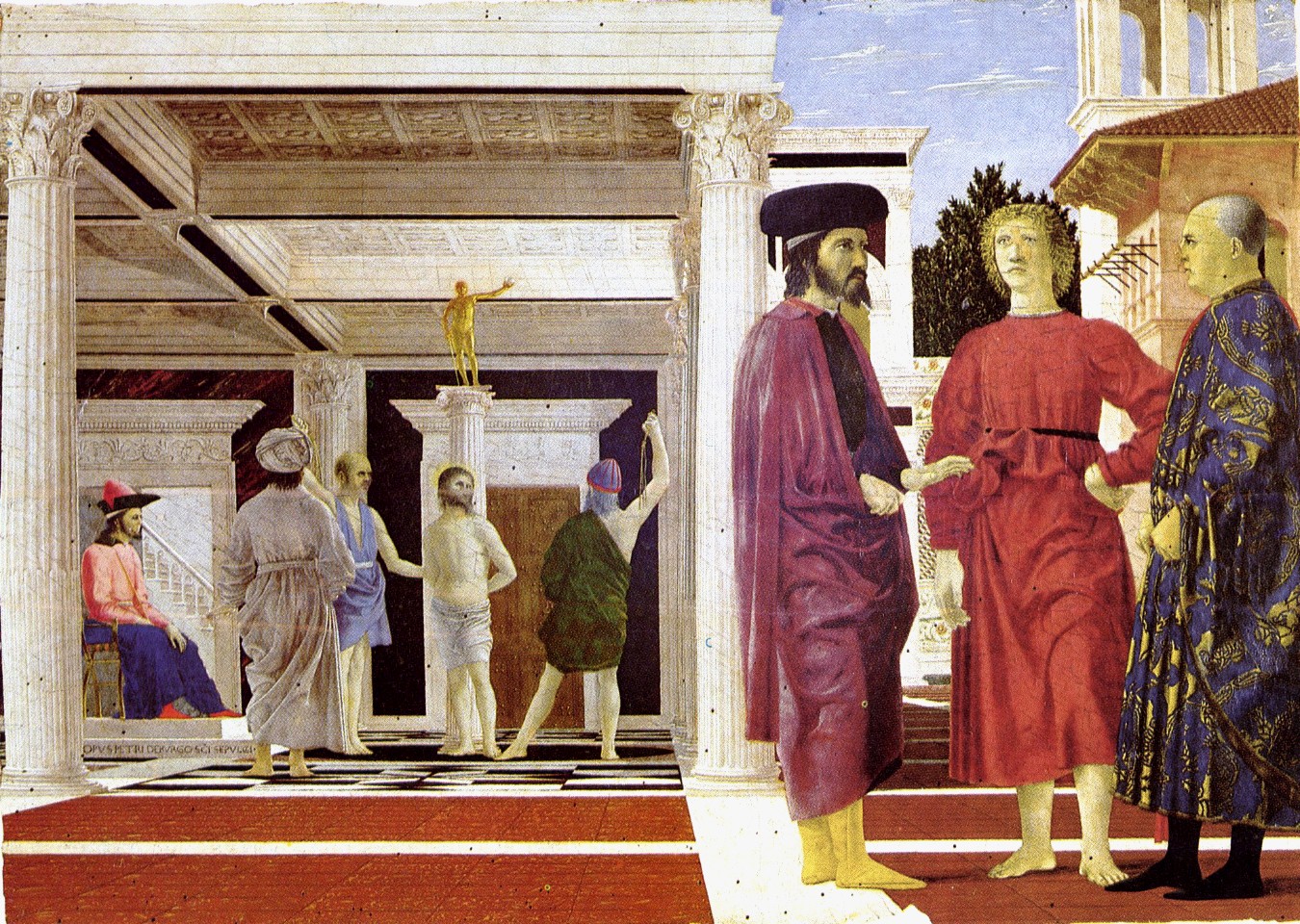
This famous painting is The Flagellation of Christ, by Piero della Francesca. I actually saw it many years ago on one of my many trips to Italy; it’s in an art gallery in Urbino. The first thing that strikes you when you see it is actually that the painting is surprisingly small (about 60cm by 80cm). However, that superficial reaction aside, the painting draws you into it in a way which few other works of art can. The composition is complicated and mathematically precise, but the use of linear perspective is sufficiently straightforward that your eye can quickly understand the geometry of the space depicted and locate the figures and actions within it. The Christ figure is clearly in the room to the left rear and the scene is then easily recognized as part of the story leading up to the crucifixion.

That’s what your eye always seems to do first when presented with a figurative representation: sort out what’s going on and fill in any details it can from memory and other knowledge.

But once you have made sense of the overall form, your brain immediately bombards you with questions. Who are the three characters in the right foreground? Why aren’t they paying attention to what’s going on indoors? Who is the figure with his back to us? Why is the principal subject so far in the background? Why does everyone look so detached? Why is the light coming from two different directions (from the left for the three men in the foreground but from the right for those in the interior)? Why is it all staged in such a peculiar way? And so on.

These unresolved questions lead you to question whether this is the straightforward depiction first sight led you to think it was. It’s clearly much more than that. Deeply symbolic, even cryptic, it’s effect on the viewer is eery and disconcerting. It has a dream-like quality. The individual elements of the painting add up to something, but the full meaning remains elusive. You feel there must be something you’re missing, but can’t find it.

This is such an enigmatic picture that it has sparked some extremely controversial interpretations, some of which are described in an article in the scientific journal Nature. I’m not going to pretend to know enough to comment on the theories, escept to say that some of them at least must be wrong. They are, however, natural consequences of our brain’s need to impose order on what it sees. The greatest artists know this, of course. Although it sometimes seems like they might be playing tricks on us just for fun, part of what makes art great is the way it gets inside the process of perception.

Here’s another example from quite a different artist.

This one is called Lavender Mist. It’s one of the “action paintings” made by the influential American artist Jackson Pollock. This, and many of the other paintings of its type, also get inside your head in quite a disconcerting way but it’s quite a different effect to that achieved by Piero della Francesca.

This is an abstract painting, but that doesn’t stop your eyes seeking within it some sort of point of reference to make geometrical sense of it. There’s no perspective to draw you into it so you look for clues to the depth in the layers of paint. Standing in front of one of these very large works – I find they don’t work at all in reduced form like on the screen in front of you now – you find your eyes constantly shifting around, following lines here and there, trying to find recognizable shapes and to understand what is there in terms of other things you have experienced either in the painting itself or elsewhere. Any order you can find, however, soon becomes lost. Small-scale patterns dissolve away into sea of apparent confusion. Your brain tries harder, but is doomed. One of the biggest problems is that your eyes keep focussing and unfocussing to look for depth and structure. It’s almost impossible to stop yourself doing it. You end up dizzy.

I don’t know how Pollock came to understand exactly how to make his compositions maximally disorienting, but he seems to have done so. Perhaps he had a deep instinctive understanding of how the eye copes with the interaction of structures on different physical scales. I find you can see this to some extent even in the small version of the picture on this page. Deliberately blurring your vision makes different elements stand out and then retreat, particularly the large darkish streak that lies to the left of centre at a slight angle to the vertical.

This artist has also been the subject of interest by mathematicians and physicists because his work seems to display some of the characteristic properties of fractal sets. I remember going to a very interesting talk a few years ago by Richard Taylor of the University of Oregon who claimed that fractal dimensions could be used to authenticate (or otherwise) genuine works by Pollock as he seemed to have his own unique signature.

I suppose what I’m trying to suggest is that there’s a deeper connection than you might think between the appreciation of art and the quest for scientific understanding.

Statistics Matters, Science Matters

Posted in Science Politics with tags , , on April 7, 2009 by telescoper

I thought I’d say something about why I think statistics and statistical reasoning are so important. Of course they are important in science. In fact, I think they lie at the very core of the scientific method, although I am still surprised how few practising scientists are comfortable even with statistical language. A more important problem is the popular impression that science is about facts and absolute truths. It isn’t. It’s a process. In order to advance it has to question itself.

Statistical reasoning also applies to many facets of everyday life, including business, commerce, transport, the media, and politics. Probability even plays a role in personal relationships, though mostly at a subconscious level. It is a feature of everyday life that science and technology are deeply embedded in every aspect of what we do each day. Science has given us greater levels of comfort, better health care, and a plethora of labour-saving devices. It has also given us unprecedented ability to destroy the environment and each other, whether through accident or design.

Civilized societies face rigorous challenges in this century. We must confront the threat of climate change and forthcoming energy crises. We must find better ways of resolving conflicts peacefully lest nuclear or conventional weapons lead us to global catastrophe. We must stop large-scale pollution or systematic destruction of the biosphere that nurtures us. And we must do all of these things without abandoning the many positive things that science has brought us. Abandoning science and rationality by retreating into religious or political fundamentalism would be a catastrophe for humanity.

Unfortunately, recent decades have seen a wholesale breakdown of trust between scientists and the public at large. This is due partly to the deliberate abuse of science for immoral purposes, and partly to the sheer carelessness with which various agencies have exploited scientific discoveries without proper evaluation of the risks involved. The abuse of statistical arguments have undoubtedly contributed to the suspicion with which many individuals view science.

There is an increasing alienation between scientists and the general public. Many fewer students enrol for courses in physics and chemistry than a a few decades ago. Fewer graduates mean fewer qualified science teachers in schools. This is a vicious cycle that threatens our future. It must be broken.

The danger is that the decreasing level of understanding of science in society means that knowledge (as well as its consequent power) becomes concentrated in the minds of a few individuals. This could have dire consequences for the future of our democracy. Even as things stand now, very few Members of Parliament are scientifically literate. How can we expect to control the application of science when the necessary understanding rests with an unelected “priesthood” that is hardly understood by, or represented in, our democratic institutions?

Very few journalists or television producers know enough about science to report sensibly on the latest discoveries or controversies. As a result, important matters that the public needs to know about do not appear at all in the media, or if they do it is in such a garbled fashion that they do more harm than good.

Years ago I used to listen to radio interviews with scientists on the Today programme on BBC Radio 4. I even did such an interview once. It is a deeply frustrating experience. The scientist usually starts by explaining what the discovery is about in the way a scientist should, with careful statements of what is assumed, how the data is interpreted, and what other possible interpretations might be and the likely sources of error. The interviewer then loses patience and asks for a yes or no answer. The scientist tries to continue, but is badgered. Either the interview ends as a row, or the scientist ends up stating a grossly oversimplified version of the story.

Some scientists offer the oversimplified version at the outset, of course, and these are the ones that contribute to the image of scientists as priests. Such individuals often believe in their theories in exactly the same way that some people believe religiously. Not with the conditional and possibly temporary belief that characterizes the scientific method, but with the unquestioning fervour of an unthinking zealot. This approach may pay off for the individual in the short term, in popular esteem and media recognition – but when it goes wrong it is science as a whole that suffers. When a result that has been proclaimed certain is later shown to be false, the result is widespread disillusionment.

The worst example of this tendency that I can think of is the constant use of the phrase “Mind of God” by theoretical physicists to describe fundamental theories. This is not only meaningless but also damaging. As scientists we should know better than to use it. Our theories do not represent absolute truths: they are just the best we can do with the available data and the limited powers of the human mind. We believe in our theories, but only to the extent that we need to accept working hypotheses in order to make progress. Our approach is pragmatic rather than idealistic. We should be humble and avoid making extravagant claims that can’t be justified either theoretically or experimentally.

The more that people get used to the image of “scientist as priest” the more dissatisfied they are with real science. Most of the questions asked of scientists simply can’t be answered with “yes” or “no”. This leaves many with the impression that science is very vague and subjective. The public also tend to lose faith in science when it is unable to come up with quick answers. Science is a process, a way of looking at problems not a list of ready-made answers to impossible problems. Of course it is sometimes vague, but I think it is vague in a rational way and that’s what makes it worthwhile. It is also the reason why science has led to so many objectively measurable advances in our understanding of the World.

I don’t have any easy answers to the question of how to cure this malaise, but do have a few suggestions. It would be easy for a scientist such as myself to blame everything on the media and the education system, but in fact I think the responsibility lies mainly with ourselves. We are usually so obsessed with our own research, and the need to publish specialist papers by the lorry-load in order to advance our own careers that we usually spend very little time explaining what we do to the public or why.

I think every working scientist in the country should be required to spend at least 10% of their time working in schools or with the general media on “outreach”, including writing blogs like this. People in my field – astronomers and cosmologists – do this quite a lot, but these are areas where the public has some empathy with what we do. If only biologists, chemists, nuclear physicists and the rest were viewed in such a friendly light. Doing this sort of thing is not easy, especially when it comes to saying something on the radio that the interviewer does not want to hear. Media training for scientists has been a welcome recent innovation for some branches of science, but most of my colleagues have never had any help at all in this direction.

The second thing that must be done is to improve the dire state of science education in schools. Over the last two decades the national curriculum for British schools has been dumbed down to the point of absurdity. Pupils that leave school at 18 having taken “Advanced Level” physics do so with no useful knowledge of physics at all, even if they have obtained the highest grade. I do not at all blame the students for this; they can only do what they are asked to do. It’s all the fault of the educationalists, who have done the best they can for a long time to convince our young people that science is too hard for them. Science can be difficult, of course, and not everyone will be able to make a career out of it. But that doesn’t mean that it should not be taught properly to those that can take it in. If some students find it is not for them, then so be it. I always wanted to be a musician, but never had the talent for it.

I realise I must sound very gloomy about this, but I do think there are good prospects that the gap between science and society may gradually be healed. The fact that the public distrust scientists leads many of them to question us, which is a very good thing. They should question us and we should be prepared to answer them. If they ask us why, we should be prepared to give reasons. If enough scientists engage in this process then what will emerge is and understanding of the enduring value of science. I don’t just mean through the DVD players and computer games science has given us, but through its cultural impact. It is part of human nature to question our place in the Universe, so science is part of what we are. It gives us purpose. But it also shows us a way of living our lives. Except for a few individuals, the scientific community is tolerant, open, internationally-minded, and imbued with a philosophy of cooperation. It values reason and looks to the future rather than the past. Like anyone else, scientists will always make mistakes, but we can always learn from them. The logic of science may not be infallible, but it’s probably the best logic there is in a world so filled with uncertainty.

Executive Roast

Posted in Science Politics with tags , , , on February 6, 2009 by telescoper

The Chief Executive of the Science and Technology Facilities Council (Keith Mason) was recently summoned to the House of Commons Select Committee on Innovation, Universities and Skills. The video of his inquisition is now available for your enjoyment (but not his) here.

(I tried embedding this using vodpod but it didn’t work, so you’ll just have to click the link…)

Notice how in traditional fashion the light was shining in his eyes throughout. I suppose I should really feel sorry for him, but somehow I don’t. He may not be entirely responsible for the budgetary crisis currently engulfing STFC, but he handled the aftermath so badly that the damage done to relations between STFC and the community of physics researchers that rely on it for funding will take a long time to fix.

Anyway, if you can’t be bothered to watch the whole show here are some of the salient points in a summary that was passed to me by an anonymous source; I was too busy laughing to make my own notes, but I’ve added a few comments in italics. For those of you not up with acronyms, DIUS is the Department for Innovation, Universities and Skills and CSR stands for the Comprehensive Spending Review.

KM insisted that STFC had been successful in giving the UK unprecedented opportunities for doing world class science, and by the end (though by that stage his most aggressive interlocutor, Ian Gibson, had left) appeared to have earned the committee’s grudging respect (though I suspect that was for the way he played a tricky wicket as much as because he had persuaded them out of their deep concerns about his management of the STFC)

Among the many issues raised were the following:

  • KM agreed to hand over the letter detailing the Science and Technology Facilities Council’s 2007 spending review allocation to MPs for scrutiny.
  • He denied that the external review of STFC had been a “total
    whitewash” on the grounds that it had not been given sufficient time to thoroughly interview a cross section of staff during the review or to do other than take the STFC’s self-assessment document, upon which their work was based, at “face value” without being able to find out if the majority of STFC staff actually agreed with its content. On the contrary staff had made their views known ‘vociferously’.
  • Challenged about the perceived overrepresentation of the executive council on the STFC council KM said that, while it had affected the perception held in the community, it made “no difference” to the outcomes (a point which the committee repeatedly contested). He added that STFC takes full account of community input via the advisory panels and science board. It’s simply not true, he insisted, that the executive dominates the Council;  rather it ensures it is properly informed so that decisions are well founded. However he acknowledged that communications had not been good – hence the new arrangements (Director of Communications appointment); Great, another spin doctor – PC .
  • An extra GBP 9M had been freed up by DIUS reducing STFC’s liabilities to exchange rate variations from the first 6 to 3 m pa over the triennium. Of this 6 would go to exploitation grants and 3 to HEIs to promote knowledge transfer. So 6M will be used properly and the rest wasted – PC .
  • He stated that Jodrell Bank had no long term future in radio astronomy since its location exposed it to too much ‘noise’ – but that was for Manchester University (which STFC would continue to support via E-MERLIN and SKA) to determine. It will take a silver bullet to kill that particular zombie -PC
  • KM also voiced the opinion that here was no tension between being simultaneously responsible for developing STFC labs/campuses and funding HEIs through grants; on the contrary it enabled better utilisation of resources bearing in mind the role of STFC which is BOTH to promote science AND its societal /economic benefits. In other words he wants the flexibility to continue robbing Peter to pay Paul – PC
  • For this reason (as well as reasons of administrative complexity)
    STFC had rejected Wakeham’s recommendation to ring fence the ex-PPARC budget line in the forthcoming CSR. Ditto
  • KM argued that  Daresbury was not being treated unfairly in relation to Harwell (there was a good deal of probing about this by North West MPs) .

My own view having watched most of the video is that Professor Mason must have an incredibly thick skin to shrug off such a sustained level of antipathy. Some of it is crude and abusive, but it’s quite impressive how well informed some of the members are.

On the Cards

Posted in Uncategorized with tags , , , , , , , on January 27, 2009 by telescoper

After an interesting chat yesterday with a colleague about the difficulties involved in teaching probabilities, I thought it might be fun to write something about card games. Actually, much of science is intimately concerned with statistical reasoning and if any one activity was responsible for the development of the theory of probability, which underpins statistics, it was the rise of games of chance in the 16th and 17th centuries. Card, dice and lottery games still provide great examples of how to calculate probabilities, a skill which is very important for a physicist.

For those of you who did not misspend your youth playing with cards like I did, I should remind you that a standard pack of playing cards has 52 cards. There are 4 suits: clubs (♣), diamonds (♦), hearts (♥) and spades (♠). Clubs and spades are coloured black, while diamonds and hearts are red. Each suit contains thirteen cards, including an Ace (A), the plain numbered cards (2, 3, 4, 5, 6, 7, 8, 9 and 10), and the face cards: Jack (J), Queen (Q), and King (K). In most games the most valuable is the Ace, following by King, Queen and Jack and then from 10 down to 2.

I’ll start with Poker, because it seems to be one of the simplest ways of losing money these days. Imagine I start with a well-shuffled pack of 52 cards. In a game of five-card draw poker, the players essentially bet on who has the best hand made from five cards drawn from the pack. In more complicated versions of poker, such as Texas hold’em, one has, say, two “private” cards in one’s hand and, say, five on the table in plain view. These community cards are usually revealed in stages, allowing a round of betting at each stage. One has to make the best hand one can using five cards from ones private cards and those on the table. The existence of community cards makes this very interesting because it gives some additional information about other player’s holdings. For the present discussion, however, I will just stick to individual hands and their probabilities.

How many different five-card poker hands are possible?

To answer this question we need to know about permutations and combinations. Imagine constructing a poker hand from a standard deck. The deck is full when you start, which gives you 52 choices for the first card of your hand. Once that is taken you have 51 choices for the second, and so on down to 48 choices for the last card. One might think the answer is therefore 52×51×50×49 ×48=311,875,200, but that’s not right because it doesn’t actually matter which order your five cards are dealt to you.

Suppose you have 4 aces and the 2 of clubs in your hand; the sequences (A♣, A♥, A♦, A♠, 2♣) and (A♥ 2♣ A♠, A♦, A♣) are counted as distinct hands among the number I obtained above. There are many other possibilities like this where the cards are the same but the order is different. In fact there are 5×4×3×2× 1 = 120 such permutations . Mathematically this is denoted 5!, or five-factorial. Dividing the number above by this gives the actual number of possible five-card poker hands: 2,598,960. This number is important because it describes the size of the “possibility space”. Each of these hands is a possible poker deal, and each is assumed to be “equally likely”, unless the dealer is cheating.

This calculation is an example of a mathematical combination as opposed to a permutation. The number of combinations one can make of r things chosen from a set of n is usually denoted Cn,r. In the example above, r=5 and n=52. Note that 52×51×50×49 ×48 can be written 52!/47! The general result for the number of combinations can likewise be written Cn,r=n!/(n-r)!r!

Poker hands are characterized by the occurrence of particular events of varying degrees of probability. For example, a flush is five cards of the same suit but not in sequence (e.g. 2♠, 4♠, 7♠, 9♠, Q♠). A numerical sequence of cards regardless of suit (e.g. 7♣, 8♠, 9♥, 10♦, J♥) is called a straight. A sequence of cards of the same suit is called a straight flush. One can also have a pair of cards of the same value, or two pairs, or three of a kind, or four of a kind, or a full house which is three of one kind and two of another. One can also have nothing at all, i.e. not even a pair.

The relative value of the different hands is determined by how probable they are, and to work that out takes quite a bit of effort.

Consider the probability of getting, say, 5 spades (in other words, spade flush). To do this we have to calculate the number of distinct hands that have this composition.There are 13 spades in the deck to start with, so there are 13×12×11×10×9 permutations of 5 spades drawn from the pack, but, because of the possible internal rearrangements, we have to divide again by 5! The result is that there are 1287 possible hands containing 5 spades. Not all of these are mere flushes, however. Some of them will include sequences too, e.g. 8♠, 9♠, 10♠, J♠, Q♠, which makes them straight flushes. There are only 10 possible straight flushes in spades (starting with 2,3,4,5,6,7,8,9,10 or J), so only 1277 of the possible hands counted above are just flushes. This logic can apply to any of the suits, so in all there are 1277×4=5108 flush hands and 10×4=40 straight flush hands.

I won’t go through the details of calculating the probability of the other types of hand, but I’ve included a table showing their probabilities obtained by dividing the relevant number of possibilities by the total number of hands (given at the bottom of the middle column).

TYPE OF HAND

Number of Possible Hands

Probability

Straight Flush

40

0.000015

Four of a Kind

624

0.000240

Full House

3744

0.001441

Flush

5108

0.001965

Straight

10,200

0.003925

Three of a Kind

54,912

0.021129

Two Pair

123,552

0.047539

One Pair

1,098,240

0.422569

Nothing

1,302,540

0.501177

TOTALS

2,598,960

1.00000


Poker involves rounds of betting in which the players, amongst other things, try to assess how likely their hand is to win compared with the others involved in the game. If your hand is weak, you can fold and allow the accumulated bets to be given to your opponents. Alternatively, you can  bluff and bet strongly on a poor hand (even if you have “nothing”) to convince your opponents that your hand is strong. This tactic can be extremely successful in the right circumstances. In the words of the late great Paul Newman in the film Cool Hand Luke,  “sometimes nothing can be a real cool hand”.

If you bet heavily on your hand, the opponent may well think it is strong even if it contains nothing, and fold even if his hand has a higher value. To bluff successfully requires a good sense of timing – it depends crucially on who gets to bet first – and extremely cool nerves. To spot when an opponent is bluffing requires real psychological insight. These aspects of the game are in many ways more interesting than the basic hand probabilities, and they are difficult to reduce to mathematics.

Another card game that serves as a source for interesting problems in probability is Contract Bridge. This is one of the most difficult card games to play well because it is a game of logic that also involves chance to some degree. Bridge is a game for four people, arranged in two teams of two. The four sit at a table with members of each team facing opposite each other. Traditionally the different positions are called North, South, East and West although you don’t actually need a compass to play. North and South are partners, as are East and West.

For each hand of Bridge an ordinary pack of cards is shuffled and dealt out by one of the players, the dealer. Let us suppose that the dealer in this case is South. The pack is dealt out one card at a time to each player in turn, starting with West (to dealer’s immediate left) then North and so on in a clockwise direction. Each player ends up with thirteen cards when all the cards are dealt.

Now comes the first phase of the game, the auction. Each player looks at their cards and makes a bid, which is essentially a coded message that gives information to their partner about how good their hand is. A bid is basically an undertaking to win a certain number of tricks with a certain suit as trumps (or with no trumps). The meaning of tricks and trumps will become clear later. For example, dealer might bid “one spade” which is a suggestion that perhaps he and his partner could win one more trick than the opposition with spades as the trump suit. This means winning seven tricks, as there are always thirteen to be won in a given deal. The next to bid – in this case West – can either pass (saying “no bid”) or bid higher, like an auction. The value of the suits increases in the sequence clubs, diamonds, hearts and spades. So to outbid one spade (1S), West has to bid at least two hearts (2H), say, if hearts is the best suit for him but if South had opened 1C then 1H would have been sufficient to overcall . Next to bid is South’s partner, North. If he likes spades as trumps he can raise the original bid. If he likes them a lot he can jump to a much higher contract, such as four spades (4S).

This is the most straightforward level of Bridge bidding, but in reality there are many bids that don’t mean what they might appear to mean at first sight. Examples include conventional bids  (such as Stayman or Blackwood),  splinter and transfer bids and the rest of the complex lexicon of Bridge jargon. There are some bids to which partner must respond (forcing bids), and those to which a response is discretionary. And instead of overcalling a bid, one’s opponents could “double” either for penalties in the hope that the contract will fail or as a “take-out” to indicate strength in a suit other than the one just bid.

Bidding carries on in a clockwise direction until nobody dares take it higher. Three successive passes will end the auction, and the contract is then established. Whichever player opened the bidding in the suit that was finally chosen for trumps becomes “declarer”. If we suppose our example ended in 4S, then it was South that becomes declarer because he opened the bidding with 1S. If West had overcalled 2 Hearts (2H) and this had passed round the table, West would be declarer.

The scoring system for Bridge encourages teams to go for high contracts rather than low ones, so if one team has the best cards it doesn’t necessarily get an easy ride; it should undertake an ambitious contract rather than stroll through a simple one. In particular there are extra points for making “game” (a contract of four spades, four hearts, five clubs, five diamonds, or three no trumps). There is a huge bonus available for bidding and making a grand slam (an undertaking to win all thirteen tricks, i.e. seven of something) and a smaller but still impressive bonus for a small slam (six of something). This encourages teams to push for a valuable contract: tricks bid and made count a lot more than overtricks even without the slam bonus.

The second phase of the game now starts. The person to the left of declarer plays a card of their choice, possibly following yet another convention, such as “fourth highest of the longest suit”. The player opposite declarer puts all his cards on the table and becomes “dummy”, playing no further part in this particular hand. Dummy’s cards are then entirely under the control of the declarer. All three players can see the cards in dummy, but only declarer can see his own hand. Apart from the role of dummy, the card play is then similar to whist.

Each trick consists of four cards played in clockwise sequence from whoever leads. Each player, including dummy, must follow the suit led if he has a card of that suit in his hand. If a player doesn’t have a card of that suit he may “ruff”, i.e. play a trump card, or simply discard some card (probably of low value) from another suit. Good Bridge players keep a careful track of all discards to improve their knowledge of the cards held by their  opponents. Discards can also be used by the defence (i.e. East and West in this case) to signal to each other. Declarer can see dummy’s cards but the defenders don’t get to see each other’s.

One can win a trick in one of two ways. Either one plays a higher card of the same suit, e.g. K♥ beats 10♥, or anything lower than Q♥. Aces are high, by the way. Alternatively, if one has no cards of the suit that has been led, one can play a trump (or “ruff”). A trump always beats a card of the original suit, but more than one player may ruff and in that case the highest trump played carries the trick. For instance, East may ruff only to be over-ruffed by South if both have none of the suit led. Of course one may not have any trumps at all, making a ruff impossible. If one has neither the original suit nor a trump one has to discard something from another suit. The possibility of winning a trick by a ruff also does not exist if the contract is of the no-trumps variety.

Whoever wins a given trick leads to start the next one. This carries on until thirteen tricks have been played. Then comes the reckoning of whether the contract has been made. If so, points are awarded to declarer’s team. If not, penalty points are awarded to the defenders which are higher if the contract has been doubled. Then it’s time for another hand, probably another drink, and very possibly an argument about how badly declarer played the hand.

I’ve gone through the game in some detail in an attempt to make it clear why this is such an interesting game for probabilistic reasoning. During the auction, partial information is given about every player’s holding. It is vital to interpret this information correctly if the contract is to be made. The auction can reveal which of the defending team holds important high cards, or whether the trump suit is distributed strangely. Because the cards are played in strict clockwise sequence this matters a lot. On the other hand, even with very firm knowledge about where the important cards lie, one still often has a difficult logical puzzle to solve if all the potential winners in one’s hand are actually to be made into tricks. It can be a very subtle game.

I only have space-time for one illustration of this kind of thing, but it’s another one that is fun to work out. As is true to a lesser extent in poker, one is not really interested in the initial probabilities of the different hands but rather how to update these probabilities using conditional information as it may be revealed through the auction and card play. In poker this updating is done largely by interpreting the bets one’s opponents are making.

Let us suppose that I am South, and I have been daring enough to bid a grand slam in spades (7S). West leads, and North lays down dummy. I look at my hand and dummy, and realise that we have 11 trumps between us, missing only the King (K) and the 2. I have all other suits covered, and enough winners to make the contract provided I can make sure I win all the trump tricks. The King, however, poses a problem. The Ace of Spades will beat the King, but if I just lead the Ace, it may be that one of East or West has both the K and the 2. In this case he would simply play the two to my Ace. The King would be an automatic winner then: as the highest remaining trump it must win a trick eventually. The contract is then doomed.

On the other hand if the spades split 1-1 between East and West then the King drops when I lead the Ace, so that strategy makes the contract. It all depends how the cards split.

But there is a different way to play this situation. Suppose, for example, that A♠ and Q♠ are on the table (in dummy’s hand) and I, as declarer, have managed to win the first trick in my hand. If I think the K♠ lies in West’s hand, I lead a spade. West has to follow suit if he can. If he has the King, and plays it, I can cover it with the Ace so it doesn’t win. If, however, West plays low I can play Q♠. This will win if I am right about the location of the King. Next time I can lead the A♠ from dummy and the King will fall. This play is called a finesse.

But is this better than the previous strategy, playing for the drop? It’s all a question of probabilities, and this in turn boils down to the number of possible deals allow each strategy to work.

To start with, we need the total number of possible bridge hands. This is quite easy: it’s the number of combinations of 13 objects taken from 52, i.e. C52,13. This is a truly enormous number: over 600 billion. You have to play a lot of games to expect to be dealt the same hand twice!

What we now have to do is evaluate the probability of each possible arrangement of the missing King and two. Dummy and declarer’s hands are known to me. There are 26 remaining cards whose location I do not know. The relevant space of possibilities is now smaller than the original one. I have 26 cards to assign between East and West. There are C26,13 ways of assigning West’s 13 cards, but once I have done this the remaining 13 must be in East’s hand.

Suppose West has the 2 but not the K. Conditional on this assumption, I know one of his cards, but there are 12 others remaining to be assigned. There are therefore C24,12 hands with this possible arrangement of the trumps. Obviously the K has to be with East in this case. The finesse would not work as East would cover the Q with the K, but the K would drop if the A were played.

The opposite situation, with West having the K but not the 2 has the same number of possibilities associated with it. Here West must play the K when a spade is led so it will inevitably lose to the A. South abandons the idea of finessing when West rises and just covers it with the higher card.

Suppose instead West doesn’t have any trumps. There are C24,13 ways of constructing such a hand: 13 cards from the 24 remaining non-trumps. Here the finesse fails because the K is with East but the drop fails too. East plays the 2 on the A and the K becomes a winner.

The remaining possibility is that West has both trumps: this can happen in C24,11 ways. Here the finesse works but the drop fails. If West plays low on the South lead, declarer calls for the Q from dummy to hold the trick. Next lead he plays the A to drop the K.

To turn these counts into probabilities we just divide by the total number of different ways I can construct the hands of East and West, which is C26,13. The results are summarized in the table here.

Spades in West’s hand

Number of hands

Probability

Drop

Finesse

None

C24,13

0.24

0

0

K

C24,12

0.26

0.26

0.26

2

C24,12

0.26

0.26

0

K2

C24,11

0.24

0

0.24

Total

C26,13

1.00

0.52

0.50

The last two columns show the contributions of each arrangement to the probability of success of either playing for the drop or the finesse. You can see that the drop is slightly more likely to work than the finesse in this case.

Note, however, that this ignores any information gleaned from the auction, which could be crucial. For example, if West had made a bid then it is more likely that he had cards of some value so this might suggest the K might be in his hand. Note also that the probability of the drop and the probability of the finesse do not add up to one. This is because there are situations where both could work or both could fail.

This calculation does not mean that the finesse is never the right tactic. It sometimes has much higher probability than the drop, and is often strongly motivated by information the auction has revealed. Calculating the odds precisely, however, gets more complicated the more cards are missing from declarer’s holding. For those of you too lazy to compute the probabilities, the book On Gambling, by Oswald Jacoby contains tables of the odds for just about any bridge situation you can think of.

Finally on the subject of Bridge, I wanted to mention a fact that many people think is paradoxical but which isn’t really. Looking at the table shows that the odds of a 1-1 split in spades here are 0.52:0.48 or 13: 12. This comes from how many cards are in East and West’s hand when the play is attempted. There is a much quicker way of getting this answer than the brute force method I used above. Consider the hand with the spade two in it. There are 12 remaining opportunities in that hand that the spade K might fill, but there are 13 available slots for it in the other. The odds on a 1-1 split must therefore be 13:12. Now suppose instead of going straight for the trumps, I play off a few winners in the side suits (risking that they might be ruffed, of course). Suppose I lead out three Aces in the three suits other than spades and they all win. Now East and West have only 20 cards between them and by exactly the same reasoning as before, the odds of a 1-1 split have become 10:9 instead of 13:12. Playing out seemingly irrelevant suits has increased the probability of the drop working. Although I haven’t touched the spades, my assessment of the probability of the spade distribution has changed significantly.

This sort of thing is a major reason why I always think of probabilities in a Bayesian way. As information is gradually revealed one updates the assessment of the probability of the remaining unknowns.

But probability is only a part of Bridge; the best players don’t actually leave very much  to chance…

A New Theory of the Universe

Posted in The Universe and Stuff with tags , , , , on January 24, 2009 by telescoper

Yesterday I went on the train to London to visit my old friends in Mile End. I worked at the place that is now called Queen Mary, University of London for nearly a decade and missed it quite a lot when I moved to Nottingham. More recently I’ve had a bit more time and plausible excuses to visit London, including yesterday’s invitation to give a seminar at the Astronomy Unit. Although we were a bit late starting, owing to extremely slow service in the restaurant where we had lunch before the talk, it all seemed to go quite well. Afterwards we had a few beers and a nice chat before I took the train back to Cardiff again.

In the pub (which was the Half Moon, formerly the Half Moon Theatre,  a place of great historical interest) I remembered a joke I sometimes make during cosmology talks but had forgotten to do in the one I had just given.  I’m not sure it will work in written form, but here goes anyway.

I’ve blogged before about the current state of cosmology, but it’s probably a good idea to give a quick reminder before going any further. We have a standard cosmological model, known as the concordance cosmology, which accounts for most relevant observations in a pretty convincing way and is based on the idea that the Universe began with a Big Bang.  However, there are a few things about this model that are curious, to say the least.

First, there is the spatial geometry of the Universe. According to Einstein’s general theory of relativity, universes come in three basic shapes: closed, open and flat. These are illustrated to the right. The flat space has “normal” geometry in which the interior angles of a triangle add up to 180 degrees. In a closed space the sum of the angles is greater than 180 degrees, and  in an open space it is less. Of course the space we live in is three-dimensional but the pictures show two-dimensional surfaces.

But you get the idea.

The point is that the flat space is very special. The two curved spaces are much more general because they can be described by a parameter called their curvature which could in principle take any value (either positive for a closed space, or negative for an open space). In other words the sphere at the top could have any radius from very small (large curvature) to very large (small curvature). Likewise with the “saddle” representing an open space. The flat space must have exactly zero curvature. There are many ways to be curved, but only one way to be flat.

Yet, as near as dammit, our Universe appears to be flat. So why, with all the other options theoretically available to it, did the Universe decide to choose the most special one, which also happens in my opinion to be also the most boring?

Then there is the way the Universe is put together. In order to be flat there must be an exact balance between the energy contained in the expansion of the Universe (positive kinetic energy) and the energy involved in the gravitational interactions between everything in it (negative potential energy). In general relativity, you see, the curvature relates to the total amount of energy.

On the left you can see the breakdown of the various components involved in the standard model with the whole pie representing a flat Universe. You see there’s a vary strange mixture dominated by dark energy (which we don’t understand) and dark mattter (which we don’t understand). The bit we understand a little bit better (because we can sometimes see it directly) is only 4% of the whole thing. The proportions look very peculiar.

And then finally, there is the issue that I talked about in my seminar in London and have actually blogged about (here and there) previously, which is why the Universe appears to be a bit lop-sided and asymmetrical when we’d like it to be a bit more aesthetically pleasing.

All these curiosities are naturally accounted for in my New Theory of the Universe, which asserts that the Divine Creator actually bought  the entire Cosmos  in IKEA.

This hypothesis immediately explains why the Universe is flat. Absolutely everything in IKEA comes in flat packs. Curvature is not allowed.

But this is not the only success of my theory. When God got home he obviously opened the flat pack, found the instructions and read the dreaded words “EASY SELF-ASSEMBLY”. Even the omnipotent would struggle to follow the bizarre set of cartoons and diagrams that accompany even the simplest IKEA furniture. The result is therefore predictable: strange pieces that don’t seem to fit together, bits left over whose purpose is not at all clear, and an overall appearance that is not at all like one would have expected.

It’s clear  where the lop-sidedness comes in too. Probably some of the parts were left out so the whole thing isn’t  held together properly and is probably completely unstable. This sort of thing happens all the time with IKEA stuff. And why is it you can never find the right size Allen Key to sort it out?

So there you have it. My new Theory of the Universe. Some details need to be worked out, but it is as good an explanation of these issues as I have heard. I claim my Nobel Prize.

If anything will ever get me a trip to Sweden, this will.

Maps, Territories and Landscapes

Posted in The Universe and Stuff with tags , , , , , , , , on January 10, 2009 by telescoper

I was looking through recent posts on cosmic variance and came across an interesting item featuring a map from another blog (run by Samuel Arbesman) which portrays the Milky Way in the style of  a public transport map:

mwta

This is just a bit of fun, of course, but I think maps like this are quite fascinating, not just as practical guides to navigating a transport system but also because they often stand up very well as works of art. It’s also interesting how they evolve with time  because of changes to the network and also changing ideas about stylistic matters.

A familiar example is the London Underground or Tube map. There is a fascinating website depicting the evolutionary history of this famous piece of graphic design. Early versions simply portrayed the railway lines inset into a normal geographical map which made them rather complicated, as the real layout of the lines is far from regular. A geographically accurate depiction of the modern tube network is shown here which makes the point:

tubegeo

A revolution occurred in 1933 when Harry Beck compiled the first “modern” version of the map. His great idea was to simplify the representation of the network around a single unifying feature. To this end he turned the Central Line (in red) into a straight line travelling left to right across the centre of the page, only changing direction at the extremities. All other lines were also distorted to run basically either North-South or East-West and produce a much more regular pattern, abandoning any attempt to represent the “real” geometry of the system but preserving its topology (i.e. its connectivity).  Here is an early version of his beautiful construction:

Note that although this a “modern” map in terms of how it represents the layout, it does look rather dated in terms of other design elements such as the border and typefaces used. We tend not to notice how much we surround the essential things with embellishments that date very quickly.

More modern versions of this map that you can get at tube stations and the like rather spoil the idea by introducing a kink in the central line to accommodate the complexity of the interchange between Bank and Monument stations as well as generally buggering about with the predominantly  rectilinear arrangement of the previous design:

I quite often use this map when I’m giving popular talks about physics. I think it illustrates quite nicely some of the philosophical issues related with theoretical representations of nature. I think of theories as being like maps, i.e. as attempts to make a useful representation of some  aspects of external reality. By useful, I mean the things we can use to make tests. However, there is a persistent tendency for some scientists to confuse the theory and the reality it is supposed to describe, especially a tendency to assert there is a one-to-one relationship between all elements of reality and the corresponding elements in the theoretical picture. This confusion was stated most succintly by the Polish scientist Alfred Korzybski in his memorable aphorism :

The map is not the territory.

I see this problem written particularly large with those physicists who persistently identify the landscape of string-theoretical possibilities with a multiverse of physically existing domains in which all these are realised. Of course, the Universe might be like that but it’s by no means clear to me that it has to be. I think we just don’t know what we’re doing well enough to know as much as we like to think we do.

A theory is also surrounded by a penumbra of non-testable elements, including those concepts that we use to translate the mathematical language of physics into everday words. We shouldn’t forget that many equations of physics have survived for a long time, but their interpretation has changed radically over the years.

The inevitable gap that lies between theory and reality does not mean that physics is a useless waste of time, it just means that its scope is limited. The Tube  map is not complete or accurate in all respects, but it’s excellent for what it was made for. Physics goes down the tubes when it loses sight of its key requirement: to be testable.

In any case, an attempt to make a grand unified theory of the London Underground system would no doubt produce a monstrous thing so unwieldly that it would be useless in practice. I think there’s a lesson there for string theorists too…

Now, anyone for a game of Mornington Crescent?