Archive for Science

Science, Poetry and Romanticism

Posted in Poetry, The Universe and Stuff with tags , , , , , , on November 4, 2014 by telescoper

I listened to a very interesting programme on BBC Radio 3 on Sunday evening, part of which was a documentary about science and poetry presented by Gregory Tate. Given that both these subjects feature heavily on this blog I couldn’t resist a quick post about it.

The feature explored why so many scientists have been inspired to write poetry, and the nature of the relationship between their artistic work and their science.

Among the famous scientists included in the programme was chemist and inventor Humphry Davy who, inspired by his friendship with the poets Wordsworth and Coleridge, wrote poems throughout his life. Others to do likewise were: physician Eramus Darwin; mathematician William Rowan Hamilton; astronomer William Herschel (who was also a noted musician and composer); J. Robert Oppenheimer; and Erwin Schrödinger.

Doing a quick google about after the programme I came across this example by Hamilton, which I searched for because he is the scientist from the list above with whose mathematical work I am most familiar because of its huge influence on physics, and because he seems to have been a very colourful character as well as a superb mathematician. Interestingly, he too was a very close friend of Wordsworth, to whom he often sent poems with requests for comments and feedback. In the subsequent correspondence, Wordsworth was usually not very complimentary even to the extent of telling Hamilton to stick to his day job (or words to that effect). What I didn’t know was that Hamilton regarded himself as a poet first and a mathematician second. That just goes to show you shouldn’t necessarily trust a man’s judgement when he applies it to himself.

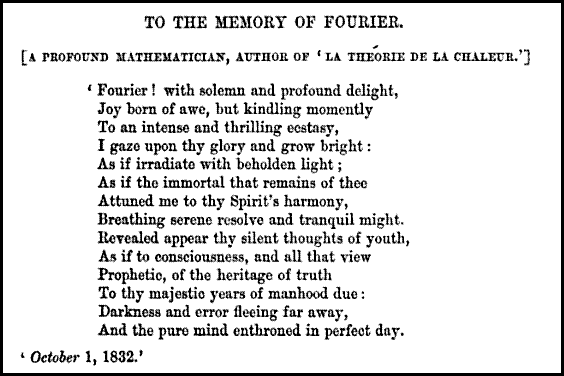
Here’s an example of Hamilton’s verse – a poem written to honour Joseph Fourier:

Hamilton-for Fourier

If that’s one of his better poems, then I think Wordsworth may have had a point!

The serious thing that struck me about this programme though was how many scientists of the 19th Century, Hamilton included, saw their scientific interrogation of Nature as a manifestation of the human condition just as the romantic poets saw their artistic contemplation. It is often argued that romanticism is responsible for the rise of antiscience. I’m not really qualified to comment on that but I don’t see any conflict at all between science and romanticism. I certainly don’t see Wordsworth’s poetry as antiscientific. I just find it inspirational:

I HAVE seen
A curious child, who dwelt upon a tract
Of inland ground, applying to his ear
The convolutions of a smooth-lipped shell;
To which, in silence hushed, his very soul
Listened intensely; and his countenance soon
Brightened with joy; for from within were heard
Murmurings, whereby the monitor expressed
Mysterious union with its native sea.
Even such a shell the universe itself
Is to the ear of Faith; and there are times,
I doubt not, when to you it doth impart
Authentic tidings of invisible things;
Of ebb and flow, and ever-during power;
And central peace, subsisting at the heart
Of endless agitation.

What’s the point of conferences?

Posted in Education, The Universe and Stuff with tags , , , , , on October 19, 2014 by telescoper

Well, here I am back in the office making a start on my extensive to-do list. Writing it, I mean. Not actually doing any of it.

It was nice to get away for a couple of weeks, to meet up with some old friends I haven’t seen for a while and also to catch up on some of the developments in my own field and other related areas. We do have pretty good seminar series here at Sussex which should in principle allow me to keep up to date with developments in my own research area, but unfortunately the timing of these events often clashes with other meetings  that I’m obliged to attend as Head of School. Escaping to a conference is a way of focussing on research for a while without interruption. At least that’s the idea.

While at the meeting, however, I was struck by a couple of things. First was that during the morning plenary lectures given by invited speakers almost everyone in the audience was spending much more time working on their laptops than listening to the talk.  This has been pretty standard at every meeting I’ve been to for the last several years. Now that everyone uses powerpoint (or equivalent) for such presentations nobody in the audience feels the need to take notes so to occupy themselves they spend the time answering emails or pottering about on Facebook. That behaviour does not depend on the quality of the talk, either. Since nobody seems to listen very much the question naturally arises as to whether the presentations have any intrinsic value at all. It often seems to me that the conference talk has turned into a kind of ritual that persists despite nobody really knowing what it’s for or how it originated. An hour is too long to talk if you really want people to listen, but we go on doing it.

The part of a conference session that’s more interesting is the discussion after each talk. Sometimes there’s a genuine discussion from which you learn something quite significant or get an idea for a new study.  There’s often also a considerable amount of posturing, preening and point-scoring which is less agreeable but in its own way I suppose fairly interesting.

At the meeting I was attending the afternoons were devoted to discussion sessions for which we split into groups. I was allocated to “Gravitation and Cosmology”; others were on “Cosmic Rays”, “Neutrino Physics and Astrophysics”, and so on. The group I was, of about 25 people, was a nice size for discussion. These sessions were generally planned around short “informal” presentations intended to stimulate discussion, but generally these presentations were about the same length as the plenary talks and also given in Powerpoint. There was discussion, but the format turned out to be less different from the morning sessions than I’d hoped for. I’m even more convinced than ever that Powerpoint presentations used in this way stifle rather than stimulate discussion and debate. The pre-prepared presentation is often used as a crutch by a speaker reluctant to adopt a more improvisatory approach that would probably be less polished but arguably more likely to generate new thoughts.

I don’t know whether the rise of Powerpoint is itself to blame for our collective unwillingness inability to find other ways of talking about science, but I’d love to try organizing a workshop or conference along lines radically different from the usual “I talk, you listen” format in which the presenter is active and the audience passive for far too long.

All this convinced me that the answer to the question “What is the point of conferences?” has very little to do with the formal  programme and more with the informal parts, especially the conversations over coffee and at dinner. Perhaps I should try arranging a conference that has nothing but dinner and coffee breaks on the schedule?

The Logistics of Scientific Growth in the 21st Century

Posted in Science Politics, The Universe and Stuff with tags , , on June 8, 2014 by telescoper

Interesting piece that argues that the recent growth in STEM PhD and postdocs is not sustainable.

caseybergman's avatarAn Assembly of Fragments

ResearchBlogging.org

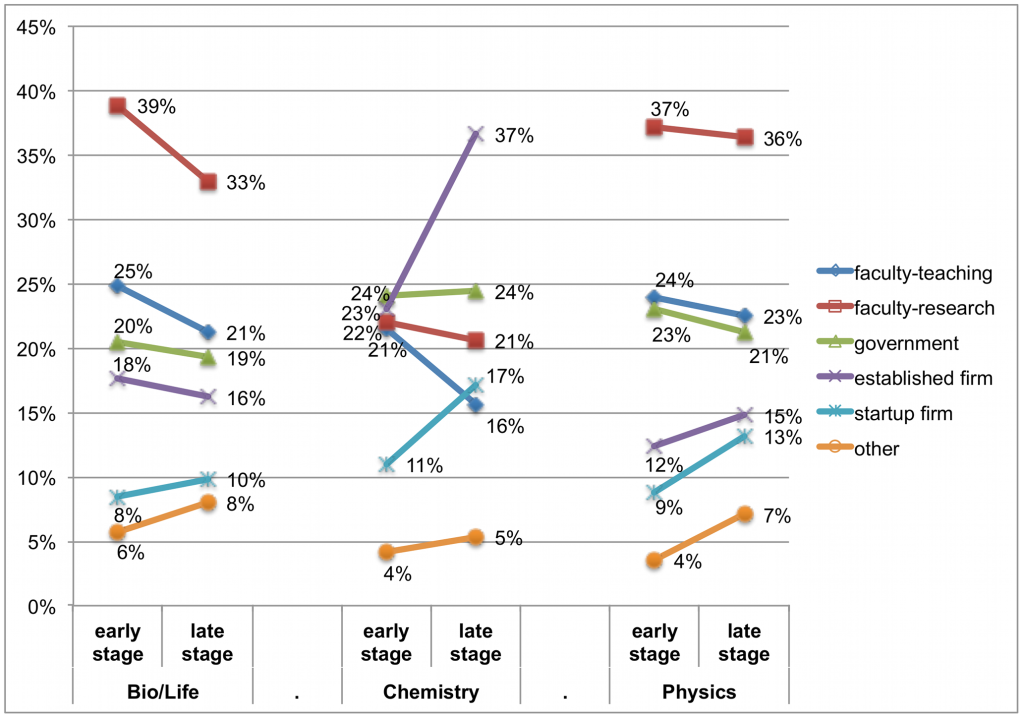
Over the last few months, I’ve noticed a growing number of reports about declining opportunities and increasing pressure for early stage academic researchers (Ph.D. students, post-docs and junior faculty). For example, the Washington Post published an article in early July about trends in the U.S. scientific job market entitled “U.S. pushes for more scientists, but the jobs aren’t there.” This post generated over 3,500 comments on the WaPo website alone and was highly discussed in the twittersphere. In mid July, Inside Higher Ed reported that an ongoing study revealed a recent, precipitous drop in the interest of STEM (Science/Technology/Engineering/Mathematics) Ph.D. students wishing to pursue an academic tenure-track career. These results confirmed those published in PLoS ONE in May that showed the interest to pursue an academic career of STEM students surveyed in 2010 showed evidence of a decline during the course of Ph.D. studies:

Figure 1. Percent of…

View original post 1,620 more words

Living in the Vortices of Infinity

Posted in Biographical, Literature, The Universe and Stuff with tags , , , , on January 16, 2014 by telescoper

As a boyhood fan of influential American horror writer Howard Phillips Lovecraft (known to his friends as “H.P.”), I was dismayed to discover some time ago a poem which revealed his obnoxiously racist attitudes. I always find it difficult knowing what to do when someone whose artistic work you admire turns out to have a dark side to his or her personality. It’s always hard to separate the creation from the creator. In the case of H.P. Lovecraft I’ve maintained an interest in him and his work, I suppose in an attempt to find some redeeming features.

Anyway, in Lovecraft’s Selected Letters, I came across a passage which is reminiscent of the following quotation from an interview with physicist Steven Weinberg:

I believe that there is no point in the universe that can be discovered by the methods of science. I believe that what we have found so far, an impersonal universe in which it is not particularly directed toward human beings is what we are going to continue to find. And that when we find the ultimate laws of nature they will have a chilling, cold impersonal quality about them.

I don’t think this means [however] there’s no point to life. Usually the remark is quoted just as it stands. But if anyone read the next paragraph, they would see that I went on to say that if there is no point in the universe that we discover by the methods of science, there is a point that we can give the universe by the way we live, by loving each other, by discovering things about nature, by creating works of art. And that — in a way, although we are not the stars in a cosmic drama, if the only drama we’re starring in is one that we are making up as we go along, it is not entirely ignoble that faced with this unloving, impersonal universe we make a little island of warmth and love and science and art for ourselves. That’s not an entirely despicable role for us to play.

This is the passage in Lovecraft’s Selected Letters

As you are aware, I have never been able to soothe myself with the sugary delusions of religion; for these things stand convicted of the utmost absurdity in light of modern scientific knowledge. With Nietzsche, I have been forced to confess that mankind as a whole has no goal or purpose whatsoever, but is a mere superfluous speck in the unfathomable vortices of infinity and eternity. Accordingly, I have hardly been able to experience anything which one could call real happiness; or to take as vital an interest in human affairs as can one who still retains the hallucination of a “great purpose” in the general plan of terrestrial life. … However, I have never permitted these circumstances to react upon my daily life; for it is obvious that although I have “nothing to live for”, I certainly have just as much as any other of the insignificant bacteria called human beings. I have thus been content to observe the phenomena about me with something like objective interest, and to feel a certain tranquillity which comes from perfect acceptance of my place as an inconsequential atom. In ceasing to care about most things, I have likewise ceased to suffer in many ways. There is a real restfulness in the scientific conviction that nothing matters very much; that the only legitimate aim of humanity is to minimise acute suffering for the majority, and to derive whatever satisfaction is derivable from the exercise of the mind in the pursuit of truth (from Letter to Reinhardt Kleiner  (14 September 1919), in Selected Letters I, 1911-1924 edited by August Derleth and Donald Wandrei, pp. 86-87).

I think my own philosophy of life is some sort of juxtaposition of these two…

Boycott Nature and Science!

Posted in Open Access, Science Politics with tags , , , , on December 11, 2013 by telescoper

On Tuesday Randy Schekman, joint winner of the 2013 Nobel Prize for Physiology or Medicine hit out at academic publishers for the way the most “prestigious” journals (specifically Cell, Nature and Science) publish only the “flashiest” research.  I see his announcement as part of a groundswell of opinion that scientists are being increasingly pressured to worry more about the impact factors of the journals they publish in than about the actual science that they do. Cynics have been quick to point out that his statements have emerged only after he received the Nobel Prize, and that it’s difficult for younger researchers who have to build their careers in a world to break free from the metrics that are strangling many disciplines. I feel, as do some of my colleagues (such as Garret Cotter of Oxford University), that it’s time for established researchers to make a stand and turn away from those publishers that we feel are having a negative impact on science and instead go for alternative modes of publication that are in better keeping with the spirit of open science.

In future, therefore, I’ll be boycotting Nature and Science (I don’t publish in Cell anyway) and I call upon my colleagues to do likewise. Here’s a nice logo (courtesy of Garrett Cotter) that you might find useful should you wish to support the boycott.

CNS

ps. For the record I should point out that during my career I have published four papers in Nature and one in Science.

Out and G3 Awards – How about some scientists?

Posted in LGBTQ+ with tags , , , , , , on November 30, 2013 by telescoper

I’m taking it easy today so this will be a brief post to follow up on an old one in which I bemoaned the lack of (visible) Lesbian, Gay, Bisexual or Transgendered physicists. I was subsequently invited to speak at an event in London about this issue. I couldn’t make it because of other commitments, but I gather it went well. Anyway, in my earlier post I wrote

It has always annoyed me that the Independent newspaper’s annual “Pink List” of the UK’s most influential LGBT people never – and I mean never – has a single LGBT scientist on it, despite the immense amount they do not only in research, but also in teaching and outreach. It’s very sad that this work is largely unacknowledged and even sadder that a great many potential role models are hidden.

Actually this year’s Pink List did have one scientist on it, but my point remains relevant. It turns out that nominations are open for the Readers’ Awards of Out  and g3 magazines  to be voted on by the public in 2014. The prizes will awarded in April and expect to be reported in the gay media, they often lead on to more widespread publicity for the winners. So I thought I’d do my little bit to encourage folk out there to think about nominating a scientist or engineer for this prize.

You may nominate your favourite sportsperson, broadcaster, celebrity or  ‘straight ally’, but why not put forward the name of a Lesbian, Gay, Bisexual, Transgender person you know from the world of science, medicine or engineering under the ‘Inspirational Role Model of the Year’ category?

All you need for now is their name and email address, so it only takes a few seconds.

Go on. You know you want to. The link is here.

Doctor Who at 50

Posted in Biographical, Music, Television, The Universe and Stuff with tags , , , , , on November 23, 2013 by telescoper

Today is the official 50th birthday celebration of Doctor Who and, since The Doctor and myself are of the same vintage, I thought I’d repeat an old post about the show. I just listened to the original theme music again before posting this and I still think it sounds amazingly fresh.

–0–

As a Professor of Astrophysics I am often asked “Why on Earth did you decide to make a career out of such a crazy subject?”

I guess many astronomers, physicists and other scientists have to answer this sort of question. For many of them there is probably a romantic reason, such as seeing the rings of Saturn or the majesty of the Milky Way on a dark night. Others will probably have been inspired by TV documentary series such as The Sky at Night, Carl Sagan’s Cosmos or even Horizon which, believe it or not, actually used to be quite good but which is nowadays uniformly dire. Or it could have been something a bit more mundane but no less stimulating such as a very good science teacher at school.

When I’m asked this question I’d love to be able to put my hand on my heart and give an answer of that sort but the truth is really quite a long way from those possibilities. The thing that probably did more than anything else to get me interested in science was a Science Fiction TV series or rather not exactly the series but the opening titles.

The first episode of Doctor Who was broadcast in the year of my birth, so I don’t remember it at all, but I do remember the astonishing effect the credits had on my imagination when I saw later episodes as a small child. Here is the  opening title sequence as it appeared in the very first series featuring William Hartnell as the first Doctor.

To a younger audience it probably all seems quite tame, but I think there’s a haunting, unearthly beauty to the shapes conjured up by Bernard Lodge. Having virtually no budget for graphics, he experimented in a darkened studio with an old-fashioned TV camera and a piece of black card with Doctor Who written on it in white. He created the spooky kaleidoscopic patterns you see by simply pointing the camera so it could see into its own monitor, thus producing a sort of electronic hall of mirrors.

What is so fascinating to me is how a relatively simple underlying concept could produce a rich assortment of patterns, particularly how they seem to take on an almost organic aspect as they merge and transform. I’ve continued to be struck by the idea that complexity could be produced by relatively simple natural laws which is one of the essential features of astrophysics and cosmology. As a practical demonstration of the universality of physics this sequence takes some beating.

As well as these strange and wonderful images, the titles also featured a pioneering piece of electronic music. Officially the composer was Ron Grainer, but he wasn’t very interested in the commission and simply scribbled the theme down and left it to the BBC to turn it into something useable. In stepped the wonderful Delia Derbyshire, unsung heroine of the BBC Radiophonic Workshop who, with only the crudest electronic equipment available, turned it into a little masterpiece. Ethereal yet propulsive, the original theme from Doctor Who is definitely one of my absolute favourite pieces of music and I’m glad to see that Delia Derbyshire is now receiving the acclaim she deserves from serious music critics.

It’s ironic that until earlier this year I used to live  in Cardiff, where the newer episodes of Doctor Who and its spin-off, the anagrammatic Torchwood, are made. One of the great things about the early episodes of Doctor Who was that the technology simply didn’t exist to do very good special effects. The scripts were consequently very careful to let the viewers’ imagination do all the work. That’s what made it so good. I’m pleased that the more recent incarnations of this show also don’t go overboard on the visuals. Perhaps that’s a conscious attempt to appeal to people who saw the old ones as well as those too young to have done so. It’s just a pity the modern opening title music is so bad…

Anyway, I still love Doctor Who after all these years. It must sound daft to say that it inspired me to take up astrophysics, but it’s truer than any other explanation I can think of. Of course the career path is slightly different from a Timelord, but only slightly.

At any rate I think The Doctor is overdue for promotion. How about Professor Who?

Science, Religion and Henry Gee

Posted in Bad Statistics, Books, Talks and Reviews, Science Politics, The Universe and Stuff with tags , , , , , , , , , on September 23, 2013 by telescoper

Last week a piece appeared on the Grauniad website by Henry Gee who is a Senior Editor at the magazine Nature.  I was prepared to get a bit snarky about the article when I saw the title, as it reminded me of an old  rant about science being just a kind of religion by Simon Jenkins that got me quite annoyed a few years ago. Henry Gee’s article, however, is actually rather more coherent than that and  not really deserving of some of the invective being flung at it.

For example, here’s an excerpt that I almost agree with:

One thing that never gets emphasised enough in science, or in schools, or anywhere else, is that no matter how fancy-schmancy your statistical technique, the output is always a probability level (a P-value), the “significance” of which is left for you to judge – based on nothing more concrete or substantive than a feeling, based on the imponderables of personal or shared experience. Statistics, and therefore science, can only advise on probability – they cannot determine The Truth. And Truth, with a capital T, is forever just beyond one’s grasp.

I’ve made the point on this blog many times that, although statistical reasoning lies at the heart of the scientific method, we don’t do anywhere near enough  to teach students how to use probability properly; nor do scientists do enough to explain the uncertainties in their results to decision makers and the general public.  I also agree with the concluding thought, that science isn’t about absolute truths. Unfortunately, Gee undermines his credibility by equating statistical reasoning with p-values which, in my opinion, are a frequentist aberration that contributes greatly to the public misunderstanding of science. Worse, he even gets the wrong statistics wrong…

But the main thing that bothers me about Gee’s article is that he blames scientists for promulgating the myth of “science-as-religion”. I don’t think that’s fair at all. Most scientists I know are perfectly well aware of the limitations of what they do. It’s really the media that want to portray everything in simple black and white terms. Some scientists play along, of course, as I comment upon below, but most of us are not priests but pragmatatists.

Anyway, this episode gives me the excuse to point out  that I ended a book I wrote in 1998 with a discussion of the image of science as a kind of priesthood which it seems apt to repeat here. The book was about the famous eclipse expedition of 1919 that provided some degree of experimental confirmation of Einstein’s general theory of relativity and which I blogged about at some length last year, on its 90th anniversary.

I decided to post the last few paragraphs here to show that I do think there is a valuable point to be made out of the scientist-as-priest idea. It’s to do with the responsibility scientists have to be honest about the limitations of their research and the uncertainties that surround any new discovery. Science has done great things for humanity, but it is fallible. Too many scientists are too certain about things that are far from proven. This can be damaging to science itself, as well as to the public perception of it. Bandwagons proliferate, stifling original ideas and leading to the construction of self-serving cartels. This is a fertile environment for conspiracy theories to flourish.

To my mind the thing  that really separates science from religion is that science is an investigative process, not a collection of truths. Each answer simply opens up more questions.  The public tends to see science as a collection of “facts” rather than a process of investigation. The scientific method has taught us a great deal about the way our Universe works, not through the exercise of blind faith but through the painstaking interplay of theory, experiment and observation.

This is what I wrote in 1998:

Science does not deal with ‘rights’ and ‘wrongs’. It deals instead with descriptions of reality that are either ‘useful’ or ‘not useful’. Newton’s theory of gravity was not shown to be ‘wrong’ by the eclipse expedition. It was merely shown that there were some phenomena it could not describe, and for which a more sophisticated theory was required. But Newton’s theory still yields perfectly reliable predictions in many situations, including, for example, the timing of total solar eclipses. When a theory is shown to be useful in a wide range of situations, it becomes part of our standard model of the world. But this doesn’t make it true, because we will never know whether future experiments may supersede it. It may well be the case that physical situations will be found where general relativity is supplanted by another theory of gravity. Indeed, physicists already know that Einstein’s theory breaks down when matter is so dense that quantum effects become important. Einstein himself realised that this would probably happen to his theory.

Putting together the material for this book, I was struck by the many parallels between the events of 1919 and coverage of similar topics in the newspapers of 1999. One of the hot topics for the media in January 1999, for example, has been the discovery by an international team of astronomers that distant exploding stars called supernovae are much fainter than had been predicted. To cut a long story short, this means that these objects are thought to be much further away than expected. The inference then is that not only is the Universe expanding, but it is doing so at a faster and faster rate as time passes. In other words, the Universe is accelerating. The only way that modern theories can account for this acceleration is to suggest that there is an additional source of energy pervading the very vacuum of space. These observations therefore hold profound implications for fundamental physics.

As always seems to be the case, the press present these observations as bald facts. As an astrophysicist, I know very well that they are far from unchallenged by the astronomical community. Lively debates about these results occur regularly at scientific meetings, and their status is far from established. In fact, only a year or two ago, precisely the same team was arguing for exactly the opposite conclusion based on their earlier data. But the media don’t seem to like representing science the way it actually is, as an arena in which ideas are vigorously debated and each result is presented with caveats and careful analysis of possible error. They prefer instead to portray scientists as priests, laying down the law without equivocation. The more esoteric the theory, the further it is beyond the grasp of the non-specialist, the more exalted is the priest. It is not that the public want to know – they want not to know but to believe.

Things seem to have been the same in 1919. Although the results from Sobral and Principe had then not received independent confirmation from other experiments, just as the new supernova experiments have not, they were still presented to the public at large as being definitive proof of something very profound. That the eclipse measurements later received confirmation is not the point. This kind of reporting can elevate scientists, at least temporarily, to the priesthood, but does nothing to bridge the ever-widening gap between what scientists do and what the public think they do.

As we enter a new Millennium, science continues to expand into areas still further beyond the comprehension of the general public. Particle physicists want to understand the structure of matter on tinier and tinier scales of length and time. Astronomers want to know how stars, galaxies  and life itself came into being. But not only is the theoretical ambition of science getting bigger. Experimental tests of modern particle theories require methods capable of probing objects a tiny fraction of the size of the nucleus of an atom. With devices such as the Hubble Space Telescope, astronomers can gather light that comes from sources so distant that it has taken most of the age of the Universe to reach us from them. But extending these experimental methods still further will require yet more money to be spent. At the same time that science reaches further and further beyond the general public, the more it relies on their taxes.

Many modern scientists themselves play a dangerous game with the truth, pushing their results one-sidedly into the media as part of the cut-throat battle for a share of scarce research funding. There may be short-term rewards, in grants and TV appearances, but in the long run the impact on the relationship between science and society can only be bad. The public responded to Einstein with unqualified admiration, but Big Science later gave the world nuclear weapons. The distorted image of scientist-as-priest is likely to lead only to alienation and further loss of public respect. Science is not a religion, and should not pretend to be one.

PS. You will note that I was voicing doubts about the interpretation of the early results from supernovae  in 1998 that suggested the universe might be accelerating and that dark energy might be the reason for its behaviour. Although more evidence supporting this interpretation has since emerged from WMAP and other sources, I remain sceptical that we cosmologists are on the right track about this. Don’t get me wrong – I think the standard cosmological model is the best working hypothesis we have _ I just think we’re probably missing some important pieces of the puzzle. I don’t apologise for that. I think sceptical is what a scientist should be.


Science, Fracking and the Balcombization of the Left

Posted in Politics with tags , , , , on August 19, 2013 by telescoper

Well, here’s a find. A rare, peer-reviewed scientific article about hydraulic fracturing. And it’s not behind a paywall! The abstract of the paper, which I’m passing (as with my earlier post) on in the (probably forlorn) hope that it will introduce some rationality into the so-called “fracking” debate, reads:

The widespread use of hydraulic fracturing (HF) has raised concerns about potential upward migration of HF fluid and brine via induced fractures and faults. We developed a relationship that predicts maximum fracture height as a function of HF fluid volume. These predictions generally bound the vertical extent of microseismicity from over 12,000 HF stimulations across North America. All microseismic events were less than 600 m above well perforations, although most were much closer. Areas of shear displacement (including faults) estimated from microseismic data were comparatively small (radii on the order of 10 m or less). These findings suggest that fracture heights are limited by HF fluid volume regardless of whether the fluid interacts with faults. Direct hydraulic communication between tight formations and shallow groundwater via induced fractures and faults is not a realistic expectation based on the limitations on fracture height growth and potential fault slip.

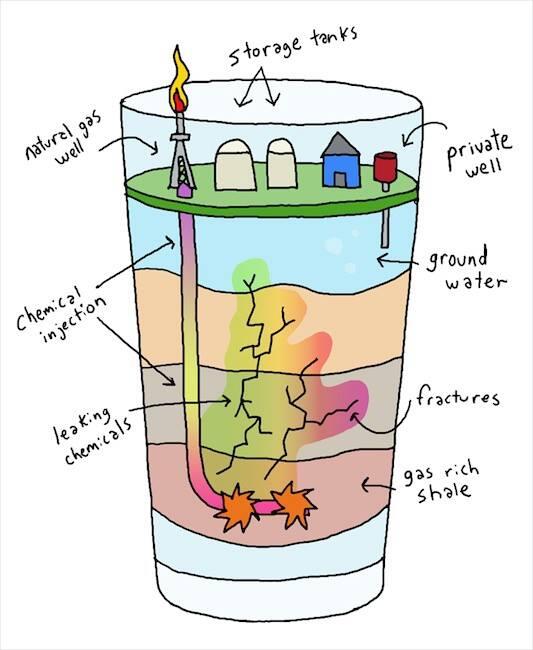
It would be nice if either the media or the protestors at Balcombe made some attempt to discuss the actual science behind fracking, but that seems a forlorn hope. The best I could come up with from the latter is this picture, offered by someone who thinks that anyone in possession of a set of crayons is qualified as a geologist:

BR-KG0SCAAAkSIu

In the interest of balance, here is a link to a blog post on fracking in the USA, the first paragraph of which reads:

For some time now, proponents of the controversial practice of hydraulic fracturing or “fracking” have claimed there was little or no evidence of real risk to groundwater. But as the classic saying goes: “the absence of evidence is not evidence of absence” of a problem. And the evidence that fracking can contaminate groundwater and drinking water wells is growing stronger with every new study.

I encourage you to read it, but if you do please carry on to the comments where you will see detailed counter-arguments.

I do not have a strong opinion either way on fracking. I’d prefer to make a decision as a result of an informed debate based on evidence, but there are clearly people who don’t want that to happen and are instead intent on scaremongering to suit their own ends. It seems to me that the legitimate concerns of sensible people have yet again been hijacked by the small but vociferous mob of “against everything” anarchists who see protest as an end in itself. It’s all so depressingly puerile. There’s no fracking going on in Balcombe anyway!

Why does the Green movement – and the left generally for that matter – have to be so comprehensively anti-scientific? As long as it remains that way it will never be taken seriously.

Fracking Confusion

Posted in Politics, Science Politics, The Universe and Stuff with tags , , , , , , on August 12, 2013 by telescoper

The news on the radio this morning featured a story about the Prime Minister wanting the UK to “get behind” hydraulic fracturing (or “fracking” as it is known for short) , a means of  liberating shale gas that offers the prospect of boosting the UK’s energy supply.

There’s not much sign any “getting behind” happening up the road from here in Balcombe, where a sizable anti-fracking protest has been going on for some time. There’s actually no fracking going on in Balcombe at the moment; the company involved, Cuadrilla Resources, is doing exploratory drilling to look for oil but may apply for a licence to pursue hydraulic fracturing if that is unsuccessful.

There’s a simple graphic on the BBC website that illustrates how fracking works:

_65309507_shale_gas_extraction464

In simple terms it involves pumping a mixture of water, sand and chemicals into a deposit of shale ato fracture the solid material contained therein and thus liberate the gas. Environmentalists argue that this technique might cause earth tremors and/or contamination of the water supply; advocates of fracking dispute these claims. I’m not sufficiently expert to be able to comment usefully on the arguments about the possible environmental dangers associated with it, so I’d be glad to receive comments via the box below.

One thing I will comment on, though, is the very poor quality of the media reporting on this issue. I’ve yet to see any meaningful attempt to comment on the science involved when surely that’s the key to whether we should “get behind” fracking or not? It struck me that quite a few readers might also be interested but ill-informed about this issue to, so for them I’d recommend reading the Beddington Report, the key findings of which were:

  • The health, safety and environmental risks can be managed effectively in the UK. Operational best practices must be implemented and enforced through strong regulation. Fracture propagation is an unlikely cause of contamination.
  • The risk of fractures propagating to reach overlying aquifers is very low provided that shale gas extraction takes place at depths of many hundreds of metres or several kilometres. Even if fractures reached overlying aquifers, the necessary pressure conditions for contaminants to flow are very unlikely to be met given the UK’s shale gas hydrogeological environments.
  • Well integrity is the highest priority. More likely causes of possible contamination include faulty wells. The UK’s unique well examination scheme was set up so that independent, specialist experts could review the design of every offshore well. This scheme must be made fit for purpose for onshore activities.
  • Robust monitoring is vital. Monitoring should be carried out before, during and after shale gas operations to detect methane and other contaminants in groundwater and potential leakages of methane and other gases into the atmosphere.
  • An Environmental Risk Assessment (ERA) should be mandatory. Every shale gas operation should assess risks across the entire lifecycle of operations, from water use through to the disposal of wastes and the abandonment of wells.
  • Seismic risks are low. Seismicity should be included in the ERA.Seismicity induced by hydraulic fracturing is likely to be of smaller magnitude than the UK’s largest natural seismic events and those induced by coal mining.
  • Water requirements can be managed sustainably. Water use is already regulated by the Environment Agency. Integrated operational practices, such as recycling and reusing wastewaters where possible, would help to minimise water requirements further. Options for disposing of wastes should be planned from the outset. Should any onshore disposal wells be necessary in the UK, their construction, regulation and siting would need further consideration.
  • Regulation must be fit for purpose. Attention must be paid to the way in which risks scale up should a future shale gas industry develop nationwide. Regulatory co-ordination and capacity must be maintained.
  • Policymaking would benefit from further research. The carbon footprint of shale gas extraction needs further research. Further benefit would also be derived from research into the public acceptability of shale gas extraction and use in the context of the UK’s energy, climate and economic policies.

I’m not sure how many anti-fracking activists, or others involved in the Balcombe protest, have read this report.

Anyway, in an attempt to gauge the mood of my totally unrepresentative readership, I thought I’d try a little poll:

And if you have strong opinions, please feel free to use the comments box.