Archive for SCOPUS

Yet Another Elsevier Scandal

Posted in Open Access with tags , , , on December 3, 2025 by telescoper

I wish to draw your attention to an article in the Spanish newspaper El Pais. I encourage you to read the full article, which in English here, and the headline is this:

The article is about a very dodgy journal called Science of the Total Environment published by Elsevier. As far as I can tell, despite the scandal, this journal is still listed in Scopus which is meant to mean that it is a quality journal. One shouldn’t be surprised however, because Scopus is itself owned by Elsevier. Why anyone would trust Scopus for anything is completely beyond me.

As well as the huge revenues and profit margins revealed in the article, it also mentions that Erik Engstrom, CEO of RELX (the multinational that owns Elsevier), earned more than €15 million ($17.4 million) in 2024 between his salary and other compensation. Nice work if you can get it…

Here’s a quote:

The scandal exposes the windfall profits of scientific publishers, who in recent years have amassed billions of dollars in earnings from public funds earmarked for science.

Quite so. I’ve been saying as much for years, in fact, and it is the major reason for setting up the Open Journal of Astrophysics. In my opinion, however, the scandalous behaviour of publishers is only half the problem: equally to blame are the institutions that go along with it.

More AI garbage

Posted in Artificial Intelligence with tags , , , on November 30, 2025 by telescoper

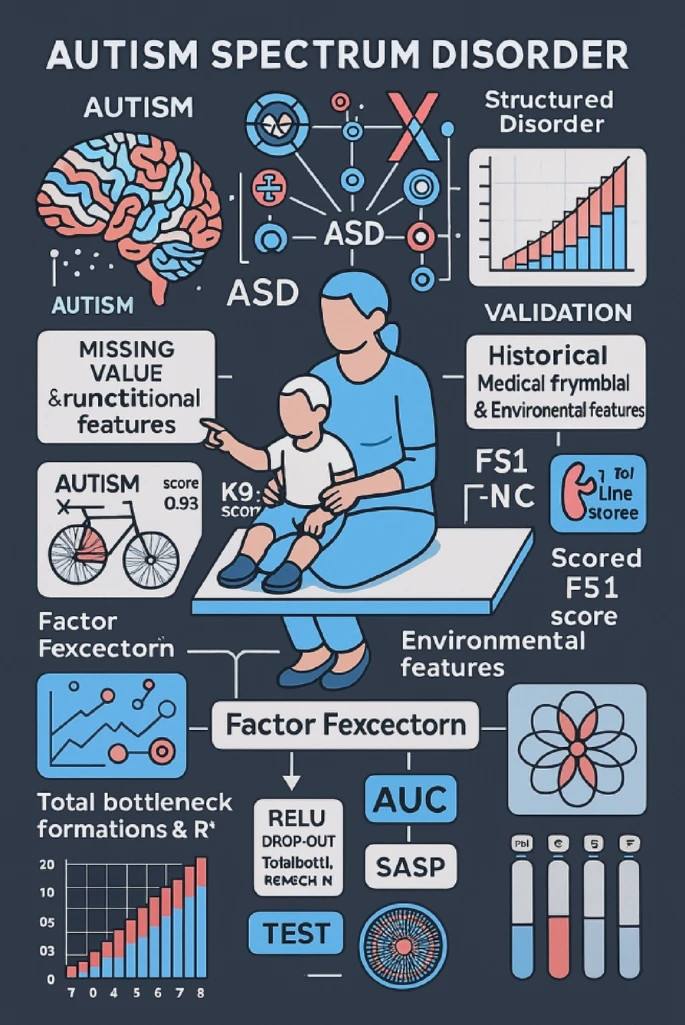
I’m indebted to a post on Mastodon for drawing my attention to a blog post about a paper with the title Bridging the gap: explainable ai for autism diagnosis and parental support with TabPFNMix and SHAP that appeared in the journal Nature Scientific Reports (which claims to be peer-reviewed).

Here is Figure 1 of that paper:

I’m no expert on Autism Diagnosis, but I’m pretty sure that neither “Fexcectorn” nor “frymblal” (medical or otherwise) nor “runctitional” are words in the English language. Why do the person’s legs go through the table? And why is Autism represented by a bicycle? This nonsensical figure was clearly generated by AI, as is much of the text of the paper. How on Earth did this crap pass peer review?

Still, Nature Scientific Reports is indexed in Scopus, which we all know is a watertight guarantee of quality…

P.S. The article was published on 19th November 2025. It is now prefaced by an Editor’s Note: “Readers are alerted that the contents of this paper are subject to criticisms that are being considered by editors. A further editorial response will follow the resolution of these issues.”

How to Fight Fraudulent Publishing

Posted in mathematics, Open Access with tags , , , , , , , on September 23, 2025 by telescoper

There’s a short article on arXiv with the title How to Fight Fraudulent Publishing in the Mathematical Sciences: Joint Recommendations of the IMU and the ICIAM which is well worth reading. The abstract is not useful but the prelude reads:

PreludeIn November 2023, Clarivate announced that it had excluded the entire field of mathematics from the latest edition of its influential list of ‘highly cited researchers’. This prompted the IMU and the ICIAM to conduct a more thorough investigation into the problem of fraudulent publishing in the mathematical sciences (see [1]). Understanding the problem is one thing; finding a way out and regaining control is another. With the recommendations given below, we would like to start the discussion on how, as a global community, we can achieve this. We are all concerned. It affects the very core of the science we love so much. I.A.

arXiv:2509.09877

The paper correctly identifies predatory journals and citation cartels as two consequences of the effort to quantify and rank the quality of research through scientific ‘performance indicators’, in the form of bibliometric measures and suggests some possible remedies.

Many of the recommendations are already included in the San Francisco Declaration on Research Assessment (SFDORA). Many also apply beyond the mathematical sciences (which is why I dropped the Mathematical Sciences bit in the title of the paper from the title of this blog post) and it’s not a long paper so I suggest you read it.

In my view one of the most important steps to take is to ditch the reliance on such companies as Scopus and Clarivate, who have deliberately constructed a system that is so easy to game. All higher education institutes should follow the examples of the Sorbonne University in Paris and, more recently, Utrecht University in the Netherlands. The academic publishing racket is inherently fraudulent. Too many universities, and indeed researchers employed by them, are willing participants in the system.

Alternatives to Scopus

Posted in Open Access with tags , , , , , on August 7, 2025 by telescoper

Yesterday I had a very interesting meeting with the Library Staff who are working behind the scenes on the Open Journal of Astrophysics. Most of the meeting was about reviewing the finances of the journal, so I had a look at the official accounts. These confirmed that the total cost incurred is under $30 per paper. The financial year here at Maynooth runs from October 1st to September 30th – don’t ask me why – so this year is not yet complete but will be just over $5000 dollars. We will have published about 180 papers in that period.

People ask me how the journal can be so inexpensive, and the answer is that we keep publishing costs to a minimum by offering a “no frills” service, and also because our editors and referees are all unpaid.

Anyway, in the course of the meeting I mentioned Scopus (which is owned by publishing behemoth Elsevier). This is used by many universities and funding agencies as a source of bibliometric information, but my experience is that it is unreliable and poorly managed. I thought I would share a few other, better, bibliometric databases here.

We have for some time being indexed in the Directory of Open Access Journals (DOAJ) and in fact our articles’ metadata are automatically deposited there every time we publish a paper. This however only covers fully Open Access journals which excludes some journals.

The go-to repository for astrophysicists is the NASA Astrophysics Data System, known to its friends as ADS. This has very complete bibliographic information going back over 100 years, as well as links to catalogues and other supplementary information. It’s also fairly complete for general physics.

Scopus being so awful I was pleased to find a system which is more general than NASA/ADS but with wider coverage. OpenAlex fits the bill rather well. It’s not quite complete but far better than Scopus. Articles from the Open Journal of Astrophysics are index there, and the information is almost as complete as NASA/ADS.

One candidate is Scimago. This is largely concerned with the (in my opinion) pointless task of journal rankings, but the Open Journal of Astrophysics is listed there. Again the information is not totally complete, but it’s not bad.

One thing I’ve learned over the last few years is that if you want to compare the impact of journals or individual articles it’s absolutely essential to use the same source of information because there is a huge variation between databases. When I look at astrophysics articles I always use NASA/ADS, but in other fields you could use OpenAlex or Scimago. There are no circumstances that justify the use of Scopus, even if your boss tells you to…

ResearchFish Again

Posted in Biographical, Science Politics with tags , , , , , , on April 1, 2025 by telescoper

One of the things I definitely don’t miss about working in the UK university system is the dreaded Researchfish. If you’ve never heard of this bit of software, it’s intended to collect data relating to the outputs of research grants funded by the various Research Councils. That’s not an unreasonable thing to want to do, of course, but the interface is – or at least was when I last used it several years ago – extremely clunky and user-unfriendly. That meant that, once a year, along with other academics with research grants (in my case from STFC) I had to waste hours uploading bibliometric and other data by hand. A sensible system would have harvested this automatically as it is mostly available online at various locations or allowed users simply to upload their own publication list as a file; most of us keep an up-to-date list of publications for various reasons (including vanity!) anyway. Institutions also keep track of all this stuff independently. All this duplication seemed utterly pointless.

I always wondered what happened to the information I uploaded every year, which seemed to disappear without trace into the bowels of RCUK. I assume it was used for something, but mere researchers were never told to what purpose. I guess it was used to assess the performance of researchers in some way.

When I left the UK in 2018 to work full-time in Ireland, I took great pleasure in ignoring the multiple emails demanding that I do yet another Researchfish upload. The automated reminders turned into individual emails threatening that I would never again be eligible for funding if I didn’t do it, to which I eventually replied that I wouldn’t be applying for UK research grants anymore anyway. So there. Eventually the emails stopped.

Then, about three years ago, ResearchFish went from being merely pointless to downright sinister as a scandal erupted about the company that operates it (called Infotech), involving the abuse of data and the bullying of academics. I wrote about this here. It then transpired that UKRI, the umbrella organization governing the UK’s research council had been actively conniving with Infotech to target critics. An inquiry was promised but I don’t know what became of that.

Anyway, all that was a while ago and I neither longer live nor work in the UK so why mention ResearchFish again, now?

The reason is something that shocked me when I found out about it a few days ago. Researchfish is now operated by commercial publishing house Elsevier.

Words fail. I can’t be the only person to see a gigantic conflict of interest. How can a government agency allow the assessment of its research outputs to be outsourced to a company that profits hugely by the publication of those outputs? There’s a phrase in British English which I think is in fairly common usage: marking your own homework. This relates to individuals or organizations who have been given the responsibility for regulating their own products. Is very apt here.

The acquisition of Researchfish isn’t the only example of Elsevier getting its talons stuck into academia life. Elsevier also “runs” the bibliometric service Scopus which it markets as a sort of quality indicator for academic articles. I put “runs” in inverted commas because Scopus is hopelessly inaccurate and unreliable. I can certainly speak from experience on that. Nevertheless, Elsevier has managed to dupe research managers – clearly not the brightest people in the world – into thinking that Scopus is a quality product. I suppose the more you pay for something the less inclined you are to doubt its worth, because if you do find you have paid worthless junk you look like an idiot.

A few days ago I posted a piece that include this excerpt from an article in Wired:

Every industry has certain problems universally acknowledged as broken: insurance in health care, licensing in music, standardized testing in education, tipping in the restaurant business. In academia, it’s publishing. Academic publishing is dominated by for-profit giants like Elsevier and Springer. Calling their practice a form of thuggery isn’t so much an insult as an economic observation. 

With the steady encroachment of the likes of Elsevier into research assessment, it is clear that as well as raking in huge profits, the thugs are now also assuming the role of the police. The academic publishing industry is a monstrous juggernaut that is doing untold damage to research and is set to do more. It has to stop.

The Scopus Horror Show

Posted in Open Access with tags , , , on October 31, 2024 by telescoper

Today being Hallowe’en, it seems an appropriate time to tell you a horror story. A few weeks ago I posted about the inaccuracy of the Scopus bibliographic database. I’ve contacted Scopus multiple times to supply them with correct data about the Open Journal of Astrophysics, but the errors persist. It seems I’ll have to take legal action to get them to correct the false and misleading information Scopus is displaying.

I was recently told about a paper with the title The museum of errors/horrors in Scopus. Written by F. Franceschini, D. Maisano & L. Mastrogiacomo and published in 2016, it demonstrates that people have known how poor Scopus is for many years. Yet still it is used.

Here is part of the abstract:

Recent studies have shown that the Scopus bibliometric database is probably less accurate than one thinks. As a further evidence of this fact, this paper presents a structured collection of several weird typologies of database errors, which can therefore be classified as horrors. Some of them concern the incorrect indexing of so-called Online-First paper, duplicate publications, and the missing/incorrect indexing of references. A crucial point is that most of these errors could probably be avoided by adopting some basic data checking systems.

DOI: 10.1016/j.joi.2015.11.006

Eight years on, there’s no sign of scopus adopting “basic data systems” but they don’t really have an incentive to improve do they? It seems the world of research assessment refuses to question the reliability of the product. Critical thinking is an alien concept to the bean counters.

P.S. Oíche Shamhna shona daoibh go léir!

Failures of Scopus

Posted in Maynooth, Open Access with tags , , , , , on October 14, 2024 by telescoper

I think it’s time to provide an update on the continuing (lack of) progress getting The Open Journal of Astrophysics properly indexed in Scopus (which markets itself as a purveyor of “metrics you can trust”). You might recall back in June that I reported that OJAp had been included in the index, but unfortunately the Scopus team messed up very badly by omitting about one-third of our papers and most of our citations. I reported a month ago that Scopus had committed to fixing the issue within two weeks. Now almost FIVE WEEKS later they haven’t done a thing.

Here’s the problem:

In the column marked Documents 2020-23  you will see the number 67. In fact we published 99 articles between 2020 and 2023, not 67. This is easily established here. The number 67 relates to the period 2022-23 only. Accidentally or deliberately, Scopus has omitted a third of our papers from its database. But the error doesn’t end there. Papers published in OJAp between 2020 and 2023 have actually been cited 959 times, not 137. If you restrict the count to papers published in 2022-23 there are 526 citations. It’s no wonder that OJAp has such a low CiteScore, and consequently appears so far down the rankings, when the citation information is so woefully inaccurate.

“Metrics you can trust?” My arse!

If you want accurate bibliometric information about the papers published in the two years that Scopus has chosen to ignore you can look here.

This all merely demonstrates the folly that so many institutions place so much trust in Scopus. Unfortunately the powers that be have decided that Scopus listing is such a reliable indicator of quality that any article not published in a Scopus journal is worthless. Knowing that it has a monopoly, Scopus has no incentive to put any effort into its own quality assurance. It can peddle any error-ridden tripe to its subscribers, most of them paying for the product with taxpayers’ money. Unfortunately the bean-counters at Maynooth University are as credulous as any, mindlessly parroting spurious announcements based on the Scopus database.

Maynooth University is proud to offer undergraduates a course in Critical Skills. I suggest it that the gullible members of its management team would do well to take it.

Scopus should be banned

Posted in Maynooth, Open Access with tags , , , on September 5, 2024 by telescoper

I think it’s time to provide an update on the (lack of) progress getting The Open Journal of Astrophysics properly indexed in Scopus (which markets itself as a purveyor of “metrics you can trust”).

You might recall back in June that I reported that OJAp had been included in the index, but unfortunately the Scopus team messed up very badly by omitting about one-third of our papers and most of our citations. Here’s what they did:

In the column marked Documents 2020-23  you will see the number 67. In fact we published 99 articles between 2020 and 2023, not 67. This is easily established here. The number 67 relates to the period 2022-23 only. Accidentally or deliberately, Scopus has omitted a third of our papers from its database. But the error doesn’t end there. Papers published in OJAp between 2020 and 2023 have actually been cited 959 times, not 137. If you restrict the count to papers published in 2022-23 there are 526 citations. It’s no wonder that OJAp has such a low CiteScore, and consequently appears so far down the rankings, when the citation information is so woefully inaccurate. “Metrics you can trust?” My arse!

If you want accurate bibliometric information about the papers published in the two years that Scopus has chosen to ignore you can look here.

I sent this information to Scopus on 15th June, soon after noticing the error, but I then got shunted around. I eventually got a reply on 23rd August, acknowledging the mistake and including this:

I want to assure you that your request has been promptly forwarded to our technical team for the addition of the paper to our database. While we strive to resolve this as swiftly as possible, please be aware that this correction process may take up to four weeks to be completed. 

I think they’re using some definition of “promptly” with which I am unfamiliar. I’m not optimistic that they will actually correct it in four weeks, either, since it took 5 months to get the initial 67 papers indexed.

This all merely demonstrates the folly that so many institutions place so much trust in Scopus. Based on my interactions with them, I wouldn’t trust them with anything at all. Unfortunately the powers that be have decided that Scopus listing is such a reliable indicator of quality that any article not published in a Scopus journal is worthless. Knowing that it has a monopoly, Scopus has no incentive to put any effort into its own quality assurance. It can peddle any error-ridden tripe to its subscribers, most of them paying for the product with taxpayers’ money.

(I might add that if OJAp were a commercial journal, then the willful publication of demonstrably false information about it would be actionable as it is potentially damaging to business. )

Presumably at the instigation of senior management, IT services at Maynooth University are still banning access to this blog from campus. It would make far more sense for them to ban Scopus.

Bogus Scopus

Posted in Open Access with tags , , , , on June 17, 2024 by telescoper

Just to show that I’m not alone in having severe doubts about the reliability and integrity of Scopus here is an article from Retraction Watch that points out that three of the top ten philosophy journals (according to that database) are fake. Among the facts that could easily have been checked by a competent agency is this:

The same editorial board serves for three journals, with 10 members who are dead. 

The article concludes:

Rankings based on Scopus frequently serve universities and funding bodies as indicators of the quality of research, including in philosophy. They play a crucial role in decisions regarding academic awards, hiring, and promotion, and thus may influence the publication strategies of researchers… Our findings show that research institutions should refrain from the automatic use of such rankings. 

Quite. Any institute that has signed up to the San Francisco Declaration on Research Assessment should not be basing any decisions on Scopus anyway, but I don’t think that goes far enough. Scopus is a corrupting influence. It is high time for universities and other agencies to stop paying their subscriptions and ditch it entirely.

Seriously, Scopus?

Posted in Open Access with tags , , , on June 10, 2024 by telescoper

Five months ago I wrote a blog post mentioning that the Open Journal of Astrophysics (OJAp) had been accepted for listing in Scopus. A couple of months later, I posted an update explaining that the process of was taking much longer than the 4 to 6 weeks I was told it would. Well, I can now report that, a full five months after acceptance, we have finally made it onto the Scopus database.

Great! I hear you say. Well, no actually. Despite taking an excessive length of time to index the Open Journal of Astrophysics, the Scopus crew have messed up the bibliometric data relating to it in a most ridiculous fashion.

Here is the entry:

I draw your attention first to the column marked Documents 2020-23 under which you will see the number 67. In fact we published 99 articles between 2020 and 2023, not 67. This is easily established here. The number 67 relates to the period 2022-23 only. Accidentally or deliberately, Scopus has omitted a third of our papers from its database.

But the error doesn’t end there. Papers published in OJAp between 2020 and 2023 have actually been cited 959 times, not 137. If you restrict the count to papers published in 2022-23 there are 526 citations. It’s no wonder that OJAp has such a low CiteScore, and consequently appears so far down the rankings, when the citation information is so woefully inaccurate.

Incidentally, CiteScores are marketed by Scopus as “metrics you can verify and trust”. Oh no you can’t.

When I first saw this travesty I thought very hard about asking to have OJAp removed from Scopus altogether, but on reflection I decided to contact them with the actual numbers and a request that they issue a correction as soon as possible. Given that it took 5 months to get this far, however, I’m not optimistic for a speedy response.

While I’m waiting for that I suggest you consider whether these egregious errors are simply incompetent or whether they are deliberate acts of sabotage by a front organization for the commercial publishing industry? And another question: how much else in the Scopus database is as badly wrong as the OJAp entry?