Archive for Solar System

The Time of Perihelion

Posted in The Universe and Stuff with tags , , , on January 3, 2024 by telescoper

Earth’s elliptical orbit viewed at an angle (which makes it look more eccentric than it is – in reality is very nearly circular).

I haven’t received a Royal Astronomical Society diary this year, which I’m sad about as it has been a bit of a tradition, as well as being a useful source of astronomical information. According to other sources,  however, today (Wednesday 3rd January 2024) at approximately 00.39 GMT the Earth reached the point on its orbit  closest to the Sun, i.e. its perihelion. At this time the distance from the Sun’s centre to Earth’s centre was  147,100,632 km. This year, aphelion (the furthest distance from the Sun) is at 06.06 GMT on July 6th 2023 at which point the centre of the Earth will be 152,099,968 km from the centre of the Sun. You can find a list of times and dates of perihelion and aphelion for future years here.

At perihelion the speed of the Earth in its orbit around the Sun is greater than at aphelion (about 30.287 km/s versus 29.291 km/s). This difference, caused by the Earth’s orbital eccentricity, contributes to the difference between mean time and solar time which, among other things, influences the time of sunrise and sunset at the winter solstice that happened a couple of weeks or so ago.

It surprises me how many people think that the existence of the seasons has something to do with the variation of the Earth’s distance from the Sun as it moves in its orbit in that the closer to the Sun we get the warmer the weather will be. The fact that perihelion occurs in the depth of winter should convince anyone living in the Northern hemisphere that this just can’t be the case, as should the fact that it’s summer in the Southern hemisphere while it is winter in the North.

The real reason for the existence of seasons is the tilt of the Earth’s axis of rotation. I used to do a little demonstration with a torch (flashlight to American readers) to illustrate this when I taught first-year astrophysics. If you shine a torch horizontally at a piece of card it will illuminate a patch of the card. Keep the torch at the same distance but tilt the card and you will see the illuminated patch increase in size. The torch is radiating the same amount of energy but in the second case that energy is spread over a larger area than in the first. This means that the energy per unit area incident on the card is decreases when the card is tilted. It is that which is responsible for winter being colder than summer. In the summer the sun is higher in the sky (on average) than in winter. From this argument you can infer that the winter solstice not the perihelion, is the relevant astronomical indicator of winter.

That is not to say that the shape of the Earth’s orbit has no effect on temperatures. It may, for example, contribute to the summer in the Southern hemisphere being hotter than in the North, although it is not the only effect. The Earth’s surface possesses a significant North-South asymmetry: there is a much larger fraction of ocean in the Southern hemisphere, for example, which could be responsible for moderating any differences in temperature due to insolation. The climate is a non-linear system that involves circulating air and ocean currents that respond in complicated ways and on different timescales not just to insolation but to many other parameters, including atmospheric composition (especially the amount of water vapour).

The dates when Earth reaches the extreme points on its orbit (apsides) are not fixed because of the variations in its orbital eccentricity so, in the short-term, the dates can vary up to 2 days from one year to another. The perihelion distance varies slightly from year to year too; it’s slightly larger this year than last year, for example.

There is however a long-term trend for perihelion to occur later in the year. For example, in 1246, the December Solstice (winter solstice for the Northern Hemisphere) was on the same day as the Earth’s perihelion. Since then, the perihelion and aphelion dates have drifted by an average of one day every 58 years and this trend will continue. This means that by the year 6430 the timing of the perihelion and the March Equinox will coincide, although I hope to have retired by then…

Four New Publications at the Open Journal of Astrophysics

Posted in OJAp Papers, Open Access, The Universe and Stuff with tags , , , , , , , , , , , , , , , , on July 29, 2023 by telescoper

The rate of publication at the Open Journal of Astrophysics has now reached the point at which I think I’ll have to limit myself to weekly updates here rather than announcing every paper as it appears. We still announce individual papers on social media of course, meaning Mastodon, Facebook and the platform formerly known as Twitter…

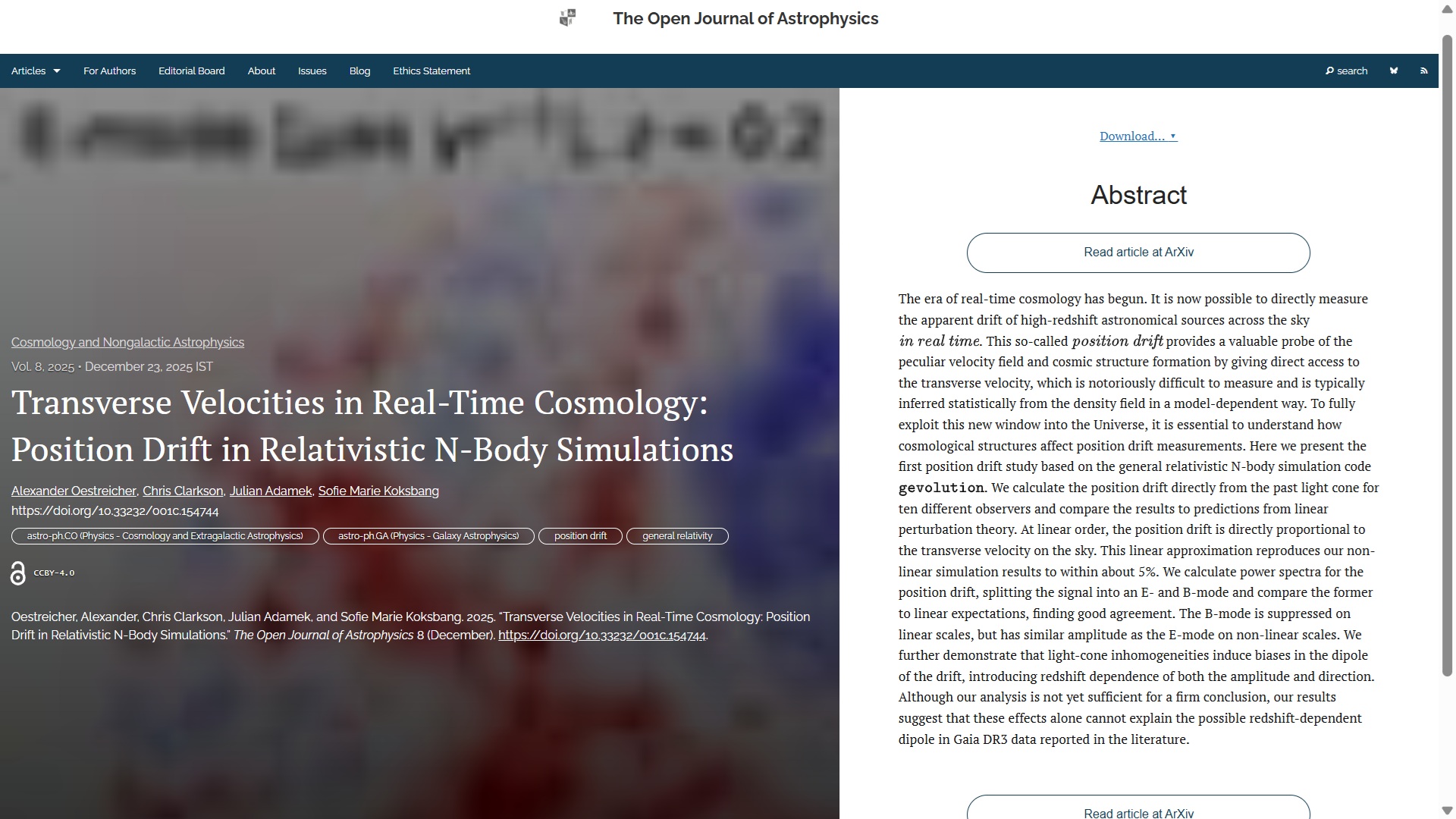
This week we have published four papers which I now present to you here. These four take the count in Volume 6 (2023) up to 31 and the total published by OJAp up to 96. I speculated earlier this year that we might reach 100 before the end of 2023, now it looks certain we will reach the century mark as early as August! It is gratifying to see the range of papers published increasing, with all four of these in different categories.

In chronological order, the four papers published this week, with their overlays, are as follows. You can click on the images of the overlays to make them larger should you wish to do so.

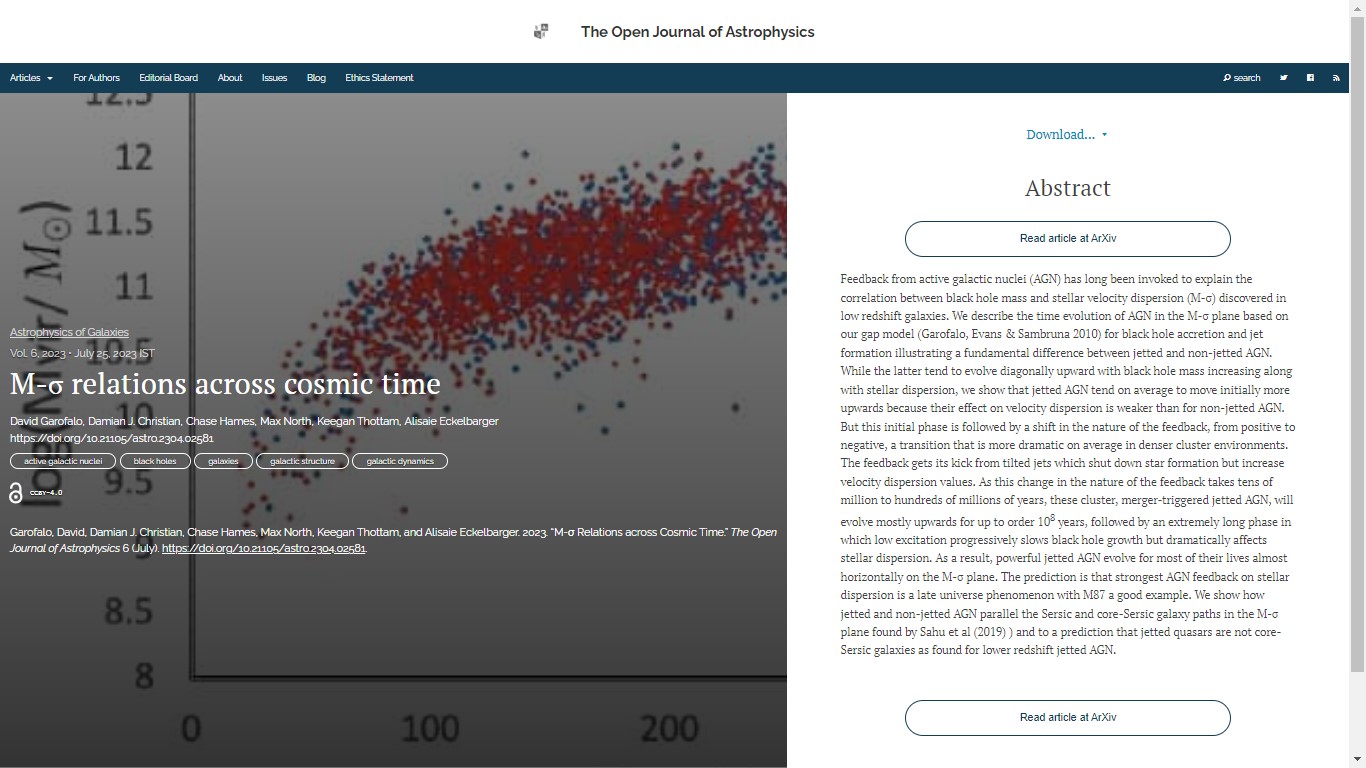
First one up is “M-σ relations across cosmic time” by David Garofalo (1), Damian J. Christian (2), Chase Hames (1), Max North (3), Keegan Thottam (1) & Alisaie Eckelbarger (1). The author affiliations are: (1) Department of Physics, Kennesaw State University, USA; (2) Department of Physics and Astronomy, California State University, Northridge, USA; (3) Department of Information Systems, Kennesaw State University, USA. This is a discussion of the relationship between black hole mass and stellar velocity dispersion discovered in low redshift galaxies and its evolution with cosmic time. The paper was published on 25th July, is in the folder marked Astrophysics of Galaxies and can be found here.

Here is a screen grab of the overlay, which includes the abstract:

You can find the officially accepted version of the paper on the arXiv here.

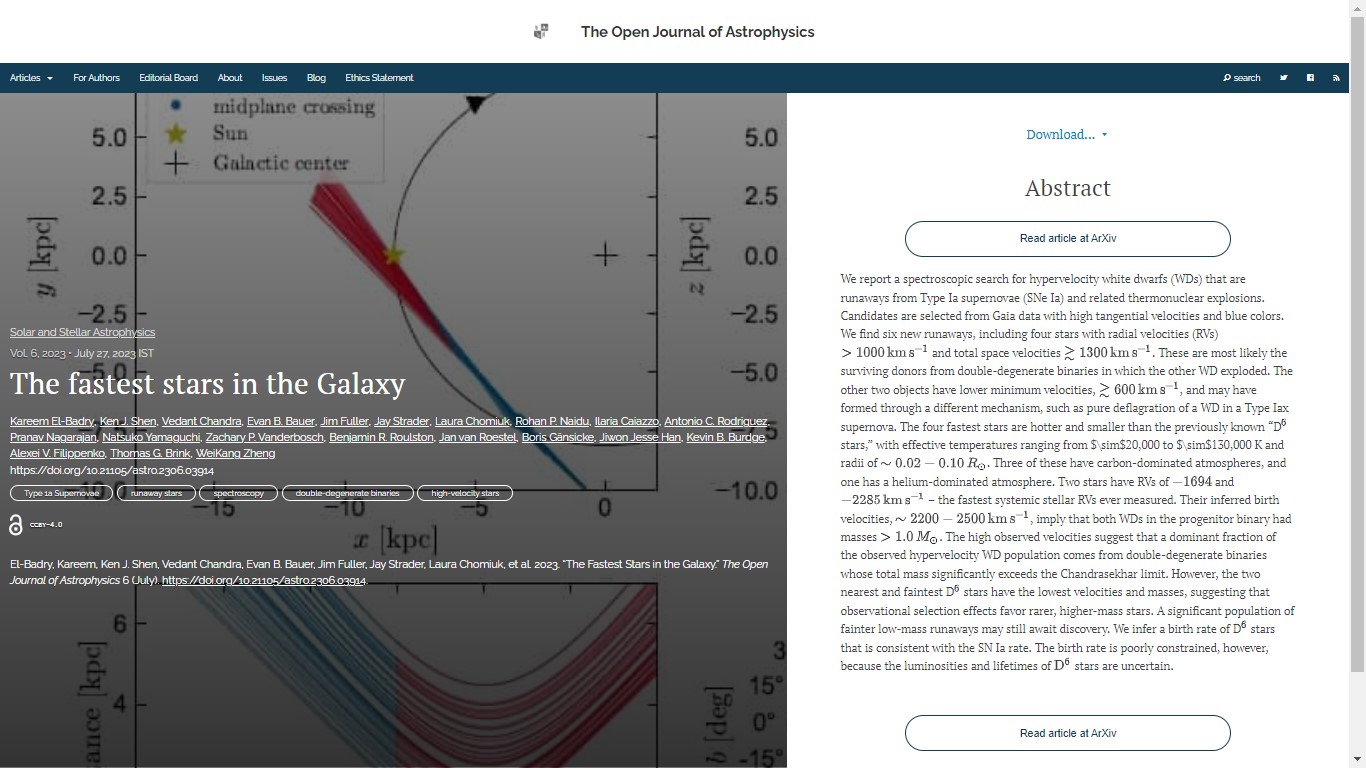
The second paper to announce is “The fastest stars in the Galaxy” by Kareem El-Badry et al. (21 authors. This one is the fourth item in the folder marked Solar and Stellar Astrophysics and it reports the spectroscopic discovery of 6 new “runaway” stars, probably the surviving members of binary star systems in which one star exploded in a Type 1a supernova. The paper was published on 27th July 2023 and you can see the overlay here:

The accepted version of this paper can be found on the arXiv here.

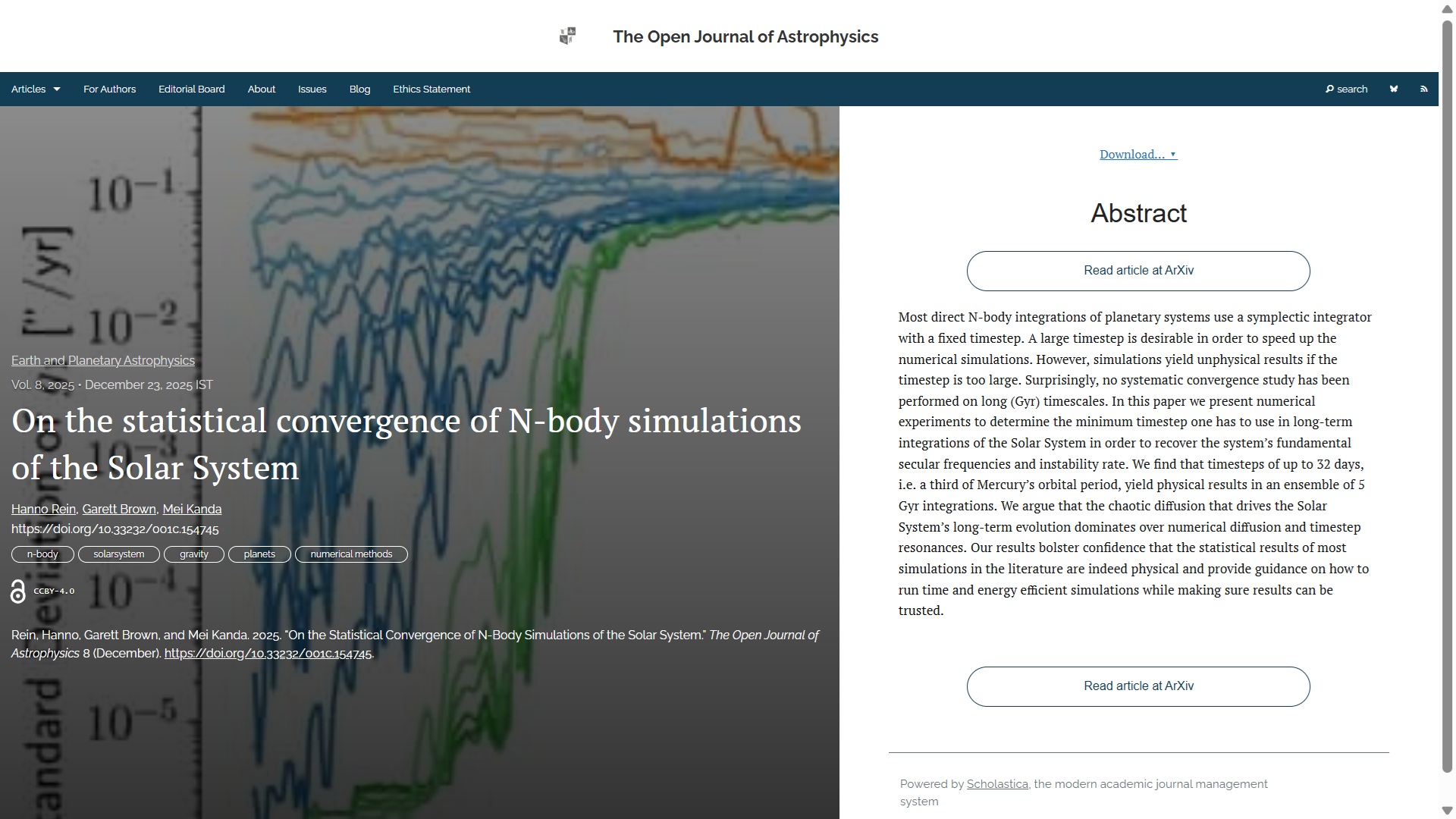
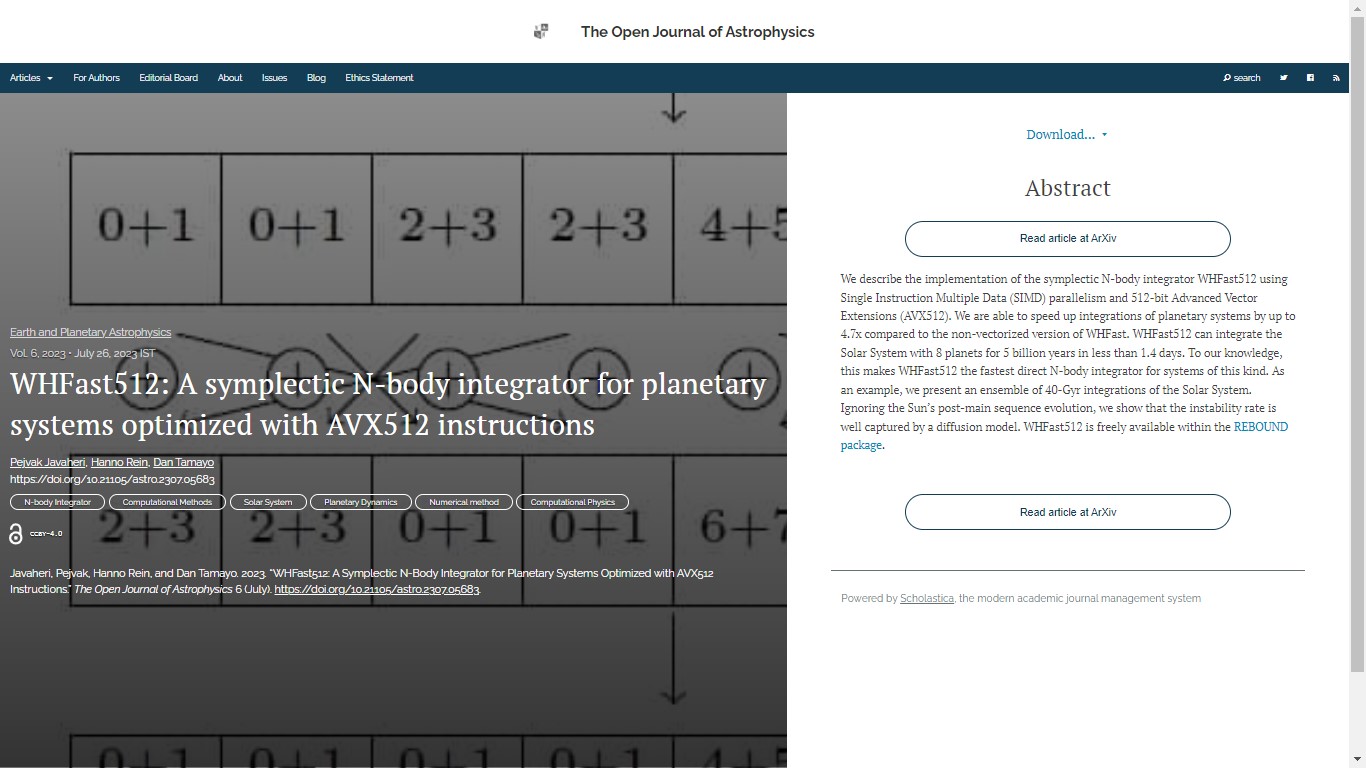
The next paper is in the Earth and Planetary Astrophysics folder. It is in fact only the second paper we have published in that area. It is entitled “WHFast512: A symplectic N-body integrator for planetary systems optimized with AVX512 instructions” by Pejvak Javaheri & Hanno Rein (University of Toronto, Canada) and Daniel Tamayo (Harvey Mudd College, USA). This paper presents a fast direct N-body integrator for gravitational systems, and demonstrates it using a 40 Gyr integration of the Solar System.

Here is the overlay:


You can find the full text for this one on the arXiv here.

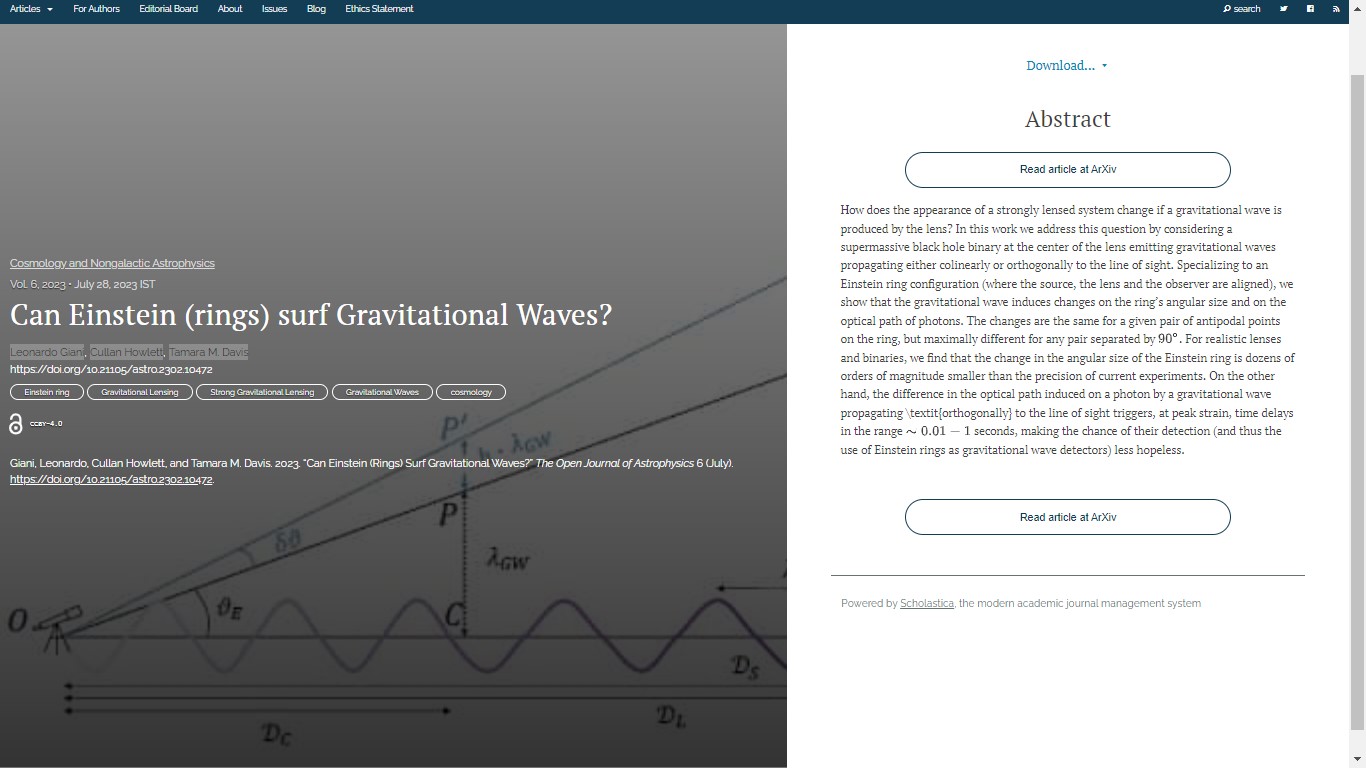
Last but by no means least, published yesterday (29th July), we have a paper that asks the question “Can Einstein (rings) surf Gravitational Waves?” by Leonardo Giani, Cullan Howlett and Tamara M. Davis of the University of Queensland, Australia. The primary classification for this one is Cosmology and Nongalactic Astrophysics and it discusses the possible effect(s) of gravitational waves on gravitational lensing observations.


You can click on the image of the overlay to make it larger should you wish to do so. You can find the officially accepted version of the paper on the arXiv here.

R.I.P. David Hughes (1941-2022)

Posted in The Universe and Stuff with tags , , on June 9, 2022 by telescoper
David W Hughes (1941-2022)

I am once again very sorry to have to pass on some sad news. Astronomer David Hughes (formerly of Sheffield University) passed away suddenly on Monday 6th June at the age of 80.

Born in Nottinghamshire, David did his first degree at Birmingham University and his DPhil in Oxford. He moved to Sheffield in 1965 and worked there until he retired in 2007.

David was an expert on the Solar System, especially its minor bodies, such as asteroids and comets; the Mars-crossing asteroid 4205 David Hughes is named in honour of his many achievements. He was also very knowledgeable about the history of astronomy and the threat to Earth from meteors and other impact phenomena. An ebullient public speaker, he was much in demand as a guest on TV programmes, as well as giving lectures on cruise ships and talks to amateur astronomical societies and lay audiences. Through these activities he did a huge amount for the popularization of astronomy especially in the UK.

I send my condolences to his family, friends and colleagues both in Sheffield and around the world.

R.I.P. David W Hughes (1941-2022)

Scale

Posted in The Universe and Stuff with tags , , , , , on January 31, 2011 by telescoper

A number of people drew my attention to this today. It’s definitely worth passing on to those of you who haven’t seen it already. Have a look at this  blog post too!


Share/Bookmark