Archive for Square Kilometre Array Observatory

Weekly Update from the Open Journal of Astrophysics – 21/02/2026

Posted in OJAp Papers, Open Access, The Universe and Stuff with tags , , , , , , , , , , , , , , , , , , , , , , , , , , , , , , , , on February 21, 2026 by telescoper

It’s Saturday once more so time for another update of activity at the Open Journal of Astrophysics. Since the last update we have published a further six papers, bringing the number in Volume 9 (2026) to 36 and the total so far published by OJAp up to 484.

I will continue to include the posts made on our Mastodon account (on Fediscience) to encourage you to visit it. Mastodon is a really excellent service, and a more than adequate replacement for X/Twitter (which nobody should be using); these announcements also show the DOI for each paper.

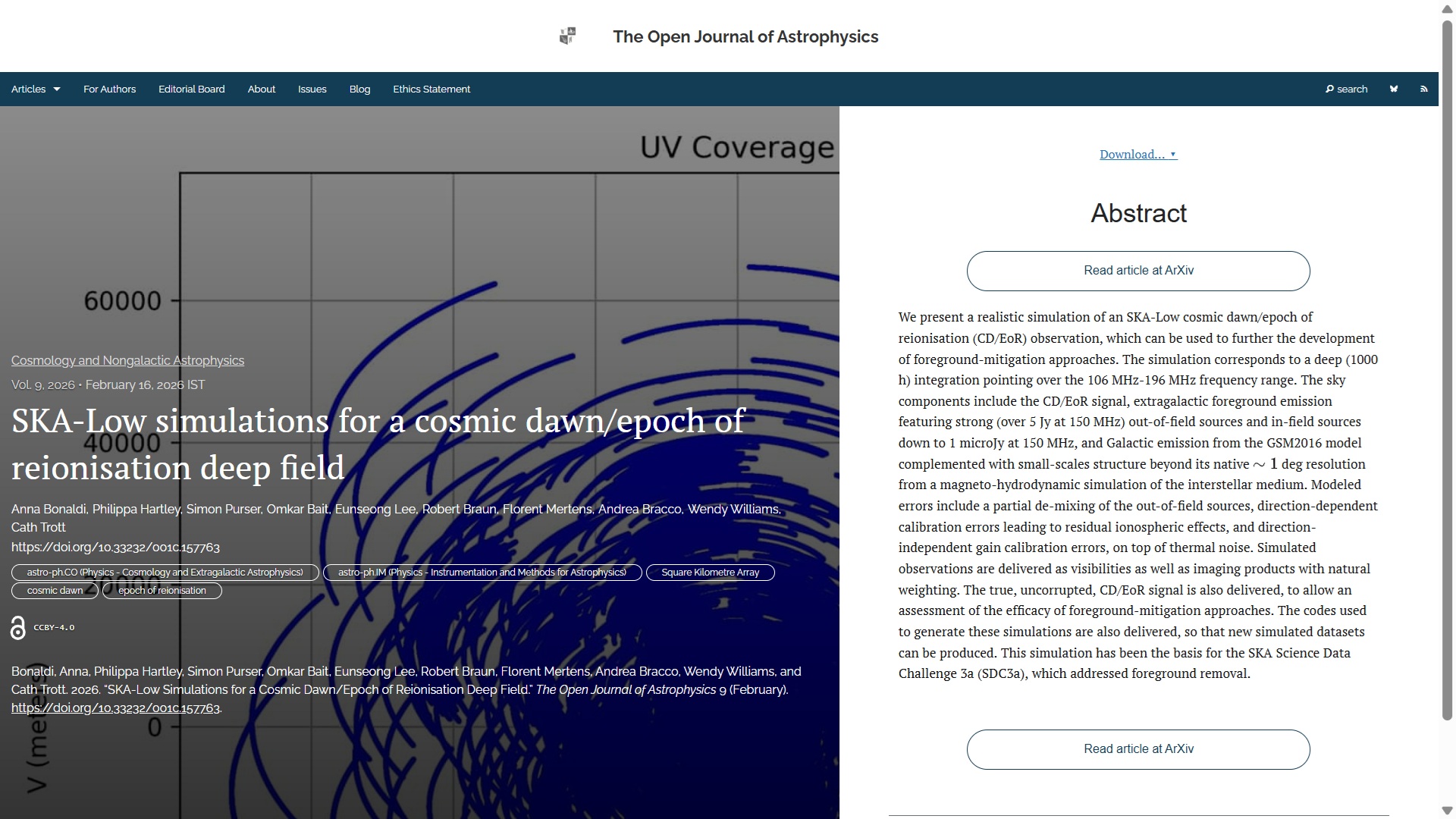
The first paper to report this week is “SKA-Low simulations for a cosmic dawn/epoch of reionisation deep field” by Anna Bonaldi, Philippa Hartley, Simon Purser & Omkar Bait (SKAO, UK), Eunseong Lee (U. Manchester, UK), Robert Braun (SKAO), Florent Mertens (Sorbonne Université, France), Andrea Bracco (Osservatorio Astrofisico di Arcetri, IT), Wendy Williams (SKAO) and Cath Trott (Curtin U., Australia). This paper presents a simulation of an SKA-Low cosmic dawn/epoch of reionisation observation to advance foreground-mitigation approaches: the simulation includes various sky components and modelled errors, allowing for efficacy assessment. It was published on Monday 16th February in the folder Cosmology and Nongalactic Astrophysics.

The overlay is here:
You can find the officially accepted version on arXiv here and the announcement on Fediverse here:

Open Journal of Astrophysics

New Publication at the Open Journal of Astrophysics: "SKA-Low simulations for a cosmic dawn/epoch of reionisation deep field" by Anna Bonaldi, Philippa Hartley, Simon Purser & Omkar Bait (SKAO, UK), Eunseong Lee (U. Manchester, UK), Robert Braun (SKAO), Florent Mertens (Sorbonne Université, France), Andrea Bracco (Osservatorio Astrofisico di Arcetri, IT), Wendy Williams (SKAO) and Cath Trott (Curtin U., Australia)

doi.org/10.33232/001c.157763

February 16, 2026, 8:28 am 1 boosts 1 favorites

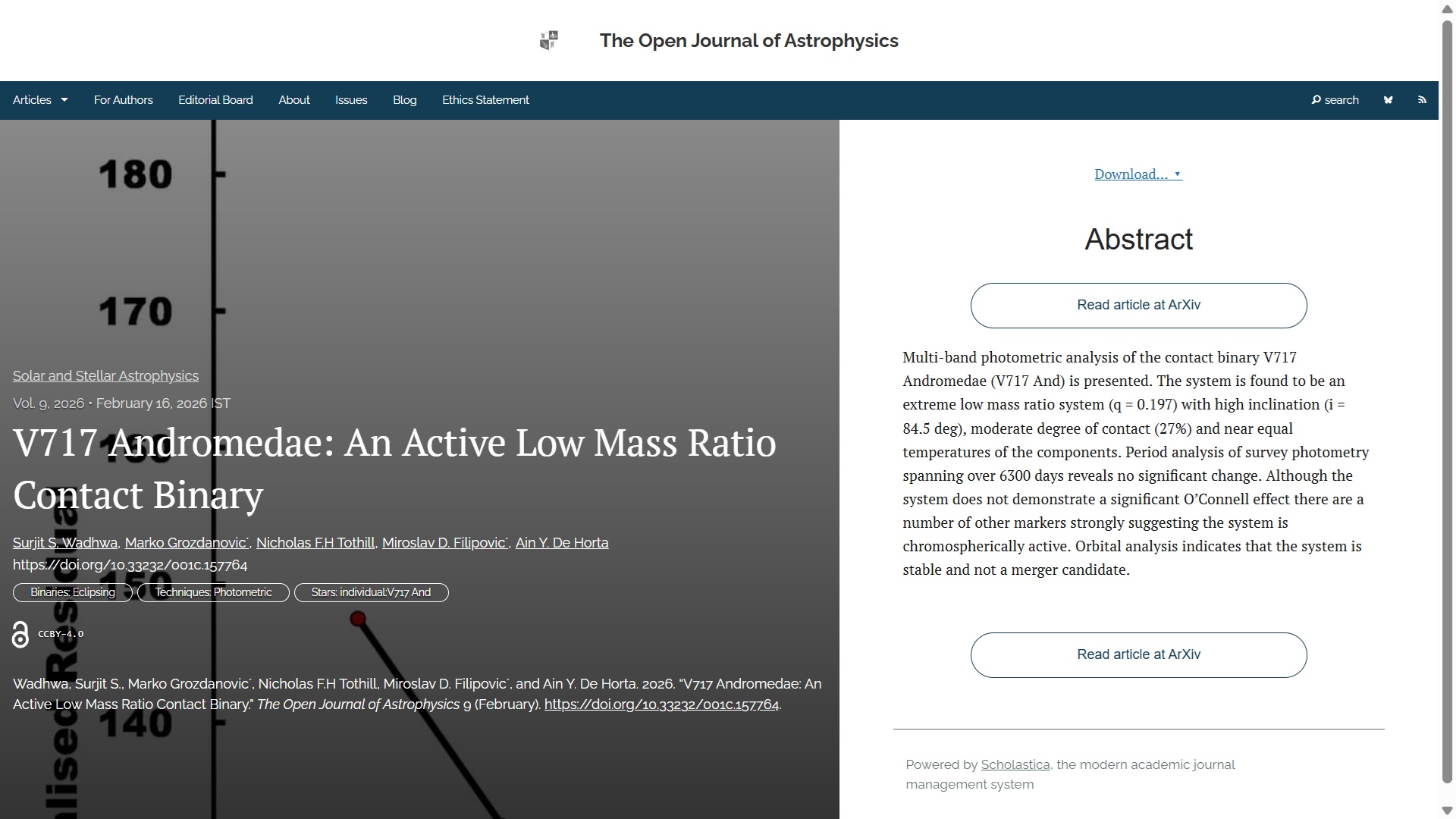
The second paper is “V717 Andromedae: An Active Low Mass Ratio Contact Binary” by Surjit S. Wadhwa (Western Sydney U. Australia), Marko Grozdanovic (Astronomical Observatory Belgrade, Serbia), and Nicholas F.H Tothill, Miroslav D. Filipovic, Ain Y. De Horta (Western Sydney U.). This was also published on Monday 1th February, but in the folder Solar and Stellar Astrophysics. The article discusses the contact binary V717 Andromedae, an extreme low mass ratio system with high inclination and moderate contact, showing signs of chromospheric activity but stable and not a merger candidate

The overlay for this one is here:
The official version of the paper can be found on arXiv here and the Fediverse announcement here:

Open Journal of Astrophysics

New Publication at the Open Journal of Astrophysics: "V717 Andromedae: An Active Low Mass Ratio Contact Binary" by Surjit S. Wadhwa (Western Sydney U. Australia), Marko Grozdanovic (Astronomical Observatory Belgrade, Serbia), and Nicholas F.H Tothill, Miroslav D. Filipovic, Ain Y. De Horta (Western Sydney U.)

doi.org/10.33232/001c.157764

February 16, 2026, 8:56 am 0 boosts 0 favorites

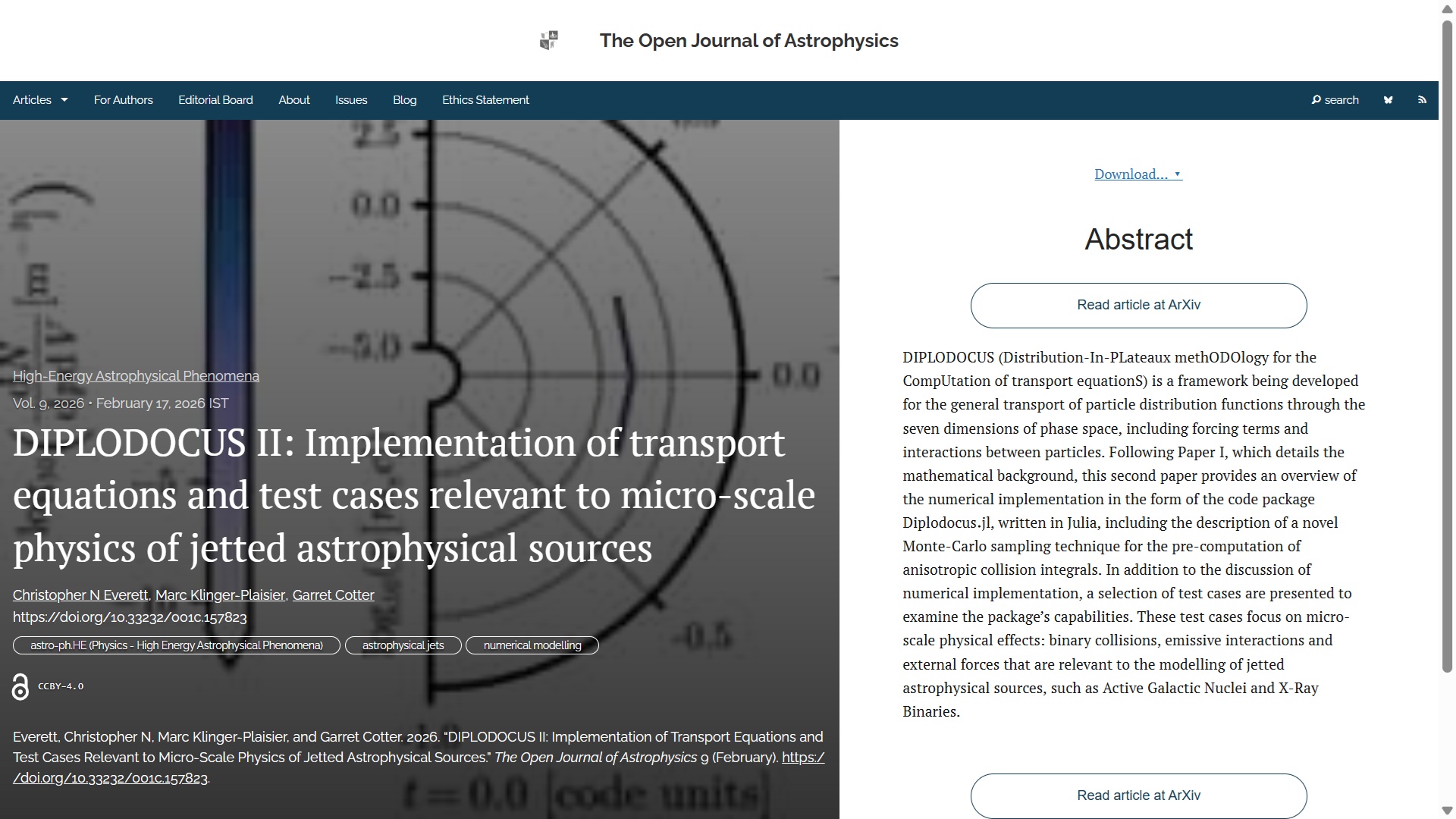
Next, published on Tuesday 17th February in the folder High-Energy Astrophysical Phenomena, is “DIPLODOCUS II: Implementation of transport equations and test cases relevant to micro-scale physics of jetted astrophysical sources” by Christopher N Everett (Oxford U., UK), Marc Klinger-Plaisier (U. Amsterdam, NL) and Garret Cotter (Oxford). This one discusses further applications of DIPLODOCUS, which is a framework developed for particle distribution transport, with its numerical implementation detailed in Diplodocus.jl. It uses a new sampling technique and is tested on micro-scale physical effects. The first paper in the series can be found here.

The overlay is here:
The official version can be found on arXiv here and the Fediverse announcement is here:

Open Journal of Astrophysics

New Publication at the Open Journal of Astrophysics: "DIPLODOCUS II: Implementation of transport equations and test cases relevant to micro-scale physics of jetted astrophysical sources" by Christopher N Everett (Oxford U., UK), Marc Klinger-Plaisier (U. Amsterdam, NL) and Garret Cotter (Oxford)

doi.org/10.33232/001c.157823

February 17, 2026, 7:13 am 1 boosts 2 favorites

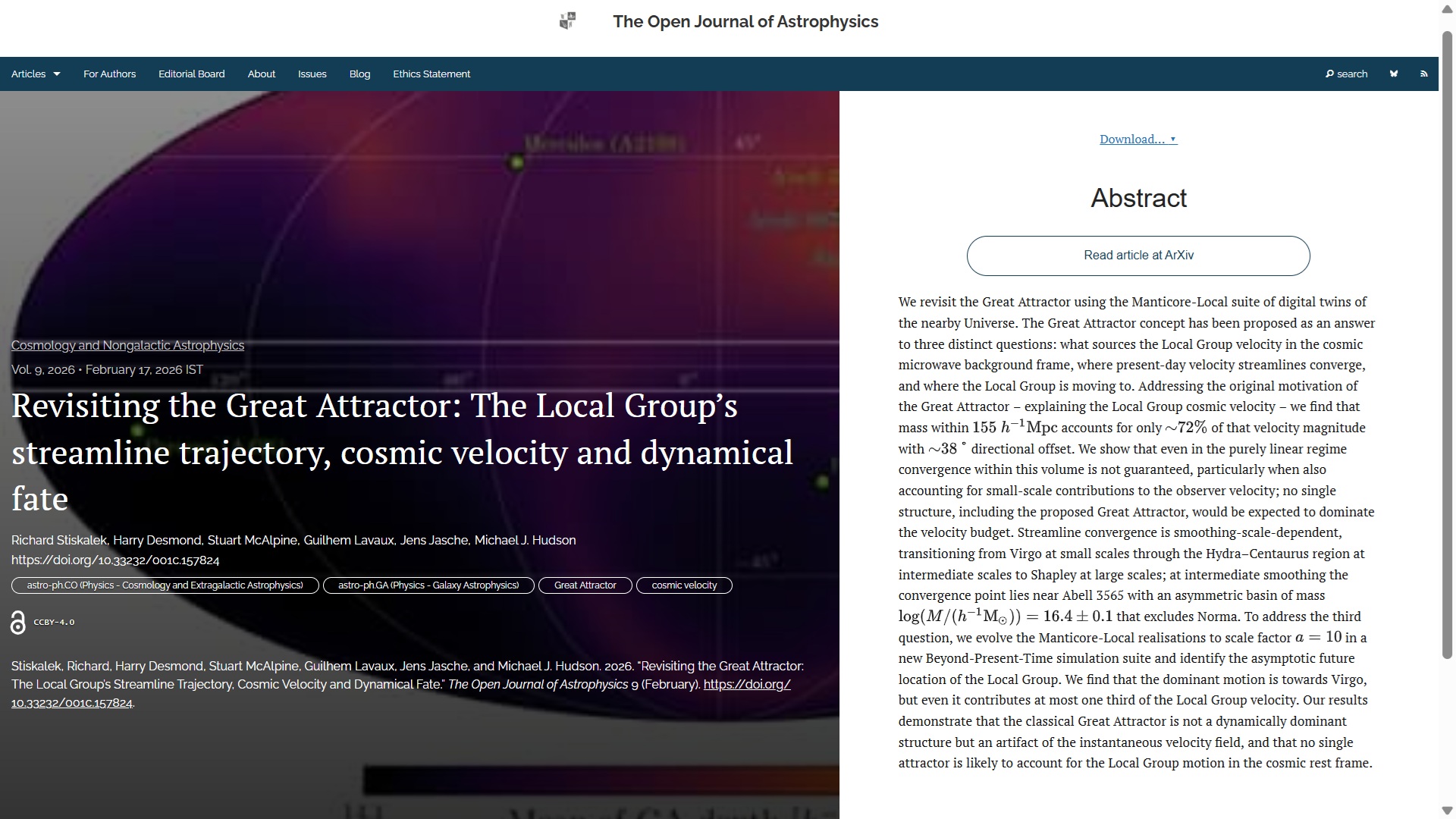
The fourth paper this week, also published on Tuesday 17th February, but in the folder Cosmology and Nongalactic Astrophysics is “Revisiting the Great Attractor: The Local Group’s streamline trajectory, cosmic velocity and dynamical fate” by Richard Stiskalek (Oxford U., UK), Harry Desmond (U. Portsmouth, UK), Stuart McAlpine (Stockholm, SE), Guilhem Lavaux (Sorbonne Université, FR), Jens Jasche (Stockholm) and Michael J. Hudson (U. Waterloo, Canada). This paper revisits the so-called “Great Attractor” concept, finding that it doesn’t dominate the Local Group’s cosmic velocity; multiple structures contribute to the motion, with no single attractor accounting for the flow.

Here is the overlay:
The official version can be found on arXiv here and the Fediverse announcement is here:

Open Journal of Astrophysics

New Publication at the Open Journal of Astrophysics: "Revisiting the Great Attractor: The Local Group’s streamline trajectory, cosmic velocity and dynamical fate" by Richard Stiskalek (Oxford U., UK), Harry Desmond (U. Portsmouth, UK), Stuart McAlpine (Stockholm, SE), Guilhem Lavaux (Sorbonne Université, FR), Jens Jasche (Stockholm) and Michael J. Hudson (U. Waterloo, Canada)

doi.org/10.33232/001c.157824

February 17, 2026, 7:33 am 3 boosts 1 favorites

The fifth paper this week, is “JWST observations of three long-period AM CVn binaries: detection of the donors and hints of magnetically truncated disks” by Kareem El-Badry (Caltech), Antonio C. Rodriguez (CfA Harvard), Matthew J. Green (U. Oklahoma) & Kevin B. Burdge (MIT); all based in the USA. The article was published on Thursday 19th February 2026 in the folder Solar and Stellar Astrophysics. The paper describes high-cadence infrared spectroscopy used to analyze three long-period, eclipsing AM CVn (AM Canum Venaticorum) binaries; findings suggest the presence of magnetized white dwarf accretors, with surface magnetic fields of 30-100 kG.

The overlay is here:
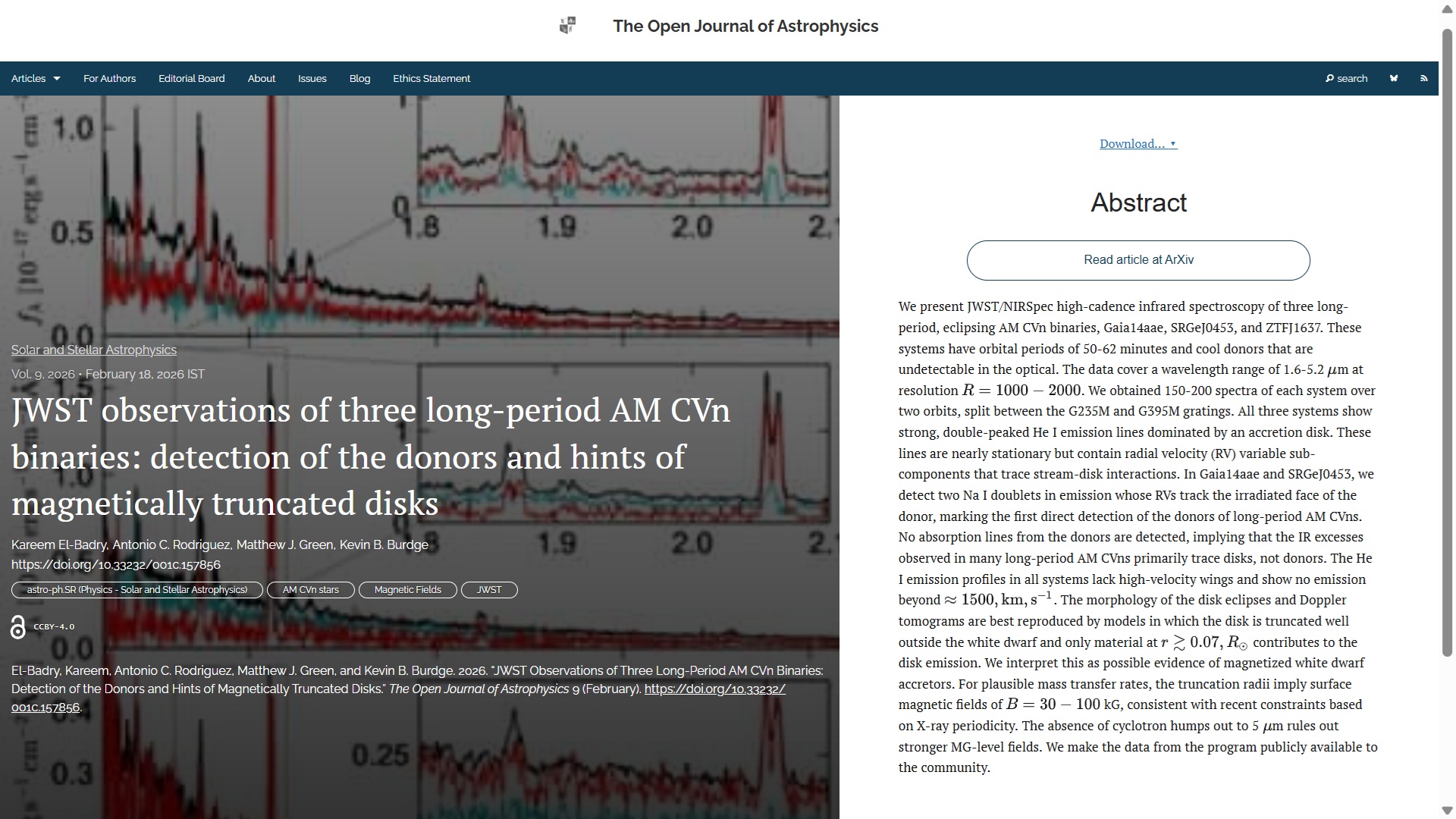
The accepted version can be found on arXiv here, and the fediverse announcement is here:

Open Journal of Astrophysics

New Publication at the Open Journal of Astrophysics: "JWST observations of three long-period AM CVn binaries: detection of the donors and hints of magnetically truncated disks" by Kareem El-Badry (Caltech), Antonio C. Rodriguez (CfA Harvard), Matthew J. Green (U. Oklahoma) & Kevin B. Burdge (MIT); all in USA

doi.org/10.33232/001c.157856

February 18, 2026, 8:15 am 1 boosts 0 favorites

Finally for this week we have “Ultra-long Gamma-ray Bursts from Micro-Tidal Disruption Events: The Case of GRB 250702B” by Paz Beniamini (Open University, IL), Hagai B. Perets (Technion, IL) and Jonathan Granot (Open University, IL); all based in Israel. The paper was published on Friday 18th February 2026 in the folder High-Energy Astrophysical Phenomena.

The overlay is here:
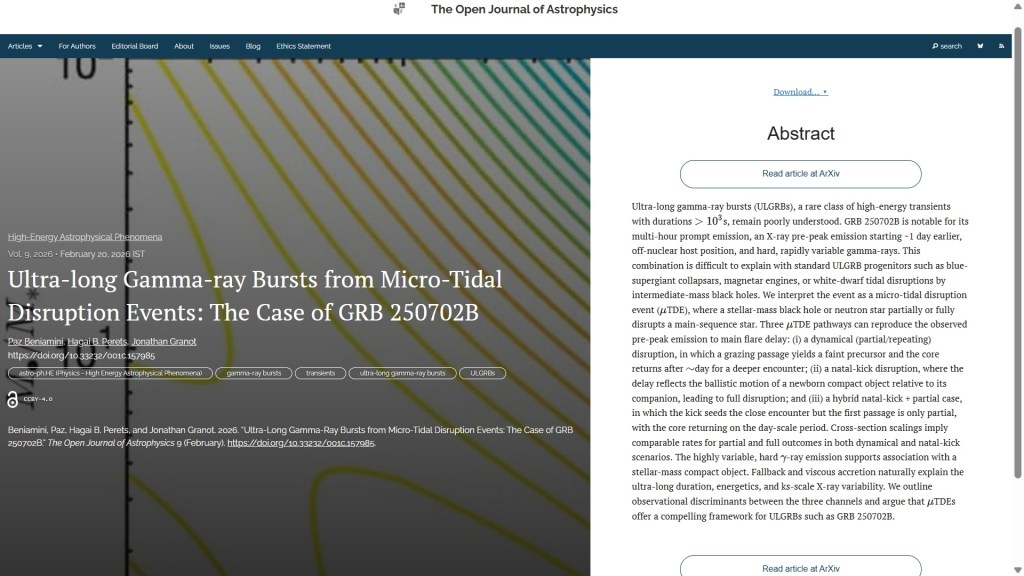
You can find the officially accepted version on arXiv here and the Mastodon announcement is here:

Open Journal of Astrophysics

New Publication at the Open Journal of Astrophysics: "Ultra-long Gamma-ray Bursts from Micro-Tidal Disruption Events: The Case of GRB 250702B" by Paz Beniamini (Open University, IL), Hagai B. Perets (Technion, IL) and Jonathan Granot (Open University, IL)

doi.org/10.33232/001c.157985

February 20, 2026, 8:43 am 0 boosts 0 favorites

And that concludes this week’s update. I will do another next Saturday, by which time I expect we will have published a similar number of papers to this week.

Supplement to the Open Journal of Astrophysics – “Pulsar Science with the SKAO”

Posted in OJAp Papers, Open Access, The Universe and Stuff with tags , , , , , , , , on December 19, 2025 by telescoper

It’s been a busy day at the Open Journal of Astrophysics as we’ve published 12 related papers in the form of our first ever Supplement; officially it is Vol. 8 Supplement Issue 1. The idea of a Supplement is to publish a set of related papers together. I imagine it might be of interest for publishing conference proceedings, etc.

The topic of this Supplement is Pulsar Science with the Square Kilometre Array Observatory and it includes updates to the Science Case for the SKAO, the previous version of which is 10 years old. All the papers are indendependently peer-reviewed, which took some organizing and a lot of time because many potential referees are themselves members of the SKA Pulsar Science Working Group! Anyway, the final versions of all the papers hit the arXiv this morning so I published them all today.

Rather than include all 12 papers in tomorrow’s Saturday update I decided just to show the overlay for the overview of the special issue, which is here:

The following paragraph describes the content of the supplement and includes links to the other 11 papers in the issue.

The large instantaneous sensitivity, a wide frequency coverage and flexible observation modes with large number of beams in the sky are the main features of the upcoming SKA observatory’s two telescopes, the SKA-Low and the SKA-Mid, which are located on two different continents. Owing to these capabilities, the SKAO telescopes are going to be a game-changer for radio astronomy in general and pulsar astronomy in particular. The eleven articles in this special issue on pulsar science with the SKA Observatory describe its impact on different areas of pulsar science. Phase 1 of the rollout of the SKAO telescope is likely to double the known pulsar population in new surveys described in the first three papers (Keane et al. 2025Abbate et al. 2025Bagchi et al. 2025). These new discoveries will improve our understanding of the dynamics, evolution and gas content of globular clusters and the black hole at the centre of the Milky Way galaxy apart from increasing the samples for each of different kinds of radio emitting neutron stars (Levin et al. 2025). The larger population sample will enhance our understanding of the magneto-ionic interstellar medium (Tiburzi et al. 2025Xu et al. 2025), the pulsar magnetosphere (Oswald et al. 2025) and pulsar wind nebulae (Gelfand et al. 2025). Moreover, the discovery of exotic neutron star systems will test gravity theory ever more stringently (Krishnan et al. 2025) and will probe fundamental physics at sub-atomic level (Basu et al. 2025). Finally, this enhanced sample is likely to make the sky portrait sharper in nano-Hertz gravitational waves impacting on our understanding of the Universe in a fundamental way (Shannon et al. 2025). In summary, the papers in this special issue describe the way the upcoming SKA Observatory’s telescopes address fundamental physics through the study of pulsars and gravitational waves.