Archive for stars

Weekly Update from the Open Journal of Astrophysics – 24/05/205

Posted in OJAp Papers, Open Access, The Universe and Stuff with tags , , , , , , , , , , , , , , , , , on May 24, 2025 by telescoper

It’s  time once again for the regular Saturday update of papers published during the past week at the Open Journal of Astrophysics. Since the last update we have published three new papers, which brings the number in Volume 8 (2025) up to 62 and the total so far published by OJAp up to 297.

In chronological order of publication, the three papers published this week, with their overlays, are as follows. You can click on the images of the overlays to make them larger should you wish to do so.

The first paper to report is: “Jet-shaped filamentary ejecta in common envelope evolution” by Ron Schreier, Shlomi Hillel and Noam Soker (Technion, Haifa, Israel). This paper, which was published on Monday May 19th 2025 in the folder High-Energy Astrophysical Processes, presents three-dimensional hydrodynamical simulations of common envelope evolution of a neutron star inside the envelope of a rotating red supergiant with Rayleigh-Taylor instabilities forming filamentary ejecta.

The overlay is here:

You can find the officially accepted version on arXiv here.

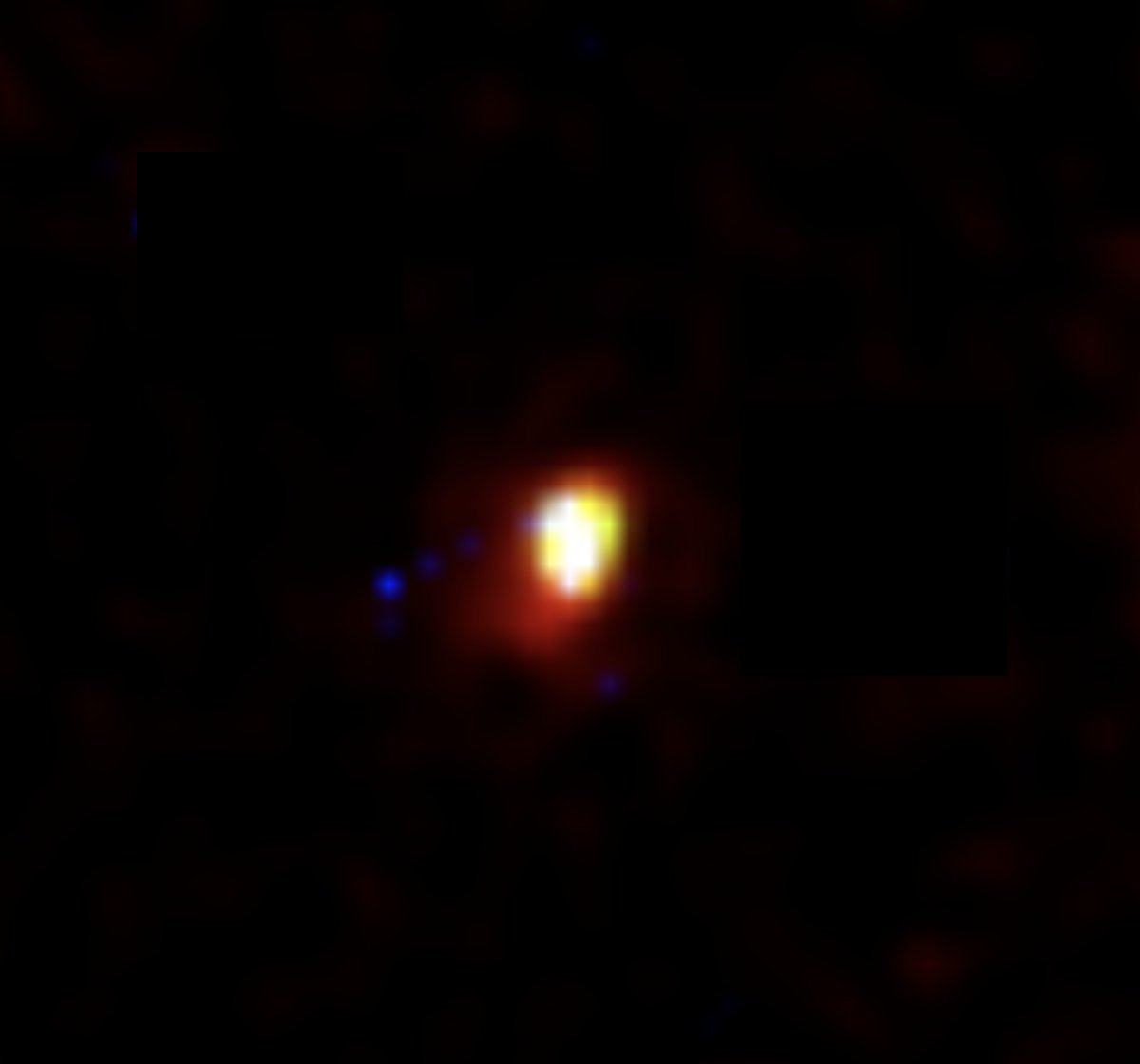
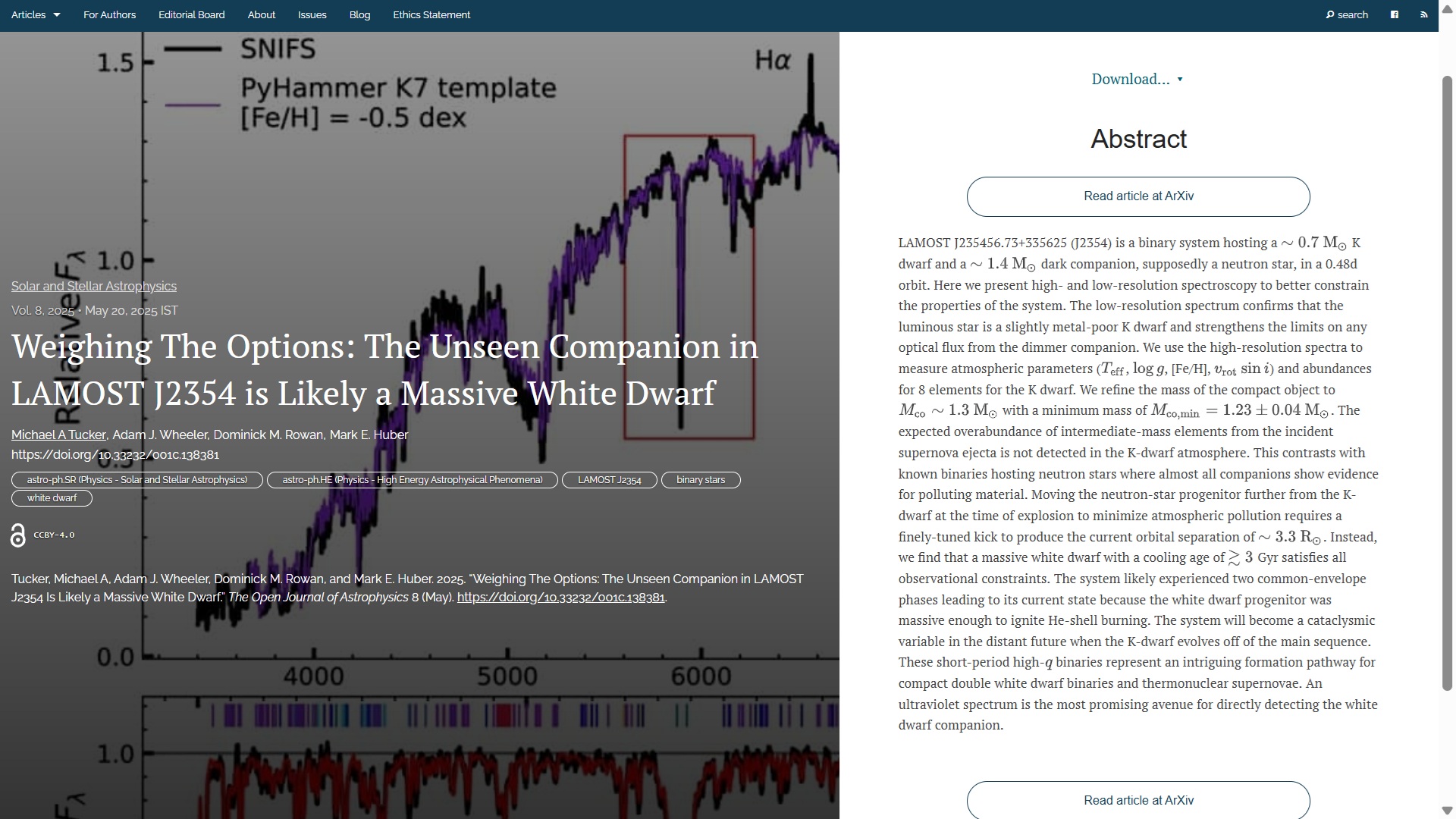
Second one up is “Weighing The Options: The Unseen Companion in LAMOST J2354 is Likely a Massive White Dwarf” by M. A. Tucker, A. J. Wheeler & D. M. Rowan (Ohio State University, USA) and M. E. Huber (U. Hawaii, USA). This paper was published on Tuesday 20th May 2025 in the folder for Solar and Stellar Astrophysics. It discusses a spectroscopic study of the binary system LAMOST J235456.73+335625 (J2354) with a discussion of the implications for the nature of the dark component.

The overlay is here:


You can find the officially-accepted version of the paper on arXiv here.

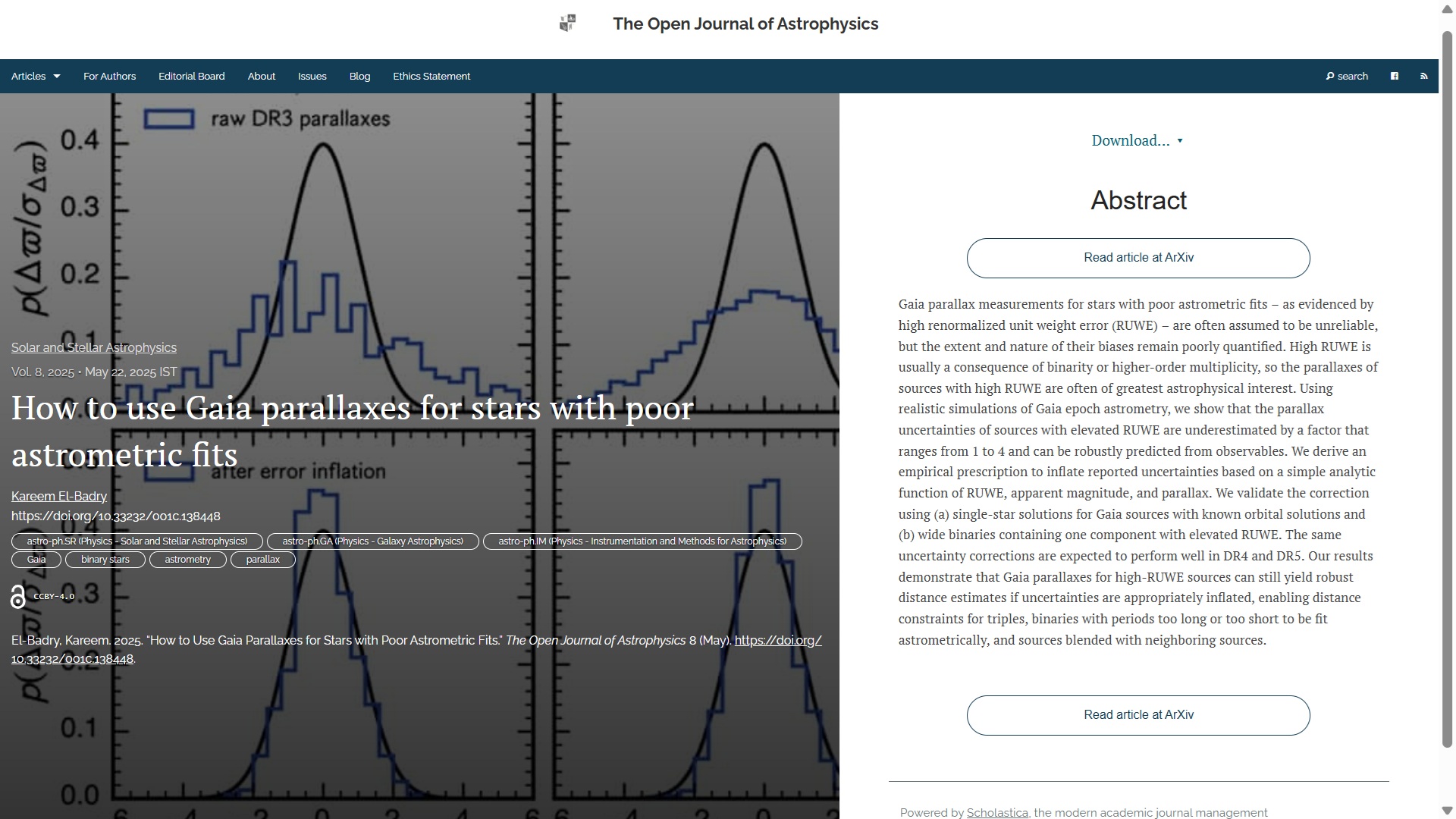
The third and last paper of the week, published on Thursday May 22nd 2025, also in the folder Solar and Stellar Astrophysics, is “How to use Gaia parallaxes for stars with poor astrometric fits” by Kareem El-Badry (Caltech, USA).  This paper presents a method for extracting reasonable estimates of stellar parallaxes from Gaia data when the overall astrometric solution is unreliable due to errors and noise

Here is the overlay:

You can find the officially accepted version of this paper on arXiv here.

That’s all the papers for this week. Looking at the publishing workflow, I expect we will pass the 300 mark next week. We’ll see when I post the next update next Saturday.


Life, the Universe and the Drake Equation

Posted in The Universe and Stuff with tags , , , , , , , on September 3, 2022 by telescoper
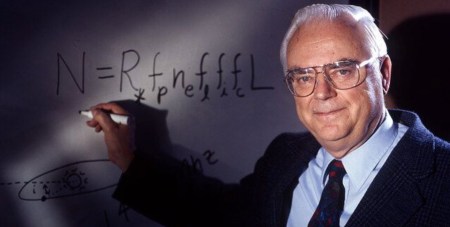
Picture of Frank Drake with his equation

Frank Drake and the Drake Equation (Picture credit: Space.com)

I heard last night of the death at the age of 92 of astronomer Frank Drake, one of the pioneers of the Search for Extraterrestrial Intelligence (SETI). He was best known to most people for formulating the Drake Equation, so since it’s a rainy Saturday morning I thought I’d commemorate him here by presenting a brief discussion of that equation and what it means.

Our Universe is contrived in such a way as to make life possible within it. After all, we’re here! But just because it is possible, that doesn’t mean that it is commonplace. Is life all around us, or did it only happen on Earth? It fascinates me that this topic comes up so often in the question sessions that follow the public lectures I give on astronomy and cosmology. Do you think there is life on other worlds? Are there alien civilisations more advanced than our own? Have extraterrestrials visited Earth? These are typical of the kind of things people ask me when I give talks on the Big Bang theory of the origin of the Universe. It often seems that people are more interested in finding out if there is life elsewhere than in making more serious efforts to sustain life in the fragile environment of our own planet. But there’s no doubting the effect that it would have on humanity to have proof that we are not alone in the cosmos. We could then accept that the Universe was not made for our own benefit. Such proof might also help release mankind from the shackles currently placed on it by certain fundamentalist religious cults. But whatever the motives for seeking out life on other worlds, this is undoubtedly a subject worthy of serious scientific study.

Our understanding of the origins of terrestrial life still has important gaps. There is still no compelling direct evidence that life has existed elsewhere in the Solar system. Conditions may, for example, have been conducive to life earlier in the history of Mars but whatever did manage to evolve there has not left any unambiguous clues that we have yet found. The burgeoning new field of astrobiology seeks to understand the possible development of life far from Earth, and perhaps in extreme conditions very different from those found on our planet. This is, however, a very new field and it will be a very long time before it becomes fully established as a rigorous scientific discipline with a solid experimental and observational foundation. What I want to do in this discussion is therefore not to answer the question “Are we alone?” but to give some idea of the methods used to determine if there might be life elsewhere, including the SETI (Search for ExtraTerrestrial Intelligence) industry which aims to detect evidence of advanced civilizations.

The first ever scientific conference on SETI was held in 1961, in Green Bank, West Virginia, the site of a famous radio telescope. A search had just been carried out there for evidence of radio signals from alien intelligences. This conference didn’t exactly change the world, which is not surprising because only about ten people showed up. It did, however, give rise to one of the most famous equations in modern science: the Drake Equation.

The astronomer Frank Drake was setting up the programme for the inaugural SETI conference and he wanted to summarize, for further discussion, the important factors affecting the chances of detecting radio transmissions from alien worlds. The resulting equation yields a rough guess of the number of civilizations existing in the Milky Way from which we might get a signal. Of course we can’t calculate the answer. The equation’s usefulness is that it breaks down the puzzle into steps, rather than providing the solution. The equation has been modified over the years so that there are various versions of it addressing different questions, but its original form in all its glory was


N=R× fp × ne × fl × fi × fc × L


The symbols in this equation have the following meanings. The left hand side N is the number of transmitting civilisations in our Galaxy, which is what we want to determine  The first term on the right hand side is R, which is the birth-rate of stars in our Galaxy per year. We know that the Milky Way is about 10 billion years old, and it contains about 100 billion stars. As a very rough stab we could guess that the required birth-rate is therefore about ten stars per year. It seems unlikely that all stars could even in principle be compatible with life existing in their neighbourhood. For example, very big stars burn out very quickly and explode, meaning that there is very little time for life to evolve there in the first place and very little chance of surviving once it has. Next in the equation is fp, the fraction of these stars having planets, followed by ne, the typical number of planets one might find.  This is followed by fl, the fraction of all planets on which life in some form does actually evolve. The next term is fi, the fraction of those planets with life on them that have intelligent life on them. Finally we have two factors pertaining to civilization: fc is the fraction of planets inhabited by intelligent beings on which civilizations arise that are capable of interstellar communication and L is the average lifetime of such civilizations.

The Drake equation probably looks a bit scary because it contains a large number of terms, but I hope you can see that it is basically a consequence of the rules for combining probabilities. The idea is that in order to have a transmitting civilisation, you must the simultaneous occurrence of various properties each of which whittles away at the original probability.

To distil things a little further we can simplify the original Drake equation so that it has only four terms

N=NH × fl × fc × fnow

The first three terms of the original equation have been absorbed into NH, the number of habitable planets and the last two have become fnow, the fraction of civilized planets that happen to be transmitting now, when we are trying to detect them. This is important because many civilizations could have been born, flourished and died out millions of years in the past so will never be able to communicate with them.

Whichever way you write it, the Drake equation depends on a number of unknown factors. Combining factors multiplicatively like this can rapidly lead to very large (or very small) numbers. In this case each factor is very uncertain, so the net result is very poorly determined.

Recent developments in astronomy mean that we at least have something to go on when it comes to NH, the number of habitable planets. Until relatively recently the only planets we knew about for sure were in our own Solar System orbiting our own star, the Sun. We didn’t know about planets around other stars because even if there were there we were not able to detect them. Many astronomers thought planets would turn out to be quite rare but absence of evidence is not evidence of absence.  Observations now seem to support the idea that planets are fairly common, and this also seems to be implied by our improved understanding of how stars form.

Planets around distant stars are difficult to detect directly because they only shine by light reflected from their parent star and are not themselves luminous. They can, however, be detected in a number of very convincing ways. Strictly speaking, planets do not orbit around stars. The star and the planet both orbit around their common centre of mass.  Planets are generally much smaller than stars so this centre of mass lies very close to the centre of the star. Nevertheless the presence of a planet can be inferred through the existence of a wobble in the stars’ path through the Galaxy. Dozens of extrasolar planets have been discovered using this basic idea. The more massive the planet, and the closer it is to the star the larger is the effect. Interestingly, many of the planets discovered so far are large and closer in than the large ones in our Solar System (Jupiter, Saturn, Uranus and Neptune). This could be just a selection effect – we can only detect planets with a big wobble so we can’t find any small planets a long way from their star – but if it isn’t simply explained away like that it could tell us a lot about the processes by which planets formed.

The birth of a star is thought to be accompanied by the formation of a flattened disk of debris in the form of tiny particles of dust, ice and other celestial rubbish. In time these bits of dirt coagulate and form larger and larger bodies, all the way up in scale to the great gas giants like Jupiter. The planets move in the same plane, as argued by Laplace way back in the 19th century, because they were born in a disk.

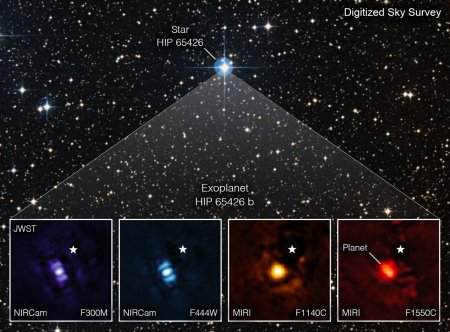
As an aside I’ll mention that when I started my PhD in 1985 there were no known extra-solar planets -exoplanets for short – so as a field exoplanet research hadn’t really started. Now it’s one of the biggest areas of astrophysics and is set to grow even more with the launch of JWST, which has just made its first direct image of an exoplanet:
 

Of course, while planets may be common we still do not know for sure whether habitable planets are also commonplace. We have no reason to think otherwise, however, so we could reasonably assume that there could be one habitable planet per system of planets. This would give a very large value for NH, perhaps 100 billion or so in our Galaxy.

The remaining terms in the Drake Equation pose a bit more of a problem. We certainly don’t have any rational or reliable way to estimate fl. We only know of one planet with life on it. Even Bayesians can’t do much in the way of meaningful statistical inference in this case because we do not have a sensible model framework within which to work. On the other hand, there is a plausibility argument that suggests fl may be larger rather than smaller. We think Earth formed as a solid object about 4.5 billion years ago. Carbon-isotope evidence suggests that life in a primitive form had evolved about 3.85 billion years ago, and the fossil record suggests it was abundant by 3.5 billion years. At least the early stages of evolution happened relatively quickly after the Earth was formed and it is a reasonable inference that life is not especially difficult to get going.

It might be possible therefore that fl=1, or close to it, which would mean that all habitable planets have life. On the other hand, suppose life has a one-in-a-million chance of arising then this reduces the number of potentially habitable planets with life actually on them to only a millionth of this value.

The factor fc represents the fraction of inhabited planets on which transmitting civilizations exist at some point. Here we really don’t have much to go on at all. But there may be some strength in the converse argument to that of the previous paragraph. The fact that life itself arose 3.85 billion years ago but humans only came on the scene within the last million years suggests that this step may be difficult, and fc should consequently take a small value.

The last term in the simplified Drake equation, fnow, is even more difficult because it involves a discussion of the survivability of civilizations. Part of the problem is that we lack examples on which to base a meaningful discussion. For present purposes, however, it is worth looking at the numbers for terrestrial life. The Milky Way is roughly 10 billion years old. We have only been capable of interstellar communication for about 80 years, initially accidentally through through stray radio broadcasts. This is only about one part in 200 million of the lifetime of our Galaxy. If we destroy ourselves in the very near future, either by accident or design, then this is our lifetime L as it appears in the original Drake equation. If this is typical of other civilizations then we would have roughly a one in 200 million chance of detecting them at any particular time. Even if our Galaxy had nurtured hundreds of millions of civilizations, there would only be a few that would be detectable by us now.

Incidentally, it is worth making the comment that Drake’s equation was definitely geared to the detection of civilizations by their radio transmissions. It is quite possible that radio-based telecommunication that results in leakage into space only dominates for a brief stage of technological evolution. Maybe some advanced form of cable transmission is set to take over. This would mean that accidental extraterrestrial communications might last only for a short time compared to the lifetime of a civilization. Many SETI advocates argue that in any case we should not rely on accidents, but embark on a programme of deliberate transmission.  Maybe advanced alien civilizations are doing this already…

In Drake’s original discussion of this question, he came to the conclusion that the first six factors on the right-hand-side of the equation, when multiplied together, give a number about one. This leads to the neat conclusion that N=L (when L is the lifetime of a technological civilization in years). I would guess that most astronomers probably doubt the answer is as large as this, but agree that the weakest link in this particular chain of argument is L. Reading the newspapers every day does not make me optimistic that L is large…

A pretty simple thing…

Posted in History, The Universe and Stuff with tags , , , on July 27, 2022 by telescoper

In a state of not inconsiderable excitement, I showed the above picture (which appears in yesterday’s post) to a friend who shrugged and said “It doesn’t look like much..”. My response was “Well, you wouldn’t look like much at z=16.7…”

That reply was of course inspired by a famous exchange between Fred Hoyle and R.O. Redman recounted here:

Fred once started a talk by saying, ‘Oh, Ooh, basically a star is a pretty simple thing.’ And from the back of the room was heard the voice of R. O. Redman, saying, ‘Well, Fred, you’d look pretty simple too, from ten parsecs!

I’ve heard this story told by many people in different versions involving different characters, including Eddington, but I think it is generally accepted to have been between Hoyle and Redman, though this may well not have been the first comment of its type. If anyone knows any more please let me know!

On the Colours of Stars

Posted in The Universe and Stuff with tags , , , on January 20, 2021 by telescoper

There’s an interesting paper on the arXiv by Harre & Heller with the title Digital Color Codes of Stars. Here’s the abstract:

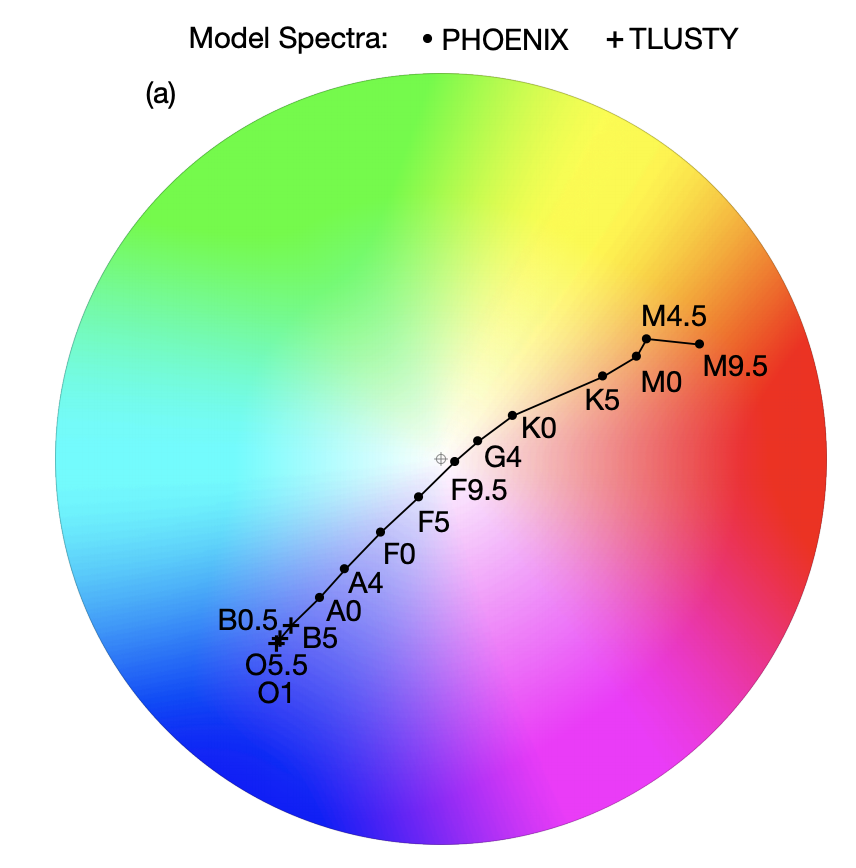
Publications in astrophysics are nowadays mainly published and read in digitized formats. Astrophysical publications in both research and in popular outreach often use colorful representations of stars to indicate various stellar types, that is, different spectral types or effective temperatures. Computer generated and computer displayed imagery has become an integral part of stellar astrophysics communication. There is, however, no astrophysically motivated standard color palette for illustrative representations of stars and some stars are actually represented in misleading colors. We use pre-computed PHOENIX and TLUSTY stellar model spectra and convolve them with the three standard color matching functions for human color perception between 360nm and 830nm. The color matching functions represent the three sets of receptors in the eye that respond to red, green, and blue light. For a grid of main sequence stars with effective temperatures between 2300K and 55,000K of different metallicities we present the red-blue-green and hexadecimal color codes that can be used for digitized color representations of stars as if seen from space. We find significant deviations between the color codes of stars computed from stellar spectra and from a black body radiator of the same effective temperature. We illustrate the main sequence in the color wheel and demonstrate that there are no yellow, green, cyan, or purple stars. Red dwarf stars (spectral types M0V – M9V) actually look orange to the human eye. Old white dwarfs such as WD1856+534, host to a newly discovered transiting giant planet candidate, occur pale orange to the human eye, not white. Our freely available software can be used to generate color codes for any input spectrum such as those from planets, galaxies, quasars etc.

This reminded me of a post I wrote in 2011 about why you never see any green stars. They say a picture paints a thousand words so here’s an illustration from the above paper:

This shows that although there are stars in the Main Sequence whose spectra peak at wavelengths corresponding to green light, none of them look green. The paper also claims that there are no yellow stars either. The Sun can look yellow when viewed from Earth but that is to do with scattering in the atmosphere: from space, the Sun looks white.

For another discussion of the use of colour representations in cosmology, see here.


Eddington in Cardiff 100 years ago today: the first proposal that stars are powered by fusion

Posted in Cardiff, History, The Universe and Stuff with tags , , on August 24, 2020 by telescoper

Here’s a fascinating bit of astrophysics history by former Cardiff colleague Bernard Schutz: one hundred years ago today, Arthur Stanley Eddington gave a talk in Cardiff in which he, with great prescience, proposed the idea that stars might be powered by nuclear fusion.

bfschutz's avatarThe Rumbling Universe

One hundred years ago today, on 24 August 1920, with over 1000 people gathered in Cardiff for the annual meeting of the British Association, Arthur Eddington gave his address as the incoming president of the physical and mathematical sciences section. He elected to speak on the subject of the “Internal Constitution of the Stars”. When I first came across the text of the address last year (published in Nature in 1920), I was amazed to find as early as this such an insightful proposal that stars are powered by the synthesis of helium from hydrogen. But what really brought me up short was this sentence:

If, indeed, the sub-atomic energy in the stars is being freely used to maintain their great furnaces, it seems to bring a little nearer to fulfilment our dream of controlling this latent power for the well-being of the human race – or for…

View original post 831 more words

Stars, by Emily Brontë

Posted in Poetry with tags , , on July 30, 2020 by telescoper

Ah! why, because the dazzling sun
Restored our Earth to joy,
Have you departed, every one,
And left a desert sky?

All through the night, your glorious eyes
Were gazing down in mine,
And, with a full heart’s thankful sighs,
I blessed that watch divine.

I was at peace, and drank your beams
As they were life to me;
And revelled in my changeful dreams,
Like petrel on the sea.

Thought followed thought, star followed star,
Through boundless regions, on;
While one sweet influence, near and far,
Thrilled through, and proved us one!

Why did the morning dawn to break
So great, so pure, a spell;
And scorch with fire the tranquil cheek,
Where your cool radiance fell?

Blood-red, he rose, and, arrow-straight,
His fierce beams struck my brow;
The soul of nature sprang, elate,
But mine sank sad and low!

My lids closed down, yet through their veil
I saw him, blazing, still,
And steep in gold the misty dale,
And flash upon the hill.

I turned me to the pillow, then,
To call back night, and see
Your worlds of solemn light, again,
Throb with my heart, and me!

It would not do—the pillow glowed,
And glowed both roof and floor;
And birds sang loudly in the wood,
And fresh winds shook the door;

The curtains waved, the wakened flies
Were murmuring round my room,
Imprisoned there, till I should rise,
And give them leave to roam.

Oh, stars, and dreams, and gentle night;
Oh, night and stars, return!
And hide me from the hostile light
That does not warm, but burn;

That drains the blood of suffering men;
Drinks tears, instead of dew;
Let me sleep through his blinding reign,
And only wake with you!

by Emily Brontë (1818-1848; she was born on 30th July)

Watch “Why the Universe is quite disappointing really – Episode 2” on YouTube

Posted in The Universe and Stuff, YouTube with tags , , on May 8, 2020 by telescoper

Episode 2, in which I explain how stars limp along unimpressively, making very poor use of the resources available to them, not doing a very good job at what they’re supposed to be doing, and then they die.

Just like people really…

Euclid Updates

Posted in Euclid, The Universe and Stuff with tags , , , , on June 17, 2019 by telescoper

Following the Euclid Consortium Meeting in Helsinki a couple of weeks ago, here are a couple of updates.

First, here is the conference photograph so you can play Spot The Telescoper:

(The picture was taken from the roof of the Finlandia Hall, by the way, which accounts for the strange viewpoint.

The other update is that the European Space Agency has released a Press Release releasing information about the location on the sky of the planned Euclid Deep Fields. Here they are (marked in yellow):

These deep fields amount to only about 40 square degrees, a small fraction of the total sky coverage of Euclid (~15,000 square degrees), but the Euclid telescope will point at them multiple times in order to detect very faint distant galaxies at enormous look-back times to study galaxy evolution. It is expected that these fields will produce several hundred thousand galaxy images per square degree…

Selecting these fields was a difficult task because one has to avoid bright sources in both optical and infrared (such as stars and zodiacal emission) so as not to mess with Euclid’s very sensitive camera. Roberto Scaramella gave a talk at the Helsinki Meeting showing how hard it is to find fields that satisfy all the constraints. The problem is that there are just too many stars and other bits of rubbish in the sky getting in the way of the interesting stuff!


For much more detail see here.


Why the Universe is extremely overrated.

Posted in Television, The Universe and Stuff with tags , , , , , , on June 19, 2018 by telescoper

A few weeks I read an article in Physics Today which prompted me to revise and resubmit an old post I cobbled together in response to the BBC television series Wonders of the Universe in which I argued that the title of that programme suggests that the Universe is wonder-ful, or even, in a word which has cropped up in the series a few times, `awesome’.  When you think about it the Universe is not really `awesome at all’. In fact it’s extremely overrated.

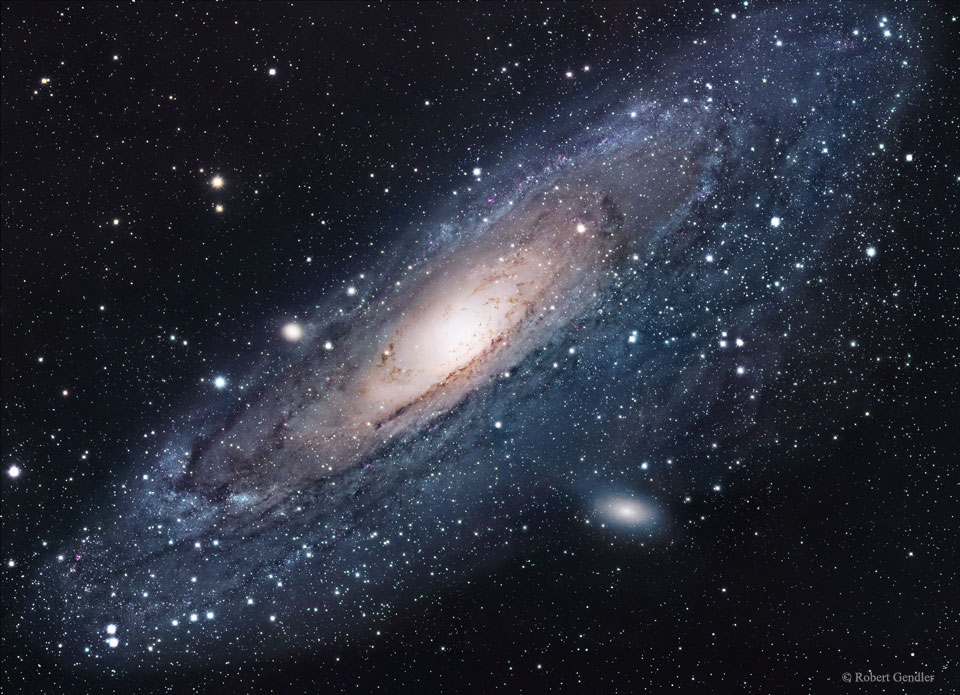
Take this thing, for example:


This is an example of a galaxy (the Andromeda Nebula, M31, to be precise). We live in a similar object. Of course it looks quite pretty on the surface but, when you look at it with a physicist’s eye, such a galaxy is really not as great as it’s cracked up to be, as I shall now explain.

We live in a relatively crowded part of our galaxy on a small planet orbiting a fairly insignificant star called the Sun. Now you’ve got me started on the Sun. I know it supplies the Earth with all its energy, but it does the job pretty badly, all things considered because the Sun only radiates a fraction of a milliwatt per kilogram. By comparison a human being radiates more than one watt per kilogram. Pound for pound, that’s more than a thousand times as much energy as a star.

So,  in reality, stars are bloated, wasteful, inefficient and not even slightly awesome. They’re only noticeable because they’re big. And we all know that size shouldn’t really matter. In short, stars are extremely overrated.

But even in what purports to be an interesting neighbourhood of our Galaxy, the nearest star is 4.5 light years from the Sun. To get that in perspective, imagine the Sun is the size of a golfball. On the same scale, where is the nearest star?

The answer to that will probably surprise you, as it does my students when I give this example in lectures. The answer is, in fact, on the order of a thousand kilometres away. That’s the distance from Cardiff to, say, Munich. What a dull landscape our Galaxy possesses. In between one little golf ball in Wales and another one in Germany there’s nothing of any interest at all, just a featureless incomprehensible void not worthy of the most perfunctory second thought.

So galaxies aren’t dazzlingly beautiful jewels of the heavens. They’re flimsy, insubstantial things more like the cheap tat you can find on QVC. What’s worse is that they’re also full of a grubby mixture of soot and dust. Indeed, some are so filthy that you can hardly see any stars at all. Somebody needs to give the Universe a good clean. I suppose you just can’t get the help these days.

And then to the Physics Today piece I mentioned at the start of this article. I quote:

Star formation is stupendously inefficient. Take the Milky Way. Our galaxy contains about a billion solar masses of fresh gas available to form stars—and yet it produces only one solar mass of new stars a year.

Hopeless! What a waste of space a galaxy is! As well as being oversized, vacuous and rather dirty, one is also pretty useless at making the very things it is supposed to be good at! What galaxies clearly need is some sort of a productivity drive or perhaps a complete redesign using more efficient technology.

So stars are overrated and galaxies are overrated, but surely the Universe as a whole is impressive?

No. Think about the Big Bang. Well, I don’t need to go on about that because I’ve already posted about it. Suffice to say that the Big Bang wasn’t anywhere near as Big as you’ve been led to believe: the volume was between about 115 and 120 decibels. Quite loud, to be sure, but many rock concerts are louder. To be honest it’s a bit of an anti-climax. If I’d been in charge (and given sufficient funding) I would have put on something much more spectacular.

In any case the Big Bang happened a very long time ago. Since then the Universe has been expanding, the space between galaxies getting emptier and emptier so there’s now less than one atom per cubic metre, and cooling down to the point where its temperature is lower than three degrees above absolute zero.

The Universe is a cold, desolate and very empty place, lit by a few feeble stars and warmed only by the fading glow of the heat left over from when it was all so much younger and more exciting. Here and there amid the cosmic void a few galaxies are dotted about, like cheap and rather tatty ornaments. It’s as if we inhabit a shabby downmarket retirement home, warmed only by the feeble radiation given off by a puny electric fire as we occupy ourselves as best we can until Armageddon comes.

In my opinion the Universe would have worked out better had it been entirely empty, instead of being contaminated with such detritus. I agree with Tennessee Williams:

BRICK: “Well, they say nature hates a vacuum, Big Daddy.
BIG DADDY: “That’s what they say, but sometimes I think that a vacuum is a hell of a lot better than some of the stuff that nature replaces it with.”

So no, the Universe isn’t wonderful. Not at all. In fact, it’s basically a bit rubbish. Again, it’s only superficially impressive because it’s quite large, and it doesn’t do to be impressed by things just because they are large. That would be vulgar.

Digression: I just remembered a story about a loudmouthed Texan who owned a big ranch and who was visiting the English countryside on holiday. Chatting to locals in the village pub he boasted that it took him several days to drive around his ranch. A farmer replied “Yes. I used to have a car like that.”

Ultimately, however, the fact is that whatever we think about the Universe and how badly constructed it it, we’re stuck with it. Just like the trains, the government and the weather. There’s nothing we can do about it, so we might as grin and bear it.

It’s being so cheerful that helps keep me going.


A Problem of Gravity

Posted in Cute Problems with tags , , on May 9, 2017 by telescoper

Here’s a nice one for the cute problems folder.

Two spherically symmetric stars A and B of equal mass M and radius r have centres separated by a distance 6r. Ignoring any effects due to the orbital motion of the stars, determine a formula (in terms of G, M and r) for the minimum velocity with which material can be ejected from the surface of A so as to be captured by B.

Answers through the comments box please. First correct answer receives 7 points.