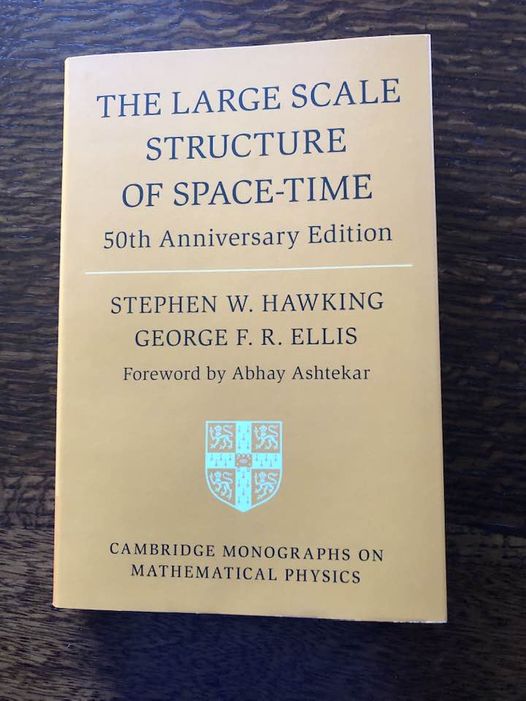
Today, 16th February 2023, sees the official publication of a special 50th anniversary edition classic monograph on the large scale structure of space-time by Stephen Hawking and George Ellis. My copy of a standard issue of the book is on the left; the special new edition is on the right. The book has been reprinted many times, which testifies to its status as an authoritative treatise. I don’t have the new edition, actually. I just stole the picture from the Facebook page of George Ellis, with whom I have collaborated on a book (though not one as significant as the one shown above).
This book is by no means an introductory text but is full of interesting insights for people who have studied general relativity before. Stephen Hawking left us some years ago, of course, but George is still going strong so let me take this opportunity to congratulate him on the publication of this special anniversary edition!
P.S It struck me while writing this post that I’ve been working as a cosmologist in various universities for getting on for about 35 years and I’ve never taught a course on general relativity. As I’ll be retiring pretty soon it’s looking very likely that I never will…
Following last week’s Maynooth Astrophysics and Cosmology Masterclass, a student asked (in the context of the Big Bang or a black hole) what a singularity is. I thought I’d share my response here in case anyone else was wondering. The following is what I wrote back to my correspondent:
–oo–
In general, a singularity is pathological mathematical situation wherein the value of a particular variable becomes infinite. To give a very simple example, consider the calculation of the Newtonian force due to gravity exerted by a massive body on a test particle at a distance r. This force is proportional to 1/r2,, so that if one tried to calculate the force for objects at zero separation (r=0), the result would be infinite.
Singularities are not always signs of serious mathematical problems. Sometimes they are simply caused by an inappropriate choice of coordinates. For example, something strange and akin to a singularity happens in the standard maps one finds in an atlas. These maps look quite sensible until one looks very near the poles. In a standard equatorial projection, the North Pole does not appear as a point, as it should, but is spread along straight line along the top of the map. But if you were to travel to the North Pole you would not see anything strange or catastrophic there. The singularity that causes this point to appear is an example of a coordinate singularity, and it can be transformed away by using a different projection.
More serious singularities occur with depressing regularity in solutions of the equations of general relativity. Some of these are coordinate singularities like the one discussed above and are not particularly serious. However, Einstein’s theory is special in that it predicts the existence of real singularities where real physical quantities (such as the matter density) become infinite. The curvature of space-time can also become infinite in certain situations.
Probably the most famous example of a singularity lies at the core of a black hole. This appears in the original Schwarzschild interior solution corresponding to an object with perfect spherical symmetry. For many years, physicists thought that the existence of a singularity of this kind was merely due to the special and rather artificial nature of the exactly spherical solution. However, a series of mathematical investigations, culminating in the singularity theorems of Penrose, showed no special symmetry is required and that singularities arise in the generic gravitational collapse problem.
As if to apologize for predicting these singularities in the first place, general relativity does its best to hide them from us. A Schwarzschild black hole is surrounded by an event horizon that effectively protects outside observers from the singularity itself. It seems likely that all singularities in general relativity are protected in this way, and so-called naked singularities are not thought to be physically realistic.
There is also a singularity at the very beginning in the standard Big Bang theory. This again is expected to be a real singularity where the temperature and density become infinite. In this respect the Big Bang can be thought of as a kind of time-reverse of the gravitational collapse that forms a black hole. As was the case with the Schwarzschild solution, many physicists thought that the initial cosmologcal singularity could be a consequence of the special symmetry required by the Cosmological Principle. But this is now known not to be the case. Hawking and Penrose generalized Penrose’s original black hole theorems to show that a singularity invariably exists in the past of an expanding Universe in which certain very general conditions apply.
So is it possible to avoid this singularity? And if so, how?
It is clear that the initial cosmological singularity might well just be a consequence of extrapolating deductions based on the classical ttheory of general relativity into a situation where this theory is no longer valid. Indeed, Einstein himself wrote:
The theory is based on a separation of the concepts of the gravitational field and matter. While this may be a valid approximation for weak fields, it may presumably be quite inadequate for very high densities of matter. One may not therefore assume the validity of the equations for very high densities and it is just possible that in a unified theory there would be no such singularity.
Einstein, A., 1950. The Meaning of Relativity, 3rd Edition, Princeton University Press.
We need new laws of physics to describe the behaviour of matter in the vicinity of the Big Bang, when the density and temperature are much higher than can be achieved in laboratory experiments. In particular, any theory of matter under such extreme conditions must take account of quantum effects on a cosmological scale. The name given to the theory of gravity that replaces general relativity at ultra-high energies by taking these effects into account is quantum gravity, but no such theory has yet been constructed.
There are, however, ways of avoiding the initial singularity in classical general relativity without appealing to quantum effects. First, one can propose an equation of state for matter in the very early Universe that does not obey the conditions laid down by Hawking and Penrose. The most important of these conditions is called the strong energy condition: that r+3p/c2>0 where r is the matter density and p is the pressure. There are various ways in which this condition might indeed be violated. In particular, it is violated by a scalar field when its evolution is dominated by its vacuum energy, which is the condition necessary for driving inflationary Universe models into an accelerated expansion. The vacuum energy of the scalar field may be regarded as an effective cosmological constant; models in which the cosmological constant is included generally have a bounce rather than a singularity: running the clock back, the Universe reaches a minimum size and then expands again.
Whether the singularity is avoidable or not remains an open question, and the issue of whether we can describe the very earliest phases of the Big Bang, before the Planck time, will remain open at least until a complete theory of quantum gravity is constructed.
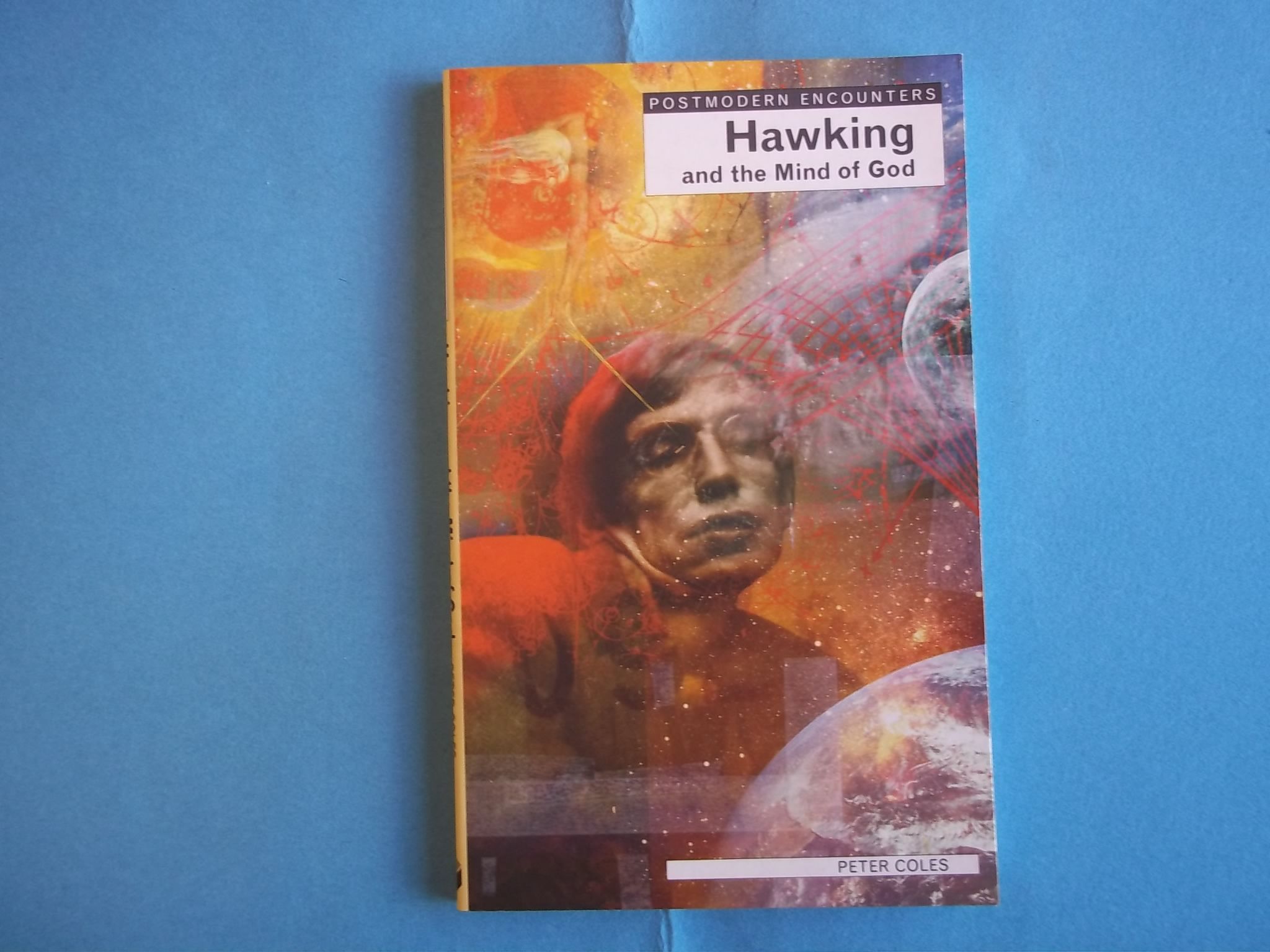
There’s a new book out about Stephen Hawking which has triggered a certain amount of reaction (see, e.g., here) so I thought I’d mention a book I wrote, largely in response to the pseudo-religious nature of some of Hawking’s later writings.
I have in the past gone on record, both on television and in print, as being not entirely positive about the “cult” that surrounds Stephen Hawking. I think a number of my colleagues have found some of my comments disrespectful and/or churlish. I do nevertheless stand by everything I’ve said. I have enormous respect for Hawking the physicist, as well as deep admiration for his tenacity and fortitude, and have never said otherwise. I don’t, however, agree that Hawking is in the same category of revolutionary thinkers as Newton or Einstein, which is how he is often portrayed.
The idea of a league table like this is of course a bit silly, but it does at least give some insight into the way physicists regard prominent figures in their subject. Hawking came way down the list, in fact, in 300th (equal) place. I don’t think it is disrespectful to Hawking to point this out. I’m not saying he isn’t a brilliant physicist. I’m just saying that there are a great many other brilliant physicists that no one outside physics has ever heard of.
It is interesting to speculate what would have happened if the list had been restricted to living physicists. I’d guess Hawking would be in the top ten, but I’m not at all sure where…
And before I get accused of jealousy about Stephen Hawking’s fame, let me make it absolutely clear that if Hawking was like a top Premiership footballer (which I think is an appropriate analogy), then I am definitely like someone kicking a ball around for a pub team on a Sunday morning (with a hangover). This gulf does not make me envious; it just makes me admire his ability all the more, just as trying to play football makes one realise exactly how good the top players really are.
I am not myself religious but I do think that there are many things that science does not – and probably will never – explain, such as why there is something rather than nothing. I also believe that science and religious belief are not in principle incompatible – although whether there is a conflict in practice does depend of course on the form of religious belief and how it is observed. God and physics are in my view pretty much orthogonal. To put it another way, if I were religious, there’s nothing in theoretical physics that would change make me want to change my mind. However, I’ll leave it to those many physicists who are learned in matters of theology to take up the (metaphorical) cudgels with Professor Hawking.
Stephen Hawking has achieved a unique position in contemporary culture, combining eminence in the rarefied world of theoretical physics with the popular fame usually reserved for film stars and rock musicians. Yet Hawking’s technical work is so challenging, both in its conceptual scope and in its mathematical detail, that proper understanding of its significance lies beyond the grasp of all but a few specialists. How, then, did Hawking-the-scientist become Hawking-the-icon? Hawking’s theories often take him into the intellectual territory that has traditionally been the province of religion rather than science. He acknowledges this explicitly in the closing sentence of his bestseller, A Brief History of Time , where he says that his ultimate aim is to know the Mind of God . Hawking and the Mind of God examines the pseudo-religious connotations of some of the key themes in Hawking’s work, and how these shed light not only on the Hawking cult itself, but also on the wider issue of how scientists represent themselves in the media.
I’m sure you’ll understand that there isn’t a hint of opportunism in the way I’m drawing this to your attention because my book is long out of print so you can’t buy it unless you get a copy second-hand…
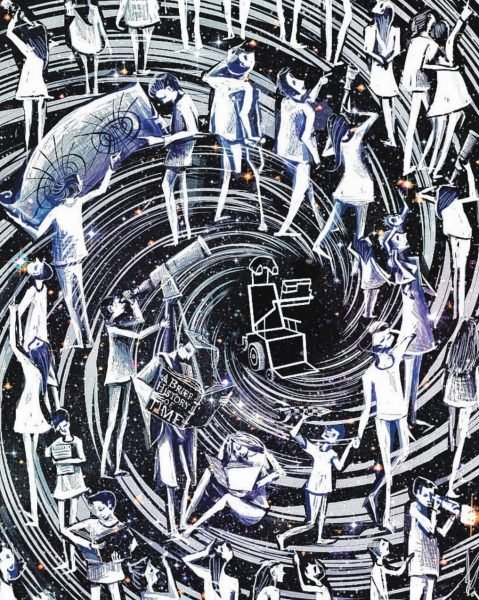
I just saw this lovely illustration (by Ella Baron) and thought I would share it here.
It appears in the March 23 of the Times Literary Supplement which arrived in Maynooth while I was away and I’ve just found time to read it. I subscribe to the TLS primarily because I like the crossword..
The ‘cartoon’ is accompanied by an excerpt from A Brief History of Time:
If a pulse of light is emitted… then as time goes on it will spread out… like ripples on the surface of a pond when a stone is thrown in…
I woke today to the sad news of the death, at the age of 76, of theoretical physicist and cosmologist Stephen Hawking. We all knew he had to pass away one day, but having been diagnosed with Motor Neurone Disease and given just a couple of years to live at the age of 22, I think we had all come to regard him as indestructible, so news of his death still came as a shock.
Stephen’s immense contributions to physics, including but not restricted to cosmology, are remarkable in their own right, but made even more remarkable that has done so much after having been stricken by such a debilitating disease when he was only in his twenties. Hawking was undoubtedly a brilliant and inspirational mind, but his courage and physical endurance in the face of difficulties that others might have found unbearable have provided inspiration for many far beyond the field of physics.
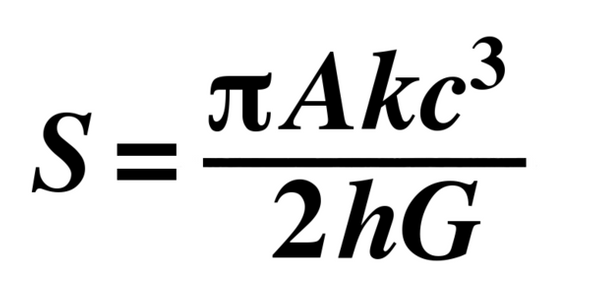
To give an example of his scientific work, here is an equation which I think would serve as a memorial to Stephen Hawking as it brings together quantum mechanics, gravity and thermodynamics in giving the entropy of a black hole in terms of its surface area and fundamental constants:
I’ve talked and written quite a lot about Stephen Hawking over the years. In particular I have in the past gone on record, both on television and in print, as being not entirely positive about the `cult’ that surrounds him. I think a number of my colleagues (and some some people at the University of Cambridge) have found things I have said insufficiently reverential or perhaps even disrespectful. This is not the time to go over these things. For the record I’ll just say (yet again) that, while I stand by everything I have said, I do – and always will have – enormous respect for Hawking the physicist, as well as deep admiration for his tenacity and courage.
I may post a longer reflection on Stephen Hawking’s life and work in due course, but for now let me just offer my condolences to his family, friends, and colleagues. He was one of the most celebrated public intellectuals of his day as well as a courageous and determined human being. He is irreplaceable.
This week sees the 2017 National Astronomy Meeting which is taking place in Hull (which, for those of you unfamiliar with British geography, is in the Midlands). I usually try to attend this annual event but this year haven’t been able to make it owing to other commitments. I’m particularly sad about this because I’ll miss seeing two old friends (Nick Kaiser and Marek Kukula) being presented with their RAS medals. Moreover, one of the pieces of astronomical research announced at this meeting that has been making headlines features my office mate and fellow resident of Pontcanna, Dr Emily Drabek-Maunder.
Anyway, to keep up with what’s going on at NAM2017 you can follow announcements on twitter:
This week also sees a meeting in Cambridge on Gravity and Black Holes to celebrate the 75th birthday of Stephen Hawking, which goes on until tomorrow (Wednesday 5th). This conference also looks like a very good one, covering a much wider range of topics than its title perhaps suggests. Stephen’s birthday was actually in January, but I hope it’s not too late to wish him many happy returns!
Finally, though not a conference as such, there’s annual Royal Society Summer Science exhibition going on in London this week too. This is a showcase for a wealth of scientific research including, this year, an exhibit about gravitational waves called Listening to Einstein’s Universe. There’s even a promotional video featuring some of my colleagues at Cardiff University (along with many others):
Anyway, if you’re in London and at a loose end and interested in science and that, do pop into the Royal Society and have a look. The Summer Science Exhibition is always well worth a visit!
Yesterday I took off early from work to head up to the Royal Institution in London to attend a recording of the Reith Lectures, this year given by Stephen Hawking.
Here’s a rather crappy phone pic to show I was there.
In fact they recorded two of this year’s lectures, as well as a lengthy question-and-answer session. The talks and answers to audience questions did of course have to be pre-loaded into Stephen’s computer before delivery which necessitated some pauses for uploads. This together with the recording of various intros, outros and idents made for quite a lengthy event but I found the whole process fascinating and didn’t mind that at all. I did have three glasses of wine at the drinks reception before the show, however, so was in quite a relaxed frame of mind generally.
In charge of the whole thing was the inestimable Sue Lawley who did her job brilliantly. On a few occasions, Stephen Hawking’s computer had a glitch and made a spontaneous interjection in an inappropriate place. Sue Lawley proved completely unflappable.
The topic for the series is, not surprisingly because it is what Hawking is most closely associated with, Black Holes. The lectures were enjoyably sprinkled with some very witty asides, but I did get surprisingly technical at a few points; the audience members beside me were visibly baffled on more than one occasion. See what you think yourself when the lectures are broadcast, the first on 26th January and the second a week later, both at 9pm on BBC Radio 4. They will also be broadcast on the BBC World Service.
The Reith Lectures are open to the public. Apparently over 20,000 applied for tickets to attend last night, such is the draw of Stephen Hawking. The capacity of the Royal Institution lecture theatre is only about 400 so many were disappointed. Fortunately for me, owing no doubt to some form of administrative error, I was an invited guest. I was however somewhat relieved to find I was only on the B-list so although I got to use the VIP entrance I didn’t have to sit among the big nobs at the front in reserved seats.
Last week there was a rather tedious flurry of media activity about Stephen Hawking’s alleged claim that there are no black holes after all. Here’s a nice blog post explaining what Hawking actually said. Also, check out the link at the start of this article to a very nice layperson’s guide to the Black Hole Information Paradox.
Media absurdity has reached new levels of darkness with the announcement that Stephen Hawking has a new theory in which black holes do not exist after all.
First, Hawking does not have a new theory… at least not one he’s presented. You can look at his paper here — two pages (pdf), a short commentary that he gave to experts in August 2013 and wrote up as a little document — and you can see it has no equations at all. That means it doesn’t qualify as a theory. “Theory”, in physics, means: a set of equations that can be used to make predictions for physical processes in a real or imaginary world. When we talk about Einstein’s theory of relativity, we’re talking about equations. Compare just the look and…
An exciting new paper by a leading theoretical physicist prominent educationalist has just appeared on the arXiv. In it the author addresses the important question of whether information is destroyed in black holes students actually learn anything during lectures.
Until recently it was generally believed that any information falling into a black hole entering the mind of a student was lost forever even though black holes do evaporate students do take examinations after a finite time. This belief is motivated by the properties of Hawking radiation produced by black holes observations of examination scripts written by students, which some claim to be entirely random, i.e. devoid of any information content whatsoever.
This picture has however been challenged by a number of educationalists theorists with a variety of counter-arguments. For example, some have argued for a statistical interpretation in terms of the multiverse a very large class; although information may be destroyed in individual black holes students, in a infinite multiverse large enough class, there may be a finite number of examples in which some information is retained.
The latest article (referred to above) offers a different resolution of the Black Hole Information Student Education Paradox which rests on the idea that information radiated by black holes examination scripts written by students are not in fact entirely random, just produced so chaotically that, although information is present, for any practical purposes such information is so garbled that it is impossible to decipher.
This intriguing suggestion has led to a number of interesting, if somewhat speculative, extensions. Some have even argued that there may after all be some information present in the speeches of Education Minister Michael Gove, though this idea obviously remains highly controversial.
It’s a lovely day so I thought I’d turn away to the doom and gloom of the ongoing bin strike towards a much cheerier subject: death. In the film about Stephen Hawking I saw last week there was a moving segment in which Hawking sought solace in music after being diagnosed with Motor Neurone Disease and given just a few years to live. The specific piece of music he discussed was the Annunciation of Death by Richard Wagner. Not being a Wagner expert I wasn’t familiar with this piece so did a bit of research over the weekend to find out more about it. That turned out to be quite interesting.
The Annunciation of Death turns out to be a leitmotif appearing in Wagner’s Der Ring des Nibelungen, often known as the Ring Cycle. Leitmotifs of various types occur throughout this epic series of four operas. Some are associated with individual characters, sometimes present on stage and sometimes absent but relevant to the drama. Other leitmotifs relate to specific emotional states, locations or even inanimate objects (e.g. a sword).
The Annunciation of Death (in German: Todesverkundigen) makes its first appearance at the beginning of Act II Scene 4 of Die Walküre, the second Opera of the Ring Cycle, when Brünnhilde approaches to tell Siegmund of his impending death. You can see why Hawking thought of this when given his prognosis. This is the leitmotif
What’s interesting about this is that it is formed by the merger of two other leitmotifs, one relating to Erda, the Goddess of earth and the mother of the three Norns, who has the ability to see the future:
and another more generally associated with fate
Doom takes on a very specific manifestation for poor old Siegmund. Here is the leitmotif as it appears in the actual Opera, as part of the instrumental prelude to the glorious voice of the legendary Kirsten Flagstad as Brünnhilde singing Siegmund! Sieh’ auf mich!
I never expected to learn something new about Wagner by watching a film about Stephen Hawking, but there you go!
The views presented here are personal and not necessarily those of my employer (or anyone else for that matter).
Feel free to comment on any of the posts on this blog but comments may be moderated; anonymous comments and any considered by me to be vexatious and/or abusive and/or defamatory will not be accepted. I do not necessarily endorse, support, sanction, encourage, verify or agree with the opinions or statements of any information or other content in the comments on this site and do not in any way guarantee their accuracy or reliability.