Archive for STFC

Enquiring into UK Astronomy

Posted in Science Politics, The Universe and Stuff with tags , , , on September 14, 2023 by telescoper

Apparently I still have a few readers in the UK, so I thought I’d share a bit of news aimed at them.

It seems the Science, Innovation and Technology Committee of the House of Commons has initiated an inquiry into ” how well placed the UK astronomy sector is to showcase the UK as a science superpower and maximise its leadership in international programmes”. Apparently this will examine the status of the UK’s astronomical research base and assets, UK access to international astronomical facilities and contribution to international programmes. It will also explore astronomy’s potential contribution to the UK economy and what considerations should inform the Science and Technology Facilities Council’s next Strategic Delivery Plan, due in 2026. 

I don’t know why STFC doesn’t just use ChatGPT to write its strategic plan like everyone else, but there you go.

Anyway, the Committee welcomes submissions addressing any or all of the following:

  • The strengths and weaknesses of UK astronomy and how these compare to other nations
  • The opportunities and challenges facing UK astronomy and whether it is receiving sufficient support
  • What the aims and focus of UK astronomy should be
  • The extent to which UK astronomy contributes to the UK’s status as a science superpower
  • Whether the UK is maximising the contribution that astronomy can make to the wider UK economy
  • What role astronomy is playing in encouraging greater diversity and inclusion in STEM and public interest in science

To find out more information and/or submit a submission go here. The deadline is 27th October.

Have fun!

The Cyclic Universe of the UK Astronomy Grant System

Posted in Biographical, Science Politics, The Universe and Stuff with tags , , , on April 17, 2023 by telescoper

I stumbled by accident yesterday on a bit of news relating to UK Astronomy Grant funding via the Science and Technology Facilities Council (STFC). I am of course completely out of that system, and have been for years, but I am nevertheless quite nosy so was interested to find out about the changes. Thanks to Alan Heavens and Paul Crowther for enlightening me.

Way back in 2010 I wrote in somewhat critical terms about the new-style Consolidated Grants that STFC was planning to introduce. This system replaced a dual approach of so-called “Standard Grants” – which were typically rather small, usually funding one postdoctoral researcher and bits and bobs – and “Rolling Grants” – which were usually larger, covering all the activities of a department or institution – with a single system of “Consolidated Grants”. The Standard Grants were “responsive”, in that investigators could put in an application whenever they wanted, whereas Rolling Grants were on a fixed timetable. After the change, the responsive mode went out the window and Departments were forced to apply collectively, once every three years.

Much of the reason for the change was the administrative cost of the system. There were huge numbers of standard grant applications. Back in the mists of time there were two application deadlines per year so it was a heavy burden on the panels and the Swindon office, especially since so little funding was available in the first place. Standard grants were also the first to get squeezed when there was a funding shortfall, whereas Rolling grants generally carried on rolling.

Well, the news is that the current Astronomy grant round, with applications in 2022 and grants starting in 2023, will see the last of these Consolidated Grants. From this year on, there will be a new system of – wait for it – “Small” and “Large” grants, thought these are officially called Type 1 and Type 2. The Small Awards scheme is described here and it looks very much like the old Standard Grant system. Details of the Large grants scheme are not yet available, but I believe they will start next year. You can find more details here (PDF).

So now it seems something very like the old system is returning, and there are no doubt the same worries that Large grants will eat up most of the money, leaving very little for the Small grants. Déjà vu.

Anyway, the way I came across this piece of news was via the announcement of a clutch of PDRA positions in cosmology and extragalactic astrophysics at the University of Sussex (where I worked from 2013-16). It seems the Astronomy Centre must have done pretty well in the (final) STFC Consolidated Grant round, which is very good to hear! It seems there might be a bit more money generally in the grant line this year too, which is also good news.

DIRAC Research Image Competition – The Winning Entries!

Posted in Art, The Universe and Stuff with tags , , , , , on November 9, 2022 by telescoper

DIRAC is a high-performance computing facility designed to serve the research community supported in the UK by the Science and Technology Facilities Council (STFC). Recently DIRAC ran a competition to select the best images produced using results obtained by this facility, and I was honoured to be asked to be one of the judges. Entries were divided into two Themes: Theme 1 (Particle and Nuclear Physics) and Theme 2 (Astronomy, Cosmology and Solar & Planetary Science) and scores were allocated by the judges based on visual impact and scientific interest. There were 41 entries altogether, all of a very high standard.

So, without further ado, I shall now show you the winning entries!

The winning image in Theme 1 was submitted by Ed Bennett and Biagio Lucini of Swansea University and called Let it (Wilson) flow. The description supplied by the creators reads:

A space-time slice of the topological charge density distribution of a 128 times 643 lattice field configuration (with periodic boundaries) from an ensemble of the SU(2) gauge theory with two flavours of Dirac fermion in the adjoint representation (also known as Minimal Walking Technicolor). Moving along the time direction from left to right, successive time-slices are also iterated using the gradient flow of the Wilson action, which removes the ultraviolet noise that would otherwise prevent computation of the configuration’s topological charge. This noise is clearly visible on the left, with the actual instantons (orange) and anti-instantons (blue) becoming visible at longer flow times to the right.

Here is the winning image for Theme 1:

Theme 1 winner: Let it (Wilson) flow by Ed Bennett and Biagio Lucini.

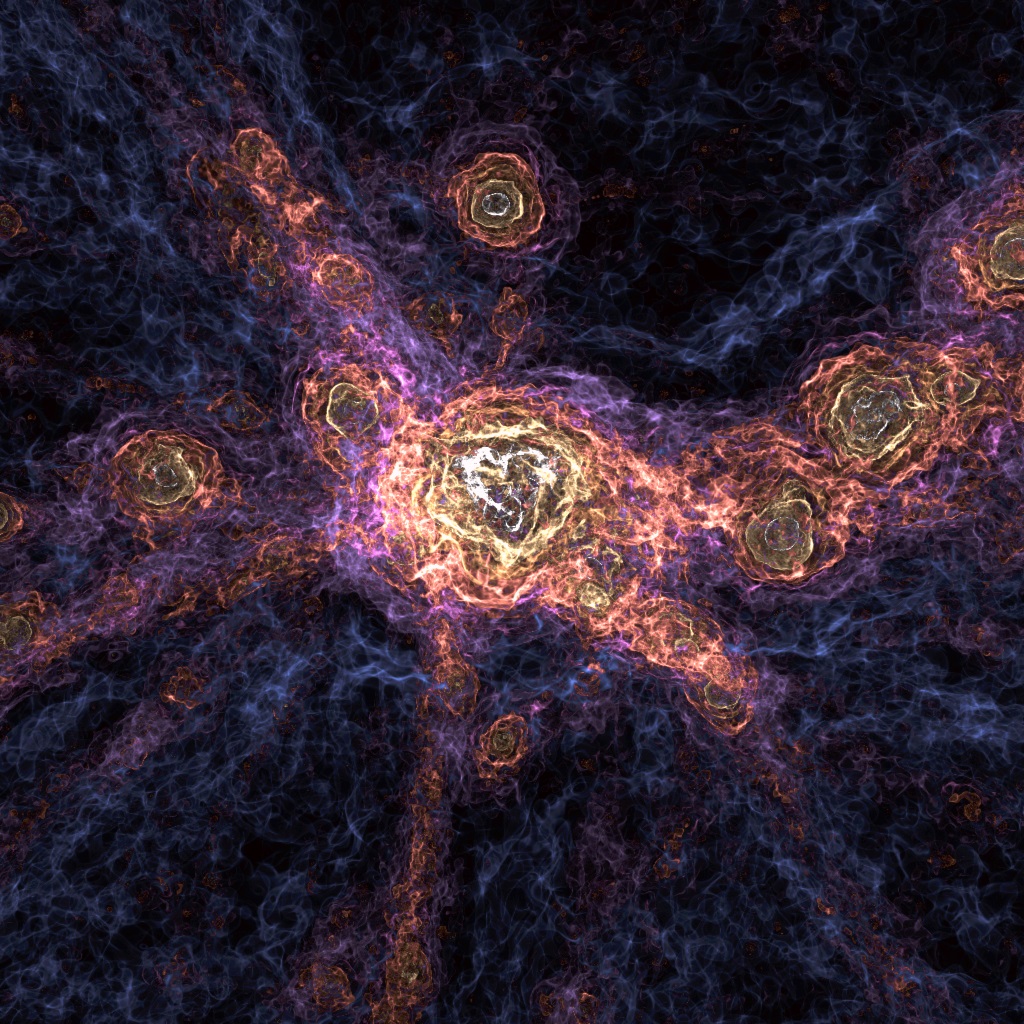
The winning entry of Theme 2 is entitled Immediate origin of the Moon as a post-impact satellite and was submitted by Jacob Kegerreis of Durham University who supplied the following description:

The Moon is thought to have formed following a giant impact, but the details are still hotly debated. New high-resolution simulations, like the one shown here, reveal that a Moon-like satellite can be immediately placed into a wide orbit around the Earth, in contrast with the traditional idea of later accretion from a debris disk. This opens up new possibilities for the Moon’s initial orbit and interior, which could help to solve mysteries like its tilted orbit, thin crust, and Earth-like isotopes. The 3D smoothed particle hydrodynamics (SPH) simulations were run using the SWIFT code on the DiRAC COSMA8 system with over 100 times higher resolution than the current standard. The SPH data from this mid-impact snapshot are rendered using Houdini and Redshift, with the colour, opacity, and emission controlled by the particle material, density, and internal energy.

Here is the winning image of Theme 2:

Theme 2 Winner: Immediate origin of the Moon as a post-impact satellite by Jacob Kegerreis

Congratulations to the winners!

It was a lot of fun being one of the judges for this competition and I learnt a lot about the science from the clever way in which many of the entries displayed their results. The field was very strong, and many more images were worthy of recognition, but we were only allowed to pick one winner from each Theme. I am however given to understand that it is planned to include the best of the rest alongside the winners in a 2023 calendar which will be distributed to the DIRAC user community.

Simons Observatory News

Posted in Cardiff, Science Politics, The Universe and Stuff with tags , , , on October 18, 2022 by telescoper

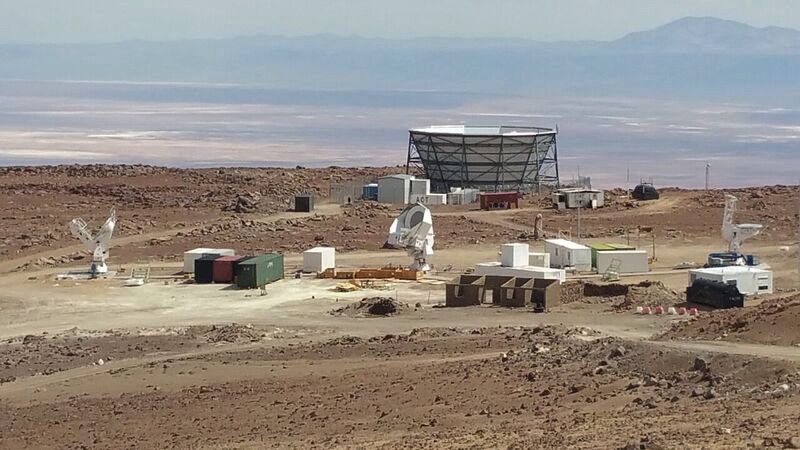
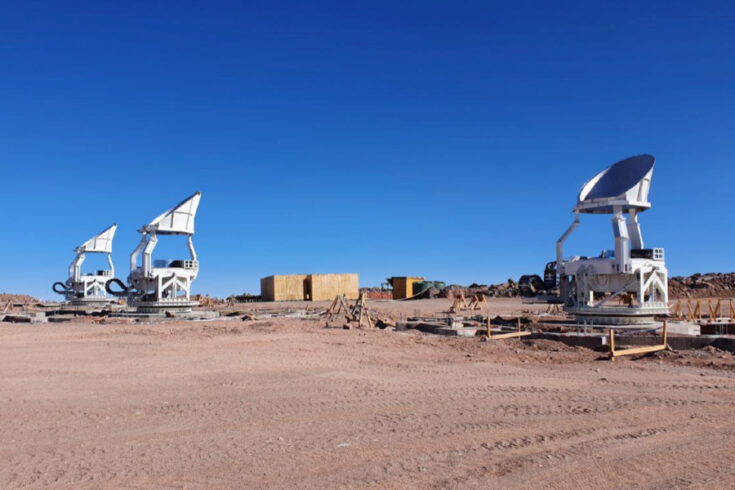
It seems a lot longer than four years ago that I drew the attention of readers of this blog to the science case for the Simons Observatory, the next big thing in ground-based studies of the cosmic microwave background.

The Simons Observatory Site in Chile, as it appeared four years ago

Obviously a couple of years of pandemic have intervened, amongst other things, but I was delighted to read yesterday that the UK has invested £18M in the Simons Observatory, which will enable further development of the facility at Cerro Toco, high above the Atacama Desert in Chile.

Simons Observatory in May 2022

The project was already a large international collaboration led from the USA, but the new funds from UKRI mean that six UK institutions will now join. These are (in alphabetical order): Cambridge; Cardiff; Imperial College London; Manchester; Oxford; and Sussex. Although I’m not involved in this project myself I know many people at these institutions (two of which I have worked at) and elsewhere who will be absolutely thrilled to be able to participate in this exciting project. Congratulations to them!

It would have been great if Ireland had been able to get involved in the Simons Observatory, but sadly fundamental science of this type is not a priority for the powers that be in Irish science funding. This is unfortunate because I think membership of international consortia like this would enable a small country to punch above its weight in science. Still, at least the UK PI, Prof. Michael Brown (Manchester), is an Irishman…

On Researchfish

Posted in Biographical, Cardiff, Maynooth, Science Politics with tags , on March 18, 2022 by telescoper

One of the things I definitely don’t miss about working in the UK university system is the dreaded Researchfish. If you’ve never heard of this bit of software, it’s intended to collect data relating to the outputs of research grants funded by the various Research Councils. That’s not an unreasonable thing to want to do, of course, but the interface is – or at least was when I last used it several years ago – extremely clunky and user-unfriendly. That meant that once a year along with other academics with research grants (in my case STFC) I had to waste hours uploading bibliometric and other data by hand. A sensible system would have harvested this automatically as it is mostly available online at various locations or allowed users simply to upload their own publication list as a file; most of us keep an up-to-date list of publications for various reasons (including vanity!) anyway. Institutions also keep track of all this stuff independently. All this duplication seems utterly pointless.

I always wondered what happened to the information I uploaded every year, which seemed to disappear without trace into the bowels of RCUK. I assume it was used for something, but mere researchers were never told to what purpose.

When I left the UK in 2018 to work full-time in Ireland, I took great pleasure in ignoring the multiple emails demanding that I do yet another Researchfish upload. The automated reminders turned into individual emails threatening that I would never again be eligible for funding if I didn’t do it, to which I eventually replied that I wouldn’t be applying for UK research grants anymore anyway so there. Eventually the emails stopped.

Now, four years later, it seems the software is no better. That’s not surprising as since everyone has to use it on threat of excommunication there is no incentive to improve it.

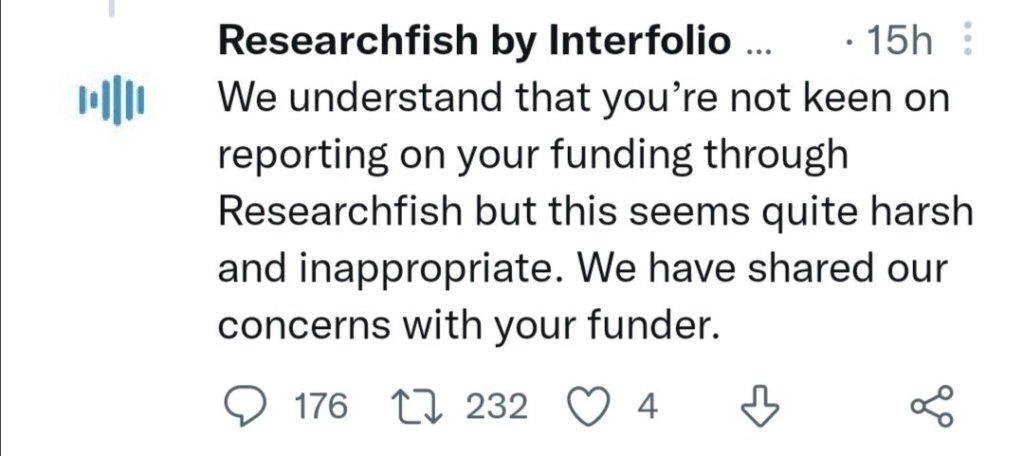
Yesterday I noticed on Twitter – not for the first time – an academic complaining about Researchfish. It was however the first time I saw this sinister reply from the company that runs the system:

I’m out of the UK system for good, so I can say what I think. To put it mildly I don’t think this response is at all appropriate. Researchfish would be better off trying to engage with the research community to improve its system, especially the awful user interface, than threatening the people who criticize it.

(And there are other software providers, you know…)

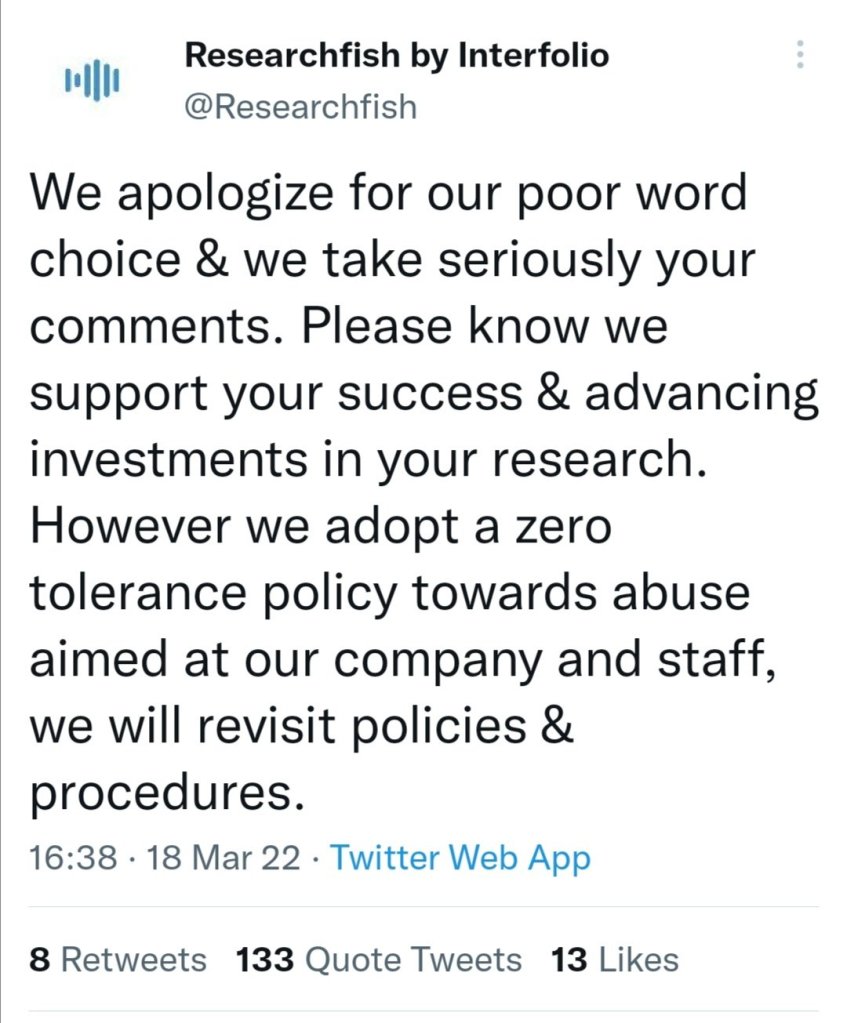
Update; unbelievably, with this crass “apology” they’ve made matters even worse!

Update: “ResearchfishGate” has now been covered by Research Professional and the Times Higher.

And now here’s their second attempt at an apology:

Apart from the very weird prose style, I’ve yet to see much evidence for what is claimed in the second paragraph…

Newsflash: New Chair at STFC

Posted in Science Politics, The Universe and Stuff with tags , , , on January 22, 2018 by telescoper

As a quick piece of community service I thought I’d pass on the news of the appointment of a new Executive Chair for the Science and Technology Facilities Council (STFC), namely Professor Mark Thomson of the University of Cambridge. Developments at STFC will cease to be relevant to me after this summer as I’m moving to Ireland but this is potentially very important news for many readers of this blog.

Professor Thomson is an Experimental Particle Physicist whose home page at Cambridge describes his research in thuswise manner:

My main research interests are neutrino physics, the physics of the electroweak interactions, and the design of detectors at a future colliders. I am co-spokesperson of the DUNE collaboration, which consists of over 1000 scientiests and engineers from over 170 institutions in 31 nations across the globe. The Cambridge neutrino group splits its acivities between MicroBooNE and DUNE and is using advanced particle flow calorimetry techniques to interpret the images from large liquid argon TPC neutrino detector.

I’ve added a link to the DUNE collaboration for those of you who don’t know about it – it’s a very large neutrino physics experiment to be based in the USA.

On the announcement, Prof. Thomson stated:

I am passionate about STFC science, which spans the smallest scales of particle physics to the vast scales of astrophysics and cosmology, and it is a great honour be appointed to lead STFC as its new Executive Chair. The formation of UKRI presents exciting opportunities for STFC to further develop the UK’s world-leading science programme and to maximise the impact of the world-class facilities supported by STFC.

This appointment needs to be officially confirmed after a pre-appointment hearing by the House of Commons Science and Technology Committee but, barring a surprise offer of the position to Toby Young, he’s likely to take over the reins at STFC in April this year. He’ll have his work cut out trying to make the case for continued investment in fundamental science in the United Kingdom, in the face of numerous challenges, so I’d like to take this opportunity to wish him the very best of luck in his new role!

The Zurich Letters

Posted in Uncategorized with tags , , , , , , on October 31, 2017 by telescoper

Just time for a quick post following up my previous piece on the Bullying Scandal at ETH Zurich.

As pointed out in a comment on that post, a letter of support for one of the named Professors (Marcella Carollo) has been signed by a number of astronomers, including some prominent senior professors. That letter can be found here (PDF).

A version of that letter which has been annotated by Chris Lintott to draw attention to some of its shortcomings can be found here. I won’t add much to Chris’s comments, but will mention that a dropout rate of 30% of students funded by the UK  Science and Technology Facilities Council would lead to financial penalties on the institution responsible. Moreover, ETH Zurich is a prestigious institution with a highly selective admissions policy for postgraduate students and a high level of funding. It is not unreasonable to expect a high completion rate under these circumstances.

Other than that, the two main messages of the first letter seem to be (a) `some people did well so it must all be OK’ and (b) `the ends justify the means’. I can’t agree with either of these points. Reaction I have seen on social media to the letter have been overwhelmingly negative, to the extent that Prof. Bryan Gaensler has drafted an alternative letter, in support of the ETH Researchers, and is collecting signatures. You can find that letter here, where you can also find a list of more than 300 nearly 700 signatories across all walks of astronomical life. You can add your name to this letter at any time until 2359 UTC on Wednesday November 1st, after which the letter and list of signatories will then be delivered to the researchers affected by this sorry affair.

P.S. I’ll just mention that as well as attracting a very large number of visitors (hopefully not all of them lawyers), my original post on this matter is the first I have written to generate over a hundred comments. The previous record was 98.

UPDATE: There’s an item about the second letter here.

National STFC Data-Intensive Science Launch Event

Posted in Science Politics, The Universe and Stuff with tags , , , , , on October 27, 2017 by telescoper

It’s been a very busy week here in Cardiff, as we have been hosting a National Event to launch the Science and Technology Facilities Council (STFC)’s new Centres for Doctoral Training in Data-Intensive Science. There are eight new CDTs involving 19 institutions across the country (including the local one that involved the Universities of Cardiff, Bristol and Swansea). We were delighted to be chosen to host this event, which has had a tremendous buzz about it, as 120 new PhD students met with academics from all the CDTs, STFC staff, and representatives of industry partners, for a mixture of training and networking activities. I took part in a panel discussion this morning about careers, which was very interesting.

Last night we had a dinner at the Mercure Hotel in Cardiff (where the Real Madrid team stayed just before this summer’s UEFA Champions League Final in Cardiff). The dinner was preceded by a welcome from Professor Karen Holford (Deputy Vice-Chancellor of Cardiff University), a talk by Brian Bowsher (Chief Executive of STFC) and Prof. Patrick Sutton of the Gravitional Physics group at Cardiff who gave an outstanding talk about the latest developments in gravitational waves. There was then a `showcase’ event to allow students and staff to talk about their work over a few drinks.

Here are some pictures of yesterday’s activities.

Prof. Karen Holford giving her welcome speech.

Dr Bian Bowsher, STFC Chief Executive

I noticed in Dr Bowsher’s talk that STFC has apparently moved the Boulby Mine from North Yorkshire (near Whitby) to Northumberland:

STFC sites (some of them in the correct geographical location).

Professor Mark Walport was unable to attend the event in person but did at least appear on a slide about the new UK Research and Innovation entity, which formally comes into existence in April 2018!

Professor Sir Mark Walport

Patrick Sutton doing his gravitational waves talk…

The Showcase Event

Showcase Event

And here are some of the members of the team from STFC who did most of the organization for this very successful and enjoyable event.

Some members of the STFC team!

The event finishes this afternoon, after which I think I’ll have a lie down!

Update: there’s a Cardiff University News item about this here.

Team News from the Vale

Posted in Uncategorized with tags , , on September 26, 2017 by telescoper

We have a short break in the schedule for our induction event here at the Cardiff Vale Resort Hotel. Yesterday we had a full schedule of presentations, an excellent interactive training session by Cardiff PhD student Ed Fauchon-Jones about version control and the use of Github, an ongoing `hackathon event’, and a networking event with our industrial partners. It’s been a busy but very exciting and enjoyable start to the new Centre for Doctoral Training. This afternoon we have more activities, but this morning the new students have been sent out into the countryside in land rovers for a `Team Building’ event, leaving us old fogeys behind to enjoy a little bit of peace and quiet back in the hotel.

One of the aims of the hackathon has been to build teamwork. The students are in groups of three or four. Each group has been given a bit of old software (written in Fortran) and charged with the task of figuring out what it does and then rewriting it in a modern programming environment (most of them are using Python). That plan was that by the end of this afternoon they should be able to present us a working piece of code. Unfortunately I don’t think we’ve allowed enough time so it may be that the teams don’t all finish their challenge, but it’s been fun to see how they’ve tackled the problems. I’m old enough to remember Fortran very well, so I was able to help a couple of the groups by explaining some of its idiosyncracies.

We discovered last night that the Leeds United football team is staying in this hotel in advance of their game this evening against Cardiff City. Some of the players were in the bar last night, but I didn’t recognise any of them. With Leeds currently top of the Championship I’m not sure to what extent their team needs building, but they’re playing a Cardiff City team which is in third place, level on points and separated only by goal difference, so it should be a good game tonight.

Anyway, I’d better get on and get some work done before the students get back. We have a full afternoon in front of us, and then we have to tackle the logistics of getting everyone back to Swansea, Cardiff and Bristol respectively!

Here is a picture of the students along with a few of the staff that attended the event, taken during the last afternoon. Happily the students all got back safely from their adventures this morning!

UPDATE: 27th September. This event finished yesterday evening and we left just as Leeds United were getting ready to depart in their team coach for their match against Cardiff City last night. Cardiff City won 3-1.

Induction at the Vale

Posted in Uncategorized with tags , , on September 25, 2017 by telescoper

So here I am, at the Cardiff Vale Hotel. It’s quite swanky. Apparently the Juventus team stayed here immediately before the UEFA Champions League final in Cardiff this summer. They lost, so perhaps they enjoyed their stay too much before the game! The view from my window this morning wasn’t bad at all:

I’m here participating in an Induction event for our new STFC-funded Centre for Doctoral Training (CDT), which involves the Universities of Cardiff, Bristol and Swansea. This is coordinated by the Data Innovation Institute at Cardiff University and it covers  a wide range of data-intensive research in particle physics, astrophysics and cosmology carried on at the three member institutions. ‘Data-intensive’ here means involving very big data sets, very sophisticated analysis methods or high-performance computing,  or any combination of these.

Since this Centre for Doctoral Training is being coordinated by Cardiff University we got to organize this launch event, at which we get the new students (14 of them), supervisors and industrial partners together to introduce the programme we’ve got in store. Over the next two days we’ll have some lectures, networking sessions, team-building exercises and a `hackathon’ challenge.

Hopefully all this will start to bring the students from the three institutions together as a cohort with its own identity, so that the CDT functions as more than the sum of three separate components. That’s the plan anyway.

Anyway, they seem a friendly bunch and I think this is going to be quite a lot of fun though it will be rather busy. Although we’re booked into this hotel as a `conference package’, the hotel is rather large and most of the clientele seem to be here to play golf…

Oh, and if you think all this luxury is probably a waste of money then I should point (a) the Cardiff Value Hotel has given us a very good deal for the accommodation and conference facilities and (b) this is induction week for new undergraduates and other postgraduates at Cardiff University and it would have been hard to find rooms for this event there. The splendid isolation of this `neutral’ venue will hopefully help folk concentrate on the matters at hand, away from the hustle and bustle of the new student arrivals.