Archive for The Open Journal of Astrophysics

Not the Open Journal of Astrophysics Impact Factor – Update

Posted in Open Access, The Universe and Stuff with tags , , , , on February 11, 2020 by telescoper

 I thought I would give an update with some bibliometric information about the 12 papers published by the Open Journal of Astrophysics in 2019. The NASA/ADS system has been struggling to tally the citations to a couple of our papers but this issue has now been resolved.  According to this source the total number of citations for these papers is 532 (as of today). This number is dominated by one particular paper which has 443 citations according to NASA/ADS. Excluding this paper gives an average number of citations for the remaining 11 of 7.4.

I’ll take this opportunity to re-iterate some comments about the Journal Impact Factor. When asked about this my usual response is (a) to repeat the arguments why the impact factor is daft and (b) point out that we have to have been running continuously for at least two years to have an official impact factor anyway.

For those of you who can’t be bothered to look up the definition of an impact factor , for a given year it is basically the sum of the citations for all papers published in the journal over the previous two-year period divided by the total number of papers published in that journal over the same period. It’s therefore the average citations per paper published in a two-year window. The impact factor for 2019 would be defined using data from 2017 and 2018, etc.

The impact factor is prone to the same issue as the simple average I quoted above in that citation statistics are generally heavily skewed  and the average can therefore be dragged upwards by a small number of papers with lots of citations (in our case just one).

I stress again we don’t have an Impact Factor as such for the Open Journal. However, for reference (but obviously not comparison) the latest actual impact factors (2018, i.e. based on 2016 and 2017 numbers) for some leading astronomy journals are: Monthly Notices of the Royal Astronomical Society 5.23; Astrophysical Journal 5.58; and Astronomy and Astrophysics 6.21.

My main point, though, is that with so much bibliometric information available at the article level there is no reason whatsoever to pay any attention to crudely aggregated statistics at the journal level. Judge the contents, not the packaging.

This post is based on an article at the OJA blog.


Not the Open Journal of Astrophysics Impact Factor – Update

Posted in Open Access, The Universe and Stuff with tags , , , , on January 20, 2020 by telescoper

Now that we have started a new year, and a new volume of the Open Journal of Astrophysics , I thought I would give an update with some bibliometric information about the 12 papers we published in 2019.

It is still early days for aggregating citations for 2019 but, using a combination of the NASA/ADS system and the Inspire-HEP, I have been able to place a firm lower limit on the total number of citations so far for those papers of 408, giving an average citation rate per paper of 34.

These numbers are dominated by one particular paper which has 327 citations according to Inspire (see above). Excluding this paper gives an average number of citations for the remaining 11 of 7.4.

I’ll take this opportunity to re-iterate some comments about the Journal Impact Factor. When asked about this my usual response is (a) to repeat the arguments why the impact factor is daft and (b) point out that we have to have been running continuously for at least two years to have an official impact factor anyway.

For those of you who can’t be bothered to look up the definition of an impact factor , for a given year it is basically the sum of the citations for all papers published in the journal over the previous two-year period divided by the total number of papers published in that journal over the same period. It’s therefore the average citations per paper published in a two-year window. The impact factor for 2019 would be defined using data from 2017 and 2018, etc.

The impact factor is prone to the same issue as the simple average I quoted above in that citation statistics are generally heavily skewed and the average can therefore be dragged upwards by a small number of papers with lots of citations (in our case just one).

I stress again we don’t have an Impact Factor for the Open Journal. However, for reference (but obviously not direct comparison) the latest actual impact factors (2018, i.e. based on 2016 and 2017 numbers) for some leading astronomy journals are: Monthly Notices of the Royal Astronomical Society 5.23; Astrophysical Journal 5.58; and Astronomy and Astrophysics 6.21.

My main point, though, is that with so much bibliometric information available at the article level there is no reason whatsoever to pay any attention to crudely aggregated statistics at the journal level. Judge the contents, not the packaging.


ADS and the Open Journal of Astrophysics

Posted in Open Access with tags , , , , , on January 19, 2020 by telescoper

Most if not all of the authors of papers published in the Open Journal of Astrophysics, along with a majority of astrophysicists in general, use the NASA/SAO Astrophysics Data System (ADS) as an important route to the research literature in their domain, including bibliometric statistics and other information. Indeed this is the most important source of such data for most working astrophysicists. In light of this we have been taking steps to facilitate better interaction between the Open Journal of Astrophysics and the ADS.

First, note that journals indexed by ADS are assigned a short code that makes it easier to retrieve a publication. For reference, the short code for the Open Journal of Astrophysics is OJAp. For example, the 12 papers published by the Open Journal of Astrophysics can be found on ADS here.

If you click the above link you will find that the papers published more recently have not got their citations assigned yet. When we publish a paper at the Open Journal of Astrophysics we assign a DOI and deposit it and related metadata to a system called CrossRef which is accessed by ADS to populate bibliographic fields in its own database. ADS also assigns a unique bibliometric code it generates itself (based on the metadata it obtains from Crossref). This process can take a little while, however, as both Crossref and ADS update using batch processes, the latter usually running only at weekends. This introduces a significant delay in aggregating the citations acquired via different sources.

To complicate things further, papers submitted to the arXiv as preprints are indexed on ADS as preprints and only appear as journal articles when they are published. Among other things, citations from the preprint version are then aggregated on the system with those of the published article, but it can take a while before this process is completed, particularly if an author does not update the journal reference on arXiv.

For a combination of reasons, therefore, the papers we have published in the past have sometimes appeared on ADS out of order. On top of this, of the 12 papers published in 2019, there is one assigned a bibliometric code ending in 13 by ADS and none numbered 6! This is not too much a problem as the ADS identifiers are unique, but the result is not as tidy as it might be.

To further improve our service to the community, we have decided at the Open Journal of Astrophysics that from now on we will speed up this interaction with ADS by depositing information directly at the same time as we lodge it with Crossref. This means that (a) ADS does not have to rely on authors updating the arXiv field and (b) we can give ADS directly information that is not lodged at Crossref.

I hope this clarifies the situation.

New Publication at the Open Journal of Astrophysics!

Posted in OJAp Papers, Open Access, The Universe and Stuff with tags , , , , , , on January 8, 2020 by telescoper

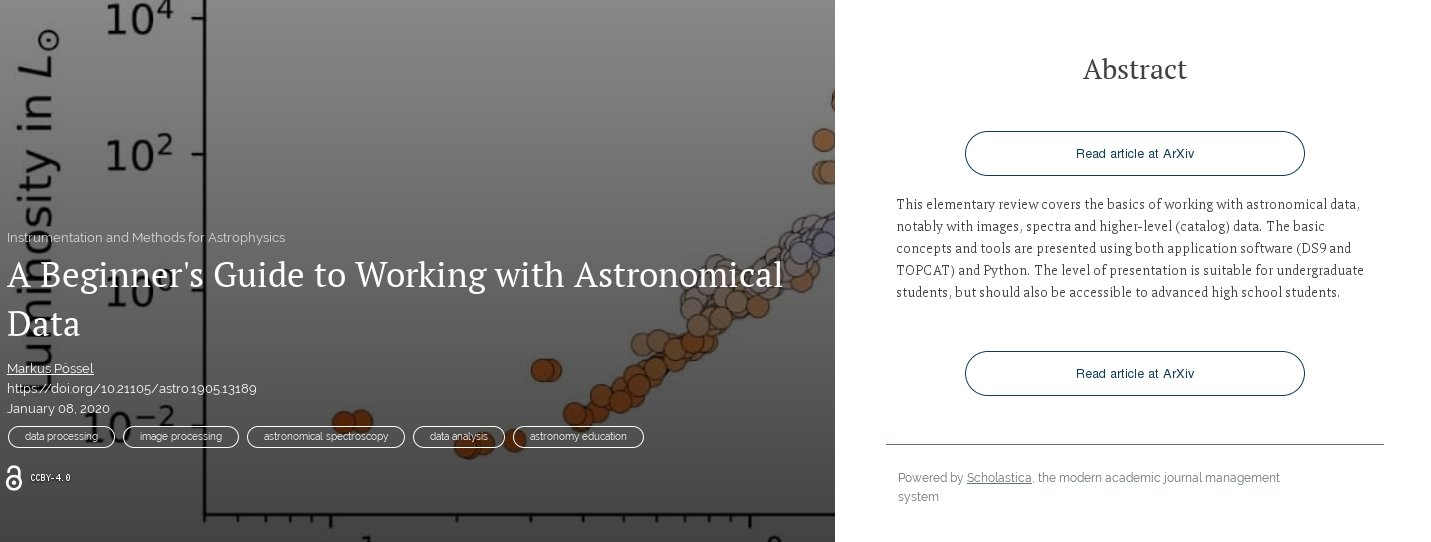
It’s two in two days because we have published another new paper at The Open Journal of Astrophysics. The title is A Beginner’s Guide to working with Astronomical Data. Here is a grab of the overlay:

You can find the arXiv version of the paper here.

The author is Markus Pössel of the Haus der Astronomie at the Max Planck Institute for Astronomy in Heidelberg (Germany). This is a long paper – 71 pages with over a hundred figures – that gives a comprehensive introduction to the various kinds of astronomical data and techniques for working with such data. I think this paper will attract a lot of interest from many different kinds of people but it will be particularly interesting to students doing undergraduate projects involving astronomical data (and their supervisors).

Another point worth noting is that there’s a small addition to the overlay for this paper, which will apply to all future papers (and retrospectively once we have worked through the back catalogue) and that is in the bottom left of the image above. It shows that the article is published with the latest form of Creative Commons License (CC-BY-4.0). It has always been our policy to publish under a CC-BY licence but Scholastica have very helpfully set up a new facility to make this explicit on each page. This is part of our efforts to ensure that we are compliant with Plan S which makes CC-BY licenses mandatory.

UPDATE: the CC-BY-4.0 license has now been applied retrospectively to all our publications.

New Publication at the Open Journal of Astrophysics!

Posted in OJAp Papers, Open Access, The Universe and Stuff with tags , , , on January 7, 2020 by telescoper

Back after the New Year break we have published another new paper at The Open Journal of Astrophysics, our first of 2020!

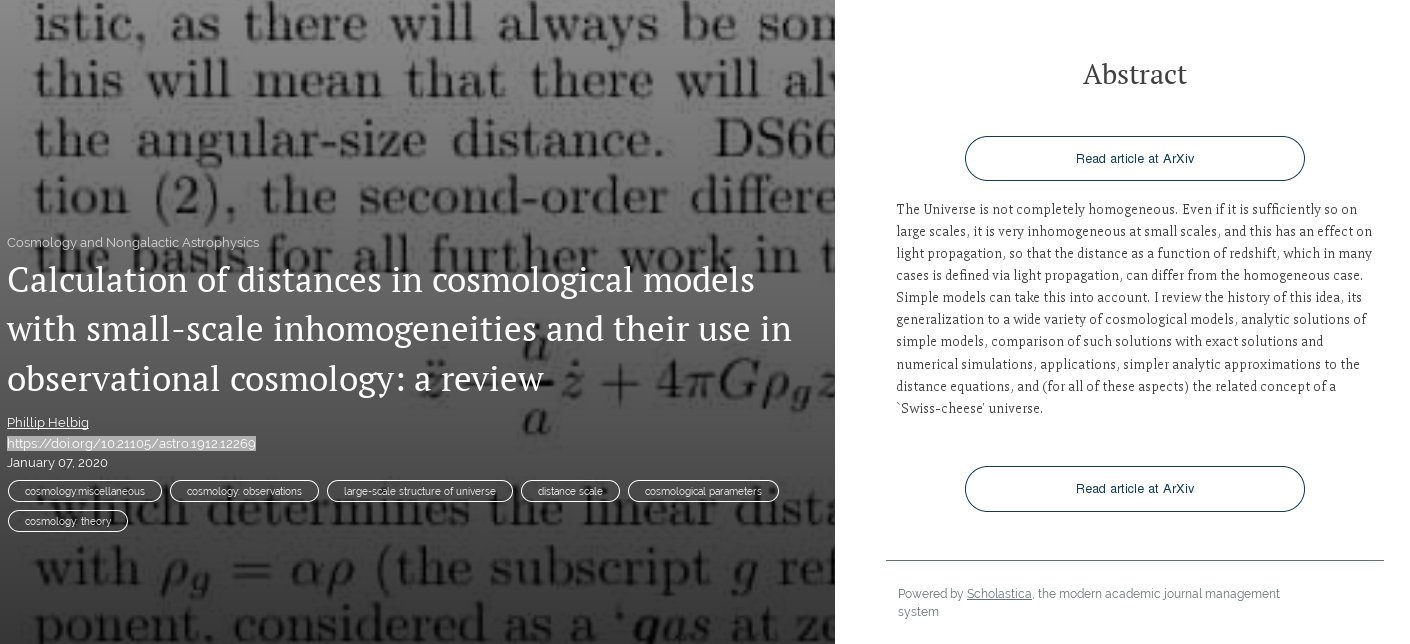
Here is a grab of the overlay:

The author is Phillip Helbig (Who? Ed). This is a review article. Our `For Authors‘ page includes the following:

We may accept review articles on appropriate subjects if the Editorial Board considers them a useful contribution to the literature.

You can find the accepted version on the arXiv here. This is another one for the `Cosmology and Nongalactic Astrophysics’ section . We would be very happy to get more submissions from other areas, especially Stellar and Planetary astrophysics. Hint! Hint!

P.S. Just another reminder that we now have an Open Journal of Astrophysics Facebook page where you can follow updates from the Journal should you so wish..

New Publication at the Open Journal of Astrophysics!

Posted in OJAp Papers, Open Access, The Universe and Stuff with tags , , , , , , on December 11, 2019 by telescoper

We seem to be having an end-of-year rush and have published yet another new paper at The Open Journal of Astrophysics!

Here is a grab of the overlay:

The authors are Aditi Krishak (IISER Bhopal) and Shantanu Desai (IIT Hyderabad), both in India.

You can find the accepted version on the arXiv here. This is another one for the `Cosmology and Nongalactic Astrophysics’ section with a cross-listing in `Instrumentation and Methods for Astrophysics’, both of which are proving rather popular.

We would be very happy to get more submissions from other areas, especially Stellar and Planetary astrophysics. Hint! Hint!

P.S. Just a reminder that we now have an Open Journal of Astrophysics Facebook page where you can follow updates from the Journal should you so wish..

New Publication at the Open Journal of Astrophysics!

Posted in OJAp Papers, Open Access, The Universe and Stuff with tags , , , , , , on December 9, 2019 by telescoper

We have published yet another new paper at The Open Journal of Astrophysics!

Here is a grab of the overlay:

The authors are Emilio Bellini (Oxford, UK), Ludovic van Waerbeke (University of British Columbia, Canada), Shahab Joudaki (Oxford) and David Alonso (Cardiff)

You can find the accepted version on the arXiv here. This is another one for the `Cosmology and Nongalactic Astrophysics’ section, which is proving rather popular.

We would be very happy to get more submissions from other areas, especially Stellar and Planetary astrophysics. Hint! Hint!

P.S. Just a reminder that we now have an Open Journal of Astrophysics Facebook page where you can follow updates from the Journal should you so wish..

New Publication at the Open Journal of Astrophysics!

Posted in OJAp Papers, Open Access, The Universe and Stuff with tags , , , , , , , , on December 2, 2019 by telescoper

We have published another new paper at The Open Journal of Astrophysics. We actually published this one last week but (presumably because of the Thanksgiving holiday) it has taken longer than usual to register the DOI with Crossref and I held off mentioning this paper here until everything was sorted.

Here is a grab of the overlay:

The authors are Farhad Feroz and Mike Hobson of the Cavendish Laboratory at the University of Cambridge (UK), Ewan Cameron (now at Oxford, UK) and Anthony N. Pettitt of Queensland University of Technology in Australia.

You can find the accepted version on the arXiv here. This version was accepted after modifications requested by the referee and editor. Because this is an overlay journal the authors have to submit the accepted version to the arXiv (which we then check against the copy submitted to us) before publishing; version 3 on the arXiv is the accepted version (which contains a link to updated software).

It is worth mentioning a couple of points about this paper.

The first is that it is mainly a statistical methods paper rather than astrophysics per se but it does contain applications to astrophysics and cosmology and, more relevantly, was posted on the `Instrumentation and Methods for Astrophysics’ section on the arXiv. The Editorial Board felt that we should consider it for publication because our rule for whether a paper can be considered for publication in the Open Journal of Astrophysics is stated clearly on our instructions for authors:

We apply a simple criterion to decide whether a paper is on a suitable topic for this journal, namely that if it it is suitable for the astro-ph section of the arXiv then it is suitable for The Open Journal of Astrophysics.

So far our publication list is dominated by papers in `Cosmology and Nongalactic Astrophysics’ and `Instrumentation and Methods for Astrophysics’ (which is not surprising given its origin) but we would be very happy to get more submissions from other areas, especially Stellar and Planetary astrophysics. Hint! Hint!

The other point to make is that this paper actually appeared on the arXiv over six years ago and has been widely cited as a preprint but it has never previously been published by a journal. The Editorial Board felt that we should consider it for publication in order to ensure that it is properly curated and citations properly assigned, but we treated it as a new submission and sent it out for review just like any other paper. The review led to some changes and, most importantly, a few updates to the software which you can find here. The editorial process has been quite lengthy for this paper but I think we have done a valuable service to the community in reviewing and publishing this paper.

P.S. Just a reminder that we now have an Open Journal of Astrophysics Facebook page where you can follow updates from the Journal should you so wish..

New Publication at the Open Journal of Astrophysics!

Posted in OJAp Papers, Open Access, The Universe and Stuff with tags , , , , , , on November 24, 2019 by telescoper

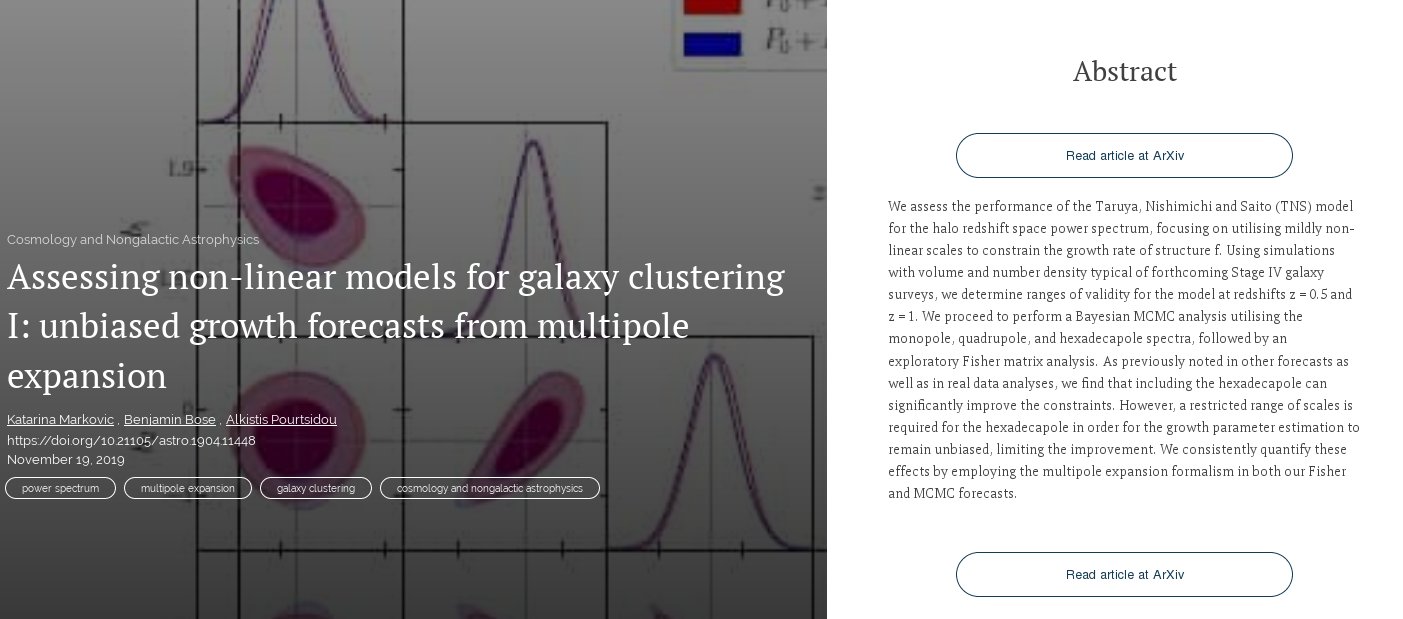
Yesterday we published another new paper at The Open Journal of Astrophysics. Here is a grab of the overlay:

The authors are Katarina MarKovic (now of JPL in California), Benjamin Bose (of the University of Geneva) and Alkistis Pourtsidou (Queen Mary, University of London).

You can find the accepted version on the arXiv here. This version was accepted after modifications requested by the referee and editor. Because this is an overlay journal the authors have to submit the accepted version to the arXiv (which we then check against the copy submitted to us) before publishing; version 2 on the arXiv is the accepted version.

I’d like to apologize to the authors for a delay in publishing this paper. It was ready to go a couple of weeks ago, but we had some trouble with an extension to the platform provided by Scholastica which was intended to register Digital Object Identifiers automatically and thus speed up the process. Unfortunately we found some bugs in, and other problems with, the new software and in the end have given up and reverted to the old manual registration process. Hopefully Scholastica will be able to offer a working system for DOI registration before too long.

Anyway, you will see that this is one for the `Cosmology and Nongalactic Astrophysics’ folder. We would be happy to get more submissions from other areas, especially Stellar and Planetary astrophysics. Hint! Hint!

P.S. Just a reminder that we now have an Open Journal of Astrophysics Facebook page where you can follow updates from the Journal should you so wish..

Not the Open Journal of Astrophysics Impact Factor

Posted in Open Access with tags , , , on October 22, 2019 by telescoper

Yesterday evening, after I’d finished my day job, I was doing some work on the Open Journal of Astrophysics ahead of a talk I am due to give this afternoon as part of the current Research Week at Maynooth University. The main thing I was doing was checking on citations for the papers we have published so far, to be sure that the Crossref mechanism is working properly and the papers were appearing correctly on, e.g., the NASA/ADS system. There are one or two minor things that need correcting, but it’s basically doing fine.

In the course of all that I remembered that when I’ve been giving talks about the Open Journal project quite a few people have asked me about its Journal Impact Factor. My usual response is (a) to repeat the arguments why the impact factor is daft and (b) point out that we have to have been running continuously for at least two years to have an official impact factor so we don’t really have one.

For those of you who can’t be bothered to look up the definition of an impact factor , for a given year it is basically the sum of the citations in a given year for all papers published in the journal over the previous two-year period divided by the total number of papers published in that journal over the same period. It’s therefore the average citations per paper published in a two-year window. The impact factor for 2019 would be defined using citations to papers publish in 2017 and 2018, etc.

The Open Journal of Astrophysics didn’t publish any papers in 2017 and only one in 2018 so obviously we can’t define an official impact factor for 2019. However, since I was rummaging around with bibliometric data at the time I could work out the average number of citations per paper for the papers we have published so far in 2019. That number is:

I stress again that this is not the Impact Factor for the Open Journal but it is a rough indication of the citation impact of our papers. For reference (but obviously not comparison) the latest actual impact factors (2018, i.e. based on 2016 and 2017 numbers) for some leading astronomy journals are: Monthly Notices of the Royal Astronomical Society 5.23; Astrophysical Journal 5.58; and Astronomy and Astrophysics 6.21.