Archive for Type Ia Supernovae

Three New Publications at the Open Journal of Astrophysics

Posted in OJAp Papers, Open Access, The Universe and Stuff with tags , , , , , , , , , on January 27, 2024 by telescoper

Once again it’s a good time for a roundup of the week’s business at the  Open Journal of Astrophysics. This past week we have once again published three papers, taking  the count in Volume 7 (2024) up to 7 and the total published by OJAp up to 122. Looking at the current work flow I expect there to be at least three next week too.

In chronological order, the three papers published this week, with their overlays, are as follows. You can click on the images of the overlays to make them larger should you wish to do so.

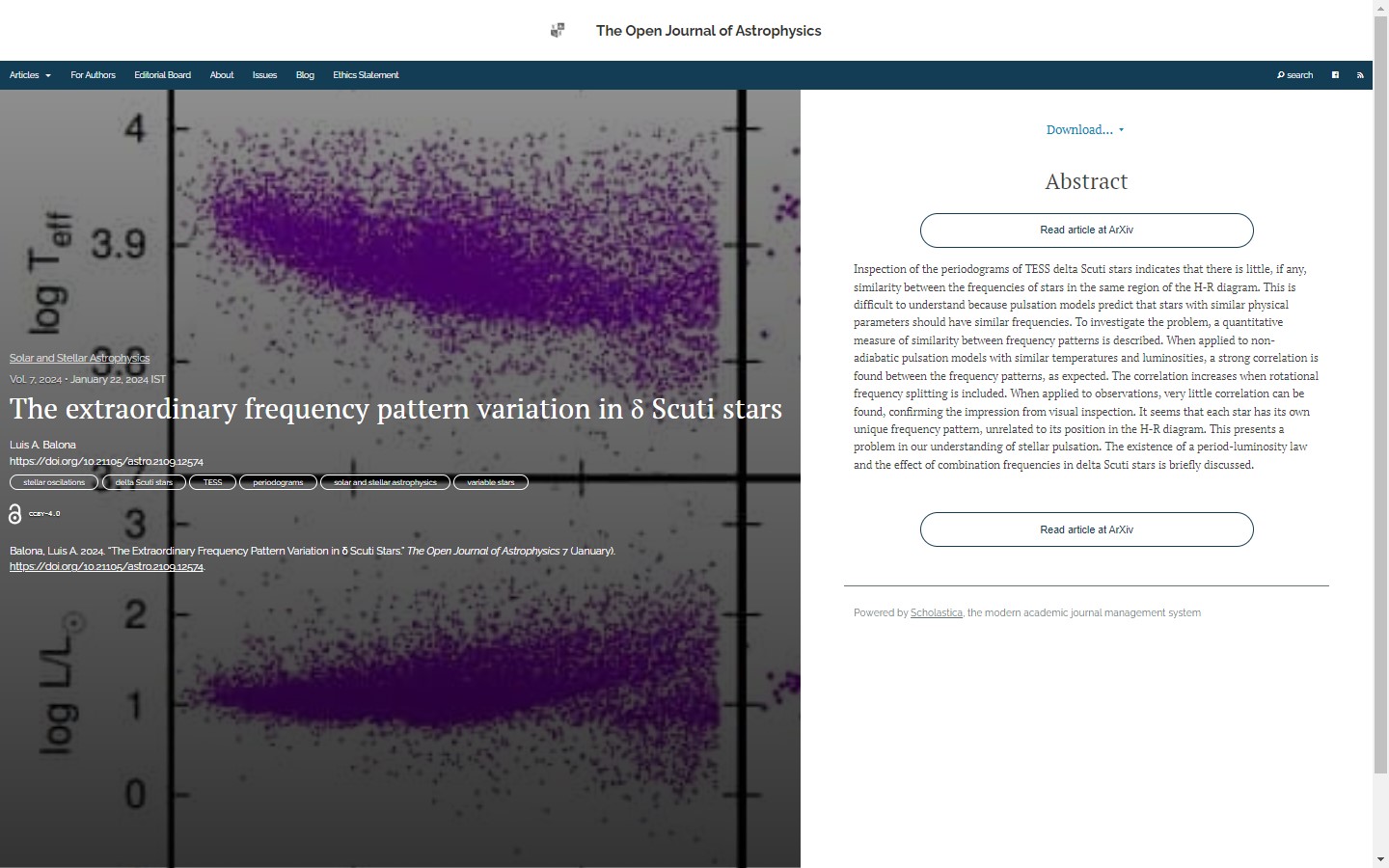
First one up is “The extraordinary frequency pattern variation in δ Scuti stars” by  Luis A. Balona of the South African Astronomical Observatory in Cape Town, South Africa. This paper, published on 22nd  January 2024, is a study of the (lack of) correlation in the structure of periodograms in Transiting Exoplanet Survey Satellite (TESS) data relating to a oscillating delta Scuti variable stars. This paper is in the category of Solar and Stelllar Astrophysics.

Here is a screen grab of the overlay, which includes the abstract:
 

You can find the officially accepted version of the paper on the arXiv here.

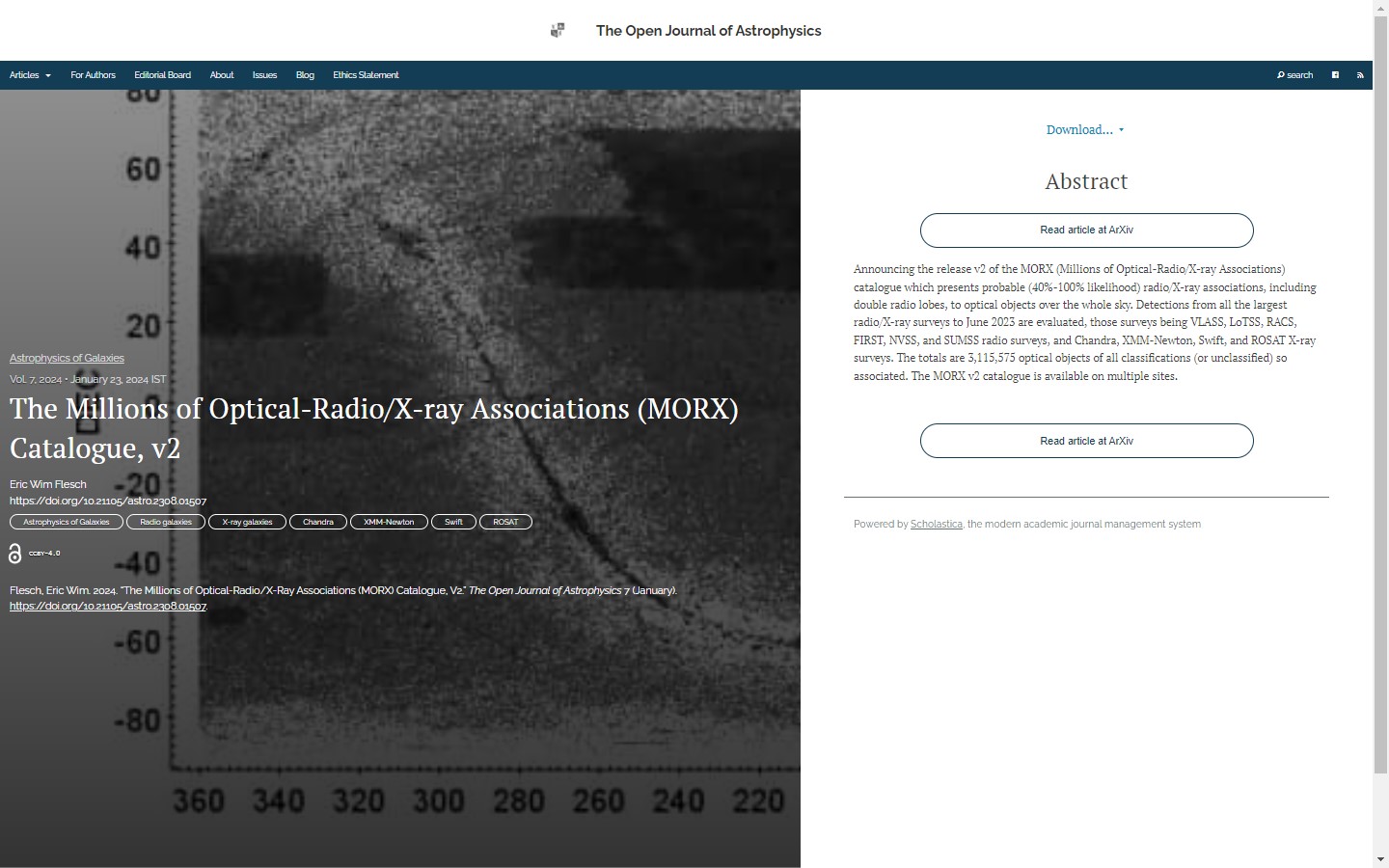
The second paper to announce is “The Millions of Optical-Radio/X-ray Associations (MORX) Catalogue, v2” by Eric Wim Flesch, an independent researcher based in New Zealand.  This presents the MORX catalogue of optical/radio/X-ray/ galaxy associations, containing over three million objects. The catalogue itself can be found in a number of locations on the web, e.g. here or here.

The paper was also published on 23rdJanuary 2024 in the category Astrophysics of Galaxies . You can see the overlay here:


The accepted version of this paper can be found on the arXiv here.

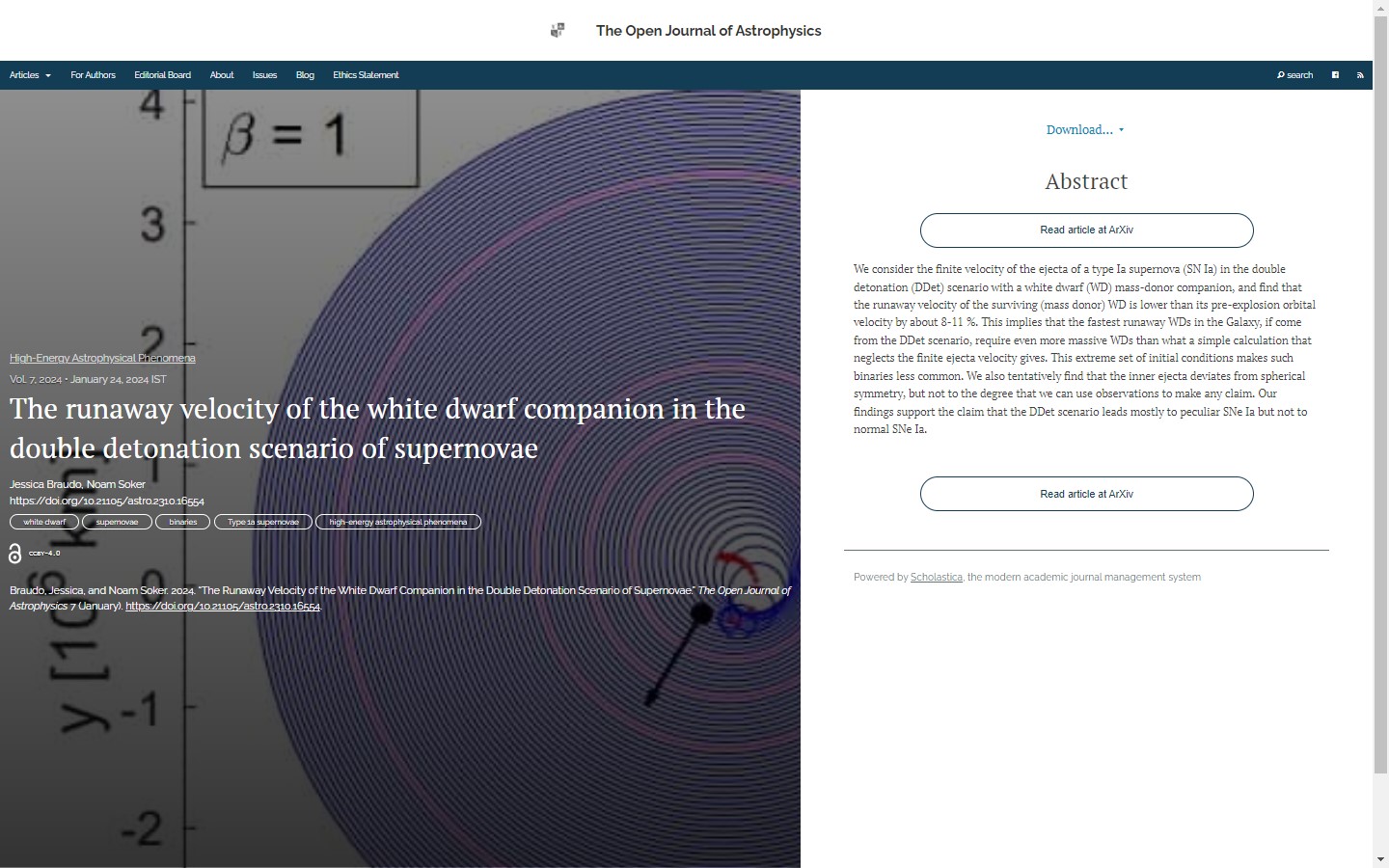
The last paper of this batch is  entitled “The runaway velocity of the white dwarf companion in the double detonation scenario of supernovae” and the authors are Jessica Braudo and Noam Soker of Technion, Haifa, in Israel.  This paper, which presents a study of ejection velocities in the double-detonation scenario of Type 1a Supernovae was published on 24th January 2024 and is in the folder marked High-Energy Astrophysical Phenomena.

Here is the overlay:


You can find the full text for this one on the arXiv here.

And that concludes the update.  As you can see, we’re getting a bit more diverse in terms of subject matter, which is nice. There’ll be more next week!

 

New Dark Energy Survey Supernovae Results

Posted in The Universe and Stuff with tags , , , , , , , on January 10, 2024 by telescoper

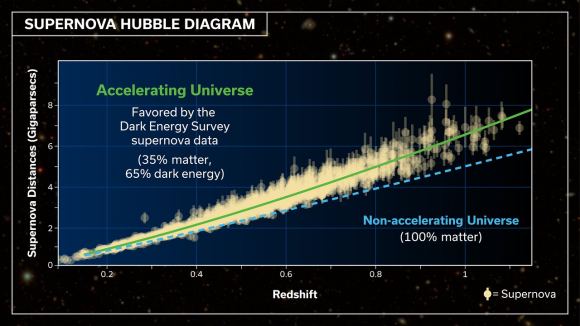
Some important cosmological results have just been announced by the Dark Energy Survey Collaboration. I haven’t had time to go through them in detail but I thought it was worth doing a quick post here to draw attention to them. The results concern a sample of Type Ia supernovae (SN Ia) discovered during the full five years of the Dark Energy Survey (DES) Supernova Program, which contains about 1500 new Type Ia Supernovae that can be used for cosmological analysis. The paper is available on the arXiv here; the abstract is:

The key numerical result of interest is the equation-of-state parameter for dark energy, designated by w, which occurs in the (assumed) relationship between pressure p and effective mass density ρ  of the form p=wρc2. A cosmological constant – which for many cosmologists is the default assumption for the form of dark energy – has w=-1 as I explained here. This parameter is one of the things Euclid is going to try to measure, using different methods. Interestingly, the DES results are offset a bit from the value of -1, but with quite a large uncertainty.

While the results for the equation-of-state parameter are somewhat equivocal, one thing that is clear is that the new SNIa measurements do confirm the existence of dark energy, in that the data can only be described by models with accelerating expansion, as dramatically demonstrated in this Figure:

I think this figure – or versions of it – will very rapidly appear in public talks on cosmology, including my own!

Luminosity Evolution in Type 1a Supernovae?

Posted in The Universe and Stuff with tags , , , , on January 14, 2020 by telescoper

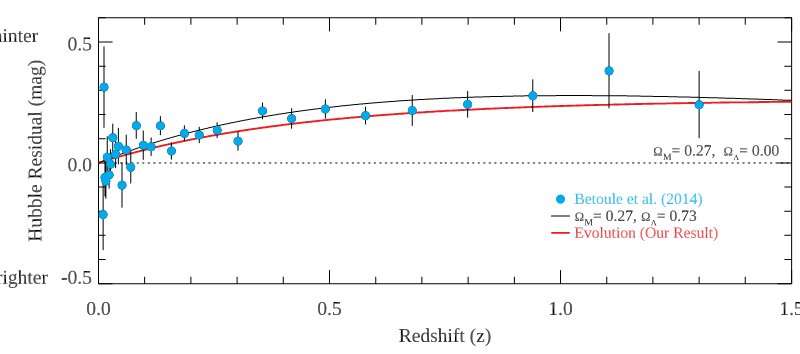
Figure 1 of Kang et al.

During this afternoon’s very exciting Meeting of the Faculty of Science and Engineering at Maynooth University I suddenly remembered a paper I became aware of over Christmas but then forgot about. There’s an article here describing the paper that makes some pretty strong claims, which was what alerted me to it. The actual paper, by Kang et al., which has apparently been refereed and accepted for publication by the Astrophysical Journal, can be found on the arXiv here. The abstract reads:

The most direct and strongest evidence for the presence of dark energy is provided by the measurement of galaxy distances using type Ia supernovae (SNe Ia). This result is based on the assumption that the corrected brightness of SN Ia through the empirical standardization would not evolve with look-back time. Recent studies have shown, however, that the standardized brightness of SN Ia is correlated with host morphology, host mass, and local star formation rate, suggesting a possible correlation with stellar population property. In order to understand the origin of these correlations, we have continued our spectroscopic observations to cover most of the reported nearby early-type host galaxies. From high-quality (signal-to-noise ratio ~175) spectra, we obtained the most direct and reliable estimates of population age and metallicity for these host galaxies. We find a significant correlation between SN luminosity (after the standardization) and stellar population age at a 99.5% confidence level. As such, this is the most direct and stringent test ever made for the luminosity evolution of SN Ia. Based on this result, we further show that the previously reported correlations with host morphology, host mass, and local star formation rate are most likely originated from the difference in population age. This indicates that the light-curve fitters used by the SNe Ia community are not quite capable of correcting for the population age effect, which would inevitably cause a serious systematic bias with look-back time. Notably, taken at face values, a significant fraction of the Hubble residual used in the discovery of the dark energy appears to be affected by the luminosity evolution. We argue, therefore, that this systematic bias must be considered in detail in SN cosmology before proceeding to the details of the dark energy.

Of course evidence for significant luminosity evolution of Type Ia supernovae would throw a big spanner in the works involved in using these objects to probe cosmology (specifically dark energy), but having skimmed the paper I’m a bit skeptical about the results, largely because they seem to use only a very small number of supernovae to reach their conclusions and I’m not convinced about selection effects. I have an open mind, though, so I’d be very interested to hear through the comments box the views of any experts in this field.

Eight Papers from the Dark Energy Survey

Posted in The Universe and Stuff with tags , , , , on November 9, 2018 by telescoper

Just a quick post to point out the exciting news that this week a clutch of papers on cosmology using Type 1a Supernovae have been released by the Dark Energy Survey team. Naturally, all of them are on the arXiv. You can also read them here. For convenience I’ve provided links below to arXiv versions through their titles:

  1. Steve: A hierarchical Bayesian model for Supernova Cosmology
  2. First Cosmology Results Using Type Ia Supernovae from the Dark Energy Survey: Effects of Chromatic Corrections to Supernova Photometry on Measurements of Cosmological Parameters
  3. First Cosmology Results using Type Ia Supernova from the Dark Energy Survey: Simulations to Correct Supernova Distance Biases
  4. First Cosmology Results Using Type Ia Supernovae From the Dark Energy Survey: Photometric Pipeline and Light Curve Data Release
  5. First Cosmology Results Using Type Ia Supernovae From the Dark Energy Survey: Analysis, Systematic Uncertainties, and Validation
  6. First Cosmological Results using Type Ia Supernovae from the Dark Energy Survey: Measurement of the Hubble Constant
  7. Cosmological Constraints from Multiple Probes in the Dark Energy Survey
  8. First Cosmology Results using Type Ia Supernovae from the Dark Energy Survey: Constraints on Cosmological Parameters

Here’s a plot showing some of the cosmological constraints:

The parameter plotted on the vertical axis is the dark energy equation of state parameter, w, and w=-1 corresponds to a cosmological constant.

For those of youparticularly interested in the Hubble constant, the headline value from Paper 6 is H0 = 67.77 +/- 1.30 km s-1 Mpc-1. This closer to the value obtained from Planck and in tension with other values as I’ve blogged about before, and gives me an excuse to continue my online poll: