Archive for YouTube

Sonification of a Galaxy

Posted in Euclid, The Universe and Stuff with tags , , , on December 19, 2024 by telescoper

Here’s an intriguing experiment in sonification of an image from Euclid.

And here’s the official blurb about it:

An ethereal dance of misty clouds of interstellar dust with a myriad of distant stars and galaxies speckled like paint drops over a black canvas. This is a sonification of a breathtaking image taken by ESA’s Euclid space telescope of the young star-forming region Messier 78.

The sonification offers a different representation of the data collected by Euclid, and lets us explore the stellar nurseries in M78 through sound. Close your eyes and listen to let the cosmic image be drawn by your mind’s eye, or watch as the traceback line in this video follows the sounds to colour the image from left to right.

The twinkling sounds of various pitches and volumes represent the galaxies and stars in the frame. The pitch of the sound points towards where we see the dot of light in the image. Higher pitches tell us that a star or galaxy appears further at the top in the image along the traceback line.

The brightness of these objects in and around M78 are represented by the volume of the twinkles. Whenever we hear a particularly loud clink, the star or galaxy that Euclid observed appears particularly bright in the image.

Underlying these jingling sounds, we can hear a steady undertone, made up of two chords which represent different regions in Messier 78. This sound intensifies as the traceback line approaches first the brightest, and later the densest regions in the nebula.

The first two deeper crescendos in this undertone indicate two patches in the image where the most intense colour is blue/purple. These appear as two ‘cavities’ in M78, where newly forming stars carve out and illuminate the dust and gas in which they were born.

The chords intensify a third time at a slightly higher pitch corresponding to the red-orange colours in the image, as the sound draws over the densest star-forming region of the frame. This stellar nursery is hidden by a layer of dust and gas that is so thick that it obscures almost all the light of the young stars within it.

As the sound traces over the entire Euclid image, these different tones together form a cosmic symphony that represents the image of Messier 78, and the stars and galaxies that lie behind and within it. You can read more about this image that was first revealed to the eyes of the world earlier this year here: https://www.esa.int/Science_Explorati…

Many thanks to Klaus Nielsen (DTU Space / Maple Pools) for making the sonification in this video. If you would like to hear more sonifications and music by this artist, please visit: https://linktr.ee/maplepools

P.S. The first sentence of the Wikipedia page on sonification uses the word “perceptualize”. Ugh!
Euclid Update

Posted in Euclid, The Universe and Stuff with tags , , , , on August 27, 2023 by telescoper

Time for a quick update on the European Space Agency’s Euclid mission. For full details about what follows you can see here. Everything I mention here is already in the public domain, so I am not disclosing any secrets!

The last update I posted mentioned that Euclid had moved into what is called the Performance Verification phase of its mission. That has now been put on hold in order to troubleshoot an intermittent problem with the Fine Guidance Sensor (FGS) which helps to maintain correct pointing of the telescope. This issue can probably be fixed by software updates, but these will have to be tested, hence the pause. This is rather irksome, but the instrument teams are confident they can find a solution soon.

Anyway, while we’re waiting, here is a video from Launch Pad Astronomy explaining about the mission. It was actually released about six days ago but I didn’t have time to post it until now. About 15 minutes long, it’s a big longer than previous official Euclid videos I’ve posted, but I think it’s very informative:

Oh, I almost forgot to mention that I’ll be talking a little bit about Euclid among other things at this event on 6th September.

Asynchronous and Public Lectures

Posted in Education, Maynooth with tags , , , , , on September 11, 2020 by telescoper

This morning I came across a very interesting blogpost by Philip Moriarty which is mainly about teaching quantum mechanics but also includes some discussion of his ideas of how he plans to conduct teaching for the forthcoming semester at the University of Nottingham.

We are in a rather different situation here at Maynooth University with Covid-19 different rules, different numbers of students and different levels of resource in terms of teaching software and equipment, but I think the primary constraints are similar.

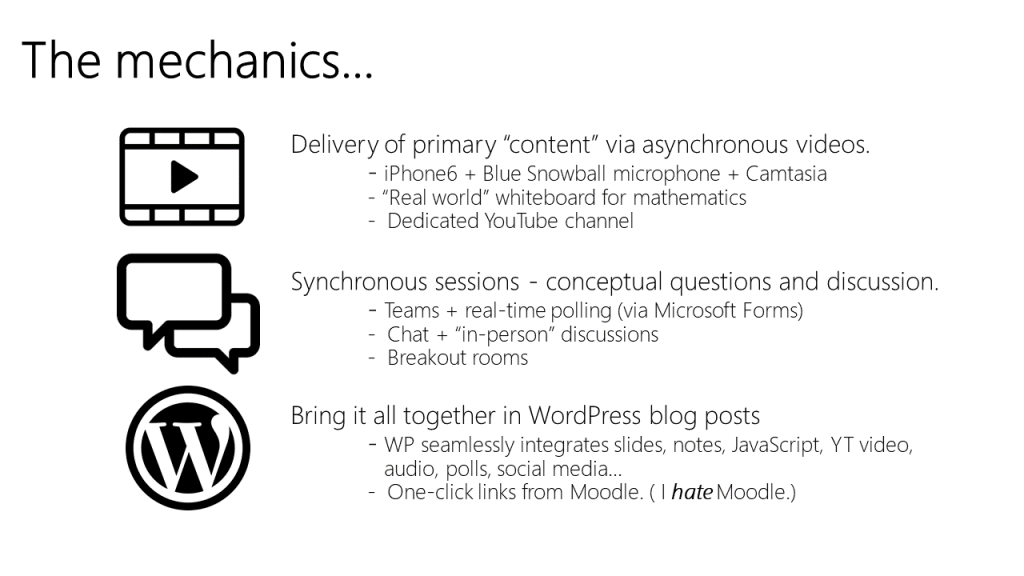
Here is is graphic Philip uses to outline the major elements of teaching he plans to adopt (copied without permission):

I think the University of Nottingham has, in common with many other UK universities, moved all its large lecture classes online. Here in Maynooth we’re restricted by physical distancing to have an absolutely maximum of 50 people in any lecture theatre at one time, so effectively the big classes will be online too. However, many of our smaller classes and tutorials will be on campus `face-to-face’ sessions. Since Theoretical Physics is a relatively small Department many of our modules will run pretty much as normal.

This are a bit different for the first year Mathematical Physics module which I teach (MP110) where the class last year was about 90 students. This class will have to be split, but I am still planning to deliver face-to-face lectures for all students in some form. There are three lectures a week in this class and I’ll probably have to have about one third of the students in each session: the other sessions will be streamed and recorded – assuming our newly-installed Panopto system works (!) – and made available to students not at the class. In addition students will get a tutorial per week, also in person.

I have thought a lot about this over the last few months and I’ve decided that the main `lectures’ (which will be with fewer than 30 students) will not be lectures but more like `workshops’ where I illustrate the main results that I would have given in a “normal” lecture using examples as well as getting students to work on problems in class.

Like Philip I plan to record videos of the “primary content” offline, probably in my office, so the students can view them at their leisure. I decided to record these primarily because I think the production quality of such lectures would be better. I’ve used Panopto before and it’s OK, but it has its limitations. I don’t have access to all the equipment Philip talks about, but at least in my office I can re-take and edit the video whenever I mess up (which will be quite frequently, I’m sure). These won’t be 50-minute lectures as I find that not having the interaction with the audience, going back over things when it’s clear they haven’t understood, giving them problems to try in class, etc, the time taken to cover the material in a video is far shorter.

Making these `asynchronous’ is, I think, extremely important. Timetabling teaching sessions looks likely to be extremely complicated for the forthcoming semester so I think it’s far better to make the content available for students to study wherever and whenever they want.

So my plan is that students will get each week:

  • A set of pre-recorded videos covering the material for that week
  • One interactive workshop on campus
  • Access to recordings of two other workshops
  • A full set of lecture notes
  • Coursework examples (assessed)
  • One tutorial on campus
  • A virtual office hour with the lecturer (me) for Q&A

It’s not the same “as normal” but I think it provides the best blend of learning approaches possible under the constraints we will have to operate. Note also that some students may be “at very high risk” for health reasons and consequently unable to come onto campus. The approach I have outlined here means that such students will miss as little as possible.

Unlike Philip, I don’t hate Moodle, so this will be where all the course materials will be made available. It will also be the principal channel of communication with the class.

Like Philip, though, I am in favour of putting all the primary content on Youtube so that anyone who wants to access it can do so. I have suggested this before and it received mixed reactions, but for me it’s more a point of principle. As my teaching is funded by the public purse, it seems reasonable to me that what I produce should all be in the public domain wherever possible. That obviously excludes some teaching activities (e.g. labs and tutorials) but I don’t see why I shouldn’t do it with lectures or other video content. I won’t make the workshop videos public, because they may accidentally identify students who do not wish to appear on a video.

I know many of my colleagues disagree with this, so here’s the unscientific poll I’ve been running to see what people think. Not that the voting will change my mind….


Testing YouTube

Posted in Biographical, mathematics, YouTube with tags , , on May 3, 2020 by telescoper

To do something a bit different during this Covid-19 lockdown I decided to set up my very own YouTube channel to which you may (or may not) wish to subscribe.

I’m new to this so I posted a short video to test how it works. It’s a little video explainer about Cramer’s Rule in linear algebra I made using Screencast-o-matic. I’ve done a lot of these over the past few weeks but they’re not what the channel is about: I posted this example is just to try out the system (mainly to see how long the upload would take).

I put this up yesterday and I’ve already amassed five subscribers so I’m well on the way to becoming a YouTube sensation. I may even become viral so please ensure that you practice social distancing while watching the videos.