It struck me just now that there’s a not inconsiderable similarity in visual appearance between Professor Stephen Smartt of Queen’s University Belfast and popular comedic entertainer Lee Evans:

Stephen Smartt

Lee Evans
It struck me just now that there’s a not inconsiderable similarity in visual appearance between Professor Stephen Smartt of Queen’s University Belfast and popular comedic entertainer Lee Evans:
Stephen Smartt
Lee Evans
Got bored with the football (England 0 Algeria 0…zzzzz). Tedious. Depressing. Decided to read some poetry instead. Found this, by Patric Dickinson, called Jodrell Bank. Is football just another expression of loneliness?
Who were they, what lonely men
Imposed upon the fact of night
The fiction of constellations
And made commensurable
The distances between
Themselves their loves and their doubt
Of government and nations;
Who made the dark stable
When the light was not? Now
We receive the blind codes
Of spaces beyond the span
Of our myths, and a long dead star
May only echo how
There are no loves nor gods
Men can invent to explain
How lonely all men are.
It’s a bit early to be officially Summertime, but the exams are over, the days are long and sunny, the World Cup’s on and … well who really needs an excuse to listen to Sidney Bechet’s all-time classic 1939 BlueNote version of George Gershwin’s great song?
I woke up this morning …
.. to the 7am news on BBC Radio 3, including a story about how GCSE science examinations are not “sufficiently rigorous”. Then, on Twitter, I saw an example of an Edexcel GCSE (Multiple-choice) Physics paper. It’s enough to make any practising physicist weep.
Most of the questions are very easy, but there’s just as many that are so sloppily put together that they don’t make any sense at all. Take Question 1:

I suppose the answer is meant to be C, but since it doesn’t say that A is the orbit of a planet, as far as I’m concerned, it might just as well be D. Are we meant to eliminate D simply because it doesn’t have another orbit going through it?
On the other hand, the orbit of a moon around the Sun is in fact similar to the orbit of its planet around the Sun, since the orbital speed and radius of the moon around its planet are smaller than those of the planet around the Sun. At a push, therefore you could argue that A is the closest choice to a moon’s orbit around the Sun. The real thing would be something close to a circle with a 4-week wobble variation superposed.
You might say I’m being pedantic, but the whole point of exam questions is that they shouldn’t be open to ambiguities like this, at least if they’re science exams. I can imagine bright and knowledgeable students getting thoroughly confused by this question, and many of the others on the paper.
Here’s a couple more, from the “Advanced” section:
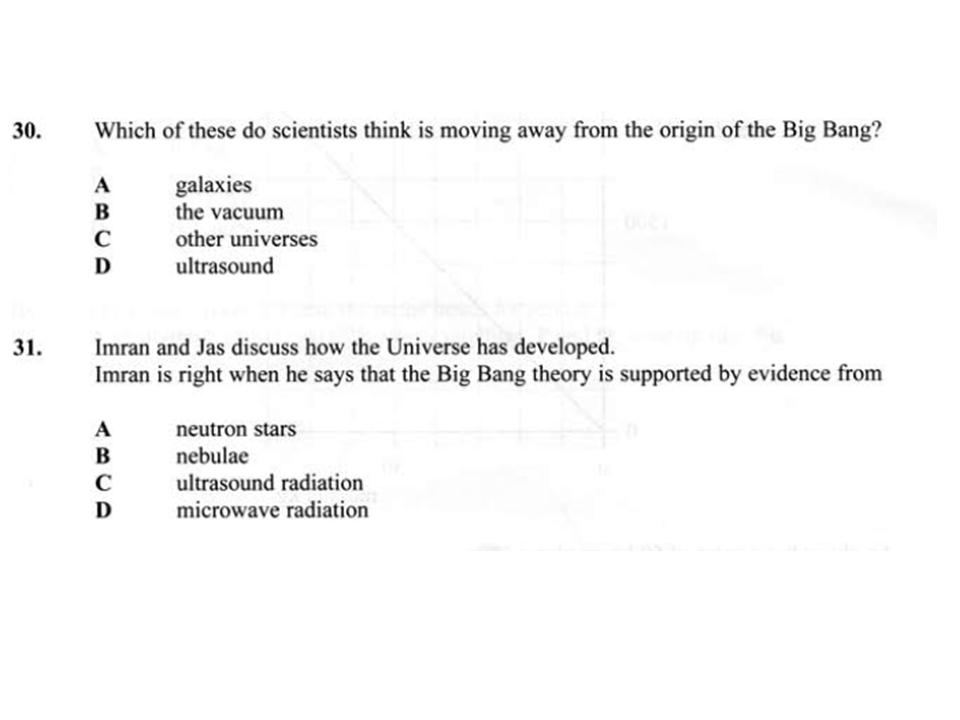 The answer to Q30 is, presumably, A. But do any scientists really think that galaxies are “moving away from the origin of the Big Bang”? I’m worried that this implies that the Big Bang was located at a specific point. Is that what they’re teaching?
Bearing in mind that only one answer is supposed to be right, the answer to Q31 is presumably D. But is there really no evidence from “nebulae” that supports the Big Bang theory? The expansion of the Universe was discovered by observing things Hubble called “nebulae”..
I’m all in favour of school students being introduced to fundamental things such as cosmology and particle physics, but my deep worry is that this is being done at the expense of learning any real physics at all and is in any case done in a garbled and nonsensical way.
Lest I be accused of an astronomy-related bias, anyone care to try finding a correct answer to this question?

The more of this kind of stuff I see, the more admiration I have for the students coming to study physics and astronomy at University. How they managed to learn anything at all given the dire state of science education in the UK is really quite remarkable.
I mentioned this a while ago, but I thought it wouldn’t do any harm to repeat the official advertisement here. Cardiff is going large (or at least larger) in experimental physics, and the first deadline is approaching..
..so get cracking with your applications now!
Chair in Experimental Physics
Reader/Senior Lecturer/Lecturer in Experimental Physics
School of Physics and Astronomy
As the first stage of a major initiative to broaden its research activity the School of Physics and Astronomy at Cardiff University has some immediate vacancies for permanent faculty positions at either full Professor/Reader/Senior Lecturer/Lecturer level in any area of Experimental Physics, other than Astrophysics.
Applications are welcome in fields new to the School as well as those complementary to the existing strengths. Candidates working in interdisciplinary areas with a firm Physics base are also welcomed. You will be expected to have demonstrated an established programme of research, and will also be expected to teach Physics at undergraduate and postgraduate level.
The School of Physics and Astronomy at Cardiff University has strong research groups in Photons & Matter (theory and experimental), Gravitational Physics and Nanophysics, as well as a large Astrophysics programme.
You should have a PhD in Physics, Mathematics or closely-related subject.
Salary:
A point on the Cardiff Professorial Salary Scale (Chair)
£45155 – £55535 per annum (Reader)
£37839 – £43840 per annum (Senior Lecturer)
£29853 – £35646 per annum (Lecturer)
Further information about the School may be found at http://www.astro.cardiff.ac.uk/
Informal enquiries regarding these positions may be made to Professor Walter Gear, Head of School, email Walter.Gear@astro.cardiff.ac.uk
To work for an employer that values and promotes equality of opportunity, visit www.cardiff.ac.uk/jobs telephone + 44 (0) 29 2087 4017 or email vacancies@cardiff.ac.uk for an application form quoting vacancy number 186 for the Chair position and 188 for the Reader/Senior Lecturer/Lecturer position.
Closing date: Friday, 23 July 2010.
Please note vacancies are for one Chair and three Senior Lecturer/Lecturer positions.
This is a recent discovery I just had to post. It was was made at a private recording session in 1943 in Kansas City, the home town of Charlie Parker. It was never released commercially and features Parker on alto saxophone with just a guitar and drum accompaniment. This recording must have been made during the musicians’ strike of 1942-44 that contributed to the fact the bebop movement (which Parker pioneered) was out of the public eye during its incubation period. Parker had moved to New York City in 1939 and was playing regularly in Harlem jazz clubs during the recording blackout, so I don’t know what he was doing back in Kansas City in 1943 to be making this track.
It’s a fascinating version of the tune called Cherokhee that Parker used as the basis of the bebop classic Ko-ko I discussed in a post last year, and which shows him already playing in a recognizably Parkeresque style, but only hinting at the harmonic adventurousness he was to develop just a year or two later; Ko-ko was first performed, I think, in 1945. Very few examples survive of his playing from this transitional period, so this is a fascinating bit of musical history as well as being a fine performance in its own right.
Interesting press release today from the Royal Astronomical Society about a paper (preprint version here) which casts doubt on whether the Wilkinson Microwave Anisotropy Probe supports the standard cosmological model to the extent that is generally claimed. Apologies if this is a bit more technical than my usual posts (but I like occasionally to pretend that it’s a science blog).
The abstract of the paper (by Sawangwit & Shanks) reads
Using the published WMAP 5-year data, we first show how sensitive the WMAP power spectra are to the form of the WMAP beam. It is well known that the beam profile derived from observations of Jupiter is non-Gaussian and indeed extends, in the W band for example, well beyond its 12.’6 FWHM core out to more than 1 degree in radius. This means that even though the core width corresponds to wavenumber l ~ 1800, the form of the beam still significantly affects the WMAP results even at l~200 which is the scale of the first acoustic peak. The difference between the beam convolved Cl; and the final Cl is ~ 70% at the scale of the first peak, rising to ~ 400% at the scale of the second. New estimates of the Q, V and W-band beam profiles are then presented, based on a stacking analysis of the WMAP5 radio source catalogue and temperature maps. The radio sources show a significantly (3-4σ) broader beam profile on scales of 10′-30′ than that found by the WMAP team whose beam analysis is based on measurements of Jupiter. Beyond these scales the beam profiles from the radio sources are too noisy to give useful information. Furthermore, we find tentative evidence for a non-linear relation between WMAP and ATCA/IRAM 95 GHz source fluxes. We discuss whether the wide beam profiles could be caused either by radio source extension or clustering and find that neither explanation is likely. We also argue against the possibility that Eddington bias is affecting our results. The reasons for the difference between the radio source and the Jupiter beam profiles are therefore still unclear. If the radio source profiles were then used to define the WMAP beam, there could be a significant change in the amplitude and position of even the first acoustic peak. It is therefore important to identify the reasons for the differences between these two beam profile estimates.
The press release puts it somewhat more dramatically
New research by astronomers in the Physics Department at Durham University suggests that the conventional wisdom about the content of the Universe may be wrong. Graduate student Utane Sawangwit and Professor Tom Shanks looked at observations from the Wilkinson Microwave Anisotropy Probe (WMAP) satellite to study the remnant heat from the Big Bang. The two scientists find evidence that the errors in its data may be much larger than previously thought, which in turn makes the standard model of the Universe open to question. The team publish their results in a letter to the journal Monthly Notices of the Royal Astronomical Society.
I dare say the WMAP team will respond in due course, but this paper spurred me to mention some work on this topic that was done by my friend (and former student) Lung-Yih Chiang. During his last visit to Cardiff we discussed this at great length and got very excited at one point when we thought we had discovered an error along the lines that the present paper claims. However, looking more carefully into it we decided that this wasn’t the case and we abandoned our plans to publish a paper on it.
Let me show you a few slides from a presentation that Lung-Yih gave to me a while ago. For a start here is the famous power-spectrum of the temperature fluctuations of the cosmic microwave background which plays an essential role in determining the parameters of the standard cosmology:
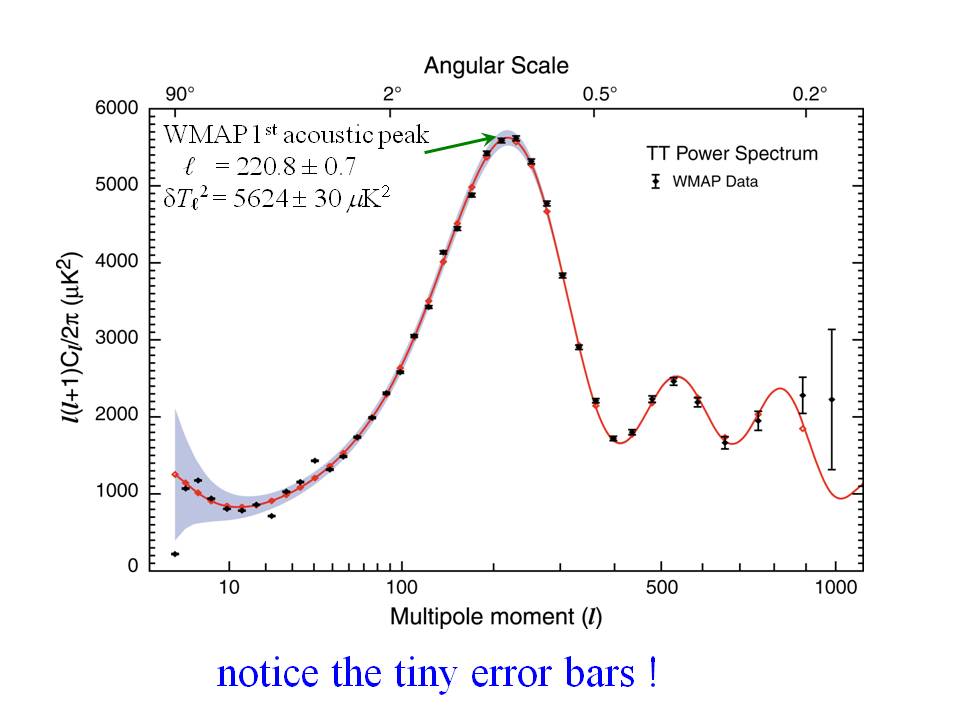
The position of the so-called “acoustic peak” plays an important role in determining the overall curvature of space-time on cosmological scales and the higher-order peaks pin down other parameters. However, it must be remembered that WMAP doesn’t just observe the cosmic microwave background. The signal it receives is heavily polluted by contamination from within our Galaxy and there is also significant instrumental noise. To deal with this problem, the WMAP team exploit the five different frequency channels with which the probe is equipped, as shown in the picture below.
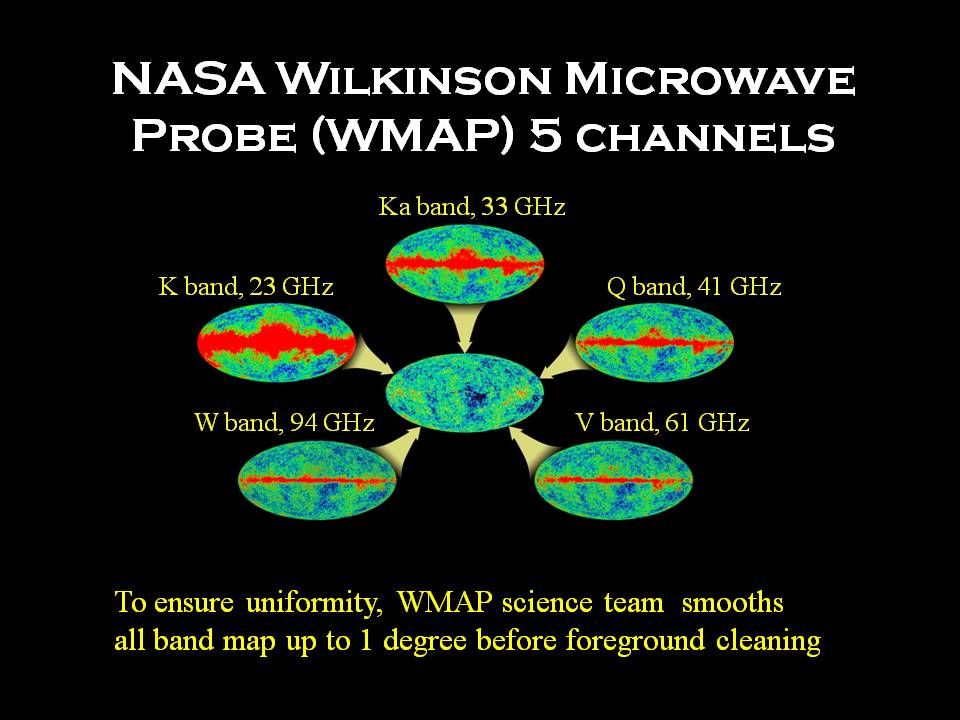
The CMB, being described by a black-body spectrum, has a sky temperature that doesn’t vary with frequency. Foreground emission, on the other hand, has an effective temperature that varies with frequency in way that is fairly well understood. The five available channels can therefore be used to model and subtract the foreground contribution to the overall signal. However, the different channels have different angular resolution (because they correspond to different wavelengths of radiation). Here are some sample patches of sky illustrating this
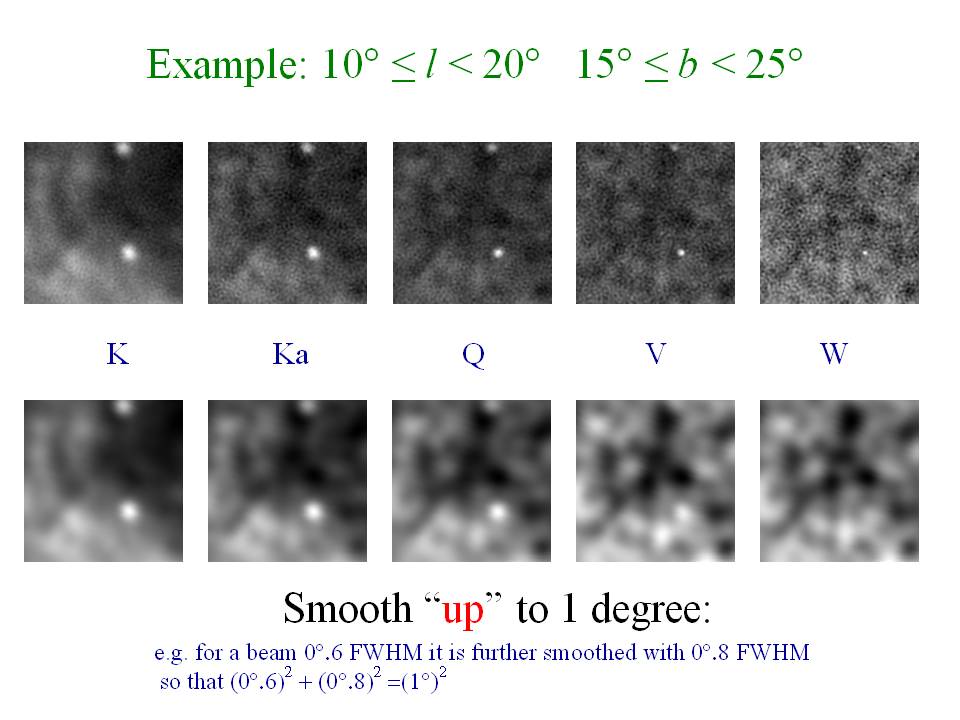
At each frequency the sky is blurred out by the “beam” of the WMAP optical system; the blurring is worse at low frequencies than at high frequencies. In order to do the foreground subtraction, the WMAP team therefore smooth all the frequency maps to have the same resolution, i.e. so the net effect of optical resolution and artificial smoothing produces the same overall blurring (actually 1 degree). This requires accurate knowledge of the precise form of the beam response of the experiment to do it accurately. A rough example (for illustration only) is given in the caption above.
Now, here are the power spectra of the maps in each frequency channel
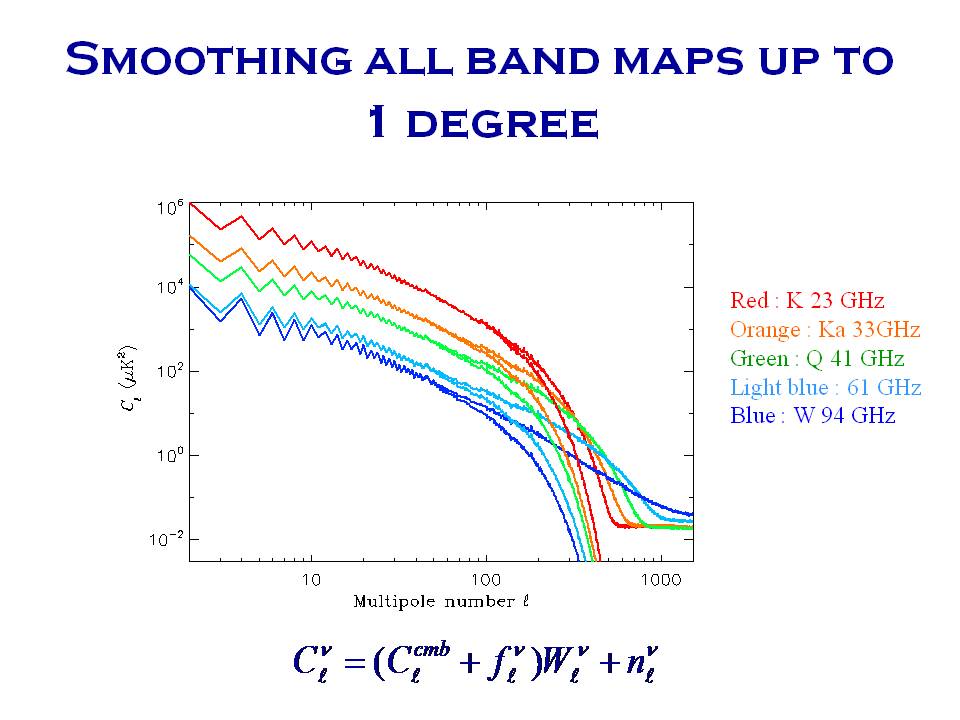
Note this is Cl not l(l+1)Cl as in the first plot of the spectrum. Now you see how much foreground there is in the data: the curves would lie on top of each other if the signal were pure CMB, i.e. if it did not vary with frequency. The equation at the bottom basically just says that the overall spectrum is a smoothed version of the CMB plus the foregrounds plus noise. Note, crucially, that the smoothing suppresses the interesting high-l wiggles.
I haven’t got space-time enough to go into how the foreground subtraction is carried out, but once it is done it is necessary to “unblur” the maps in order to see the structure at small angular scales, i.e. at large spherical harmonic numbers l. The initial process of convolving the sky pattern with a filter corresponds to multiplying the power-spectrum with a “window function” that decreases sharply at high l, so to deconvolve the spectrum one essentially has to divide by this window function to reinstate the power removed at high harmonics.
This is where it all gets very tricky. The smoothing applied is very close to the scale of the acoustic peaks so you have to do it very carefully to avoid introducing artificial structure in Cl or obliterating structure that you want to see. Moreover, a small error in the beam gets blown up in the deconvolution so one can go badly wrong in recovering the final spectrum. In other words, you need to know the beam very well to have any chance of getting close to the right answer!
The next picture gives a rough model for how much the “recovered” spectrum depends on the error produced by making even a small error in the beam profile which, for illustration only, is assumed to be Gaussian. It also shows how sensitive the shape of the deconvolved spectrum is to small errors in the beam.
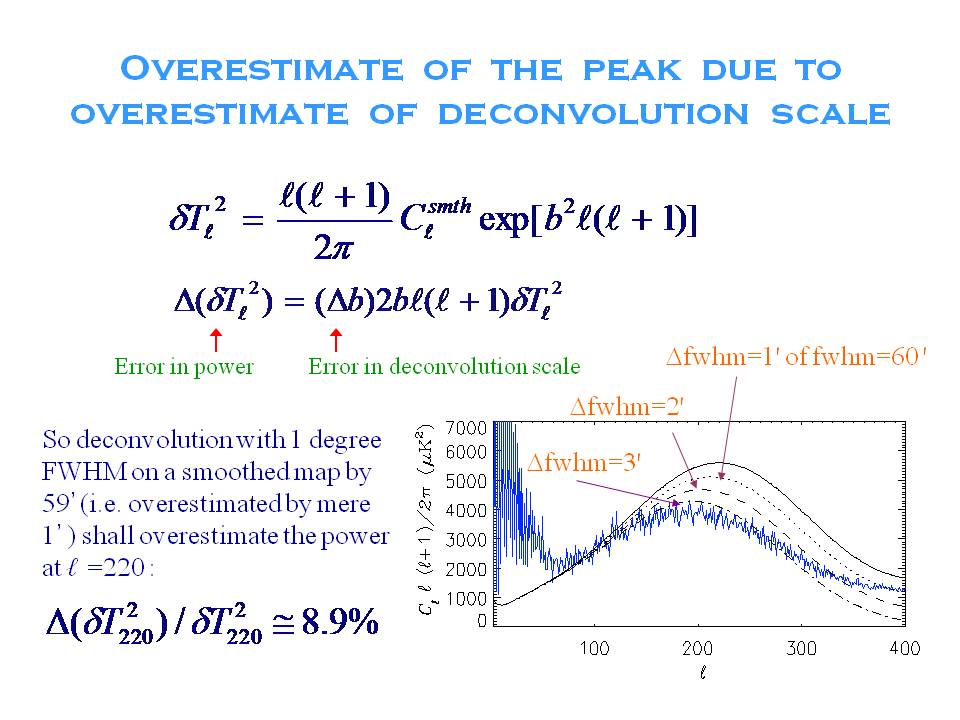
Incidentally, the ratty blue line shows the spectrum obtained from a small patch of the sky rather than the whole sky. We were interested to see how much the spectrum varied across the sky so broke it up into square patches about the same size as those analysed by the Boomerang experiment. This turns out to be a pretty good way of getting the acoustic peak position but, as you can see, you lose information at low l (i.e. on scales larger than the patch).
The WMAP beam isn’t actually Gaussian – it differs quite markedly in its tails, which means that there’s even more cross-talk between different harmonic modes than in this example – but I hope you get the basic point. As Sawangwit & Shanks say, you need to know the beam very well to get the right fluctuation spectrum out. Move the acoustic peak around only slightly and all bets are off about the cosmological parameters and, perhaps, the evidence for dark energy and dark matter. Lung-Yih looked at the way the WMAP had done it and concluded that if their published beam shape was right then they had done a good job and there’s nothing substantially wrong with the results shown in the first graph.
Sawangwit & Shanks suggest the beam isn’t right so the recovered angular spectrum is suspect. I’ll need to look a bit more at the evidence they consider before commenting on that, although if anyone else has worked through it I’d be happy to hear from them through the comments box!
Just finished my last batch of exam marking and am off to do today’s Azed so no time for a proper blog but I couldn’t resist putting up this brilliant skit on homeopathic medicine, passed on to me by Anton.
I offer this as my contribution to homeopathy awareness week.
I’ve spent most of today trying (and failing) to complete what’s left of my examination marking. Now I’ll have to finish it during the weekend, because I stopped this evening in order to catch a concert by the BBC National Orchestra (and, for the latter part) Chorus, of Wales at the splendid St David’s Hall here in Cardiff. It was broadcast live on BBC Radio 3, in fact, so if you happened to listen in at 7pm this evening then I was among the applauds. The programme was introduced by Catherine Bott, whose voice I’ve heard many times on the radio but have never actually seen before in the flesh, so to speak. There she was on stage doing the intro, as large as life. And that’s really quite large, I can tell you.
The concert featured two uncompleted works. First we had a piece completely new to me, which was intended to be the first movement of Gustav Mahler‘s 10th Symphony.The composer died a hundred years ago in 1910 having only just started this work. I’ve never heard this music before and it both fascinated and surprised me. It’s quintessentially Mahler in many ways, but it’s a strange opening for a symphony because it’s a very long Adagio movement (lasting about 30 minutes). I wonder how long the entire symphony would have been if Mahler had finished it? And how would it have developed?
I thought the single movement we heard was extraordinarily beautiful but then ever since I was introduced to Mahler I’ve been a complete devotee. In fact, I think if I could listen to Mahler all day I probably wouldn’t bother thinking about anything else at all. Thank you, John.
After the interval we heard the Mozart Requiem, with four excellent soloists and a choir added to the orchestra. Mozart only really finished two sections of this work, and we heard the standard completion of the rest of it done by Süssmayr. I don’t think anybody knows for sure exactly what was done by Mozart and what wasn’t, but the opening section is so spine-tinglingly marvellous it just has to be authentic Mozart. On the other hand, the sections for four voices don’t seem to have the magic that Mozart managed to conjure up in his operas so perhaps they aren’t of the same provenance. There’ll always be a mystery about this work, and I guess that will always be among its fascinations. In any case, even a little Mozart will always go a very long way.
Just over £20 for seats so close that I could read the score of the first Cello too. And people ask me why I moved to Cardiff!

 In the Dark