Archive for 2010

Universities Challenged

Posted in Education, Politics with tags , , , , , on June 10, 2010 by telescoper

The news headlines over the last couple of days have been dominated by remarks made by David Willetts, Minister for Universities and Science, who has called for a radical overhaul of the way UK universities are organized and funded. Predictably, his comments set alarm bells ringing about the savage cuts likely to be coming our way, but I hope it’s not just about slash-and-burn and that some imagination is applied to the problem of sorting out the mess the system has become. We’ll see.

According to a piece in the Guardian, for example, Willetts suggested that some students could study at smaller local colleges instead of going to a big university, but these colleges would teach courses designed and administered by the larger “elite” institutions, such as the University of London. This suggestion isn’t  exactly new because it’s actually how things used to work many years ago. In fact, Nottingham University, where I used to work used to be Nottingham University College and its degrees, along with those of a number of similar provincial universities, were University of London degrees. Nottingham University only got the power to award its own degrees in 1948. Of course, there wasn’t really such a thing as distance learning in those days, so there’s a possibility that a 21st Century revival of this basic idea could turn out very differently in terms of how things are actually taught.

On the up side of this suggestion is the fact that it would be a lot easier to maintain standards, if examinations were set by a common body. On the down side is the fact that the distinctive flavour of speciality courses taught in different colleges, which is a strength of research-led teaching, would be lost. In between these positives and negatives there is a huge grey area of questions, such as where the funding would go, precisely which universities should administer the changes and so on. A lot of thinking and planning will be  needed before anything like this could be implemented.

Let me add two more specific comments to this. First, I think Willetts’ suggestion would make a lot of sense here in Wales where it could be easily implemented by returning to the old University of Wales.  As I’ve mentioned before, as well as suffering from many of the problems besetting the English university system, the Principality has a few extra ones all its own. Among the most pressing is the proliferation of small colleges and the consequent duplication of administrative systems. I think a great deal of money could be saved and teaching quality improved by cutting out the unnecessary bureaucracy and having the smaller places administered by a larger central University (as Willetts imagined with the University of London).

My other comment is specific to my own subject, physics (and astronomy). The problem with this – and other laboratory based STEM subjects – is that it’s very difficult to imagine how they can actually be taught at all at degree level without access to research laboratories for, e.g., project work. This is why physics is only taught in 40-0dd of the 131 universities and colleges around the UK. You can call me old-fashioned, but I just don’t think it’s either possible or desirable to separate teaching from research in science subjects in the way this plan seems to suggest. I know some colleagues of mine disagree strongly with this, but there you go.

Behind this proposal is the issue of student funding, as it is at least partly motivated by the suggestion that students could stay at home and study at a local college instead of moving to a university further away, which would necessitate them taking out student loans which the Treasury has to pay out. 

There’s also the issue of fees. At the moment students in England are expected to pay a flat-rate annual fee of £3225. In addition to this the government pays to the University concerned an amount called the “Unit of Resource”. Last year, in England, the basic amount was around £4K but there is multiplier for more expensive courses. Clinical medicine, for example, attracts four times the basic rate. Subjects like physics and chemistry get a multiplier of 1.7 (so each student comes with around £6.7K of funding). Subjects with no laboratory component, i.e. most Arts and Humanities courses,  just get the bog-standard amount.

I think there’s an obvious problem with this system, namely that physics (and other science subjects) are  much more expensive to teach than the formula allows for. The total income per student for an arts subject would be about £7.2K, while that for physics is about £10K. Why bother with all that expensive laboratory space and shiny new kit when the funding differential is so small. That’s another reason why so many universities have scrapped their physics departments in favour of cheaper disciplines that generate a profit much more easily.

Coincidentally I attended a lunch yesterday with some of our soon-to-be-graduating students. I’ve been a member of a committee working on updating our Physics courses and we wanted to discuss the proposed changes with them. One of the group was a mature student who had already done an English degree (at another university). She said that a physics drgee was much harder work, but was impressed at how much more contact she had with staff. Like most physics department, virtually all our teaching is done by permanent academic staff. Students doing  Physics at Cardiff get about three times as many contact hours with staff as students doing English. It’s unfair to compare apples with oranges, but I’m convinced the funding model is stacked against STEM subjects.

The awful financial climate we’re in has led to a general sense of resignation that the government contribution to university education (the Unit of Resource) is going to decrease and the student contribution go up to compensate. However, there’s a Catch-22 here for the Treasury. If the tuition fee goes up students will have to borrow more, and the Treasury doesn’t want to take on more  subsidised student loans. It seems much more likely to me that the cuts will be achieved by simply reducing the number of funded places. However, in the light of what I argued above, I think this is a great opportunity to think about what is the correct Unit of Resource for different subjects. If we all agree the country needs more scientists and engineers, not less, I’d argue that funded places elsewhere should be cut, and that the difference between arts and science units of resource also be substantially increased.

I’d even go so far as to suggest that there should be zero-rated courses, i.e. those which students are welcome to take if they pay the full cost but to which the government will not contribute at all. That should put an end to the Mickey Mouse end of Higher Education provision once and for all.

PS. A review of the tuition fee system is currently taking place but isn’t due to report until the autumn. It is led by Lord Browne who was formerly the boss of BP. I wonder if there’ll be any leaks?

The Garden of Eros

Posted in Poetry with tags , on June 9, 2010 by telescoper

I was drawn to the idea of using this poem by Oscar Wilde as a blog post simply because I wanted something timely to celebrate the abundance of lovely flowers in my Garden, especially the Honeysuckle which has started dispensing an extraordinary perfume in the evenings. I hadn’t seen this poem before yesterday, but noticed that the (superb) first verse mentions the month of June, which made it especially timely:

It is full summer now, the heart of June,
Not yet the sun-burnt reapers are a-stir
Upon the upland meadow where too soon
Rich autumn time, the season’s usurer,
Will lend his hoarded gold to all the trees,
And see his treasure scattered by the wild and
spendthrift breeze.


Once I started reading it, however, I was completely captivated. Amongst other things, it’s a lament against the growth of materialism in the 19th Century. Although the language is as over-the-top as you would expect for Oscar Wilde, it’s a beautifully sustained work and Wilde’s natural flair for words shines throughout. He refers in admiration to a large number of other poets (including Keats, Shelley, Swinburne, Rossetti and William Morris), but I think it’s unfortunate that Wilde isn’t as much appreciated as a poet as he is as a playwright.

It’s not really feasible to post the entire text because it’s so very long but fortunately I found an excellent reading that lasts about 15 minutes so it’s split over two youtube-sized chunks. I hope you find time to listen to it all and simply bask in the glow of a true genius…

Pecha Kucha

Posted in Education with tags , , , , , on June 8, 2010 by telescoper

A few months ago I was invited to take part in an evening of Pecha Kucha in a hotel in Geneva. I’ll try anything once, so I agreed. I have to admit, though, that I wasn’t actually very good at it. Neither were any of the other scientists present.

No idea what a Pecha Kucha is? Well then you’re probably not an architect or an artist or a designer. Then again, you’re reading this blog so that’s pretty much a given anyway. Pecha Kucha is a style of presentation at which arty types display their portfolios in a strictly disciplined format. The standard form is twenty slides with twenty seconds allowed for each one, i.e. a total time of 6 minutes and 40 seconds. The timing is ruthlessly regulated.

Those of us scientists used to taking at least a few  minutes per slide find this format very challenging, but then that’s because we tend to have text and equations on our slides and they take some explaining. Designers and the like tend to just show pictures, and these should – if they’re any good – be pretty self-explanatory. I guess this is why the Pecha Kucha format is de rigeur in such disciplines while it has yet to catch on in physics.

I only just survived my initiation into the strange world of Pecha Kucha. Before being told what it was I thought it was a mountain in the Andes. I was reminded about it this morning by a tweet from John Butterworth (a particle physicist who, incidentally, has a nice blog of his own) confessing similar trepidation to what I experienced before I lost my Pecha Kucha virginity. The first time can be disappointing, but I hope he survived his inauguration.

Looking back on it though I think this might be an interesting idea to try in a physics context. We’re trying increasingly hard these to teach our physics and astronomy students transferable skills, but when it comes to presentations we’re fixated by the traditional presentation format. Why not get undergraduate students to do a Pecha Kucha about their project, instead of a 20-minute lecture? Why not include a Pecha Kucha in the PhD viva?

The more I think about it, the more attractive the idea seems. Has anyone out there tried a physics Pecha Kucha?

Cauchy Statistics

Posted in Bad Statistics, The Universe and Stuff with tags , , , , on June 7, 2010 by telescoper

I was attempting to restore some sort of order to my office today when I stumbled across some old jottings about the Cauchy distribution, which is perhaps more familiar to astronomers as the Lorentz distribution. I never used in the publication they related to so I thought I’d just quickly pop the main idea on here in the hope that some amongst you might find it interesting and/or amusing.

What sparked this off is that the simplest cosmological models (including the particular one we now call the standard model) assume that the primordial density fluctuations we see imprinted in the pattern of temperature fluctuations in the cosmic microwave background and which we think gave rise to the large-scale structure of the Universe through the action of gravitational instability, were distributed according to Gaussian statistics (as predicted by the simplest versions of the inflationary universe theory).  Departures from Gaussianity would therefore, if found, yield important clues about physics beyond the standard model.

Cosmology isn’t the only place where Gaussian (normal) statistics apply. In fact they arise  generically,  in circumstances where variation results from the linear superposition of independent influences, by virtue of the Central Limit Theorem. Noise in experimental detectors is often treated as following Gaussian statistics, for example.

The Gaussian distribution has some nice properties that make it possible to place meaningful bounds on the statistical accuracy of measurements made in the presence of Gaussian fluctuations. For example, we all know that the margin of error of the determination of the mean value of a quantity from a sample of size n independent Gaussian-dsitributed varies as 1/\sqrt{n}; the larger the sample, the more accurately the global mean can be known. In the cosmological context this is basically why mapping a larger volume of space can lead, for instance, to a more accurate determination of the overall mean density of matter in the Universe.

However, although the Gaussian assumption often applies it doesn’t always apply, so if we want to think about non-Gaussian effects we have to think also about how well we can do statistical inference if we don’t have Gaussianity to rely on.

That’s why I was playing around with the peculiarities of the Cauchy distribution. This comes up in a variety of real physics problems so it isn’t an artificially pathological case. Imagine you have two independent variables X and Y each of which has a Gaussian distribution with zero mean and unit variance. The ratio Z=X/Y has a probability density function of the form

p(z)=1/\pi(1+z^2),

which is a form of the Cauchy distribution. There’s nothing at all wrong with this as a distribution – it’s not singular anywhere and integrates to unity as a pdf should. However, it does have a peculiar property that none of its moments is finite, not even the mean value!

Following on from this property is the fact that Cauchy-distributed quantities violate the Central Limit Theorem. If we take n independent Gaussian variables then the distribution of sum X_1+X_2 + \ldots X_n has the normal form, but this is also true (for large enough n) for the sum of n independent variables having any distribution as long as it has finite variance.

The Cauchy distribution has infinite variance so the distribution of the sum of independent Cauchy-distributed quantities Z_1+Z_2 + \ldots Z_n doesn’t tend to a Gaussian. In fact the distribution of the sum of any number of  independent Cauchy variates is itself a Cauchy distribution. Moreover the distribution of the mean of a sample of size n does not depend on n for Cauchy variates. This means that making a larger sample doesn’t reduce the margin of error on the mean value!

This was essentially the point I made in a previous post about the dangers of using standard statistical techniques – which usually involve the Gaussian assumption – to distributions of quantities formed as ratios.

We cosmologists should be grateful that we don’t seem to live in a Universe whose fluctuations are governed by Cauchy, rather than (nearly) Gaussian, statistics. Measuring more of the Universe wouldn’t be any use in determining its global properties as we’d always be dominated by cosmic variance..


Among the Crachach

Posted in Education, Politics with tags , , , , on June 6, 2010 by telescoper

Catching up on the news by looking through my copy of last week’s Times Higher, I came across an account of a speech made by Welsh Assembly Minister Leighton Andrews about the Future of Higher Education in Wales. I mentioned this was coming up in an earlier post about the state of the Welsh university system, but wasn’t able to attend the lecture. Fortunately, however the text of the lecture is available for download here.

There is some discussion of positives  in the speech, including a specific enthusiastic mention of

the involvement of the School of Physics and Astronomy in the international consortium which built the Herschel Space Observatory.

I was pleased to see that, especially since much of the rest of it is extremely confrontational. Much of it focusses on the results of a recent study by accountants PriceWaterhouseCooper that revealed, among other things, that  52% of the funding provided by the Welsh Assembly Government for higher education goes on adminstration and support services, with only 48% to teaching and research. Mr Andrews suggests that about 20% of the overall budget could be saved by reducing duplication and introducing shared services across the sector.

I can’t comment on the accuracy of the actual figures in the report, but I wouldn’t be surprised if they were correct.  They might shock outsiders to the modern higher education system but most universities – not just those in Wales – seem to employ at least as many administrative staff and support staff as “front-line” teachers and researchers. I’m likewise sure that the Welsh Assembly employs many more such staff than there are Members…

Within academic Schools we need to employ staff to handle financial matters, student records, recruitment, admissions,  and general day-to-day administration. On top of that we have technical staff, to support both research and teaching laboratories as well as computing support staff. Add them all together and you definitely have a number comparable to the number of academic staff,  but  they don’t account for 52% of our salary bill because they are generally paid less than lecturers and professors. The mix in our School is no doubt related to the specific demands of physics and astronomy, but these staff all provide essential services and if they weren’t there, the academic staff would have to spend an even greater part of their time doing such things themselves.

As well as the staff working in individual Schools there are central administrative departments (in Cardiff they’re called “directorates”) which don’t employ academics at all. I have no idea what fraction of Cardiff’s budget goes on these things, but I suspect it’s  a big slice. My own anecdotal experience is that some of these are helpful and efficient while others specialise in creating meaningless bureaucratic tasks for academic staff to waste their time doing. I think such areas are where 20% savings might be achievable, but that would depend on the University having fewer and less complicated “initiatives” to respond to from the WAG.

The Times Higher story discusses the (not entirely favourable) reaction from various quarters to Mr Andrews speech, so I won’t go into it in any more detail here.

However, I was intrigued by one word I found in the following paragraph

 I was interested to learn recently that some members of university governing bodies have been appointed on the basis of a phone call. Who you know not what you know. It appears that HE governance in post devolution Wales has become the last resting place of the crachach.

Crachach? Being illiterate in the Welsh language this was a new one on me. However, I found an article on the BBC Website  that revealed all.

The term used to denote local gentry but 21st century crachach is the Taffia, the largely Welsh-speaking elite who dominate the arts, culture and media of Wales and to a lesser extent its political life.

It goes onto say

The Vale, Pontcanna and Whitchurch are crachach property hotspots while barn conversions in Llandeilo and cottages in Newport, Pembrokeshire, provide weekend retreats.

Hang on. Pontcanna? That’s where I live! I wonder if they let foreigners join the crachach, provided of course they learn the Welsh language? I note however that “arts culture and the media” is their remit, so science apparently doesn’t count. Perhaps I could start a scientific wing? Maybe those Welsh lessons will be useful after all. I’m told that the crachach always manage to get tickets for the big rugby matches…

On a more serious note, however, that part of Leighton Andrews’ speech stressed the importance of university governance. If he’s true to his word he should look into the Mark Brake affair. I think the taxpayers of Wales have a right to know what’s been going on.

Signs of the Times

Posted in Biographical, Science Politics, The Universe and Stuff with tags , , , on June 5, 2010 by telescoper

Well, I’m back from sunny Copenhagen to a very muggy Cardiff. I arrived by train just as this afternoon’s rugby match between Wales and South Africa finished so I got caught up in the crowds and had to follow a lengthy diversion to get home. I was a bit tetchy with the heat and feeling a bit tired, but feel a bit mellower now after a nice shower. Apparently it was a cracking game, with Wales losing narrowly to the Springboks in the end. I missed it all.

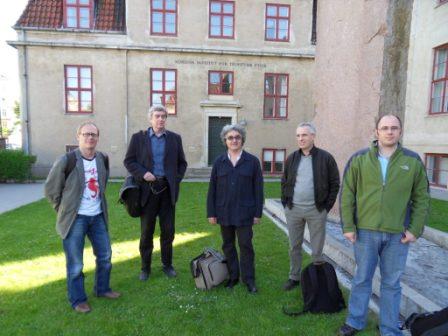
Not feeling like doing anything more energetic blogwise, I thought I’d just put up a few pictures of the trip before making dinner. I heard while I was in Copenhagen that there are plans to relocate the historic Niels Bohr Institute to new accommodation nearby. I’m very attached to the old place and I think it will be a terrible shame if the original buildings are flogged off or bulldozed. I believe that’s not going to happen but I’m not sure what their fate is going to be. Anyway, I asked one of the locals, Tamara Davis, to take a picture in front of the sign outside the old NORDITA  building, looking grumpy, to show my disapproval. I think she caught the mood perfectly.

Actually, Tamara isn’t really a local because she’s Australian, but she spends a couple of months a year in Denmark at the Dark Cosmology Centre, which is about ten minutes’ walk from the Niels Bohr Institute. I sat next to her at the conference dinner and found out that she’s also an international quality Ultimate Frisbee player. I wish I could pretend I knew what that was, but it sounds impressive. The fact that she’s training for a major event at the moment meant that she wasn’t drinking much wine so, being a gentleman, I drank the surplus on her behalf.

I wonder if there’s such a sport as Penultimate Frisbee?

Here’s another picture in front of the same building, featuring some folks from the workshop.

From left they are Dominik Schwarz (Bielefeld, Germany), Anthony Lasenby (Cambridge, UK), Carlo Burigana (Bologna, Italy),  Sabino Matarrese (Padova, Italy) and Paolo Natoli (Rome, Italy).

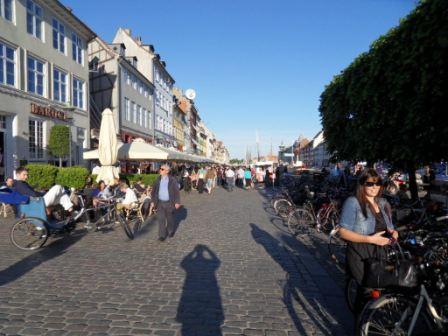
Last one shows the view in the evening sun looking down towards the picturesque old harbour area, called Nyhavn. I took this in anticipation of a nice cold beer among the crowds of people out enjoying themselves in the lovely weather. I wasn’t disappointed!

The Meaning of Inflation

Posted in Biographical, The Universe and Stuff with tags , , on June 4, 2010 by telescoper

Our little meeting here in Copenhagen is more-or-less over and I’ve now got a free day to enjoy my birthday. It’s a lovely sunny morning and I’m looking forward to being a tourist. Yesterday we had a busy day of talks and discussions followed by a pleasant dinner in a nearby restaurant. One of the good things about small informal meetings like this is that you really get the chance to ask proper questions and have a meaningful dialogue, although sometimes things get a bit heated – especially when people like Leonid Grishchuk are present!

Leonid’s talk yesterday contained various polemical statements about cosmic inflation involving words like “bullshit” and “nonsense”. In the subsequent discussion the question arose as to what, precisely, the word inflation means.

In a nutshell, cosmic inflation is the name given to a short period of rapidly accelerating expansion in the very early Universe that caused it to expand by an enormous factor and also laid down a spectrum of fluctuations through quantum-mechanical processes.  Inflation is a part of the standard “Big Bang” cosmological model, and there is a great deal of circumstantial evidence for it having happened and it’s a very elegant theory. I think it’s safe to say that there isn’t definitive proof but it’s certainly a thriving industry associated with its many versions.

However, the point is that there are many variants of the basic inflationary universe scenario – involving different fields, energy scales and so on – and, although they share some common features, they also differ dramatically from one to the other. What, it was asked, are the essential elements of inflation and what bits are just the trimmings?

In order to contribute meaningfully to the discussion I called upon the assistance of the Oxford English Dictionary to see how it defines inflation. The result was unexpectedly hilarious. Here are the first four definitions as they appear in the OED’s online edition:

  1. The action of inflating or distending with air or gas
  2. The condition of being inflated with air or gas, or being distended or swollen as if with air
  3. The condition of being puffed up with vanity, pride or baseless notions
  4. The quality of language or style when it is swollen with big or pompous words; turgidity, bombast

I was quite surprised that definitions to do with economics only appear further down the list, but cosmology’s position even lower down wasn’t unexpected.   However, the leading entries are brilliant, especially definition number 3, which I think is hilarious. I’ll never be able to mention inflation again without thinking of that!

I fear I may have given Leonid quite a bit of ammunition for future anti-inflation rants although if he uses the phrase “baseless notions” in future talks he should perhaps also be careful  to steer clear of “bombast”…

My Sweet Prince

Posted in Music with tags , on June 3, 2010 by telescoper

Being here in Copenhagen has made me very nostalgic, so I thought I’d be a bit self-indulgent and post something a bit different from my usual, in remembrance of things past.

Never thought I’d have to retire
Never thought I’d have to abstain

(Guest Post) FQXi

Posted in The Universe and Stuff with tags on June 2, 2010 by telescoper

I’m happy to post the following message from Brendan Foster of the Foundational Questions Institute in order to help advertise their Large Grants Program. I should make clear that I have no formal connection with this Institute so if you have any questions about the program please contact them as advised in the post. And if you wish to apply, good luck!

-0-

I’d like to announce the 2010 round of the Foundational Questions
Institute
(FQXi) Large Grants Program.  Initial applications are due
in under two weeks, so get started now!

FQXi is an independent, philanthropically funded non-profit organization.  Our mission is to catalyze, support, and disseminate research on questions at the foundations of physics and cosmology.  We want to bring special focus to new frontiers and innovative ideas integral to a deep understanding of reality, but unlikely to be supported by conventional funding sources.

As part of our mission, we now invite proposals for research on foundational questions in physics and cosmology. The focus for this grant round is “Time and Foundations”.  We wish to especially encourage projects targeted on the Nature of Time. To quote from the Request for Proposals, “The topic of Time is of both deep and broad interest for research in foundational questions in physics and cosmology. Science, and particularly physics, has produced dramatic insights into the nature of time…Careful consideration of time has
likewise caused revolutions in physics, and may again do so.”

We will also consider more general proposals of exceptional quality, including suitable outreach projects. All proposed projects should qualify as foundational and unconventional. You can get a sense of the range of supported work by checking out the funded projects from the previous grant rounds, at

http://www.fqxi.org/grants/large/awardees/list

The application consists of a two-step, online process, with review by an external panel of experts.  The Initial Proposal is short and simple, consisting of little more than a page of summary and a rough budget. You should have more than enough time to get ready by the Initial Proposal deadline: June 14, 2010 (midnight, EST).

We will then invite selected proposals to be expanded into Full Proposals based on the selections of the Review Panel.  Funds for approved Full Proposals will be available (via a Donor Advised Fund) soon after January 1, 2011.

To view full instructions and the application form, go to

http://www.fqxi.org/grants/large/initial

The deadline again is Monday, June 14.

While you’re at it, visit our blog and online forums, at

http://fqxi.org/community

You’ll find articles, essays, and discussions on foundational physics questions, including the Nature of Time.  Send any questions to us at mail@fqxi.org.

Discovering Copenhagen

Posted in The Universe and Stuff with tags , , on June 2, 2010 by telescoper

Here I am, again, in the fine city of Copenhagen in Denmark. It’s a lot warmer here than last time I was here, in January, but I’m here for a short meeting at the Discovery Center which we be held on the premises of the Niels Bohr Institute over the next few days.

It looks like being a funny little meeting, because  nobody is allowed to talk about any Planck results yet so most speakers are talking about extraneous matters, almost like they’ll be talking about their hobbies. Should be fun. I haven’t decided what I’ll talk about yet, but my talk isn’t until tomorrow…

I travelled yesterday from Heathrow Airport with Leonid Grishchuk who I met in the airport. It turns out he had checked in extra-specially early for the the short flight to Copenhagen. The result of this enthusiasm was that his bags didn’t arrive with the plane. After filing a lost luggage report the usually avuncular Leonid turned into grumpy Grishchuk for the short Metro journey downtown. I saw him at breakfast just now and he told me his bag had actually been delivered to the hotel late last night. All’s well that ends well. It sounds like it must have come on the later flight, which probably means it never left Heathrow.

I was worried for a while I was going to miss the flight because my train from Cardiff was late as a result of being stuck in the Swansea area behind a broken-down train. Despite the delay and the fact that only one automatic check-in machine was working at the airport, I still had plenty of time to make the flight. My bag was one of the first out of the carousel.

Our meeting doesn’t start until lunchtime, so I’m going to take a walk around and do a little sightseeing beforehand. I know the city fairly well, but it will be nice to see how things have changed over the years. If memory serves, I think the first time I came here was in 1988. Quite a few of the places I went during that time have now closed but then I’m too old now to go them anyway!