Archive for 2010

The Day After

Posted in Finance, Politics with tags on May 7, 2010 by telescoper

I wasn’t planning to stay up last night watching the General Election results come in, but in the end I stuck with it until about 3am, basically hoping to understand what was going on.  Even by that hour there didn’t seem to be a particularly clear pattern emerging, so off I went. I had a revision lecture this morning as well as a lot of other things so I didn’t fancy an all night sitting.

Whenever there’s a General Election I always pay attention to constituencies I used to live in to see how things are changing. Broxtowe (the constituency that contains Beeston, where I used to live when I worked at Nottingham University) changed hands from Labour to the Conservatives. It had been a Conservative marginal in 1997 when it was won during the New Labour landslide. It seemed fairly typical for seats like that to revert to what they were pre-Blair. Brighton – remarkably – returned Britains first ever Green Party MP. Bethnal Green returned to the Labour fold after a flirtation with George Galloway’s Respect party.

Meanwhile here in Cardiff the results were as mixed as elsewhere. My own constituency, Cardiff West, stayed Labour, as did Cardiff South (and Penarth). The Vale of Glamorgan reverted to its pre-1997 Tory hue, unsurprisingly. The Labour candidate in Cardiff North was the wife of former Welsh Assembly leader Rhodri Morgan and it was a definite surprise to see that seat turn blue too. Cardiff Central remained Liberal Democrat.

As it has turned out the exit polls got it just about right, with the Conservative Party leading the popular vote (36%) and number of  seats (306), but not enough to make an overall majority. Labour (28%, 258 seats) and Liberal Democrats (23%, 57 seats) between them have a majority of the votes cast but don’t have enough seats to form a coalition. It’s a well and truly hung Parliament and we look set for days of discussions to see what kind of agreement can be reached between which parties. Gordon Brown remains Prime Minister until some kind of resolution is reached. We live in interesting times.

Although the election results were extremely interesting by virtue of their puzzlingly inhomogeneous variation across the country,  they really amount to little more than a sideshow compared with the spreading panic on international markets. The markets fell sharply, not because of the hung parliament but as part of a worldwide panic over the knock-on effect of the Greece and Portugal sovereign debt problems. The contagion could be very dangerous if Greece can’t convince traders that it’s not going to default and in an attempt to do so its government has put together a severe austerity package. Cue violent unrest. The Greeks live in even more interesting times than us.

I’m not going to pretend that I have the slightest clue how either of these things will pan out, but I’m not very optimistic about the forthcoming months. I hope I’m wrong. We’ll see.

The other thing that struck me  was the story of people being unable to vote because of long queues at the polling stations near 10pm when they closed. At first I wasn’t at all sympathetic. Polls are open from 7am until 10pm, so there’s no need to turn up with only 5 minutes remaining. However, it then emerged that  some polling stations couldn’t cope with the large turnout and people had been queuing for hours by the time the doors closed. The turnout was 65% nationally, higher than last time but by no means ridiculously high. In fact I think it’s a shame the usual turnout  isn’t very much higher than this. However, turnout seems to have been much higher in certain wards and the staff unprepared for the demand, sometimes with insufficient ballot papers and sometimes with out-of-date copies of the electoral register. I don’t mind saying that I found this level of incompetence deeply shaming. We can’t afford to be so careless with our democratic system. It doesn’t matter if only a few hundred people were affected. It’s the principle that matters.

Over the next few days there’ll be a lot of discussion about electoral reform. Perhaps the fact that our current electoral system seems to be showing signs of neglect might generate some impetus for change, quite apart from the scandals of MPs fiddling their expenses. I’ve always been on the fence over proportional representation. Our system is absurd in some respects, delivering huge majorities in the Commons to parties with only a modest share of the popular vote. On the other hand our country is so divided that it’s not obvious what the short-term consequences of changing to PR would be. It seems likely, for one thing, that fringe parties such as the neo-fascist BNP would actually be represented in Westminster. I find that a repulsive prospect, but putting up with people you can’t abide is one of the consequences of democracy.

I have an open mind on electoral reform and I’d like to hear the arguments for and against different systems of PR aired properly. Presumably the Liberal Democrats will want a referendum on this as part of the price of their support in a coalition, so no doubt there’ll be a lot of chat about this.

Polling Day

Posted in Biographical, Politics with tags , , on May 6, 2010 by telescoper

At last we’ve reached General Election day and I’ve just been to cast my vote following the guidance I passed on a few days ago. I was going to go this morning but I had a meeting at 9.15am to go to (which went on until 1pm, in fact) and I didn’t get up in time to visit the polling station, even though it’s in a Church Hall only a few hundred yards from my house. When I eventually got there just after 7pm it was still quite busy and I had to queue to get my ballot paper. It was very different during last year’s European elections, where the turnout is always pretty low. I don’t know what the turnout is like this time, but I hope it’s good. I don’t think there’s really any excuse for not voting.

I’ve already explained why I’m not as caught up in the campaigning this time as I have been in previous years, so I doubt if I’ll stay up late to watch the results come in. Polls don’t close until 10pm and until then there’s a blackout of press coverage relating to the vote so there’s nothing to follow until quite late at night, when I’m usually tucked up in bed with my cocoa.  The latest opinion polls suggest that the Conservative Party will get the biggest share of the vote, but it’s not clear if they’ll win a majority of the seats. Nor should they, in fact, even if they get as high a share as the polls suggest (37%) then that’s still far less than the number that didn’t vote for them. Labour and LibDems are together worth about 55%. The likelihood therefore is a hung parliament, at which point we’ll probably find all parties agreeing with each other to the implement massive spending cuts they’ve been carefully keeping from the electorate. It will still be interesting to see how the horse-trading works out over the next few days, but after three weeks of phoney war we’ll soon have to face up to reality. I’m not really looking forward to that.

Anyway, a comment by Keith Ashman on an item I posted a few days ago reminded me that no less than 13 years ago I was actually in Lawrence, Kansas, on polling day. Don’t ask me why. I’d arranged a postal vote, but had to watch the proceedings from afar on the TV. In fact, Keith and his partner decided to hold a party that night in their house and I went along to drink beer while the results came in. Watching a British election from the midwest USA is a bit strange, but it’s improved by the fact that the polls close in the UK at what is early evening Kansas-time and it’s all pretty much over by midnight.

That election I was swept up in the euphoria generated by the prospect of a New Labour government with its slogan “Things can only get better”. When they won a landslide majority we celebrated in grand style, singing Jerusalem in Keith’s back garden and then tottered not too soberly to a tattoo parlour to have a red rose put on my arm.

We had a great time that night, and the good vibes continued after I returned to London from my short stay at the University of Kansas. It didn’t take long, however, for my enthusiasm to wane. Instead of doing the really radical things their large majority would have allowed, they basically pratted about for four years. I’m not saying they didn’t do any good things, but they were so keen to tie everyone up in red tape that the good ideas often came to nothing except frustration. Then of course Blair took us into Iraq and I vowed never again to vote for the Labour Party until it renounced that decision, which I haven’t.

But I’ve still got the red rose tattoo.

First Science from Herschel

Posted in The Universe and Stuff with tags , , , on May 4, 2010 by telescoper

A comment posted today on a previous item reminded me that this is supposed to be a science blog, so I thought it would be a good idea to put up a brief message about the status of Herschel.

Today is the first day of the Herschel First Results Symposium which is being held on the premises of ESTEC at Noordwijk in The Netherlands; you can see the poster below. There’s quite a strong Cardiff contingent there, and the meeting will go on until Friday, so it’s a going to be a bit quiet around here for the rest of the week.

The results being presented at this Symposium are covered by a strict ESA policy and most of them are embargoed, at least  for the time being. However, you can keep up with the meeting to some extent on Twitter, as I’ve been doing from time to time. Just follow #eslab2010. There are also edited highlights on the Herschel Mission Blog. It’s a bit frustrating only getting the odd snippet, but it does at least give you an idea of what’s going on and a heads-up for things that will be released officially soon.

In fact pretty soon a load of Herschel images and other results will be made public and I’ll be spoilt for choice as to what to post on here. In fact, I think all the presentations at the Symposium will be put online after it’s finished. There’s also going to be a deluge of science papers on the arXiv, the result of a lot of hard work (not to say a total panic) by those directly involved in analysing the first data to come through from the telescope. I’m looking forward to that, although there’s no way I’ll have time to read them all!

It’s hard to believe that it’s just a little under a year since we gathered in a state of nervous tension (moderated by a steady intake of alcohol) to watch the launch of Planck and Herschel. I don’t think I’m giving away any secrets when I write that the mission has been an outstanding success so far, even exceeding its specified performance in some respects.

I’ll be posting some Herschel goodies from time to time once the embargo is lifted, but until that happens you’ll just have to wait. I could tell you more but if I did I’d have to kill you.

PS. To return to my first sentence, I’m not even sure I should call this a science blog. I think of it as a personal blog, written by a person who happens to be a scientist…

Over the Rainbows

Posted in Jazz with tags , , , , , on May 3, 2010 by telescoper

I had the misfortune a few weeks ago to see a bit of a terrible BBC TV show called Over the Rainbow, the main aim of which seems to be to use TV License payers’ money to provide free advertising for a forthcoming West End production of the Wizard of Oz. Anyway, when I was thinking yesterday about cover versions of tunes that turned out better than the original, the tune Over the Rainbow sprang to mind. Since I’ve been on holiday today – studiously avoiding doing very much at all – I thought I’d put up some interesting jazz versions of that particular song.

There are hardly any tunes ever written that some jazz musician somewhere hasn’t taken a fancy to and done their own original version, however unpromising the raw material. Louis Armstrong had a particularly amazing ability to turn base metal into solid gold, making glorious music out of tunes nobody else wanted to touch. I’ve picked three quite different versions of Over the Rainbow, all of which I think are brilliant despite the mawkish sentimentality of the original song.

The first is from a concert by Keith Jarrett in Tokyo in 1984. As well as being a brilliant jazz musician, Jarrett is an accomplished classical performer who, for example, made an exceptionally fine recording of Bach’s Goldberg Variations a few years ago. Quite a few people seem to get put off by watching his antics at the keyboard. I can see why. I think he sometimes looks like the piano is playing him, rather than the other way around. But if his contortions bother you, just listen to the music, which is just gorgeous… 

When I was still at school back in 1980 or 81 I had the good fortune to get to see the great alto saxophonist Art Pepper playing live with a band led by pianist Milcho Leviev. He played so beautifully on that concert that I became an immediate fan and tried to get hold of as many of his records as I could. I was devastated to hear just a couple of years later that he had died. Like many jazz musicians of his generation, Art Pepper had a serious drugs problem and he spent long periods in jail as a consequence. He joked that San Quentin Prison had better musicians than any establishment on Earth.

His tender, lyrical sound and graceful improvisations are  beautifully represented on this track recorded with George Cables (piano) and – I think – Charlie Haden (bass) and Billy Higgins on drums.

The last one up is by the great Bud Powell. He was another musician who struggled with narcotics, but he also had serious mental illness to deal with – he suffered numerous breakdowns and was heavily medicated in an attempt treat his schizophrenia. Although he moved to Paris in 1959 to make a fresh start, his self-destructive tendencies caught up with him. The quality of his playing deteriorated, his behaviour became erratic and he eventually died in 1966. Before leaving the States, however, Powell had made a number of recordings in which he demostrated the virtuousity and musical imagination that established him as one of the greatest jazz pianists of all time, and certainly the leading stylist of the bebop era.

Bud Powell’s version of Over the Rainbow is one of my all-time favourite pieces of music. He puts so much variation into the way he plays it, alternating a lush romantic style with jagged boppy lines and dark undertones introducing a strong element of parody juxtaposed with a more orthodox treatment of the melody. As much as I love the other two versions, this is my a favourite. By any standards, it is a masterpiece.

Nobody’s fault but mine

Posted in Jazz, Uncategorized with tags on May 2, 2010 by telescoper

It being a rainy bank holiday weekend, I’ve been working, although I didn’t start until I’d done the Sunday crosswords and watched the football on the telly. Now it’s too late to post anything substantial, so I’ll resort to something from my back catalogue of bookmarked masterpieces from Youtube. This is a wonderful bluesy gospelly piece by the late great Nina Simone, a rare example in my opinion of a cover version being better than the original (in this case by Blind Willie Johnson).

Incidentally, I wonder if either of my regular readers can think of cover versions better than the original? Jeff Buckley’s intensely moving  version of Leonard Cohen’s great song Hallelujah springs to mind, but I’d be interested to hear other suggestions…

Skepsis

Posted in Politics, The Universe and Stuff with tags , , , , , , on May 1, 2010 by telescoper

This past week was the final week of proper teaching at Cardiff University, so I’ve done my last full lectures, tutorials and exercise classes of the academic year. Yesterday I assessed a bunch of 3rd-year project talks, and soon those students will be handing in their written reports for marking.  Next week will be a revision week, shortly after that the examinations begin. And so the cycle of academic life continues, in a curious parallel to the  football league season – the other routine that provides me with important markers for the passage of the year.

Anyway, this week I gave the last lecture to my first-year class on Astrophysical Concepts. This is a beginning-level course that tries to introduce some of the theory behind astronomy, focussing on the role of gravity. I cover orbits in newtonian gravity, gravity and hydrostatic equilibrium in extended bodies, a bit about stellar structure, gravitational collapse, and so on. In the last part I do a bit of cosmology. I decided to end this time with a lecture about dark energy as, according to the standard model, this accounts for about 75% of the energy budget of the Universe. It’s also something we don’t understand very well at all.

To make a point, I usually show the following picture (credit to the High-z supernova search team).

 What is plotted is the redshift of each supernova (along the x-axis), which relates to the factor by which the universe has expanded since light set out from it. A redshift of 0.5 means the universe was compressed by a factor 1.5 in all dimensions at the time when that particular supernova went bang. The y-axis shows the really hard bit to get right. It’s the estimated distance (in terms of distance modulus) of the supernovae. In effect, this is a measure of how faint the sources are. The theoretical curves show the faintness expected of a standard source observed at a given redshift in various cosmological models. The bottom panel shows these plotted with a reference curve taken out so the trend is easier to see.

The argument from this data is that the high redshift supernovae are fainter than one would expect in models without dark energy (represented by the \Omega_{\Lambda}  in the diagram. If this is true then it means the luminosity distance of these sources is greater than it would be in a decelerating universe. They can be accounted for, however, if the universe’s expansion rate has been accelerating since light set out from the supernovae. In the bog standard cosmological models we all like to work with, acceleration requires that \rho + 3p/c^2 be negative. The “vacuum” equation of state p=-\rho c^2 provides a simple way of achieving this but there are many other forms of energy that could do it also, and we don’t know which one is present or why…
This plot contains the principal evidence that has led to most cosmologists accepting that the Universe is accelerating.  However, when I show it to first-year undergraduates (or even to members of the public at popular talks), they tend to stare in disbelief. The errors are huge, they say, and there are so  few data points. It just doesn’t look all that convincing. Moreover, there are other possible explanations. Maybe supernovae were different beasties back when the universe was young. Maybe something has absorbed their light making them look fainter rather than being further away. Maybe we’ve got the cosmological models wrong.

The reason I show this diagram is precisely because it isn’t superficially convincing. When they see it, students probably form the opinion that all cosmologists are gullible idiots. I’m actually pleased by that.  In fact, it’s the responsibility of scientists to be skeptical about new discoveries. However, it’s not good enough just to say “it’s not convincing so I think it’s rubbish”. What you have to do is test it, combine it with other evidence, seek alternative explanations and test those. In short you subject it to rigorous scrutiny and debate. It’s called the scientific method.

Some of my colleagues express doubts about me talking about dark energy in first-year lectures when the students haven’t learned general relativity. But I stick to my guns. Too many people think science has to be taught as great stacks of received wisdom, of theories that are unquestionably “right”. Frontier sciences such as cosmology give us the chance to demonstrate the process by which we find out about the answers to big questions, not by believing everything we’re told but by questioning it.

My attitude to dark energy is that, given our limited understanding of the constituents of the universe and the laws of matter, it’s the best explanation we have of what’s going on. There is corroborating evidence of missing energy, from the cosmic microwave background and measurements of galaxy clustering, so it does have explanatory power. I’d say it was quite reasonable to believe in dark energy on the basis of what we know (or think we know) about the Universe.  In other words, as a good Bayesian, I’d say it was the most probable explanation. However, just because it’s the best explanation we have now doesn’t mean it’s a fact. It’s a credible hypothesis that deserves further work, but I wouldn’t bet much against it turning out to be wrong when we learn more.

I have to say that too many cosmologists seem to accept the reality of dark energy  with the unquestioning fervour of a religious zealot.  Influential gurus have turned the dark energy business into an industrial-sized bandwagon that sometimes makes it difficult, especially for younger scientists, to develop independent theories. On the other hand, it is clearly a question of fundamental importance to physics, so I’m not arguing that such projects should be axed. I just wish the culture of skepticism ran a little deeper.

Another context in which the word “skeptic” crops up frequently nowadays is  in connection with climate change although it has come to mean “denier” rather than “doubter”. I’m not an expert on climate change, so I’m not going to pretend that I understand all the details. However, there is an interesting point to be made in comparing climate change with cosmology. To make the point, here’s another figure.

There’s obviously a lot of noise and it’s only the relatively few points at the far right that show a clear increase (just as in the first Figure, in fact). However, looking at the graph I’d say that, assuming the historical data points are accurate,  it looks very convincing that the global mean temperature is rising with alarming rapidity. Modelling the Earth’s climate is very difficult and we have to leave it to the experts to assess the effects of human activity on this curve. There is a strong consensus from scientific experts, as monitored by the Intergovernmental Panel on Climate Change, that it is “very likely” that the increasing temperatures are due to increased atmospheric concentrations of greenhouse gas emissions.

There is, of course, a bandwagon effect going on in the field of climatology, just as there is in cosmology. This tends to stifle debate, make things difficult for dissenting views to be heard and evaluated rationally,  and generally hinders the proper progress of science. It also leads to accusations of – and no doubt temptations leading to – fiddling of the data to fit the prevailing paradigm. In both fields, though, the general consensus has been established by an honest and rational evaluation of data and theory.

I would say that any scientist worthy of the name should be skeptical about the human-based interpretation of these data and that, as in cosmology (or any scientific discipline), alternative theories should be developed and additional measurements made. However, this situation in climatology is very different to cosmology in one important respect. The Universe will still be here in 100 years time. We might not.

The big issue relating to climate change is not just whether we understand what’s going on in the Earth’s atmosphere, it’s the risk to our civilisation of not doing anything about it. This is a great example where the probability of being right isn’t the sole factor in making a decision. Sure, there’s a chance that humans aren’t responsible for global warming. But if we carry on as we are for decades until we prove conclusively that we are, then it will be too late. The penalty for being wrong will be unbearable. On the other hand, if we tackle climate change by adopting greener technologies, burning less fossil fuels, wasting less energy and so on, these changes may cost us a bit of money in the short term but  frankly we’ll be better off anyway whether we did it for the right reasons or not. Of course those whose personal livelihoods depend on the status quo are the ones who challenge the scientific consensus most vociferously. They would, wouldn’t they? Moreover, as Andy Lawrence pointed out on his blog recently, the oil is going to run out soon anyway…

This is a good example of a decision that can be made on the basis of a  judgement of the probability of being right. In that respect , the issue of how likely it is that the scientists are correct on this one is almost irrelevant. Even if you’re a complete disbeliever in science you should know  how to respond to this issue, following the logic of Blaise Pascal. He argued that there’s no rational argument for the existence or non-existence of God but that the consequences of not believing if God does exist (eternal damnation) were much worse than those of behaving as if you believe in God when he doesn’t. For “God” read “climate change” and let Pascal’s wager be your guide….

Honour the Fate you are

Posted in Poetry with tags , , on April 30, 2010 by telescoper

Poetry again, Auden this time. I’ve always loved this, one of his “quest” poems, although I’m not sure the last verse really works.

ATLANTIS

Being set on the idea
Of getting to Atlantis
You have discovered of course
Only the Ship of Fools
Is making the voyage this year,
As gales of abnormal force
Are predicted, and that you
Must therefore be ready to
Behave absurdly enough
To pass for one of The Boys,
At least appearing to love
Hard liquor, horseplay and noise.

Should storms, as may well happen,
Drive you to anchor a week
In some old harbour-city
Of Ionia, then speak
With her witty scholars, men
Who have proved there cannot be
Such a place as Atlantis:
Learn their logic, but notice how its subtlety betrays
Their enormous simple grief;
Thus they shall teach you the ways
To doubt that you may believe.

If later, you run aground
Among the headlands of Thrace,
Where with torches all night long
A naked barbaric race
Leaps frenziedly to the sound
Of conch and dissonant gong;
On that stony savage shore
Strip off your clothes and dance, for
Unless you are capable
Of forgetting completely
About Atlantis, you will
Never finish your journey.

Again, should you come to gay
Carthage or Corinth, take part
In their endless gaiety;
And if in some bar a tart,
As she strokes your hair, should say
‘This is Atlantis, dearie,’
Listen with attentiveness
To her life-story: unless
You become acquainted now
With each refuge that tries to
Counterfeit Atlantis, how
Will you recognise the true?

Assuming you beach at last
Near Atlantis, and begin
That terrible trek inland
Through squalid woods and frozen
Tundras where all are soon lost;
If, forsaken then, you stand,
Dismissal everywhere,
Stone and snow, silence and air,
O remember the great dead
And honour the fate you are,
Travelling and tormented,
Dialectic and bizarre.

Stagger onwards rejoicing;
And even then if, perhaps
Having actually got
To the last col, you collapse
With all Atlantis shining
Below you yet you cannot
Descend, you should still be proud
Just to peep at Atlantis,
In a poetic vision:
Give thanks and lie down in peace,
Having seen your salvation.

All the little household gods
Have started crying, but say
Goodbye now, and put out to sea.
Farewell, my dear, farewell: may
Hermes, master of the roads
And the four dwarf Kabiri,
Protect and serve you always;
And may the Ancient of Days
Provide for all you must do
His invisible guidance,
Lifting up, dear, upon you
The light of His countenance.

House of Cards

Posted in Finance, Politics with tags , , , on April 29, 2010 by telescoper

There’s now only a week left until polling day in the General Election, and I’ve managed to avoid blogging about it as much as possible. The main reason for this is that I feel almost entirely disconnected from the whole thing, as if it’s all a bit unreal. One of the things in the news this week sparked a memory of something I wrote a few weeks ago which, in turn, made me realise why I find it difficult to take this election seriously.

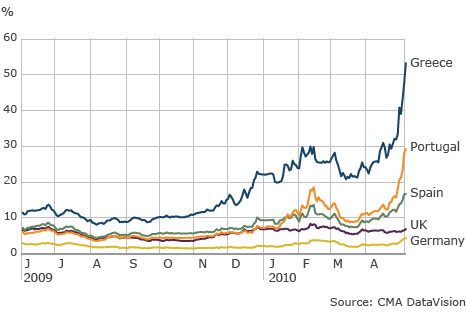
It emerged on Tuesday that the international money markets had downgraded Greece’s credit rating to “junk” status. Portugal and, more recently, Spain have since been downgraded too, but not as far as Greece. Yet. The reason for this downgrading is that analysts doubt whether these countries will be able to control their public spending sufficiently in order for them to honour huge levels of sovereign debt. The probability that Greece in particular will default in a big way has been growing steadily, according to the calculations of financial experts, and has now reached the level at which traders are adopting strategies that essentially involve betting on this actually happening.

The consequence of all this turmoil is that Greece would have to borrow money at huge levels of interest – over 15% – in order to carry on. The eurozone countries – particularly Germany – are trying to put together a package that that can be paid back at less ruinous rates, but while they continue to debate the details the panic continues.

The knock-on effect of a Greek default would be to remove money from the balance sheets of banks and financial institutions around the world. If a  bank has holdings of Greek debt, and the Greeks default, then the bonds become worthless and billions of pounds disappear off its balance sheet. Some British banks are exposed in this way, but nowhere near as much as France, Germany and Switzerland.

The baleout of Greece may work, but if it doesn’t it looks likely that Greece will be ejected from the euro and will have to take drastic measures to set its house in order. Fine, you might say. They’ve been living beyond their means for too long. That’s true. But so has Spain, which suffered even more than the UK from a housing bubble that went pop and is left with a huge budget deficit.  Spain is too large an economy to be rescued, even by Germany.  A default there, and there’s a real possibility of a chain reaction that will probably mean  curtains for the euro and possibly a real meltdown of the global financial system.  I’m just surprised that it has taken since 2007 for phase 2 of the global financial crisis to start. I think the contagion is still spreading.

 By some measures, our economy is in even worse shape than Spain’s.  However, the reason the markets haven’t downgraded us yet is that we’ve been given a stay of execution by the imminent general election. I’m sure analysts will be looking for very prompt and effective action to tackle our budget deficit if they are not going to put us through the wringer like they did with Greece. Greece, Portugal and Spain are all relatively recent democracies and it’s not obvious their governments can deliver huge public spending cuts and survive the resulting social unrest intact. They certainly haven’t managed to convince the markets they can anyway.

 What’s clear from the UK general election campaign is that none of the main political parties is willing to go public about the scale of the challenge facing whoever takes office after the election. The recent budget did a bit of trim around the edges here and there, and the party manifestos talk about the odd billion here and there in savings, but these are dwarfed by the real scale of our deficit. It seems the politicians have agreed to keep quiet about this to avoid frightening the electorate. When the votes are counted we’re going to get a rude awakening. The general election campaign is just a bizarre masquerade that’s too ridiculous to get involved in.

The scale of what could happen here is indicated by what’s happening in Ireland. Politicians here are talking about a public sector pay freeze. Ireland is actually cutting salaries in the public sector by up to 20%. I think the next UK government is going to have to do something similar or we’ll suffer the same fate as Greece. These next three years are going to be very grim for those of us working in the public sector, or at least for those who decide to stay in the UK.

We generally like to think we’re a mature democracy that’s a bit more sensible that all those mediterranean hotheads and that we’ll be able to grin and bear it for the sake of the economy. However, I’m old enough to remind the Winter of Discontent and it’s by no means obvious to me that cuts on the necessary scale will go through without sustained opposition. If – as seems likely – we end up with a coalition government with a fragile majority, this sort of thing could easily bring it down. If the markets see political instability in the UK they will certainly start downgrading our credit rating too. Public borrowing will  become more expensive, deeper spending cuts will be needed, and Britain be well and truly scuppered.

Science Fiction

Posted in Poetry on April 28, 2010 by telescoper

I haven’t posted any poems for a while so I thought I’d put one up this morning.  However, just to make things a bit different I thought I’d make this one into a little quiz. This is called Science Fiction and it’s from a second-hand paperback book of poems I bought ages ago and I wonder if any of you know who wrote it?  Of course it’s quite easy to stick the words in google and find out that way, but see if you can figure it out without doing that.

Or maybe you know anyway…

Science Fiction

What makes us rove that starlit corridor
May be the impulse to meet and face
Our vice and folly shaped into a thing,
And so at last ourselves; what lures us there
Is simpler versions of disaster:
A web that shuffles time and space,
A sentence to perpetual journeying,
A wotrld of ocean without shore,
And simplest, flapping down the poisoned air,
A ten-clawed monster.

In him, perhaps, we see the general ogre
Who rode our ancestors to nightmare,
And in his habitat their maps of hell.
But climates and geographies soon change,
Spawning mutations none can quell
With silver sword or thaumaturge’s ring
Worse than their sides, of wider range,
And much more durable.

Black Hole Hunter

Posted in The Universe and Stuff with tags , , , on April 27, 2010 by telescoper

A discussion yesterday with one of my colleagues in the gravitational physics group here in Cardiff gave me the idea of including a little advert here for a fun website called Black Hole Hunter.

The site was developed as a part of the Royal Society Summer Exhibition 2008, Can you hear black holes collide? presented by Cardiff University, and the Universities of Birmingham, Glasgow and Southampton in the UK in collaboration with the Albert Einstein Institute and Milde Marketing in Germany.

The idea is to use your skill, judgement and lugholes to detect the gravitational wave signal from the merger of two black holes in the noisy output of a gravitational wave detector. The image on the left shows the pattern of gravitational radiation as calculated numerically using Einstein’s general theory of relativity. Why not give it a try and see how you get on?

You can play here.