Archive for July, 2011

Never mind the Higgs, where’s the Supersymmetry?

Posted in The Universe and Stuff with tags , , , , , on July 25, 2011 by telescoper

There’s been a big conference on High Energy Physics going on in Grenoble since last Thursday, which I’ve been following a little bit via Tweets from various participants and links to blog articles contained therein. The media seem to be almost exclusively focussed on the Higgs boson but, as is made clear in a Guardian blog article by John Butterworth, the situation is that the latest data from the Large Hadron Collider do not provide clear evidence for it yet. Strangely, though, the Guardian ran another piece at the weekend claiming that “CERN scientists suspect a glimpse of the Higgs”, which appears to have been based on a blog article which offers various possible interpretations of a set of measurements which lie at the margin of statistical significance. It must be very frustrating not having a clear detection, but this  strikes me as clutching at straws. Far better to wait for more data before speculating in public. Nobody really expected to see the Higgs so soon, so it’s surely better to wait for more data rather than  over-interpreting what’s there. Let’s put it down to overenthusiasm.

However the real point of the latest news is not in my view the lack of, or marginal nature of, evidence for the Higgs Boson. It’s the extremely strong limits that have been placed on supersymmetry. This is of particular (geddit?) interest to me as a cosmologist because supersymmetric theories provide us with plausible candidates for the non-baryonic dark matter we think pervades the Universe.  The possibilities include fermionic counterparts of the bosons that mediate the standard model interactions. The photon, for example, which is a boson, mediates the electromagnetic interaction between charged particles; in SUSY theories it would have a fermionic partner called a photino. There would also be the Higgsino (assuming there is a Higgs!), gluino, gravitino and so on. Supersymmetry is a beautiful idea and many theorists love it to bits, but there isn’t a shred of evidence that has anything to do with the way nature is.

The search for supersymmetry is thus more directly relevant to my work than the Higgs, in fact, but the Large Hadron Collider was largely “sold” to politicians and the public in terms of the quest for the Higgs.  That’s the MacGuffin, as Alfred Hitchcock would have said. Actually the LHC will do many other things, but I guess it’s easier to make the case for funding to government if you have one Big Idea rather than lots of smaller ones.

Anyway, a piece from New Scientist today hits the nail on the head. While the Higgs search may or may not be producing tantalising clues, the searches for supersymmetry has drawn a complete blank. Zilch. Nada. Not the merest smidgeon of a scintilla. The class of supersymmetric theories is broad and no doubt many possibilities remain viable; the current measurements only rule out the “minimal” variety. But I think this is a timely reminder not to take nature for granted. Perhaps an  ugly fact is about to slay a beautiful hypothesis…

UPDATE: Bookmaker Paddy Power has shortened the odds on a Higgs discovery this year from 12-1 against to 3-1 on.

What do children need to develop in science during KS3 and KS4? (via 13scidave)

Posted in Education with tags , , , , , on July 25, 2011 by telescoper

I thought I’d reblog this post in order to send some traffic in its direction. The piece is asking for input concerning the science curriculum for Years 7 to 11. We didn’t have Years like this when I was at School, so I’ll translate this as meaning the age group 11 to 16, i.e. secondary school.

I’m going to have a think before I post a comment on the site, but I will do eventually, and I hope many of you will consider doing likewise.

You’ll have already gathered that I’m a school science adviser with the Hampshire Science Team. We support all schools in Hampshire in trying to develop exciting and inspiring science, as well as helping children make the best possible progress. Schools often feel under pressure to ‘teach to the test’ in order to achieve good examination results and this pressure can actually impede the development of good scientific thinking. Yesterday we began … Read More

via 13scidave


Round Midnight

Posted in Music with tags , , on July 25, 2011 by telescoper

During the afternoon’s play at the Test Match on Saturday I picked up on Twitter the sad news of the death, at the age of 27, of singer Amy Winehouse, an event which susbsequently stirred up the internet pondlife as much and as tastelessly as the actions of Anders Behring Breivik.  I don’t really follow pop music much these days, but Amy Winehouse caught my ear when she recorded a version of the Thelonious Monk jazz classic Round Midnight and I was impressed that she had taken on such challenging material, although the track itself is horribly overproduced.

For what it’s worth I think that Amy Winehouse was an exceptionally talented singer, in an age that celebrates mediocrity rather than talent, although she sadly never came to terms with her addictions to drugs and alcohol. I feel sadness at her passing, not least because her potential remained largely unfulfilled. For those who cling to the belief that taking drugs somehow accompanies or even enhances musical ability, I can only offer this quote from another supremely gifted but tragically dissolute singer, Billie Holiday:

Dope never helped anybody sing better or play music better or do anything better. All dope can do for you is kill you – and kill you the long, slow, hard, way.

Billie was 44 when she died, so she lasted longer than Amy, but they trod a similar path. Both made great music despite, and in no way because of, being drug addicts.

As well as sadness, though, I also feel disgust, as much for the vultures picking over Amy Winehouse’s remains after her death as for the parasites that profited from her addiction during her life.  No addict can be cured of his or her addiction by another person – one has to take control of oneself in order to do that – but that does not make it right to simply mock a junkie as the newspapers did relentlessly with Amy Winehouse, willing the car crash to happen. Well, it worked. She’s dead now. I hope they’re proud.

Amy Winehouse’s life and death represent a kind of Shakespearean tragedy, in that her character contained the seeds of its own destruction and that her life seems largely to have been acted out for the “enjoyment” of others. I hope  her death serves as a warning to those youngsters who have been tempted to emulate her.  There are enough dangers in the world without being a danger to yourself.

Rest in Peace, Amy Winehouse (1983-2011).

A Refusal to Mourn

Posted in Poetry with tags , , on July 24, 2011 by telescoper

This poem by Dylan Thomas, arguably his greatest, was first published just after the end of the Second World War and was written after Thomas heard news of a young girl who had burned to death when the house she was in was set on fire during an air raid. The full title is A Refusal to Mourn the Death by Fire of a Child in London.

The idea behind the poem is complex, and its message double-edged,  but Thomas finds a perfect balance between horror and sadness, and between indignation and heartbreak. Children shouldn’t have to die, and neither should anyone else whose life is cut short by another’s hand, but we have to accept that they can and do.  There’s no consolation to be found in mourning  and in any case it’s hypocritical to favour one death with elegies, when suffering is so widespread. The best we can do is allow the dead some dignity.

During my delayed journey yesterday I passed some of the time by following the reaction on Twitter to the terrible events in Norway. I wish I hadn’t. Such events bring out the ghloulish worst in some people, and the worst of the worst is always to be found on the internet. Going online is sometimes like lifting the lid on a cesspit.

I was going to post something myself, but having realised that I don’t really care much for what other people think about this, I can see no point in adding to the blizzard of opinion. Far better to post this, which expresses everything I might have aspired to say far more eloquently than I ever could.

Never until the mankind making
Bird beast and flower
Fathering and all humbling darkness
Tells with silence the last light breaking
And the still hour
Is come of the sea tumbling in harness

And I must enter again the round
Zion of the water bead
And the synagogue of the ear of corn
Shall I let pray the shadow of a sound
Or sow my salt seed
In the least valley of sackcloth to mourn

The majesty and burning of the child’s death.
I shall not murder
The mankind of her going with a grave truth
Nor blaspheme down the stations of the breath
With any further
Elegy of innocence and youth.

Deep with the first dead lies London’s daughter,
Robed in the long friends,
The grains beyond age, the dark veins of her mother,
Secret by the unmourning water
Of the riding Thames.
After the first death, there is no other.

The Lord’s Day

Posted in Cricket with tags , , , , , , on July 24, 2011 by telescoper

Time for a brief report on yesterday’s Big Day Out to London to watch the third day’s play of the First Test between England and India at Lord’s. The journey there passed off without a hitch, and I got into London a shade after 9am. It’s a fairly short walk from Paddington to Lord’s (if you know the way!) and the queue to get in moved pretty quickly, so  I was inside the ground well before 10am, scoffing a splendid bacon sandwich in the Warner stand, adjacent to the pavilion.

The weather wasn’t quite as good as I’d hoped – overcast most of the day, and not particularly warm – but we got started on time at 11am and had a full day’s play. The ground was full, and there was a good atmosphere, with a sizeable contingent of Indian supporters adding to that special buzz you get on the Saturday of a Test Match at Lord’s.

Conditions, being conducive to swing, were fairly helpful to the bowlers, although it took them a while to find their line (especially in the case of Tremlett, who also kept bowling no-balls). Of the two Indian openers, Mukund looked far the more assured; his partner, Gambhir struggled in comparison. This pair took the total to 63 without too many alarms until Stuart Broad was brought into the attack and proved to be the pick of the England bowlers. He quickly disposed of Gambhir for a slow 15 of 46 balls, managing to squeeze a full delivery between bat and pad.

That brought in Raul Dravid, who batted most of the rest of the day for a very fine century (103 not out). Mukund, who had scored the lion’s share of the runs in the opening partnership, got to 49 and stuck there for quite some time, held up by the accuracy of England’s bowling and, one suspects, nerves at the prospect of a half-century at Lord’s. Eventually he reached for a wide ball from Broad to drive and, rather unluckily, played on.

That brought in one of the all-time greats Sachin Tendulkar (to a warmly-felt standing ovation from the Lord’s crowd). I had been looking forward for ages to see him play.  One or two early alarms notwithstanding, Tendulkar and Dravid looked increasingly secure and began to score freely against the attacking field placings set by England captain Andrew Strauss. It was starting to look like  a mammoth Indian score might be on the cards when, somewhat surprisingly to me, Tendulkar edged one from Broad and a sharp chance was snaffled by Swann at slip; he was gone for 34 and India were 158 for 3.

There then followed a fascinating period of play, in which Swann (who hadn’t bowled before lunch) twirled away from the Pavilion End while a combination of quick bowlers (first Broad, and then Tremlett) steamed in from the Nursery End. England dropped two catches in one over from Broad, and Swann was posing problems but not making a breakthrough. Laxman, who had come in to replace Tendulkar looked all at sea and eventually played a rash lofted pull shot, which was caught right in front of us at deep backward square leg. India 182 for 4 was soon 183-5 as Raina went lbw to Swann, who deserved a wicket, although he did tend to bowl a bit short on occasions.

Mindful of the possibility of a collapse, the Indian batsmen went into their shells and there followed an absorbing period of attritional cricket, as Dhoni and Dravid steadied the ship. Then Dhoni was caught at slip of Tremlett – who bowled much better later in the day – to be replaced by Harbhajan Singh who survived one no-ball before playing a dreadful shot which resulted in him being caught at the wicket by Prior.

At 241-7 India were in real danger of being forced to follow on (which can be enforced if the team batting second does not get within 200 runs of the first innings total; England scored 474-8, so India needed to reach 275 to avoid it). In strode Kumar who made it quite clear what his strategy was going to be by clubbing his first ball for 4. He played  a variety of shots in his short innings – some authentic, some agricultural – not only adding entertainment value, but also taking India to 276 before skying a hook shot and getting caught.  Neither the injured Khan (batting with a runner) nor Sharma troubled to scorers and India ended up all out for 286, with Dravid remaining unbeaten until the end.

It was getting fairly dark at this point, about 6.30pm, and England couldn’t have been relishing the 5 overs they had to face before the close but they survived without loss, and I headed off back to Paddington. A thoroughly enjoyable day’s cricket and, I might add, quite a few beers. I also took a bit of time off the cricket to take a stroll around the perimeter of the stadium, which is an interesting thing to do as there are many shops and catering outlets around. The main shop at Lord’s is a bit of a disappointment, however, full of ugly overpriced tat, but  at least no hideous paperweights.

Anyway, many thanks to my genial host for the day – we were in the part of the ground reserved for members and their guests – old friend and regular contributor this blog, Anton.

Unfortunately the journey home wasn’t so enjoyable. I got the train on time, but we stopped just past Swindon where it appeared that all power had been lost on the signals between Swindon and Bristol Parkway. We sat motionless and then trundled back to Swindon, eventually setting off again via Gloucester, of all places. I’m glad I took a good long book with me, as the crossword didn’t take very long. I was supposed to be at Cardiff Central at 21.47, but didn’t actually arrive until 11.27, 1 hour and 40 minutes late. Columbo was most annoyed.

A Day Out

Posted in Cricket with tags , , , , on July 23, 2011 by telescoper

Here I am, up at the crack of dawn for a day trip to the Home of Cricket. The plan is to see the Third Day of the 1st Test between England and India at Lord’s, which just happens to be the 2000th Test Match and the 100th between these two countries.  England seem to have the upper hand after Day 2, in which Kevin Pietersen scored a double century and England declared on 474 for 8. India survived without losing a wicket to end on 17-0 at stumps. With some time lost to rain, and India a very strong batting side, it looks like a draw is the most likely outcome but I’m really looking forward to Day 3, during which I hope to have the privilege of seeing the great Sachin Tendulkar bat. This is the 100th Test Match between England and India, and Tendulkar might score his 100th Test International century in it. If he does I will be the first to congratulate him, but I won’t mind if he’s out for a duck either! Anyway, the weather forecast is pretty good and however the match goes I’m looking forward to my day out. Not sure it will be the best I’ve ever had, but then..

Astronomy Look-alikes, No. 60

Posted in Astronomy Lookalikes with tags , on July 22, 2011 by telescoper

I’m struck by the remarkable similarity between cosmologist Will Percival of Portsmouth University and James Murdoch, heir apparent to the disintegrating empire of News International. I wonder if, by any chance, they might be related (to Rupert Murdoch)?

Will Percival

James Murdoch

Please Fire Me

Posted in Poetry with tags , , on July 22, 2011 by telescoper

Here comes another alpha male,
and all the other alphas
are snorting and pawing,
kicking up puffs of acrid dust

while the silly little hens
clatter back and forth
on quivering claws and raise
a titter about the fuss.

Here comes another alpha male–
a man’s man, a dealmaker,
holds tanks of liquor,
charms them pantsless at lunch:

I’ve never been sicker.
Do I have to stare into his eyes
and sympathize? If I want my job
I do. Well I think I’m through

with the working world,
through with warming eggs
and being Zenlike in my detachment
from all things Ego.

I’d like to go
somewhere else entirely,
and I don’t mean
Europe.

by Deborah Garrison

The Curious Case of the Twisted Ring

Posted in The Universe and Stuff with tags , , , , , , , on July 21, 2011 by telescoper

Just time for a quickie this morning, prompted by the appearance of our own Professor Matt Griffin on the Today programme on BBC Radio 4 earlier on talking about newly published results from the Herschel Space Observatory. I didn’t hear it live as I’m strictly a Radio 3 person, but it must have made a pleasant change from stories about the imminent collapse of the euro and continuing extraordinay revelations about widespread corruption involving the British media, police force and political establishment. Among all this doom and gloom it’s nice to hear news of something that’s actually successful.

Anyway, the news from Herschel is that it has unveiled a ring structure in the centre of our Milky Way galaxy. The ribbon of gas and dust is more than 600 light years across and appears to be twisted, for reasons which have yet to be explained. The origin of the ring could yield important clues about the history of the Milky Way.

Warmer gas and dust from the Centre of our Galaxy is shown in blue in the  image below, while the colder material appears red. The ring, in yellow, is made of gas and dust at a temperature of just 15 degrees above absolute zero. The bright regions are denser, and include some of the most massive and active sites of star formation in our Galaxy.

and here it is with the curious ring drawn on with crayons:

The central region of our Galaxy is dominated by an elongated structure, rather like a bar, which stirs up the material in the outer galaxy as it rotates over millions of years and is probably connected with the spiral structure seen in the disk of the Milky Way. The ring seen by Herschel lies right in the middle of this bar, encircling the region which harbours a super-massive black hole at the centre of our galaxy. The ring of gas is twisted, so we see two loops which appear to meet in the middle. These are seen in yellow in the image above, tilted slightly such that they run from top-left to bottom-right. Secondly, it seems to be slightly offset from the very centre of our Galaxy. The reason for the ring’s twist and offset are unknown, but understanding their origin may help explain the origin of the ring itself. Computer simulations indicate that bars and rings such as those we see in the centre of our Galaxy can be formed by gravitational interactions, either within the Milky Way itself or between it and the nearby Andromeda galaxy, M31.

For the experts, and others interested, the scientific paper containing these results can be found here.

Haloes, Hosts and Quasars

Posted in The Universe and Stuff with tags , , , , , , , , on July 20, 2011 by telescoper

Not long ago I posted an item about the exciting discovery of a quasar at redshift 7.085. I thought I’d return briefly to that topic in order (a) to draw your attention to a nice guest post by Daniel Mortlock on Andrew Jaffe’s blog giving more background to the discovery, and (b) to say  something  about the theoretical interpretation of the results.

The reason for turning the second theme is to explain a little bit about what difficulties this observation might pose for the standard “Big Bang” cosmological model. Our general understanding of galaxies form is that gravity gathers cold non-baryonic matter into clumps  into which “ordinary” baryonic material subsequently falls, eventually forming a luminous galaxy forms surrounded by a “halo” of (invisible) dark matter.  Quasars are galaxies in which enough baryonic matter has collected in the centre of the halo to build a supermassive black hole, which powers a short-lived phase of extremely high luminosity.

The key idea behind this picture is that the haloes form by hierarchical clustering: the first to form are small but  merge rapidly  into objects of increasing mass as time goes on. We have a fairly well-established theory of what happens with these haloes – called the Press-Schechter formalism – which allows us to calculate the number-density N(M,z) of objects of a given mass M as a function of redshift z. As an aside, it’s interesting to remark that the paper largely responsible for establishing the efficacy of this theory was written by George Efstathiou and Martin Rees in 1988, on the topic of high redshift quasars.
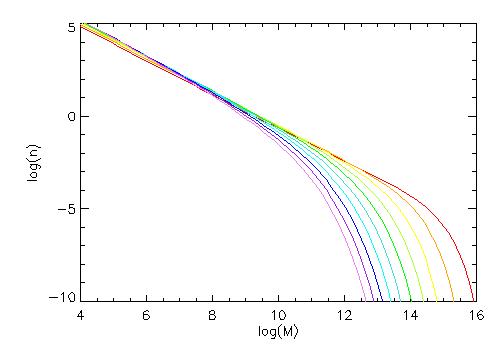
Anyway, courtesy of my estimable PhD student Jo Short, this is how the mass function of haloes is predicted to evolve in the standard cosmological model (the different lines show the distribution as a function of redshift for redshifts from 0 to 9):

It might be easier to see what’s going on looking instead at this figure which shows Mn(M) instead of n(M).

You can see that the typical size of a halo increases with decreasing redshift, but it’s only at really high masses where you see a really dramatic effect.

The mass of the black hole responsible for the recently-detected high-redshift quasar is estimated to be about 2 \times 10^{9} M_{\odot}. But how does that relate to the mass of the halo within which it resides? Clearly the dark matter halo has to be more massive than the baryonic material it collects, and therefore more massive than the central black hole, but by how much?

This question is very difficult to answer, as it depends on how luminous the quasar is, how long it lives, what fraction of the baryons in the halo fall into the centre, what efficiency is involved in generating the quasar luminosity, etc.   Efstathiou and Rees argued that to power a quasar with luminosity of order 10^{13} L_{\odot} for a time order 10^{8} years requires a parent halo of mass about 2\times 10^{11} M_{\odot}.

The abundance of such haloes is down by quite a factor at redshift 7 compared to redshift 0 (the present epoch), but the fall-off is even more precipitous for haloes of larger mass than this. We really need to know how abundant such objects are before drawing definitive conclusions, and one object isn’t enough to put a reliable estimate on the general abundance, but with the discovery of this object  it’s certainly getting interesting. Haloes the size of a galaxy cluster, i.e.  10^{14} M_{\odot}, are rarer by many orders of magnitude at redshift 7 than at redshift 0 so if anyone ever finds one at this redshift that would really be a shock to many a cosmologist’s  system, as would be the discovery of quasars at  redshifts significantly higher than seven.

Another thing worth mentioning is that, although there might be a sufficient number of potential haloes to serve as hosts for a quasar, there remains the difficult issue of understanding how precisely the black hole forms and especially how long that  takes. This aspect of the process of quasar formation is much more complicated than the halo distribution, so it’s probably on detailed models of  black-hole  growth that this discovery will have the greatest impact in the short term.