Archive for December, 2011

December Blues

Posted in Poetry with tags , , on December 20, 2011 by telescoper

At the bad time, nothing betrays outwardly the harsh findings,
The studies and hospital records. Carols play.

Sitting upright in the transit system, the widow-like women
Wait, hands folded in their laps, as monumental as bread.

In the shopping center lots, lights mounted on cold standards
Tower and stir, condensing the blue vapour

Of the stars; between the rows of cars people in coats walk
Bundling packages in their arms or holding the hands of children.

Across the highway, where a town thickens by the tracks
With stores open late and creches in front of the churches,

Even in the bars a businesslike set of the face keeps off
The nostalgic pitfall of the carols, tugging. In bed,

How low and still the people lie, some awake, holding the carols
Consciously at bay, Oh Little Town, enveloped in unease.

by Robert Pinsky (b. 1940)

Out to Lunch!

Posted in Jazz with tags , , on December 19, 2011 by telescoper

Today’s the day for our infamous annual departmental Christmas Lunch, which last year started at 12.30 and carried on until 3.30 the following morning (at least for me and a few other diehards). I thought I’d mark the occasion this year with an appropriate piece of music featuring one of my favourite jazz artists, saxophonist Eric Dolphy. This is the title track of the pioneering free jazz album Out to Lunch. This album is without doubt one of the high points of 1960s avant-garde jazz, primarily because of Dolphy’s extraordinary playing but also because of the brilliance of the other musicians. It’s a virtuoso performance all round, and it’s especially hard to believe that the superb drummer Tony Williams was only 18 when this track was recorded!

Unfortunately the original track is a bit too long for Youtube so this is in two parts; you’ll have to click through for the second bit.

Anyway, this would definitely be one of my Desert Island Discs and it probably also serves as an accurate musical illustration of the state my brain will be in later today. Enjoy!

Closer to Erdös…

Posted in Biographical with tags , , , , on December 18, 2011 by telescoper

After one of my  lectures a year or so ago, a student came up to me and asked whether I had an Erdős number and, if so, what it was.  I didn’t actually know what he was talking about but  tried to find out and eventually posted about it.

In case you didn’t know, Paul Erdős (who died in 1996) was an eccentric Hungarian mathematician who wrote more than 1000 mathematical papers during his life but never settled in one place for any length of time. He travelled between colleagues and conference, mostly living out of a suitcase, and showed no interest at all in property or possessions. His story is a fascinating one, and his contributions to mathematics were immense and wide-ranging.  The Erdős number is a tiny part of his legacy, but one that seems to have taken hold. Some mathematicians appear to take it very seriously, but most treat it with tongue firmly in cheek, as I certainly do.

So what is the Erdős number?

It’s actually quite simple to define. First, Erdős himself is assigned an Erdős number of zero. Anyone who co-authored a paper with Erdős has an Erdős number of 1. Then anyone who wrote a paper with someone who wrote a paper with Erdős has an Erdős number of 2, and so on. The Erdős number is thus a measure of “collaborative distance”, with lower numbers representing closer connections.

I say it’s quite easy to define, but it’s rather harder to calculate. Or it would be were it not for modern bibliographic databases. In fact there’s a website run by the American Mathematical Society which allows you to calculate your Erdős number as well as a similar measure of collaborative distance with respect to any other mathematician.

A list of individuals with very low Erdős numbers (1, 2 or 3) can be found here.

Given that Erdős was basically a pure mathematician, I didn’t expect first to show up as having any Erdős number at all, since I’m not really a mathematician and I’m certainly not very pure. However, his influence is clearly felt very strongly in  physics and a surprisingly large number of physicists (and astronomers) have a surprisingly small Erdős number.

Anyway, my erstwhile PhD supervisor John D. Barrow recently emailed to point out that he had written a paper with Robin Wilson, who once co-authored a paper (on graph theory) with Erdős himself. That means John’s Erdős number is now  2, mine is consequently no higher than 3, and  anyone I’ve ever written a paper with now has an Erdős number no greater than 4.

I’ll be making sure this new information is included in our forthcoming REF submission.

The Fall of the House of Usher

Posted in Uncategorized with tags , , , on December 17, 2011 by telescoper

It’s a strange tradition that the Christmas season tends to bring with it an appetite for ghost  stories and other tales of supernatural horror. It’s probably a reflection of a much earlier age when the winter was a harsh and dangerous time, during which food was scarce and survival through the winter meant huddling around a fire trying to stay warm. It seems natural to me that the kind of stories that would be told in such an environment would be of fear and foreboding. It’s not really a Christian tradition, therefore, but the legacy of a much older pagan one. Like Christmas itself, as a matter of fact.

Anyway, a few days ago at our little cosmology group Christmas night out the subject of horror films came up.  I’ve never been a particular aficianado of this genre, and I’m afraid most modern horror films are so formulaic that they bore me to tears. I do enjoy the classics enormously, however. James Whale’s 1931 Frankenstein, for example,  has to my mind never been bettered; a great film turned into a masterpiece by an unforgettably moving  performance by Boris Karloff. I think that’s a wonderful film, but I have to say I never found it particularly frightening, even as a child.

The first film I remember seeing that really terrified me was Roger Corman’s The Fall of the House of Usher starring the inimitable Vincent Price, a film based on a short story by Edgar Allan Poe. When I was around 8 or 9 I was once  left home alone on a Friday night by my parents. In those days the BBC used to show horror films late at night on Fridays and, against parental guidance, I decided to watch this one. It scared me witless and when my parents got home they found me a gibbering wreck. I don’t really know why I found it so scary – younger people reared on a diet of slasher movies probably find it very tame, as you don’t actually see anything particularly shocking – but the whole atmosphere of it really got to me. Here’s an example.

This reminds me that I need to get some replastering done in the new year….

Anyway, I’d be interested in hearing other suggestions for the most scariest film through the Comments box…

Bye Bye Blackbird

Posted in Jazz with tags , , on December 16, 2011 by telescoper

I’ve posted about Albert Ayler before, but the excuse for posting this remarkable track is that it is preceded by a rare recording  of him talking. It dates back to January 1963 and was recorded in Copenhagen; Ayler had relocated to Sweden in 1962 in the hope that he would find a freer artistic environment than was available in the USA at the time. In the spoken segment, he comes across as a very quiet and thoughtful young man and gives little hint of his troubled character, but his life was a constant struggle against depressive illness and critical disdain for his music. Especially moving is the phrase he utters at the end “One day, everything will be as it should be”. Sadly that wasn’t to be the case for him, and in 1970 he took his own life. The track is a standard tune, Bye Bye Blackbird, on which he uses his extraordinary saxophone tone to give voice to some of the pain he obviously couldn’t express in words.

The Last Words of Sherlock Holmes

Posted in Literature, Television with tags , , on December 16, 2011 by telescoper

Being bombarded with advertising for a new Sherlock Holmes film I thought I’d remind myself of the greatest Holmes of all, Jeremy Brett. I have a complete collection on DVD of all the episodes produced by Granada TV between 1984 and 1994. I chose a couple at random to watch last night and it turned out that the pair included the very last one in the last series, based on the dark and disturbing story The Adventure of the Cardboard Box from The Memoirs of Sherlock Holmes.

Brett was gravely ill during the filming of the last series, largely owing to side-effects of the medication he had to take to deal with a severe depressive illness which plagued him for most of his life.  It didn’t help that he had become almost obsessive about the character of Holmes, putting all his energy into doing the best possible job. It obviously took a lot out of him. He looks so much older in the last series than in the first, although it was only ten years after he made the first episodes. Jeremy Brett passed away in 1995, just a year after the last episode was filmed, but his Sherlock Holmes will live forever.

The last words spoken by Jeremy Brett as Sherlock Holmes are at the end (from 8.55 onwards) of the  following clip, a piece of film so poignant that I find it almost unbearable to watch.

What is the meaning of it, Watson? What is the object of this circle of misery and violence and fear? It must have a purpose, or our universe has no meaning, and that  is unthinkable. But what purpose? That  is humanity’s great problem, to which reason so far, has no answer.

O Helga Natt

Posted in Music with tags , on December 15, 2011 by telescoper

I’m struggling to get into the festive spirit this year, but this should help. Here’s a Christmas song that even Ebenezer Scrooge himself would find hard to resist. It’s the old carol “O Holy Night” sung in magnificent style (and in Swedish) by the wondrous Swedish tenor, Jussi Björling.

The Day After…

Posted in The Universe and Stuff with tags , , , on December 14, 2011 by telescoper

Yesterday was a memorable day for more reasons than the outbreak of Higgs-teria I blogged about. The main event was in fact the PhD examination of my student Jo Short. Being the supervisor, I didn’t actually attend the examination in person but did get to have lunch with the Chair and other examiners, including external examiner Andrew Jaffe from Imperial College, who blogs at Leaves on the Line.

After lunch the Examiners, Chair and candidate disappeared into the special room we keep for such occasions (complete with thumbscrews, etc) and I went back to my office to wait it out while Jo was grilled. I always feel a bit protective towards my PhD students, and a viva voce examination always brings back painful memories of the similar ordeal I went through twenty-odd years ago. Although I had every confidence in Jo, I was a bit nervous sitting in my office wondering how it was going. However, this is something a PhD candidate has to go through on their own, a sort of rite of passage during which the supervisor has to stand aside and let them stand up for their own work.

About 90 minutes after the viva started I remembered that I had to pick up some medication from a chemist, so braved the inclement weather to do that.  Yesterday, incidentally, threw an extraordinary range of weather at us: hail, thunder, gales and dark apocalyptic clouds. When I returned the examination was already over; Jo passed with minimal corrections to be made. My nerves clearly weren’t justified. Congratulations Dr Short!

Caught on the hop by the fact that the viva finished in just over 2 hours, I then had to mobilize the obligatory champagne which was chilling in a fridge belonging to the Astronomy Instrumentation Group. Worse, a team of PhD students which had been dispatched to buy celebratory gifts hadn’t returned with the goodies by the time we opened the bubbly. Nevertheless, an appropriate celebration was eventually held in the department, followed – so I’m told – by an evening of revelry in the town. I didn’t go to the latter, as I’m far too old for that sort of thing.

By the way, Jo’s thesis is partly about the analysis of the pattern of temperature variations in the cosmic microwave background and partly about modelling galaxy clustering revealed by the Herschel Space Observatory and she’s staying on at Cardiff on a research fellowship.

P.S. Our genial external was last seen getting into a taxi to get to the station and thence back to London. I assume he got home safely…

P.P.S. For the sake of complete disclosure I should admit that I wrote this blog post while chairing another viva…

Higgs-mania Day

Posted in Science Politics, The Universe and Stuff with tags , , , , , on December 13, 2011 by telescoper

I woke up this morning to the BBC Radio News at 7am announcing that scientists at CERN were going to report “hints” of the discovery of the Higgs Boson at the Large Hadron Collider;  you can find a longer discussion by the BBC here. This was later accompanied by articles tackling the important questions of the day such as whether the discovery of the Higgs would justify the enormous expense of Brian Cox the LHC.

Prize for the most  inaccurate science report goes to  the Daily Fail:

‘God’ particle found:

Atom smasher reveals Higgs boson, the key to the universe

Evidence soon emerged however that this particular squib might be of the damp variety. Consistent with previous blogospheric pronouncements, a paper on the arXiv this morning suggested no convincing detection of the Higgs had actually been made by the ATLAS experiment.

I then had to make an important choice between watching the live webcast of the CERN seminar at which detailed information on the Higgs searches was to be presented or to accept a free lunch with the examiners of a PhD candidate. I chose the latter.

Catching up on events after lunch confirmed the underwhelming nature of the Higgs “detection”, but with some intriguing evidence an excess signal at around 126 GeV at the 2.3 sigma level, in the frequentist parlance favoured by particle physicists and others who don’t know how to do statistics properly. In the words of the late John Bahcall:  “half of all three-sigma detections are false“. Of course if they used proper Bayesian language, scientists wouldn’t make so many nonsensical statements. Personally, I just don’t do sigmas.

My attention then switched to the CMS experiment. As a point of information you should be aware that CMS stands for Compact Muon Solenoid, where “compact” is a word used by particle physicists to mean “fucking enormous”. CMS makes  pictures like this:
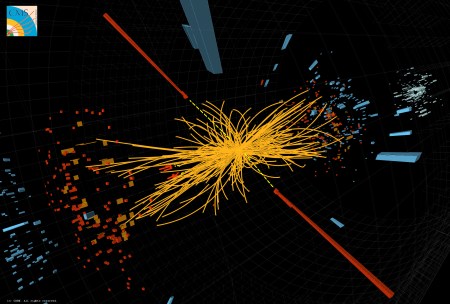
Anyway, it seems from the CMS part of the presentation that they find a bit of a peak at a similar mass ~ 125 GeV but spread out over a larger range, this time at a level of – sigh – 2.6 sigma.

All in all, it’s a definite maybe. Putting the results together in the way only a frequentist can the result is a 2.4 sigma detection. In other words,  nothing any serious scientist would call convincing.

It’s interesting how certain these particle physicists are that the Higgs actually exists. It might, of course, and I think these results may be pointing the way to more convincing evidence based on more data. However,  I still think we should bear in mind the words of Alfred North Whitehead:

There is no more common error than to assume that, because prolonged and accurate mathematical calculations have been made, the application of the result to some fact of nature is absolutely certain.

If there is a Higgs boson with a mass of 125 GeV then that would of course be an exciting discovery, but if there isn’t one at all wouldn’t that be even more exciting?

Final word from the Director of CERN:

We have not found it yet, we have not excluded it yet, stay tuned for next year.

Thunder and hail descended on Cardiff just as the webcast finished, which is clearly not a coincidence although I couldn’t say how many sigmas were involved.

And a final, final word from the Chief Executive of the Science & Technology Facilities Council, John Womersley:

There is still some way to go before the existence of the Higgs boson can be confirmed or not, but excitement is mounting. UK physicists and engineers have played a significant role in securing today’s results, and will continue to be at the forefront of exploring the new frontiers of knowledge opened by the results coming from the LHC. This is an incredibly exciting time to be involved in physics!

Brian Cox is 43.

Before an Examination

Posted in Poetry with tags , on December 12, 2011 by telescoper

The little letters dance across the page,
Flaunt and retire, and trick the tired eyes;
Sick of the strain, the glaring light, I rise
Yawning and stretching, full of empty rage
At the dull maunderings of a long dead sage,
Fling up the windows, fling aside his lies;
Choosing to breathe, not stifle and be wise,
And let the air pour in upon my cage.

The breeze blows cool and there are stars and stars
Beyond the dark, soft masses of the elms
That whisper things in windy tones and light.
They seem to wheel for dim, celestial wars;
And I — I hear the clash of silver helms
Ring icy-clear from the far deeps of night.

by Stephen Vincent Benét (1898-1943)