Archive for March, 2012

Cosmology, Escher and the Field of Screams

Posted in Art, Education, The Universe and Stuff with tags , , , , , on March 20, 2012 by telescoper

Up early this morning for yet another busy day I thought I’d post a quick follow-up to my recent item about analogies for teaching physics (especially cosmology).

Another concept related to the cosmic microwave background that people sometimes have problems understanding is that of last scattering surface.

Various analogies are useful for this. For example, when you find yourself in thick fog you may have the impression that you are surrounded by an impenetrable wall at some specific distance around you. It’s not a physical barrier, of course, it’s just the distance at which there sufficient water droplets in the air to prevent light from penetrating further. In more technical terms the optical depth of the fog exceeds unity at the distance at which this wall is seen.

Another more direct analogy is provided by the Sun. Here’s a picture of said object, taken through an H-α filter..
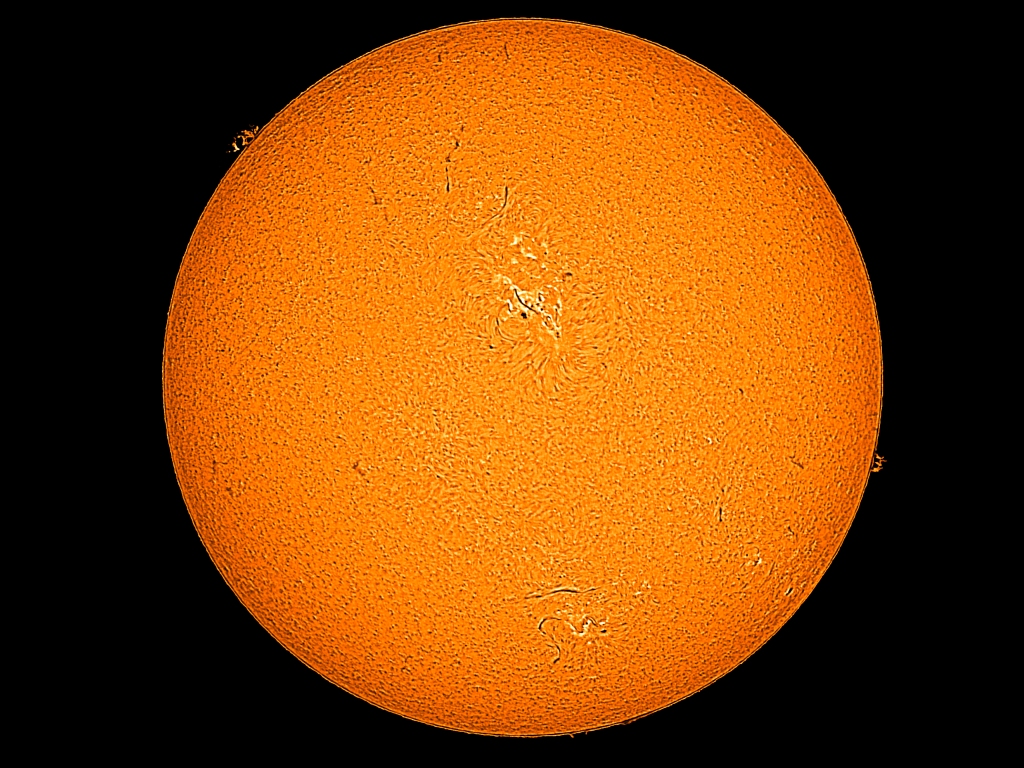
What’s surprising to the uninitiated about an image such as this is that the Sun appears to have a distinct edge, like a solid object. The Sun, however, is far from solid. It’s just a ball of hot gas whose density and temperature fall off with distance from its centre. In the inner parts the Sun is basically opaque, and photons of light diffuse outwards extremely slowly because they are efficiently scattered by the plasma. At a certain radius, however, the material becomes transparent and photons travel without hindrance. What you see is the photosphere which is a sharp edge defined by this transition from opaque to transparent.

The physics defining the Sun’s photosphere is much the same as in the Big Bang, except that in the case of the Sun we are outside looking in whereas we are inside the Universe trying to look out. Take a look at this image from M.C. Escher:

The universe isn’t actually made of Angels and Demons – at least not in the standard model – but if you imagine you are in the centre of the picture  it nicely represents what it is like looking out through an expanding cosmology. Since light travels with finite speed, the further you look out the further you look back into the past when things were denser (and hotter). Eventually you reach a point where the whole Universe was as hot as the surface of a star, this is the cosmic photosphere or the last scattering surface, which is a spherical surface centred on the observer. We can’t see any further than this because what’s beyond is hidden from us by an impenetrable curtain,  but if we could just a little bit further we’d see the Big Bang itself where the density is infinite, not as a point in space but all around us.

Although it looks like we’re in a special place (in the middle) of the image, in the Big Bang theory everywhere is equivalent; any observer would see a cosmic photosphere forming a sphere around them.

And while I’m on about last scattering, here’s another analogy which might be useful if the others aren’t. I call this one the Field of Screams.

Imagine you’re in the middle of a very large, perhaps infinite, field crammed full of people, furnished with synchronised watches, each of whom is screaming at the top of their voice. At a certain instant, say time T, everyone everywhere stops screaming.

What do you hear?

Well , you’ll obviously  notice that it gets quieter straight away as the people closest to you have stopped screaming.  But you will still hear a sound because some of the sound entering your ear set out at a time before t=T. The speed of sound is 300 m/s or so, so after 1 second you will still hear the sound arriving from people further than 300 metres away. It might be faint, but it would be there. After two seconds you’d still be hearing from people further than 600 metres away,. and so on. At any time there’ll be circle around you, defined by the distance sound can have travelled since the screaming stopped – the Circle of Last Screaming. It would appear that you are in the centre of this circle, but anyone anywhere in the field would form the same impression about what’s happening around them.

Change sound to light, and move from two dimensions to three, and you can see how last scattering produces a spherical surface around you. Simples.


Nora the Piano Cat

Posted in Music with tags , , , on March 19, 2012 by telescoper

A busy day, filled with meetings meetings and more meetings. Time to relax with some music. This is a complete performance of a work by Mindaugas Piecaitis, featuring Nora the Piano Cat….


Failed Physics Teaching Analogies

Posted in Education, The Universe and Stuff with tags , , , , , , , on March 18, 2012 by telescoper

Last week I deputized for a colleague who was skiving off away at an important meeting so, for the first time ever in my current job, I actually got to give a proper lecture on cosmology. As the only out-and-out specialist in cosmology research in the School of Physics and Astronomy at Cardiff, I’ve always thought it a bit strange that I’ve never been asked to teach this subject to undergraduates, but there you are. Ours not to reason why, etc. Anyway, the lecture I gave was about the cosmic microwave background, and since I have taught cosmology elsewhere in the past it was quite easy to cobble something together.

As a lecturer you find, over the years, that various analogies come to mind that you think will help students understand the physical concepts underpinning what’s going on, and that you hope will complement the way they are developed in a more mathematical language. Sometimes these seem to work well during the lecture, but only afterwards do you find out they didn’t really serve their intended purpose. Sadly it also  sometimes turns out that they can also confuse rather than enlighten…

For instance, the two key ideas behind the production of the cosmic microwave background are recombination and the consequent decoupling of matter and radiation. In the early stages of the Big Bang there was a hot plasma consisting mainly of protons and electrons in an intense radiation field. Since it  was extremely hot back then  the plasma was more-or-less  fully ionized, which is to say that the equilibrium for the formation of neutral hydrogen atoms via

p+e^{-} \rightarrow H+ \gamma

lay firmly to the left hand side. The free electrons scatter radiation very efficiently via Compton  scattering

\gamma +e^{-} \rightarrow \gamma + e^{-}

thus establishing thermal equilibrium between the matter and the radiation field. In effect, the plasma is opaque so that the radiation field acquires an accurate black-body spectrum (as observed). As long as the rate of collisions between electrons and photons remains large the radiation temperature adjusts to that of the matter and equilibrium is preserved because matter and radiation are in good thermal contact.

Eventually, however, the temperature falls to a point at which electrons begin to bind with protons to form hydrogen atoms. When this happens the efficiency of scattering falls dramatically and as a consequence the matter and radiation temperatures are no longer coupled together, i.e. decoupling occurs; collisions can longer keep everything in thermal equilibrium. The matter in the Universe then becomes transparent, and the radiation field propagates freely as a kind of relic of the time that it was last in thermal equilibrium. We see that radiation now, heavily redshifted, as the cosmic microwave background.

So far, so good, but I’ve always thought that everyday analogies are useful to explain physics like this so I thought of the following. When people are young and energetic, they interact very effectively with everyone around them and that process allows them to keep in touch with all the latest trends in clothing, music, books, and so on. As you get older you don’t get about so much , and may even get married (which is just like recombination, in that it dramatically  reduces your cross-section for interaction with the outside world). Changing trends begin to pass you buy and eventually you become a relic, surrounded by records and books you acquired in the past when you were less introverted, and wearing clothes that went out of fashion years ago.

I’ve used this analogy in the past and students generally find it quite amusing even if it has modest explanatory value. I wasn’t best pleased, however, when a few years ago I set an examination question which asked the students to explain the processes of recombination and decoupling. One answer said “Decoupling explains Prof. Coles’ terrible fashion sense”. Grrr.

An even worse example happened when I was teaching particle physics some time ago. I had to explain neutrino oscillations, a process in which neutrinos (which have three distinct flavour states, associated with the electron, mu and tau leptons) can change flavour as they propagate. It’s quite a weird thing to spring on students who previously thought that lepton number was always conserved so I decided to start with an analogy based on more familiar physics.

A charged fermion such as an electron (or in fact anything that has a magnetic moment, which would include, e.g. the neutron)  has spin and, according to standard quantum mechanics, the component of this in any direction can  can be described in terms of two basis states, say |\uparrow> and |\downarrow> for spin in the z direction. In general, however, the spin state will be a superposition of these, e.g.

\frac{1}{\sqrt{2}} \left( |\uparrow> + |\downarrow>\right)

In this example, as long as the particle is travelling through empty space, the probability of finding it with spin “up” is  50%, as is the probability of finding it in the spin “down” state. Once a measurement is made, the state collapses into a definite “up” or “down” wherein it remains until something else is done to it.

If, on the other hand, the particle  is travelling through a region where there is a  magnetic field the “spin-up” and “spin-down” states can acquire different energies owing to the interaction between the spin and the magnetic field. This is important because it means the bits of the wave function describing the up and down states evolve at different rates, and this  has measurable consequences: measurements made at different positions yield different probabilities of finding the spin pointing in different directions. In effect, the spin vector of the  particle performs  a sort of oscillation, similar to the classical phenomenon called  precession.

The mathematical description of neutrino oscillations is very similar to this, except it’s not the spin part of the wavefunction being affected by an external field that breaks the symmetry between “up” and “down”. Instead the flavour part of the wavefunction is “precessing” because the flavour states don’t coincide with the eigenstates of the Hamiltonian that describes the neutrinos’ evolution. However, it does require that different neutrino types have intrinsically different energies  (which, in turn, means that the neutrinos must have different masses), in quite  a similar way similar to the spin-precession example.

Although this isn’t a perfect analogy I thought it was a good way of getting across the basic idea. Unfortunately, however, when I subsequently asked an examination question about neutrino oscillations I got a significant number of answers that said “neutrino oscillations happen when a neutrino travels through a magnetic field….”. Sigh. Neutrinos don’t interact with  magnetic fields, you see…

Anyhow, I’m sure there’s more than one reader out there who has had a similar experience with an analogy that wasn’t perhaps as instructive as hoped. Feel free to share through the comments box…

Remembering Bird

Posted in Jazz with tags , , , , on March 18, 2012 by telescoper

Last week saw the 57th anniversary of the death of Charlie Parker, aka Bird, a musical genius on the saxophone whose influence not only on jazz but on twentieth century music is incalculable. I’ve posted quite a few tracks by Bird over the years and one thing I’ve learned from doing that is that he’s by no means everyone’s cup of tea. I can’t do anything about that, of course, but I can at least point out the existence of his wonderful legacy to those (regrettably many) people who’ve never heard of him or his musicI still remember the mixture of astonishment and exhilaration I felt when I first heard him on record and if I can give that sense of joy to just one person via the blogosphere then it’s worth a hundred posts.

Here’s Kim, another one of Bird’s tunes based on the rhythm changes, with an alto sax solo improvised at breakneck speed and with incredible virtuosity. The other day I was talking to a friend of mine who only has a passing interest in jazz and he asked me whether Charlie Parker really was that good. Well, if you’re asking that question to yourself, listen to this and then you’ll have the answer. As far as I’m concerned this is three minutes of pure awesome….

A Grand Day for a Grand Slam

Posted in Rugby with tags , , , , , on March 17, 2012 by telescoper

It’s a lovely morning in Cardiff. Later on, at 2.45pm, Wales will be playing their final match of the 2012 Six Nations Rugby against France here in Cardiff. Having won all four previous games they’re in line for a Grand Slam if they win. The atmosphere here is already electric with anticipation. Last night the city was filled with men in berets here to support France and today everything will be at a standstill for the match. I can’t describe what a wonderful feeling it is to be in Cardiff on match days, even if you don’t have a ticket!

People here seem to be taking it for granted that Wales will win this afternoon. I’d love a Welsh Grand Slam to happen, but I’m not sure it’s as much of cast-iron certainty the Welsh supporters seem to think it is. France are a dangerous side and their disappointing performances so far in the Six Nations don’t preclude the possibility that they’ll turn it on in the Millennium Stadium; they’re certainly not here just to make up the numbers. The Welsh team has its weaknesses and may yet meet their downfall…

Comparisons with the great Welsh teams of the 1970s are inevitable today. Although it may be tempting fate, I thought I’d post this video showing some of the great players of that era in action. Good though the current team is – and clearly the best of the six nations playing in the competition this year – I don’t think they’re in the same league as the side that included such wonderful players as Gerald Davies, Gareth Edwards, J.P.R. Williams, Barry John and, of course, Mervyn Davies who sadly died last week and in whose honour there will be a minute’s silence before this afternoon’s kick off. Here are some scintillating moments from that great team. We’ll never see their like again.

Even the commentators – especially the great Bill Maclaren – were so much better than the current generation!

But that was then and this is now. Good luck to Wales, and here’s to another Grand Slam this afternoon!

Guest Post – Copyright, Text Mining and Research

Posted in Uncategorized with tags , , , , , , on March 16, 2012 by telescoper

As a second bit of community service for the day, here is a guest contribution, written by Kaya Cantekin of the Open Rights Group about possible changes in UK copyright law and the implications for scientific research, particularly in the area of data mining. I’m grateful to Peter Bradwell of the same organisation for initially drawing my attention to this issue.

–o–

A Government consultation that may lead to badly needed reforms to copyright law opened for business in December. The consultation paper is available to download as a PDF file at the Intellectual Property Office website. The consultation would benefit significantly from input and evidence from the academic community. If you’d like to contribute, the call closes next Wednesday March 21st.

The consultation contains lots of important proposals for reforms that would help copyright adapt to the digital age, bringing greater access to and exploitation of information. Of particular interest to academics may be the proposal for a new copyright ‘exception’ that would allow researchers to text and data mine material that they have lawful access to (e.g. the web / subscribed-to journal databases etc) – on page 79 of the consultation document.

The consultation says (paras. 7.87, 7.96):

there is a strong case for ensuring that copyright does not obstruct the use of new technologies for scientific research, in particular where the use of those technologies does not unduly prejudice the aims of copyright.

The Government proposes to make it possible for whole works to be copied for the purpose of data mining for non-commercial research.

And asks:

Would an exception for text and data mining that is limited to non-commercial research be capable of delivering the intended benefits? Can you provide evidence of the costs and benefits of this measure? Are there any alternative solutions that could support the growth of text and data mining technologies and access to them?

Text mining is a technique used to harvest vast amounts of data from copyrighted research articles papers, by copying entire databases en masse and sifting through them using specialised algorithms. This allows researchers to use a much greater pool of information than that can be collected otherwise. It allows researchers to take advantage of the phenomenal opportunities for new kinds of analysis that new technology affords.

Evidence submitted previously to the ‘Hargreaves Review’ (where these proposals came from) by the British Library, Joint Information Systems Committee, and the National Centre for Text Mining  supports this. And just last week, JISC published a new study on the benefits and value of text mining that added further weight behind the idea.
They found, for example, that

UK copyright restrictions mean that most text mining
in UKFHE is based on Open Access documents or bespoke arrangements. This means that the availability of material for text mining is limited.

The proposal has been the subject of some intense criticism from publishers, who propose market-based solutions instead.

The Government says in the consultation paper that it looked for collective solutions set forward by the publishers to address the problem of licensing text and data mining, but that it couldn’t find any good examples of best practice. We at the Open Rights Group agree that the issue should not be left for self-regulation. We disagree that it is the publishers who should be allowed to decide when and how researchers can undertake this valuable work, with material they have legal access to.

It’s really important that the government hears from people who may benefit from these changes and that they receive evidence of the possible benefits.

In other words, the Government is looking for evidence to make non-commercial research exempt from copyright laws that govern published research, and wants you to provide it.

There’s not much time left. So we’ve made available a guide to the issues and a full list  of the consultation questions.

If you have evidence to submit, or just want to have your say on some of the issues raised here, you have until Wednesday 21st March to do so. You can find the consultation response form here.

We can’t stress enough how important it is that those of you who have answers to those questions submit them. Without evidence, reform may not happen.

Research Opportunities in the Philosophy of Cosmology

Posted in The Universe and Stuff with tags , , , , , , on March 16, 2012 by telescoper

I got an email this morning telling me about the following interesting opportunities for research fellowships. They are in quite an unusual area – the philosophy of cosmology – and one I’m quite interested in myself so I thought it might ahieve wider circulation if I posted the advertisement on here.

–0–

Applications are invited for two postdoctoral fellowships in the area of philosophy of cosmology, one to be held at Cambridge University and one to be held at Oxford University, starting 1 Jan 2013 to run until 31 Aug 2014. The two positions have similar job-descriptions and the deadline for applications is the same: 18 April 2012.

For more details, see here, for the Cambridge fellowship and  here for the Oxford fellowship.

Applicants are encouraged to apply for both positions. The Oxford group is led by Joe Silk, Simon Saunders and David Wallace, and that at Cambridge by John Barrow and Jeremy Butterfield.

These appointments are part of the initiative ‘establishing the philosophy of cosmology’, involving a consortium of universities in the UK and USA, funded by the John Templeton Foundation. Its aim is to identify, define and explore new foundational questions in cosmology. Key questions already identified concern:

  • The issue of measure, including potential uses of anthropic reasoning
  • Space-time structure, both at very large and very small scales
  • The cosmological constant problem
  • Entropy, time and complexity, in understanding the various arrows of time
  • Symmetries and invariants, and the nature of the description of the universe as a whole

Applicants with philosophical interests in cosmology outside these areas will also be considered.

For more background on the initiative, see here and the project website (still under construction).

Volumina

Posted in Music, The Universe and Stuff with tags , , on March 15, 2012 by telescoper

I forgot to mention that, at the end of my talk on Monday evening,  a gentleman in the audience who is apparently a regular reader of this blog asked if I was aware of that composer György Ligeti had written a piece of music called Volumina  inspired by the Big Bang.  I was indeed  aware of this piece, and have a recording of it, but his question gives me the excuse to post a version here.  I’m sure at least some of you will have heard some of it before, in fact, as an excerpt  featured in the original radio series of The Hitchhiker’s Guide to the Galaxy which I listened to on the wireless many moons ago.

You might find Volumina a bit perplexing, but I can tell you that in surround sound with the volume up it’s absolutely amazing. My neighbours clearly agree, and were banging on the wall last night to show their appreciation.

Memories of Trieste

Posted in Biographical with tags , , , , on March 14, 2012 by telescoper

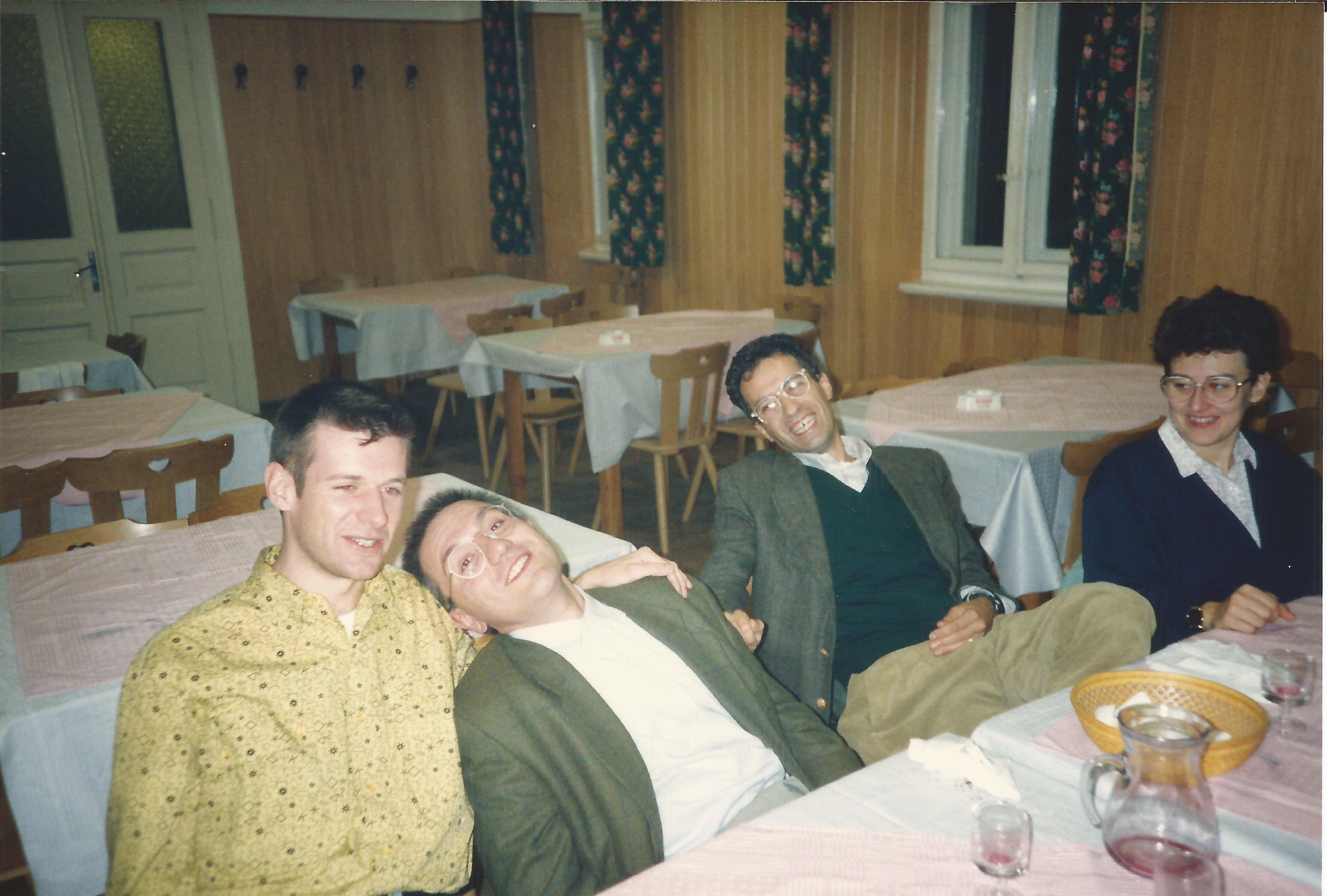
I was too tired last night to do anything but vegetate, and in the course of doing that I found a box of unsorted old photographs which made me all nostalgic. Here are some that reminded me of old friends. I don’t remember exactly when they were taken (probably in 1990), when I was visiting SISSA in Trieste. I don’t remember which particular trip it was or what paper resulted from it but I went there a number of times and had great fun. The first picture was taken in the office of Manolis Plionis, who is seated at the window facing the camera. In those days Manolis had a big motorbike, and I had a number of near-death experiences as his pillion passager on various high speed trips around Trieste, usually along the Strada Costiera…

To the right of Manolis is Francesco Lucchin (standing) with whom I co-authored a textbook on cosmology; Francesco sadly died in 2002. Seated in front of Francesco is Sabino Matarrese and at the computer is Lauro Moscardini.

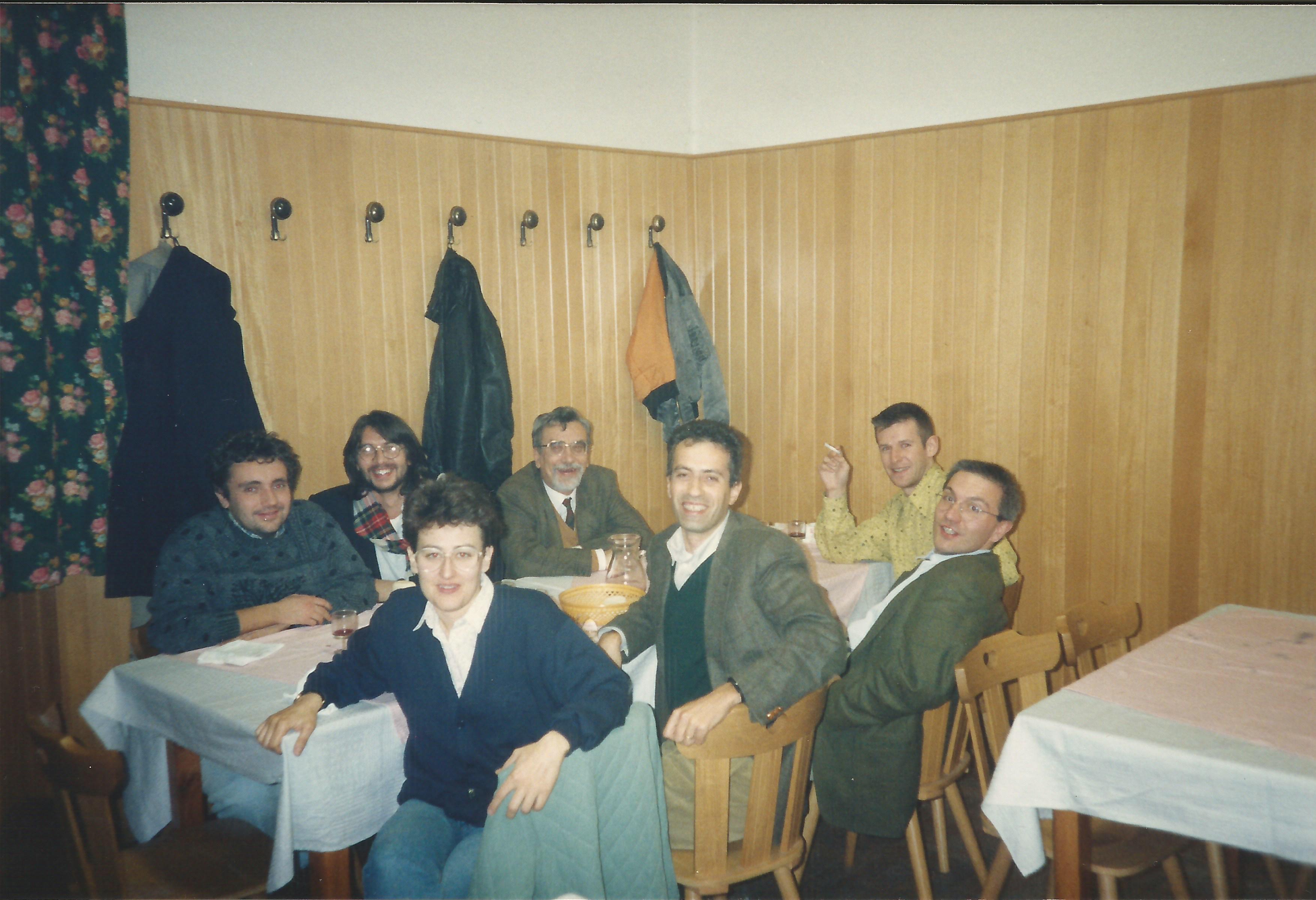
I think these next two were taken over the nearby border in Slovenia at the end of a dinner but that is relying on my memory which, at my age, is not very reliable. Me and Lauro on the left with Sabino laughing at us. As usual.

And this was the same evening. On Francesco’s right is Paolo Catelan, with whom I also wrote a paper, but I have now completely lost touch with him…

Everyone looks very youthful in these pictures, but it was 20 years ago .. and we’ve all passed a lot of water since then.

Laughin’ to Keep from Cryin’

Posted in Jazz with tags , , , , , , on March 13, 2012 by telescoper

Neither the time nor the energy to post anything other than a bit of music, so I’ve picked a track someone happens to have posted on Youtube. I have Laughin’ to Keep from Cryin’ the original vinyl LP on the Verve label, but it’s still waiting for me to transfer it to digital. I love this record so much because it’s so joyful and at the same time so tragic. There’s some wonderfully upbeat stuff from the two trumpeters, the great Harry “Sweets” Edison (whom I’ve had the privilege to hear play live), who opens the piece, and then the perhaps even greater Roy Eldridge, but it’s also one of the last recordings made by legendary saxophonist Lester Young who was terminally ill with cancer at the time of this session in February 1958; he died just a year later. His formerly smooth tenor tone now ragged, barely able to stand or hold the saxophone, and playing almost in slow motion, he nevertheless manages to cast his fading light over the latter part of this tune and conjure up something quite magical. The other members of the band are Herb Ellis (guitar), Hank Jones (piano), George Duvivier (bass) and Mickey Sheen (drums) and this track is called Romping.