Archive for October, 2012

Pastures New

Posted in Biographical, Education with tags , , , on October 17, 2012 by telescoper

Well, after what seems like ages the news is now official. I’ve been appointed Head of the School of Mathematical and Physical Sciences at the University of Sussex. I’ll be taking up my new job on 1st February 2013.  I was actually offered the job back in September and decided pretty quickly to accept it, but there have been quite a few things to sort out before the news could be made public. Anyway, yesterday the University of Sussex decided it was time to make a formal announcement, and there we are.

As I am quoted as saying in the press release it will definitely be a wrench to leave Cardiff. I’ve really enjoyed living and working here for the last five years or so, and will miss the staff and the students of the School of Physics and Astronomy at Cardiff University. I’m especially grateful for the help and support I received during the difficulties I experienced this summer. However, I felt the position at Sussex represented an exciting opportunity to make a fresh start which would offer new and exciting challenges and which I couldn’t afford to turn down. It means a lot that my Cardiff colleagues – particularly the Head of School, Walter Gear – have accepted my decision in such good spirit, and are doing everything possible to smooth the transition.

As it also explains in the official news item, I’m not exactly a stranger to Sussex. I did my DPhil there (from 1985-88) and stayed on for a couple of years as a PDRA (1988-90). That was a long time ago, of course. In fact, in those days I was  a member of a School called “MAPS” (Mathematics and Physics). I’ve been back to Sussex on numerous occasions over the past twenty-odd years, usually discovering that some reorganisation had happened – Maths separated from Physics, changes of building, and so on. Now, ironically, I’ll return to a School that, on paper at any rate, looks very similar to the old MAPS and is even back in the same building! Plus ça change.

I won’t be leaving Cardiff immediately, of course. I’m still an employee of Cardiff University and will do my best to carry out my duties until the end of January. That means I’ll carry on lecturing as normal, and will be around to mark the examinations after Christmas. I also have two PhD students and three final-year projects students, and will be travelling back to Cardiff regularly to ensure they continue get as much supervision as they need even after the (formal) end of my employment here. I’ll also be continuing to collaborate with folks in Cardiff (and elsewhere) on, e.g., the Herschel ATLAS survey.

The position of Head of MPS at Sussex only became available because of the untimely death of the previous Head of School, David Axon, in April this year, so I’m fully aware that the circumstances that have given me such a wonderful opportunity have also brought much sadness to David’s colleagues and loved ones. I only hope that I can build on the many excellent things he did during his time at Sussex, and so eventually earn the respect and acceptance of the School.

Many of my colleagues at Cardiff have expressed sadness that I’ll be leaving. But just as there are exciting developments in the pipeline at Sussex, so are there different but equally exciting things in store at Cardiff. In no way will my departure have a negative impact on the School of Physics and Astronomy at Cardiff University. Quite the contrary, in fact. There will now be a bit more headroom in the budget that I’m sure will help bring at least some of the School’s plans to fruition.

And anyway, as I said previously, I’m not going just yet. I’ll probably keep the house in Cardiff until the spring (at the earliest) so I’ll be back here regularly, especially when it’s Opera season. And having branches in both Brighton and Cardiff for a while might even give me an excuse to have two 50th birthday celebrations next year!

After the Storm…

Posted in Biographical, History with tags , , , on October 16, 2012 by telescoper

Twenty-five years ago I was living in Brighton as a graduate student at the University of Sussex. On October 16th 1987 (a Friday) I woke up to find the electricity had been cut off. Without breakfast I struggled out to find the street lined with fallen trees, smashed cars and houses with broken windows. This was the Great Storm of 1987 which, according to weather forecaster Michael Fish, was “not a hurricane” and I had slept through the whole thing…

Here’s the infamous weather forecast broadcast on the Thursday evening

and here is the BBC News from the following day:

I’m sure my readers (Sid and Doris Bonkers) will be anxious to share their recollections of that wild and windy night through the comments box!

The Co-op that wasn’t….

Posted in Uncategorized with tags , , , , on October 16, 2012 by telescoper

Yesterday evening I went to a meeting of local Pontcanna residents for an update about the plans to build a supermarket on King’s Road. The developer, a Mr Voyle, has tried before but had his planning application rejected. He’s back again with a revised application that states that the Co-op want to put a supermarket on the site.

However, this is where the plot thickens. Last night’s meeting was attended by a senior member of the Co-op’s management, who stated categorically that they had no interest in the site and were unaware until a few days ago that their name was being used in the planning application.

You can draw your own inferences about what this developer is up to.

Anyway, the proposed development will cause a huge increase in traffic in an already heavily congested area, so I’ll be sending my objections in writing to the Council, just as soon as I can find my green biro. It’ll also be interesting to see what steps the Co-op take concerning the developer’s misrepresentation of their involvement…

Pontcanna Hub's avatarPontcannaHub

As anticipated, despite having their proposals recommended for rejection last time and OVERWHELMING PUBLIC CRITICISM OF THE PLANS the developers have DISREGARDED LOCALS’ CONCERNS and resubmitted plans for a supermarket on the Pontcanna Pine/Dairy site.

Please attend the meeting to discuss revised scheme and decide on action:
7pm, Monday 15 October, St Catherine’s  Church Hall, Kings Road.
We will also place petitions in local shops and kindly request that you write letters again – the deadline for letters/emails is October 22 2012.

The application for a store at Pontcanna Pine/The Dairy has been submitted again as expected – pretty much the same as before, with a large retail unit on the ground floor and 8 2-bed flats in the two storeys above. There is gated parking for 10 cars – 1 for each flat, 1 for disabled customers and 1 for the store manager – NONE FOR CUSTOMERS.

The main…

View original post 1,147 more words

Portrait in the Dark

Posted in Biographical with tags , on October 15, 2012 by telescoper

It’s been a while since I updated my photo on this site, so this afternoon I asked a friend of mine to take a picture. It turned out to be more appropriate for In the Dark than I’d expected…

This Week’s Bridge Problem, No. 236

Posted in The Universe and Stuff with tags , , on October 15, 2012 by telescoper

All Blues at School

Posted in Biographical, Jazz with tags , , , , , on October 14, 2012 by telescoper

I discovered by accident the other day that the classic Miles Davis composition All Blues has found its way onto the GCSE Music syllabus. I think that’s wonderful. In fact here’s a recording of the track,  produced and distributed as “set work” for that purpose:

I never took any qualifications in music at School – although I did get music lessons, I didn’t find them at all inspiring and it took me years to develop a taste for anything other than Jazz, which I knew about mainly from home, because my father was a (part-time) Jazz drummer. There wasn’t much mention of Jazz at School from teachers, and none of my friends were into it, so it became a very private passion, although I’m glad to say it never faded.

Anyway, what little I know about music I picked up by studying on my own, and trying to figure out what was going on by listening to records. All Blues is a really interesting composition to unpick in this way, as it tells you a lot about how Jazz was evolving in the late 1950s (it was released in 1959). Musicians like Miles Davis were experimenting with ways of breaking away from the standard approach to Jazz improvisation based on chord progressions, and one of the routes that developed was modal Jazz. All Blues is particularly interesting because it teeters on the edge between the old approach and the new; it’s clearly based on the traditional 12-bar blues progression but diverges from it in several respects.

A standard blues progression in G might go  like this (although there are many variations):

|G|G|G|G|
|C|C|G|G|
|D|C|G|G|

It’s based on just three chords: the tonic (in this case G): the sub-dominant IV (C) and the dominant V (D); the V-IV-I progression in the last four bars is usually called the turnaround.

The progression for All Blues is this:

|G7| G7| G7| G7|
|Gm7| Gm7| G7| G7|
|D7| E♭7 D7| F G|F G6|

While the addition of a major 7th note to the basic triad G isn’t unusual, the two G minor 7th chords are more interesting, because they involve adding a blue note (a flattened third) to the basic chord . But it’s in the last four bars that the harmonies move dramatically away from the standard turnaround. Chromatic chords are included and the usual resolution back to G is subtly changed by the addition of a 6th note (E) to the basic G chord (GBD) at the end; that trick became a bit of a trademark for Jazz of this period.

However, it’s the two F chords that represent the strongest connection with modal harmony. The scale of G major involves F-sharp, so the F is a flattened note (a flattened VIIth).  In fact, all the Fs in the piece are natural rather than sharp.  For this reason you could argue that this is a piece not played in the key of G major but in the corresponding Mixolydian mode (the white notes on the piano from G to G).

So it’s a blues that’s not quite a blues, but is (appropriately enough) Kind of BlueThere’s so much going on harmonically that the fact that it’s played in 6/8 rhythm (rather than the more usual 4/4 for the Blues) seems almost irrelevant.

Those are just the bare bones, but the improvisations of Miles Davis, Bill Evans, Cannonball Adderley and John Coltrane et al.  breath life into them and create a living Jazz masterpiece. Although it seems like a complicated tune, apparently what happened at the recording session was that Miles Davis talked the band through the piece, they played it once to get a feel for it, and then recorded the entire track that was released on the album, in one go.

I must have listened to All Blues a thousand times, and I’ve never tired of it. The thing is, though, I could say the same thing about all the other tracks on the album Kind of Blue, about which Stephen Thomas Erlewine wrote

Kind of Blue isn’t merely an artistic highlight for Miles Davis, it’s an album that towers above its peers, a record generally considered as the definitive jazz album, a universally acknowledged standard of excellence. Why does Kind of Blue posses such a mystique? Perhaps because this music never flaunts its genius… It’s the pinnacle of modal jazz — tonality and solos build from the overall key, not chord changes, giving the music a subtly shifting quality… It may be a stretch to say that if you don’t like Kind of Blue, you don’t like jazz — but it’s hard to imagine it as anything other than a cornerstone of any jazz collection.

Will we talk about the black bird?

Posted in Film with tags , , , , on October 13, 2012 by telescoper

My favourite scene from  my favourite film. Great direction, great script, great acting, and all based on a truly great novel by a truly great writer.

Not a wasted word, not an awkward phrase, and all lines delivered perfectly by actors who seem as though they were born to play these characters.

Quite. And I’ll tell you right out that I’m a man who likes talking to a man who likes to talk…

Rolling Boulders…

Posted in Bad Statistics, The Universe and Stuff with tags , , , , , , , , on October 13, 2012 by telescoper

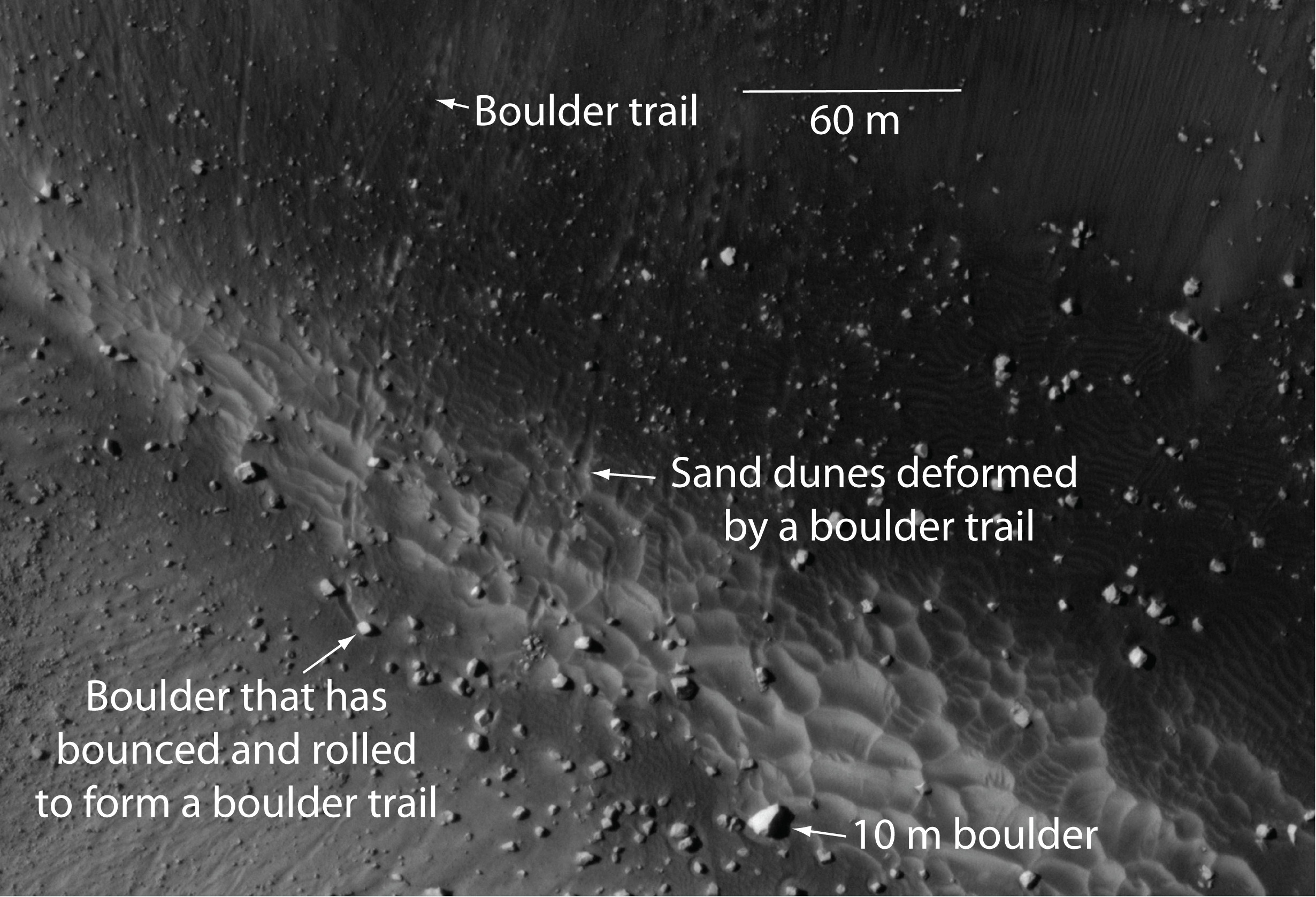
I’m a bit slow to get started this morning, since I didn’t get home until the wee small hours after a trip to the Royal Astronomical Society yesterday, followed by a pleasantly tipsy dinner at the Athenaeum with the RAS Club. Anyhow, one of the highlights of the meeting was a presentation by Prof. Gerald Roberts from Birkbeck on Marsquakes: evidence from rolled boulder populations, Cerberus Fossae, Mars.  The talk was based on a recent paper of his (unfortunately behind a paywall), which is about trying to reconstruct the origin and behaviour of “Marsquakes” using evidence from the trails made by rolling boulders, dislodged by seismic activity or vulcanism.  Here is a sample picture showing the kind of trails he’s using – the resolution is such that one pixel is only 20cm!

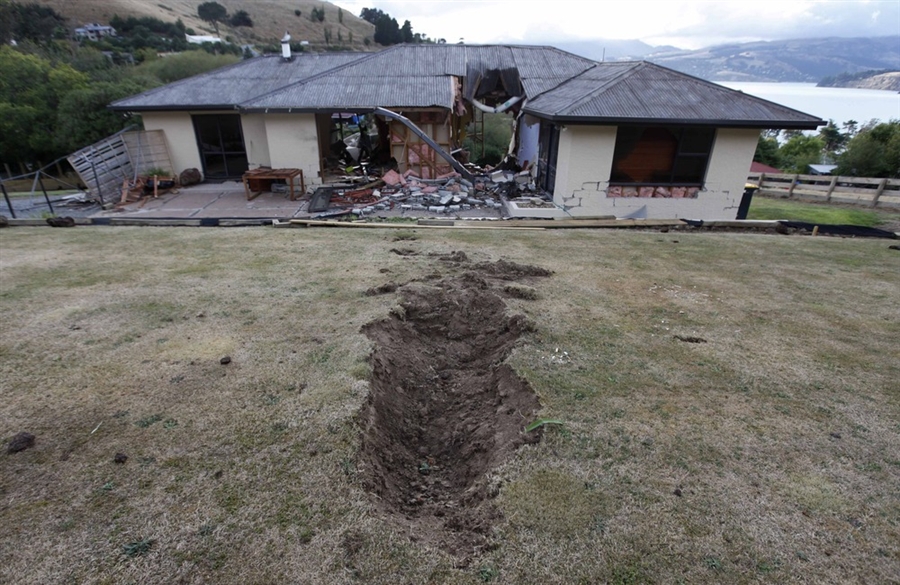
There are enough trails to allow a statistical analysis of their distribution in space and in terms of size (which can be inferred from the width of the trail). I had some questions about the analysis, but I haven’t been able to read the paper in detail yet so I won’t comment on that until I’ve done so, but the thing I remember most from the talk were these remarkable pictures of what a rolling boulder can do on Earth. They were taken after the earthquake in Christchurch, New Zealand, in 2011.

A large boulder was dislodged from the top of the hill behind the house in the second picture. It didn’t just roll, but bounced down the slope (see the large furrow in the first picture; similar bouncing trajectories can be seen in the picture from Mars), smashed straight through the house, exited the other side and came to rest on a road. Yikes.

A bit of CBT…

Posted in Biographical with tags , , , , , , on October 12, 2012 by telescoper

Up early because a busy day lies ahead, I thought I’d just post this video produced by the National Health Service on the subject of Cognitive Behaviour Therapy.  I’m posting it just in case there might be someone out there who has been recommended for such a treatment and is reluctant to try it, like I was at first, thinking that it is just a load of psycho-babble.

Well, it isn’t psycho-babble. It works. So if you need it, go for it!

How many hours per week should a graduate student work?

Posted in Biographical, Education, The Universe and Stuff with tags , on October 11, 2012 by telescoper

Here’s one of those things from Blogland that is flying around the Twittersphere today..

The original post revealed a leaked email  “sent to the entire graduate student body enrolled in the well-regarded astronomy program at Unnamed Academy” containing such gems as this:

We have received some questions about how many hours a graduate student is expected to work.  There is no easy answer, as what matters is your productivity, particularly in the form of good scientific papers.  However, if you informally canvass the faculty (those people for whose jobs you came here to train), most will tell you that they worked 80-100 hours/week in graduate school.  No one told us to work those hours, but we enjoyed what we were doing enough to want to do so.  We were almost always at the office, including at night and on weekends.

This missive has already provoked a number of responses (e.g. here and here), but I couldn’t resist putting in a few comments myself.

The first and most obvious thing is that I don’t think the faculty members mentioned above were telling the truth. It’s by no means a new phenomenon for oldies to pretend that they worked harder than the younger generation. “When I were a lad…”, etc. This is either  form of delusion that accompanies ageing or a kind of one-upmanship designed to create a impose some sort of authority over the junior members of the department.  A supervisor who demands such things of a PhD student is likely to be someone who regards a grad student simply as a form of cheap labour and doesn’t care at all about their development as a researcher or indeed as a human being.

The following sentence gives the game away

No one told us to work those hours, but we enjoyed what we were doing enough to want to do so.

It is clearly intended to mean No one told us, but we’re sure as hell telling you…“.

My advice to a young PhD student would be: if your supervisor tells you to put in 100 hours per week on the project, find another supervisor –  because he/she clearly hasn’t put sufficient thought into the practical feasibility of your project. The fact is if you have to work 100 hours per week to get your work done you must be exceptionally inefficient or working on a stupid project or simply nuts. Or all three.

The email is correct in saying that it’s “productivity” that counts. I’m sure there are many people who can sit at their desks for 11 hours a day without producing anything very much at all. It’s not the hours that matter, but what you do with them. In no way will indulging your outside interests (sporting, cultural, political, or “other”…),   or simply relaxing, detract from your ability to do research. I think such diversions actually improve your work, as well as (of course) your general well-being.

I had plenty of outside interests (including music, sport and nightlife)  and took time out regularly to indulge them. I didn’t – and still don’t – feel any guilt about doing that. I’m not a robot. And neither are you.

In fact, I can think of many times during my graduate studies when I was completely stuck on a problem – to the extent that it was seriously bothering me. On such occasions I learned to take a break. I often found that going for a walk, doing a crossword, or just trying to think about something else for a while, allowed me to return to the problem fresher and with new ideas. I think the brain gets into a rut if you try to make it work in one mode all the time.

But there is an element of truth in the paragraph quoted above. There were indeed many times during my time as a research student – and have been since – that I worked extremely long hours. I wouldn’t say exactly that was because I “enjoyed” it, but that I wanted to know the answer and couldn’t get the problem out of my head.  I’ve stayed up into the early hours of the morning trying to finish a crossword too. Not because I had to, but because I couldn’t put it down unfinished. I know that makes me a saddo in many minds, but I think that’s the sort of obsessiveness and tenacity a researcher needs: becoming so absorbed by the task in hand that you don’t notice the passage of time.

Anyway, as  a research student I certainly didn’t work 80-100 hours per week routinely, although I might have done a few times when things were getting interesting. I think an average working week of 40 hours is perfectly fine for a PhD student, as long as you use that time efficiently and are prepared to step up a gear when motivated to do so.

It’s been a while since I last had a poll, so let’s see if we can generate some statistics on this…