Archive for March, 2015

Tell Them Science Is Vital

Posted in Politics, Science Politics with tags on March 15, 2015 by telescoper

To follow up on my previous post, here’s a a lot more about the Tell Them Science Is Vital initiative…

noodlemaz's avatarPurely a figment of your imagination

There’s another election coming up and, whatever the outcome, we’ll all (hopefully) still be doing our jobs and waiting for the situation to improve.

Something the government could do to lay foundations for education, industries and economic growth in the UK is to fund science. Over the last 2 decades, they’ve really let this slide. Enter #TellThemSiV, the new campaign from Science is Vital, to do just that…

Tell Them Science is Vital

In just a few weeks, Britain goes to the polls to vote in a new government. This is obviously a crucial time for science funding and policy.

That is why Science Is Vital needs you to contact your MP or parliamentary candidate.

Since 2010, the science budget, despite having been protected from the worst of the austerity measures by the ring-fence we fought for, will nevertheless have shrunk in real terms by up to 20%.

In…

View original post 811 more words

Science Is Vital, So Don’t Let It Be Strangled.

Posted in Politics, Science Politics with tags , , on March 15, 2015 by telescoper

The General Election looming on the horizon could prove to be a watershed for scientific research in the United Kingdom. In the period immediately following the 2010 Election there was a great deal of nervousness about the possibility of huge cuts to spending on research. One of the most effective campaigns to persuade the new government against slashing funding for science on the grounds that scientific research was likely to be the principal fuel for any economic recovery was led by Science is Vital. I have written a few posts about this organisation.

The scientific community breathed a collective sigh of relief in autumn 2010 when the UK Government announced that research funding would be “ring-fenced” and maintained in cash terms for the duration of the Parliament. Things could have been far worse, as they have been in other parts of the public sector, but over the years the effect of inflation has been that this “flat cash” settlement involves a slow strangulation as opposed to a quick fall of the axe.

A recent piece in the Guardian includes this picture, which speaks for itself:

Science_spendingThe United Kingdom now spends less than 0.5% of its GDP on research, and this fraction is falling rapidly. We are now ranked last in the G8 by this criterion, way behind the USA and Germany. Why are we in this country so unbelievably miserly abou funding research? Other countries seem to recognize its important, so why can’t our politicians see it? We should be increasing our investment in science, not letting it wither away like this.

It seems to me that much more of this squeeze and we’ll be needing to close down major facilities and start withdrawing from important international collaborations. The Science and Technology Facilities Council (STFC) is particularly vulnerable, as such a large fraction of its budget is committed to long-term projects. It’s already trimmed funding for other activities to the bone, with research grants under particularly intense pressure. Will the ongoing Nurse Review of the Research Councils spell doom for STFC, as many of my colleagues think? Will be research funding  be transferred rom universities into research institutes?

Anyway, it seems an appropriate time to advertise the latest campaign from Science is Vital, which involves writing to candidates (including incumbent MPs) in your constituency to Tell Them That Science Is Vital. You might consider including some of the following, or others suggested by the website. If you’re a scientist, describe why your research is important. Here are some suggestions. If there is a local research institute in your constituency, explain how important it is to your local economy (how many people it employs, for example). If you’re a patient, or someone who cares for a patient, say how important you think research into that disease. Ask your candidate or MP to endorse the Science is Vital campaign to increase public funding of science to 0.8% of GDP. And if you do write, remember that the economic argument for investing research isn’t the only one…

Astronomy Look-alikes, No. 95

Posted in Astronomy Lookalikes with tags , , on March 14, 2015 by telescoper

I wonder if anyone else has noticed the resemblance between Coel Hellier, Founder and Head of International Rescue, and Jeff Tracey, Professor of Astrophysics at Keele University? Thunderbirds are go!

Perhaps the UK space programme could benefit significantly from the assistance of his organisation?

Hellier_Tracey

SKA Matters

Posted in Science Politics, The Universe and Stuff with tags , , , , on March 13, 2015 by telescoper

There’s been quite a lot going on recently to do with the Square Kilometre Array (SKA), some of it scientific and some of it political, some of it good and some of it bad. At least those seem to me to be the appropriate descriptions.

First the scientific good news is the the SKA Board has decided which of the planned components of SKA should be constructed during the first phase, which has a budget of around €650M. Details can be found here but, in a nutshell, it seems that the SKA Survey Telescope, which was to be built around the existing pathfinder project ASKAP located in Australia is not going to be built in the first phase. This implies the low-frequency bit of SKA will be in Australia while the higher-frequency activities will be concentrated in South Africa. That seems a pragmatic decision to me based on the budgetary constraints and should lead to a lot of good science being done. At the very least it’s a clear decision.

This positive news has however been overshadowed by an unseemly spat over the choice of headquarters over the location of the SKA Headquarters which has culminated in a rather unhelpful story in Nature. SKA HQ has been temporarily housed at Jodrell Bank Observatory (in the Midlands) since 2012 and there are clearly some who would like it to be located there permanently. There is however a rival bid, from the historic Italian city of Padova, at whose university Galileo Galilei once lectured, and which remains one of the top universities in Italy.

I should put my cards on the table and say that I’ve enjoyed many visits to Padova in my career, starting when I was a PhD student back in the 1980s and have many fond memories of the place. The late co-author of my cosmology textbook, Francesco Lucchin was Director of the Department of Astronomy in Padova at that time. For many years Padova has been home to a large concentration of astronomers and is undoubtedly a centre of excellence. Moreover it is a city that is very well served by transport links, just a short distance from Venice so easily reachable by air, and also on a major railway line offering fast national and international services. It’s also a considerably better place to dine out than Jodrell Bank!

Specola

Padova’s astronomers are housed in the Castello Carrese which adjoins the Specola (above), a tower which was once a working astronomical observatory but, being right in the city centre, has not been useful for such purposes for many moons. When I first started going to Padova the Department of Astronomy was located in the tower and in some nearby buildings but the rest of the Castello Carrese was used as a prison. Now it’s been renovated and all the astronomers have been located there. I remember the frequent walks across the little bridge over the canal to a coffee bar where we often did some of our best research!

Given its strategically important location, Padova was bombed by Allied planes on a number of occasions in 1944 and 1945. My Italian colleagues would regularly draw my attention to the plaque near the entrance to the Specola pointing out that it was hit and badly damaged by Allied bombs during one raid.

Anyway I can certainly see the merits of locating SKA HQ in Padova but it’s not my decision to make. Those responsible have not yet made a final decision, but what’s sad is that a number of stories have been flying around in the media that imply that the UK is trying to exert undue political interference to stop SKA HQ being moved to Italy. Whether this is true or not I don’t know. As far as I’m concerned the powers that be are following proper process and that process has not yet been brought to a conclusion. Whatever the outcome, though, there’s no question that the language being used in the press coverage is very damaging. Let’s hope it can all be resolved amicably.

Now for a spot of lunch and then up to the Royal Astronomical Society where the topic of the Discussion Meeting is, somewhat ironically, Building an Open UK SKA-Science Consortium…

Bloomdido – In Memoriam Charlie Parker

Posted in Jazz with tags , , , , , , on March 12, 2015 by telescoper

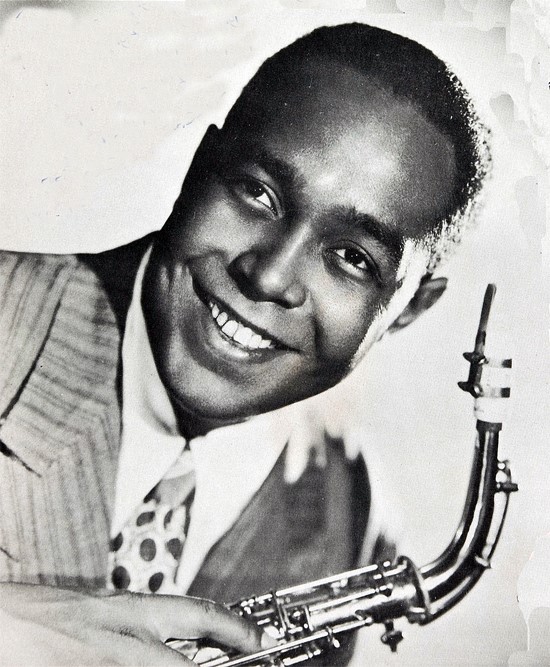
bird

Today marks the 60th anniversary of the death of the great saxophonist Charlie Parker (“Bird”) on 12th March 1955. I’ve written quite a few posts relating to Charlie Parker over the years but today has provided a good excuse to spend my lunchtime writing another one, this time featuring one of my favourite tracks from one of my favourite albums. First released in 1952 but in fact recorded in two separate sessions in 1949 and 1950, the album Bird and Diz was actually the last studio album made under the joint leadership of Charlie Parker and Dizzy Gillespie, the two main architects of the bebop revolution; the track I’ve picked has the added advantage of featuring another great musical genius on piano, Thelonious Monk.

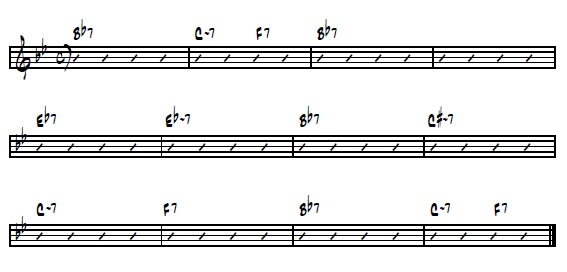
The Charlie Parker composition Bloomdido is yet another of his variations on the blues, though this one is a bit less intricate than some of the others he wrote. Here are the chords for Bloomdido:

Bloomdido

You can see that the progression is based around the standard three chords of a blues in B♭. The foundation is a  “tonic” chord (T) based on the root note of whatever key it’s played in, in this case B♭. This sometimes a basic triad consisting of the first, third and five notes of a major scale starting on that note or, as in this example,  including the dominant 7th so it’s B♭7. The next chord is the subdominant chord  (S), shifting things up by a perfect fourth relative to the tonic, in this case an E♭7 and then finally we have the dominant (D) which brings us up by a fifth from the original root note, in this case F7.

The basic blues sequence in B♭ would be four bars of B♭7 (T), two of E♭7 (S), back to B♭7 (T) for two, then the characteristic bluesy cadence returning to two bars of  B♭7 (T) via one bar each of F7 (D) and E♭7 (S). The sequence for Bloomdido has a few alterations, including a characteristic turnaround at the end instead of the tonic, but is otherwise fairly recognizable. I guess the first part of the title  is a play on the blues origin too, though I wonder if the second part suggests that some of the alterations are inspired by the A-section of the  Juan Tizol standard Perdido?

Some people tell me they find Charlie Parker’s music “too technical” and that somehow if music “needs to be explained” it’s not good music. I don’t understand that attitude at all. I find this music so fascinating and exciting to listen to that I want to try to dig a little bit into it and find out what’s going underneath the surface. It’s particularly striking what a difference a few substitutions and passing chords can make to the overall harmonic “feel” of a piece like this compared to a standard blues sequence, for example. But you don’t need to study the chords to appreciate the sheer beauty of the music that Charlie Parker built on these harmonic foundations; his solo on this track, as on so many others he recorded in his short life,  is just sublime even if you don’t realise how hard it is to play! I guess it all depends whether your way of enjoying a thing is to sit back and let it wash over you, or for it to inspire you to find out more. Many of the physicists I know are deeply interested in music. Perhaps that’s because they’re the sort of people who don’t just think “wow that’s beautiful”, they tend to think “wow that’s beautiful – how does it work?”.

Charlie Parker and Albert Einstein died in the same year, just over a month apart, the former in March 1955 and the latter in April. They were two very different geniuses but it’s as difficult to imagine physics without  Einstein as jazz without Bird.

Forthcoming Attraction: Dark Energy and its Discontents

Posted in Talks and Reviews, The Universe and Stuff with tags , , on March 11, 2015 by telescoper

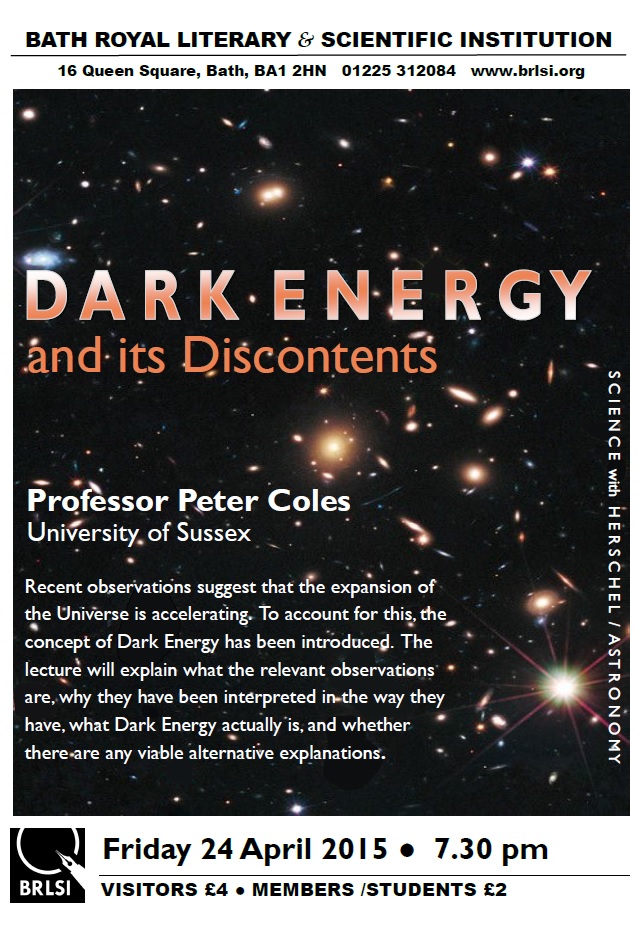
Busy again today, so just time for a spot of gratuitous self-promotion. I shall be giving a public lecture on Friday 24th April 2015 at the very posh-sounding Bath Royal Literary and Scientific Institution. Here is the poster, which explains all. Will I see any readers of this blog there?

Bath_lecture

To His Coy Mistress

Posted in Poetry with tags , , on March 10, 2015 by telescoper

Had we but world enough, and time,
This coyness, Lady, were no crime
We would sit down and think which way
To walk and pass our long love’s day.
Thou by the Indian Ganges’ side
Shouldst rubies find: I by the tide
Of Humber would complain. I would
Love you ten years before the Flood,
And you should, if you please, refuse
Till the conversion of the Jews.
My vegetable love should grow
Vaster than empires, and more slow;
A hundred years should go to praise
Thine eyes and on thy forehead gaze;
Two hundred to adore each breast,
But thirty thousand to the rest;
An age at least to every part,
And the last age should show your heart.
For, Lady, you deserve this state,
Nor would I love at lower rate.

But at my back I always hear
Time’s wingèd chariot hurrying near;
And yonder all before us lie
Deserts of vast eternity.
Thy beauty shall no more be found,
Nor, in thy marble vault, shall sound
My echoing song; then worms shall try
That long preserved virginity,
And your quaint honour turn to dust,
And into ashes all my lust:
The grave’s a fine and private place,
But none, I think, do there embrace.

Now therefore, while the youthful hue
Sits on thy skin like morning dew,
And while thy willing soul transpires
At every pore with instant fires,
Now let us sport us while we may,
And now, like amorous birds of prey,
Rather at once our time devour
Than languish in his slow-chapped power.
Let us roll all our strength and all
Our sweetness up into one ball,
And tear our pleasures with rough strife
Through the iron gates of life:
Thus, though we cannot make our sun
Stand still, yet we will make him run.

by Andrew Marvell (1621-1678)

Parametric Resonance – It Don’t Mean A Thing If It Ain’t Got That Swing

Posted in The Universe and Stuff with tags , , , on March 10, 2015 by telescoper

It’s a small universe world. This  lunchtime I turned up to the local Cosmology discussion group for a talk on reheating after inflation during which the topic of parametric resonance came up. To illustrate the concept the speaker showed this nice video, and there was my esteemed former University of Nottingham colleague and fellow jazz enthusiast Roger Bowley explaining all!


Four Times a Supernova

Posted in The Universe and Stuff with tags , , , , on March 9, 2015 by telescoper

I’ve been a bit pressed for time recently (to put it mildly) so am a bit late catching up on a wonderful observation (by Kelly et al.) reported in last week’s issue of Science. Here’s the abstract:

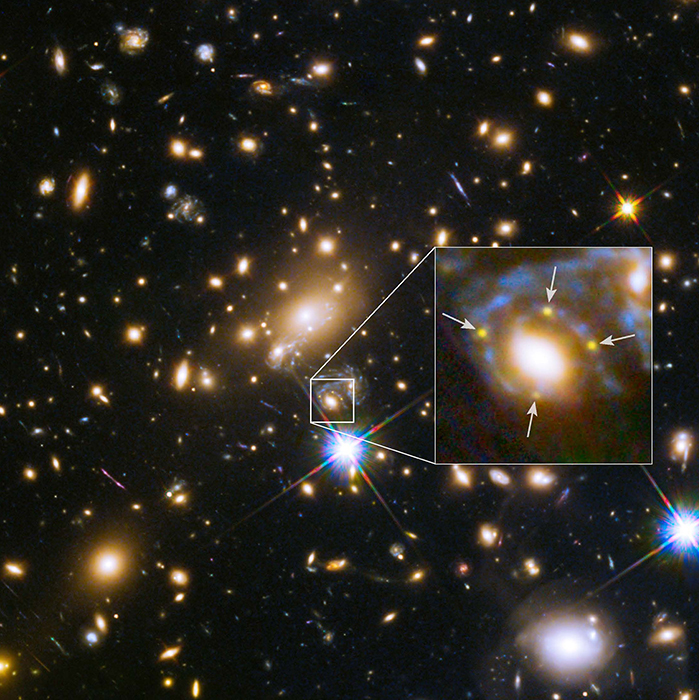
In 1964, Refsdal hypothesized that a supernova whose light traversed multiple paths around a strong gravitational lens could be used to measure the rate of cosmic expansion. We report the discovery of such a system. In Hubble Space Telescope imaging, we have found four images of a single supernova forming an Einstein cross configuration around a redshift z = 0.54 elliptical galaxy in the MACS J1149.6+2223 cluster. The cluster’s gravitational potential also creates multiple images of the z = 1.49 spiral supernova host galaxy, and a future appearance of the supernova elsewhere in the cluster field is expected. The magnifications and staggered arrivals of the supernova images probe the cosmic expansion rate, as well as the distribution of matter in the galaxy and cluster lenses.

And here’s a nice picture of the system which I ripped of from a nice report in Physics World:

PW-2015-03-05-Commissariat-supernovae

Multiple images of background objects caused by gravitational lensing have been observed before, but the key thing about this particular “Einstein Cross” is that the background object is a type of exploding star called a supernova. That means that the light it emits will decay over time. That light reaches us via four different paths around the intervening galaxy cluster so monitoring the different evolution in the four images will yield direct measurements of the physical scale of the cluster and hopefully  answer a host of interesting cosmological questions.

Tony Blair, dread creature of the forbidden swamp

Posted in Uncategorized on March 8, 2015 by telescoper

Withering. Wonderful. Worth reblogging.