Archive for November, 2016

Five – Tony Scott & Bill Evans

Posted in Jazz with tags , , , , on November 24, 2016 by telescoper

Just this morning finally submitted some documents for a couple of proposals that I’ve been stressing over for the past couple of months, so I thought I’d relax a little bit by posting some music.

Not long ago I shared a track on which Lester Young played clarinet as opposed to his usual tenor saxophone. I got to thinking afterwards that it’s quite interesting how the clarinet has become less prominent in Jazz as the music has evolved. The old `liquorice stick’ is one of the instruments that appears in the front line in `traditional’ New Orleans Jazz (alongside trumpet and trombone) and remained a key part of bands as different styles gradually developed until the Swing Era of the 1930s. Some of the greatest big bands of that period were led by clarinetists such as Benny Goodman, Artie Shaw and Woody Herman to name but three. However, when bebop arrived on the scene in the immediate post-War era the clarinet had been almost totally eclipsed by the saxophone. Perhaps that was because bebop was largely a reaction against swing music and musicians wanted to establish a radically different musical vocabulary. The alto saxophone in particular, championed by Charlie Parker, could – at least in the hands of a virtuoso like Parker – be played at breakneck speed but also had a much edgier sound and was capable of a different range of expression. The same comments apply to the tenor saxophone, as exemplified by John Coltrane. There were exceptions of course, notably Buddy Defranco, but as modern jazz developed the saxophone remained the dominant solo instrument.

Anyway, these thoughts popped into my head the other day when I was listening to Composer of the Week on BBC Radio 3 which featured the great Jazz pianist Bill Evans. One of the tracks played on the programme I listened to featured Evans together with clarinetist Tony Scott taken from the album A Day in New York which was recorded in 1957. A very large proportion of my very favorite recordings derive from the late 1950s, largely because so many new directions were being explored, and this is another track that seems to be looking ahead to something beyond the bebop era. Anyway, this is the track I heard the other day. It’s called Five, and I love the way the Scott constructs his solo from the jagged fragmentary theme, at first cautiously but gradually gathering momentum until it gets fully into its groove.

R.I.P. John M Stewart (1943-2016)

Posted in Biographical, Education, The Universe and Stuff with tags , , , on November 23, 2016 by telescoper

john-stewartI was very sad this morning to hear of the death of distinguished mathematical physicist Dr John M. Stewart (left). Apart from a few years in Munich in the 1970s John Stewart spent most of his working life in Cambridge, having studied there as an undergraduate and postgraduate and then returning from his spell at the Max Planck Institute to the Department of Applied Mathematics and Theoretical Physics for forty years.

John’s research mostly concerned relativistic fluid dynamics. Indeed, he was one of the pioneers of numerical relativity in the United Kingdom, and he applied his knowledge to a number of problems in early Universe cosmology and structure formation. I think it is fair to say that he wasn’t the most prolific researcher in terms of publications, which is perhaps why he only got promoted to Senior Lecturer in 2000 and never made it to a Chair, retiring as Reader in Gravitational Physics in 2010. However, his work was always of a very high technical standard and presented with great clarity and he was held in a very high regard by those who knew him and worked with him.

The tributes paid to John Stewart by King’s College (of which he was a Life Fellow) here and his colleagues in the Centre for Theoretical Cosmology here give a detailed account of his research achievements, so I refer you to them for more information about that aspect of his career.

I just wanted to add a personal note not about John Stewart’s research, but about something else mentioned in the obituaries linked to above: his teaching. I was fortunate enough to have him as a lecturer when I was studying Natural Sciences at Cambridge during the early 1980s. In the second year (Part IB) I specialised in Physics and Mathematics, and John taught part of the Mathematics syllabus. He was an absolutely superb teacher. For a start he was superbly well organized and had clearly thought very deeply about how best to present some quite difficult material. But it wasn’t just that. He projected a very engaging personality, with nice touches of humour, that made him easy to listen. His lectures were also very well paced for taking notes. In fact he was one of the few lecturers I had whose material I didn’t have to transcribe into a neat form from rough notes.

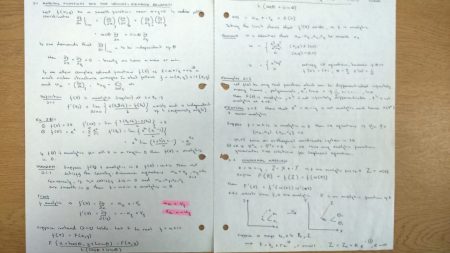
I have kept all the notes from that course for over thirty years. Here are a couple of pages as an example:

wp-1479909754508.jpeg

Anyone who has ever seen my handwriting will know that this is about as neat as I ever get!

When I was called upon to teach similar material at Cardiff and Sussex I drew on them heavily, so anyone who has learned anything from me about complex analysis, contour integration, Green’s functions and a host of other things actually owes a huge debt to John Stewart. Anything they didn’t understand was of course my fault, not his..

I also remember that John came to Queen Mary to give a seminar when I worked there in the early 90s as a postdoc. I was still a bit in awe of him because of my experience of him in Cambridge. His talk was about a method for handling the evolution of cosmological matter perturbations based on an approach based on the Hamilton-Jacobi formalism. His visit was timely, as I’d been struggling to understand the papers that had been coming out at the time on this topic. In the bar after his talk I plucked up the courage to explain to him what it was that I was struggling to understand. He saw immediately where I was going wrong and put me right on my misconceptions straight away, plucking a simple illustrative example apparently out of thin air. I was deeply impressed, not only by his ability to identify the issue but also with his friendly and helpful demeanour.

Rest in Peace, Dr John M. Stewart (1943-2016).

Bullying and Sexual Harassment at CSIRO

Posted in Uncategorized with tags , , , on November 22, 2016 by telescoper

No sooner has the deluge of emails I’ve been receiving about the Case of Bode versus Mundell started to dry up when I hear about another alarming story revolving around sexual harassment in Astronomy.

This time the revelations concern the Commonwealth Scientific and Industrial Research Organization (CSIRO), the federal government agency for scientific research in Australia, and specifically relate the organization’s handling of  numerous instances of  sexual harassment and bullying that have driven several female astronomers out of the organization’s Division of Astronomy and Space Science (CASS). You can listen here listen to a radio programme about this that was broadcast last Sunday on the Australian station ABC. It’s not an easy thing to listen to, but I urge you to make the effort.

Once again one of the key issues raised by this is that of confidentiality. As outlined by the official response from CASS, there are indeed very good reasons for respecting confidentiality:

To make details of our individual investigations public, we could prevent people from coming forward in the future or we could lead to situations of trial by the public or media without full information or a proper process.

Fair enough, but confidentiality cuts both ways. Once again I quote the official response:

Around 200 people on average work in the astronomy and space science business unit. In the past 8 years we have had 16 formal allegations of inappropriate behaviour within this business unit. The cases varied in their degree of seriousness and all of the allegations were investigated. Three of the allegations were of a sexual nature, with two of these three allegations upheld.

Two cases of alleged inappropriate behaviour per year for eight years seems rather a lot for a unit of this size. Granted that isn’t known how many of those are genuine, but in my view even one case is one case too many. However, what is really worrying is that two of the allegations that were “of a sexual nature” were upheld but the outcomes of these investigations were not made known to staff in CASS. I’m all for confidentiality and due process, but if one thing is going to stop people “coming forward in the future” it’s the perception that nothing will be done if they do. There just has to be a better way of dealing with misconduct allegations than what CSIRO (and all organizations) I’ve worked in do now. I hope we’re past the stage of denying that there is a problem. The question is how to make things better.

I’ve thought a lot about this since I blogged about the Bode versus Mundell case (here and here). We should all agree that we need to strive to create working environments wherein harassment and bullying simply do not happen, but sadly they do and until that changes we need to find ways of dealing with the perpetrators fairly but firmly and promptly.

I have two concrete suggestions to make.

The first is that organizations of a sufficient size to bear the cost should have independent misconduct investigators rather than relying on staff from the same workplace. This role could even be fulfilled by someone from a different organization altogether. Universities, for example, could set up a shared resource to deal with this kind of thing. Such a move would avoid any perceived conflict of interest but, more importantly, a dedicated investigator could carry out the work much more quickly than a senior academic who is busy with many other things.

The other suggestion is that confidentiality agreements covering disciplinary should become void if an employee leaves the institution, whether that is as a result of dismissal or because they leave before investigations are completed. That would put an end to the game of “pass the harasser”.

There are probably serious problems with both these suggestions and I’d be happy to take criticism through the comments box below.

Vladimir Ashkenazy and the Philharmonia Orchestra

Posted in Music with tags , , , , , , , , , on November 21, 2016 by telescoper

I was indisposed over the weekend so I wasn’t able to do a write-up of the concert I attended at St David’s Hall on Friday evening, featuring the Philharmonia Orchestra conducted by Vladimir Ashkenazy in a programme of all-Russian music. Ashkenazy is of course best known as a pianist, but he has in recent years increasingly appeared in public performances as a conductor, apparently preferring to confine his piano playing to the recording studio. I’d never seen him in the flesh before and was surprised when this rather diminutive man bounded onto the stage and, hardly pausing for breath, started the concert. He’s obviously not one for hanging about.

First item on the menu was the Overture to the Opera Prince Igor by Alexander Borodin. At least the piece is attributed to Borodin, but no trace of the original score has ever been found; the piece as performed nowadays was entirely reconstructed from memory by Alexander Glazunov. It’s a rather conventional overture for the time, consisting of a sort of fast-forward of some of the outstanding themes and musical motifs that occur in the Opera.

In case you didn’t know Borodin was only a part-time composer. His day job was as a Professor of Organic Chemistry. He also died quite young – at the age of 53 – suffering a heart attack at a fancy dress ball.
Given is relatively short life and his occupation with other matters, Borodin didn’t write all that much music, but what survives is of generally very high quality, and this piece is no exception. A very nice warm-up for the larger works to come.

(Yes, I say Borodin was “quite young” at the age of 53 because that’s how old I am…)

Next up was one of the most familiar concert pieces of the entire classical repertoire, the  Piano Concerto No. 1 by Pyotr Ilyich Tchaikovsky. Certainly the spectacular opening, with its fanfare-like introduction followed by a dramatic string theme supported by huge chords from the piano, must be one of the best-known introductions to a classical work. It’s curious though that the theme that gives it such an imposing start is not heard anywhere else in the concerto, though what follows is hugely absorbing and entertaining, if a bit theatrical for some tastes. It’s not too theatrical for me, I hasten to add. I love it.

(Coincidentally, Tchaikovsky also died at the age of 53.)

The soloist for the performance was Alice Sara Ott who played with great verve and virtuosity. It’s a piece that calls for some muscular playing, and despite her slender build, Alice Sara Ott was up tot the task. She practically lifted herself up off the stool on a number of occasions to generate enough downward force on the keys.

After the interval we had Symphony Number 1 in D Minor by Sergei Rachmaninov. The first performance of this work in 1897, conducted by Glazunov with the composer in the audience, was a complete disaster and the piece was so badly received that Rachmaninov refused to allow it to be published (and even destroyed the score). It wasn’t until 1945 that the orchestral parts were found and the symphony reconstructed that it was performed again. I think it’s a very satisfying symphonic work. Although ostensibly in D Minor it spends most of the time in major keys (F major in the second movement, B♭ major in the third, and D major in the finale).  Like all great symphonies it takes the listener on a journey through a very varied soundscape – and times wistful and  and at others exuberant. I particularly enjoyed the lengthy coda at the end of the 4th movement.

I really don’t know why this work was so savaged by the critics when it was first performed, although Rachmaninov laid the blame firmly at  the conductor’s feet. I think he would have appreciated last night’s concert a lot more than

[twitter-f0llow screen_name=’telescoper’]


The Tay Bridge Disaster

Posted in Literature with tags , , on November 21, 2016 by telescoper

Over the years I’ve posted quite a number of poems on this blog, but I recently realized I have yet to share anything by the great William McGonagall, Scottish poet who I think I can safely say is in a class of his own. Here is what many regard as his greatest poem, a majestic work composed in commemoration of the Tay Bridge Disaster of 1879, which I’m sure you’ll agree represents an extraordinary level of achievement…


Beautiful Railway Bridge of the Silv’ry Tay!
Alas! I am very sorry to say
That ninety lives have been taken away
On the last Sabbath day of 1879,
Which will be remember’d for a very long time.

’Twas about seven o’clock at night,
And the wind it blew with all its might,
And the rain came pouring down,
And the dark clouds seem’d to frown,
And the Demon of the air seem’d to say-
“I’ll blow down the Bridge of Tay.”

When the train left Edinburgh
The passengers’ hearts were light and felt no sorrow,
But Boreas blew a terrific gale,
Which made their hearts for to quail,
And many of the passengers with fear did say-
“I hope God will send us safe across the Bridge of Tay.”

But when the train came near to Wormit Bay,
Boreas he did loud and angry bray,
And shook the central girders of the Bridge of Tay
On the last Sabbath day of 1879,
Which will be remember’d for a very long time.

So the train sped on with all its might,
And Bonnie Dundee soon hove in sight,
And the passengers’ hearts felt light,
Thinking they would enjoy themselves on the New Year,
With their friends at home they lov’d most dear,
And wish them all a happy New Year.

So the train mov’d slowly along the Bridge of Tay,
Until it was about midway,
Then the central girders with a crash gave way,
And down went the train and passengers into the Tay!
The Storm Fiend did loudly bray,
Because ninety lives had been taken away,
On the last Sabbath day of 1879,
Which will be remember’d for a very long time.

As soon as the catastrophe came to be known
The alarm from mouth to mouth was blown,
And the cry rang out all o’er the town,
Good Heavens! the Tay Bridge is blown down,
And a passenger train from Edinburgh,
Which fill’d all the peoples hearts with sorrow,
And made them for to turn pale,
Because none of the passengers were sav’d to tell the tale
How the disaster happen’d on the last Sabbath day of 1879,
Which will be remember’d for a very long time.

It must have been an awful sight,
To witness in the dusky moonlight,
While the Storm Fiend did laugh, and angry did bray,
Along the Railway Bridge of the Silv’ry Tay,
Oh! ill-fated Bridge of the Silv’ry Tay,
I must now conclude my lay
By telling the world fearlessly without the least dismay,
That your central girders would not have given way,
At least many sensible men do say,
Had they been supported on each side with buttresses,
At least many sensible men confesses,
For the stronger we our houses do build,
The less chance we have of being killed.

by William Topaz McGonagall (1825-1902).


Dunes on Mars

Posted in Art, The Universe and Stuff with tags , , , , on November 21, 2016 by telescoper

dunes

This isn’t a new picture, but I hadn’t seen it before a friend put in on their Facebook page at the weekend. It isn’t what I first thought it was – a wonderful piece of abstract art – but is, in fact, an equally wonderful photograph of the inside of the Bunge crater on Mars, where a complex pattern of dunes has formed through wind action. The area covered by the image is about 14 kilometers wide.

According to the official NASA webpage: “This image was taken in January 2006 by the Thermal Emission Imaging System instrument on NASA’s Mars Odyssey orbiter and posted in a special December 2010 set marking the occasion of Odyssey becoming the longest-working Mars spacecraft in history.”

Magnets, Data Science and the Intelligent Pig

Posted in Biographical, The Universe and Stuff with tags , , , , , on November 18, 2016 by telescoper

The other day I was talking to some colleagues in the pub (as one does). At one point the subject of conversation turned to the pressure we academics are under these days to collaborate more with the world of industry and commerce. That’s one of the things that the Cardiff University Data Innovation Research Institute – which currently pays half my wages  – is supposed to do, but there was general consternation when I mentioned that I have in the past spent quite a long time working in industry. I am, after all, Professor of Theoretical Astrophysics. Of what possible interest could that be to industry?

My time in industry was spent at one of the research stations of British Gas, called the On-Line Inspection Centre (“OLIC”) which was situated in Cramlington, Northumberland. I started work there in 1981, just after I’d finished my A-levels and the Cambridge Entrance Examination and I worked there for about 9 months, before leaving to start my undergraduate course in 1982. At that time British Gas was still state-owned, and one of the consequences of that was that I had to sign the Official Secrets Act when I joined the staff. Among other things that forbade me from making “unauthorized disclosures” of what I was working on for thirty years. I feel comfortable discussing that work now, partly because the thirty years passed some time ago and partly because OLIC no longer exists. I’m not sure exactly what happened to it, but I presume it got flogged off on the cheap when British Gas was privatized during the Thatcher regime.

The main activity of the On-Line Inspection Centre was developing and exploiting techniques for inspecting gas pipelines for various forms of faults. The UK’s gas transmission network comprises thousands of kilometres of pipelines, made from steel in sections joined together by seam welds. I always thought of it as like a road network: the motorways which were made of 36″ diameter pipes; the A-roads were of smaller, 24″, diameter; and the minor roads were generally made of 12″ pipes. It’s interesting that despite the many failings of my memory now that I’ve reached middle age, I can still remember the names of some of the routes: “Huddersfield to Hopton Top” and “Seabank to Frampton Cotterell” spring immediately to mind.

Anyway, as part of the Mathematics Group at OLIC my job was to work on algorithms to analyse data from various magnetic inspection vehicles. These vehicles – known as “pigs” – were of different sizes to fit snugly  in the various pipes. The term “pig” had originally been applied to simple devices used to clean the gunk from inside of a pipe. They were just put in one end of the line and  gas pressure would push them all the way to the other end, often tens of kilometres away. The pipeline could thus be cleaned without taking it out of service.

This basic idea was modified to produce the much more sophisticated “intelligent pig” which produced the data I worked on. You can read much more about this here. This looked very similar to the cleaning pig, but had a complicated assembly of magnets and sensors, shown schematically here:
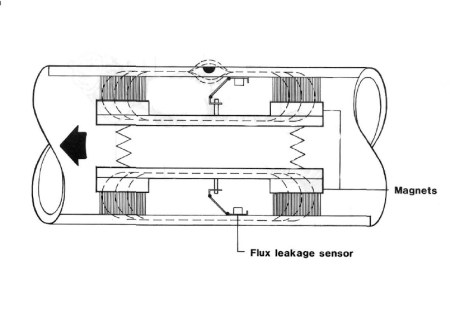
pig

The two sets  of magnets are connected to the pipe wall by steel brushes to maintain good contact. The magnetic field applied by the front set of magnets is contained within the pipe wall forms a kind of circuit with the rear set as shown, unless there is a variation in the thickness of the material. In that case magnetic flux leaks out and is detected by the sensors. The magnets and sensors are deployed in rings to cover the whole circumference of the pipe. A 24″ diameter pig would have 240 sensors, each recorded as a separate channel on the vehicle.

The actual system is fairly complicated so some of the work was experimental. Sections of pipe were made with defects of various sizes machined into them. The pig would then be pulled through these sections and the signals studied to build up an understanding of how the magnetic field would respond in different situations.

The actual pig (which could be several metres long and weighing a couple of tonnes) looks like this:
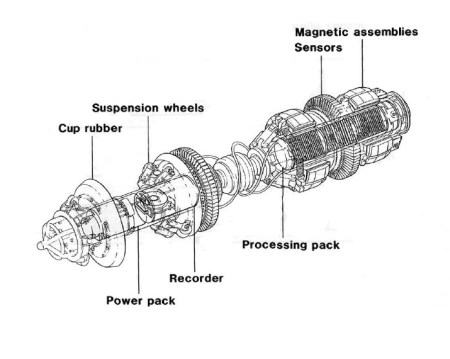
pig2

I always thought they looked a bit like spacecraft.

The pig usually travels at something like walking pace along the pipeline, and the sampling rate of the sensors was such that a reading would be taken every few millimetres. That sampling rate was necessary because corrosion pits as small as 1cm across could be dangerous.  The larger vehicles had “on-board thresholding” so that recordings of quiescent sections were discarded. Even so pipe surfaces (especially those of smaller bore) could be uneven for various reasons to do with their production rather than the effects of corrosion. Moreover, every few metres there would be a circumferential seam weld where two sections of pipe were joined together; these features would produce a large signal on all channels which the thresholding algorithm did not suppress.  The net result was that a lot of data had to be stored on the vehicle. When I say “a lot”, I mean for that time. A full run might produce about 5 × 107 readings. That seems like nothing now, but it was “Big Data” in those days!

So how was all this data processed back at the station? You probably won’t believe this, but it was printed out on Versatec printers in the form of a chart recording for each channel. Operators then identified funny-looking signals by eye and we then pulled down the data from tape and had a further look, usually comparing the patterns visually with those obtained from “pull-through” experiments.

Among the things I worked on was an algorithm to recognize seam weld signals automatically. That was quite easy actually – because it just requires looking for simultaneous activity on all channels – although it had to be made robust enough to deal with the odd dead channel and other instrumental glitches. This algorithm proved to be useful because sometimes the on-board telemetry would go wrong and we had to locate the pig by counting the number of welds it had passed since the start of the run.

A far more difficult challenge was dealing with data from 12″ diameter pipe. These are manufactured in a way that’s completely different from that used to make pipes of larger diameter, which are made of rolled steel. The 12″ pipes were made from a solid plug of molten steel, the centre of which is bored out by a device that rotates as it goes along. The effect of this is that it imposes a peculiar form of variation on the pipe wall, in the form of a spirally modulated “noise”. Annoyingly, the pitch and amplitude of the spiral varied from one section of pipe to another. After many failed attempts, the group finally came up with an algorithm that used the weld detector as a starting point to establish the vehicle had entered a new section of pipe. It then used data from the start of each section to estimate the parameters of the spiral pattern for that section, and then applied a filter to remove it from the rest of the section. It wasn’t particularly elegant, but it certainly cleaned up the data massively and made it much easier to spot significant features.

You might ask why I’ve written at such length about this when it’s got nothing to do with my current research (or indeed, anything else I’ve done since I graduated from Cambridge in 1985). One reason is that, although I didn’t know it at the time, my time at OLIC was going to prepare me very well for when I started my PhD. That was the case because all the programming I did used VAX computers, which turned out to be the computers used by STARLINK.  When I started my life as a research student I was already fluent in the command language (DCL) as well as the database software DATATRIEVE, which was a great advantage. Another reason is that working in this environment I had to learn to make my code (which, incidentally, was all in Fortran-77) conform to various very strict standards. I didn’t like some of the things we were forced to do, but I was shouted at sufficiently often that I gave up and did what I was told. I have never been particularly good at doing that in general, but in the context of software it is a lesson I’m glad I learned. Above all, though, I think working outside academia gave me a different perspective on research.  As academics were are very lucky to be able- at least some of the time – to choose our own research problems, but I believe that in the long run it can be very for your intellectual development to do something completely different every now and then.

We’re currently discussing a scheme whereby Physics and Astrophysics research students can interrupt their PhD for up to 6 months to undertake a (paid) work placement outside academia. I suspect many graduate students will not be keen on this, as they’ll see it as a distraction from their PhD topic, but I think it has many potential advantages as I hope I’ve explained.


November 18th 1916: The End of the Somme Offensive

Posted in History with tags , , , on November 18, 2016 by telescoper

If you think a lot has happened between this summer and now, it is perhaps worth reflecting on the fact that the Battle of the Somme, which started on July 1st 1916, only came to an end on November 18th 1916, i.e. one hundred years ago today. The last phase of the Somme Offensive was the Battle of the Ancre which lasted from November 13th until November 18th. Though the key objective (of eliminating a German salient) was not met, and casualties were heavy, this battle is considered a qualified success for the British Army, who secured the key position of Beaumont Hamel, though the village itself was almost completely destroyed during the fighting:


beaumont-hamel

The battlefield at Beaumont-Hamel, taken in November 1916

Incidentally, Beaumont-Hamel had seen fighting since the very first day of the Battle of the Somme. On July 1st 1916, 700 men of the Newfoundland Regiment gave their lives there as they went “over the top” and were promptly mown down by machine guns. There is an important memorial to their sacrifice there.

The statistics of the Somme Offensive are truly horrific. In total well over a million men were killed or seriously wounded during the 141 day campaign. By the time it finished the British, French and Commonwealth armies had advanced a maximum of about 6 miles. Most historians describe the outcome as “inconclusive”, largely on the grounds equal numbers of soldiers were slaughtered on each side.  It was a stalemate, but the price paid in blood was appalling.

The carnage didn’t end with the Somme. As the “Great War” stumbled on, battle after battle degenerated into bloody fiasco. Just a year later the Third Battle of Ypres saw another 310,000 dead on the British side as another major assault on the German defences faltered in the mud of Passchendaele. By the end of the War on 11th November 1918, losses on both sides were counted in millions.


Cardiff: Centre of Gravity

Posted in The Universe and Stuff with tags , , , on November 17, 2016 by telescoper

It’s a very busy period for me as the Cardiff University Data Innovation Research Institute (DII) gears up for some exciting new activities in both teaching and research (of which more in due course) and embarks on is strategy for promoting and fostering interdisciplinary research across Cardiff University and beyond.

Yesterday, however, I attended an informal meeting in the School of Physics & Astronomy at which we had an update about other strategic developments in the Gravitational Physics Group, some of whose members work in the DII Following on from the first-ever detection of gravitational waves earlier this year the group has ambitious plans to build on its involvement in this discovery. Here’s a nice short video produced by Cardiff University that discusses this discovery:


Cardiff University has supported research on gravitational waves for a very long time, and it is important that it reaps the benefit now that its investment is starting to pay off. To rest on laurels at this stage would be to risk losing the benefits of that sustained investment. It was very exciting to hear about the group’s plans for further sustained expansion, which will make the Cardiff one of the leading centres of gravitational wave research  in the world.

I’ve already mentioned on this blog that a couple of new positions have already been advertised, one in gravitational wave astronomy (to consolidate existing activities in theory and data analysis) and the other in a completely new area of Gravitational Wave Experimentation. Those advertisements have now closed and the process of filling the vacancies is under way.

However, yesterday we heard of even more expansion of gravitational physics research, in the form of a new academic position in Time Domain Astronomy with particular emphasis on transient sources of electromagnetic radiation that could be associated with gravitational wave production (such as gamma-ray bursts). I’ll post the advertisement on this blog when it is available. And that’s just the start: further positions will be released over the next few years which will turn Cardiff into a true Centre of Gravity.

Exciting times!

Roopa Panesar – Raga Puriya Gat

Posted in Music with tags , , , , , , , on November 16, 2016 by telescoper

Last night I listened to an absolutely fascinating live concert of Indian Classical Music on BBC Radio 3. I know very little about this kind of music, but was captivated by the energy, spontaneity and sense of excitement – not to mention the extreme virtuosity – of the playing. I wish I knew more so I’ve decided to enlist the help of the blogosphere to suggest recordings suitable for the education of an ignorant person like myself. Please offer your suggestions through the comments box below.

In the meantime, though, here is a clip featuring one of the musicians from last night’s concert, Roopa Panesar on sitar (the large stringed instrument) with the amazing Sukhwinder Singh on tabla (the small drums) and Gunwant Kaur on the tanpura. There’s a lot of improvisation in a Raga such as this, which gives it a lot of the freewheeling flavour of Jazz (complete with audience applause at particularly exciting moments) but it inhabits a sound world all of its own and is underpinned by wonderfully fluid rhythmic pulse.