Archive for October, 2018

The Blue of the Night: Giant Steps from Ondine

Posted in Jazz, Music with tags , , , , , , on October 17, 2018 by telescoper

Time for a quick lunchtime post before I settle down to an afternoon of marking coursework.

On Monday evening after finishing preparing my lectures and things for Tuesday, I decided to tune in for a while to The Blue of the Night on RTÉ Lyric FM which is presented by Bernard Clarke. This is a programme that I listen to quite often in the evenings as I enjoy its eclectic mix of music.

Anyway, the Blue of Monday Night included a recording of the movement Ondine from the piano suite Gaspard de la Nuit by Maurice Ravel. As I listened to it, I started to think of an entirely different piece, the jazz classic Giant Steps, by John Coltrane (which I’ve actually posted on this blog here). Not really expecting anything to come of it, I sent a message on Twitter to Bernard Clarke mentioning the fact that the Ravel piece reminded me of Giant Steps. A few minutes later I was astonished to hear Giant Steps playing. Bernard had not only replied to me on Twitter, but had slipped the Coltrane track into the programme. Which was nice.

That confirmed the similarity in my mind and I did some frantic Googling to see if anyone else had noticed the similarity. Of course they have. In a rather dense article about music theory (most of which I don’t understand, having never really studied this properly) I found this:

I didn’t know at first what the up and down arrows annotating the two pieces were, but they represent the harmonic progression in a very interesting way that I had never thought about it before. The assertion is that in some sense the (sub-dominant) IV and (dominant) V chords which very common in popular music are closely related. To see why, imagine you play C on a piano keyboard. If you go 7 semitones to the right you will arrive at G, which is the root note of the relevant V chord. That’s up a perfect fifth. But if instead you go 7 semitones to the left you get to F which is a fifth down but is also a perfect fourth if looked at from the point of view of C an octave below where you started. In this way `up’ arrow represents a perfect fifth up (or a perfect fourth down) while the `down’ arrow is a perfect fifth down or a perfect fourth up. This is deemed to be the basic (or `simple proper’) chord progression.

Single or double arrows to left or right represent substitutions of various kinds (e.g. a minor third), but I won’t go further into the details. The key point is that while the actual chords differ after the first few changes because of the different substitutions, the chord progression in these two piece is remarkably similar judged by the sequence of arrows. The main exception is a different substitution in bar 3 of the Coltrane excerpt. Both pieces end up achieving the same thing: they complete an entire chromatic cycle through a sequence of basic progressions and substitutions.

I don’t know whether Coltrane was directly inspired by listening to Ravel or whether they both hit on the same idea independently, but I find this totally fascinating. So much so that I’ll probably end up trying to annotate some of the chord changes I’ve worked out from other recordings and see what they look like in the notation outlined above.


Open Journal Updates

Posted in Open Access, The Universe and Stuff with tags , on October 16, 2018 by telescoper

Just finished today’s teaching so I thought I’d chill for a few minutes and pass on a few quick updates about the Open Journal of Astrophysics, which was formally (re)launched last week.

The first thing is that at the weekend I sent an online training video and guide around the members of the Editorial Board and introduced them all to the new platform’s messaging system, which is a very convenient way for us to keep in touch. I had lots of volunteers for the Editorial Board and I couldn’t select everyone but I tried to choose members with a good geographical distribution, spread of expertise, and gender balance. We may add more in due course, as we’re still quite cosmologist-heavy, but I think we have enough to get started: we have editors in Australia, France, Italy, United States of America and Mexico as well as the United Kingdom.

We have received some submissions already and are dealing with them through the new platform, which is requiring the Editors to engage in some `on-the-job’ training. Hopefully they’ll get the hang of it soon!

Another relevant piece of news is that we have updated the DOIs associated with the papers we published with the old platform to point to the new site so they are now fully incorporated. For the record these are:

10.21105/astro.1708.00605

10.21105/astro.1603.07299

10.21105/astro.1602.02113

10.21105/astro.1502.04020

I’ll also take this opportunity to remind you that the Open Journal of Astrophysics is open for new submissions, so please feel free to give it a try!

Finally, I’d like to point you to an article about Open Access Publishing in the latest Physics Today, which begins

Publishers of scientific journals are facing renewed threats to their business models from both sides of the Atlantic.

You better believe it!

The Big Bang Exploded?

Posted in Biographical, The Universe and Stuff with tags , , , on October 15, 2018 by telescoper

I suspect that I’m not the only physicist who receives unsolicited correspondence from people with wacky views on Life, the Universe and Everything. Being a cosmologist, I probably get more of this stuff than those working in less speculative branches of physics. Because I’ve written a few things that appeared in the public domain, I probably even get more than most cosmologists (except the really famous ones of course).

Many “alternative” cosmologists have now discovered email, and indeed the comments box on this blog, but there are still a lot who send their ideas through regular post. Whenever I get a envelope with an address on it that has been typed by an old-fashioned typewriter it’s a dead giveaway that it’s going to be one of those. Sometimes they are just letters (typed or handwritten), but sometimes they are complete manuscripts often with wonderfully batty illustrations. I remember one called Dark Matter, The Great Pyramid and the Theory of Crystal Healing. I used to have an entire filing cabinet filled with things like his, but I took the opportunity of moving from Cardiff some time ago to throw most of them out.

One particular correspondent started writing to me after the publication of my little book, Cosmology: A Very Short Introduction. This chap sent a terse letter to me pointing out that the Big Bang theory was obviously completely wrong. The reason was obvious to anyone who understood thermodynamics. He had spent a lifetime designing high-quality refrigeration equipment and therefore knew what he was talking about (or so he said). He even sent me this booklet about his ideas, which for some reason I have neglected to send for recycling:

His point was that, according to the Big Bang theory, the Universe cools as it expands. Its current temperature is about 3 Kelvin (-270 Celsius or thereabouts) but it is now expanding and cooling. Turning the clock back gives a Universe that was hotter when it was younger. He thought this was all wrong.

The argument is false, my correspondent asserted, because the Universe – by definition – hasn’t got any surroundings and therefore isn’t expanding into anything. Since it isn’t pushing against anything it can’t do any work. The internal energy of the gas must therefore remain constant and since the internal energy of an ideal gas is only a function of its temperature, the expansion of the Universe must therefore be at a constant temperature (i.e. isothermal, rather than adiabatic). He backed up his argument with bona fide experimental results on the free expansion of gases.

I didn’t reply and filed the letter away. Another came, and I did likewise. Increasingly overcome by some form of apoplexy his letters got ruder and ruder, eventually blaming me for the decline of the British education system and demanding that I be fired from my job. Finally, he wrote to the President of the Royal Society demanding that I be “struck off” and forbidden (on grounds of incompetence) ever to teach thermodynamics in a University. The copies of the letters he sent me are still will the pamphlet.

I don’t agree with him that the Big Bang is wrong, but I’ve never had the energy to reply to his rather belligerent letters. However, I think it might be fun to turn this into a little competition, so here’s a challenge for you: provide the clearest and most succint explanation of why the temperature of the expanding Universe does fall with time, despite what my correspondent thought.

Answers via the comment box please!

Especially when the October Wind

Posted in Poetry with tags , , on October 15, 2018 by telescoper

Especially when the October wind
With frosty fingers punishes my hair,
Caught by the crabbing sun I walk on fire
And cast a shadow crab upon the land,
By the sea’s side, hearing the noise of birds,
Hearing the raven cough in winter sticks,
My busy heart who shudders as she talks
Sheds the syllabic blood and drains her words.

Shut, too, in a tower of words, I mark
On the horizon walking like the trees
The wordy shapes of women, and the rows
Of the star-gestured children in the park.
Some let me make you of the vowelled beeches,
Some of the oaken voices, from the roots
Of many a thorny shire tell you notes,
Some let me make you of the water’s speeches.

Behind a pot of ferns the wagging clock
Tells me the hour’s word, the neural meaning
Flies on the shafted disk, declaims the morning
And tells the windy weather in the cock.
Some let me make you of the meadow’s signs;
The signal grass that tells me all I know
Breaks with the wormy winter through the eye.
Some let me tell you of the raven’s sins.

Especially when the October wind
(Some let me make you of autumnal spells,
The spider-tongued, and the loud hill of Wales)
With fists of turnips punishes the land,
Some let me make you of the heartless words.
The heart is drained that, spelling in the scurry
Of chemic blood, warned of the coming fury.
By the sea’s side hear the dark-vowelled birds.

by Dylan Thomas (1914-1953)


All The Girls Go Crazy

Posted in Jazz with tags , , , on October 14, 2018 by telescoper

I came across this on Youtube a while ago and I quite often play it when I’m at work if I’m in need of an aural pick-me-up when I’m flagging a bit. The tune All The Girls Go Crazy is one of many manifestations of a 16-bar blues theme that was fairly ubiquitous in New Orleans Jazz. The recording is by a band led Ken Colyer who I think is on cornet rather than trumpet on this track, but the Youtube poster gives no other information about the personnel or the date. I’m going to stick my neck out and say that the clarinettist sounds to me like Ian Wheeler and the drummer is without doubt Colin Bowden, one of the very best drummers in this style that the UK has ever produced. If I’m right then I think the date is somewhere around the mid-1950s, at the peak of the New Orleans revival in the UK. No doubt some other jazz fan out there will correct me if I’m wrong!

Ken Colyer (`the guvnor’) had very firm ideas about how New Orleans music should be performed, and you’ll notice that there’s much more ensemble work here than you find in the typical string-of-solos approach adopted by many `Trad’ bands of the period.

I’m going to look very silly if it’s not Colin Bowden on drums here, but for me he (or whoever else is the drummer) is the star of this performance, as it is he who is responsible for the steadily increasing sense of momentum, achieved without speeding up (which is the worst thing a rhythm section can do). Notice how he signals the end of each set of 8-bars with a little figure on the tom-toms and/or a cymbal crash, and it is by increasing the strength of these that he raises the excitement level. Notice also that he also has the last word with his cymbal, something jazz drummers are wont to do.

P.S. If you look here, you’ll see a certain Peter Coles playing alongside Ken Colyer in the 1970s. It’s not me, though. It’s my uncle Peter…

Union Matters

Posted in Education, Politics with tags , , , , , on October 14, 2018 by telescoper

The above collection of goodies arrived last week in a Welcome Pack from the Irish Federation of University Teachers (IFUT), my new trade union. I sent in an application to join some time ago, and was getting a bit worried that it might have been lost, but then confirmation arrived in the form of my membership card along with a pen, a badge, a lanyard, an application form for a Credit Union and various other bits and bobs. It’s only by standing together that academics in Irish universities have any hope of exerting enough pressure on the Government to get it to reverse the persistent underfunding of Higher Education in this country. Even then it won’t be easy – last week’s budget had nothing whatsoever in it for universities or students.

Incidentally, according to the online budget calculator, I’ll be a princely €28 per month better off next year as a result of small changes in taxation, but it seems to me that the priority should have been to help the less well off and it failed to do that. No doubt, however, the cautious approach to public finances shown by the Government is largely down to the uncertain effects of Brexit.

While I am on about unions, some of the readers of this blog will recall that I was participating in industrial action by UCU (the Universities and Colleges Union) in the UK earlier this year in relation to proposed cuts to pensions in the Universities Superannuation Scheme (USS). I have since left that scheme, deferring my benefits from it until I retire, but I couldn’t resist passing on a link to an article I read yesterday, which argues that USS’s valuation (which resulted in a deficit) rests on a large and demonstrable mistake and, when this is corrected there is no deficit as at 31 March 2018 and no need for detrimental changes to benefits or contributions.

Could it be that all that pain was caused by an accounting error? If so, then heads should roll!

Bax, Vaughan Williams & Potter at the NCH.

Posted in Music with tags , , , , , , , , on October 13, 2018 by telescoper

Last night I was once again at the National Concert Hall in Dublin for a concert by the RTÉ National Symphony Orchestra, this time conducted by Kenneth Montgomery. I took the above picture about five minutes before the start of the concert and, although a few more people arrived before the music began, it was a very low attendance. I don’t think the hall was more than 20% full. I’m not sure why. Perhaps Storm Callum made it difficult for some to make the journey to Dublin? I was delayed a bit on the way there from Maynooth, but I’m glad I made it because it was a fine concert.

I always appreciate it when unfamiliar works are programmed alongside more standard repertoire, and last night provided a good example of that. One piece was an established favourite among concert-goers, another I have on CD but have never heard live, and one I had never heard before at all.

The opening piece was In Memoriam by Arnold Bax. Although considered by many to be an archetypal English composer, Bax had a strong affinity for Ireland and indeed lived here from 1911 until the outbreak of war in 1914. I’ve always felt Bax’s music was greatly influenced by Sibelius, but he was very interested in Celtic culture and that comes across in his In Memoriam, which is built around a very folk-like melody. The work was composed to honour Pádraig Pearse, one of the leaders of the 1916 uprising, who was subsequently executed by the British authorities, and was written in the immediate aftermath of the rebellion in 1916. It is a very fine piece, in my opinion, starting in a rather elegiac mood, but with passages that celebrate of Pearce’s life than mourn his death, and the ending is very moving, like a beautiful sunset.

There was then a short delay while various rearrangements were made on stage. Off went the wind instruments and percussion, and into the space vacated by their departure moved a subset of the string instruments, creating a second (smaller) string orchestra separated from the remaining musicians. In addition, the principals of the relevant sections arranged themselves to form a string quartet around the conductor’s podium. If you didn’t know before reading this what was about to be played, then that description will no doubt have led you to conclude that it must be the Fantasia on a Theme by Thomas Tallis by Ralph Vaughan Williams. This is an evergreen concert piece, for good reason, and the string players of the RTÉ National Symphony Orchestra delivered a very fine account of it. I remarked on the fine playing of the string section after the last concert I attended at the NCH, and they did it again.

After the interval was a piece I had never heard before, the Sinfonia “De Profundis” by Belfast-born A.J. `Archie’ Potter, composed fifty years ago in 1968, and first performed in 1969 by the RTÉ National Symphony Orchestra in Dublin. The title is a reference to Psalm 130, and some of the thematic material comes from liturgical music. In the composer’s own words:

As the title suggests, it is a musical account of one man’s own progress from despair over a particular circumstance in his life to spiritual recovery and (for the time being of course) triumph over the powers of darkness.

Although `a journey from darkness into light’ is a description that could apply to many symphonies (especially those of Beethoven), this work in five movements does not have a typically `symphonic’ structure in that it is based on variations on a theme drawn from a 16th century carol spread throughout the whole work rather than confined to one movement, alongside another element comprising a `tone row’. The juxtaposition of `traditional’ diatonic and `modernist’ serialist explorations generates tension which is only released at the very end, when it is released by the arrival of a new theme borrowed from the `Old 124th’.

That brief description of what is going on in this work doesn’t do justice at all to the impression it creates on the listener, which is of a richly varied set of textures sometimes mournful but sometimes boisterous, with dashes of robust humour thrown in for good measure. I’m not at all familiar with A.J. Potter, but I must hear more of his music. Based on this piece, he was both clever and expressive.

As a bonus we had an orchestral encore in the form of another piece by Archie Potter, much shorter and much lighter. Orchestral encores are rare in the UK, but seem to be less so here in Ireland.

After that I left in order to return to Maynooth. Appropriately enough, in the light of the piece by Bax, I took a train from Pearse station…

Vector Calculus Weather

Posted in mathematics, The Universe and Stuff with tags , , on October 12, 2018 by telescoper

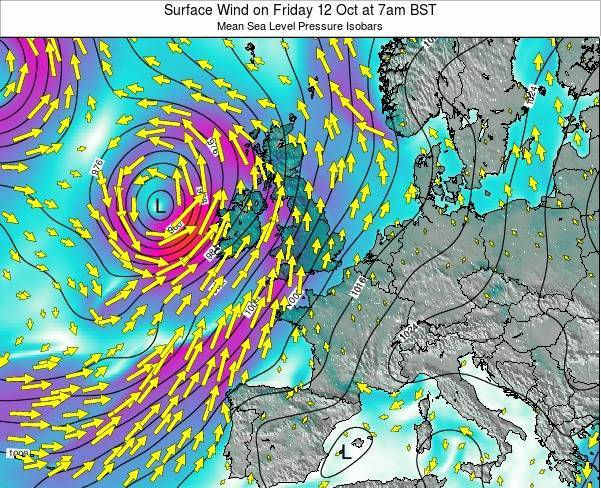
As it happens I did a lecture today about vector fields as part of my module on vector calculus. Whenever I did similar lectures in the past I used the day’s weather map as an illustration, so this morning I downloaded what turned out to be a particularly dramatic example. The curl of the velocity field around the weather system off the west coast of Ireland this morning was definitely non-zero…

Storm Callum turned out to be not as damaging as feared. Apparently it was rather windy in Maynooth overnight, but I slept right through it.

Hubble Problems

Posted in Cute Problems, The Universe and Stuff with tags , on October 12, 2018 by telescoper

Here I am, only connecting again.

Almost every day I get a spam message from a certain person who thinks he can determine the Hubble constant from first principles using  biblical references. The preceding link takes you to an ebook. I was thinking of buying it, but at 99c* I considered it prohibitively expensive.

*I am informed that it has now gone up to £1.30.

My correspondent also alleges that in writing this blog I am doing the Devil’s work. That may be the case, of course, but I can’t help thinking that there must be more effective ways for him to get his work done. Either that or he’s remarkably unambitious.

Anyway, to satisfy my correspondent here is one for the problems folder:

Using  the information provided in Isaiah Chapter 40 verse 22, show that the value of the Hubble constant is precisely 70.98047 km s-1 Mpc-1.

You may quote the relevant biblical verse without proof. In the King James version it reads:

40.22. It is he that sitteth upon the circle of the earth, and the inhabitants thereof are as grasshoppers; that stretcheth out the heavens as a curtain, and spreadeth them out as a tent to dwell in.

By the way, please note that the inverse of the Hubble constant has dimensions of time, not distance.

Answers into my spam folder please (via the comments box).


While I am on the subject of Hubble, I will mention the news that the Hubble Space Telescope is having a few technical problems as a result of a failure of one of its gyros. In fact a few days ago it went into `safe mode’ to help engineers diagnose and fix the problem, during which time no observations are being taken. I’m told by people who know about such things that the spacecraft can actually operate on only one gyro if necessary, using information from other systems for attitude control, so this problem is not going to be terminal, but it will slow down the pointing quite a bit thus make it less efficient. With a bit of luck HST will be back in operation soon.


Moon Child – Pharaoh Sanders

Posted in Jazz, The Universe and Stuff with tags , , , , on October 11, 2018 by telescoper

Following the advice of novelist E.M. Forster to `only connect’, I thought I’d do just that by only connecting  two bits of news. The first is that legendary saxophonist Pharaoh Sanders is playing at the National Concert Hall in Dublin next month and the second is that astronomers have been discussing whether or not a moon can have a moon and, if it can, whether it should be called a moonmoon or a submoon or something else. Well, I think such an object should be called a Moon Child, after the album by Pharaoh Sanders from which this is the title track. With a link like that, I’m sure it’s only a matter of time before I get offered a job as a radio presenter!