Archive for March, 2019

Semper Cavete Quod Idibus Martiis

Posted in Uncategorized with tags , , on March 15, 2019 by telescoper

Today is the Ides of March so I thought I’d keep up the little tradition I’ve established of posting this  priceless bit of British cultural history relevant to such a fateful day.

This is from the First Folio Edition of Carry On Cleo, and stars the sublime Kenneth Williams as Julius Caesar delivering one of the funniest lines in the whole Carry On series. The joke may be nearly as old as me, but it’s still a cracker…

They – by R.S. Thomas

Posted in Poetry with tags , , on March 14, 2019 by telescoper

The new explorers don’t go
anywhere and what they discover
we can’t see. But they change our lives.

They interpret absence
as presence, measuring it by the movement
of its neighbours. Their world is

an immense place: deep down is as distant
as far out, but is arrived at
in no time. These are the new

linguists, exchanging acrosss closed
borders the currency of their symbols.
Have I been too long on my knees

worrying over the obscurity
of a message? These have their way, too,
other than a prayer of breaking that abstruse code.

by R.S. Thomas (1913-2000)

New Publication at the Open Journal of Astrophysics!

Posted in OJAp Papers, Open Access, The Universe and Stuff with tags , , , , , on March 13, 2019 by telescoper

It’s nice to be able to announce that the Open Journal of Astrophysics has just published another paper. Here it is!

It’s by Pauline Barmby of the University of Western Ontario. You can find the accepted version on the arXiv here.

I think this paper is a good demonstration of the broad remit of the Open Journal of Astrophysics: our only rule is that if it’s suitable for the astro-ph section of the arXiv then we will consider if for publication. Rather than being a hardcore research paper, this is comprehensive and pedagogical review of observational techniques, instrumentation and data analysis in astronomy for use by researchers and educators in other disciplines, which we feel is a very useful addition to the literature

My thanks to the Editor and referees for dealing with this one so efficiently! We even have a Twitter testimonial from the author:

We have more publications in the pipeline but would be more than happy to receive more…!
I hope soon to get to the point where we have so many papers I can’t write a blog post about every one!

Theresa May: Friend of Hedge Funds

Posted in Uncategorized on March 12, 2019 by telescoper

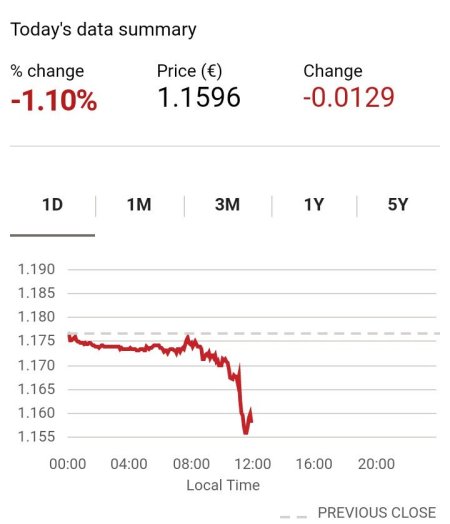
Compare and contrast the following behaviour of the Pound Sterling versus the Euro last night

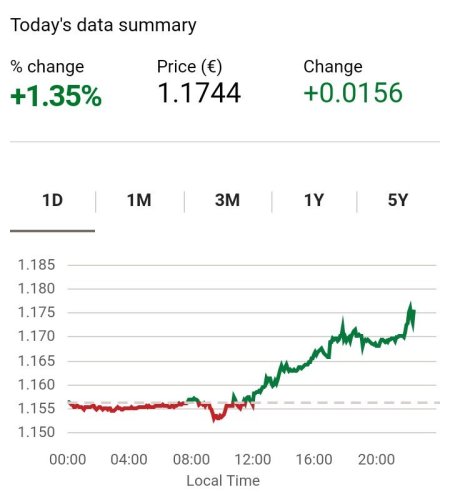
And this morning

Of course the Pound’s rise yesterday was based on speculation that the Prime Minister Theresa May’s trip to Strasbourg would lead to changes to the Withdrawal Agreement between the UK and EU that would make it acceptable to the House of Commons (by which I mean to the pro-Brexit faction of the Conservative Party). The subsequent fall this morning is explained by the fact that she achieved nothing of substance and the Withdrawal Agreement is unchanged.

It seems to me that there are two possible explanations for yesterday’s elaborately choreographed charade. Only a fool would think that Mrs May succeeded in negotiating a concession from the EU, but one thing she can be sure of is that the House of Commons (and particularly the Conservative Party) has plenty of fools in it. The PM might have thought this absurd piece of flummery was worth a shot and convincing Tory buffoons who haven’t read the Withdrawal Agreement anyway. It might even* work!

On the other hand, regardless of what happens in this evening’s `Meaningful Vote’, one thing is clear. Some currency traders will have made an awful lot of money by short-selling the pound. Theresa May’s Strasbourg pantomime will undoubtedly have made her very popular among the Hedge Fund Managers who in any case are the main financial beneficiaries of Brexit…

*It worked with some, but not enough to stop the deal being lost by 149 votes.

A Boost for Data Science in Ireland

Posted in Cardiff, Maynooth with tags , , , , , on March 11, 2019 by telescoper

Regular readers of this blog (both of them) will know that before I moved to Maynooth University I worked (part-time) in the Data Innovation Research Institute at Cardiff University, during which time we were very happy to be awarded a Centre for Doctoral Training by the Science & Technology Facilities Council (STFC), shared across Cardiff, Swansea and Bristol, as part of a big investment in this area by the UK government.

Now Science Foundation Ireland has announced a similar programme in Ireland: on Tuesday 5th March, Minister for Business, Enterprise, and Innovation, Heather Humphreys TD, and Minister of State for Training, Skills, Innovation, Research and Development, John Halligan TD, announced investment of over €100 million in six new SFI Centres for Research Training in the fields of ICT and data analytics. I’m very pleased to hear that Maynooth University is involved in two of these; there’s a news item on the University web pages here.

One of the new SFI Centres for Research Training, in Foundations of Data Science, is a joint initiative of Maynooth University, University College Dublin and the University of Limerick, with the support of Skillnet Ireland underpinning its industry and enterprise engagement. This Centre was awarded a total of €21 million, including industry and university contributions to train 139 PhD students towards a world-class foundational understanding of Applied Mathematics, Statistics, and Machine Learning. This represents the largest ever investment in mathematical sciences research in Ireland. The Maynooth involvement is based around the famous Hamilton Institute.

I’m not involved in this initiative myself, at least part of the reason for which is that I didn’t even know about the scheme until the results were announced, but I do hope there will be opportunities for my future PhD students working in `Big Data’ problems in cosmology to benefit from some of the training opportunities it provides.

A much wider issue is that companies based in Ireland have reported difficulties in filling vacancies with candidates sufficiently well trained in data science so hopefully this will help close the skills gap here.

The Gaia Sausage

Posted in The Universe and Stuff with tags , , , , , on March 10, 2019 by telescoper

I had to undertake a top secret mission on Friday, which turned out to be much less exciting than I’d hoped, but at least it gave me an excuse to catch some of the Royal Astronomical Society Open Meeting followed by dinner at the RAS Club. I actually sat next to the Club Guest Michael Duff, the eminent theoretical physicist Michael Duff who gave a nice after-dinner speech.

An artist’s impression of the Gaia Sausage. The Gaia fork has not yet been proved to exist.

The last talk at the RAS Meeting was by Neil Wyn Evans of Cambridge University in the Midlands on the subject of the `Gaia Sausage‘ (which, as you can see, has its own Wikipedia page). The Gaia Sausage is so named because it is consists of a marked anisotropy of the velocity distribution of stars in Milk Way, which is elongated in the radial direction (like a sausage) indicating that many stars are on near-radial (i.e. low angular momentum orbits). This feature has been revealed by studying the second data release from Gaia.

The work Wyn described in his talk is covered by a nice press release from Cambridge University which links to no fewer than five articles on it and related topics, which can all be found on the arXiv here, here, here, here and here.

The most plausible explanation of the Gaia Sausage is that it is a consequence of a major collision between the Milky Way with a smaller galaxy containing about 109 stars about 8-10 billion years ago, as illustrated in this simulation.

I vote that this explanation of the velocity structure of the Milky Way should henceforth be called the Big Banger Theory.

Geddit?

I’ll get my coat.

Technical Problems

Posted in Biographical, Cardiff with tags , , , , on March 10, 2019 by telescoper

This morning I got up early to travel to Cardiff Airport to get a flight back to Dublin.

We boarded the plane on time, left the gate on time and arrived at the end of the runway, apparently about to take off. We then sat there for 20 minutes before the pilot explained that there was a problem with the instruments on the flight deck. The plane then taxied back to the terminal, and an engineer got on, but he was unable to fix the problem so we all got off the plane which is clearly going nowhere soon.

A FlyBe Embraer 175 actually flying.

I’m currently sitting in the departure lounge drinking a coffee and wondering when (if) I’ll get to Dublin.

We’re told a plane will arrive from Edinburgh in half an hour and that will take us to Dublin. I’m not convinced. I think there’s a significant probability that my flight will be cancelled, but you never know..

The service with FlyBe has deteriorated in recent weeks almost as quickly as its fares have gone up. The airline has only recently been rescued from collapse and I suspect a major reorganisation is coming up.

Anyway, I know it’s safety first and all that, but my main concern is that we got all the way to the runway before anyone noticed there was a problem. Don’t they check before leaving the gate?

Update: we arrived in Dublin on Plane Number Two at 12.30, two hours and twenty minutes late but all in one piece.

Star Maker, by Remedios Varo

Posted in Art with tags , , , , , on March 9, 2019 by telescoper

by Remedios Varo Uranga (1908-63), painted in 1958.

To Like and to Like not

Posted in Biographical, Poetry with tags , , , on March 8, 2019 by telescoper

Travelling today, I was reminded that exactly a week ago, WordPress sent me this notification:

I was a bit surprised, to be honest, as that I posted a St David’s Day poem and usually when I post poetry the traffic goes down. Last Friday however it seems all my St David’s Day poetry posts going back years attracted traffic (and ‘likes’), so I was quite pleased.

Some time ago a senior astronomer emailed me to say that he thought that, for a science blog, there was far to much other stuff for his liking. Other stuff presumably including poetry, music, sport and the rest.

Anyway my response was that this isn’t really a science blog. It’s just a personal blog written by someone who happens to be a scientist. I post about science fairly often but I wouldn’t enjoy blogging half as much if I only covered that.

Some people have asked me why I post poetry and music and the rest. The answer is simple: to share things I enjoy. If just one person were to discover a poem they like by reading it here then it makes it all worthwhile!

Splitting with Elsevier

Posted in Open Access with tags , , , , on March 7, 2019 by telescoper

Just time today to pass on a bit of Open Access news: the University of California has ended negotiations which academic publishing giant Elsevier and will no longer subscribe to Elsevier Journals. The negotiations broke down over two key points: a refusal by Elsevier to reduce its charges (currently $11M) and a failure to meet guarantees on Open Access. There’s another piece about this here.

The University of California should be congratulated on its firm position here, as should organizations in Sweden and Germany for their similar decisions last year.

I’ve made my views of the academic publishing racket very clear over a number of years so I won’t repeat that rant here. I’ll just remind readers of the staggering fact that the global revenues of the academic publishing industry amount to about, €22 billion per annum. This exceeds the global revenues of the recorded music industry. Profit margins for these publishers are much larger (up to 45%) than Apple, Google and BMW.

The research community is being fleeced, and the worst offenders are the `Big Four’: Elsevier, Springer, Wiley and Taylor & Francis. It’s taken a while but it seems many organizations are finally waking up to what is going on. I don’t think we need `for-profit’ publishers at all – there are far better and cheaper ways of disseminating scientific research in the digital era, such as the arXiv.

I’ll also make a small plea here. If there are any rich philanthropists out there who want to do something positive for science then let me suggest that instead of funding more prizes or awards they consider making a large donation to the arXiv? In my view that would do far more for science than throwing yet more money at a few eminent individuals!