Archive for April, 2019

Our Lady of Paris

Posted in Architecture, History with tags , , , , on April 15, 2019 by telescoper

As I write, a catastrophic fire is raging in the Cathedral of Notre-Dame de Paris. Having started on the roof (or perhaps in a space underneath it), the flames spread rapidly through the mediaeval timbers of the building, bringing down the ceiling onto the nave, and causing the spire to collapse.

Restoration work on the roof started just four days ago and the area where the fire began was surrounded by scaffolding. Though nobody yet knows for sure what caused the fire, it seems likely to have been something to do with the ongoing repairs.

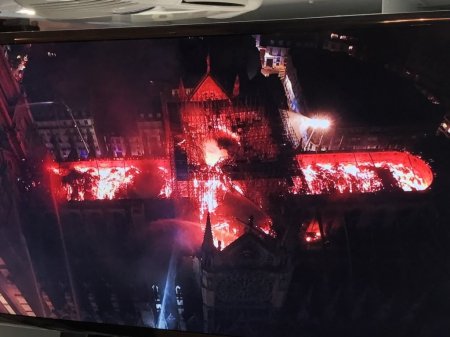
Watching the video streamed live from the scene with increasing horror, it seemed to me that the firemen were helpless to halt the advancing inferno. They just couldn’t get enough water onto the top of the huge structure quickly enough to contain the blaze. It was heartbreaking viewing. I fear very little will be left standing and most of the interior will have been completely destroyed, as this drone picture suggests:
At least there seem to have been no fatalities, although one brave fireman is reported to be seriously injured.

The loss of an iconic building like Notre Dame is shattering event for anyone who has been there, as I have on several occasions. Nobody who has seen the splendour of the 13th Century Rose Windows, for example, will ever forget the experience, so the destruction feels like losing a part of one’s own life. But above all it is a terrible loss for the people of Paris, as Notre Dame is the embodiment of so much of that beautiful and ancient city’s history.

Nobody put this better than Victor Hugo in Notre-Dame de Paris:

Notre Dame de Paris, in particular, is a curious specimen of this variety. Every surface, every stone of this venerable pile, is a page of the history not only of the country, but of science and of art. Thus—to mention here only a few of the chief details—whereas the small Porte Rouge almost touches the limits of fifteenth century Gothic delicacy, the pillars of the nave, by their massiveness and great girth, reach back to the Carlovingian Abbey of Saint-Germain-des-Prés. One would imagine that six centuries lay between that door and those pillars. Not even the Hermetics fail to find in the symbols of the grand doorway a satisfactory compendium of their science, of which the Church of Saint-Jacques-de-la-Boucherie was so complete a hieroglyph. Thus the Roman Abbey—the Church of the Mystics—Gothic art—Saxon art—the ponderous round pillar reminiscent of Gregory VII, the alchemistic symbolism by which Nicolas Flamel paved the way for Luther—papal unity—schism—Saint-Germain-des-Prés—Saint-Jacques-de-la-Boucherie—all are blended, combined, amalgamated in Notre Dame. This generative Mother-Church is, among the other ancient churches of Paris, a sort of Chimera: she has the head of one, the limbs of another, the body of a third—something of all.

I’m sure Parisians will be in a state of shock tonight and that will turn to something very close to grief. Mere words from me won’t help much, but let me in any case express my profound sadness and sympathy to my French friends and colleagues in Paris and around the world.

But if I know them at all, the French will soon set about the task of rebuilding, probably creating something majestic and extraordinary to replace what has been lost.

UPDATE: the morning after, it seems the fire was brought under control quickly enough to save the walls and towers, and at least one of the Rose Windows.
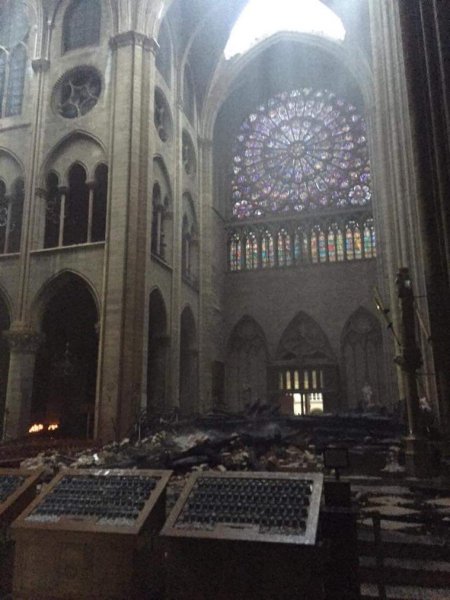
That this has been achieved owes everything to the courage and skill of the Pompiers, 500 of whom fought the blaze last night. Magnifique.

Grubb Parsons: the Irish Connection

Posted in History, The Universe and Stuff with tags , , , , , , , , on April 15, 2019 by telescoper

The other day I stumbled across an interesting article that discusses, among other things, the famous telescope and optical instrument manufacturing company, Grubb Parsons. The piece is a few years old but I didn’t see it when it came out. It’s well worth a read.

Grubb Parsons was still a famous company when I was at school, but it closed down in 1985. The main works were in Heaton, in Newcastle Upon Tyne, not far from where I was born; my father went to Heaton Grammar School.

Grubb Parsons made a huge number of extremely important astronomical telescopes, including the Isaac Newton Telescope, pictured above at the works in Heaton.

Interestingly, the names ‘Grubb’ and ‘Parsons’ both have strong Irish connections.

Howard Grubb was born in Dublin in 1844 and in 1864 he joined the optical instruments company set up there by his father Thomas Grubb. When his father died in 1878 Howard Grubb took over the Grubb Telescope Company and consolidated its reputation for manufacturing high quality optical components and devices. He was knighted in 1887.

Back in 1845 Thomas Grubb had helped build the famous ‘Leviathan‘ telescope for William Parsons, 3rd Earl of Rosse at Birr Castle in County Offaly.

Charles Algernon Parsons, who took over the Grubb Telescope Company after it was liquidated in 1925, and relocated it to Tyneside, was the youngest son of William Parsons ( just as Howard Grubb was the youngest son of Thomas). He no doubt kept the name Grubb in the company name because of its associated reputation.

Parsons had a wide range of business interests besides telescopes, mainly in the marine heavy engineering sector, especially steam turbines. When I was a lad, ‘C A Parsons & Company’ was still one of the biggest employers on Tyneside. It still exists but as part of Siemens and is a much smaller operation than in its heyday.

One final connection is that Sir Howard Grubb and Sir Charles Algernon Parsons both passed away in the same year, 1931.

Patterns – by Amy Lowell

Posted in Poetry with tags , , on April 14, 2019 by telescoper

I walk down the garden paths,
And all the daffodils
Are blowing, and the bright blue squills.
I walk down the patterned garden-paths
In my stiff, brocaded gown.
With my powdered hair and jewelled fan,
I too am a rare
Pattern. As I wander down
The garden paths.

My dress is richly figured,
And the train
Makes a pink and silver stain
On the gravel, and the thrift
Of the borders.
Just a plate of current fashion,
Tripping by in high-heeled, ribboned shoes.
Not a softness anywhere about me,
Only whalebone and brocade.
And I sink on a seat in the shade
Of a lime tree.For my passion
Wars against the stiff brocade.
The daffodils and squills
Flutter in the breeze
As they please.
And I weep;
For the lime-tree is in blossom
And one small flower has dropped upon my bosom.

And the plashing of waterdrops
In the marble fountain
Comes down the garden-paths.
The dripping never stops.
Underneath my stiffened gown
Is the softness of a woman bathing in a marble basin,
A basin in the midst of hedges grown
So thick, she cannot see her lover hiding,
But she guesses he is near,
And the sliding of the water
Seems the stroking of a dear
Hand upon her.
What is Summer in a fine brocaded gown!
I should like to see it lying in a heap upon the ground.
All the pink and silver crumpled up on the ground.

I would be the pink and silver as I ran along the paths,
And he would stumble after,
Bewildered by my laughter.
I should see the sun flashing from his sword-hilt and the buckles
on his shoes.
I would choose
To lead him in a maze along the patterned paths,
A bright and laughing maze for my heavy-booted lover,
Till he caught me in the shade,
And the buttons of his waistcoat bruised my body as he clasped me,
Aching, melting, unafraid.
With the shadows of the leaves and the sundrops,
And the plopping of the waterdrops,
All about us in the open afternoon —
I am very like to swoon
With the weight of this brocade,
For the sun sifts through the shade.

Underneath the fallen blossom
In my bosom,
Is a letter I have hid.
It was brought to me this morning by a rider from the Duke.
“Madam, we regret to inform you that Lord Hartwell
Died in action Thursday se’nnight.”
As I read it in the white, morning sunlight,
The letters squirmed like snakes.
“Any answer, Madam,” said my footman.
“No,” I told him.
“See that the messenger takes some refreshment.
No, no answer.”
And I walked into the garden,
Up and down the patterned paths,
In my stiff, correct brocade.
The blue and yellow flowers stood up proudly in the sun,
Each one.
I stood upright too,
Held rigid to the pattern
By the stiffness of my gown.
Up and down I walked,
Up and down.

In a month he would have been my husband.
In a month, here, underneath this lime,
We would have broke the pattern;
He for me, and I for him,
He as Colonel, I as Lady,
On this shady seat.
He had a whim
That sunlight carried blessing.
And I answered, “It shall be as you have said.”
Now he is dead.

In Summer and in Winter I shall walk
Up and down
The patterned garden-paths
In my stiff, brocaded gown.
The squills and daffodils
Will give place to pillared roses, and to asters, and to snow.
I shall go
Up and down,
In my gown.
Gorgeously arrayed,
Boned and stayed.
And the softness of my body will be guarded from embrace
By each button, hook, and lace.
For the man who should loose me is dead,
Fighting with the Duke in Flanders,
In a pattern called a war.
Christ! What are patterns for?

by Amy Lowell (1874-1925)

A Prominence from Principe

Posted in History, The Universe and Stuff with tags , , , , on April 13, 2019 by telescoper

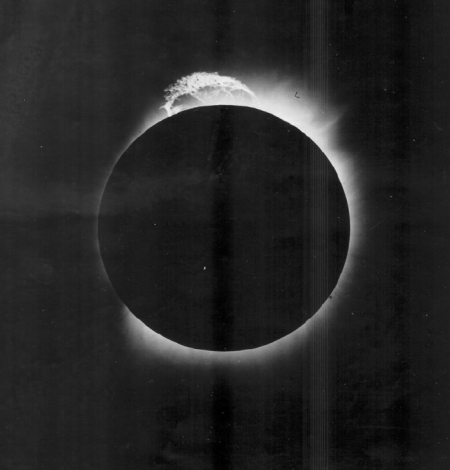
While I seem to be on a little run of posts about the 1919 Eclipse I thought I’d share the above photograph, taken at Principe, that shows that the bending of light from stars was not the only observation made at this eclipse. At the top of the figure you can see a wonderful example of a solar prominence..

The Mystery Object Revealed

Posted in History, The Universe and Stuff with tags , , , , , on April 12, 2019 by telescoper

As I revealed this afternoon in my talk at the Royal Astronomical Society, yesterday’s mystery object..

..is in fact the 4-inch object (geddit?) glass that was manufactured by Howard Grubb in Dublin and taken to Sobral in Brazil in 1919 to be used in a famous experiment to measure the bending of light by the Sun during a total eclipse.

Here is a picture of the observing setup in Sobral:

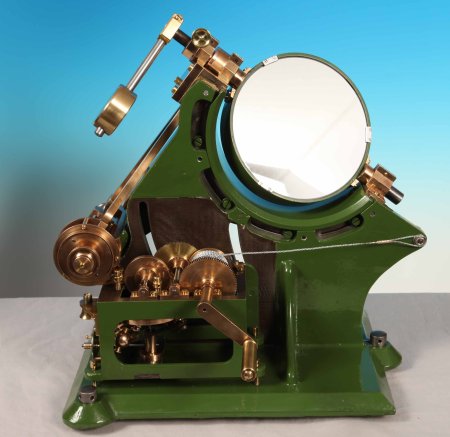
The 4-inch lens is mounted in the square tube on the right. The eclipse was observed using a coelostat (a steerable mirror) that reflected light into the telescopes. Here is a photograph of the coelostat:

The object glass and coelostat are usually on display at Dunsink Observatory but these are currently en route to Brazil for the commemorations of the centenary of the historic expedition.

Photo Credits to Tom Ray of DIAS…

Mystery Object

Posted in History, The Universe and Stuff on April 11, 2019 by telescoper

I’ve had a very busy day today and am now about to dash off again so I’ll just post this picture to see if anyone can guess what the mystery object is..

Answers through the Comments Box please!

Results from the Event Horizon Telescope

Posted in Astrohype, The Universe and Stuff with tags , , on April 10, 2019 by telescoper

Following yesterday’s little teaser, let me point out that there is a press conference taking place today (at 2pm Irish Summer Time, that’s 3pm Brussels) to announce a new result from the Event Horizon Telescope. The announcement will be streamed live here.

Sadly, I’m teaching at the time of the press conference so I won’t be able to watch, but that doesn’t mean that you shouldn’t!

I’ll post pictures and comments when I get back. Watch this space. Or you could watch this video..

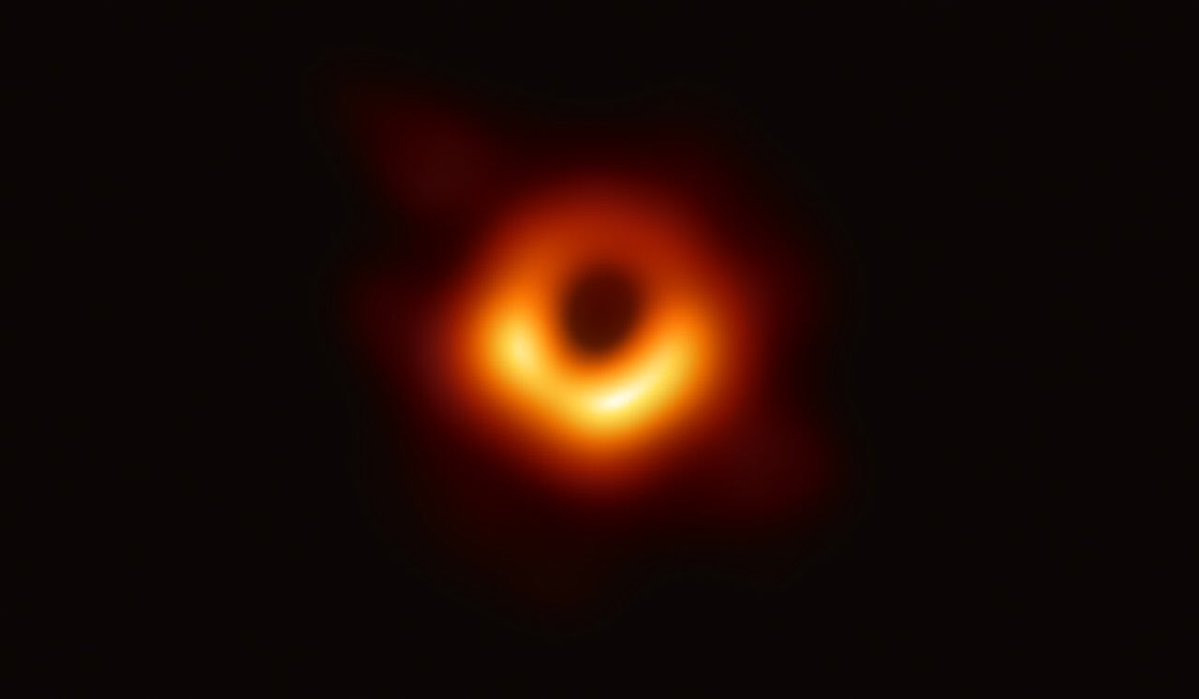
UPDATE: Well, there we are. Here is the image of the `shadow’ of the event horizon around the black hole in M87:

The image is about 42 micro arcseconds across. I guess to people brought up on science fiction movies with fancy special effects the image is probably a little underwhelming, but it really is an excellent achievement to get that resolution. Above all, it’s a great example of scientific cooperation – 8 different telescopes all round the world. The sizeable European involvement received a substantial injection of funding from the European Union too!

Other parameters are here:

The accompanying EU press release is here. Further information can be found here. The six publications relating to this result can be found here:

The Shadow of an Event Horizon

Posted in The Universe and Stuff with tags , , , , , on April 9, 2019 by telescoper

There is a paper on the arXiv written about 5 years ago called Towards the event horizon – the supermassive black hole in the Galactic Center by Falcke and Markoff, the abstract of which reads:

The center of our Galaxy hosts the best constrained supermassive black hole in the universe, Sagittarius A* (Sgr A*). Its mass and distance have been accurately determined from stellar orbits and proper motion studies, respectively, and its high-frequency radio, and highly variable near-infrared and X-ray emission originate from within a few Schwarzschild radii of the event horizon. The theory of general relativity (GR) predicts the appearance of a black hole shadow, which is a lensed image of the event horizon. This shadow can be resolved by very long baseline radio interferometry and test basic predictions of GR and alternatives thereof. In this paper we review our current understanding of the physical properties of Sgr A*, with a particular emphasis on the radio properties, the black hole shadow, and models for the emission and appearance of the source. We argue that the Galactic Center holds enormous potential for experimental tests of black hole accretion and theories of gravitation in their strong limits.

Please note that the black hole in the centre of the giant elliptical galaxy M87 is about 1000 times further away from us than the black hole in the centre of the Milky Way but is also about 1000 times more massive, so its Schwarzschild radius is 1000 times larger. The observational challenge of imaging the event horizon is therefore similar in the two cases.

You may find this useful if, by sheer coincidence, there is some big announcement tomorrow..

Gravitational Wave Flash!

Posted in The Universe and Stuff with tags , , , , on April 9, 2019 by telescoper

The third observing run for Advanced LIGO – O3 – started on April 1 2019, after 19 months upgrading the detectors. Last night, April 8, saw the first new detection of a candidate gravitational wave source, apparently another black hole binary, dubbed S190408an.

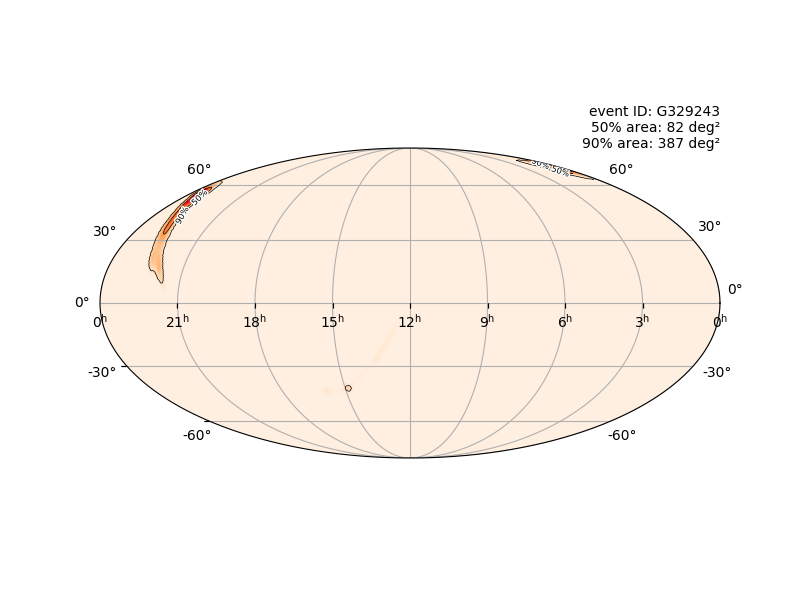
It is anticipated that sources like this will be discovered at a rate of roughly one per week for the (planned) year-long run. Given the likely rate of events the policy of LIGO is now to make data publicly available directly without writing papers first. You can find the data entry for this event here, including this map of its position.

Whether the LIGO Scientific Collaboration will release sufficient data for others to perform a full analysis of the signal remains to be seen, but if the predicted detection rate matches reality, the field is going to move very rapidly from studies of individual events to statistical analysis of large populations. Such is the way of science!

This is not an Animation…

Posted in Art with tags , on April 8, 2019 by telescoper

To find out more about this optical illusion, which was created by Yurii Peripedia using nothing more complicated than Adobe Illustrator, see here.