Archive for July, 2019

Hubble’s Constant – The Tension Mounts!

Posted in The Universe and Stuff with tags , , , , on July 12, 2019 by telescoper

There’s a new paper on the arXiv (by Wong et al.) that adds further evidence to the argument about whether or not the standard cosmological model is consistent with different determinations of the Hubble Constant. The abstract is here:

You can download a PDF of the full paper here.

You will that these measurements, based on observations of time delays in multiply imaged quasars that have been  gravitationally lensed, give higher values of the Hubble constant than determinations from, e.g., the Planck experiment.

Here’s a nice summary of the tension in pictorial form:

And here are some nice pictures of the lensed quasars involved in the latest paper:


It’s interesting that these determinations seem more consistent with local distance-scale approaches than with global cosmological measurements but the possibility remains of some unknown systematic.

Time, methinks, to resurrect my long-running poll on this!

Please feel free to vote. At the risk of inciting Mr Hine to clog up my filter with further gibberish,  you may also comment through the box below.


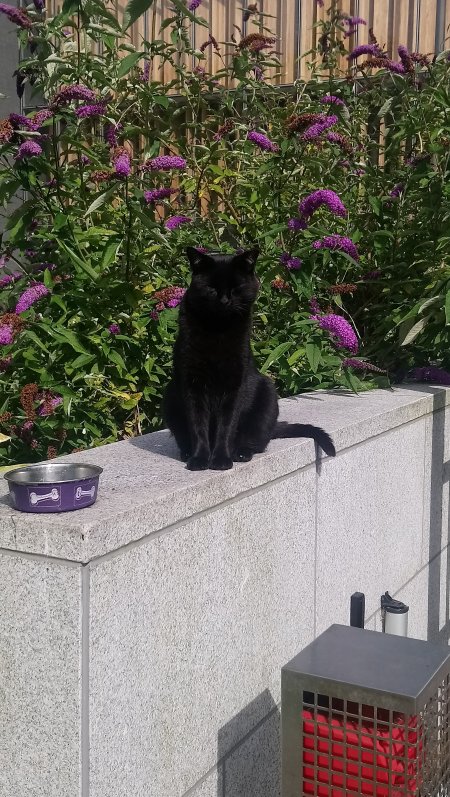
The Buddleian Library Cat

Posted in Uncategorized with tags , , on July 11, 2019 by telescoper

Geddit?

I’ll get my coat.

Thirty Years as a Doctor!

Posted in Biographical, The Universe and Stuff with tags , , , , , on July 11, 2019 by telescoper

A chance discovery while rummaging around in my filing cabinet reminded me that today is the anniversary of a momentous event. What I found was this:

It’s the programme of the summer Graduation Ceremony in 1989 at which I formally received my DPhil (Doctor of Philosophy). As you will see that was precisely thirty years ago today!

I actually submitted my thesis the previous summer (either at the end of August or start of September 1988) but had to wait a few months for the examination, which I think was in December.  By the time I had done my corrections (mainly typographical errors) the next available date for the degree to be formally conferred was in July 1989 so that’s when I officially got doctored. I was actually still in Brighton at the time, as had started work as a postdoctoral researcher soon after I had submitted my thesis.

Here’s my thesis:

In those days they actually printed the thesis title in the programme, alongside the graduand’s name in the case of DPhil degrees.

It’s normal practice for people to assume the title of Doctor as soon as they have passed the viva voce examination but although I’ve never objected to that,  I’ve always been a bit unsure of the legality. Probably one doesn’t actually have a doctorate until it is conferred (either at a ceremony or in absentia).

Anyway, here is a picture of me (aged 26!)  emerging from the Brighton Centre wearing the old-style Sussex doctoral gown just after I received my DPhil:
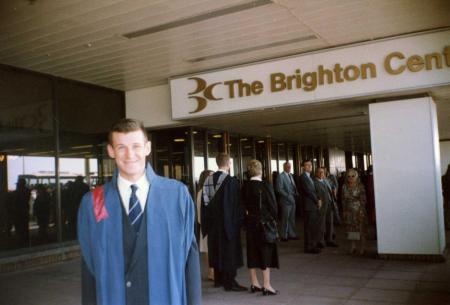
Graduation

Unfortunately the University of Sussex decided a while ago to change the style of its academic dress recently to something a bit more conventional and as far as I know it’s not possible to obtain the old-style gowns any more. They also changed the title DPhil to PhD because it confused potential students, especially those not from the UK.

My first degree came from Cambridge so I had to participate in an even more archaic ceremony for that institution. The whole thing is done in Latin there (or was when I graduated) and involves each graduand holding a finger held out by their College’s Praelector and then kneeling down in front of the presiding dignitary, who is either the Vice-Chancellor ot the Chancellor. I can’t remember which. It’s also worth mentioning that although I did Natural Sciences (specialising in Theoretical Physics), the degree I got was Bachelor of Arts. Other than that, and the fact that the graduands had to walk to the Senate House from their College through the streets of Cambridge,  I don’t remember much about the actual ceremony.

I was very nervous for that first graduation. The reason was that my parents had divorced some years before and my Mum had re-married. My Dad wouldn’t speak to her or her second husband. Immediately after the ceremony there was a garden party at my college, Magdalene, at which the two parts of my family occupied positions at opposite corners of the lawn and I scuttled between them trying to keep everyone happy. It was like that for the rest of the day and I have to say it was very stressful. A few years later I got my doctorate from the University of Sussex, at the Brighton Centre on the seafront. It was pretty much the same deal again with the warring family factions, but I enjoyed the whole day a lot more that time. And I got to wear the funny gown.

Radiante – Olga Albizu

Posted in Art with tags , , , on July 10, 2019 by telescoper

Radiante by Olga Albizu (1924-2005), painted in 1967, 68 x 62 in (172.7 x 157.5 cm), oil on canvas. Smithsonian American Art Museum.

Father Callan and the Induction Coil

Posted in History, Maynooth, The Universe and Stuff with tags , , , , , on July 9, 2019 by telescoper

Historically speaking, Maynooth is more strongly associated with theology than with science but I thought I’d mention here one famous pioneering physicist, who happened also to be a Roman Catholic priest, who spent his working life in these parts.

Father Nicholas Callan (or, more formally, The Reverend Professor Nicholas Joseph Callan) was born in County Louth in 1799 went to the seminary of St Patrick’s College, Maynooth, in 1816 to train as a priest. During his time as a seminarian Callan studied ‘Natural Philosophy’ and became interested in experiments involving electricity. In 1823 Callan was ordained as a priest, and went to Rome in 1826 to obtain his doctorate in Divinity. At the time Italy was a centre for research into electricity and here Callan became familiar with the work of the Italian physicist Alessandro Volta who had developed the world’s first battery. Callan returned to Maynooth where he was made chair of Natural Philosophy, a post he would hold until his death in 1864.

Callan is most famous for inventing the induction coil (in 1836). By connecting two copper wire coils to a battery and electromagnet and then interrupting the current he was able to generate much larger voltages than could be obtained from batteries alone. His 1837 version that used a clock mechanism to interrupt the current 20 times a second is estimated to have produced 60,000 volts – the largest artificially generated charge at that time. It is said that his induction coil could produce sparks 15″ long, which must have been fun to watch.

Callan’s biggest induction coil, unfinished at the time of his death, can be found in the National Science Museum of Ireland (which is in Maynooth). This was one of the largest in the world at the time. The iron core is 109 cm long. The secondary windings are 53 cm in diameter and consist of about 50 km of iron wire insulated with beeswax. They were made in three separate rings separated by air gaps, so wires carrying large voltage differences would not lie adjacent to each other, reducing the risk of the insulation breaking down. At the left end is a vibrating mercury ‘contact breaker’ in the primary circuit, actuated by the magnetic field in the primary, which interrupted the primary current to generate potentials of over 200,000 volts.

Sadly Callan’s work was forgotten for quite a period after his death – experimental electromagnetism was not a priority for St Patrick’s College at this time – for which reason the invention of the induction coil has often been attributed to Heinrich Ruhmkorff who made his first device (independently) about 15 years after Callan. More recently, however, Callan’s achievements have been more widely recognized and in 2000 the Irish government issued a stamp in his honour.

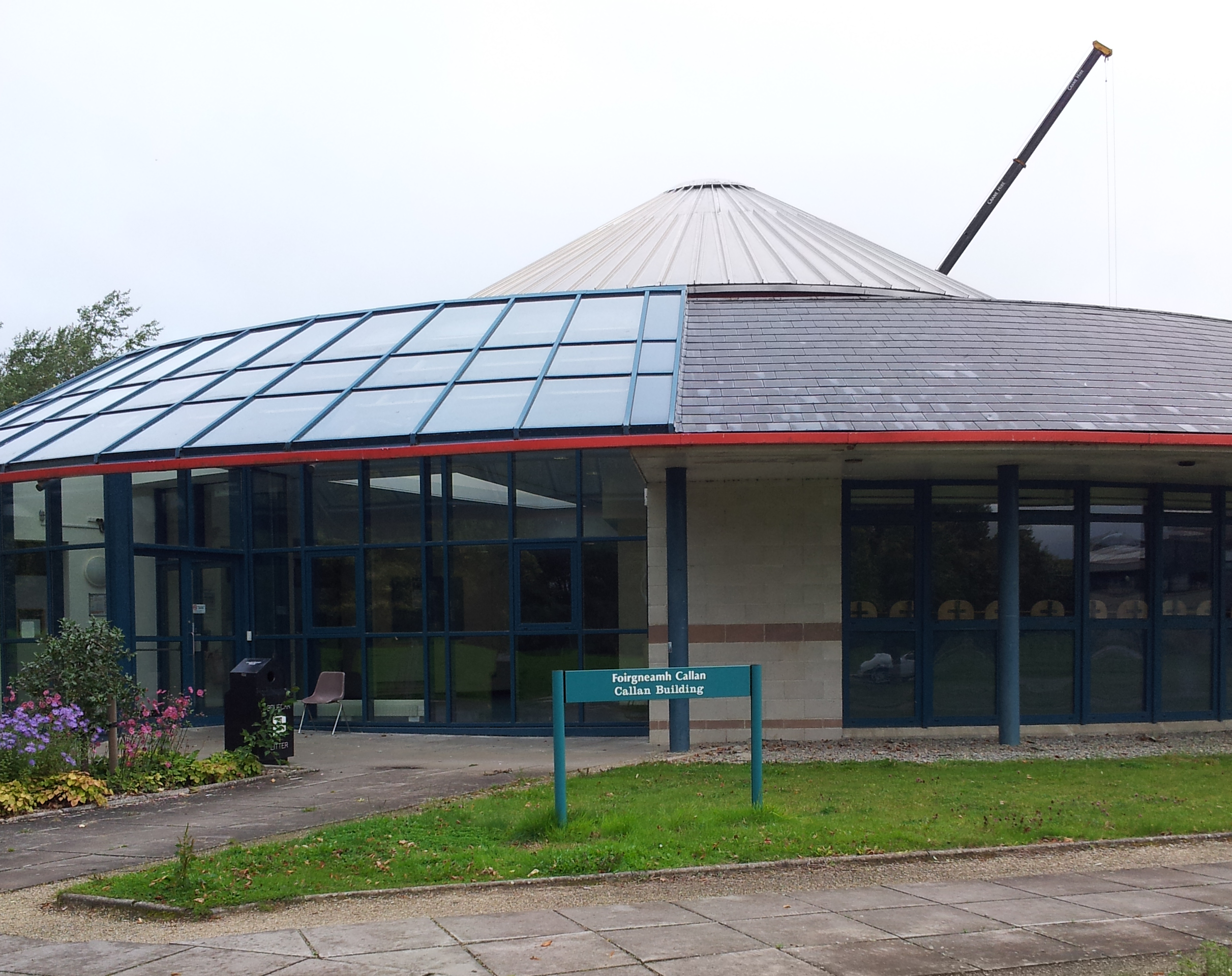
The Callan Building

Nicholas Callan was laid to rest in the College Cemetery at Maynooth in 1864. The Callan Building (above) on the North Campus of the present-day Maynooth University is named in his honour.

Insects, by John Clare

Posted in Literature with tags , , , on July 9, 2019 by telescoper

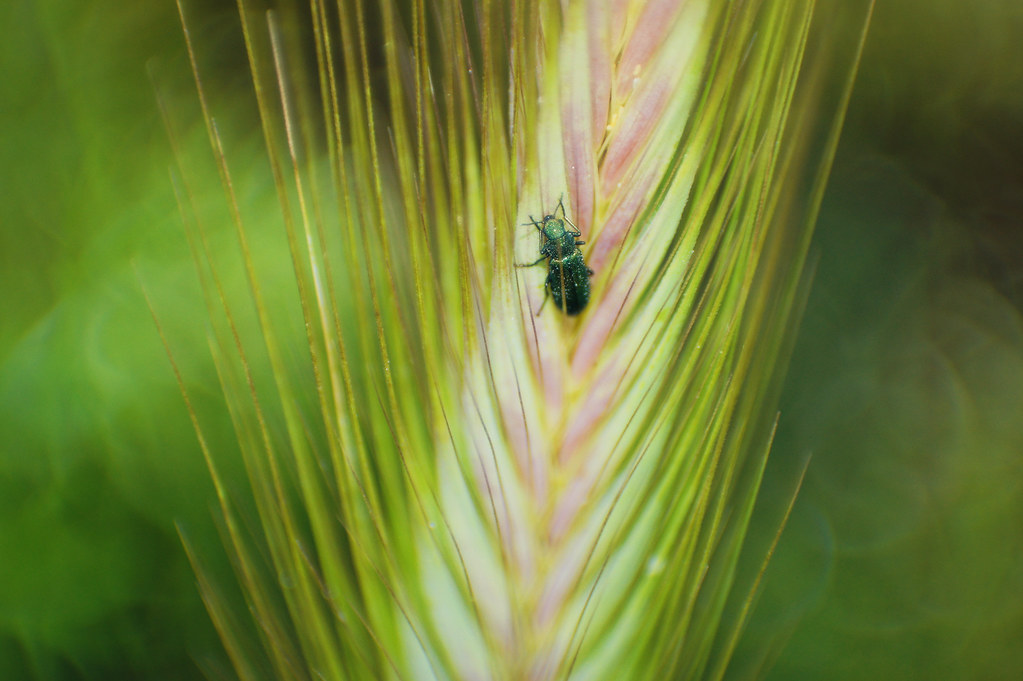
These tiny loiterers on the barley’s beard,
And happy units of a numerous herd
Of playfellows, the laughing Summer brings,
Mocking the sunshine in their glittering wings,
How merrily they creep, and run, and fly!
No kin they bear to labour’s drudgery,
Smoothing the velvet of the pale hedge-rose;
And where they fly for dinner no one knows–
The dew-drops feed them not–they love the shine
Of noon, whose sun may bring them golden wine.
All day they’re playing in their Sunday dress–
Till night goes sleep, and they can do no less;
Then, to the heath bell’s silken hood they fly,
And like to princes in their slumbers lie,
Secure from night, and dropping dews, and all,
In silken beds and roomy painted hall.
So merrily they spend their summer day,
Now in the cornfields, now the new-mown hay.
One almost fancies that such happy things,
With coloured hoods and richly burnished wings,
Are fairy folk, in splendid masquerade
Disguised, as if of mortal folk afriad,
Keeping their merry pranks a mystery still,
Lest glaring day should do their secrets ill.

by John Clare (1793-1861)


O Grande Amor – Getz & Gilberto

Posted in Jazz with tags , , , , on July 8, 2019 by telescoper

There was a time in the 1960s when the Bossa Nova seemed to be everywhere and no one person did more to stimulate the growth of this uniquely Brazilian musical form than singer, guitarist and composer João Gilberto, who passed away on Saturday 6th July at the age of 88. It was Gilberto’s collaboration with tenor saxophonist Stan Getz (and, on some tracks, his wife Astrud Gilberto) on the award-winning album Getz/Gilberto that made the Bossa Nova go global, penetrating not only the world of jazz but the much wider cultural sphere including pop and film music. The most famous track from Getz/Gilberto is undoubtedly The Girl From Ipanema which was a smash hit around the globe in 1964, but my own favourite number from that album is this, with lovely playing by Stan Getz and characteristically understated, almost whispered vocal by João Gilberto himself.

Rest in Peace João Gilberto (1931-2019)

Cosmology with the Minimal Spanning Tree

Posted in The Universe and Stuff with tags , , , , , , on July 8, 2019 by telescoper

There’s a nice paper on the arXiv (by Naidoo et al) with the abstract:

The code mentioned at the end can be found here.

The appearance of this paper gives me an excuse to mention that I actually wrote a paper (with Russell Pearson) on the use of the Minimal (or Minimum) Spanning Tree (MST) to analyze galaxy clustering way back in 1995.

Here’s how we described the Minimal Spanning Tree in that old paper:

Strictly speaking , we used the Euclidean Minimum Spanning Tree in which the total length of the lines connecting a set of points in a tree is minimized. In general cases a weight can be assigned to each link that is not necessarily defined simply by the length. Here is visual illustration (which I think we drew by hand!)

You can think of the MST as a sort of pre-processing technique which accentuates linear features in a point process that might otherwise get lost in shot noise. Once one has a tree (pruned and/or separated as necessary) one can then extract various statistical properties in order to quantify the pattern present.

Way back in 1995 there were far fewer datasets available to which to apply this method and it didn’t catch on at the time. Now, with  ever-increasing availability of spectroscopic redshift surveys maybe its time has come at last! I look forward to playing with the Python code in due course!


Proper Cricket Update

Posted in Cricket with tags , , on July 7, 2019 by telescoper

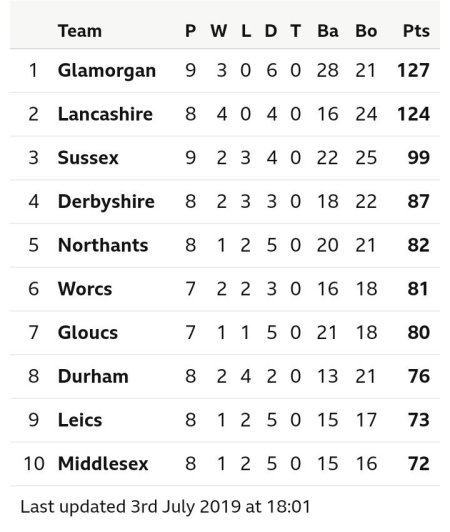
Now that the seemingly interminable Round Robin of matches in the ICC World Cup is over, leaving just India, New Zealand, Australia and England to fight on through the Semi-Finals, I thought I’d give a quick update on the state of play in the Proper Cricket, specifically Division 2 of the County Championship.

After their draw last week against Worcestershire, Glamorgan remain unbeaten at the top of the table. Given last season’s performance that’s pretty amazing even if they have played a game more than second-place Lancashire.

Glamorgan aren’t playing in the latest round of matches so I expect Lancashire to go top this week unless they lose their current game (against Northamptonshire) and gain fewer than four bonus points in the process.

Sussex, in third place, got thrashed in their last game, also against Northants, bowled out twice in fewer than eighty overs in total.

Glamorgan’s next game is against Middlesex at Sophia Gardens and then there’s a break in the proper cricket for the Twenty20 slogging matches.

It’s been a good season for Glamorgan so far, and they have a real chance of getting promoted to Division One. Fingers crossed. The big difference has been far more resilient batting, especially in the 2nd innings, but a sensible rotation of the fast bowlers has also helped keep them fresh.

Scientific Challenge

Posted in Uncategorized on July 6, 2019 by telescoper

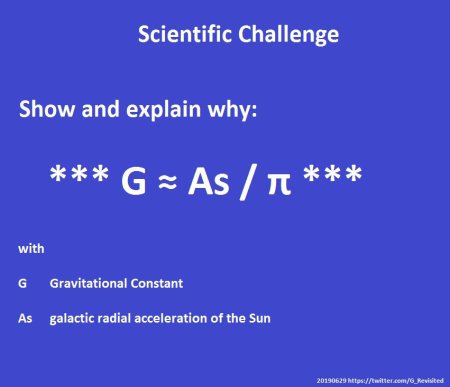
I’m gradually coming to the conclusion that not everything on social media that purports to be from an expert is necessarily scientifically valid. Shocking, I know.

Here’s an example:

I’m afraid I failed this challenge. Can you do better?

And no it shouldn’t be π21.