Archive for November, 2019

Newton’s Laws in Translation

Posted in History, Maynooth, The Universe and Stuff with tags , , on November 13, 2019 by telescoper

I’m about to do some lectures about Newton’s Laws of Motion to my first-year Mathematical Physics class so I thought I’d put up a quick post about how these laws have been expressed through the years. The original versions in the Principia (frontispiece above, first published in 1687) are of course in Latin. I did five years of Latin at school, but found most of the Principia impenetrable when I tried to read it in the original
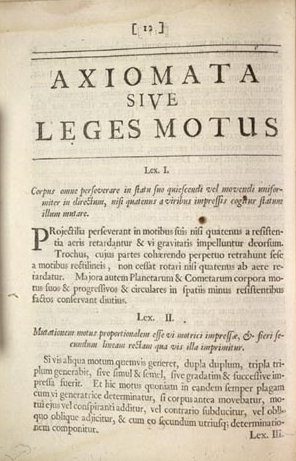
 

The laws of motion are however fairly clear, perhaps because they are familiar in English:

Lex I: Corpus omne perseverare in statu suo quiescendi vel movendi uniformiter in directum, nisi quatenus illud a viribus impressis cogitur statum suum mutare.

Lex II: Mutationem motus proportionalem esse vi motrici impressæ, & fieri secundum lineam rectam qua vis illa imprimitur.

Lex III: Actioni contrariam semper & æqualem esse reactionem: sive corporum duorum actiones in se mutuo semper esse æqualeset in partes contrarias dirigi.

As I am teaching in a room in the old college here in Maynooth (which was founded in 1795), I looked for a contemporary English translation. This is from 1792:

Law I: Every body perseveres in a state of being at rest or of moving uniformly straight forward except insofar as it is compelled to change its state by forces impressed.

Law II: The alteration of motion is ever proportional to the motive force impressed; and is made in the direction of the right line in which that force is impressed.

Law III: To every action there is always opposed an equal reaction: or the mutual action of two bodies upon each other are always equal, and directed to contrary parts.

And finally here’s the modern version I was taught at School:

First Law: Every body continues in a state of rest or uniform motion in a straight line unless it is acted upon by an external (unbalanced) force.

Second Law: The rate of change of momentum of a body is proportional to the impressed force, and is in the direction in which this force acts.

Third Law: To every action there is always an equal and opposite reaction,

an alternative form of the Third Law being:

Third Law: If Body A exerts a force on Body B then Body B exerts a force on Body A which is equal in magnitude and opposite in direction.

Going back to the 1792 English translation, the exposition of the second law continues:

If a force generates a motion, a double force will generate double the motion, a triple force triple the motion, whether that force be impressed altogether and at once, or gradually and successively. And this motion (being always directed the same way with the generating force), if the body moved before, is added to or subtracted from the former motion, according as they directly conspire with or are directly contrary to each other; or obliquely joined, when they are oblique, so as to produce a new motion compounded from the determination of both.

If only Newton had known vector notation!


More Cosmic Tension?

Posted in The Universe and Stuff with tags , , , , , , , , , on November 12, 2019 by telescoper

Quite a lot of fuss was being made in cosmological circles while I was away last week concerning a paper that had just been published in Nature Astronomy by Eleonora Di Valentino, Alessandro Melchiorri and Joe Silk that claims evidence from the Planck Cosmic Microwave background and other data that the Universe might be closed (or at least have positive spatial curvature) in contrast to the standard cosmological model in which the spatial geometry is Euclidean. Nature Astronomy is behind a paywall but the paper is available for free on the arXiv here. The abstract reads:

The recent Planck Legacy 2018 release has confirmed the presence of an enhanced lensing amplitude in CMB power spectra compared to that predicted in the standard ΛCDM model. A closed universe can provide a physical explanation for this effect, with the Planck CMB spectra now preferring a positive curvature at more than 99% C.L. Here we further investigate the evidence for a closed universe from Planck, showing that positive curvature naturally explains the anomalous lensing amplitude and demonstrating that it also removes a well-known tension within the Planck data set concerning the values of cosmological parameters derived at different angular scales. We show that since the Planck power spectra prefer a closed universe, discordances higher than generally estimated arise for most of the local cosmological observables, including BAO. The assumption of a flat universe could, therefore, mask a cosmological crisis where disparate observed properties of the Universe appear to be mutually inconsistent. Future measurements are needed to clarify whether the observed discordances are due to undetected systematics, or to new physics, or simply are a statistical fluctuation.

I think the important point to take from this study is that estimates of cosmological parameters obtained from Planck are relatively indirect, in that they involve the simultaneous determination of several parameters some of which are almost degenerate. For example, the `anomalous’ lensing amplitude discussed in this paper is degenerate with the curvature so that changing one could mimic the effect on observables of changing the other; see Figure 2 in the paper.

It’s worth mentioning another (and, in my opinion, better argued) paper on a similar topic by Will Handley of Cambridge which is on the arXiv here. The abstract of this one reads:

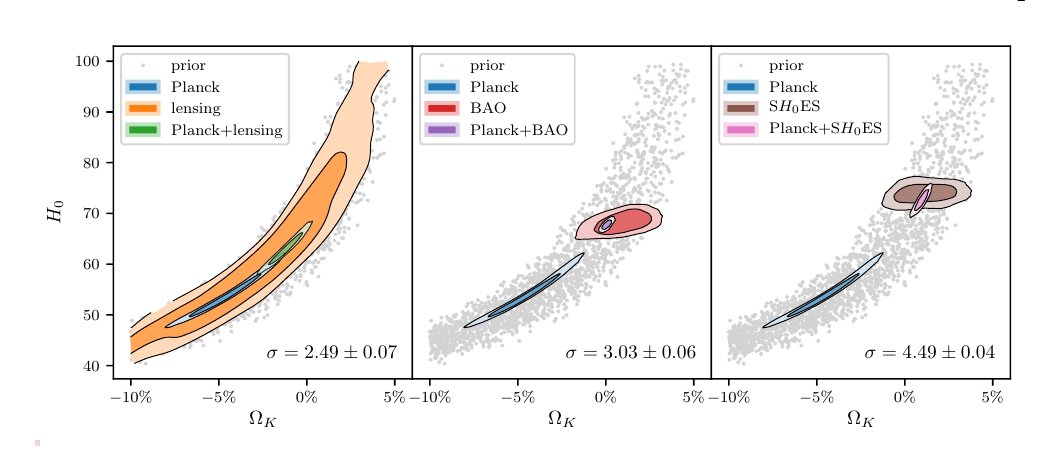
The curvature parameter tension between Planck 2018, cosmic microwave background lensing, and baryon acoustic oscillation data is measured using the suspiciousness statistic to be 2.5 to 3σ. Conclusions regarding the spatial curvature of the universe which stem from the combination of these data should therefore be viewed with suspicion. Without CMB lensing or BAO, Planck 2018 has a moderate preference for closed universes, with Bayesian betting odds of over 50:1 against a flat universe, and over 2000:1 against an open universe.

Figure 1 makes a rather neat point that the combination of Planck and Baryon Acoustic Oscillations does not separately give consistent values for the Hubble constant and the curvature and neither does the combination of Planck and direct Hubble constant estimates:

I don’t know what the resolution of these tensions is, but I think it is a bit dangerous to dismiss them simply as statistical flukes. They might be that, of course, but they also might not be. By shrugging one’s shoulders and ignoring such indications one might miss something very fundamental. On the other hand, in my opinion, there is nothing here that definitely points the finger at spatial curvature either: it is possible that there is something else missing from the standard model that, if included, would resolve these tensions. But what is the missing link?

Answers on a postcard, or through the comments box.

Cosmology Job Opportunity at Maynooth!

Posted in Maynooth with tags , on November 11, 2019 by telescoper

With everything else going on I completely forgot to mention on here that there is a job opportunity for a senior research position in cosmology here in the Department of Theoretical Physics here in Maynooth that may
lead to a permanent position subject to satisfactory performance. The position was advertised some time ago through the usual channels (including jobs.ac.uk and the Times Higher job site) as well as on the Maynooth University jobs site.

The details can be found here, at which site you can also apply.

You will have to hurry, though, as the deadline is Wednesday 13th November 2020 – about 48 hours from now!

Because I could not stop for Death

Posted in Poetry with tags , , , on November 10, 2019 by telescoper

Because I could not stop for Death,
He kindly stopped for me;
The carriage held but just ourselves
And Immortality.

We slowly drove, he knew no haste,
And I had put away
My labor, and my leisure too,
For his civility.

We passed the school, where children strove
At recess, in the ring;
We passed the fields of gazing grain,
We passed the setting sun.

Or rather, he passed us;
The dews grew quivering and chill,
For only gossamer my gown,
My tippet only tulle.

We paused before a house that seemed
A swelling of the ground;
The roof was scarcely visible,
The cornice but a mound.

Since then ’tis centuries, and yet each
Feels shorter than the day
I first surmised the horses’ heads
Were toward eternity.

by Emily Dickinson (1830-1886)


No More Poppies

Posted in Biographical, History, Politics with tags , , , , on November 9, 2019 by telescoper

Over the years I have written quite a few pieces on this blog, around the time of Remembrance Sunday, about the wearing of a poppy, the last being in 2016. I have worn a poppy at this time of year for most of my adult life, but in 2017 I decided to stop.

For one thing, there is no pressure to wear a poppy here in Ireland. Indeed, many Irish people see the poppy mainly as a symbol of British militarism and colonial oppression. At a concert to mark the Armistice last year I saw only a few audience members wearing a poppy, and most of them were the shamrock version commemorating the sacrifice of Irish soldiers during the Great War.

But I don’t think I’ve ever really been that susceptible to peer pressure, so that’s not the main reason for my not wearing a poppy. The main reason is that over the past couple of years the poppy has been appropriated by the likes of racist thug, career criminal and founder-member of the EDL, Stephen Yaxley-Lennon (also known as Tommy Robinson):

I simply cannot bring myself to wear the same badge as this horrible racist gobshite, nor can I stand the hypocrisy of those politicians who make a show of wearing it while happily encouraging the rise of nationalism that caused all the suffering just a century ago. The message of the poppy is supposed to be `Lest We Forget’. I’m afraid far too many have already forgotten.

I have a lecture on Monday 11th November at 11am, when the traditional two minutes’ silence to mark the 1918 armistice is observed. Fortunately, lectures at Maynooth run from five past the hour until five to, so I will be able to observe this on my own before I start the lecture. But I won’t be wearing a poppy.

Is it disrespectful to the war dead to refuse to wear a poppy? No, of course it isn’t. What is disrespectful to them is to seek to reoeat the mistakes that led to wars in the first place.

Back to Ireland

Posted in Biographical, Maynooth on November 9, 2019 by telescoper

I’m back in a very cold and windy Maynooth after a trip to Newcastle (via London) for my Mam’s funeral. It went as well as could have been expected, though it was a difficult occasion for all concerned. It was nice to see such a good turnout, though, including several members of my family I haven’t seen for many years. The service was both simple and dignified (and entirely secular).

I’ve got a lot of things to catch up on after the few days I spent away so I don’t have time for a long post today. I did, however, want to put up a short message to express my gratitude to everyone who has contacted me privately to offer condolences and good wishes. All your messages mean a lot, so thank you all. That also goes for all the friends I met at the RAS Club on Friday evening, all of whom were very supportive.

Now, I have three examination papers and two problem sets to write by Monday, five lectures to prepare for next week, and a lengthy review article about the Hubble constant to finish by Friday so I’d best get on with it. Moping about isn’t going to help.

Bridget Riley at the Hayward Gallery

Posted in Art with tags , on November 8, 2019 by telescoper

Circumstances require me to travel back to Dublin via London today, so I took the opportunity to spend an hour or so at the wonderful Bridget Riley retrospective at the Hayward Gallery. The exhibition is on until January 26th and I recommend it very enthusiastically.

I took a few pictures, but none of them give an adequate impression of the experience of seeing them in the flesh.

These three deceptively simple compositions made from coloured stripes play with the eye’s colour perception, seeming to change in texture and hue as the observer changes position or viewing angle.

The “rhomboid” pictures like this one November use changes in colour to disrupt the brain’s interpretation of the two-dimensional nature of the painting. The rhombi seem to rise and fall, the surface buckling as a result.

From the black and white collection this is Movement in Squares which uses simple changes in shape to imply depth, but also creates a visual instalibity to the perception is not of a static image.

This (Drift 2) generates a twisting effect on that makes you feel quite dizzy!

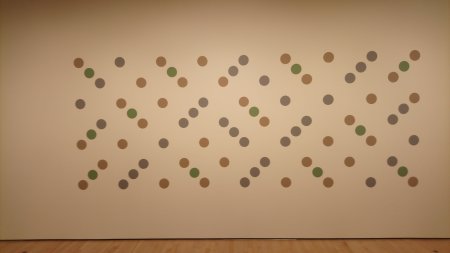
This one from 2017 is untitled and is simultaneously the least successful to be photographed and one of the most successful to view in person. It is very large – about 4 metres by 2 metres – and the circles filled with colour seem to jump about in your field of vision with every slight change of eyeline!

There are many more treats to experience in this exhibition which is highly recommended.

A Musical Memory: Mabel’s Dream

Posted in Biographical, Jazz with tags , , , , , on November 7, 2019 by telescoper

So that’s that. The funeral is over. We all said our goodbyes, and there many tears.

My Mam chose the music for her funeral a long time ago, and the piece that was playing as we arrived in the West Chapel of the West Road Crematorium was one that I wrote about about a decade ago, so I thought I’d indulge myself by posting here the version we heard today.

Years ago my Mam told me that she heard the tune Mabel’s Dream played on the piano by a friend of the family by the name of Johnny Handle. Best known as a folk musician (and founder member of a well-known band called The High Level Ranters) he is also a music teacher and musicologist with a wide range of interests in music. I read somewhere that this lovely tune was originally written by Jelly Roll Morton and performed by him on solo piano, but by far the most famous recording of Mabel’s Dream was made by King Oliver and his Creole Jazz Band in Chicago in 1923. This was the band that the young Louis Armstrong belonged to before going on to make the classic Hot Fives and Hot Sevens, one of which I posted a bit ago. It’s interesting how different the earlier band sounds: with two cornets (King Oliver and Louis Armstrong), clarinet (Johnny Dodds), and trombone (Honore Dutrey) playing together virtually all the time except for short improvised solo breaks. King Oliver usually played lead cornet, at least in their earlier recordings, with Louis Armstrong playing a decorative counterpoint around him rather like a clarinettist might. Later on, they swapped leads freely and completely intuitively producing a sound that was entirely unique.

The ensemble playing is intricate, but the band had no written music, preferring to work exclusively from “head” arrangements. Their music is consistently delightful to listen to, with a succession of marchy themes that makes it impossible not to want to tap your feet when you listen to them.

Over time, this classic type of polyphonic Jazz- derived from its New Orleans roots – gradually morphed into musical form dominated by much simpler arrangements and a succession of virtuoso solos. This change was also reflected in the differing fortunes of Louis Armstrong and King Oliver. The former went on to become an international celebrity, while the latter lost all his savings when his bank went bust during the Wall Street Crash.

Considering the relatively brief time that they played together, King Oliver and Louis Armstrong made an astonishingly large number of astonishingly beautiful records, including this one which I’m posting here to show that as well as many other things my Mam had great taste in Jazz.

The University Strikes are Back!

Posted in Education, The Universe and Stuff with tags , , , , on November 6, 2019 by telescoper

I noticed that a recent ballot of members of the University and College Union (UCU) has delivered a mandate for industrial action across 60 UK universities. Eight days of strikes will start later this month: they will last from November 25th until December 4th. The cause of the dispute is twofold: (1) the long-running saga of the Universities pension scheme (about which there were strikes in 2018); and (2) over pay, equality, workloads and the ever-increasing casualisation of lecturing and other work.

Among the institutions to have voted for strike action are my previous employers Cardiff, Sussex and Nottingham.
It seems to have taken a long time to count the votes in the case of Sussex UCU, but the result was a large majority in favour of action. It remains to be seen what the impact of these strikes will be, but they could affect a very large number of students. Nobody likes going on strike but the UK higher education system is a very poor state right now, and many of my former colleagues feel that they have no alternative.

Anyway, the real purpose of this short post is simply to express solidarity with those taking industrial action. It it set to be a big struggle, but I wish everyone taking part all the best on the picket lines!

The Cosmic Web in Maynooth

Posted in Books, Talks and Reviews, Talks and Reviews, The Universe and Stuff with tags , , on November 5, 2019 by telescoper

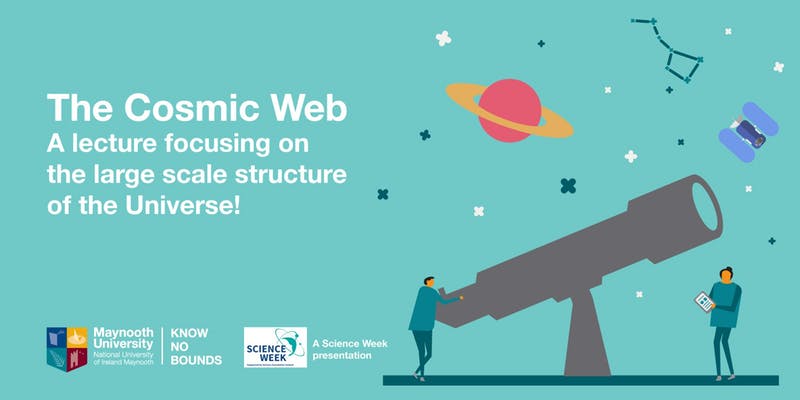
Next week (10th to 17th November) in Ireland is Science Week and this will be celebrated by a number of events here in Maynooth, among which is a talk by yours truly on 15th November:

Here is a short description:

How can we map the distribution of galaxies over thousands of millions of light years? What does the Universe look like on these scales? How did get to look like that? And how do we know?This talk will explain how astronomers and cosmologists have come together over the past couple of decades to make huge surveys of the Universe, revealing the existence of a complex but beautiful `Cosmic Web’ with vast chains of galaxies strung out around immense dark voids. These observational breakthroughs have been mirrored by advances in theory and computer simulation that allow us to understand how this amazing structure was born 14 billion years ago in the Big Bang and has been growing and evolving ever since. Free and open to TY, 5th and 6th year students, this talk will be of particular interest in those interested astronomy, space, physics and the Universe itself!

It is on in the morning to make it possible for school students to attend and the talk is adapted to this audience, so it won’t be the same as the one I gave in Dublin last week. The timing seems to have worked because the lecture theatre has over 200 seats in it but is already almost full. There are still a few places available so if you’re in the area you can book here.