Archive for July, 2020

New Results from the Atacama Cosmology Telescope!

Posted in The Universe and Stuff with tags , , , , on July 16, 2020 by telescoper

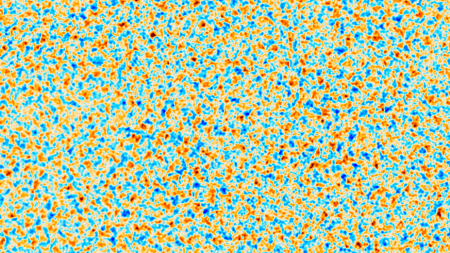
There’s some excitement in cosmological circles with the announcement of new results from the Atacama Cosmology Telescope, which is situated in the Atacama Desert in Chile. The two papers describing the new results can be found on the arXiv here and here and the data set will be made available here (it is Data Release 4; or DR4 for short).

If you want a laugh, the structure in the above map is on arc-minute scales – exactly the sort of thing I was trying to simulate way back in the 1980s. Here’s an ancient monochrome plot! The contours show 1σ, 2σ and 3σ fluctuations above the mean rather than the full distribution shown in the map above.

The full results will be discussed at a Zoom presentation at 11am Eastern Time (4pm Irish Time). I suspect it will be very busy so you will have to register in advance.

UPDATE: The Webinar is over but was recorded. I will post a link to the video when it is available. You can then guess which question was mine!

The new results from ACTPol are consistent with those from Planck, even down to the colour scheme used for the map, but the line taken by most media presentations I’ve seen (e.g. here and here) has been the issue of the Hubble Constant. The value of around 67.6 km s-1 Mpc-1 obtained by the Atacama Cosmology Telescope, though consistent with Planck measurements, is lower than most distance-scale measurements of H0. The dichotomy between `low’ estimates from cosmological observations and `high’ values persists.

This gives me an excuse to include my poll again:

There have been nearly a thousand responses so far, with opinion very divided.

The burning question however is when will face masks featuring the above map be made available for purchase? It could be a nice little earner…

More Evidence of Marxist Indoctrination in Universities!

Posted in Politics on July 15, 2020 by telescoper

The Cosmological Evidence – 25 Years Ago

Posted in Biographical, The Universe and Stuff with tags , , , on July 15, 2020 by telescoper

Today Facebook reminded me that the picture below is now 25 years old. I have posted it before and it has done the rounds at a number of cosmology conferences (usually to the accompaniment of lots of laughter), but I thought I’d circulate again as a bit of nostalgia and also to embarrass all concerned with this image. The picture was taken at a graduate school in cosmology in Leiden (in The Netherlands) in July 1995. In my memory that was a sweltering hot summer, which is my excuse for the informality of my attire.

Anyway, various shady characters masquerading as “experts” were asked by the audience of graduate students at a summer school to give their favoured values for the cosmological parameters. from from top to bottom these are:

  • the Hubble constant H0;
  • density parameter Ω0 (not split into dark matter and `ordinary’  matter as is now customary);
  • cosmological constant Λ0,
  • curvature parameter k
  • and age of the Universe t0.


From left to right we have Alain Blanchard (AB), Bernard Jones (BJ, standing), John Peacock (JP), me (yes, with a beard and a pony tail – the shame of it), Vincent Icke (VI), Rien van de Weygaert (RW) and Peter Katgert (PK, standing). You can see on the hi-tech digital display screen blackboard that the only one to get anywhere close to correctly predicting the parameters of what would become the standard cosmological model was, in fact, Rien van de Weygaert. Actually he was the only one of us to include a non-zero cosmological constant. My own favourite model at the time was a low-density model with negative spatial curvature.

Nobody is suggesting that panel discussions are the right way to settle scientific questions, of course, but it is interesting to see the diversity of opinions that were around in 1995.

P.S. Note that not all the combinations of parameters presented there are consistent with a Friedman model, but nobody said they had to be!


Cosmology Examination Results

Posted in Education, Maynooth, The Universe and Stuff with tags , , , , on July 14, 2020 by telescoper

The examination season in Maynooth being now over, and the results having been issued, I thought I’d pass on the results not for individual students but for the Universe as a whole.

As you can see Dark Energy is top of the class, with a good II.1 (Upper Second Class). A few years ago this candidate looked likely to get a mark over 70% and thus get First Class Honours, but in the end fell just short. Given the steady performance and possible improvement in future I think this candidate will probably be one to reckon with in a future research career.

In second place, a long way behind on about 27%, is Dark Matter. This candidate only answered some of the questions asked, and those not very convincingly. Although reasonably strong on theory, the candidate didn’t show up at all in the laboratory. The result is a fail but there is an opportunity for a repeat at a future date, though there is some doubt as to whether the candidate would appear.

At the bottom of the class on a meagre 5% we find Ordinary Matter. It seems this candidate must have left the examination early and did not even give the correct name (baryons) on the script. Technically this one could repeat but even doing so is unlikely even to get an Ordinary Degree. I would suggest that baryons aren’t really cut out for cosmology and should make alternative plans for the future.


P.S. Photons and neutrinos ceased interacting with the course some time ago. Owing to this lack of engagement they are assumed to have dropped out, and their marks are not shown.


Viva Zoom!

Posted in Biographical, The Universe and Stuff with tags , , , , on July 13, 2020 by telescoper

They say that there’s a first time for everything and this morning I conducted my first ever viva voce examination as an External Examiner via Zoom. Given the Covid-19 restrictions it was inevitable that I’d have to do this at some point! As it turned out candidate in question happened to be at University College London.

For those of you not familiar with how this sort of examination usually works, at least in the UK and Ireland, a PhD involves doing research into a particular topic and then writing up what you’ve done in a thesis. The thesis is a substantial piece of work, often in the region of 100,000 words (200 pages or so), which is then assessed by two examiners (one internal to the university at which the research was done, and one external). They read copies of the thesis and write preliminary reports assessing its suitability. Then the candidate has to defend the thesis in an oral examination, which was what happened today, after which the examiners make a final recommendation to the university about whether the degree should be awarded.

There aren’t many rules for how a viva voce examination should be conducted or how long it should last, but the can be as short as, say, 2 hours and can be as long as 5 hours or more. The examiners usually ask a mixture of questions, some about the details of the work presented and some about the general background. The unpredictable content of a viva voce examination makes it very difficult to prepare for, and it can be difficult and stressful for the candidate (as well as just tiring, as it can drag on for a long time). However, call me old-fashioned but I think if you’re going to get to call yourself Doctor of Philosophy you should expect to have to work for it.

As it happens, my own PhD examination (almost 30 years ago!)  was quite long (about 4hrs 30 minutes) and my external examiner was John Peacock. Today’s was a bit shorter – around three hours – and the internal examiner was Andrew Pontzen. Obviously I can’t give details of what went on in the examination except that the internal examiner Andrew Pontzen and I agreed to recommend the award of a PhD to the candidate, Krishna Naidoo. Although it was slightly strange doing this over Zoom instead of in person, it worked out OK. The only thing really missing was a blackboard or whiteboard. I also found it a bit awkward having the PDF thesis and videoconference on the same screen, but that was my fault for not appropriating a spare monitor.

At UCL as in most UK universities, the PhD examiners simply make a recommendation to a higher authority (e.g. Board of Graduate Studies) to formally award the degree, but only in very rare and peculiar circumstances do they not follow the recommendation.

The sad thing about these times of social distancing is that not being there in person I couldn’t shake the hand of the candidate at the end of the examination nor could I join him and his friends and colleagues for a drink afterwards. I’m sure they’ll find a way of celebrating. I couldn’t even join them remotely as I had another Zoom call to make. ..

P.S. If you want an idea of what is in  Krishna’s thesis you could have a look at one of the papers to come from it.

Maynooth University Library Cat Update

Posted in Maynooth with tags on July 12, 2020 by telescoper

I’m busy today reading a PhD thesis in advance of a virtual viva voce examination tomorrow morning but since a few people have asked, I’m taking a short break to update about Maynooth University Library Cat.

The weather has been fairly grim for the last few weeks so he’s been keeping to the various sheltering places he uses but the weather was a bit better on Friday so he was out and about.

As you can see, he’s in good health. In fact he’s as fit as a fiddle. Various people take offerings on a daily basis so he never has any shortage of food. As a matter of fact I wonder where he puts it all as he manages to stay very trim…

R. I. P. Jack Charlton (1935-2020)

Posted in Football with tags , , , , on July 11, 2020 by telescoper

Sad news today of the death at the age of 85 of legendary footballer and manager Jack Charlton.

The tributes to Jack Charlton here in Ireland focus on his time as manager of the Republic of Ireland national team, during which he produced many great results, including qualifying for two World Cups (in 1990 and 1994). Ireland got to the quarter-finals in 1990, which was an amazing achievement. Jack Charlton created some marvellous memories and became like an adopted son in the hearts of Irish folk, spending a lot of his time here in his retirement. He had a house in Ballina (County Mayo) and enjoyed going fishing. I suspect he rarely had to buy a drink in the local pubs! As a fellow Geordie living in Ireland I can understand very well why he loved it here.

He gave up the house in Ireland a few years ago when his health started to fail and moved to Stamfordham in Northumberland, the County of his birth. Jack was actually born in Ashington and was the nephew of legendary Newcastle United centre-forward Jackie Milburn.

As a player he was an old-school centre half: tall and tough and not prone to try anything fancy. He knew his limitations as a footballer and concentrated on what he could do well. He spent his entire professional playing career of 21 years at Leeds United. He wasn’t capped for England until he was 29 and a year later he was a member of the team that won the 1966 World Cup, as was his brother Bobby.

I remember an interview with Jack Charlton during which he recalled asking manager Sir Alf Ramsay why he had been picked for the England team when there were many better players than him around. Ramsay’s reply was that he didn’t always pick the best players, he picked the best team. What I think he meant by that is that he saw Jack’s steadiness as a providing an ideal blend in the centre of the defence balance to the less conventional Bobby Moore.

My own memories of Jack Charlton are dominated by his time as manager of Newcastle United between 1984 and 1985; see the picture, which is from this time, including Peter Beardsley (left) and Chris Waddle (right). I was a student at Cambridge at this time and there was quite a large Newcastle United Supporters’ Club of which I was a member. We travelled to quite a few games in the 84/85 season. The Club Secretary wrote a letter to Jack Charlton inviting him to visit us for a dinner and speech. We couldn’t even offer him travel expenses so I assumed he would just ignore the request, but he didn’t. He actually wrote a very nice letter politely declining the invitation but thanking us for our support and good wishes. He also reminded us not to neglect our studies because of football as he regretted not having had “much of an education”.

It’s worth mentioning that 1984/5 was the time of the Miners’ Strike during which Jack Charlton was a staunch supporter of the Miners. He even lent his car to help miners on flying pickets. He was rather left-wing generally, actually.

Jack Charlton brought to football management the same approach he had brought to his own playing. It was by focusing on doing the basics well that he was able to get outstanding results using limited resources. He wouldn’t have been a good manager of a huge club full of luxury players, but in his niche he was superb.

As a person Jack Charlton was as strong-minded and uncompromising as he was as a player and a manager, but he was also down to earth, completely unpretentious, funny and self-deprecating, and as honest as the day is long.

Rest in peace, Jack Charlton (1935-2020)
Poppies in July – Sylvia Plath

Posted in Poetry with tags , , , on July 10, 2020 by telescoper

Little poppies, little hell flames,
Do you do no harm?

You flicker. I cannot touch you.
I put my hands among the flames. Nothing burns

And it exhausts me to watch you
Flickering like that, wrinkly and clear red, like the skin of a mouth.

A mouth just bloodied.
Little bloody skirts!

There are fumes I cannot touch.
Where are your opiates, your nauseous capsules?

If I could bleed, or sleep! –
If my mouth could marry a hurt like that!

Or your liquors seep to me, in this glass capsule,
Dulling and stilling.

But colorless. Colorless.

by Sylvia Plath (1932-1963)


The R in Ireland

Posted in Covid-19 with tags , , , on July 9, 2020 by telescoper

I was playing about with different ways of presenting the Covid-19 data I’ve been collecting here to make the trends clearer. This is what the daily confirmed cases and reported deaths look like if smoothed with a simple 7-day moving average and plotted on a log-linear scale:

This confirms something I’ve suspected over the last couple of weeks: that the number of confirmed cases has been edging upwards. This is not so clear in the raw counts, but is suggested: the smoothing makes this easier to see by reducing the noise and removing any weekend reporting artefacts:

This recent upward trend is consistent with the latest estimates of the basic reproduction number R that suggest it has crept up to around unity.

The number of cases per day remains low and confined to particular clusters. Hopefully contact tracing and isolation will prevent the increase getting out of hand.

It seems about two thirds (15 out of 23) of the new cases are associated with travel, though, so any loosening of restrictions on overseas travel would be very unwise.

The maximum age of any of the new cases reported yesterday is 44 and 77% are under 25. Perhaps its younger people who are less likely to observe social distancing.

I worry a bit that Ireland may be unlocking too quickly and people may be getting a bit complacent about the situation.

This is not over.

Open Contact Tracing

Posted in Covid-19 with tags , , , on July 9, 2020 by telescoper

I was interested to see in the news this week   that Ireland’s Covid-19 contact tracing app has been released and is now available for download. According to the HSE it has been downloaded over a million times in the last few days. I haven’t downloaded it myself (yet) but I probably will.

One of the interesting things about this app is that it cost €850,000 (which is about £760K at today’s exchange rate). The UK’s attempt to produce a similar bit of software has so far cost over £11M for an app that doesn’t exist. It seems a rather similar situation to the £50M paid for ferries that didn’t exist.

“Where has that money gone?”, I hear you ask. The answer is “I don’t know”, but it’s probably been pocketed by friends of Mr Cummings.

But UK residents needn’t fear. Not only is the Irish Covid-19 tracker app free to download and I’m told it also works on the other side of the Irish Sea. Not only that, but  the source code is also freely available on Github.

This app does of course raise genuine concerns about data protection, though perhaps not as great as it would if the data was being handed to friends of Mr Cummings. I was amused yesterday however to see usual conspiracy theorists expressing their fears about what would happen to their data if they downloaded the app on – of all places – Facebook.