Archive for September, 2020

A Semester of Covid-19

Posted in Biographical, Covid-19, Education, Maynooth, Music with tags , , , , , , , on September 12, 2020 by telescoper

It’s the Twelfth of September so it’s now precisely six months to the day since schools and colleges in Ireland were closed because of the Covid-19 pandemic. The initial announcement on 12th March was that the closure would be until 29th March. Little did we know then that six months later campus would still be closed to students.

Here is how the pandemic has progressed in Ireland since March:
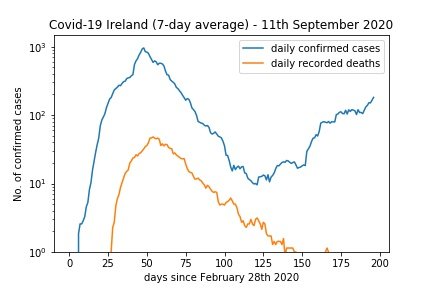
On 12th March, 70 new cases of Covid-19 were announced in Ireland; yesterday there were 211. The current 7-day average in Ireland is over 180 new cases per day and is climbing steadily. Things are similar, if not worse, elsewhere in Europe. as countries struggle to contain the pandemic while simultaneously attempting to reopen their economies. We are heading towards a very difficult autumn, with a large second peak of infection definitely on the cards. Who knows how this will turn out?

The word ‘semester’ is derived from the Latin for ‘six months’ but the term now applies almost exclusively to half a university teaching year, usually more like four months.

I’m looking ahead to the next teaching semester at Maynooth University, which starts in two weeks. The last time I gave a face-to-face lecture was on the morning of March 12th (a Thursday). Going home that evening I was engulfed by morbid thoughts and wondered if I would ever see the students again. Now we’re making plans for their return to (limited) on-campus teaching. Outline teaching plans have now been published, so returning students will have an idea how things will go. These will be refined as we get a better idea of student numbers. Given the continued increase in Covid-19 cases there is a significant chance of another campus closure at some point which will necessitate going online again but, at least to begin with, our students in Theoretical Physics will be getting 50% or more of the in-person teaching they would have got in a normal year.

Yesterday third-level institutions made their first round of CAO offers. Maynooth’s can be found here. Our offer for MH206 Theoretical Physics & Mathematics is, like many courses around the country, up a bit at 510 points reflecting the increase in high grades in this year’s Leaving Certificate.

We won’t know the final numbers for at another week or more but based on the traffic on Twitter yesterday Maynooth in general seems to be very popular:

Outline teaching plans are available for new students but these will not be finalised until Orientation Week is over and students have registered for their modules, which will not be until Thursday 24th September, just a few days before teaching starts. The weekend of 26th/27th looks like being a very busy one!

Returning to the original theme of the post I have to admit that I haven’t set foot outside Maynooth once in the last six months. I haven’t minded that too much, actually, but one thing I have missed is my weekly trip to the National Concert Hall in Dublin. Last night saw the start of a new season of concerts by the RTE National Symphony Orchestra at the NCH. There is no live audience for these so it’s not the same as being there in person, but watching and listening on the live stream is the next best thing.

Last night’s programme was a very nice one, of music by Mendelssohn Mozart and Beethoven, that not only provided a welcome tonic to the end of a busy week but also provided a great example of how to adapt. I’m glad they’re back and am looking forward to the rest of the season.

Asynchronous and Public Lectures

Posted in Education, Maynooth with tags , , , , , on September 11, 2020 by telescoper

This morning I came across a very interesting blogpost by Philip Moriarty which is mainly about teaching quantum mechanics but also includes some discussion of his ideas of how he plans to conduct teaching for the forthcoming semester at the University of Nottingham.

We are in a rather different situation here at Maynooth University with Covid-19 different rules, different numbers of students and different levels of resource in terms of teaching software and equipment, but I think the primary constraints are similar.

Here is is graphic Philip uses to outline the major elements of teaching he plans to adopt (copied without permission):

I think the University of Nottingham has, in common with many other UK universities, moved all its large lecture classes online. Here in Maynooth we’re restricted by physical distancing to have an absolutely maximum of 50 people in any lecture theatre at one time, so effectively the big classes will be online too. However, many of our smaller classes and tutorials will be on campus `face-to-face’ sessions. Since Theoretical Physics is a relatively small Department many of our modules will run pretty much as normal.

This are a bit different for the first year Mathematical Physics module which I teach (MP110) where the class last year was about 90 students. This class will have to be split, but I am still planning to deliver face-to-face lectures for all students in some form. There are three lectures a week in this class and I’ll probably have to have about one third of the students in each session: the other sessions will be streamed and recorded – assuming our newly-installed Panopto system works (!) – and made available to students not at the class. In addition students will get a tutorial per week, also in person.

I have thought a lot about this over the last few months and I’ve decided that the main `lectures’ (which will be with fewer than 30 students) will not be lectures but more like `workshops’ where I illustrate the main results that I would have given in a “normal” lecture using examples as well as getting students to work on problems in class.

Like Philip I plan to record videos of the “primary content” offline, probably in my office, so the students can view them at their leisure. I decided to record these primarily because I think the production quality of such lectures would be better. I’ve used Panopto before and it’s OK, but it has its limitations. I don’t have access to all the equipment Philip talks about, but at least in my office I can re-take and edit the video whenever I mess up (which will be quite frequently, I’m sure). These won’t be 50-minute lectures as I find that not having the interaction with the audience, going back over things when it’s clear they haven’t understood, giving them problems to try in class, etc, the time taken to cover the material in a video is far shorter.

Making these `asynchronous’ is, I think, extremely important. Timetabling teaching sessions looks likely to be extremely complicated for the forthcoming semester so I think it’s far better to make the content available for students to study wherever and whenever they want.

So my plan is that students will get each week:

  • A set of pre-recorded videos covering the material for that week
  • One interactive workshop on campus
  • Access to recordings of two other workshops
  • A full set of lecture notes
  • Coursework examples (assessed)
  • One tutorial on campus
  • A virtual office hour with the lecturer (me) for Q&A

It’s not the same “as normal” but I think it provides the best blend of learning approaches possible under the constraints we will have to operate. Note also that some students may be “at very high risk” for health reasons and consequently unable to come onto campus. The approach I have outlined here means that such students will miss as little as possible.

Unlike Philip, I don’t hate Moodle, so this will be where all the course materials will be made available. It will also be the principal channel of communication with the class.

Like Philip, though, I am in favour of putting all the primary content on Youtube so that anyone who wants to access it can do so. I have suggested this before and it received mixed reactions, but for me it’s more a point of principle. As my teaching is funded by the public purse, it seems reasonable to me that what I produce should all be in the public domain wherever possible. That obviously excludes some teaching activities (e.g. labs and tutorials) but I don’t see why I shouldn’t do it with lectures or other video content. I won’t make the workshop videos public, because they may accidentally identify students who do not wish to appear on a video.

I know many of my colleagues disagree with this, so here’s the unscientific poll I’ve been running to see what people think. Not that the voting will change my mind….


R.I.P. Diana Rigg (1938-2020)

Posted in Film, Television, Theatre with tags , , on September 10, 2020 by telescoper

More sad news today: the death at the age of 82 of the wonderful actress Diana Rigg. She had a long and distinguished career on TV, film and in the theatre. I had the privilege of seeing her opposite David Suchet in Who’s Afraid of Virginia Wolf on stage in London many years ago and thought she was brilliant. But it is as Emma Peel in The Avengers that people of my age will remember her best. Here, by way of a small tribute, is her very first appearance in that role, way back in 1965.

Rest in peace, Diana Rigg (1938-2020)

New Publication at the Open Journal of Astrophysics!

Posted in OJAp Papers, Open Access, The Universe and Stuff with tags , , , , , , , , on September 10, 2020 by telescoper

Another new paper  has been published in the Open Journal of Astrophysics! This is another for the folder marked Cosmology and Nongalactic Astrophysics and is entitled Low-scatter galaxy cluster mass proxies for the eROSITA all-sky survey.

The authors of this paper are Dominique Eckert of the University of Geneva, Alexis Finoguenov (Helsinki), Vittorio Ghirardini (MPE Garching), Sebastian Grandis (LMU), Florian Käfer (MPE Garching), Jeremy Sanders (MPE Garching) and Miriam Ramos-Ceja (MPE Garching).

For those of you unfamiliar with eROSITA, it is an X-ray instrument that was built at the Max Planck Institute for Extraterrestrial Physics, where several of the authors work.

Here is a screen grab of the overlay:

You can click on the image to make it larger should you wish to do so.

You can find the arXiv version of the paper here.

The Ghost Room in Maynooth

Posted in History, Maynooth, Poetry with tags , , , on September 9, 2020 by telescoper

I stumbled across this rather macabre post about Maynooth University and thought I’d share it….don’t have nightmares!

That reminds me of this poem by Emily Dickinson:

One need not be a chamber to be haunted,
One need not be a house;
The brain has corridors surpassing
Material place.

Far safer, of a midnight meeting
External ghost,
Than an interior confronting
That whiter host.

Far safer through an Abbey gallop,
The stones achase,
Than, moonless, one’s own self encounter
In lonesome place.

Ourself, behind ourself concealed,
Should startle most;
Assassin, hid in our apartment,
Be horror’s least.

The prudent carries a revolver,
He bolts the door,
O’erlooking a superior spectre
More near.

Sam's avatarCome Here To Me!

Path leading down to the College Graveyard at Saint Patrick’s College. (Carax)

Just on the outskirts of Dublin lies the historic university town of Maynooth. It is the home of Ireland’s main Roman Catholic seminary, St Patrick’s College, which has been churning out priests since 1795.

One particular room in the college has been associated with demonic apparitions, suicide and paranormal activity for over 150 years.

In the mid 19th century in Room Two of Rhetoric House, two young seminarists took their own lives, nineteen years apart, and the room has been the source of many tales ever since.

Rhetoric House in the South Campus, built in 1834, was formerly a residential house for trainee priests. It now hosts the Department of History.

Rhetoric House, Maynooth (http://bogwarrior.com)

On 1 March 1841, a young student from Limerick by the name of Sean O’Grady (b. 1820) jumped out of room and fell…

View original post 525 more words

R.I.P. Gary Peacock (1935-2020)

Posted in Jazz with tags , , , , , , on September 8, 2020 by telescoper

I heard on Saturday via social media that the great bass player Gary Peacock had passed away on 4th September, only to see other posts claiming that the rumours of his death were a hoax. I was relieved about that but then it turns out that the hoax reports were themselves a hoax and Gary Peacock had indeed died. He was 85 years old.

Gary Peacock is probably best known for his work with the likes of Keith Jarrett, Bill Evans and Jack DeJohnette but as a tribute I thought I would post an example of his earlier work with Albert Ayler. I think the album Spiritual Unity with Gary Peacock on bass and Sonny Murray on drums is one of the highlights of 1960s free jazz.

This tune, the shorter of two versions on Spiritual Unity of an original composition by Albert Ayler called Ghosts, is a great example how he could make coherent what at first hearing sounds like disassociated bursts of sound. It involves remarkable improvised melodies based on short thematic lines designed to evoke unsophisticated  folk music or nursery tunes. It may sound primitive on the surface, but it’s very complex underneath and creating this extraordinary sound world clearly required great technical mastery from Ayler and his supporting musicians, especially Gary Peacock, who plays wonderfully on this track.

Rest in peace, Gary Peacock (1935-2020)


R.I.P. Govind Swarup (1929-2020)

Posted in The Universe and Stuff with tags , , , on September 8, 2020 by telescoper

This morning I learnt the sad news of the passing of Professor Govind Swarup who died yesterday at the age of 91. Govind Swarup was a pioneer in radio astronomy, especially in India, and in particular was a driving force behind the construction of the Giant Metrewave Radio Telescope, and the establishment of a world-leading radioastronomy group, which is located about 80km North of Pune in Maharashtra. I remember meeting with him a couple of times during visits to Pune and was struck by his friendliness and unbounded enthusiasm for astrophysics.

I send my condolences to his family, friends and colleagues in India who I know will miss him enormously.

R. I. P. Govind Swarup (1929-2020).

Leaving Out

Posted in Covid-19, Education, Maynooth with tags , , on September 7, 2020 by telescoper

This morning students across Ireland have been receiving their Leaving Certificate grades. First of all let me congratulate the 2020 Leaving Certificate Class for their success in what has been a very difficult year!

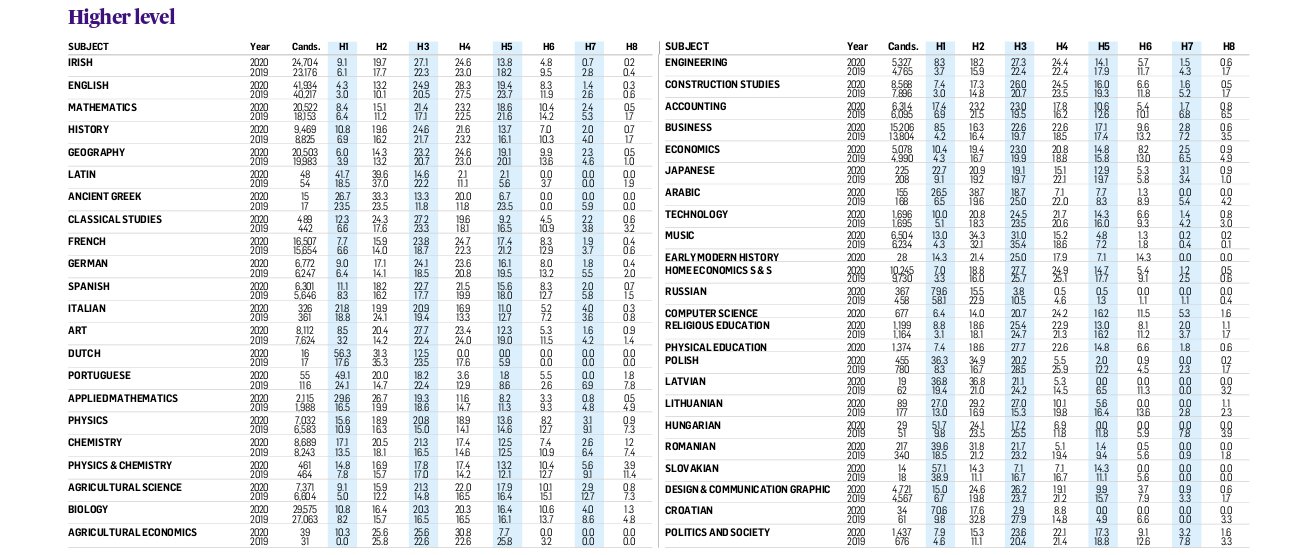
The release of Leaving Certificate results will trigger even more of a scramble than usual for university places through the CAO process. This year things are likely to be very different from previous years as (a) the process is much shorter in duration (students who get into university will be having their first lectures just three weeks from today) and (b) the distribution of grades is unlike previous years because they are based on “calculated grades” rather than examination results. This has led to an increase in top grades across many subjects. Here is a useful summary from the Irish Times:

(I know it looks small but you can click on it to make it legible…)

Note the number of top grades in Mathematics, Applied Mathematics and Physics has gone up because of the general grade inflation and because the number of students taking them has gone up. This is potentially good news for our recruitment here in Maynooth but it’s probably not so simple. For example, it may be that bigger departments elsewhere try to offset the lack of international students this year by recruiting more home students. We’ll just have to wait and see. By the start of next week the picture will probably be clearer.

At any rate, a certain local celebrity is looking forward to welcoming the new students onto campus shortly…

The Year Ahead

Posted in Biographical, Covid-19, Education, Maynooth with tags , , on September 6, 2020 by telescoper

Tomorrow sees the release of the 2020 Leaving Certificate results which this year are based on “calculated grades” rather than examination results. It seems that for about 79% of students these grades will be the same as the teacher’s assessment, about 17% will be lower than the teacher assessment and in about 4% of cases it will be higher. It remains to be seen whether the results will create the sort of stir that this year’s A-level results did.

That seems to imply that CAO points will be a bit higher on average than previous years so more students will make the grade for their first choice of course, which may have a significant impact on recruitment.

We’ll find out all about that next week when the details come in. Teaching term starts on Monday 28th September so there’s very little time to get things organised for the new cohort, especially on the Omnibus Science course on which students have a wide range of alternatives from which to pick their first-year subjects.

Next week at Maynooth University we also have our repeat Examination Board (a week later than usual). After that we will have a good idea of how many students will be returning for Years 2, 3 and 4 and how many will not progress.

So soon we will have enough information to fine-tune our teaching plans. These are challenging this year because of the reduced capacity of the rooms we use for lectures and tutorials due to physical distancing. Some rooms are affected more than others – it’s far worse for large lecture theatres than for tutorial rooms – so we have to look at each module separately.

We had a (virtual) meeting of teaching staff in the Department of Theoretical Physics to coordinate the approaches to different modules. Among other things, that showed how very sensitive everything is to numbers of students taking. If a room can take N students then if the actual number taking the class is less than or equal to N then the class can proceed as usual but if it exceeds N, even by just one, then we have to split the class somehow.

Having detailed numbers is essential to sorting all this out but students can change modules during the first few weeks of teaching, we’re likely to be reorganising as we go along.

All this causes multiple headaches but, despite the extra complications this year, I’m looking forward to seeing the students on campus again. I haven’t given a ‘proper’ lecture since March 12th.

I was so busy last week, grappling with these and other matters, that I missed the fact that I took over as Head of Department on 1st September 2019, a year ago last Tuesday. Little did I know what I was letting myself in for…

World Beard Day

Posted in Beards with tags , , , on September 5, 2020 by telescoper

Today is the first Saturday in September which means that it is World Beard Day.

I quote from official guidance:

On World Beard Day, it is customary for the bearded members of a family to relax and partake in no jobs or chores. The beardless members of the family traditionally show their support by waiting on the bearded hand and foot. World Beard Day is all about promoting and elevating the global status of the the beard. Whilst many countries and cities practice World Beard Day customs specific to their own region, shaving on World Beard Day is universally considered to be highly disrespectful.

See here for a celebratory blog post by Beard Liberation Front Organiser, Keith Flett.