Archive for February, 2021

Goin’ Down Slow – Archie Shepp & Horace Parlan

Posted in Covid-19, Jazz with tags , , , , , on February 7, 2021 by telescoper

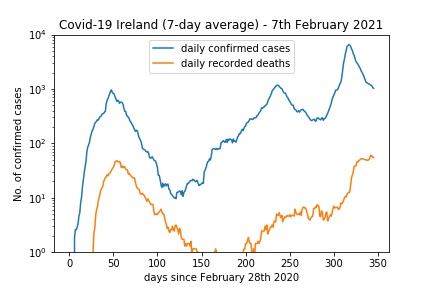
I just updated my Coronavirus page with the days statistics for Ireland (1024 new cases, 12 deaths). We’re obviously well past the Christmas peak but cases are falling very slowly. At this rate we’ll still have several hundred a day by the end of February (which, incidentally will be a year since the first Covid-19 case was recorded in Ireland).

Unlocking with case levels in the hundreds before Christmas was a disaster and I sincerely hope there’s no repeat of that foolishness.

Anyway, the current state of play remind me of this track from a great album called Trouble in Mind which I bought as a vinyl LP about 40 years ago. It’s by Archie Shepp (tenor sax) and Horace Parlan (Piano). Both made their reputations as avant garde jazz musicians but in this album they went back to the roots and explored the classic blues repertoire. Goin’ Down Slow dates back to 1941 and it’s a standard 12-bar blues (usually performed in B♭). Horace Parlan passed away in 2017, but Archie Shepp is still going strong.


Celtic Europe

Posted in History, Irish Language with tags , , , , on February 6, 2021 by telescoper

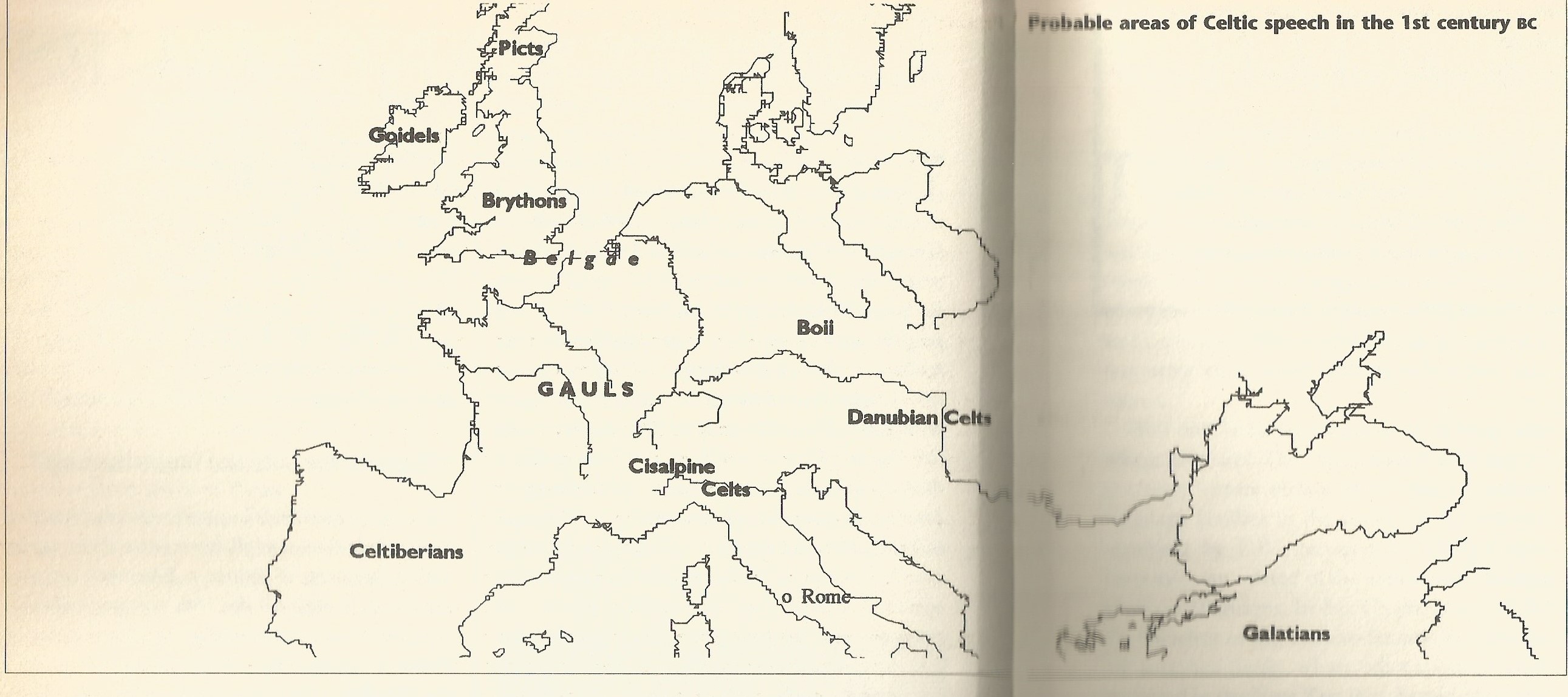
The Extent of Celtic Europe, from “Dictionary of Languages” by Andrew Dalby

Following on from Thursday’s post I thought I’d show the above map that shows the spread of Celtic languages in Europe. I’m sorry that the picture isn’t great but I scanned the map from a big hardback book and the map spreads across the fold as you can see.

The Celtic languages at the time depicted in the map (1st Century BC) were all oral languages, but when the Roman Empire spread across Europe about two thousand years ago it came into contact with the major dialects. Evidence for these can be found in place names, from Mediolanum (modern-day Milan, originally in cisalpine Gaul) to Singidunum (the Roman name for modern-day Belgrade) and Laccobriga (Lagos in Southern Portugal).

Belgium gets its name from the Belgae, regarded by Julius Caesar as the bravest and most fearsome of the tribes of Gaul. There are also words recorded in early inscriptions and in reconstructions based on later texts from which it is possible to glean clues about these languages. The picture that emerges is of a network of dialects spoken by Celtic peoples that inhabited a swathe of Continental Europe from the Iberian peninsula in the West to Galatia in the East, much of the Danube valley, and from Cisalpine Gaul (now part of Italy) in the South to modern-day Germany in the North.

Galatia (in classical Asia Minor) merits a special mention. St Paul’s Letter to the Galatians was addressed to the young Christian churches in this Celtic-speaking enclave which was then a distant province of the Roman Empire.

Linguists refer to the language that was spoken in Ireland at this time as Goidelic and it sits apart from the others because Ireland was never part of the Roman Empire. Brythonic is the name given to the dialects spoken in Britain. Continental Celtic is the name given to the dialects stretching all the way from Spain to Galatia of which the largest group was Gaulish. The language of the Scottish highlands Pictish may have been a separate subdivision but I don’t think anybody really knows because the language is extinct.

None of these groups was homogeneous. The Celts lived in relatively small communities and there were many regional variations even within each major group. Irish has four main dialects, roughly aligned with the four provinces. In Description of Ireland (1577), Richard Stanyhurst wrote:

As the whole realme of Ireland is sundred into foure principal parts so eche parcell differeth very much in the Irish tongue, euery country hauing his dialect or peculiar manner in speaking the language.

Our Irish teacher speaks the Irish of Connacht in which some pronunciations are very different from Leinster, which is the province I live in. As an absolute beginner this is the least of my worries at the moment.

The Goidelic group comprises Irish, Manx and Scottish Gaelic; and the Brythonic group that comprises Welsh, Cornish and Breton. These are sometimes referred to as q-Celtic and p-Celtic, respectively, although not everyone agrees that is a useful categorization. It stems from the fact that the “q” in Indo-European languages morphed into a “p” in the Brythonic languages. The number five in Irish is a cúig which has a q sound (though there is no letter q in the Irish alphabet); five in Welsh is pump. Contrast with the number two: a dó in Irish and dau in Welsh.

Incidentally, Scottish Gaelic is not the language spoken by the Celtic people who lived in Scotland at the time of the Romans, the Picts, which is lost. Scottish Gaelic is actually descended from Middle Irish due to migration and trading contacts. The Ulster dialect of Irish is in turn much influenced by reverse migration from Scotland. Languages do not evolve in isolation or in any simple linear trajectory.

Contrary to popular myth, Breton is not a Continental Celtic language but was taken to Brittany by a mass migration of people, which peaked in the 6th Century AD, from South-West Britain, fleeing the Anglo-Saxons. The Saxons won a great victory in battle at Dyrham (near Bath) in 577 after which they advanced through Somerset and Devon, splitting the Celts of Cornwall and Wales and leading to the formation of two distinct Brythonic language groups, Welsh and Cornish. Breton is much closer to Cornish than Welsh.

The Continental Celtic languages are all extinct, except for fascinating remnants that linger here and there in local dialect words in French and Spanish.

Open Journal of Astrophysics Impact Factor Poll

Posted in Open Access with tags , , on February 5, 2021 by telescoper

A few people ask from time to time about whether the Open Journal of Astrophysics has a Journal Impact Factor.

For those of you in the dark about this, the impact factor for Year N, which is usually published in year N+1, is based on the average number of citations obtained in Year N for papers published in Years N-1 and N-2 so it requires two complete years of publishing.

For the OJA, therefore, the first time an official IF can be constructed is for 2021, which would be published is in 2022 and it would be based on the citations gained in 2021 (this year) for papers published in 2019 and 2020. Earlier years were incomplete so no IF can be defined.

It is my personal view that article-level level bibliometric data are far more useful than journal-level descriptors such as the Journal Impact Factor (JIF). I think the Impact Factor is very silly actually. Unfortunately, however, there are some bureaucrats that seem to think that the Journal Impact Factor is important and some of our authors think we should apply to have an official one.
What do you think? If you have an opinion you can vote on the twitter poll here:

https://twitter.com/OJ_Astro/status/1357653546146136069

I should add that my criticisms of the Journal Impact Factor are not about the Open Journal’s own citation performance. We have every reason to believe our impact factor would be pretty high.

Comments welcome.

Language Lessons

Posted in History, Irish Language, Maynooth with tags , , , , , , , , , , on February 4, 2021 by telescoper

Thursday is Computational Physics Day this term so this morning I delivered the first Panopto lecture of that module and in the afternoon we had our first laboratory session. The students are all at home of course so we had to run the lab with them using their own laptops rather than the dedicated Linux cluster we have in the Department and interacting via Microsoft Teams.  The first lab is very introductory so it was really just me presenting and them following on their machines without too much interaction. The ability to share a screen is actually very useful though and I imagine using it quite a lot to share Spyder. It went fairly well, I think, with all the students getting started out on the business of learning Python.

In between lecturing the morning and running the laboratory session this afternoon I had the chance to study another kind of language. Soon after I first arrived in Maynooth I got an email from Maynooth University about Irish language classes. Feeling a bit ashamed about not having learned Welsh in all my time in Cardiff, I thought I’d sign up for the Beginners class and fill in a Doodle Poll to help the organizers schedule it. Unfortunately, when the result was announced  it was at a time that I couldn’t make owing to teaching, so I couldn’t do it. That  happened a couple of times, in fact. This year however I’ve managed to register at a time I can make, though obviously the sessions are online.

I’m not sure how wise it is for me to try learning a new language during a term as busy as this, but I have to say I enjoyed the first session enormously. It was all very introductory, but I’ve learnt a few things about pronunciation – unsurprisingly the Irish word for pronunciation fuaimniú is unsurprisingly quite difficult to pronounce – and the difference between slender and broad vowels. I also learnt that to construct a verbal noun, instead of putting -ing on the end as you would in English, in Irish you use the word ag in front of the verb.

That’s not to say I had no problems. I’m still not sure I can say  Dia duit (hello) properly. The second “d” is hardly pronounced. 

Irish isn’t much like Welsh, which I failed to learn previously.  Although Irish and Welsh are both Celtic languages they are from two distinct groups: the Goidelic group that comprises Irish, Manx and Scottish Gaelic; and the Brythonic group that comprises Welsh, Cornish and Breton. These are sometimes referred to as q-Celtic and p-Celtic, respectively, although not everyone agrees that is a useful categorization. Incidentally, Scottish Gaelic is not the language spoken by the Celtic people who lived in Scotland at the time of the Romans, the Picts, which is lost. Scottish Gaelic is actually descended from Middle Irish. Also incidentally, Breton was taken to Brittany by a mass migration of people from South-West Britain fleeing the Anglo-Saxons which peaked somewhere around 500 AD. I guess that was the first Brexodus.

Welsh and Irish don’t sound at all similar to me, which is not surprising really. It is thought that the Brythonic languages evolved from a language  brought to Britain by people from somewhere in Gaul (probably Northern France), whereas the people whose language led to the Goidelic tongues were probably from somewhere in the Iberia (modern-day Spain or Portugal). The modern versions of Irish and Welsh do contain words borrowed from Latin, French and English so there are similarities there too.

Only a diacritic mark appears in Irish, the síneadh fada (`long accent’), sometimes called the fada for short, which looks the same as the acute accent in, e.g., French. There’s actually one in síneadh if you look hard enough. It just means the vowel is pronounced long (i.e. the first syllable of síneadh is pronounced SHEEN). The word sean (meaning old) is pronounced like “shan” whereas Seán the name is pronounced “Shawn”.

One does find quite a few texts (especially online) where the fada is carelessly omitted, but it really is quite important. For example Cáca is the Irish word for `cake’, while the unaccented Caca means `excrement’…

I took the above text in Irish and English from the front cover of an old examination paper. You can see the accents as well as another feature of Irish which is slightly similar to Welsh, the mysterious lower-case h in front of Éireann. This is a consequence of an initial mutation, in which the initial character of word changes in various situations according to syntax or morphology (i.e. following certain words changing the case of a noun or following certain sounds). This specific case is an an example of h-prothesis (of an initial vowel).

In Welsh, mutations involve the substitution of one character for another. For example, `Wales’ is Cymru but if you cross the border into Wales you may see a sign saying Croeso i Gymru, the `C’ having mutated. The Irish language is a bit friendlier to the learner than Welsh, however, as the mutated character (h in the example above) is inserted in front of the unmutated character. Seeing both the mutated and unmutated character helps a person with limited vocabulary (such as myself) figure out what’s going on.

Mutations of consonants also occur in Irish. These can involve lenition (literally `weakening’, also known as aspiration) or eclipsis (nasalisation). In the case of eclipsis the unmutated consonant is preceded by another denoting the actual sound, e.g. b becomes m in terms of pronunciation, but what is written is mb. On the other hand, lenition is denoted by an following the unmutated consonant. In older forms of Irish the overdot (ponc séimhithe) -another diacritic – was used to denote lenition.

Anyway, I’ve seen Dia duit written Dia dhuit which might explain why the d sounds so weak. We live and learn. If I keep at it long enough I might eventually be able to understand the TG4 commentary on the hurling..
Old and New Dreams

Posted in Jazz with tags , , , , , , on February 3, 2021 by telescoper

I was just relaxing by listening to the superb album Old and New Dreams (vintage 1977) and thought I’d share a track here given the ongoing prevalence of lockdown dreams. This album was actually the debut album by the Quartet of the same name that featured Dewey Redman on tenor sax, Don Cherry on trumpet, Charlie Harden on bass and Ed Blackwell on drums. I love the balance they achieved between free improvisation and swing and the interplay between the different instruments. Just listen to Charlie Haden’s playing on this, holding everything together rhythmically but also leading it in so many different directions! This is called Augmented

Teaching from Home

Posted in Covid-19, Education, Maynooth on February 3, 2021 by telescoper

Determined to follow the public health advice and work from home I decided to set up a blackboard in my study so I can do lectures online. I find the blackboard shows up better on camera than a whiteboard and using this arrangement allows me to stand up while I deliver the material, which I find much more comfortable than sitting down.

I’m fortunate of course in having enough space to do this. Not every University lecturer can do this.

The bit you see on the board was the start of my second Engineering Mathematics lecture to first-year students. I had asked the students at the end of Lecture 1 to think about the Laplace Transform of f(t)=t and began Lecture 2 by going through the necessary integration on the board.

Today I have three lectures – another Engineering Maths and two Advanced Electromagnetism to give so the board will be more extensively used. I just hope my internet connection stays up!

P. S. Playing back today’s videos I have discovered an optical defect in the Panopto system that makes my hair look grey.

P.P.S. Three lectures in an afternoon (12-1, 2-3 and 4-5) is quite hard work but at least I had breaks between them!

New Publication at the Open Journal of Astrophysics

Posted in OJAp Papers, Open Access, The Universe and Stuff with tags , , , , , , , on February 2, 2021 by telescoper

Time to announce the first publication of 2021 in the Open Journal of Astrophysics. This one was actually published a few days ago but  it took a bit of time to get the metadata and DOI registered so I held off announcing it until that was done.

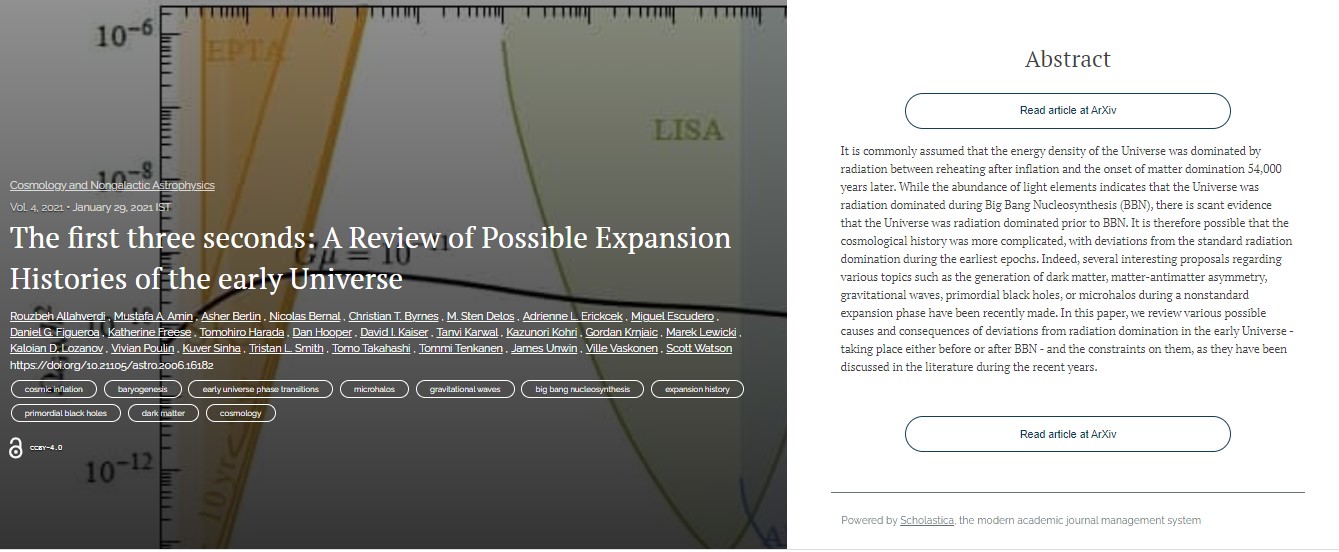
The latest publication is a lengthy and comprehensive review article (67 pages altogether) by Allahverdi et al. which has 26 authors from all round the world. It is entitled The First Three Seconds: a Review of Possible Expansion Histories of the Early Universe and is a study of the various possible evolutionary histories of cosmic expansion possible with a wide range of cosmological models with their implications for baryogenesis, nucleosynthesis, primordial gravitational wave production, and many other things besides.

Here is a screen grab of the overlay:

You can click on the image to make it larger should you wish to do so. You can find the arXiv version of the paper here. This is one for the Cosmology and Nongalactic Astrophysics folder.

And so Volume 4 begins. Volume 3 had 15 papers, Volume 2 had 12 , and Volume 1 just 4 so we’re growing slowly but surely! Let’s see how many we publish in 2021. I can tell you  we have some very exciting papers in the pipeline…

The Start of Spring Semester

Posted in Biographical, Education, Maynooth with tags , , , , , , , on February 1, 2021 by telescoper

It’s February 1st 2021, which means that today is Imbolc, a Gaelic festival marking the point halfway between the winter solstice and vernal equinox, i.e. it’s a Cross-Quarter Day. To be pedantic, Imbolc is actually the period between this evening and tomorrow evening as in the Celtic calendar days were counted from sunset to sunset.

The first Day of February is also the Feast day of St Brigid of Kildare (c. 451-525), one of Ireland’s patron saints along with Saints Patrick and Colm Cille. One of her miraculous powers was the ability to change water into ale, which perhaps explains her enduring popularity among the Irish.

In Ireland this day is sometimes regarded as the first day of spring, as it is roughly the time when the first spring lambs are born. It corresponds to the Welsh Gŵyl Fair y Canhwyllau and is also known as the `Cross Quarter Day’ or (my favourite) `The Quickening of the Year’. According to legend it is also the day on which jackdaws mate. Given how many of them there are around Maynooth there should be a lot of action today.

Today is, appropriately enough in the light of all this, the start of the Spring Semester of teaching at Maynooth University, the fourth Spring Semester I will have experienced here although this is obviously not like the others in that we’ll be teaching online at least for the first half and probably for the entirety. I was planning to stay at home today but I realised I’d left some things I need in the office on campus so will have to go to collect them. That’s why I’m up early. That and the need to shake myself out of the lockdown torpor that has afflicted me since New Year. It’s time to get my act together, pull my finger out, put my best foot forward, etc.

This Semester I am teaching Engineering Mathematics II, Computational Physics I and Advanced Electromagnetism. The former, what you would probably call a `service course’, covers a mixture of things, mainly Linear Algebra but with some other bits thrown in for fun, such as Laplace transforms. Interestingly I find the Mathematical Physics students do not encounter Laplace Transforms in the first year, but perhaps engineers use them more often than physicists do? I think I’ve written only one paper that made use of a Laplace transform. Anyway, I have to start with this topic as the students need some knowledge of it for some other module they’re taking this semester. I reckon six lectures will be enough to give them what they need. That’s two weeks of lectures, there being three lectures a week for this module.

Once again my teaching timetable for this module is quite nice. I have lectures on Monday, Tuesday and Wednesday and then the students have a choice of tutorial (on either Thursday or Friday). That means I can get through a decent amount of material each week before each tutorial. I don’t do the tutorials, by the way: that’s left to one of our PhD students, who gets paid for doing that and correcting the weekly coursework. There are about 50 students on this module, divided into two courses: Electronic Engineering and Robotics and Intelligent Devices. We don’t have Civil or Mechanical or Chemical Engineering, etc, at Maynooth, in case you were wondering. Lectures will be done as webcasts using Panopto but also recorded for later viewing.

My first Computational Physics lecture, which I will do from home, is on Thursday, after which there is a lab session which we will do via Microsoft Teams. That’s the way we did it after lockdown last year and it worked OK. Students attend one two-hour lab session in addition to the lecture, on either Thursday or Tuesday. The first lecture being on Thursday the first lab session will be Thursday afternoon, with the same material being covered the following Tuesday. Fortunately, Python is free to download and easy to install so it’s quite straightforward to run the labs remotely. Teams has a screen sharing facility so it’s quite easy for myself or my demonstrator to see what is wrong in the same way we would do in a laboratory class.

The Advanced Electromagnetism module is a new one for me but I’m quite looking forward to it. Being a final-year module its content is less prescriptive than others and I’ll be adding a few things that I find interesting. Both lectures for that one are on Wednesdays and again will be given as webcasts with recordings available later.

Today is a particularly busy day because in addition to my first lecture (at 2pm) I have a meeting of Academic Council (3pm via Teams), a Euclid telecon (via Zoom) and a meeting with my PhD student via Teams. I have also been trying to sort out tutors and tutorials for the forthcoming Semester: these don’t start until next week so there’s time, but it has been quite a challenge to get everyone sorted. Fortunately I think that’s now done.

Oh, and another thing. I signed up for Irish language lessons (Beginners Level) and will be having classes once a week from now on.

It’s going to be a very busy term but I reckon being busy is probably going to be a good way to get through the next few months.