Today is the last day of teaching ahead of next week’s mid-term break. As it happens I did two consecutive lectures from 11-1 today instead of the usual one from 12-1 because of a rearrangement necessitated by a staff absence. I don’t mind admitting that I’m looking forward to a bit of a pause during Study Week, before embarking on the remaining 7 teaching weeks of the Semester.
The room I give my 12-1 lecture in has a chalkboard but the one for the 11-12 slot only has a whiteboard. The downside of the whiteboard is that it is almost impossible to make a lecture recording because the contrast is too low. I was happy to move to the usual room for the second one, which isn’t great either but at least has a decent blackboard.
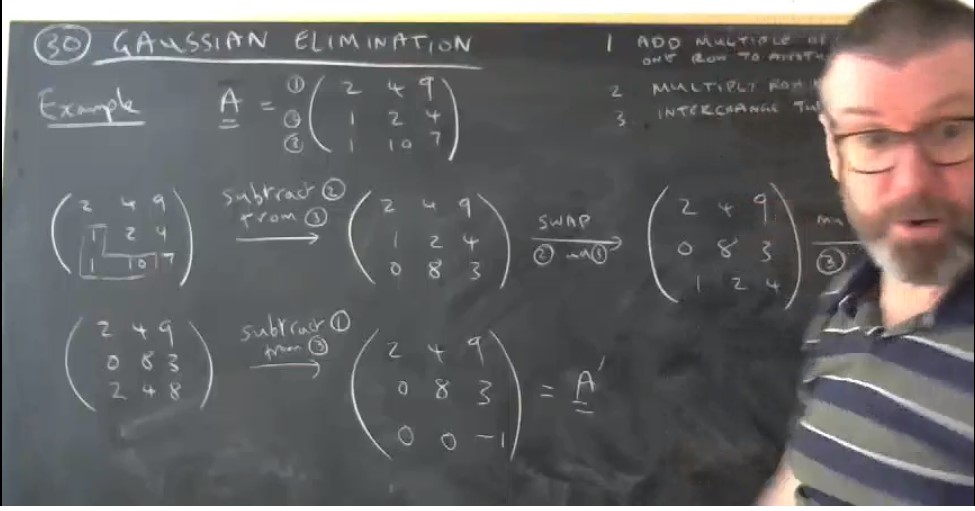
A still from one of last year’s Engineering Maths lectures from home…
I know people think I am very old fashioned in persistently using a chalkboard. They also find it quite amusing that I bought one especially so I could do lectures from home using it. It’s far easier to get a decent contrast than using a whiteboard and I find that standing up and walking around allows me to communicate more effectively, at a decent pace and with a reasonable amount of energy. Most importantly of all I think it’s important for the students to see a process unfolding.
It’s proving much more difficult to provide decent quality lecture recordings on campus than at home because of the lack of decent camera facilities, but I’m doing the best I can.
One of the things I’ve picked up about Hiberno-English pronunciation is that Irish people tend to pronounce the English word “film” as something like “fillum”. I always thought this was just a sort of mannerism, but it turns out to be quite a bit more interesting than that.
The general term for the addition of an extra sound to the pronunciation of a word is epenthesis and it is a fairly common feature of many languages. The extra sound can be added at the beginning, at the end or in the middle. The latter case is specifically called anaptyxis or sometimes svarabhakti, which is a Sanskrit word specifically for the insertion of a vowel after the letter l or r before another consonant.
In most cases these extra vowel sounds are inserted to aid pronunciation, If you think about it the mouth and tongue have to do something quite complicated to get from l to m and a nice easy “uh” sound makes the transition simpler.
The Celtic group of languages was the first wave of Indo-European languages, to sweep across Europe. I blogged about this here. It seems the idiosyncratic pronunciation of “film” as “fillum” (which, I’m told, is also in widespread use in India) is a relic of the Irish language’s distant origins in Sanskrit, having no doubt crossed into Hiberno-English at a time when Irish was more widely spoken than it is now.
Another topical example is the name Colm (as in Colm Tóibín), which is pronounced “Collum” (or, depending on dialect, something more like “Cullum”).
Anaptyxis isn’t restricted to Irish, of course. There are examples in English. Who could forget the form favoured by football supporters? Engerland! Engerland! Engerland! (I don’t remember the rest of the lyrics to that song…)
Last month I mentioned that I attended an event to mark the departure of Professor Philip Nolan at the end of his term as President of Maynooth University. Over drinks afterwards he wasn’t very forthcoming about what he was planning to do next, but yesterday news broke that he is to become the Director General of Science Foundation Ireland.
Amusingly, I see the slogan for SFI is ‘For What’s Next…’
Congratulations to Professor Nolan on this appointment! For the last 18 months, as well as being President of Maynooth University, he has been chairing the Epidemiological Modelling effort as part of National Public Health Emergency Team dealing with Covid-19. He won’t be starting his new job until January, so is now probably taking a bit of a rest.
The job at SFI will be a big challenge. Science in Ireland is in a dire state of under-investment, especially in basic (i.e. fundamental) research. Until recently SFI really only funded applied science, but recently seemed to have shifted its emphasis a little bit in its latest strategic plan.
Currently Ireland spends just 1.1% of its GDP on scientific research and development and SFI currently has a heavy focus on applied research (i.e. research aligned with industry that can be exploited for short-term commercial gain). This has made life difficult for basic or fundamental science and has driven many researchers in such areas abroad, to the detriment of Ireland’s standing in the international scientific community.
The new strategy, which covers the period from now to 2025, plans for 15% annual rises that will boost the agency’s grant spending — the greater part of the SFI budget — from €200 million in 2020 to €376 million by 2025. Much of this is focused in top-down manner on specific programmes and research centres but there is at least an acknowledgement of the need to support basic research, including an allocation of €11 million in 2021 for early career researchers. The overall aim is to increase the overall R&D spend from 1.1% of gross domestic product, well below the European average of 2.2%, to 2.5% by 2025.
Obviously this increase in funding is welcome and that is a big positive for the incoming Director General, but important strategic decisions will need to be taken about the overall balance of the programme. I wish Professor Nolan well as he takes over the helm.
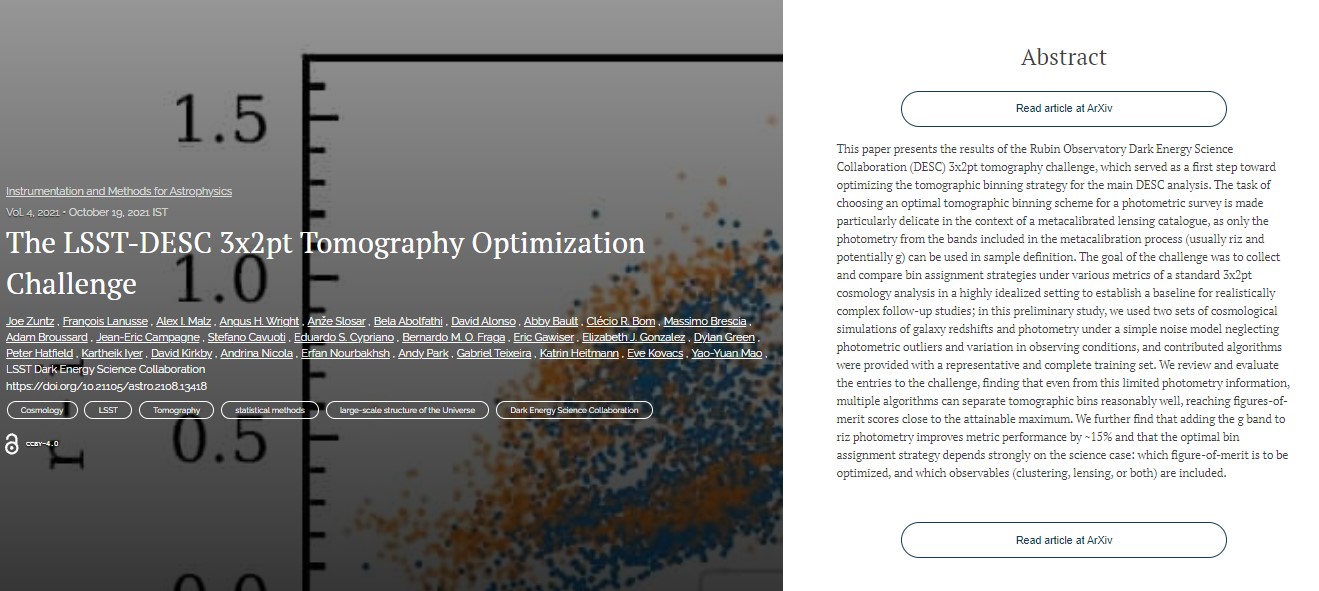
The latest publication is entitled The LSST-DESC 3x2pt Tomography Optimization Challengeand is in the folder marked Instrumentation and Methods for Astrophysics, and is especially relevant for cosmology. The paper is led by Joe Zuntz of the University of Edinburgh, and there are 27 authors altogether, scattered across the globe, representing the LSST Dark Energy Science Collaboration.
Here is a screen grab of the overlay which includes the abstract:
You can find the paper on the Open Journal of Astrophysics site here and can also read it directly on the arXiv here.
I’ve just finished my 11th Lecture on Mechanics and Special Relativity. The Tuesday lecture is in a 5pm to 6pm slot which means quite a few students need to leave early in order to get buses home. I try therefore to design it in such a way that the last 10 minutes or so is optional, so those that depart before the end don’t miss anything vital. Today I ended with a sort of philosophical aside about the nature of things versus how they interact with other things. I wrote about such thoughts already on this blog but that was almost a decade ago so I reckon enough time has elapsed for me to reiterate it here in a slightly modified form.
The text for this dissertation is a short speech by Hannibal Lecter from the film The Silence of the Lambs (1991), specifically the “quotation” from the Meditationsof Roman Emperor and stoic philosopher>Marcus Aurelius.
The quotation by Lecter reads
First principles, Clarice. Simplicity. Read Marcus Aurelius. Of each particular thing ask: what is it in itself? What is its nature? What does he do, this man you seek?
I always felt this would make a good preface to a book on particle physics, playing on the word “particular”, but of course one has to worry about using part of a film script without paying the necessary copyright fee, and there’s also the small matter of writing the book in the first place.
Anyway, I keep the Penguin Popular Classics paperback English translation of the Meditations with me when I go travelling; I can’t read Greek, the language it was originally written in. It is one the greatest works of classical philosophy, but it’s also a collection of very personal thoughts by someone who managed to be an uncompromisingly authoritarian Emperor of Rome at the same time as being a humble and introspective person. Not that I have ever in practice managed to obey his exhortations to self-denial!
Anyway, the first point I wanted to make is that Lecter’s quote is not a direct quote from the Meditations, at least not in any English translation I have found. The nearest I could find in the version I own is Book 8, Meditation X:
This, what is it in itself, and by itself, according to its proper constitution? What is the substance of it? What is the matter, or proper use? What is the form, or efficient cause? What is it for in this world, and how long will it abide? Thus must thou examine all things that present themselves unto thee.
Or possibly, later on in the same Book, Meditation XII:
As every fancy and imagination presents itself to unto thee, consider (if it be possible) the true nature, and the proper qualities of it, and reason with thyself about it.
There are other translated versions to be found on the net (e.g. here), all similar. Thus Lecter’s reference is a paraphrase, but by no means a misleading one.
A more interesting comment, perhaps, relates to the logical structure of Lecter’s quote. He starts by asking about a thing “in itself”, which recalls the ding an sich of Immanuel Kant. The point is that Kant argued that the “thing in itself” is ultimately unknowable. Lecter continues by asking not what the thing (in this case a man) is in itself but what it (he) does, which is not the same question at all.
It has long struck me that this is similar to the way we work in physics. For example, we might think we understand a bit about what an electron is, but actually what we learn about is how it interacts with other things, which of its properties change and which remain the same, i.e. what it does. From such behaviour we learn about what attributes we can assign to it, such as charge, mass and spin, but we know these only through their interactions with other entities. The electron-in-itself remains a mystery.
This is true of mathematical objects too. Objects are defined to do certain things under certain operations. That is the extent of their definition. Physicists tend to think there is a reality beyond the mathematics used to represent it, but can we ever really know anything about that reality?
If the reference to mathematical physics all sounds a bit nerdy, then I’ll make the obvious point that it also works with people. Do we ever really know what another person is in himself or herself? It’s only through interacting with people that we discover anything. They may say kind or nasty things and perform good or evil deeds, or act in some other way that leads us to draw conclusions about their inner nature. But we never really know for sure. They might be lying, or have ulterior motives. We have to trust our judgement to some extent otherwise we’re forced to live in a world in which we don’t trust anyone, and that’s not a world that most of us are prepared to countenance.
Even that is similar to physics (or any other science) because we have to believe that, say, electrons (or rather the experiments we carry out to probe their properties) don’t lie. This takes us to an axiom upon which all science depends, that nature doesn’t play tricks on us, that the world runs according to rules which it never breaks.
Just time today to pass on the news that the University of Cork is advertising a Lectureship in Theoretical Astrophysics “with a specialism in astrophysics, gravitational physics or cosmology (although outstanding candidates from any research area in astronomy can also apply)”. More details can be found here. The deadline for applications is 11th November.
I’m posting this information here to encourage cosmologists and gravitational physicists to apply because I would love to see the community in these areas grown in Ireland. This is a follow-up position to the Professorship in Astrophysics recently advertised.
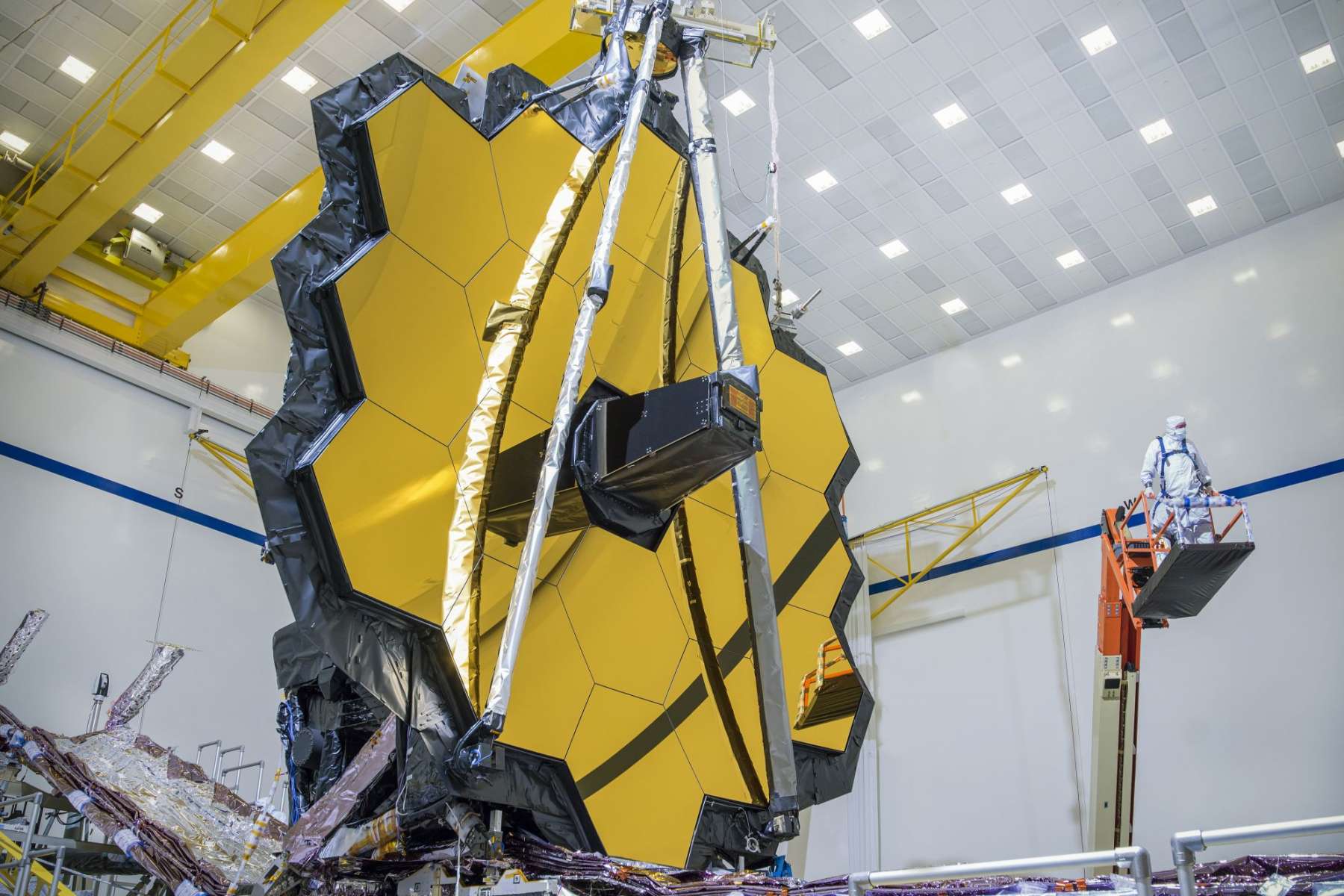
I heard last week that the ship carrying the James Webb Space Telescope (JWST) arrived safely in French Guiana and is now being prepared for launch on an Ariane-5 rocket at the European Space Agency’s facility at Kourou. Since the telescope cost approximately $10 billion there was some nervousness it might have been hijacked by pirates on the way.
I’m old enough to remember JWST when it was called the Next Generation Space Telescope NGST); it was frequently discussed at various advisory panels I was on about 20 years ago. Although the basic concept hasn’t changed much – it was planned to be the successor to the Hubble Space Telescope working in the infrared and with a deployable mirror – at that time it was going to have an even bigger mirror than the 6.5m it ended up with, was going to be launched in or around 2010, and was to have a budget of around $600 million. About a decade ago cost overruns, NASA budget problems, and technical hitches led to suggestions that it should be cancelled. It turned out however that it was indeed too big too fail. Now it is set for launch in December total cost greater than ten times the original estimate.
I know many people involved in the JWST project itself or waiting to use it to make observations, and I’ll be crossing my fingers on launch day and for the period until its remarkable folding mirror is deployed about a fortnight later. I hope it goes well, and look forward to the celebrations when it does.
There is a big problem with JWST however and that is its name, which was changed in 2002 from the Next Generation Space Telescope to the James Webb Space Telescope after James E. Webb, a civil servant who was NASA’s chief administrator from 1961 to 1968.
It’s not uncommon for scientific space missions like this to be named after people once the proposal has moved off the drawing board and into serious planning. That happened with the European Space Agency’s Planck and Herschel to give two examples. In any case Next General Space Telescope was clearly never anything but a working title. Yet naming this important mission after a Government official always seemed a strange decision to me. Then news emerged that James Webb had enthusiastically cooperated in a McCarthyite purge of LGBT+ people working in government institutions, part of a wider moral panic referred to by historians as the Lavender Scare. There have been high-profile protests (see, e.g., here) and a petition that received over a thousand signatures, but NASA has ruled out any change of name.
The main reason NASA give is that they found no evidence that Webb himself was personally involved in discrimination or persecution. I find that very unconvincing. He was in charge, so had responsibility for what went on in his organization. If he didn’t know then why didn’t he know? Oh, and by the way, he didn’t have anything to do with infrared astronomy either…
It’s a shame that this fantastic telescope should have its image so tarnished by the adoption of an inappropriate name. The name is a symbol of a time when homophobic discrimination was even more prevalent than it is now, and as such will be a constant reminder to us that NASA seems not to care about the many LGBT+ people working for them directly or as members of the wider astronomical community.
P.S. As an alternative name I suggest the Lavender Scare Space Telescope (LSST)…
Yesterday was the end of Week 4 of the Autumn Semester. Because Hallowe’en is on Sunday this year, the mid-term study break is a bit earlier than usual, meaning that Week 5 is the last week before that. That’s not to say we have a holiday of course, apart from the October Bank Holiday on 25th October, the first day of that week. There is, however no teaching in that week. Although the break is welcome, it does mean a rather long run-in of seven uninterrupted weeks of teaching until the Christmas break.
Anyway, yesterday we had our first in-person Departmental Meeting since I don’t know when. It wasn’t quite “normal” as some members of the Department joined via Teams, everyone wore masks and we held the meeting in a large-ish lecture theatre to enable physical distancing. We still have one lecturer who is not able to be in Ireland because of visa delays, so he joined remotely. At least there is a sign of movement on that issue, and we think he’ll be in Ireland and ready to teach after the study break, on November 1st. We did have student representatives present, which was very welcome, as it was difficult to arrange during the lockdown.
Although I’ve had about 18 months of practice to get used to virtual meetings I still dislike them so intensely that my heart sinks whenever anyone calls one that I have to attend, which is depressingly often. Meetings in person are so much better in my view. I don’t know why that is. Just call me old-fashioned. I think yesterday’s meeting went rather well, all things considered, with contributions from just about everyone present.
The October study break is traditionally when we prepare our examinations for the January period. One of the most important items on the agenda was what to do for this January. The official line is that we’re supposed to return to normal, with traditional examinations on campus. I think most lecturers will do their exams like that unless the public health situation deteriorates even more rapidly and we are forced to switch online again. With Covid-19 cases rising significantly, that is a distinct possibility.
I think most staff agree that there are positives to the online style of examinations and I’ve left it up to individuals to decide what they think is best for their particular modules. The important thing however is to inform the students as quickly as possible so they know what’s going to hit them. Students in Year 2 have never had a “traditional” examination at Maynooth and those in Year 3 only had one set, way back in January 2020. They will need to readjust to not having an “open book” style of examination. On the other hand, in theoretical physics we try to test problem-solving rather than memory so I think we’re in a better position than many disciplines to manage this.
First-year students this year are in a different but also tricky situation, in that they are facing their first set of University examinations having had their school education significantly disrupted by the pandemic. We have to help them cope with the fact that they may not be as well prepared as students in previous years. Since I’m teaching the first-years this Semester, this means doing more revision classes and tips on examination technique.
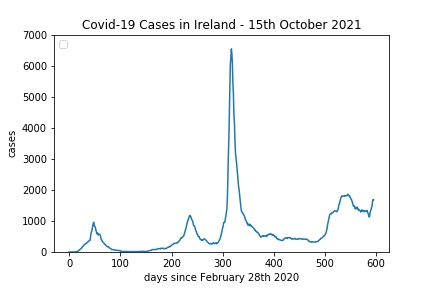
I’ve alluded to the backdrop of rising Covid-19 cases already, and this is causing considerable uncertainty. Some time ago the Irish Government announced that most remaining public health restrictions would be scrapped from 22nd October, i.e. on Friday but case numbers are alarmingly high:
There has been a steep rise recently, not only in positive tests as shown on the graph, but also in positivity rate and hospitalizations. I think this is not surprising. The Coronavirus is circulating like wildfire in the UK right now and it is very difficult for Ireland to insulate itself from that given the open border. In addition it is still the case that about 10% of the adult population is not vaccinated and those who refuse the vaccine are also most likely not to observe social distancing, wear masks, etc. Only 1-in-10 are not vaccinated, but it only takes one to give you the virus.
At least I can say that students in my classes have observed the rules on mask-wearing diligently once in the classroom. The one-way systems in place in campus and staggered lecture start times have been less somewhat successful. I’ve arrived for classes several times only to find the previous lecturer over-running with the consequence that the students in my class are in close proximity to those in the previous class on the way in and out respectively.
I doubt if these infringements are causing significant problems, however. I think it’s far more likely that the virus is spreading in social events and on public transport. The basic problem is that in the minds of some people the pandemic is already over, though in my experience of everyday life outside the University people in shops etc are masking up and behaving sensibly.
We await the announcements due on Friday with interest. If I had to guess I would say that the Government will once again cave in to pressure from the hospitality industry and remove restrictions on bars, restaurants and nightclubs and then feign surprise that infections rise yet again. That won’t have an immediate effect on universities and colleges but it will probably prolong the pandemic well into next year, and necessitate a programme of booster shots for the whole population.
It’s been a while since I last shared another one of those interesting cosmology talks on the Youtube channel curated by Shaun Hotchkiss. This channel features technical talks rather than popular expositions so it won’t be everyone’s cup of tea but for those seriously interested in cosmology at a research level they should prove interesting. I found this one particular interesting as it is a field that I lost track of quite a long time ago and it was great to see what has been going on!
Here James Alvey gives a pedagofical overview of the general state of the field of Big Bang Nucleosynthesis (BBN) in 2021, including the basic physics that goes into BBN calculations through each of the relevant epochs (neutrino decoupling, the deuterium bottleneck, etc). He gives particular emphasis to the recent LUNA measurements of the D + p →γ + 3He reaction (or deuterium + proton goes to photon and 3-Helium). This was previously the source of greatest uncertainty in predicting the final deuterium abundance of BBN. He ends by talking about the implications of the LUNA measurements on possible new physics beyond the standard model, in particular possible thermal relics.
There is a Nature paper about the LUNA results here and two other papers on this topic by James can be found here and here.
Knowing that not all readers of this blog have a flair for writing like what I have got, I thought I’d pass on a link to a paper that appeared on the arXiv earlier this week. Here is the abstract:
Writing is a vital component of a modern career in astronomical research. Very few researchers, however, receive any training in how to produce high-quality written work in an efficient manner. We present a step-by-step guide to writing in astronomy. We concentrate on how to write scientific papers, and address various aspects including how to crystallise the ideas that underlie the research project, and how the paper is constructed considering the audience and the chosen journal. We also describe a number of grammar and spelling issues that often cause trouble to writers, including some that are particularly hard to master for non-native English speakers. This paper is aimed primarily at Master’s and PhD level students who are presented with the daunting task of writing their first scientific paper, but more senior researchers or writing instructors may well find the ideas presented here useful.
Knapen et al. 2021, arXiv:2110.05503
The title of the paper is actually Writing Scientific Papers in Astronomy, which seems curious wording to me – rather like Writing Scientific Papers in French (for example) – which is why I didn’t use it for the title of this post. Not that I’m pedantic or anything.
One of the problems with the scientific literature is that most journals have their own style rules which are often in conflict with one another so the detailed guidance on grammar, etc is probably of lesser value than the good tips on how to structure a paper. Those bits apply to any scientific field really, not just astronomy.
I remember very well what a struggle I found it when I wrote my first scientific paper. I had invaluable help, though, from my supervisor, who was an excellent writer. This is well worth reading for those early career researchers who want to avoid at least some of the pain!
The only tip I can offer to a postgraduate student struggling to write a paper is to think of who is going to be reading it. In most cases that will mainly be other early career researchers, so write in such a way that you can connect with them. That usually means, for example, taking special care to explain the things that you found difficult when you started in the area. In other words, you should put enough in your paper to allow someone else entering the field to understand it.
Other tips are of course welcome through the Comments Box.
The views presented here are personal and not necessarily those of my employer (or anyone else for that matter).
Feel free to comment on any of the posts on this blog but comments may be moderated; anonymous comments and any considered by me to be vexatious and/or abusive and/or defamatory will not be accepted. I do not necessarily endorse, support, sanction, encourage, verify or agree with the opinions or statements of any information or other content in the comments on this site and do not in any way guarantee their accuracy or reliability.


 In the Dark