Archive for November, 2022

The Hubble Tension and Early Dark Energy

Posted in The Universe and Stuff with tags , , , , on November 14, 2022 by telescoper

In recent times I’ve posted quite a few times about the Hubble Tension and possible resolutions thereof. I also had polls to gauge the level of tension among my readers, like this one

and this one:

I’m not sure if these are still working, though, as I think I’ve reached the number of votes allowed on the basic free version of crowdsignal that comes with the free version of WordPress. I refuse to pay for the enhanced version. I’m nothing if not cheap. You can however still see the votes so far.

Anyway, there is a new(ish) paper on the arXiv by Mark Kamionkowski and Adam Riess that presents a nice readable introduction to this topic. I’m still not convinced that the Hubble Tension is anything more than an observational systematic, but I think this is a good discussion of what it might be if it is more than that.

Here is the abstract:

Over the past decade, the disparity between the value of the cosmic expansion rate directly determined from measurements of distance and redshift or instead from the standard ΛCDM cosmological model calibrated by measurements from the early Universe, has grown to a level of significance requiring a solution. Proposed systematic errors are not supported by the breadth of available data (and “unknown errors” untestable by lack of definition). Simple theoretical explanations for this “Hubble tension” that are consistent with the majority of the data have been surprisingly hard to come by, but in recent years, attention has focused increasingly on models that alter the early or pre-recombination physics of ΛCDM as the most feasible. Here, we describe the nature of this tension, emphasizing recent developments on the observational side. We then explain why early-Universe solutions are currently favored and the constraints that any such model must satisfy. We discuss one workable example, early dark energy, and describe how it can be tested with future measurements. Given an assortment of more extended recent reviews on specific aspects of the problem, the discussion is intended to be fairly general and understandable to a broad audience.

The Ott Case Revisited

Posted in Harassment Bullying etc with tags , , , , on November 13, 2022 by telescoper

It is hard to keep up with everything that is surfacing these days to do with bullying and harassment in astronomy. A number of people have contacted me about the anonymous guest post that appeared here recently, all from different universities, and all convinced that the unidentified Department referred to in the post was theirs. I can only infer that there must be a lot of this sort of thing about.

Anyway, there was news of a different sort last week when the magazine Science reported on a legal case initiated by Christian Ott against two Finnish astrophysicists, Syksy Räsänen and Till Sawala. The verdict in this case is due next week, on 17th November to be precise.

Christian Ott resigned from a position at Caltech in 2016 after being found guilty of gender-based harassment against two graduate students, I wrote about this case and some of the issues it raised here. Little information about the case was divulged publicly by Caltech at the time.

After leaving Caltech, Ott was offered a position at the University of Turku in Finland but that offer was rescinded after protests about this apparent case of “passing the harasser”. Syksy Räsänen and Till Sawala initiated an open letter that was signed by a large number of academics calling for Ott’s appointment to be cancelled. Syksy blogged about the case here (in Finnish; scroll down to see the English translation). Ott now works as a software consultant.

Not being at all knowledgeable about Finnish law, I’m not sure of the legal basis on which Ott’s case is being pursued but it seems to involve an accusation of defamation and the publication of confidential documents. As far as I understand it in Finland defamation is a criminal offence, rather as it in Germany, and can lead to a substantial fine and/or a prison sentence on conviction. I sincerely hope that it doesn’t come to either of those, as I believe that Syksy and Till took a principled stand in this matter regardless of what the law says.

According to the Science article

Sawala’s lawyer, Jussi Sarvikivi, said the prosecutor’s position appears to be that “any commentary on the Caltech finding demonstrates an intent to harm” Ott because it inevitably casts Ott in a poor light.

I had better not say any more about this until the verdict is delivered, at which point I expect the defendants to make statements. I will say though that I doubt it was Ott’s intention to draw attention again to his past behaviour but that is something this case has definitely achieved…

Free Jazz – A Collective Improvisation

Posted in Jazz with tags , , , , , , , , on November 12, 2022 by telescoper

In late 1960 the great saxophonist Ornette Coleman did a recording session with a stellar band of eight musicians: Coleman himself (alto sax); Eric Dolphy (bass clarinet); Freddie Hubbard and Don Cherry (trumpets); Charlie Haden and Scott Lafaro (both on bass); Billy Higgins and Ed Blackwell (both on Drums). The octet thus formed is actually two quartets and these are presented one on each stereo channel.

What Ornette Coleman did with these musicians on that day was extraordinary, a piece of collective improvisation that lasted almost 40 minutes duration and which had never been attempted before on record. It’s not entirely improvised – there is a brief introduction and some pre-arranged polyphonic passages (some just an individual chord) between the soloists – but other than that the soloists were told to take turns playing whatever they liked while the rest of the band should accompany as they saw fit. The intervals between solos are largely dissonant which produces an interesting challenge for the soloists in deciding exactly how to start.

One aspect of this otherwise superb album that doesn’t work consistently for me is the inclusion of two drummers; tt least at the start they seem to get in each other’s way more than anything else but as the piece develops they seem to understand that a more subdued approach is needed and that makes it easier for the soloists as well as making the atmosphere looser and more relaxed. Listening to this track just now it struck me how much it is dominated by Ornette Coleman who directs the traffic as well as playing a terrific solo of his own in the middle.

This track was Free Jazz was originally released in two parts on a vinyl LP but it’s now available on CD in one track, along with the originally discarded first take. Not surprisingly given the nature of the piece, critics were divided, with some recognizing it as an important new development, and others hating it. This record is not exactly easy listening and when I first heard this about 40 years ago I didn’t get it at all, but now I think that for all its unevenness it’s a superb record. If you’ve got 40 minutes to spare you can now listen to it and make your own mind up!

Astrophysics & Cosmology Masterclass Next Week!

Posted in Maynooth, The Universe and Stuff with tags , , , , on November 11, 2022 by telescoper

As next week is Science Week I thought I’d remind readers that as part of the festivities we are hosting a virtual  Masterclass in Astrophysics & Cosmology in Maynoothon Wednesday 16th November 2022  .

You may remember that we have presented such events twice before. Last year’s event was a particularly big success, with over a hundred schools joining in, with probably over a thousand young people listening and asking questions.

Like last year’s event this year’s will be a half-day virtual event via Zoom. It’s meant for school students in their 5th or 6th year of the Irish system. There might be a few of them or their teachers who see this blog so I thought I’d share the news here. You can find more information, including instructions on how to book a place, here.

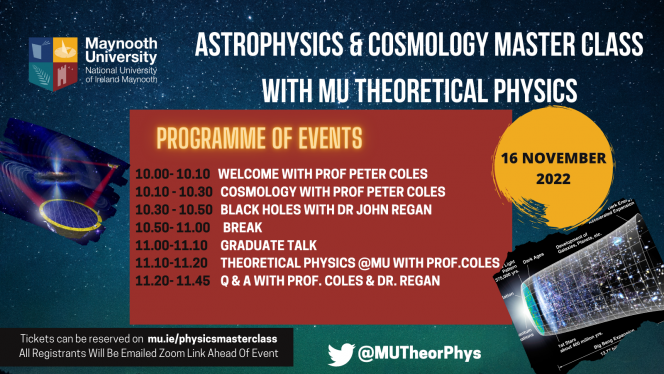
Here is the flyer for the event:

I’ll be talking about cosmology early on, and John Regan will talk about black holes later on. After the coffee break one of our students will talk about why they wanted to study astrophysics. Then I’ll say something about our degree programmes for those students who might be interested in studying astrophysics and/or cosmology as part of a science course. We’ll finish with questions either about the science or the studying!

Here is a more detailed programme:

New Publication at the Open Journal of Astrophysics

Posted in OJAp Papers, Open Access, The Universe and Stuff with tags , , , , on November 10, 2022 by telescoper

I’m delighted to be able to announce the 10000th paper this year, and 1000000th publication overall, at the Open Journal of Astrophysics!

That is counting in binary, of course. In base ten the  new paper at the 16th paper in Volume 5 (2022) as well as the 64th in all.

The latest publication is entitled “Evolution of Cosmic Voids in the Schrödinger-Poisson Formalism” and the authors are Aoibhinn Gallagher and Peter Coles (Who he? Ed) both of the Department of Theoretical Physics at Maynooth University. Obviously as author I played no role in the selection of referees or any other aspect of the editorial process.

Aoibhinn Gallagher – bonus marks for pronouncing both names correctly – is my first Maynooth PhD student and this is her first paper, of many I hope (and expect)! We’re already working on extensions of this approach to other aspects of large-scale structure. You can find some discussion of this general approach here.

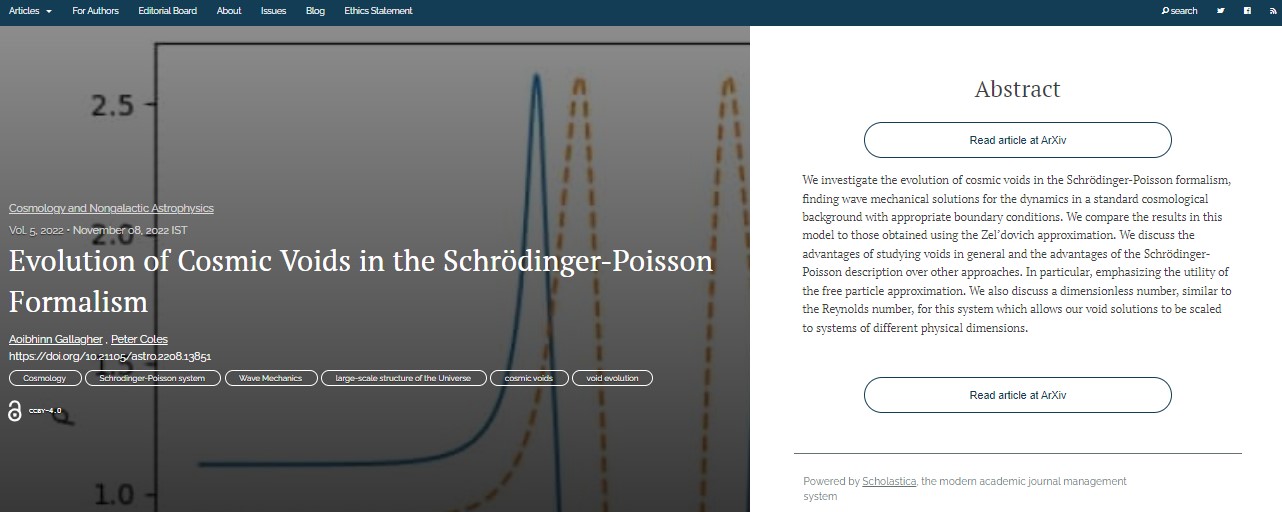
Anyway, here is a screen grab of the overlay which includes the  abstract:


You can click on the image to make it larger should you wish to do so. You can find the officially accepted version of the paper on the arXiv here.

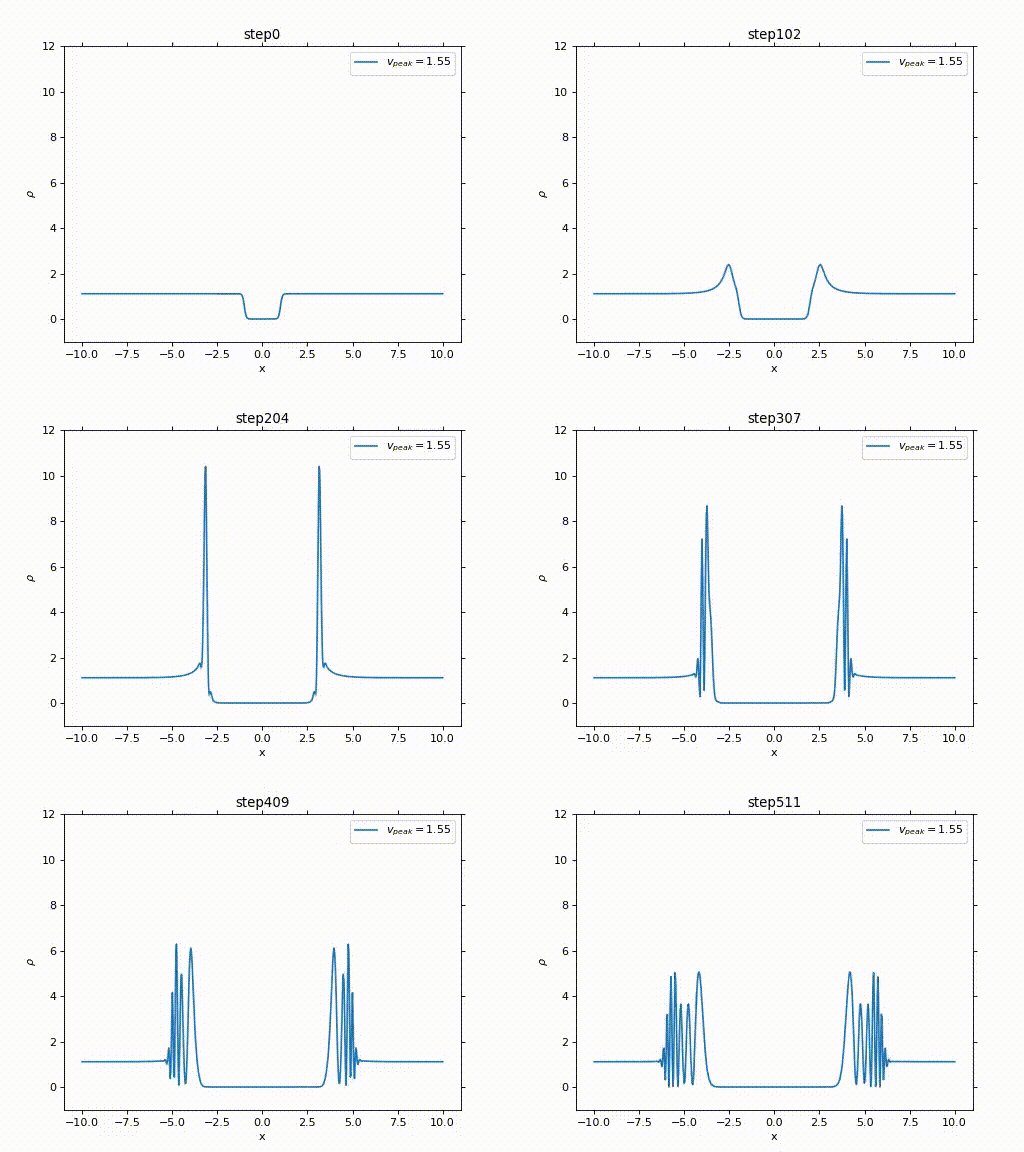
Here is a nice animated version of Figure 5 of the paper showing, for a 1D slice, the radial expansion of a spherically symmetric void (i.e. underdense region) using periodic boundary conditions:

The x-axis is in (scaled) comoving coordinates, i.e. expanding with the cosmological background, so that the global expansion is removed.  You can see that the void expands in these coordinates, so is expanding more quickly than the background, initially pushing matter into a dense ring around the rim of the empty void. That part of the evolution is just the same as for “normal” matter but in this case the wave-mechanical behaviour of the matter prevents it from being confined to a strongly-localized structure as well as affecting the subsequent expansion rate.

Of course in the real Universe, voids are not isolated like this but instead tend to push into each other, but we felt it was worth studying the single void case to understand the dynamics!

DIRAC Research Image Competition – The Winning Entries!

Posted in Art, The Universe and Stuff with tags , , , , , on November 9, 2022 by telescoper

DIRAC is a high-performance computing facility designed to serve the research community supported in the UK by the Science and Technology Facilities Council (STFC). Recently DIRAC ran a competition to select the best images produced using results obtained by this facility, and I was honoured to be asked to be one of the judges. Entries were divided into two Themes: Theme 1 (Particle and Nuclear Physics) and Theme 2 (Astronomy, Cosmology and Solar & Planetary Science) and scores were allocated by the judges based on visual impact and scientific interest. There were 41 entries altogether, all of a very high standard.

So, without further ado, I shall now show you the winning entries!

The winning image in Theme 1 was submitted by Ed Bennett and Biagio Lucini of Swansea University and called Let it (Wilson) flow. The description supplied by the creators reads:

A space-time slice of the topological charge density distribution of a 128 times 643 lattice field configuration (with periodic boundaries) from an ensemble of the SU(2) gauge theory with two flavours of Dirac fermion in the adjoint representation (also known as Minimal Walking Technicolor). Moving along the time direction from left to right, successive time-slices are also iterated using the gradient flow of the Wilson action, which removes the ultraviolet noise that would otherwise prevent computation of the configuration’s topological charge. This noise is clearly visible on the left, with the actual instantons (orange) and anti-instantons (blue) becoming visible at longer flow times to the right.

Here is the winning image for Theme 1:

Theme 1 winner: Let it (Wilson) flow by Ed Bennett and Biagio Lucini.

The winning entry of Theme 2 is entitled Immediate origin of the Moon as a post-impact satellite and was submitted by Jacob Kegerreis of Durham University who supplied the following description:

The Moon is thought to have formed following a giant impact, but the details are still hotly debated. New high-resolution simulations, like the one shown here, reveal that a Moon-like satellite can be immediately placed into a wide orbit around the Earth, in contrast with the traditional idea of later accretion from a debris disk. This opens up new possibilities for the Moon’s initial orbit and interior, which could help to solve mysteries like its tilted orbit, thin crust, and Earth-like isotopes. The 3D smoothed particle hydrodynamics (SPH) simulations were run using the SWIFT code on the DiRAC COSMA8 system with over 100 times higher resolution than the current standard. The SPH data from this mid-impact snapshot are rendered using Houdini and Redshift, with the colour, opacity, and emission controlled by the particle material, density, and internal energy.

Here is the winning image of Theme 2:

Theme 2 Winner: Immediate origin of the Moon as a post-impact satellite by Jacob Kegerreis

Congratulations to the winners!

It was a lot of fun being one of the judges for this competition and I learnt a lot about the science from the clever way in which many of the entries displayed their results. The field was very strong, and many more images were worthy of recognition, but we were only allowed to pick one winner from each Theme. I am however given to understand that it is planned to include the best of the rest alongside the winners in a 2023 calendar which will be distributed to the DIRAC user community.

Playfair Again

Posted in Crosswords with tags , , , , on November 8, 2022 by telescoper

It’s been a while since I’ve blogged about my passion for crosswords, but this Sunday’s Azed puzzle in the Observer was in one of my favourite forms so I thought I’d mention it briefly here.

Azed is the pseudonym used by Jonathan Crowther who has been setting the Observer crossword since 1972; this week’s was number 1967. His  puzzles are usually standard cryptic crosswords which, though quite difficult as such things go, are nevertheless set in a fairly straightforward style. Every now and again, however,  he puts together a different type of puzzle that makes a different set of demands on the solver.  To be honest, I don’t always like these “funny” ones, as they sometimes seem to me to be contrived and inelegant, but this last one was a type I really like as it combines the normal cryptic crossword style with another interest of mine, namely codes and codebreaking.

The interesting aspect of this particular puzzle, which is laid out on a normal crossword grid, is that it involves a type of code called a Playfair cipher. In fact, this particular scheme was invented by the scientist Charles Wheatstone whom most physicists will have heard of through “Wheatstone Bridge“. It was, however, subsequently popularized by Lord Playfair, whose name stuck rather than its real inventor’s. Stigler’s Law of Eponymy strikes again!

The Playfair scheme is built around the choice of a code word, which must have the special property that no letter occurs twice within it.  Other than that, and the fact that the more letters in the codeword the better the code, there aren’t any real constraints on the choice. The particular example used by Azed to illustrate how it works is ORANGESTICK.

The codeword is used to construct a Playfair square which is a 5×5 arrangement of letters involving the codeword first and then afterwards the rest of the alphabet not used in the codeword,  in alphabetical order. Obviously, there are 26 letters altogether and the square only holds 25 characters,  so we need to ditch one: the usual choice is to make I stand for both I and J, doing double duty, which rarely causes ambiguity in the deciphering process. The Playfair square formed from ORANGESTICK is thus

This square is then used as the basis of a literal digraph substitution cipher, as follows. To encode a word it must first be split into pairs of letters e.g. CR IT IC AL. Each pair is then seen as forming the diagonally opposite corners of a rectangle within the word square, the other two corner letters being the encoded form. Thus, in the example shown, CR gives SG (not GS, which RC would give).

Where a pair of letters appears in the same row or column in the word square, its encoded form is produced from the letters immediately to the right of or below each respectively. For the last letters in a row or column the first letters in the same row or column become the encoded forms. Thus IC is encoded as CE. When all the pairs are encoded, the word is joined up again, thus CRITICAL is encoded as SGCICEOP.

Obviously, to decipher encrypted text into plain one simply inverts the process as it is completely reversible.

The advantage of this over simpler methods of encipherment is that a given letter in the plain text is not always rendered as the same letter in the encrypted form: that depends on what other letter is next to it in the digraph. That means it isn’t cracked so easily using letter frequencies, as simple subsitution ciphers are.

Now, what does this have to do with a crossword? Well, in a Playfair puzzle like the one I’m talking about a certain number of answers – in the case of the latest Azed puzzle, eight – have to be encrypted before they will fit in the diagram. These “special” clues, however, are to the unencrypted form of the answer words. The codeword is not given, but must be deduced.

What one has to do, therefore, is to solve the clues for the unencrypted words, then solve all the other clues that intersect with them on the grid. Given a sufficient number of digraphs in both plain text and encrypted form one can infer the codeword and hence encrypt the remaining (unchecked) letters for the special answers.

It probably sounds very convoluted, but in this puzzle it isn’t so bad because the “special” clues are relatively straightforward which generates enough “cribs” in the form of letter-pairs in both plain and encrypted form. There aren’t enough pairs to deduce the codeword exactly – as not every letter in the codeword appears among the digraphs – but it helps knowing that it is an actual word rather than a jumble of letters. That, together with the rules for encryption using the  Playfair square, gives enough information to infer the codeword; the digraph PA which encrypts to AE is particularly useful in this case. In this case the codeword has 14 letters. I won’t tell you what it is because the competition is not yet closed!

What has to be done then is to use the codeword to complete the unchecked letters in the specials in their encrypted form. That bit is relatively straightforward but for the competition one also has to supply a “normal” cryptic clue for 9 down. That’s always the bit I find hardest!



Neutrinos from NGC 1068

Posted in The Universe and Stuff with tags , , , , , on November 7, 2022 by telescoper

I’m a bit late onto this as I was rather busy last week, but I couldn’t resist passing on the news that the IceCube Neutrino Observatory has detected high-energy neutrinos (Tev) from the active galaxy NGC1068 (also known as Messier 77). The result is published in Science whence I stole this figure showing the concentration neutrinos correlated with the position of NGC1068, along with a couple of other sources.

The hotspot associated with NGC 1068 is the most intense feature observed on the whole sky. I won’t write any more because there are two videos about this discovery, the first a quick summary for general viewers:

/

And the second is the full hour-long presentation as given last week.

The Week(s) Ahead

Posted in Biographical, Education, Irish Language with tags , , on November 6, 2022 by telescoper

So here we are then. The study break is over. Tomorrow we resume teaching. Six weeks of the semester gone. Another six to go. I didn’t do half the things I meant to do last week but at least I’m not behind with teaching things. I should be able to cover everything I need to cover in the second half without having to speed up too much. That’s the hope anyway.

Over the weekend I’ve been thinking a bit about my social media strategy, if you can call it that. It seems Elon Musk has realized that Twitter isn’t worth a fraction of what he paid for it, and is worth even less now that advertisers are fleeing, so has decided to recoup at least some of his losses by giving priority to anyone who wants to pay $8 a month so they can broadcast whatever they like withouyt moderation. The famous “blue tick” will no longer even mean a verified user, just someone willing to pay to shout at everyone else. Musk is also in the process of sacking about half his workforce.

I’m not going to pay anything to the Chief Twit and don’t like the way Twitter is going anyway so I’ve decided that I will indeed move to Mastodon, which I quite like, and where you can find me here. I don’t have a huge Twitter following so migrating to Mastodon is no big deal for me. I see many thousands I know on Twitter and many more I don’t are doing likewise.

Posts from this blog are automatically sent to Twitter and I won’t stop doing that, but I won’t be logging on there much except from time to time to block anyone I see who has a blue tick on their profile…

Anyway, in other news, the forthcoming week also sees me resume my feeble attempts to learn the Irish language, so it’s possible I may be boring you all with updates over the next few weeks and months. You have been warned.

Nocturne in Black and Gold

Posted in Art, Biographical with tags , , on November 5, 2022 by telescoper

`Only Connect’ – the epigraph of the novel Howard’s End by E.M. Forster – was a favourite phrase of one of my English teachers at school, and he invoked it whenever he set us one of his creative writing challenges. We were given two apparently disconnected things (usually news items), asked to think of a possible connection between them and write an story joining them together. From time to time when stuck for a topic for a blog post I’ve resorted to playing the same game.

In that vein: (a) I noticed a story last week about a painting by Piet Mondrian which has been hanging upside down for 75 years and (b) today is November 5th, Bonfire Night in the United Kingdom. The connection between these two things that sprang to my mind is this painting, Nocturne in Black and Gold – The Falling Rocket by James McNeill Whistler.

James Abbott McNeill Whistler, Nocturne in Black and Gold – the Falling Rocket, c1875, oil on panel, 60.3 × 46.7 cm (Detroit Institute of Arts)

This, the last in his wonderful series of paintings of night-time scenes, first displayed in 1877, is set in the Cremorne Gardens, which was a park in Chelsea, though in a manner typical of Whistler’s work of this period it is more a response to the location than a representation of it. The sombre colours – mainly green and blue, except for the grey smoke of the falling rocket and the gold flames and flashes of fireworks – are layered in such a way as to blur the situational context of the composition so that it’s no longer a purely figurative work. It’s certainly an enigmatic painting, but I think the arrangement of colours and textures is very well balanced as well as intriguing. It is historically important too, because it represents one of the first stirrings of modernism in art in England.

The compositional ambiguity is deliberate. The ghostly figures in the foreground are almost transparent. Are they even people? When asked this question himself, Whistler replied “They are just what you like”. Whistler is encouraging viewers of his work to construe their own meaning in, and interpretation of, what he put on the canvas. As an astrophysicist, the filamentary pattern of sparks reminds me of chains of distant galaxies. What does it remind you of?

Nocturne in Black and Gold is also famous for having been at the centre of a libel case. The influential art critic John Ruskin hated it and accused Whistler of “flinging a pot of paint in the public’s face”. Whistler sued for damages (though he couldn’t really afford to). He won the case against Ruskin, but the outcome was financially disastrous for him because he was awarded only one farthing in damages.

Anyway, the connection with the Mondrian story is that Whistler’s case was done no favours when this painting was brought into the courtroom during the Whistler v Ruskin case, as it was was presented for viewing upside down