Last week I learned something I never knew before about the origin of the word sine as in the well-known trigonometric function sin(x). I came to this profound knowledge via a circuitous route which I won’t go into now, involving the Italian word for sine which is seno. Another meaning of this word in Italian is “breast”. The same word is used in both senses in Spanish, and there’s a word in French, sein, which also means breast, although the French use the word sinus for sine. The Latin word sinus is used for both sine and breast (among other things); its primary meaning is a bend or a curve.
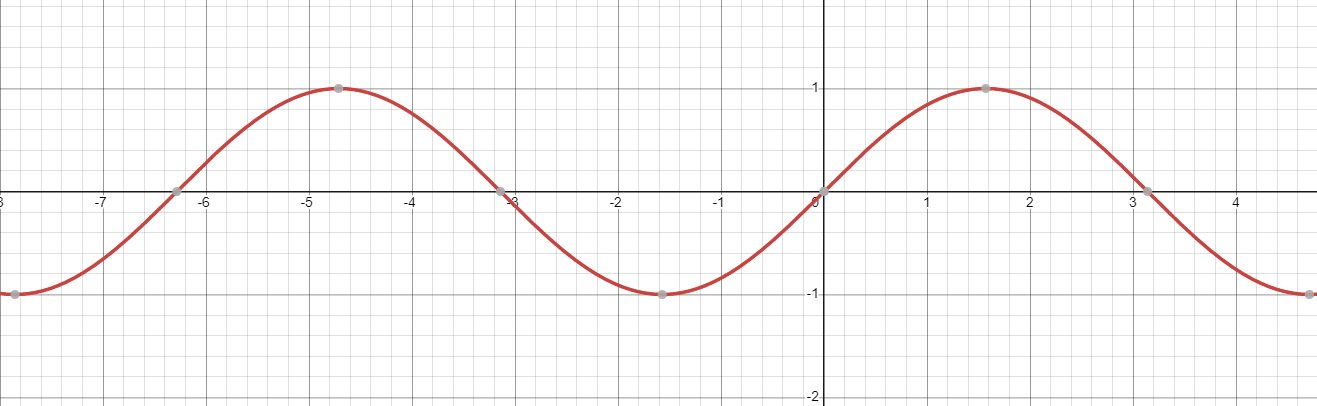
A friend suggested that it has this name because of the shape of the curve (above) but I didn’t think it would be so simple, and indeed it isn’t.
Since trigonometry was developed for largely for the purpose of compiling astronomical tables, I looked in the excellent History of Ancient Mathematical Astronomy by Otto Neugebauer. What follows is a quick summary.
Astronomical computations only became possible after the adoption of the Babylonian sexagesimal notation for numbers, which is why we still use seconds and minutes of arc. Trigonometry is indispensable in most such computations, such as passing from equatorial to ecliptic coordinates. This is needed for such things as calculating the time of sunrise and sunset. Spherical trigonometry was more important than plane trigonometry for this type of calculation, though both were developed alongside each other.
As an aside I’ll remark that I had to do spherical trigonometry at school, but I don’t think it’s taught anymore at that level. Because everything is done by computers nowadays it’s no longer such a big part of astronomy syllabuses even at university level either. I’m also of an age when we had to use the famous four-figure tables for sine and cosine. But I digress.
The first great work in the field of spherical trigonometry was Spherics by Menelaus of Alexandria which was written at the end of the First Century AD. If Menelaus compiled any trigonometric tables these have not survived. The earliest surviving work where trigonometry is fully developed is Ptolemy‘s Almagest which was written in the 2nd Century contains the first known trigonometric tables.
Almagest, however, does not use our modern trigonometric functions. Indeed, the only trigonometric function used and tabulated there was the chord, define in terms of modern sin(x) by
chd(x)= 2 sin(x/2).
If you’re familiar with the double-angle formulae you will see that chd2(x)=2[1-cos(x)].
Sine was used by Persian astronomer and mathematician Abu al Wafa Buzjani in the 10th Century from which source it began t spread into Europe. The term had however been used elsewhere much earlier and many historians believe it was initially developed in India at least as early as the 6th century. Anyway, sine proved more convenient than chord, but its usage spread only very slowly in Europe. Nicolaus Copernicus used sine in the discussion of trigonometry in his De revolutionibus orbium coelestium but called it “half of the chord of the double angle”.
But what does all this have to do with breasts?
Well, the best explanation I’ve seen is that Indian mathematicians used the Sanskrit word jīva which means bow-string (as indeed does the Greek chordē). When Indian astronomical works were translated into Arabic, long before they reached Europe, the Indian term was translated as jīb. This word is written and pronounced in the same way as the word jayb which means the “hanging fold of a loose garment” or “breast pocket”, and this subsequently mistranslated into Latin as sinus “breast”.
I hope this clarifies the situation.
P.S. I’m told that if you Google seno iperbolico with your language set to Italian, you get some very interesting results…













 In the Dark