Archive for May, 2023

Open Access: the Future is Diamond

Posted in Open Access with tags , , , on May 24, 2023 by telescoper

As it was foretold the Council of Europe has now released a document (PDF) that calls for “transparent, equitable, and open access to scholarly publications”.  In its conclusions, the Council calls on the Commission and the member states to support policies towards a scholarly publishing model that is not-for-profit, open access and multi-format, with no costs for authors or readers. In other words, it calls for Diamond Open Access. The covering press release includes:

If we really believe in open science, we need to make sure that researchers can make their findings available and re-usable and that high-quality scientific articles are openly accessible to anyone that needs to read them. This should be particularly the case for research that benefits from public funding: what has been paid by all should be accessible to all.

Mats Persson, Swedish Minister for Education, Ministry of Education and Research

This is clearly how Open Access should be, though I am still worried that the sizeable publishing lobby will still try to persuade research agencies and institutions to pay the existing fees on behalf of authors, which does not solve the problem but merely hides it.

I know I’m not alone in thinking that the current publishing ecosystem is doomed and will die a natural death soon enough. The replacement should be a worldwide network of institutional and/or subject-based repositories that share research literature freely for the common good. Universities and research centres should simply bypass the grotesque parasite that is the publishing industry. Indeed, I would be in favour of hastening the demise of the Academic Journal Racket by having institutions make it a disciplinary offence for any researcher to pay an APC to any journal.

We are lucky in physics and astronomy because arXiv has already done the hard work for us. With the existence of arXiv, old-style journals are no longer necessary. It is great that arXiv is being joined by similar ventures in other fields, such as BiorXiv and EarthArxiv. A list of existing repositories can be found here. I’m sure many more will follow. The future is Diamond.

What is needed is a global effort to link these repositories to each other and to peer review mechanisms. One way is through overlays as demonstrated by the Open Journal of Astrophysics, there being no reason why the idea can’t be extended beyond arXiv. Other routes are possible, of course, and I would love to see different models developed. I hope the European Council call will result in more support for Diamond Open Access. But whether this happens or not, I think the next few years are going to be very exciting.

Do “high-quality journals” always publish “high-quality papers”?

Posted in Uncategorized with tags , , , , on May 23, 2023 by telescoper

After a busy morning correcting examination scripts, I have now reached the lunch interval and thought I’d use the opportunity to share a paper I found via Stephen Curry on Twitter with the title In which fields do higher impact journals publish higher quality articles?. It’s quite telling that anyone should ask the question. It’s also telling that the paper, in a Springer journal called Scientometrics is behind a paywall. I can at least share the abstract:

The Journal Impact Factor and other indicators that assess the average citation rate of articles in a journal are consulted by many academics and research evaluators, despite initiatives against overreliance on them. Undermining both practices, there is limited evidence about the extent to which journal impact indicators in any field relate to human judgements about the quality of the articles published in the field’s journals. In response, we compared average citation rates of journals against expert judgements of their articles in all fields of science. We used preliminary quality scores for 96,031 articles published 2014–18 from the UK Research Excellence Framework 2021. Unexpectedly, there was a positive correlation between expert judgements of article quality and average journal citation impact in all fields of science, although very weak in many fields and never strong. The strength of the correlation varied from 0.11 to 0.43 for the 27 broad fields of Scopus. The highest correlation for the 94 Scopus narrow fields with at least 750 articles was only 0.54, for Infectious Diseases, and there was only one negative correlation, for the mixed category Computer Science (all), probably due to the mixing. The average citation impact of a Scopus-indexed journal is therefore never completely irrelevant to the quality of an article but is also never a strong indicator of article quality. Since journal citation impact can at best moderately suggest article quality it should never be relied on for this, supporting the San Francisco Declaration on Research Assessment.

There is some follow-up discussion on this paper and its conclusions here.

The big problem of course is how you define “high-quality papers” and “high-quality journals”. As in the above discussion this usually resolves itself into something to do with citation impact, which is problematic to start with but if that’s the route you want to go down then there is sufficient readily available article-level information for each paper nowadays that you don’t need any journal metrics at all. The academic journal industry won’t agree of course, as it’s in their interest to perpetuate the falsehood that such rankings matter. The fact that correlation between article “quality” measures and journal “quality” measures is weak does not surprise me. I think there are many weak papers that have passed peer review and appeared in high-profile journals. This is another reason for disregarding the journal entirely. Don’t judge the quality of an item by the wrapping, but by what’s inside it!

There is quite a lot of discussion in my own field of astrophysics about what the “leading journals” are. Different ranking methods produce different lists, not surprisingly given the arbitrariness of the methods used. According to this site, The Open Journal of Astrophysics ranks 4th out of 48 journals., but it doesn’t appear on some other lists because the academic publication industry, which acts as gate-keeper via Clarivate, does not seem not to like its unconventional approach. According to Exaly, Monthly Notices of the Royal Astronomical Society (MNRAS) is ranked in 13th place, while according to this list, it is 14th. No disrespect to MNRAS, but I don’t see any objective justification for calling it “the leading journal in the field”.

The top ranked journals in astronomy and astrophysics are generally review journals, which have always attract lots of citations through references like “see Bloggs 2015 and references therein”. Many of these review articles are really excellent and contribute a great deal to their discipline, but it’s not obvious they can be compared with actual research papers. At OJAp we decided to allow review articles of sufficiently high quality because we see the journal primarily as a service to the community rather than a service to the bean-counters who make the rankings.

Now, back to the exams…

Days of Invigilation

Posted in Biographical, Education, Maynooth with tags , on May 22, 2023 by telescoper

I’ve now collected the scripts from my second examination – held on Saturday – and will spend the next day or two marking them and combining the exam grades with grades from class tests and projects to produce a final score.

When I went to collect the scripts for my first examination on Thursday at the end of the examination, I had to wait a little bit for them to be collated and sealed in their official packet. While that was going on I chatted to a member of staff who was putting out papers for the next examination. She was giving out about how students often move the desks when they leave, requiring them to be put back in position before the next examination.

The invigilator also expressed irritation about the system of ID cards. Each desk in the examination room has a card with a unique number on it placed in the right front corner (as seen by the student). During the examination, students are supposed to place their ID card on the desk so an invigilator can check the identity of the candidate. The student ID cards at Maynooth are about the same size as a credit card, as are the cards with the numbers. Apparently many students place their ID card directly over the number card, obscuring the number and requiring the invigilator to lift it up in order to do the crosscheck. As things go, it seems a mild transgression, but I suppose it makes an already boring job even longer for the invigilators.

Years ago, academic staff had to invigilate their own examinations. I had to do this in my first teaching job at Queen Mary and, later, at Nottingham but more recently the job has generally been done by support staff rather than academics. I moved from Nottingham to Cardiff in 2007 and don’t think I ever had to invigilate examinations there., so I haven’t done it for 16 years or so. Nowadays we are just expected to be “on call” to deal with any queries that arise in the Exam Hall by phone.

I’m not sorry that I no longer have to perform this task, as it was always one of my least favourite jobs, and not only because I don’t enjoy seeing people under stress. Initially I thought supervising an examination might allow me time to do something useful, but there always seemed to be some interruption, such as students wanting an extra answer book, or asking about some issue with the examination paper, or wanting to leave to go to the toilet, etc.

The most dramatic interruption I can remember was when a student who suffered from epilepsy had a seizure in the examination hall. Fortunately we invigilators had been briefed as to what to do in such an eventuality, namely to move the furniture so the student didn’t hurt themselves but otherwise not to intervene until they went to sleep – which usually happens after a minute or two. We were told that such an episode was unlikely as the student was taking medicine to prevent them occurring. It was quite when it actually happened, but happily the student recovered quickly but was perfectly OK afterwards. Apparently he had been so busy preparing for the examination that day he had forgotten to take his medication in the morning.

Having given up on the idea of doing some other work during an examination, I used to take a few crosswords to do. These are good for passing the time because you can solve a few clues at a time. Other things I used to do included walking around counting the number of right-handed and left-handed students, for example, though I never did any detailed statistical analysis of the results.

The primary purpose of invigilation is to prevent cheating or other misbehaviour, and I only ever saw a few examples of that – most of them involving calculators with, e.g., graph-plotting facilities which are not allowed.

Anyway, I’m glad I no longer have to invigilate examinations, and that makes me all the more grateful for the people who do. Here in Maynooth there are three examinations per day during the Examination Period, with a brief period between to put out the next set of papers, which means a long day for those who do this job. Hats off to the dedicated staff of the Exams Office at Maynooth who carry out this thankless task three times a year!

Defamation in Germany

Posted in Uncategorized on May 22, 2023 by telescoper

Tangentially related to yesterday’s post, I’m reminded that, some time ago, a friend of mine, based in Germany, who happens to be a lawyer (Rechtsanwältin), informed me that defamation is a criminal offence under German law. This is different from the UK and Ireland, where defamation is a matter for the civil courts. Here is a translation of Section 187 of the German criminal code (Strafgesetzbuch):

Sections 185 and 186 are related to this. The law applies to acts committed in Germany, such as sending messages by email or via social media using a computer based there.

I mention this law for two reasons. One is that to point out to readers that they have legal recourse if a person based in Germany is intentionally defaming you. The other is to suggest that, if you are based in Germany and are in the habit of committing repeated acts of intentional defamation, it may be in your best interests to desist.

I hope this clarifies the situation.

The Hate is still Out There

Posted in Biographical, LGBTQ+, Mental Health with tags , , on May 21, 2023 by telescoper

A few days ago I mentioned on this blog the case of a gay teenager in Navan being beaten up by boys from the same school; there was a news report here. Five youths were subsequently arrested but have now been released without charge. I felt a strong sense of dismay when I heard the news of their release, as the decision to let them go seemed to declare open season on homophobic violence. It may however because the assailants have to be treated as minors.

Press coverage related to this story has generally condemned the sharing on social media of a video showing the violent assault. There are quite a few people, however, including me, who think that the Gardaí would not have taken any action at all had they not been shamed into doing so by the publicity generated by the video.

Regular readers of this blog will probably understand why this case resonates with me: a similar thing happened to me way back in the 1980s. There are differences, of course. For one thing, I was rather older – in my mid-twenties rather than mid-teens. For another, the incident wasn’t reported to the police. There wasn’t any point in those days. The Brighton police at that time were notorious for dismissing complaints of gay-bashing despite the fact it was an endemic problem. People I knew who had reported such incidents usually found themselves being investigated rather than their assailants. In those days the law did not recognize homophobic offences as hate crimes. Far from it, in fact. Attacking a gay person was, if anything, considered to be a mitigating circumstance. This attitude was fuelled by a number of high-profile cases (including a number of murders) where gay-bashers had been acquitted or charged with lesser offences after claiming their victim had provoked them.

Another difference is that I didn’t go to hospital. I had a black eye, a fat lip and a lot of bruises, and had been unconscious for a time, but there didn’t seem to be any serious physical damage. The psychological effects were far from negligible, though, and I have experienced intermittent mental health problems ever since, sometimes needing to be hospitalized for psychiatric treatment. You can read about this here; a short summary is that I should have got help with this much earlier. The important thing now is that the boy who was targeted in Navan gets proper treatment and counselling. I wish him a speedy recovery.

Here’s something I wrote in 2010 after in the blog post describing my own experience of homophobic violence:

Now fast-forward about 20 years. Attitudes have definitely changed, and so has the law. Certain types of criminal offence are now officially recognized as hate crimes: the list treats sexual orientation as equivalent to race, gender, religious belief and disability in such matters. The Police are now obliged to treat these with due seriousness, and penalties for those found guilty of crimes exacerbated by homophobia are consequently more severe.

Recently, there are increasing signs of a backlash against LGBT+ people, most obviously in America but also here in Ireland. Much of this is fueled by toxic rhetoric of the Far Right who seem to want to target trans people. Social media, especially Twitter are awash with transphobic abuse and threats of violence for the reason that trans people are perceived to be easy targets. It’s up to the rest of us to make sure this strategy does not work.

I worry that the rights that the LGBT+ community has taken so long to win, could so easily be taken away. If we are complacent and pretend that everything is fixed because we have equal marriage then we will soon see those rights being eroded. LGBT+ people have to remain active and visible, show solidarity with one another, and keep pushing against all forms of discrimination, harassment and bullying wherever it happens. And the first step in doing that is to raise awareness that there is a serious problem.

I was reflecting on my own encounter with violence the other day. I try not to think about that very much, but I found myself wondering where the four guys who attacked me are now. They were about the same age as me, so will be around 60 now. Do you think the hate they expressed with their fists back in the 1980s has gone away? More importantly, do you think it reasonable that I should believe that? I don’t. The hate is still out there and will find its expression at the slightest provocation.

The reference to hate crimes in the above quote relates to the UK, of course. I was a little surprised to see that until very recently there was no legal definition of a hate crime in Ireland. Legislation has only just been introduced on this subject, with cross-party support. Among other provisions:

The new legislation will criminalise any intentional or reckless communication or behaviour that is likely to incite violence or hatred against a person or persons because they are associated with a protected characteristic. The penalty for this offence will be up to five years’ imprisonment.

The protected characteristics in the new legislation are: race; colour; nationality; religion; national or ethnic origin; descent; gender; sex characteristics; sexual orientation; and disability.

It remains to be seen how the new law works in practice.

Britten, Bacewicz & Prokofiev at the NCH

Posted in Music with tags , , , , , , , , , on May 20, 2023 by telescoper

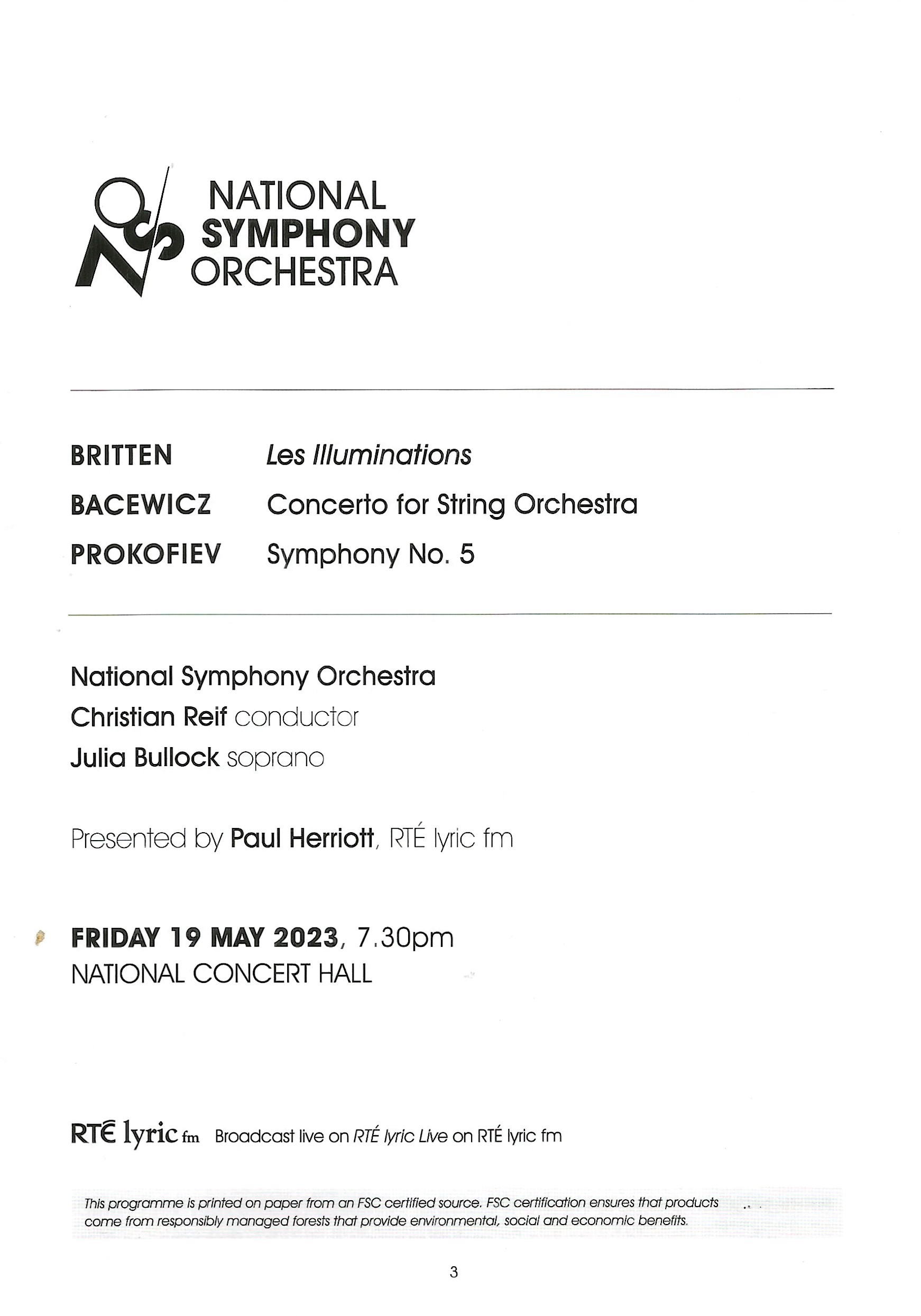
Last night I went to the National Concert Hall in Dublin for the penultimate performance of the season by the National Symphony Orchestra under the direction of Christian Reif, for a programme of music by Benjamin Britten, Grażyna Bacewicz and Sergei Prokofiev all written in the 1940s. The hall was not even half full for this concert, which is a shame because it was both interesting and enjoyable, but at least it was broadcast live so it could be heard on the radio.

Before the concert

I’d never heard Britten’s Les Illuminations in a live performance before last night, although I had heard it on BBC Radio 3 some time ago. It’s a cycle of nine songs based on poems by Arthur Rimbaud, including an opening ‘fanfare’ and interlude based on a single phrase of Rimbaud J’ai seul la clef de sette parade sauvage. The themes of the text are the poet’s reactions to desire, exile, transgression and decadence. Britten apparently felt more comfortable setting these themes, and conveying the sense of homoerotic desire that pervades the poems, in French because he felt that he could use them to say things he couldn’t say in English. Even so, he did omit some of the naughtier bits of Rimbaud’s texts.

Britten started writing Les Illuminations in 1939 but finished it after he had moved to America and it was first performed in 1940. This was an early “hit” for Britten and I found Julia Bullock‘s lovely soprano voice give it a very different form of sensuality than it has when performed by a tenor; it was performed quite often by Peter Pears, actually. Incidentally, Julia Bullock is married to conductor Christian Reif.

Next up was a work that was completely new to me, the Concerto for String Orchestra by Grażyna Bacewicz which was written in 1948. In three movements, this is rather like an old-fashioned Concerto Grosso in construction, but with a distinctively modern edge. The outer movements are forceful and energetic, contrasting with a beautiful but rather desolate Andante in the middle. I’m glad to have been introduced to this work and indeed to this composer. I must find out more about her.

The first two pieces featured only the strings of the National Symphony Orchestra but after the win break the stage was joined by the brass, woodwinds, and a full panoply of percussion (including a piano) for Symphony No. 5 in B♭ Major, which he wrote in the summer of 1944 and was first performed in January 1945 with Prokofiev himself conducting. This work is generally perceived to be an expression of the anticipation of victory over the Nazis after the opening up of the Western front by the Normandy landings. According to the programme, however, the composer had been sketching the symphony for several years beforehand, so this can’t all be true. I think you can read it in two ways, one as the devastating human cost of the war with Russia and the other as a covert response to Soviet oppression. Prokofiev, like Shostakovich, was good at ambiguity. I guess he had to be.

In four movements, this Symphony opens with an expansive Andante movement, followed by and Allegro which is rather like a Scherzo, a darkly beautiful Adagio, and a very varied final Allegro. I found myself at times thinking of Prokofiev’s music for the film Alexander Nevsky and the menacing atmosphere of the ballet Romeo and Juliet.

The winds and percussion had obviously been champing at the bit during the first half, and they unleashed some terrific playing during this performance, especially during the climactic passages that evoke thunderstorms or battles. Whatever they are intended to represent, if anything, I enjoyed the loud bits very much.

Congratulations to the National Symphony Orchestra and soloist Julia Bullock on an excellent evening of music. I do enjoy being introduced to unfamiliar works and do love the site and sound of a big orchestra in full flood. I look forward to next week’s concert, the Season Finale.

The Physics World Mystery

Posted in The Universe and Stuff, Maynooth with tags , on May 19, 2023 by telescoper

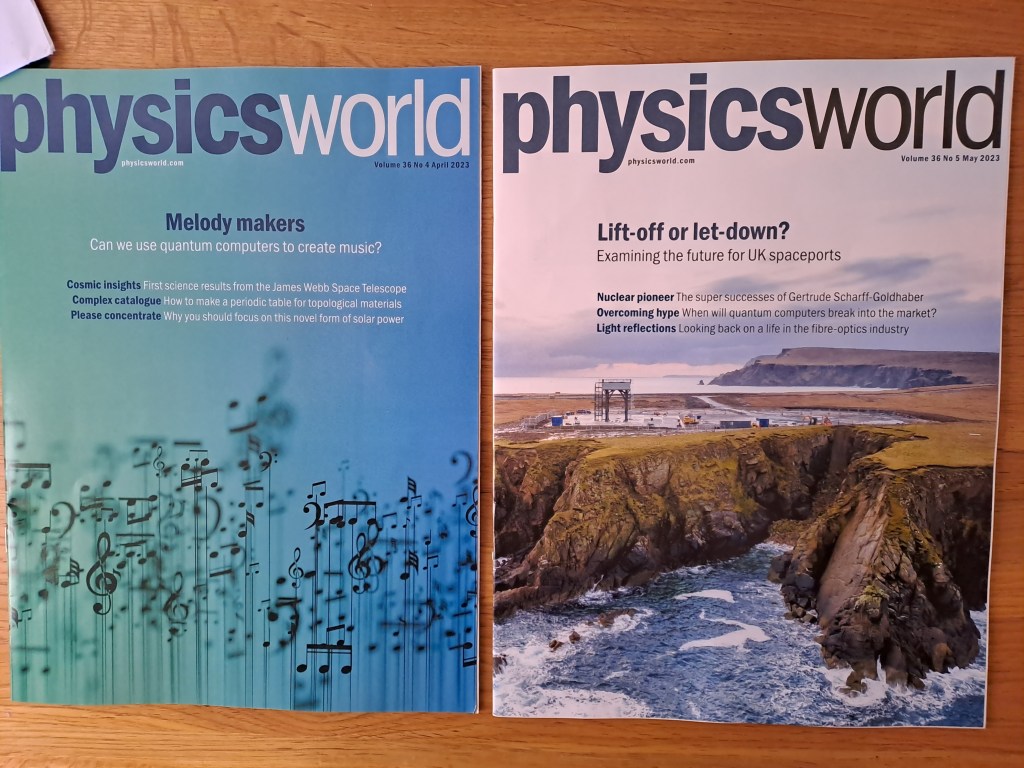
Now here’s a funny thing. The April and May 2023 editions of Physics World, shown above, published a month apart in the UK, arrived in the same day earlier this week in the post at my house in Maynooth. Both were correctly addressed. One took just over two weeks to cross the Irish Sea; the other took a whole month longer.

Can anyone provide a physical explanation for this phenomenon?

Between Papers

Posted in Biographical, Education, Maynooth with tags , , , on May 19, 2023 by telescoper
Maynooth University Library Cat, photographed yesterday by Joost Slingerland.

Yesterday morning final-year students theoretical physics students sat my first examination of the session, on Advanced Electromagnetism, and tomorrow another group will take my second, on Computational Physics 1. I collected the first scripts from the Exam Hall at the end of the examination at 11.30 and have actually finished correcting them. I don’t think I’ll come in tomorrow morning though. Correcting the second batch can wait until Monday. That doesn’t mean I get a break though because I still have to complete grading the Computational Physics Projects. It does mean, however, that I’ll probably be finished with examination marking for this session by the end of next week, in good time for the Exam Boards in June.

That won’t mean that I’m finished with examination matters for the year; I’ll have four repeat examinations to grade in August. When those are done, however, I won’t have to do any further marking of examinations or anything else to do with teaching for a whole year. My sabbatical starts on 1st September.

Meanwhile, Maynooth University Library Cat, has been patrolling the area in front of the Library, which is quite busy these days with students doing last-minute revision in the study spaces there. By the end of next week the examinations will be over, most students will have departed for the summer, many staff will be at home marking scripts, and campus will be much quieter.

Newsflash: another Neutron Star – Black Hole merger?

Posted in The Universe and Stuff with tags , , , , , on May 18, 2023 by telescoper
Fanciful “artist’s impression” of a Neutron Star – Black Hole merger (from last time).

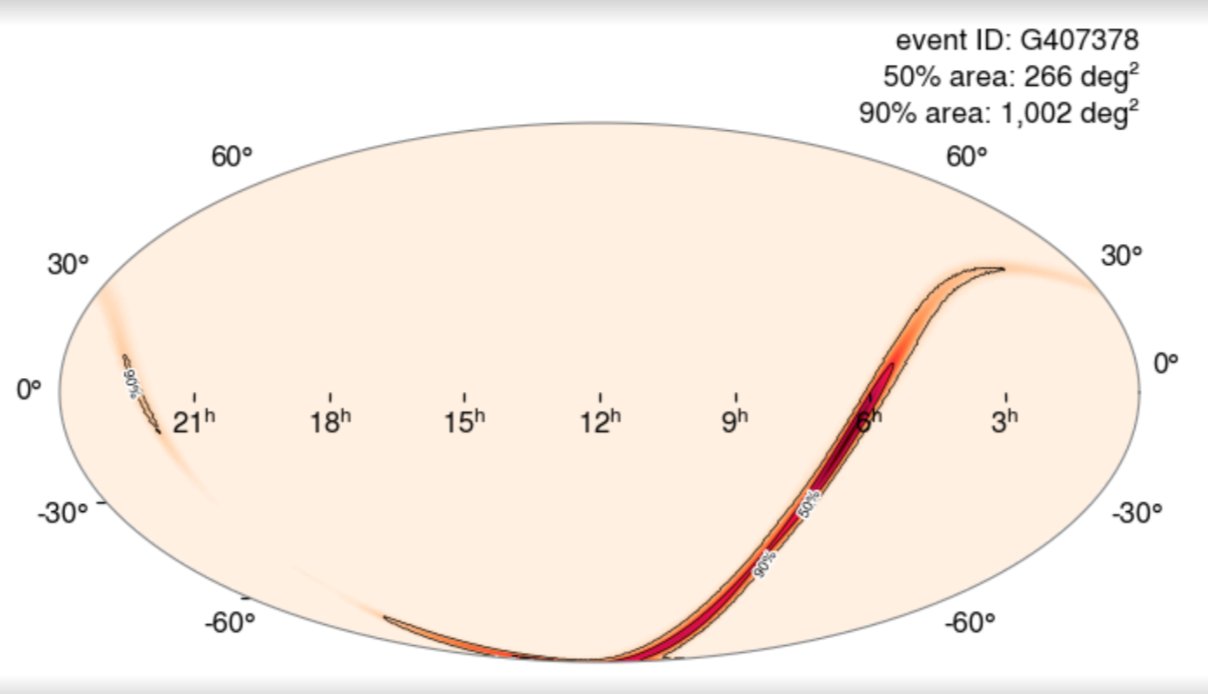
It seems that the engineering data ahead of the imminent observing run from the newly refurbished LIGO gravitational wave observatory has just triggered an alert for astronomers to look for an electromagnetic counterpart. The code number for this candidate event is S230518h. If confirmed this could very well be another Neutron-Star – Black Hole merger event. The search area is rather large, with the 90% probability region being about 1002 square degrees on the sky:

For more details, see here.

I’m reminded about the excitement surrounding the first Neutron Star merger way back in 2017. In fact, rumours started to spread via this blog as people outside the LIGO/transient source community used a comments thread here to share information of where telescopes were looking. Those were the days. Was that really 6 years ago?

New Publication at the Open Journal of Astrophysics

Posted in OJAp Papers, Open Access, The Universe and Stuff with tags , , , on May 18, 2023 by telescoper

It’s time to announce yet another new paper at the Open Journal of Astrophysics. This one was published yesterday (17th May).

The latest paper is the 17th paper so far in Volume 6 (2023) and the 82nd in all. With this one we have now published as many papers so far in 2023 as we did in all of last year. With significantly less than half the year gone, and a large number of papers in the pipeline, I think it’s quite likely we will exceed a total of 100 papers by the end of 2023. How’s that for cosmic acceleration?

The primary classification for this paper is Instrumentation and Methods for Astrophysics and its title is “Deep-field Metacalibration”. This article describes a technique that reduces the pixel noise in estimators of weak gravitational lensing shear signals by using a deeper imaging survey for calibration.

The authors are Zhuoqi (“Jackie”) Zhang (University of Chicago, IL, USA), Erin Sheldon (Brookhaven National Laboratory, NY, USA), and Matthew Becker (Argonne National Laborary, IL, USA).

Here is a screen grab of the overlay which includes the  abstract:


You can click on the image of the overlay to make it larger should you wish to do so. You can find the officially accepted version of the paper, along with all other astrophysics and cosmology research papers worth reading, on the arXiv here.