Archive for August, 2023

R.I.P. Mark Birkinshaw (1954-2023)

Posted in Biographical, R.I.P., The Universe and Stuff with tags , , , , on August 17, 2023 by telescoper

I just heard this morning of the passing of Mark Birkinshaw (left) who was, since 1992, William P. Coldrick Professor of Cosmology and Astrophysics at the University of Bristol. Before that he held positions in Cambridge and Harvard.

I’m told that he died in hospital of a “short but serious illness”.

Among other important contributions to cosmology and astrophysics, in 1984, along with Steve Gull of Cambridge and Harry Hardebeck of the Owens Valley Observatory, was the first to measure experimentally the Sunyaev-Zel’dovich effect in a galaxy cluster; the reference is here.

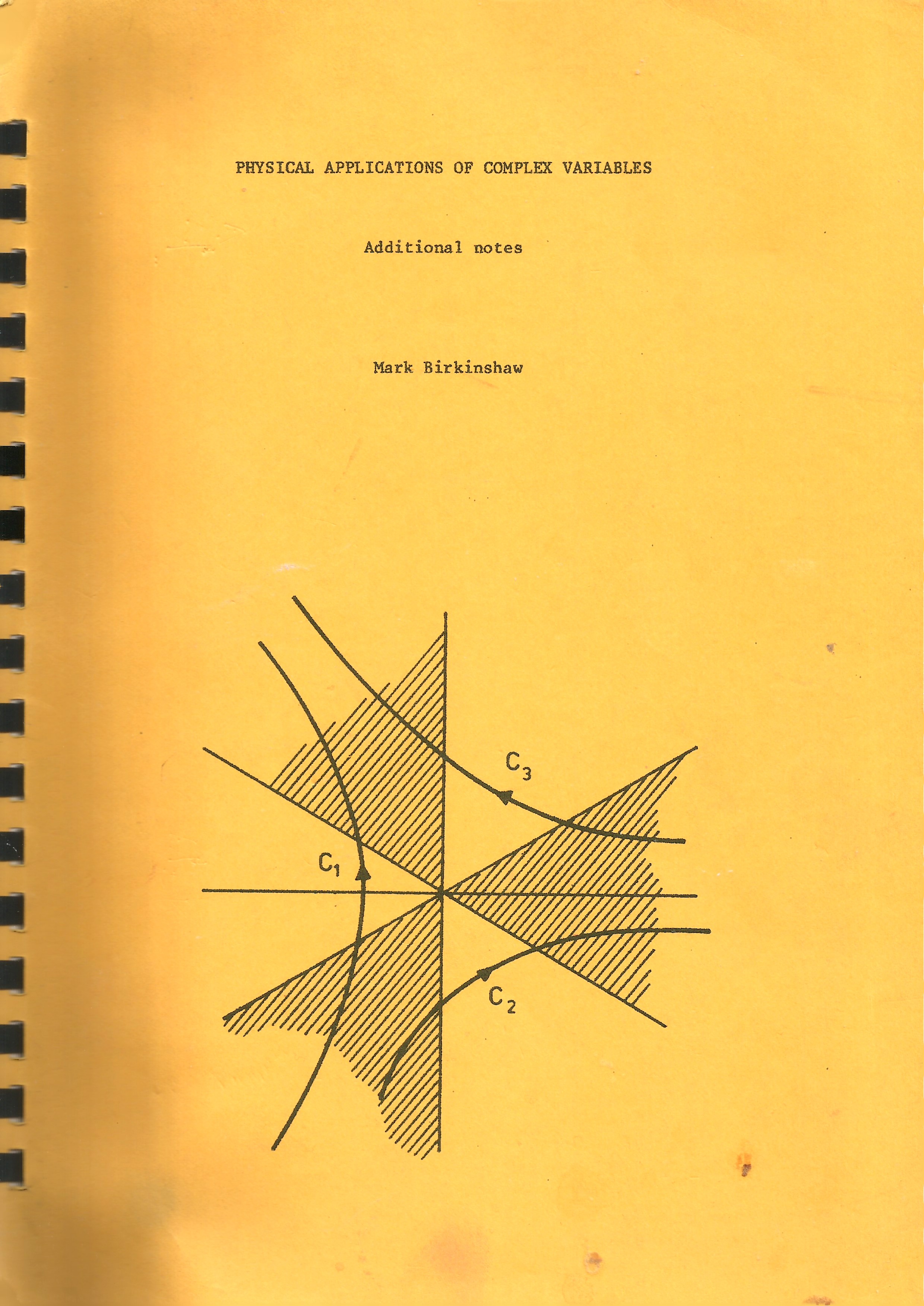
It was in Cambridge as an undergraduate that I first met Mark Birkinshaw. He taught the long vacation course on Physical Applications of Complex Variables that I took in the summer of 1984. It was a tough course but he was an excellent teacher. All these years later I still have my handwritten notes for that course as well as the handouts. I still use them too.
After that I saw him regularly at conferences and seminars and on various committees for PPARC and then STFC. He was extremely diligent in such “community service” roles and was an invaluable contributor owing to his wide range of knowledge beyond his own speciality.

Having been a mainstay of astrophysics research at Bristol University for over thirty years, Mark will be greatly missed. I send condolences to his friends and colleagues at Bristol and elsewhere in the world, and especially to Diana. You can send thoughts, tributes and condolences and/or make a charitable donation in Mark’s memory here, where there are also details of the funeral arrangements.

Winding Up

Posted in Biographical, Education, Maynooth with tags , , , on August 16, 2023 by telescoper

This morning, we held the last meeting this academic year of the Departmental Examination Board to look over the results of the recent repeat examinations ahead of the final upload this afternoon. That having been satisfactorily completed, I have now finished my teaching-related duties for this academic year. I start a year’s sabbatical on 1st September, so I won’t be attending more Exam Boards for a while!

Another loose end to be dealt with was the Departmental Twitter account, which I have been running. Twitter is really terrible these days and I have decided to deactivate my own personal account entirely on 31st August. The departmental account probably should stay open, so this afternoon I transferred its controls to our Departmental Adminstrator. Just before doing so, I realised that the password was a bit rude, so I quickly changed it to something more presentable before handing it over to avoid embarrassment.

If you want to follow that account, by the way, you can!

All I have left to do now is remove a few personal things from my office for whoever uses it next academic year. I’ve got plenty of time to do that, although I will be away for part of next week (way down South, in Cork).

Tonight, however, although it’s a school night, I think I’ll celebrate by having a little drink and watching the Super Cup Final between Man City and Sevilla the telly box. Cheers!

Euclid Update

Posted in Euclid with tags , , , , , on August 15, 2023 by telescoper
ESA/Euclid/Euclid Consortium/NASA. Background galaxies: NASA, ESA, and S. Beckwith (STScI) and the HUDF Team.

Since I’ve been working today on stuff related to ESA’s Euclid mission, I thought I would post a brief update on the mission status before I go home. The official channel to which I refer you for full updates is here.

A message was sent out on Saturday to member of the Euclid Consortium indicating that the commissioning phase of the Euclid satellite was essentially completed, although with some issues still to be fixed. In particular, as has previously been reported, there is an issue with stray light in the VIS instrument, which will have to be coped with. To prevent stray sunlight getting onto VIS detectors, Euclid will be configured to operate at a range of specific angles with respect to the Sun. This means that the survey strategy will have to be adapted in order to be as optimal as possible with this new constraint.

The next phase after the commissioning phase is called performance verification, for which control switches over to the science ground segment. The operations team will then operate the spacecraft in the same way as required for the full survey in order to assess the performance of the instruments and obtain calibration data ahead of the start of the full survey.

Blues for the Fisherman

Posted in Biographical, Jazz with tags , on August 15, 2023 by telescoper

I had a pleasant surprise when I switched on the radio last night to listen to The Blue of the Night in that the presenter Bernard Clarke not only played a lot of music by the late great Art Pepper but also mentioned my name on air for having pointed him at the particular session from which he chose the tracks. I think he mistakes me for some sort of expert!

Anyway, listening last night brought back a lot of memories of hearing Art Pepper play in the flesh and many nights I spent in Ronnie Scott’s club during the 1990s when I lived in London. I thought I’d share here one of the tracks played last night.

The performance in question was recorded live at Ronnie Scott’s Club in London in June 1980 and first released on the small British record label Mole Jazz, an offshoot of the famous (sadly now defunct) record shop of the same name that used to be on Gray’s Inn Road. It’s a brilliant, brilliant album, with the intense atmosphere of a live performance adding to the superb playing of the musicians. It’s also extremely well recorded – so much so that you feel you are on stage with the musicians!

The band is listed as the “Milcho Leviev Quartet featuring Art Pepper”, although that was probably for contractual reasons, as this was the same band that toured extensively as “The Art Pepper Quartet”: Art Pepper on alto saxophone, Milcho Leviev on piano, Tony Dumas on bass and Carl Burnett on drums. I was also lucky enough to see this band play live at the Newcastle Jazz festival in 1981, not long after this recording, and they were great then too although that was in a concert hall so had a much less intense atmosphere. Art Pepper sadly passed away in 1982 and Milcho Leviev in 2019.

As far as I’m aware this record wasn’t released on CD until relatively recently, but now a whole lot of extra tracks recorded during Art Pepper’s residency in Frith Street are also available. There’s so much to enjoy in these recordings, including the superb drumming of Carl Burnett and virtuosic piano of Milcho Leviev, but the star of the performance for me is Art Pepper. His playing is at times lyrical and at times agonized, but always compelling and this band was especially good at spontaneous transitions of mood and dynamic. Anyway, here is the title track of the original album, Blues for the Fisherman.

Anomalous Media Coverage

Posted in The Universe and Stuff with tags , , , on August 14, 2023 by telescoper

Via a characteristically garbled piece in the Grauniad, bizarrely entitled Scientists may be on brink of discovering fifth force of nature, I found out that there has been an announcement of a new measurement of the anomalous magnetic dipole moment – known to its friends as (g-2) – of the muon. This new measurement is consistent with one made a couple of years ago, but with a smaller range of uncertainty. It’s an impressive result from an experimental point of view.

There is a news item explaining the new result here, which says

Precision test of particle’s magnetism confirms earlier shocking findings — but theory might not need a rethink after all.

That’s pretty much the opposite of what the Guardian piece says.

There’s also a video produced by the Fermilab Muon g-2 team that explains what has changed from 2021 to now:

My own view is that these recent experimental measurements of g-2, which seem to be a bit higher than theorists expected, can be straightforwardly reconciled with the predictions of the standard model of particle physics by simply adopting a slightly lower value of 2 in the theoretical calculations.

P.S. The classical value is of course  g-2 ≈ 7.81 m s-2.

Not the First Room-Temperature Superconductor?

Posted in The Universe and Stuff with tags , , , , , on August 13, 2023 by telescoper

A few weeks ago I reported on a paper on arXiv entitled The First Room-Temperature Ambient-Pressure Superconductor. It presented a material now known as LK-99. The quest for high temperature superconductivity has been very active for many years so this claim generated a lot of interest and LK-99 now has a very active Wikipedia page. Not entirely surprisingly, the claim of superconductivity has been met with some resistance. Geddit?

To summarise, a number of groups seem to have managed to synthesize LK-99, but none have managed to recreate the claimed superconductivity.

This paper on arXiv by scientists at the CSIR National Physical Laboratory in India states:

The report of synthesis of modified Lead apatite (LK-99) with evidence of superconductivity at more than boiling water temperature has steered the whole scientific community. There have been several failures to reproduce superconductivity in LK-99 including partial successes. Here, we have continued our efforts to synthesize phase pure LK-99 with improved precursors. The process has been followed as suggested by Sukbae Lee et. al., [1,2]. The phase purity of each precursor is evidenced by Powder X-ray diffraction (PXRD) and well fitted by Rietveld refinement. The PXRD confirms the synthesis of phase pure polycrystalline LK-99 with apatite structure. The freshly synthesized sample does not show any signature of superconductivity levitation on a magnet (diamagnetism). The magnetization measurements on SQUID also show that LK-99 is diamagnetic at 280 K, there is no sign of superconductivity in LK-99 at room temperature. Moreover, we have also performed first principle calculations to investigate the electronic band structure of the LK-99 near Fermi level. Our study verifies that the Cu doped lead apatite (LK-99) has bands crossing at Fermi level, indicating generation of strong correlation in the system.

arXiv:2308.03544

There is also this paper submitted to arXiv on the same day (7th August) by scientists from the University of Manchester:

Recently, two arXiv preprints (arXiv:2307.12008arXiv:2307.12037) reported signatures of superconductivity above room temperature and at ambient pressure, striking worldwide experimental research efforts to replicate the results3-7, as well as theoretical attempts to explain the purported superconductivity8-12. The material of interest has chemical formula Pb10−xCux(PO4)6O, where x≈1, and was named by the authors as LK-99. It belongs to lead apatite family, and was synthesized from two precursors, lanarkite (PbSO4⋅PbO) and copper phosphide (Cu3P). Here we performed a systematic study on LK-99, starting from solid-state synthesis, followed by characterisation and transport measurements. We did not observe any signatures of superconductivity in our samples of LK-99.

arXiv:2308.03823

While other studies suggest that LK-99 may have some interesting magnetic properties, it’s not looking good for this as a room-temperature superconductor, or indeed any kind of superconductor at all. I would like to see a few more results published before deciding firmly that the matter is closed, but I don’t think I’ll be buying shares in LK-99.

P.S. Nobody should get too overwrought if the claim is refuted: it’s an example of a thing called the scientific method.

The Challenges of Large Collaborations in STEM

Posted in Biographical, Harassment Bullying etc, Mental Health with tags , , , , , on August 12, 2023 by telescoper

There’s a new paper on the arXiv by Kamiel Janssens and Michiko Ueda that addresses some of the challenges that arise for people working in large STEM collaborations. Although the sample they use is drawn from gravitational-wave collaborations I think many of the patterns that emerge will also apply elsewhere, e.g. in the Euclid Consortium.

Here is the abstract:

Large-scale international scientific collaborations are increasingly common in the field of STEM (Science, Technology, Engineering, and Mathematics). However, little is known about the well-being of the members participating in these `big science’ collaborations, which can present unique challenges due to the scale of their work. We conducted a survey among members of three large, international collaborations in the field of gravitational-wave astrophysics in the summer of 2021. Our objective was to investigate how career stage, job insecurity and minority status are associated with reported levels of depressive symptoms as well as the desire to leave academia. We found that early-career scientists and certain minoritized groups reported significantly higher levels of depressive symptoms compared to senior members or those who do not consider themselves as a member of minoritized groups. Furthermore, relatively young members, staff scientists/engineers, and those experiencing high levels of job insecurity and lack of recognition were more likely to frequently consider leaving academia. Our findings suggest that improving recognition for personal contributions to collaborative work and providing clearer job perspectives could be two key factors in enhancing the well-being of young scientists and reducing the potential outflow from academia.

arXiv:2308.05107

I would like to add a personal note. When I was an early-career researcher in cosmology I was for the most part given a free hand to work on whatever I wanted to do. My first papers were either sole author or with one or two others, being people I’d met and wanted to collaborate with. Nowadays many opportunities – indeed, most – for postdocs are associated with very large teams into which one just has to fit. The work is also highly directed with little choice of what to do, and it is harder to individuals to shine even if the team is well managed, and not all senior scientists in such collaborations have good leadership skills. Theoretical astrophysics is challenging enough but sometimes the really difficult thing is the behaviour of other people!

I’m not saying that this way of working is necessarily bad, just that it is very different from what I experienced. It does not therefore surprise me to hear that many, especially younger, people struggle in the current environment and why it is important for large collaborations to do the best they can to help. I think part of that involves us oldies recognizing that things are very different now from what they were like back in our day.

Break Points

Posted in Biographical, Education, Maynooth with tags , , , on August 11, 2023 by telescoper

Well, that’s one reasonably large set of tasks finished. Today I completed the grading of my repeat examinations. The marks are now checked and uploaded to the system. For good measure, I also checked the marking of a few papers done by other staff. So that’s all done and dusted in time for a meeting of the Examination Board next week at which we’ll peruse the outcomes.

It’s strange to think that this will be the last set of examinations I have to correct until January 2025. I’m away on sabbatical from September 1st 2023 until 31st August 2024 so have no teaching duties until the First Semester of 2024, with examinations coming the following January. Although I realize the assessment of student learning is important, setting and marking examinations is not something that I greatly enjoy so it will be very nice to have a break from it.

Earlier this week the President of Maynooth University sent around a missive to all staff about the news that had leaked out about the proposed merger with Dundalk IT. That email referred twice to the “summer break”. It is ironic that such wording should be used right in the middle of repeat examination period. The last few weeks certainly haven’t felt like a break to me! It’s yet another indication of the gulf between the view that Senior Management have of academic life and the reality.

By the way, the aforementioned Presidential circular promised that staff would be fully updated in the Autumn about the proposed merger. I hope in this new spirit of openness the President will also update staff about the outcomes of the “Staff Climate and Culture Survey” which was carried out in 2022. The promise was made then that results would be published in early 2023. No such results have ever been communicated to staff and all mention of this survey has been wiped off the University’s web pages.

Having finished exam marking duties for the academic year, my attention will now turn to other things to be done before I take off for sabbatical land. Next week I have cleared the decks to complete a paper I’ve been struggling over for a long time. Just before the repeat examinations started I spotted the error that was holding me back, so hopefully it will now all fall quickly into place. I’ll be very happy if I can get that submitted before leaving.

In the mean time, though, it’s time for a wine break. Cheers!

How Euclid will map the Universe

Posted in Euclid, The Universe and Stuff with tags , , on August 10, 2023 by telescoper

Time for another nice little video explainer about Euclid. This one is largely about the role of large computer simulations (particularly the Flagship simulation) in preparing for (and in future in analyzing) the Euclid survey.

The full blurb accompanying the video is appended here:

ESA’s Euclid mission will create a 3D-map of the Universe that scientists will use to measure the properties of dark energy and dark matter and uncover the nature of these mysterious components. The map will contain a vast amount of data, it will cover more than a third of the sky and its third dimension will represent time spanning 10 billion years of cosmic history.

But dealing with the huge and detailed set of novel data that Euclid observations will produce is not an easy task. To prepare for this, scientists in the Euclid Consortium have developed one of the most accurate and comprehensive computer simulations of the large-scale structure of the Universe ever produced. They named this the Euclid Flagship simulation.

Running on large banks of advanced processors, computer simulations provide a unique laboratory to model the formation and evolution of large-scale structures in the Universe, such as galaxies, galaxy clusters, and the filamentary cosmic web they form. These state-of-the-art computational techniques allow astrophysicists to trace the motion and behavior of an extremely large number of dark-matter particles over cosmological volumes under the influence of their own gravitational pull. They replicate how and where galaxies form and grow, and are used to predict their distribution across the celestial sphere.

Explore the Euclid Flagship simulation in this video and get a sneak preview of the structure of the dark Universe, as we currently model it. New insights will be brought to you by the Euclid mission in the coming years.

Morale, Managerialism and Money

Posted in Maynooth with tags , , on August 10, 2023 by telescoper

Just so you don’t think I’m the only member of academic staff at Maynooth University who is desperately worried about the management shenanigans going on here, I am reblogging this blog piece by Conrad Brunstrom.

I suggest you read the whole article, and urge you to sign the petition therein, but here is a sentence that leapt out at me:

The morale of a university suffers when a fissure opens up between those who teach and research and those who “manage”. 

An additional negative effect on morale arises when one sees teaching loads increasing and departmental resources being cut at an institution that already has the highest student-staff ratio in Ireland, and the University’s only response is to create new managerial positions all over the place. Every euro spent on “managers” is money taken away from teaching and research. Just this week we saw this one and this one. The advertisements for these positions both include

Maynooth University, a place of research and learning for over 15,000 students and almost 1,300 staff, is one of the fastest growing third level institutions on the island of Ireland, with ambitious plans for the future of its campus. The University’s campus master plan envisions the expansion and enhancement of the university estate to host over 20,000 students in a vibrant learning environment, supporting  world-class research, outstanding teaching and learning, and a vivid cultural and sporting life, in a rich, diverse, green and sustainable campus. The University not only envisions major developments in the physical facilities and infrastructure of the campus, but also significant changes in how it is operated and used. 

I have no idea where the number 20,000 has come from, nor how the Maynooth campus is going to accommodate this number of students, as it is already bursting at the seams. An increase on this scale will require a huge uplift in numbers of teaching staff, if we are not to collapse under the burden. The only argument I can see is that we need to have more students so we can support the dead weight of bloated management, under which we will be required to struggle.