Archive for February, 2024

Sydney Calling…

Posted in Biographical with tags , , on February 7, 2024 by telescoper
Zoom calls from Australia are awkward

I know that’s an obvious joke, but I couldn’t resist.

The thing that’s really awkward about Zoom calls from Australia is when the other attendees are in Europe and North America. I had to chair a (Euclid-related) telecon in the early hours of yesterday morning, which wasn’t much fun, though I think it went OK and I did manage to get some sleep afterwards.

Other than that I’ve been remarkably free of jet lag. I had received dire warnings from other colleagues who have made the trip, but it doesn’t seem to have affected me badly at all. By now I’m used to what time it is, though I still have problems with what day it is. That’s because most of the emails I get are sent from Europe and these are generally sent yesterday (my time), i.e. from a place where my today is the sender’s tomorrow. If somebody says “let’s chat tomorrow” that confuses me!

Although I haven’t had much trouble with the time difference, the one thing that I have taken time to adjust to is eating habits. I got on the plane at Abu Dhabi at 10.25pm and once the plane had reached cruising altitude they served dinner (and, of course, wine). The trouble is that was around 7am Sydney time when I should have been having breakfast. I arrived in Sydney around 7pm Sydney time, when I should have had dinner, but all I had was a craving for breakfast (especially coffee). Obviously my stomach wasn’t yet tuned in. Anyway, just two (or is it three?) days later, I’m back to having breakfast at breakfast time and dinner at dinner time so all is well.
University of Sydney, Physics, and Astronomy…

Posted in Biographical, History with tags , , , , on February 7, 2024 by telescoper

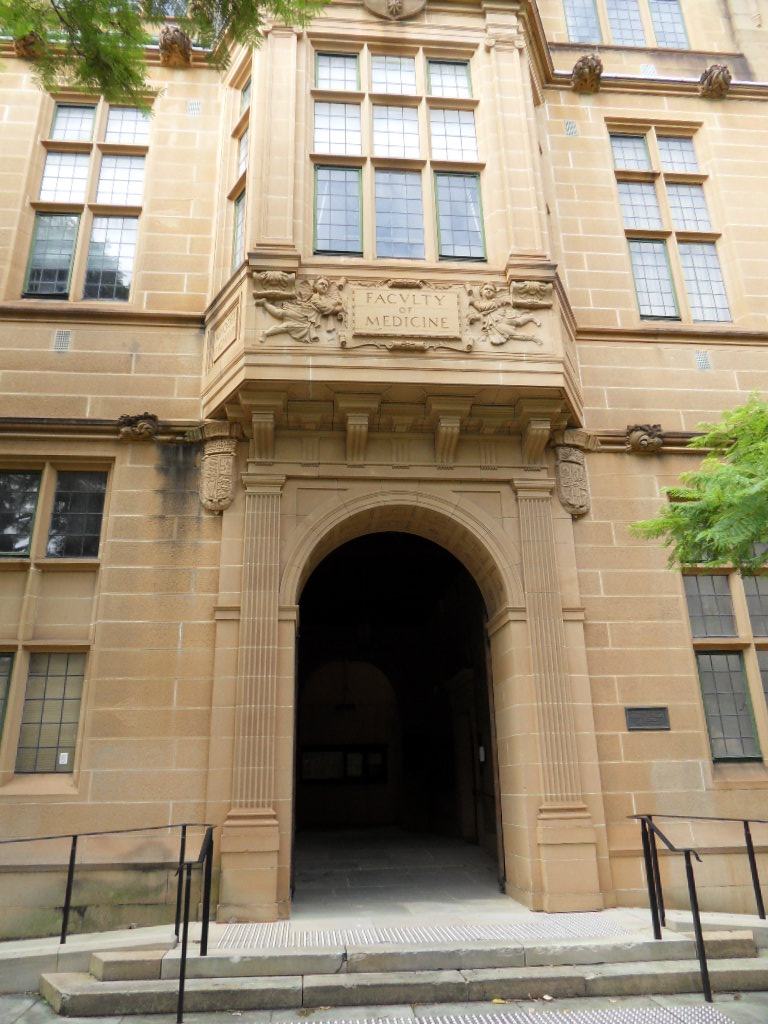
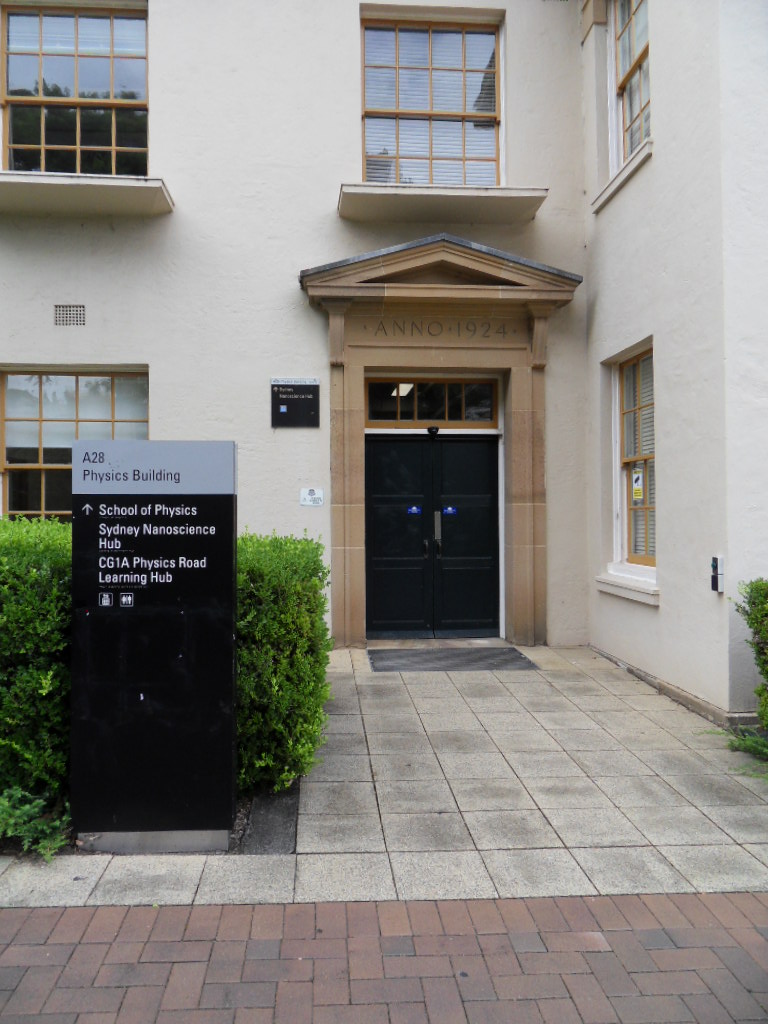
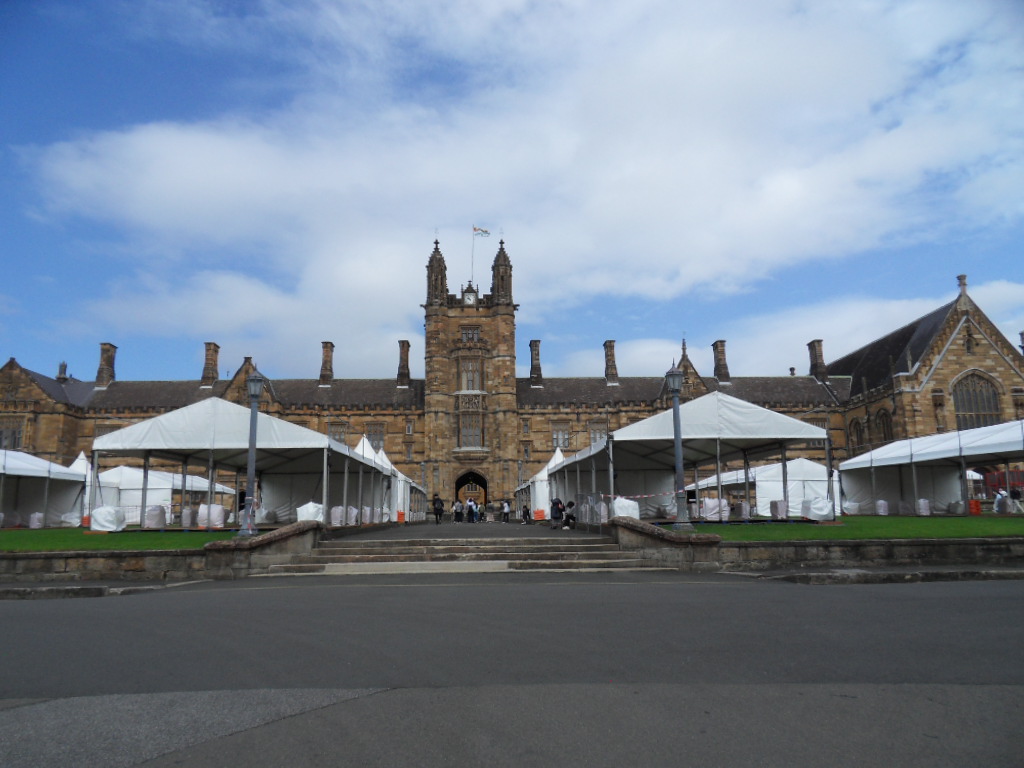
Here’s a gallery of random pictures I took on the way to the Physics Department at the University of Sydney this morning.

The academic year at the University of Sydney is about to start, with the new intake of students beginning to arrive next week and the first lectures taking place the week after that. The rows of tents are for the various student societies which will be hoping to recruit new members. The University was founded in 1850 and the architectural style of the older buildings on campus is what you might call Victorian Gothic Revival. There are also buildings dating from the 1920s, such as the Faculty of Medicine (1922) and the Physics Building (1924); the latter seems much bigger on the inside than the outside, and also has a new building next to it devoted to nanoscience.

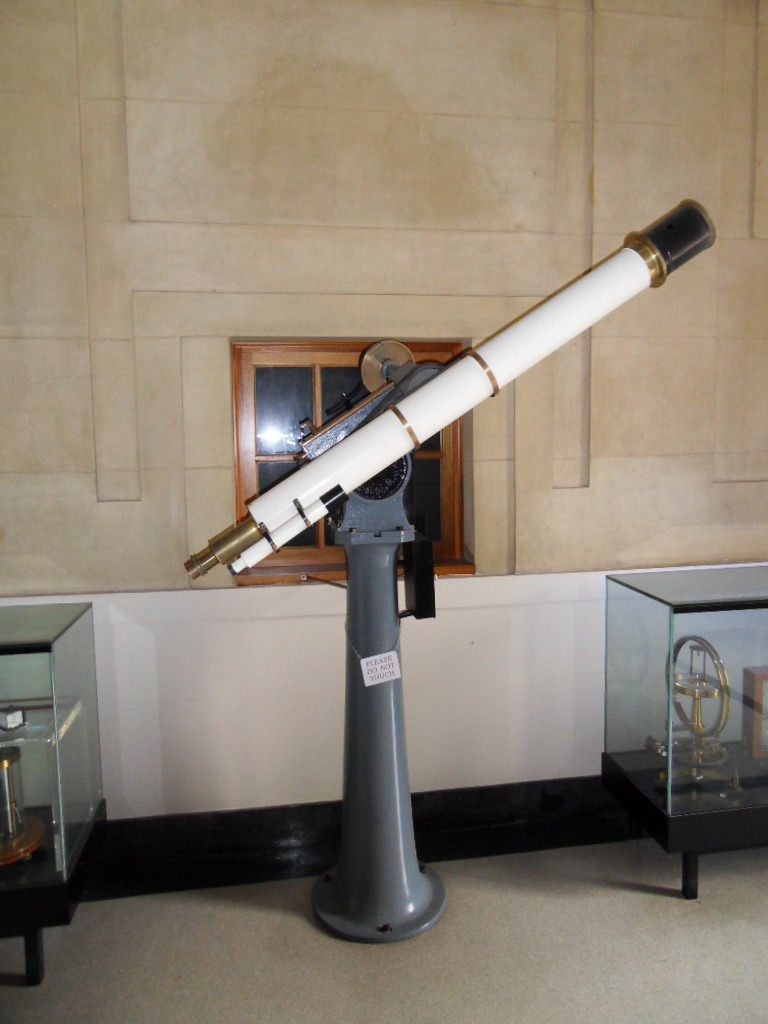
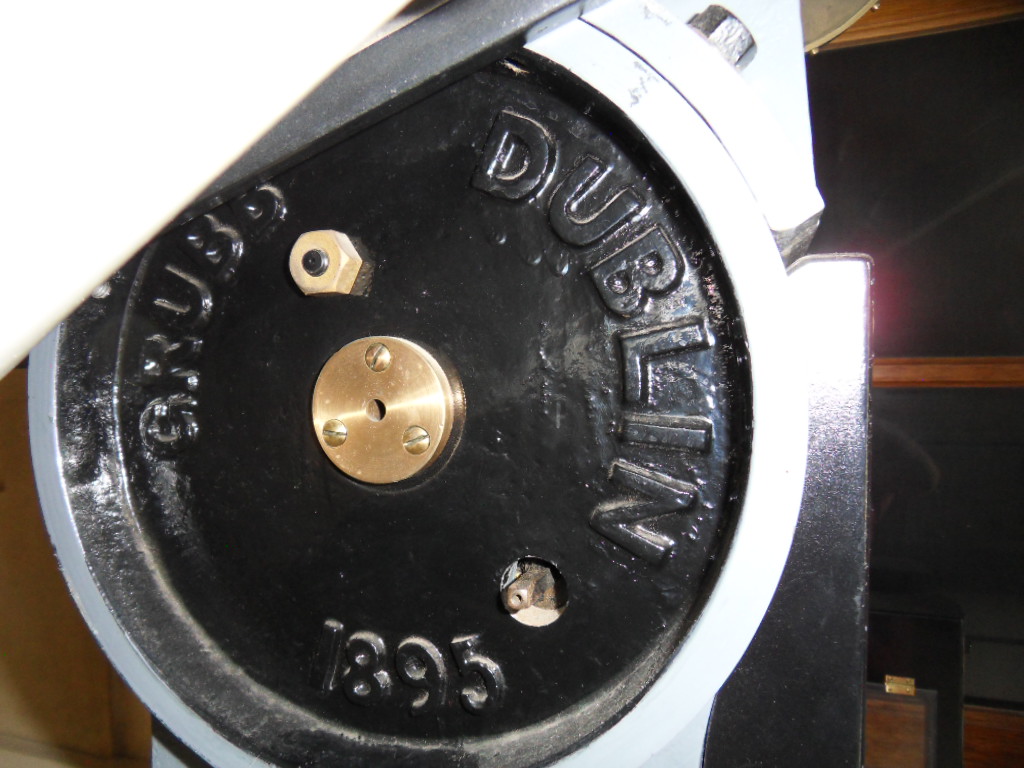
I’ve posted before about the famous optical instrument manufacturer, the Grubb Telescope Company, founded in Dublin by Thomas Grubb and later renamed Grubb Parsons after its relocation to Newcastle upon Tyne. I’ve posted about other connections too, including the presence in the Physics Department in Barcelona of a refracting telescope made by Grubb. Imagine my surprise, then, when I saw yet another Grubb Telescope near the entrance to the Physics building of the University of Sydney, this one made in 1893. This is further evidence – as if it were needed – that, in its time, the Grubb Telescope Company really was the world leader in optical instrumentation.

P.S. The later manifestation of the Grubb Telescope Company – Grubb Parsons – also has Australian connections, including making the primary mirror for the Anglo-Australian Telescope (AAT) and building the UK Schmidt situated next to the AAT at Siding Spring Observatory (about 500 km from Sydney).

R.I.P. Barry John (1945-2024)

Posted in R.I.P., Rugby with tags , , , on February 6, 2024 by telescoper

I just read the terrible news of the death at the age of 79 of yet another icon of Welsh Rugby Union, the legendary standoff Barry John.

Five years ago I posted an item about Barry John inspired by this clip

The opening part of this clip had caught my attention because it was filmed near the bus stop just outside The Halfway, a pub on Cathedral Road just a few yards from the house in Cardiff in which I lived for many years; in the background you can see Llandaff Fields.

I had often wondered what became of Barry John. He was 74 when I wrote about him and no longer the slim young prodigy who was undoubtedly the best rugby player I ever saw. Since he played in a great era for Welsh rugby that included Gareth Edwards, J.P.R. Williams, Gerald Davies et al, that really says something. As the Guardian obituary aptly puts it, he “played Rugby from another world”.

As a sort of rugby equivalent of George Best, Barry John was incredibly famous during his career. Budding rugby players – even those not born in Wales – all wanted to play like Barry John. But suddenly, at the age of just 27, after playing just 25 internationals, he turned his back on all the publicity and adulation and retired from rugby. He found the pressure of being such a star in the amateur era too difficult to cope with.

So was Barry John really that good? Absolutely yes, he was. Slight of build but with superb balance, he had an extraordinary, almost magical, ability to find his way through a crowd of potential tacklers as if they weren’t there at all. In the memorable words of that great commentator Bill McLaren “he flits like a little phantom”. But you don’t need to take my word for it. Just look at him – and some other giants of the time – in these highlights of the classic Scotland-Wales tie in the Five Nations of 1971. Watch about 30 seconds in, where he wrong-foots half the Scottish three-quarter line before ghosting through three more and releasing the ball to his forwards. Will there ever be another Barry John? I doubt it..

I’m sure there are many of us who remember the excitement of watching Barry John play and feel enriched by what he gave us.

Rest in Peace, Barry John (1945-2024).

Masters in Theoretical Physics & Mathematics at Maynooth

Posted in Education, Maynooth, The Universe and Stuff with tags , , on February 6, 2024 by telescoper

Yesterday was a holiday in Ireland but now, with the January examinations over, it’s back to teaching. I am not in Maynooth to enjoy the fun but I can use the medium of this blog to advertise the fact that the MSc in Theoretical Physics & Mathematics is now open to applications for entry in September.

This postgraduate course is run jointly between the Departments of Theoretical Physics and Mathematics & Statistics, with each contributing about half the material. The duration is one calendar year (full-time) or two years (part-time) and consists of 90 credits in the European Credit Transfer System (ECTS). This is split into 60 credits of taught material (split roughly 50-50 between Theoretical Physics and Mathematics) and a research project of 30 credits, supervised by a member of staff in a relevant area from either Department.

This course is a kind of follow-up to the existing undergraduate BSc Theoretical Physics & Mathematics at Maynooth, also run jointly. We think the postgraduate course will appeal to many of the students on that programme who wish to continue their education to postgraduate level, though applications are very welcome from suitably qualified candidates who did their first degree elsewhere.

Postgraduate admissions in Ireland operate differently from the UK, in that there is a central system in Ireland (called PAC) that is similar to the undergraduate admissions system; in the UK PG courses are dealt with by individual institutions. You will need to apply online via PAC after the following the instructions here. The requisite PAC code for the full-time version of the course is MHQ56.

The closing date for applications is 30th June 2024.

Two New Publications at the Open Journal of Astrophysics

Posted in OJAp Papers, Open Access, The Universe and Stuff with tags , , , , , , , on February 5, 2024 by telescoper

Now that I’m settled in Sydney it’s time to post another update relating to the  Open Journal of Astrophysics.  Since the last update we have published two more papers, taking  the count in Volume 7 (2024) up to 11 and the total published by OJAp up to 126. I should have posted these before leaving but it slipped my mind.

Both the current papers discussed here are in the folder marked Cosmology and NonGalactic Astrophysics, our most popular category.

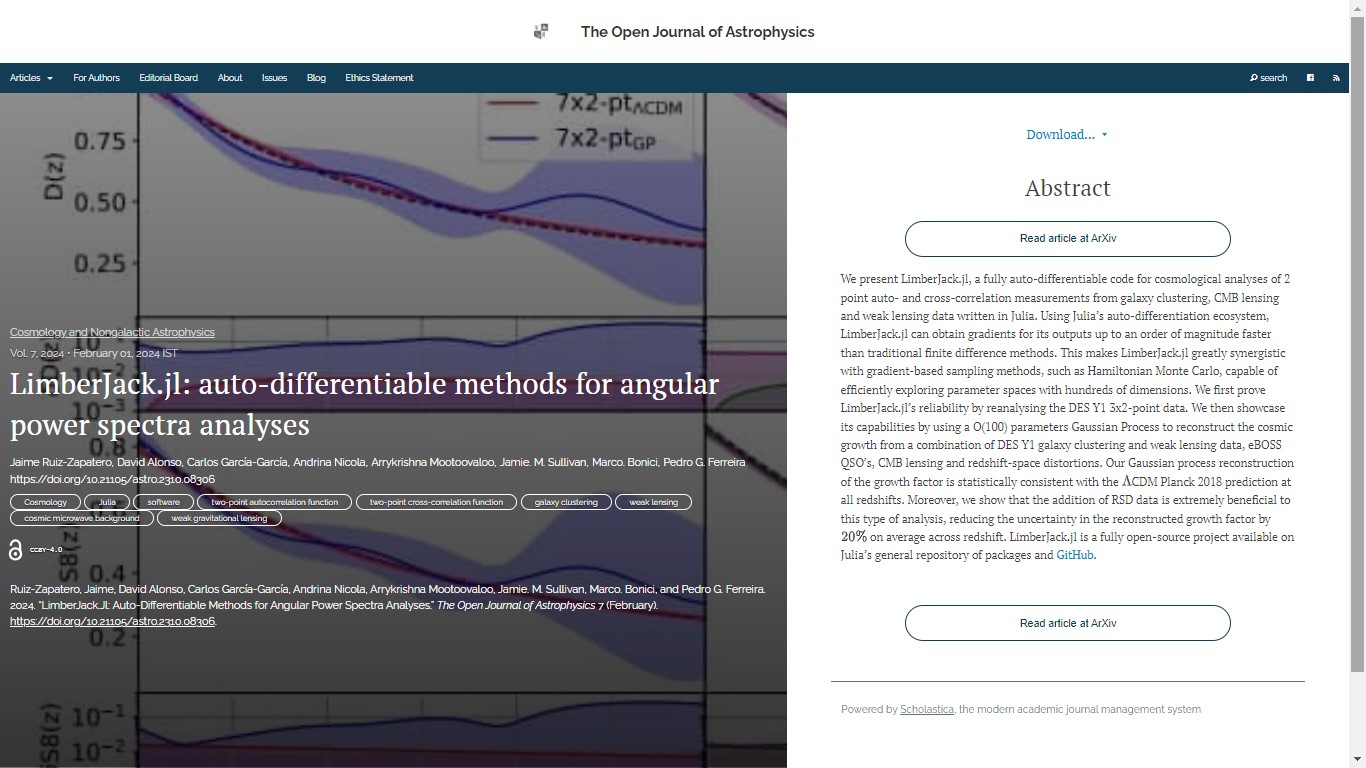
Anyway, the first paper of the most recent pair – published on February 1st – is “LimberJack.jl: auto-differentiable methods for angular power spectra analyses”, Jaime Ruiz-Zapatero (Oxford, UK), David Alonso (Oxford, UK), Carlos García-García (Oxford, UK) , Andrina Nicola (Bonn, Germany), Arrykrishna Mootoovaloo (Oxford, UK), Jamie Sullivan (Berkeley, USA), Marco Bonici (Milan, Italy), and Pedro Ferreira (Oxford, UK). This paper presents a fully auto-differentiable code for cosmological analyses of two-point auto- and cross-correlation measurements from galaxy clustering, CMB lensing and weak lensing data written in Julia.

Here is a screen grab of the overlay which includes the abstract:


You can click on the image of the overlay to make it larger should you wish to do so. You can find the officially accepted version of the paper on the arXiv here.

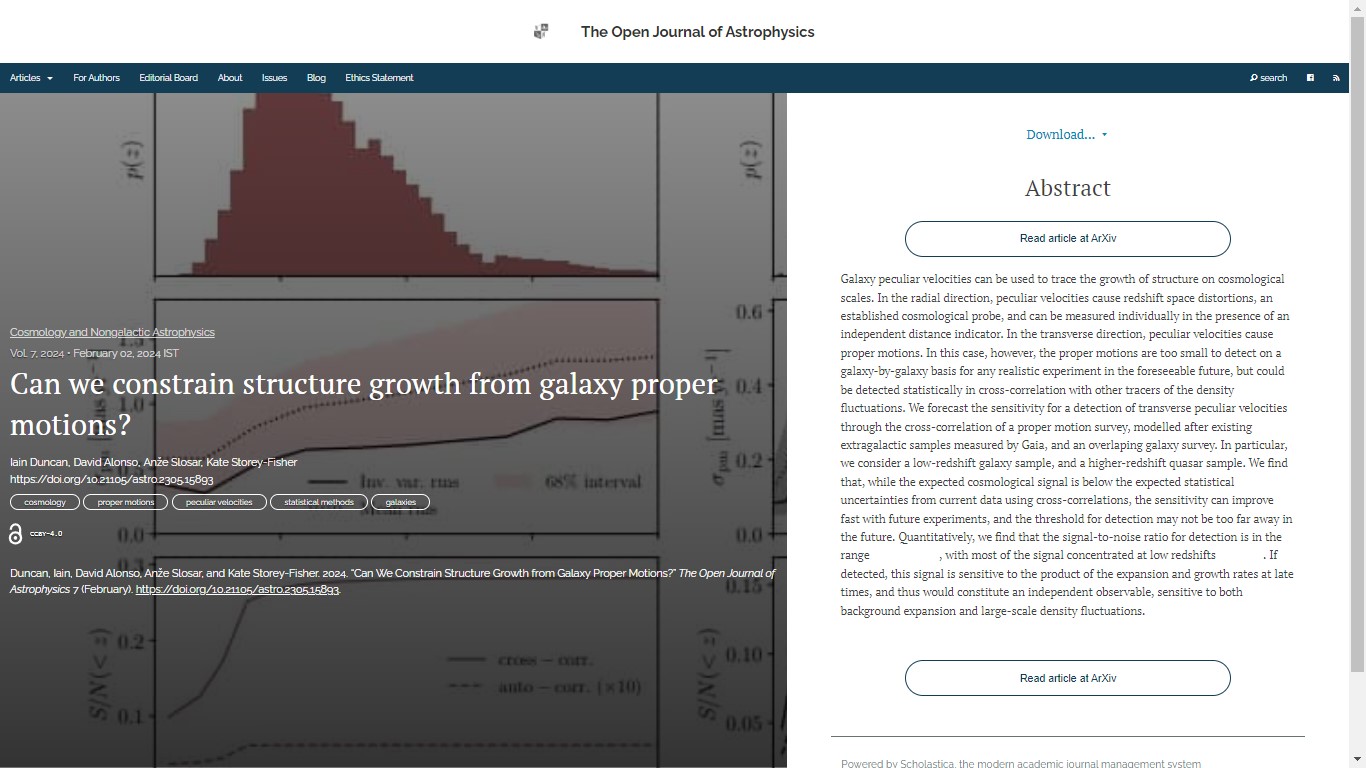
The second paper was published on Friday 2nd February and has the title “Can we constrain structure growth from galaxy proper motions?” which, as its title suggests, looks at the feasibility of using transverse peculiar velocities (i.e. proper motions) of galaxies for cosmological studies. The authors are Iain Duncan (Oxford, UK), David Alonso (Oxford, UK), Anže Slosar (Brookhaven National Laboratory, USA), and Kate Storey-Fisher (New York University, USA). To find out the answer to the question posed in its title you’ll have to read the paper!

Here is a screen grab of the overlay which includes the abstract:


You can click on the image of the overlay to make it larger should you wish to do so. You can find the officially accepted version of the paper on the arXiv here.

Because of the high rate of publications coming out, we’re moving to a system where we register papers in batches once a week rather than individually as they are published. This is just a temporary measure until we can automate this process more fully. Anyway, you can expect another update in a week or so.

Arrived Down Under

Posted in Biographical with tags on February 5, 2024 by telescoper

The plane from Abu Dhabi to Sydney set off a bit late but, 13 hours later, arrived slightly ahead of schedule in Sydney at about 7pm local time. I hadn’t quite realized how much of the flight is actually across Australia itself. It’s quite a big place. Who knew? The route took us over Sri Lanka, incidentally.

Australian immigration and customs were a bit of a rigmarole but didn’t really take all that long and once through I took a taxi to the hotel where I’ll be stating for the next month or so. I have a self-catering suite, which is very nice so I’m looking forward to my stay here.

It’s warm in Sydney – about 26° when I landed – but a bit overcast and very muggy. Rain is forecast.

Today is a public holiday in Ireland, the first Monday on or after 1st February. Astronomically speaking this cross-quarter day is about half-way between the Winter Solstice and the Spring Equinox in the Northern Hemisphere. Here of course it’s between the Summer Solstice and the Autumn Equinox, which takes place at the beginning of August in the Northern Hemisphere and is in Ireland sometimes referred to as the start of Autumn. The climate here in Sydney is very different from Ireland, however, and I don’t think anyone thinks of 1st August as Autumn.

Anyway, the flight went really well. I even slept for a few hours so I’m not particularly tired, but I’m still 11 hours out of kilter so I’ll try to stay up as long as possible and get a good night’s sleep to try to reset my internal clock. I plan to go for a walk tomorrow morning to explore my immediate surroundings then head up to the University campus to say hello to Physics Department.

In Transit

Posted in Biographical with tags , on February 4, 2024 by telescoper

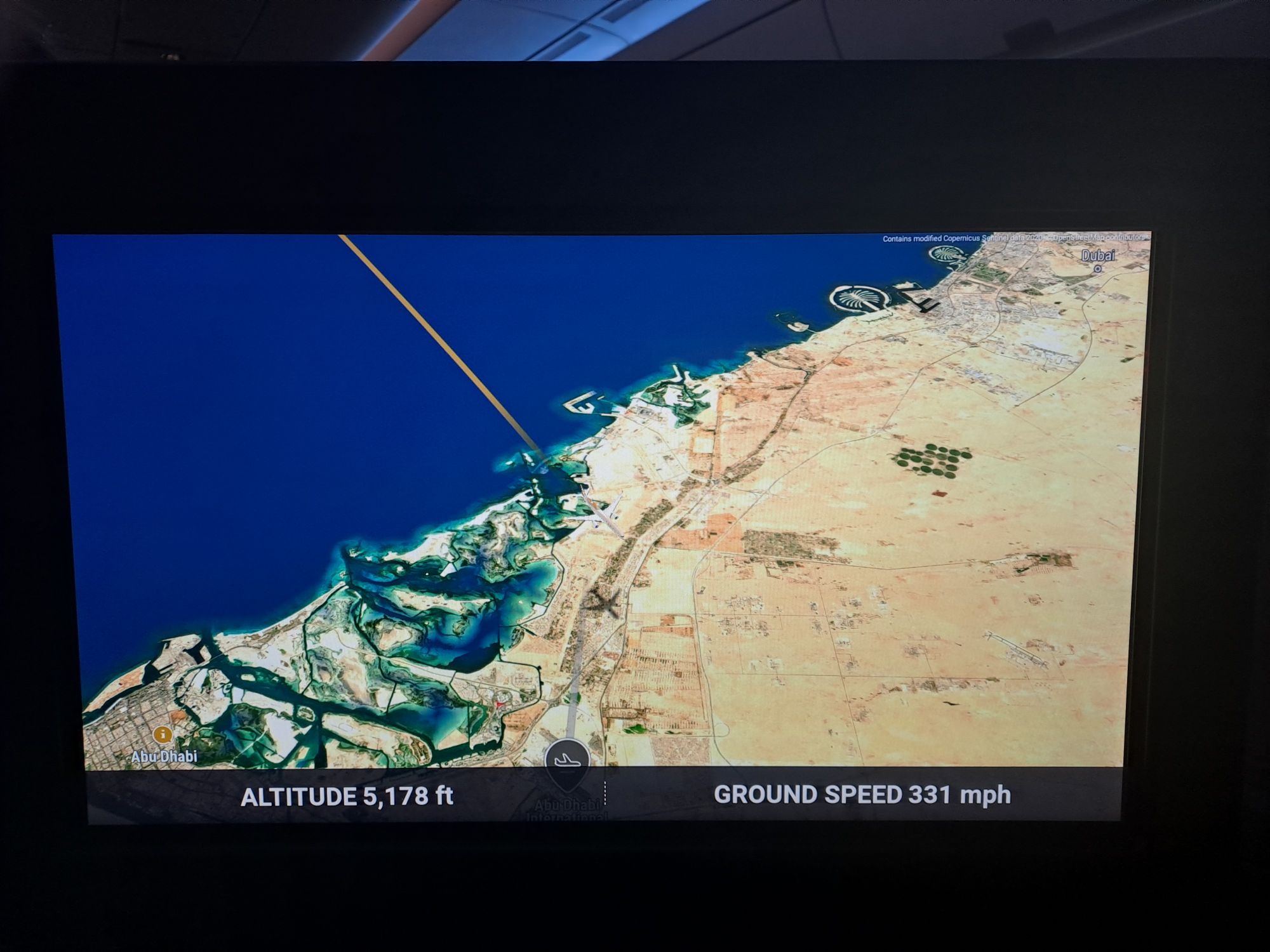
So here I am in Abu Dhabi International Airport. It’s about 8.40 pm my time, which is about 4.40 pm GMT. I’ve decided to take the so-called “silly” route to Barcelona to resume my sabbatical (via Sydney Australia), and Abu Dhabi is the first staging post along the way. The flight so far – with Etihad – has been pleasant enough: on time, and with nice food and wine. I wasn’t sure about the in-flight entertainment though. That seemed to consist of a very long cartoon showing a very large aeroplane moving very slowly over a map. Still, there was some nice music to listen to, including some jazz and several Schubert piano sonatas and I’ve got plenty to read.

The first leg was about 7 hours or so, which isn’t too bad. The next bit is almost twice as long and there’s another +7 hrs in terms of time difference. I’m not sure what state I’ll be in when I get to my final destination but I’ll find out by about 7.30pm Sydney time tomorrow.

I’ll update when I get to the other side!

Six Nations Weekend

Posted in Rugby with tags , , , on February 3, 2024 by telescoper

I found out yesterday that some of my colleagues at Maynooth were planning to go to a pub to watch the first match of the new Six Nations competition last night. They were optimistic, but I thought it was going to be a very tough match for Ireland in Marseille. Despite the absence of Dupont and Ntamack I thought home advantage would prove decisive. I am very happy that I was proved wrong. It was a comprehensive victory for Ireland, 38-17. I bet the Maynooth contingent enjoyed the game! I never imagined a bonus point win for Ireland nor did I think I’d ever see a French side so unimaginative in attack and so porous in defence.

(In the interest of full disclosure, I should mention that last weekend I was confident that Australia would beat the West Indies and India would beat England in their respective test matches. I was wrong on both counts. Clearly my predictive powers are limited!)

The remaining two games of the first round were played today. England beat Italy by 27-24 in a game of much lower quality. Italy were OK in the first half, but offered very little in the second until with the game virtually over they scored a fine try that gave them a losing bonus point. I think the scoreline flattered Italy a bit, though I don’t think England were particularly impressive.

The last game, Wales versus Scotland in Cardiff, turned out to be very exciting. Wales were dreadful in the first half, and trailed 20-0 at half time. When Scotland scored another try to make it 27-0 Wales looked a beaten side and I feared they would be walloped by 50 points or more. Then Wales scored a try, Scotland had Turner sent to the sin bin and Wales ran riot, scoring three more tries. With ten minutes left to play, Wales were within a point and with the wind in their sails, and Scotland imploding, looked the likelier team to win. They had a good chance too, but messed up a lineout in a good position and lost the ball. Scotland almost scored at the death but it finished 26-27, Wales netting two bonus points after a stirring revival that almost brought them victory.

It’s dangerous to draw too many conclusions from the first round of matches, but I can make one prediction with some confidence: neither France nor Wales nor Italy will do a Grand Slam in 2024.

Reformscape – the Video!

Posted in Education, Maynooth with tags , , , on February 2, 2024 by telescoper

Not long ago, I posted an item about the San Francisco Declaration on Research Assessment (DORA). I was interested this week to see the latest initiative from DORA which is called Reformscape. You can read much more about here. Here are some excerpts from the introduction:

  • The old ways of assessing the quality of research and progressing the careers of researchers are no longer fit for purpose. These dated approaches are neither fair nor responsible and often leave talented people overlooked, holding back progress in diversity, equity and inclusion. Institutions are increasingly expected to move with the times and update their assessment practices, but making meaningful change isn’t easy. 
  • Luckily, many have gone before you. Institutions around the world have been busy figuring out how to overcome the challenges of reforming academic career assessment, and we are here to help you learn from their experiences.
  • DORA Reformscape is an online tool where you can explore examples of how to bring responsible assessment for hiring, promotion and tenure into your institution, and to share your approach with others.
  • DORA Reformscape is an online tool where you can explore examples of how to bring responsible assessment for hiring, promotion and tenure into your institution, and to share your approach with others.

There’s also an introductory video:

Since my own institution, Maynooth University, is a signatory of DORA I am sure that it will already be working to implement the Reformscape recommendations into its own processes…

Two New Publications at the Open Journal of Astrophysics

Posted in OJAp Papers, Open Access, The Universe and Stuff with tags , , , , , , , , , , , on February 1, 2024 by telescoper

As the first month of 2024 is now over, I thought I’d post an update relating to the  Open Journal of Astrophysics.  Since the last update we have published two papers, taking  the count in Volume 7 (2024) up to 9 (the total for January) and the total published by OJAp up to 124. We will have others soon, but I will be travelling for the first few days of February so the next update will be in a week or so.

Using our sophisticated forecasting algorithm, based on the first month of 2024 as input, I predict that we will publish around 9×12=108 papers in 2024, more than double last year’s total of 50.

Both the current papers discussed here are in the folder marked Cosmology and NonGalactic Astrophysics, our most popular category.

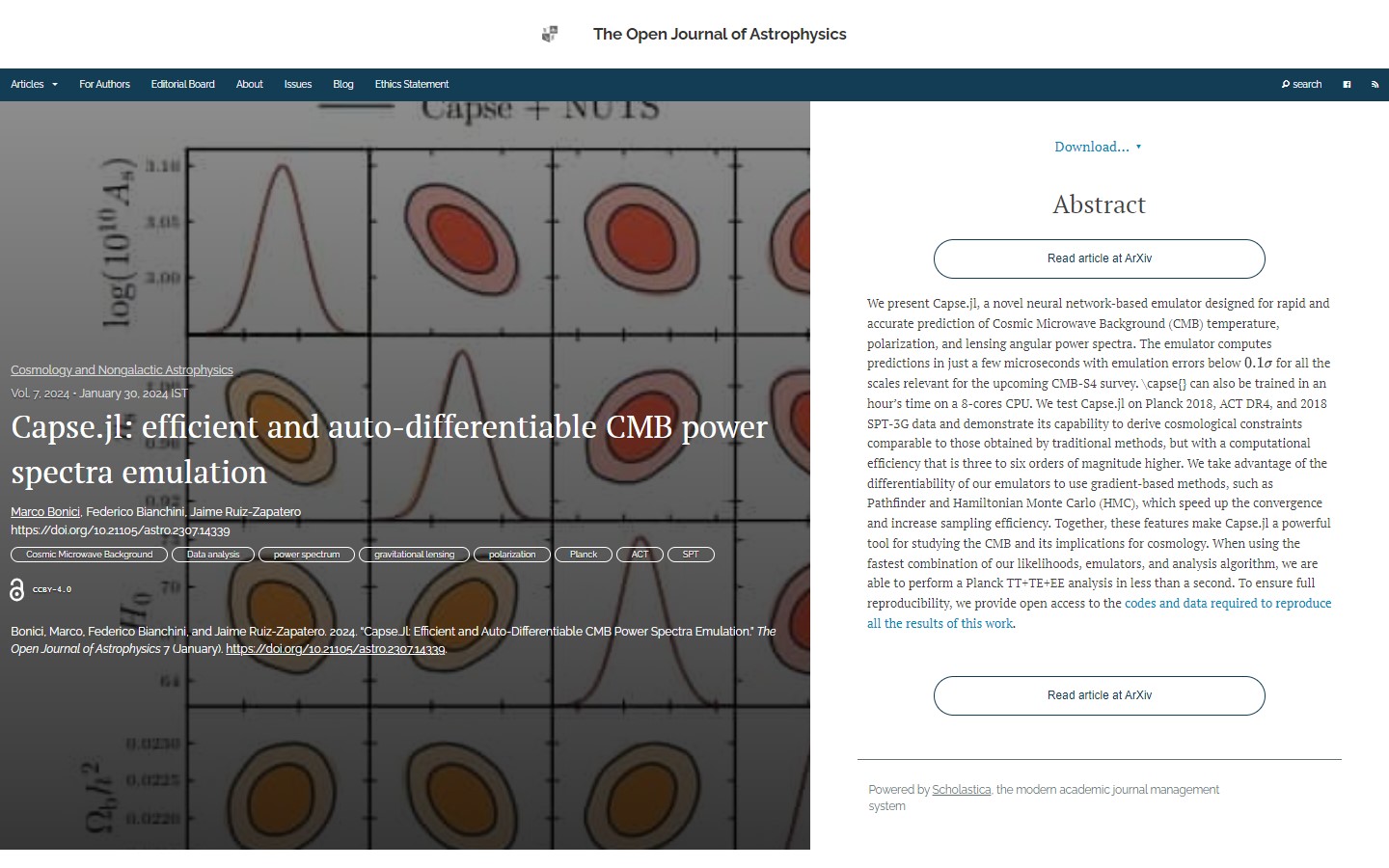
Anyway, the first paper of the most recent pair – published on January 30th – is “Capse.jl: efficient and auto-differentiable CMB power spectra emulation”, by Marco Bonici (INAF Milano, Italy & Waterloo, Canada), Federico Bianchini (Stanford, USA) and Jaime Ruiz-Zapatero (Oxford, UK). This paper presents an emulator for rapid and accurate prediction of Cosmic Microwave Background (CMB) temperature, polarization, and lensing angular power spectra, that works much faster than traditional methods. The code is written in Julia, in which language we are seeing an increasing number of submissions to OJAp.

Here is a screen grab of the overlay which includes the abstract:


You can click on the image of the overlay to make it larger should you wish to do so. You can find the officially accepted version of the paper on the arXiv here.

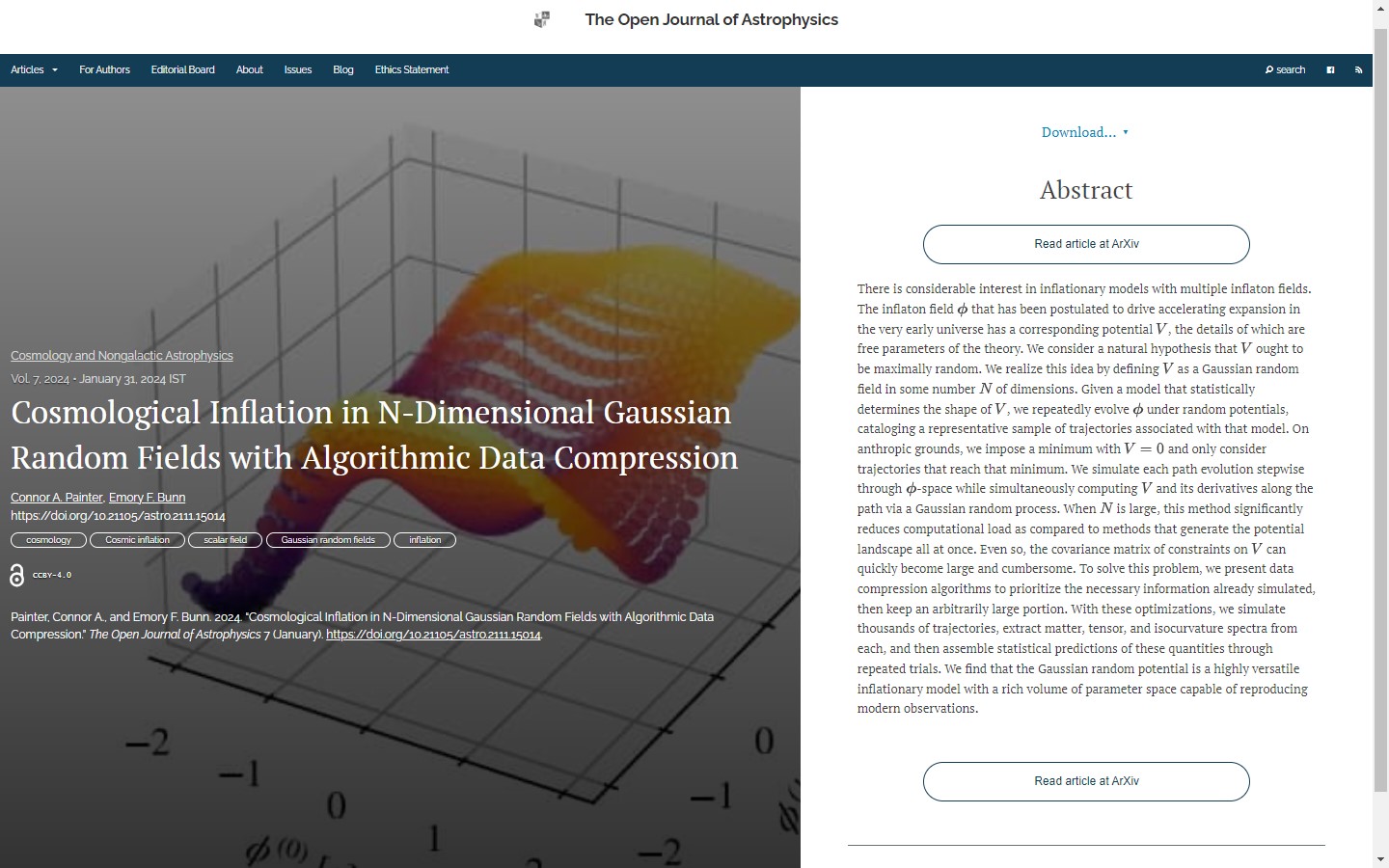
The second paper was published yesterday (31st January 2024) and has the title “Cosmological Inflation in N-Dimensional Gaussian Random Fields with Algorithmic Data Compression” which is a  study of inflationary models with Gaussian random potentials for multiple scalar fields, tracking the evolutionary trajectories numerically. The authors are Connor Painter and Emory Bunn, both the Physics Department at the University of Richmond, Virginia (USA). Ted Bunn (as he is usually known) is a longstanding member of the Editorial Board of the Open Journal of Astrophysics (and was thereby excluded from any involvement in the editorial process for this paper).

Here is a screen grab of the overlay which includes the abstract:


You can click on the image of the overlay to make it larger should you wish to do so. You can find the officially accepted version of the paper on the arXiv here.

Here Endeth the Update.