Archive for April, 2024

Two New Publications at the Open Journal of Astrophysics

Posted in OJAp Papers, Open Access, The Universe and Stuff with tags , , , , , , , , , , on April 20, 2024 by telescoper

It’s Saturday, and it’s time to post another update relating to the  Open Journal of Astrophysics.  Since the last update we have published two more papers, taking  the count in Volume 7 (2024) up to 27 and the total published by OJAp up to 142.

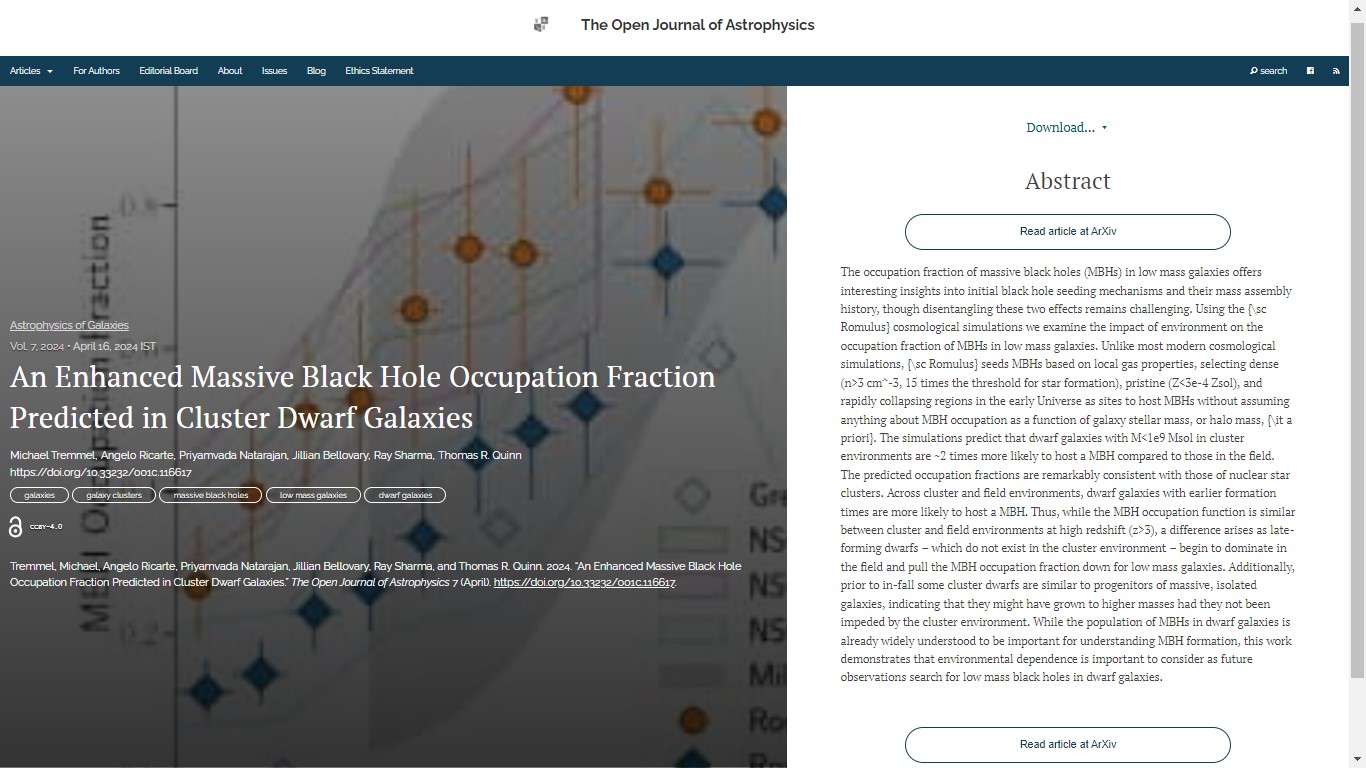
The first paper of the most recent pair – published on  Tuesday April 16th – is “An Enhanced Massive Black Hole Occupation Fraction Predicted in Cluster Dwarf Galaxies” by Michael Tremmel (UCC, Ireland), Angelo Ricarte (Harvard, USA), Priyamvada Natarajan (Yale, USA), Jillian Bellovar (American Museum of Natural History, New York, USA), Ray Sharma (Rutgers, USA), Thomas R. Quinn (University of Washington, USA). It presents a  study, based on the Romulus cosmological simulations, of the impact of environment on the occupation fraction of massive black holes in low mass galaxies. This one is in the folder marked “Astrophysics of Galaxies“.

Here is a screen grab of the overlay which includes the abstract:


You can click on the image of the overlay to make it larger should you wish to do so. You can find the officially accepted version of the paper on the arXiv here.

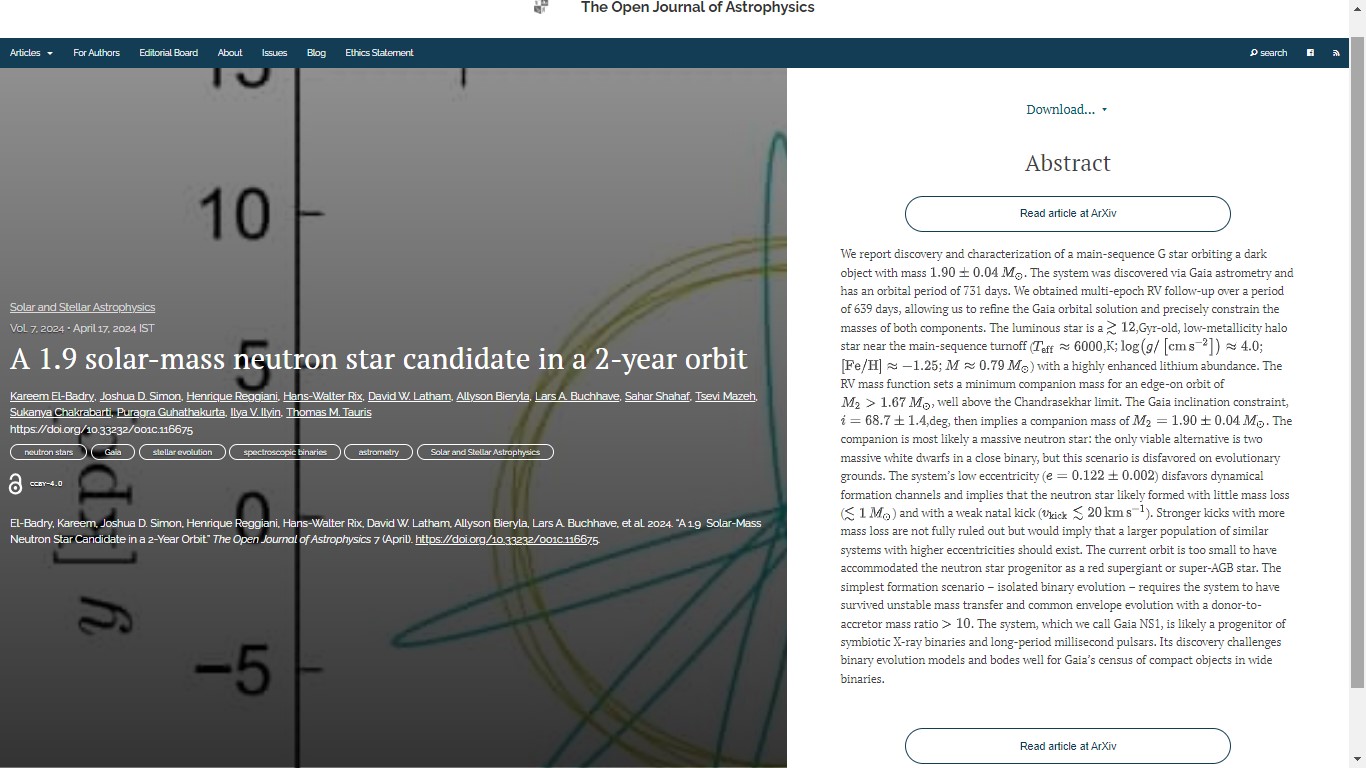
The second paper was published on Wednesday 17th April and has the title “A 1.9 solar-mass neutron star candidate in a 2-year orbit” and the authors are: Kareem El-Badry (Caltech, USA), Joshua D. Simon (Carnegie Observatories, USA), Henrique Reggiani (Gemini Observatory, Chile), Hans-Walter Rix (Heidelberg, Germany),  David W. Latham (Harvard, USA),  Allyson Bieryla (Harvard, USA),  Lars A. Buchhave (Technical University of Denmark, Denmark),  Sahar Shahaf (Weizmann Institute of Science, Israel),  Tsevi Mazeh (Tel Aviv University, Israel), Sukanya Chakrabarti (University of Alabama, USA), Puragra Guhathakurta (University of California Santa Cruz, USA), Ilya V. Ilyin (Potsdam, Germany), and Thomas M. Tauris (Aalborg University, Denmark)

This one, which is in the folder marked Solar and Stellar Astrophysics, presents a discussion of the discovery of a 1.9 solar mass neutron star candidate using Gaia astrometric data, together with the implications of its orbital parameters for the formation mechanism.

Here is a screen grab of the overlay which includes the abstract:


You can click on the image of the overlay to make it larger should you wish to do so. You can find the officially accepted version of the paper on the arXiv here.

That concludes this week’s update!

An Unmarked Anniversary

Posted in History with tags , , , on April 19, 2024 by telescoper

I didn’t have time to mention yesterday, 18th April 2024, that it was the 75th anniversary of the day that that the Republic of Ireland came into existence. The  Republic of Ireland Act, which provided the legal basis for the establishment of a new Republic, was passed in 1948 but only came into force on 18th April 1949. From that point the Republic no longer had the British monarch as Head of State and was no longer part of the Commonwealth.

That day was marked with parades and celebrations but “Republic Day” never became the public holiday that might have been expected given how many other countries mark such events in their history and indeed is hardly marked at all, not even on its 75th anniversary. I have quite a few Irish friends who were unaware of the significance of yesterday’s date.

The reason is probably explained by the statement made by Éamon De Valera when he declined an invitation extended to him by Taoiseach John A. Costello to attend the official ceremonies on 18th April 1949:

Celebrations such as those now proposed ought to be reserved until the national task which we have set ourselves is accomplished…We still believe that public demonstrations and rejoicings are out of place and are likely to be misunderstood so long as that task remains uncompleted and our country partitioned.

The Inaugural Euclid Spain Meeting

Posted in Barcelona, Euclid, The Universe and Stuff with tags , , , , on April 18, 2024 by telescoper

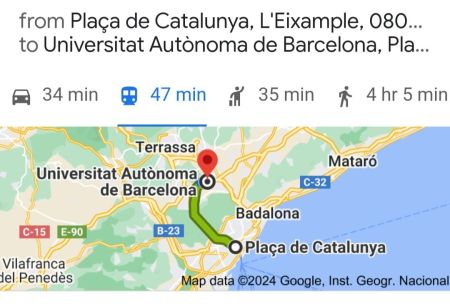
So here I am at the Institut de Ciencies de L’Espai (ICE-CSIC) which is on the campus of the Universidad Autónoma de Barcelona (UAB) for the first ever Euclid Spain Meeting. This involved a 40-minute trip on the S2 train from Plaça de Catalunya, which is a short walk from my apartment, then a short walk from the railway station at UAB through the campus to the Institute.

I was able to speak at this meeting because I happen to be in Barcelona right now. I mean that I was able to attend because I was in Barcelona anyway, not that the meeting was held because I am in Barcelona!

Anyway, I gave my talk early on this morning, so have been able to enjoy the rest of the day having got that out of the way. There are about 50 people here. It’s great to see the sizable Euclid community in Spain getting together and sharing their work.

P.S. My surname always causes some amusement in Spain, as “Coles” means “Cabbages” in Spanish…

Mad about the Boy – Blossom Dearie

Posted in Jazz with tags , , , , , , on April 17, 2024 by telescoper

The song Mad about the Boy was written by Noel Coward and published in 1932. It’s a song about an infatuation with a movie star and has generally been performed by female singers, although it was apparently inspired by Coward’s own crush on Douglas Fairbanks Jnr (which wasn’t reciprocated). The song became popular again in 1992 when a version recorded by Dinah Washington was used in a famous Levi commercial. . I never liked Noel Coward’s own recording – with him singing in a curious falsetto – very much at all, although I suppose it is authentic to what Coward was writing about. For a long time my favourite version was Dinah Washington’s but recently I came across this version, which has now, for me, eclipsed that one.

Blossom Dearie was a very underrated singer and pianist. Her voice – very high and girlish – was well suited to the whimsical songs she seemed to like to sing, but it meant that she wasn’t taken as seriously as a singer as she might have been. The lack of appreciation of her singing also extended to her piano playing, which was consistently excellent and innovative. No less a pianist than the great Bill Evans was a huge admirer of her musicianship, and he even attributed his use of stacked fourths in the left hand as inspired by Blossom Dearie. Other reasons to like this recording are that it was made live at Ronnie Scott’s Club in London and she goes straight into a verse that’s missed in many versions, probably because it uses the word “gay”. I love the way the accompaniment changes the mood each time she repeats the verses.

Challenging the Standard Cosmological Model

Posted in The Universe and Stuff with tags , , , on April 16, 2024 by telescoper

Some time ago I used the medium of this blog to plug a mini-conference at the Royal Society in London entitled Challenging the Standard Cosmological Model. Here’s a description of the meeting:

Is the universe simple enough to be adequately described by the standard ΛCDM cosmological model which assumes the isotropic and homogeneous Friedmann-Lemaître-Robertson-Walker metric? Tensions have emerged between the values of cosmological parameters estimated in different ways. Do these tensions signal that our model is too simple? Could a more sophisticated model account for the data without invoking a Cosmological Constant?

That conference is actually taking place this week (on 15th and 16th April, i.e. yesterday and today). I can’t be there, of course, because I’m here, but I can share the recording of the talks. Here is the first day’s worth. The recording is about 8 hours long so you probably won’t want to watch it all in one sitting. Let me point out the talk by Wendy Freedman, which starts at around 2:13.30 talking about the Hubble Tension largely from the point of view of stellar distance indicators and suggesting an answer of 69.1 ± km s-1 Mpc-1, which reduces the tension with Planck significantly.

And here is Day 2:

You can find more information about the meeting, including a full list of the talks here.

R.I.P. Derek Underwood (1945-2024)

Posted in Cricket, R.I.P. with tags , , , , on April 16, 2024 by telescoper

Another sporting hero of my youth has passed away. Derek Underwood – “Deadly” was his nickname – was a bowler like no other. Officially a left-arm orthodox spinner, with a rather flat-footed run-up, and a characteristic twist of his body as he delivered the ball at a brisk medium pace with infallible accuracy, he was not only a prolific taker of wickets but also an extremely difficult bowler to score off. He played for Kent for 24 seasons, his entire First Class career, during which he took 2,465 wickets at a remarkable average of 20.28. Underwood was a regular in the England Test side from 1966 onwards, barring an interruption when he joined Kerry Packer’s cricket circus in the 70s, and played his last Test match in 1982.

Tributes to Derek Underwood have understandably focused on his bowling, but it should be mentioned that, although of limited ability with the bat, he was a capable and stubborn night-watchman who didn’t give his wicket away easily. I remember seeing him bat in that role with great courage (and without a helmet) against Lillee and Thomson, getting struck on the body several times in the process.

When I was a kid I used to get completely absorbed watching him bowl, even on good wickets, and he never seemed to bowl badly and you could see batters getting visibly impatient at his refusal to bowl them a ball they could hit. Here is a little tribute video produced by Kent Cricket Club, with action mostly from the 1960s: you can see what a handful he was when he could use his pace to extract extra bounce from the pitch.

Rest in Peace Derek Underwood (1945-2024)

The Last Mughal by William Dalrymple

Posted in History, Literature with tags , , , , , , , on April 15, 2024 by telescoper

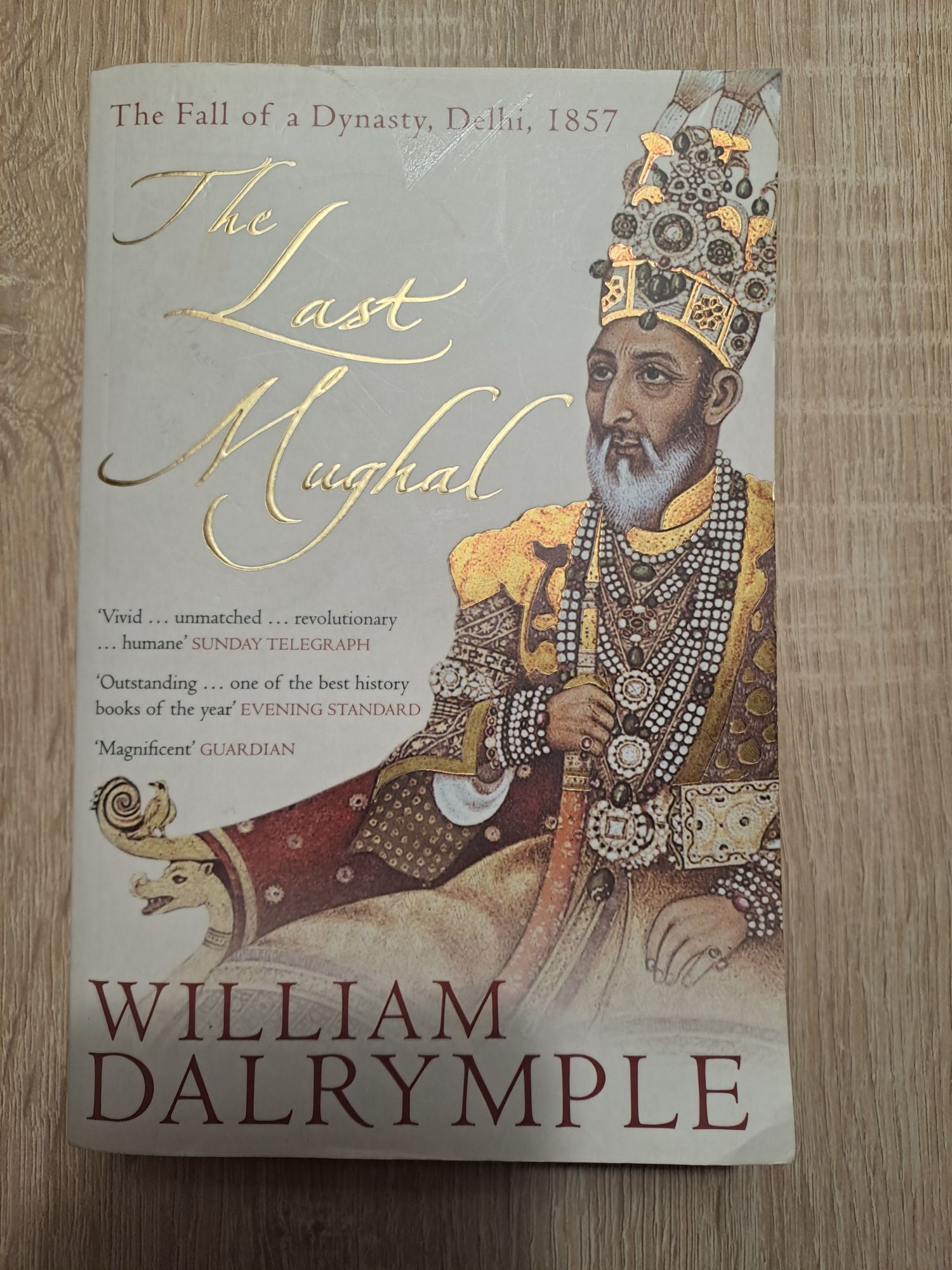
The latest item on my sabbatical reading list is The Last Mughal by William Dalrymple. This is about Bahadur Shah Zafur, the last King of the Mughal Dynasty that ruled Hindustan from its capital Delhi for 350 years, but it’s really about the last years of his life, focusing on the Indian Rebellion (Uprising) of 1857, when Mughal rule was already in a state of decline, to his death in exile in Rangoon five years afterwards. His narrative makes much use of the Mutiny Papers, an enormous collection of correspondence from the time of the rebellion collected in India’s National Archive, and there is extensive use of quoted material. There is also an extensive glossary and some excellent illustrations.

I remember learning about the “Indian Mutiny” (as it was called then) when I was doing my O-level History (in 1979) but that was more-or-less entirely from a British perspective. The immediate trigger for the rebellion of the sepoys in the British Army, we were told with some amusement by our teacher, was that a rumour had spread that the grease used to lubricate cartridges for the newly-issued Enfield rifles contained a mixture of beef fat and lard, offensive to both Hindus and Muslims. The implication was that this was a silly and trivial matter. There was, of course, a lot more to it than that…

Dalrymple explains how the British, Hindus and Muslims in Delhi co-existed reasonably peacefully until the middle of the 19th Century; there were many mixed marriages and it was by no means unknown for British representatives of the East India Company to wear Indian dress. This began to change with the arrival of a new British colonial class who disrespected any religion other than their own form of Christianity; the same attitudes were held by this class towards Irish Catholics. Resentment had been building up among both Hindus and Muslims, who felt their beliefs were under threat. The Enfield rifles were just the spark that lit the fire.

Let me quote from the book:

But while Zafar was certainly never cut out to be a heroic or revolutionary leader, he remains, like his ancestor the Emperor Akbar, an attractive symbol of Islamic civilisation at its most tolerant and pluralistic. he himself was a notable poet and calligrapher; his court contained some of the talented and artistic and literary figures in modern South Asian history; and the Delhi he presided over was undergoing one of its great periods of learning, communal amity and prosperity. He is certainly a strikingly liberal and sensitive figure when compared to the Victorian Evangelicals whose insensitivity, arrogance and blindness did so much to bring the Uprising of 1857 down upon their own heads, and those of the people and court of Delhi, engulfing all of northern India in a religious war of terrible violence

The Last Mughal, pp. 483-4

The Indian Rebellion (which took place between May and September 1857) was on a huge scale and involved terrible atrocities: women and children were not spared, many of the executed in sadistic fashion. The rebels (“mutineers” to the British) flocked to Delhi drawn to the idea that the Mughal King would lead them to victory. Unfortunately Zafar was already an old man of 82 and he was in no fit state, either mentally or physically, to be a military leader. By then he had very little power as King anyway; he certainly had only modest financial resources. He was really more of a mascot than anything else.

The lack of military leadership at Delhi was a serious problem for the rebels. In the British army a sepoy was unable to rise to a rank that involved commanding more than about 100 men. There was no-one at Delhi capable of organizing and coordinating the huge rebel army, with the result that they were unable to dislodge a much smaller British force that had assembled on a ridge outside the city. Eventually a much larger British column arrived and Delhi’s fate was sealed. Not without themselves suffering heavy casualties, the British eventually stormed the Kashmiri Gate, entered the city, looted what they could find and massacred the remnants of the rebel army in revenge for the atrocities committed by the sepoys. The famous Red Fort was largely destroyed. A plan to flatten Delhi completely was seriously considered, but eventually rejected. What remained however was a City of the Dead – that’s the title of Chapter 11.

Zafar was eventually captured but in contrast to most of the rest of his family and members of his court, was not summarily executed but exiled to Rangoon where he died in obscurity just five years later.

This book is vividly written with a extraordinary eye for detail as well as a sense of the grand sweep of the history. It must be difficult to combine the large and small scale like that. Although it’s well written it’s not always easy to read. The graphic descriptions of indiscriminate slaughter by both sides made me very uncomfortable, as did the obvious racism of many British officials and army officers revealed by the Mutiny Papers. But these are part of history, and we have to be made aware of them.

Zafar was of course Muslim, but a significant majority – almost two-thirds – of the sepoys who took part in the rebellion were Hindus. It’s interesting that both factions seem to have been content to rally around the Mughal banner. At his “trial” the British authorities in the form of prosecutor Major Harriott tried to argue that Zafar was the leader of a global Muslim conspiracy.

Here’s another quote:

The Uprising in fact showed every sign of being initiated by upper-caste Hindu sepoys reacting against specifically grievances perceived as a threat to their faith and dharma.; it then spread rapidly through the country, attracting a fractured and diffuse collection of other groups alienated by aggressively insensitive and brutal British policies. Among these were the Mughal court and the many Muslim individuals who made their way to Delhi and fought as civilian jihadis united against the kafir enemy. Yet Harriott’s bigoted and Islamophobic argument oversimplified this complex picture down to an easily comprehensible, if quite fictional, global Muslim conspiracy with an appealingly visible and captive hate figure at its centre, towards whom righteous vengeance could now be directed.

The Last Mughal, pp. 439-40

I won’t dwell on the obvious and important lesson about how bigotry and intolerance feed extremism, as the one lesson one can learn from studying history is that nobody ever learns the most obvious and important lesson.
Mini-Heatwave

Posted in Barcelona, Biographical on April 15, 2024 by telescoper

If it was warm on Saturday it was even warmer on Sunday. I went for an afternoon walk down to the harbour but was unfortunately unable to remember which of the yachts is mine so instead of putting out to sea, I had an ice cream and returned home for a siesta.

Obviously 27°C isn’t really hot by the standards of Barcelona but it is only mid-April and the temperature at the weekend in some areas did get up to 29.1°C, which is the highest temperature in April since 1914. It was about 10°C higher at the weekend than last week. The forecast for this week is similar to last week, around 18°C

Torre de Comunicacions de Montjuïc

Posted in Barcelona on April 14, 2024 by telescoper

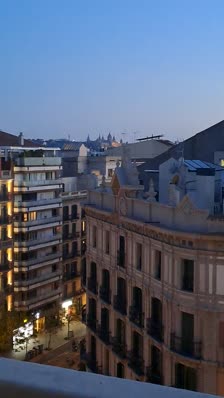
It was rather warm yesterday, even near sunset, so I found myself sitting out on my balcony, staring out into the distance, with a small bottle of wine by my side, and decided to record the view. Off in the distance, with the flashing lights, is the Montjuïc Communications Tower, which was built to transmit television signals from the 1992 Barcelona Olympics. To the left you can see the dome and spires of the Palau Nacional. The traffic noise is authentic.

No ERC Advanced Grants for Ireland…

Posted in Politics with tags , , , on April 14, 2024 by telescoper

I noticed last week that the results of the latest round of ERC Advanced Grants under the European Union’s Horizon Europe programme have been announced. This is the outcome of the 2023 round of applications.

First of all, many congratulations to the 255 recipients of almost €652 million in grants across all disciplines! There are some names I recognize among the awardees, which is very nice to see.

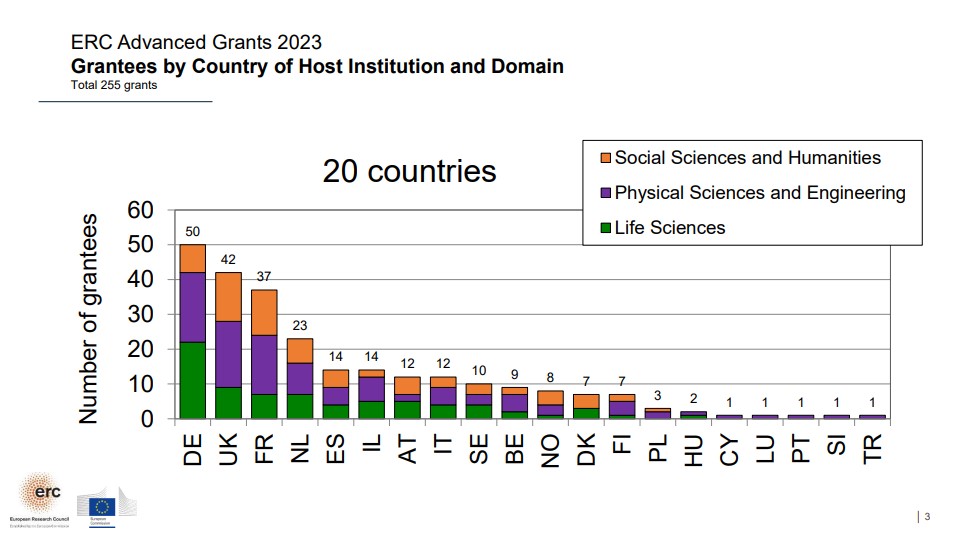
Unfortunately, not one cent of that money will be coming to Ireland as not one researcher based in Ireland is among the winners. Here’s the breakdown of awards:

Germany heads the table, with the UK in second – though, if I understand correctly, there is no ERC money attached to the UK awards in this round because the association agreement between the UK and Horizon Europe was only signed in September 2023 and will only come into play from the 2024 round onwards. Funds for these grants will have to be provided by the UK Government.

The outcome for Ireland is dismal but hardly surprising. Ireland spends only around 1% of its GDP on Research and Development, and only a small part of that is in research grants. There simply isn’t a funding stream to nurture a environment that would allow research to flourish here as it does in other countries. It is true that Ireland is a much smaller country than those at the top table, but it is massively out-performed by nations of a similar size such as Denmark, Finland and Norway. Advanced Grant winners represent the tip of the research pyramid, but they require a solid platform on which to build. In Ireland that platform simply doesn’t exist.

It often seems that Irish politicians think Ireland’s universities exist for the sole purpose of training people to work for Google. At any rate they are unconvinced that academic research is important enough to fund adequately, and this is unlikely to change in the near future as this issue is unlikely to be on the agenda at all for forthcoming election campaigns. The systemic failure of successive governments to invest in R&D, even when running a healthy budget surplus, is just one example of the short-termism that plagues Irish politics. Until attitudes change, talented young researchers, who could contribute so much to the scientific, technological and cultural landscape here, will continue to leave to carry out their research elsewhere.