Archive for October, 2024

52 Weeks of Euclid in Space

Posted in Euclid with tags , , on October 7, 2024 by telescoper

The Euclid Consortium is celebrating the first year of the journey of the European Space Agency’s Euclid Mission into space! Over the past 52 weeks, Euclid has been scanning the cosmos, uncovering new insights into dark matter, dark energy, and the structure of the universe. The Euclid Consortium has produced a slideshow, showcasing the key moments and discoveries from the first year in space.

The slideshow can be seen on YouTube here:

Here is a poster:

This can also found in interactive form here where you can click on each of the 52 images to see what it’s about.

P.S. The subtitle of the poster is “first year of a big journey to new physics”. There’s no guarantee that Euclid will find any new physics, rather than confirming our existing ideas, but it might.

Nobel Prize for Physics Speculation

Posted in Biographical, Science Politics, The Universe and Stuff with tags , on October 6, 2024 by telescoper

Just  to mention that that Tuesday (October 8th 2024) will see the announcement of this year’s Nobel Prize for Physics. I must remember to make sure my mobile phone is fully charged so I can be easily reached.

The announcement of the Nobel Prize for Physics is preceded tomorrow (Monday) by the announcement of the Prize for Applications of Physics to Physiology or Medicine, and on Wednesday by the Prize for Applications of Physics to Chemistry. You can find links to all the announcements here.

I do, of course, already have a Nobel Prize Medal of my own already, dating from 2006, when I was lucky enough to attend the prize-giving ceremony and banquet.

I was, however, a guest of the Nobel Foundation rather than a prizewinner, so my medal is made of chocolate rather than gold. I think after 17 years the chocolate is now inedible, but it serves as a souvenir of a very nice weekend in Stockholm!

Regular readers of this blog may recall that I called it correctly in 2022 when Alain Aspect, John F. Clauser and Anton Zeilinger won the Nobel Prize for Physics that year. I had, however, predicted them every year for many years until they won, and they won’t win it again. I really have no idea who will win it this year, but I’ll suggest that there’s still an outside chance for Michael Berry and Yakir Aharonov for their work on the geometric phase, although if they were going to win they probably would have done so by now.

Feel free to make your predictions through the comments box below!

To find out you’ll have to wait for the announcement, around about 10.45 (UK/Irish time) on Tuesday morning. I’ll update this post when the wavefunction has collapsed.

P.S. My own claim for the 2023 Physics Nobel Prize is based on the discovery of the Coles Law.

P.P.S. I’ve just realized this was my 7000th blog post.

UPDATE: The 2024 Nobel Prize for Physics goes to was awarded to John J. Hopfield and Geoffrey E. Hinton “for foundational discoveries and inventions that enable machine learning with artificial neural networks”. Odd. Not really physics, IMHO.

Grieg and Elgar at the National Concert Hall

Posted in Music with tags , , , , , , , , , , on October 5, 2024 by telescoper

Yesterday I once again headed off after work into Dublin by train to attend a concert by the National Symphony Orchestra this time under the direction of guest conductor Dinis Sousa (whose name is new to me). The programme consisted of two very familiar works, Grieg’s Piano Concerto in A Minor by Grieg and Elgar’s Enigma Variations by Elgar.

To start with, however, we heard a very interesting short piece by Anna Clyne called Masquerade which I enjoyed very much. This is only about five minutes long in performance, but full of energy and dynamics, and was a very suitable appetizer for the courses to follow.

The soloist for the Grieg Piano Concerto was Louis Schwizgebel who played it very well indeed. His articulation was crisp where necessary but also flowing when called for in the more romantic sections. The performance was very well received by the audience and by me. Actually I think that was the best performance of this work that I’ve heard live. Incidentally, I’m told the piano on which he performed was a brand new Steinway. Also incidentally, Edvard Grieg was only 24 when he wrote this piece.

During the second movement a member of the viola section of the orchestra had to leave the stage. I don’t know if she had broken a string or was just feeling unwell. I suppose both of these most happen from time to time in concerts, but I’d never seen it before. Thankfully she was back for the second half.

The Enigma Variations is another piece that is performed quite frequently. I’m not a huge fan of Elgar but this work definitely has its moments and I think anyone who doesn’t find Variation IX (“Nimrod”) uplifting must have something wrong with them. That said, that part is often played too slowly for my taste and can sound funereal rather than inspirational. Anyway, I hadn’t heard this in live performance for a long time so it was very pleasant to hear it again. I had forgotten that there is an organ part to this, actually, and it was good to hear the splendid NCH instrument used especially in the finale.

Overall it was a short (just 66 minutes playing time) but enjoyable concert. I’ll certainly be looking out for Louis Schwizgebel’s name on recordings in future as I think he is a fine soloist.

Sturm und Liouville

Posted in Biographical, Education, mathematics with tags , , , , , on October 4, 2024 by telescoper

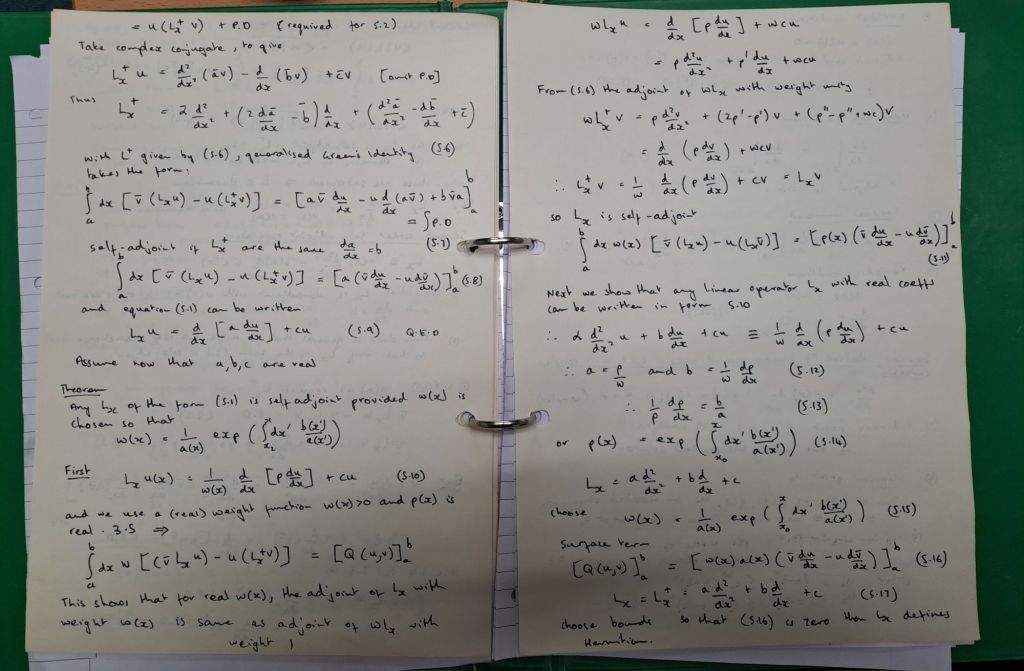
It’s Friday afternoon at the end of Week 2 here at Maynooth so I’ve now completed the 4th lecture of my 4th-year module Differential Equations and Complex Analysis. We’ve now in the section of Sturm-Liouville Theory. I’ve never taught this module before and, as always, teaching a new thing reminds me of all the things I had forgotten since I was a student. In this particular case, I still have the notes I took when I was studying this topic as an undergraduate. It’s scary to think the notes shown above were written by me 40 years ago!

Anyway, as I like to know something about the people behind the names, Sturm-Liouville Theory is named after Jacques Charles François Sturm (1803–1855)* and Joseph Liouville (1809–1882). Contrary to what I’d always assumed, Sturm was not German but was born in Geneva, which is now in Switzerland but which had been annexed by revolutionary France in 1798 so technically speaking he was born in France. Liouville was born in Saint-Omer, near Calais, which to my knowledge has never been part of Switzerland but has been part of the Spanish Netherlands.

*Given the dates, Sturm must have collaborated with Liouville after his earlier work with Drang

Mental Health and Graduate Studies

Posted in Biographical, Mental Health with tags , , , , , , , , on October 3, 2024 by telescoper

There has been a lot of comment on social media about a recent article in Nature about the mental health of graduate students and the numbers looking for treatment. There are many sources of stress that can have a negative effect on mental health, including financial pressures and poor accommodation to name but two. These aren’t really specific to graduate studies. One that is is the pressure to produce results. That actually continues throughout an academic career – burnout is a very real phenomenon – but it’s probably worse during the “apprenticeship” phase when one is inexperienced and still learning the trade.

“Productivity” is indeed important but should not be interpreted as having to work ridiculously long hours. I remember many years ago commenting on an article that claimed 80-100 hours a week was not unusual. There are people who can sit at their desks for 12 hours a day without producing anything very much at all. It’s not the hours that matter, but what you do with them. In no way will indulging your outside interests (sporting, cultural, political, or “other”…),  or simply relaxing, detract from your ability to do research. As a matter of fact, I think such diversions actually improve your work, as well as (of course) your general well-being.

I think it is fair to say that you have to work hard to do a PhD. I worked hard on mine back in the day. But don’t think that means it has to be a grim slog. I can only speak for myself, but I greatly enjoyed my time as a graduate student. I think this was at least in part because when I was doing my PhD I had plenty of outside interests (including music, sport and (ahem) “nightlife”)  and took time out regularly to indulge them. I did experience mental health problems later during my PhD, but these were not caused by being a research student.

I can think of many times during my graduate studies when I was completely stuck on a problem – to the extent that it was seriously bothering me. On such occasions I learned to take a break. I often found that going for a walk, doing a crossword, or just trying to think about something else for a while, allowed me to return to the problem fresher and with new ideas. I think the brain gets into a rut if you try to make it work in one mode all the time.

There were indeed many times during my time as a research student – and have been since – that I worked extremely long hours – all night sometimes. I wouldn’t say exactly that was because I “enjoyed” it, but that I wanted to know an answer and couldn’t get the problem out of my head.  I’ve stayed up into the early hours of the morning trying to finish a crossword too. Not because I had to, but because I couldn’t put it down unfinished. I know that makes me a saddo in many minds, but I think that’s the sort of obsessiveness and tenacity a researcher needs: becoming so absorbed by the task in hand that you don’t notice the passage of time.

I don’t think anyone should try to infer too much from these personal reflections, but I do think there’s one important point that I try to point to every graduate student I advise and that is to look after your mental health. Perhaps the Nature article has a positive side, in that at least graduate students are seeking help. Recognizing that you might have a problem is a very important first step.

O(G)HAM

Posted in History, Irish Language with tags , , on October 3, 2024 by telescoper

Here’s a fascinating video about a project looking into Ogham, an early-mediaeval way of writing that dates back to about the 4th Century AD.

As the video reflects, there’s some controversy about whether the ‘g’ is pronounced but most Irish people I know would say “Oham” rather than “Ogam”. Anyway, this video reports on a research collaboration between the University of Glasgow and Maynooth University that aims to harness Digital Technologies to Transform Understanding of Ogham Writing, from the 4th Century to the 21st.

The Return of the Hume Doctoral Scholarships?

Posted in Education, Maynooth with tags , , , on October 2, 2024 by telescoper

This morning it was drawn to my attention that the TSI Building on Maynooth University campus was surrounded by fences and barricades. A colleague then explained that they were there because the President was delivering her latest Presidential Address in one of the lecture theatres there. I was sadly prevented from attending this inspirational event by having better things to do, but naturally assumed the obstacles were in place to prevent people from leaving before the end. It seems however that campus security were worried there might be “protests”. I’m told that there was a kind of protest, with people displaying placards but it was quite a low-key affair.

So what was the subject of the protest?

You may recall that a few weeks ago, while this blog was still banned from campus, I posted an item bemoaning the sudden decision by University Management to scrap the John and Pat Hume Doctoral Scholarships for PhD students at Maynooth University. Well, this decision created an angry response at Faculty and Departmental meetings across campus, as did the President’s obvious intention to keep any discussion off the agenda as much as possible.

It seems that today the President announced a retreat and the Hume Fellowships will continue this year after all. After exhausting all the alternatives, they have at least decided to do the right thing. At least that’s what I’m told. I wasn’t at the speech and there has been no official communication about it to all staff.

There are many reasons to be glad if this programme continues. On the other hand, reversing the decision does not mean that we should pretend it was never made. Every time the Management does something dumb, and is forced to retreat, more of its credibility is eroded. In due course I plan to post the results of a Staff Culture and Climate Survey that was carried out in 2022. I mentioned this here. These results were obtained recently via a Freedom of Information request as they are so bad – especially concerning the performance of the University Executive – that they were buried for two years. The sad thing is that, two years on, the Culture and Climate at Maynooth have deteriorated still further thanks to episodes like the Hume Scholarship fiasco.

Maynooth Space Week Update!

Posted in Maynooth, The Universe and Stuff with tags , on October 1, 2024 by telescoper
Euclid View of the Perseus Cluster

A couple of week ago I posted about the event we are putting on at Maynooth University to mark Space Week in Ireland, which is is from October 4th – 10th this year. The event at Maynooth is on Wednesday October 9th, i.e. a week tomorrow. I’ll be doing a talk, the description of which reads:

Two of the greatest mysteries in modern science concern the nature of the dark matter and dark energy we think dominate the Universe. In this talk I will explain how the European Space Agency’s Euclid mission, launched last year, is designed to shed light on the “dark side” of the cosmos, present some of the early results, and show how you can get involved in analyzing Euclid data.

Anyway, I did think today would provide a good excuse to boost the bookings, but I’m afraid the venue is already full so I needn’t have bothered.

If you didn’t manage to book you can at least read the programme here to see what you’re going to miss!

The Shortest Physics Paper Ever?

Posted in The Universe and Stuff with tags , , on October 1, 2024 by telescoper

I thought I’d share this for the benefit of those who haven’t seen it already:

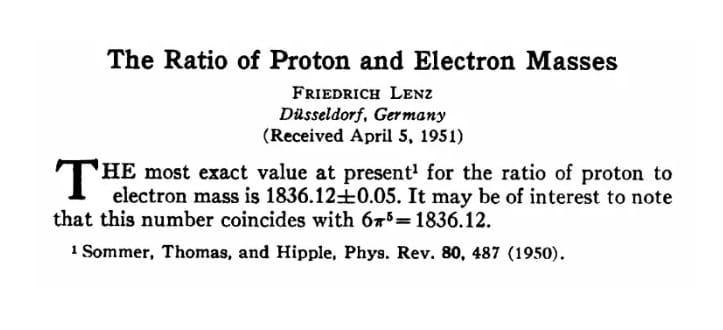
Published in the Physical Review in 1951 this paper is just 27 words long, contains one number (+ error bounds), one equation, and one reference. Is this the shortest physics paper ever?

P.S. Current measurements of the electron and proton masses give a ratio inconsistent with the number derived from the measurements in [1].

Penny Dreadful

Posted in Literature, Television with tags , , , , , , , , on October 1, 2024 by telescoper

The other day I was in the local library and walked past the DVD collection on the way to checking out a couple of books. I noticed the boxed set of the first series of Penny Dreadful which was first broadcast in 2014. Ten years is quite a short time for me to catch up with things so I decided to borrow it. I’m glad I did because I thought it was excellent.

It’s hard to describe what Penny Dreadful is about without making it seem absurd, but it’s a horror drama based in Victorian London that features many characters from fiction of that period, including Mary Shelley’s Frankenstein, Oscar Wilde’s Dorian Gray, and numerous others from Bram Stoker’s Dracula including Professor van Helsing and Mina Harker. There are some originals too: Ethan Chandler, a rodeo performer, and the enigmatic Vanessa Ives. These characters join forces with Malcolm Murray who is attempting to find his daughter Mina (the name of the principal female character in Dracula). Mina is the MacGuffin but the quest to find her is mostly sidelined by other plots.

The title of course refers to the “Penny Dreadful“, a form of cheap fiction that was very popular in Victorian London and which often included a supernatural element, as well as lots of gory violence, as does the TV series. Oscar Wilde’s A Picture of Dorian Gray wasn’t a penny dreadful (nor were Frankenstein and Dracula for that matter) but the mix of characters, both mundane and supernatural, is a very ingenious concoction. It was fun trying to spot the literary references and quotations.

It’s also a bit raunchy in places, although when Dorian Gray was about to get it on with hunky cowboy Ethan Chandler, it cut immediately to the closing credits so, disappointingly, we didn’t see any actual rumpy pumpy.

Anyway, it’s a superb cast including Timothy Dalton as Malcolm Murray, Rory Kinnear as The Creature (from the Frankenstein story), and Eva Green as Vanessa Ives. A young Olly Alexander plays the vampire’s familiar Fenton. It’s beautifully photographed, and the sets are a visual feast for lovers of Victoriana. There are one or two anachronisms in the language and setting, but you have to cut a story like this a bit of slack. For example, the Grand Guignol, which supplies a subplot, was really a Parisian phenomenon.

I’ve seen some criticisms of the plotting, as the episodes don’t really resolve: the next one often starts a new thread rather than tying up the existing loose ends. I didn’t actually mind that at all. It seemed to me that this gives it a dreamlike or rather nightmarish quality.

Anyway, I enjoyed this series a lot and I’ll definitely look out for the other two series, as they may well offer excellent binge viewing during the dark autumn months.