Archive for November, 2024

Letter in November – Sylvia Plath

Posted in Poetry with tags , , , , , on November 15, 2024 by telescoper
Love, the world
Suddenly turns, turns color. The streetlight
Splits through the rat's tail
Pods of the laburnum at nine in the morning.
It is the Arctic,

This little black
Circle, with its tawn silk grasses - babies hair.
There is a green in the air,
Soft, delectable.
It cushions me lovingly.

I am flushed and warm.
I think I may be enormous,
I am so stupidly happy,
My Wellingtons
Squelching and squelching through the beautiful red.

This is my property.
Two times a day
I pace it, sniffing
The barbarous holly with its viridian
Scallops, pure iron,

And the wall of the odd corpses.
I love them.
I love them like history.
The apples are golden,
Imagine it ----

My seventy trees
Holding their gold-ruddy balls
In a thick gray death-soup,
Their million
Gold leaves metal and breathless.

O love, O celibate.
Nobody but me
Walks the waist high wet.
The irreplaceable
Golds bleed and deepen, the mouths of Thermopylae.

by Silvia Plath (1932-1963)

The Sun – Edvard Munch

Posted in Art with tags , , on November 14, 2024 by telescoper

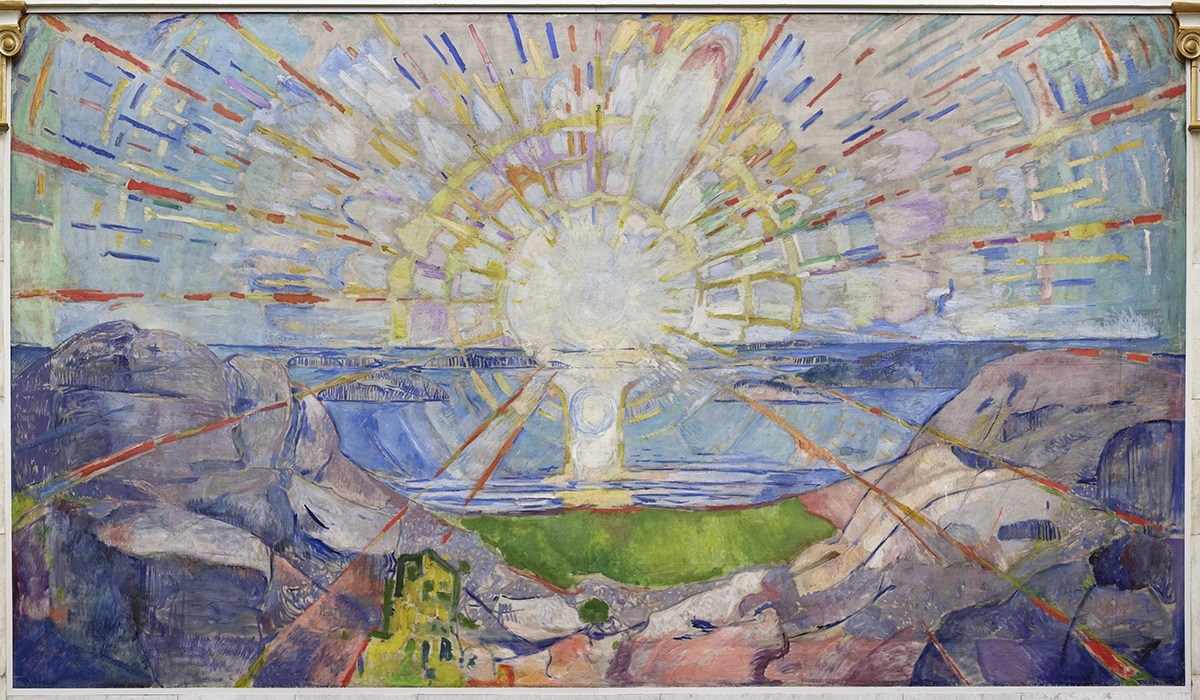
by Edvard Munch (1911, 455 x 780 cm, oil on canvas, University of Oslo; this very large work hangs in the University Aula at the University of Oslo where it is flanked by ten other Munch paintings )

R.I.P. Roy Haynes (1925-2024)

Posted in Jazz, R.I.P. with tags , , , , , , , , , on November 13, 2024 by telescoper

I was very sad to hear of the death yesterday (12th November) at the age of 99 of legendary jazz drummer Roy Haynes, one of the last survivors of the bebop era of the 1940s. Roy Haynes had a career that was not only exceptionally long but also exceptionally prolific: just look at the discography on his Wikipedia page! If I can add a personal note, he features on the first ever Charlie Parker LP I bought when I was about 15 and which I still have. I bought it on impulse, not really knowing who Charlie Parker was, was this record that turned me onto his music and I’ve never turned off.

No information is provided on Youtube, but the sleeve note reveals that the track was recorded from a radio broadcast live from Birdland in New York City on March 31st 1951 using a primitive disc recording machine by an amateur recording buff called Boris Rose. The sound quality isn’t great, but he deserves much greater recognition for capturing this and so many other classic performances and preserving them for posterity.

The personnel consists of Charlie Parker (alto saxophone), Dizzy Gillespie (trumpet), Bud Powell (piano), Tommy Potter (bass) and Roy Haynes (drums).

Here’s what the sleevenote (written by Gary Giddens) says about this track:

“Anthropology is an “I Got Rhythm” variation which originally appeared, in a slightly different form, as “Thriving on a Riff” on Parker’s first session as leader. The tempo is insanely fast; the performance is stunning. Bird has plenty of ideas in his first chorus, but he builds the second and third around a succession of quotations: “Tenderly”, “High Society”, “Temptation.” Gillespie’s second chorus is especially fine – only Fats Navarro had comparable control among the trumpeters who worked with Bird. His blazing high notes tend to set his lyrical phrases in bold relief. Bud, the ultimate bop pianist (and much more), jumps in for two note-gobbling choruses: no quotes, though, it’s all Powell. The four bar exchanges that follow demonstrate Haynes’s precision.

It’s a very exciting track not least because of the contributions of Roy Haynes, not only in the chase sequence mentioned in that quote but throughout the track where he demonstrates tremendous energy and imagination as well as control at such a high tempo.

Rest in peace, Roy Haynes (1925-2024), one of the greatest of all jazz drummers.

Save the Hume Scholarships!

Posted in Maynooth, Politics with tags , , on November 12, 2024 by telescoper

You may recall that I recently posted about the terrible decision by the Management of Maynooth University to scrap the John and Pat Hume Doctoral Scholarships and followed this up with another post suggesting the decision might be reversed.

As it turns out, the decision has not been reversed but, in a truly bizarre step, the scheme is to be paused for a “review” with the possibility that applications would be opened in June 2025 for PhDs starting in October 2025. The vast majority of qualified students intending to do PhDs will have accepted offers elsewhere by then so effectively the scheme is cancelled for 2025. Only students not able to secure a place elsewhere will be around to apply in June. A sensible decision would be to keep the scheme going until the review is complete, but clearly the University bosses want to divert the funds elsewhere. Perhaps the money saved will go towards the €500k luxury limousine service for self-defined VIP managers currently out to tender. Who knows?

Anyway, the decision and the manner in which it has been imposed by the University Executive is highly objectionable (though I’m afraid typical of the regime at Maynooth). Along with the union to which I belong, IFUT, I am therefore happy to support the Postgraduate Workers’ Organization (PWO) in their campaign on this issue. Please consider signing the petition either using the QR code or by following the link here.

Midpoint at Maynooth

Posted in Biographical, Education, mathematics, Maynooth with tags , , , , on November 11, 2024 by telescoper

Amid all the excitement last week I forgot that it was the sixth teaching week of the Semester. That means that we’re now past the halfway point. Among other things that meant that examination papers were due in on Friday (8th November). That means two papers for each module I’m teaching, one to be sat in January and another for the repeat opportunity in August, so that’s four altogether.

I always find setting examination questions very difficult. In theoretical physics we want to stretch the stronger candidates at the same time as allowing the weaker ones to show what they can do. It’s a perennial problem how to make the questions neither too easy nor too difficult, but it is compounded this time by the fact that I’m teaching two modules for the very first time so judging the right level is tricky.

Another issue is that I’m once again in a situation in which I have to set examination papers without having taught all the material. At least I’ve covered the first half of the content so I have some idea of what the students found difficult, but that’s not the case for the second half. It should be a bit easier next year once I’ve experience of covering the whole syllabus. Assuming, of course, that I’m teaching the same modules again next year, which is by no means guaranteed…

I’m teaching a module on Differential Equations and Complex Analysis for 4th year students and just about ready to switch to the part that comes after the and. I taught a bit of Complex Analysis when I was at Sussex and I’m quite looking forward to it, although it does pose a particular challenge. Some of the class are doing a Double Major in Theoretical Physics and Mathematics, and have done quite a lot of Complex Analysis before, while others are doing a Single Major in Theoretical Physics and haven’t really done any. I have to somehow find a way to satisfy these two different groups. The only way I can think of to do that is to teach the subject as a physicist rather than a pure mathematician, with an emphasis on examples and real-world applications rather than in the abstract. We’ll see how this works out over the next few weeks.

P.S. On the subject of Complex Analysis, I just remembered this post from a few years ago.

Election News

Posted in Politics with tags , , , , , on November 10, 2024 by telescoper

On Friday 8th November Taoiseach Simon Harris (left) inspired Ireland’s rugby team to a very disappointing home defeat by New Zealand. Earlier on that day he had visited the President to request a dissolution of the  33rd Dáil and to call a General Election on November 29th 2024.

The Saturday newspapers were full of nonsense about how the “General Election campaign starts now” when in fact I’ve had canvassers knocking at my door for at least a fortnight already. Two of them were for Fine GaeI – far scarier than trick-or-treat! I made it abundantly clear that I wouldn’t be voting for their party and hoped that they wouldn’t bother me again.

Fine Gael’s opening gambit was to announce that if elected they would reduce VAT on the hospitality sector to 11%. There was a budget just a few weeks ago in which they could have announced such a reduction had they really wanted it to happen. If re-elected no doubt they will find an excuse for not doing it. If you believe what they say I have a 340k bike shed to sell you.

Talking about the budget, Ireland’s government is in a very different position from the UK, with a large fiscal surplus thanks to buoyant tax receipts. This year presented a great opportunity to use that cash for much-needed investment in public housing, transport, education, the health service, etc. Instead the Government decided to tinker here and there with allowances and bung some cash to middle-income families in order to buy votes. Simon Harris has the air of a man who would sell his Grandmother if he could buy votes with the proceeds. The FG approach may well work but, if it does, we’re in for many years more of decaying public services, homelessness and high rents. As the Landlord Party in all but name, this will suit Fine Gael very well.

My constituency is Kildare North which in 2020 elected four TDs: 1 Social Democrat, 1 Fianna Fáil, 1 Fine Gael, and 1 Sinn Féin. This time, owing to population growth in the area, the seat will return five TDs. Fine Gael is standing three. I won’t say anything about Fianna Fáil. To all intents and purposes they are indistinguishable from Fine Gael and I won’t be voting for either of them. For me “more of the same” is not an option. I hope it goes without saying that I won’t be voting for any neofascists who get onto the ballot paper either.

Catherine Murphy (SD) is not standing and since she had a strong personal following the SDs will struggle to keep that seat. Angela Feeney, who is very active on the Local Council, is standing for Labour and Réada Cronin for Sinn Féin will be trying to hold onto her seat. Nominations of candidates continue for another week, so I don’t know the final list of candidates. I’ll wait until then before deciding on my order of preferences.

Not that long ago Sinn Féin were riding high in the polls, but a series of missteps have left them trailing Fine Gael. They also did poorly in the local and European elections earlier this year, seeming to have lost supporters of the more extreme nationalist type to overtly right-wing candidates.

The only prediction I am willing to make at this stage is that, owing to disaffection with the mainstream political parties, the number of independent TDs is likely to increase considerably from the 20 last time. This will make the task of forming a government even more complicated than before.

Four New Publications at the Open Journal of Astrophysics

Posted in OJAp Papers, Open Access, The Universe and Stuff with tags , , , , , , , , , , , , , , , , on November 9, 2024 by telescoper

Once again it’s time for a quick update of activity at the Open Journal of Astrophysics. Since the last update a week ago we have published  four papers, which takes the count in Volume 7 (2024) up to 102 and the total published altogether by OJAp up to 217.   This means not only that we have reached a century for the year but also that so far in 2024 we have published more than double the number of papers that we published in all of 2023. I blogged about the significance of the figure 217 here.

In chronological order, the four papers published this week, with their overlays, are as follows. You can click on the images of the overlays to make them larger should you wish to do so.

First one up is “A generative model for Gaia astrometric orbit catalogs: selection functions for binary stars, giant planets, and compact object companions” by Kareem El-Badry (Caltech, USA), Casey Lam (Carnegie Observatories), Berry Holl & Jean-Louis Halbwachs (U. Geneva), Hans-Walter Rix (MPA Heidelberg, Germany), Tsevi Mazeh (Tel Aviv, Israel) and Sahar Shahaf (Weizmann Institute of Science, Israel). This one is in the folder Solar and Stellar Astrophysics. The paper presents a forward method for estimating the selection function (i.e. the probability of a system with a given set of parameters being included in a catalog). It was published on November 4th 2024.

Here is a screen grab of the overlay, which includes the abstract:


You can find the officially accepted version of the paper on the arXiv here.

The second paper to announce, published on 5th November 2024. is “Primordial magnetogenesis in a bouncing model with dark energy” by Marcus V. Bomfim (Rio de Janeiro, Brazil), Emmanuel Frion (Western U. Canada), Nelson Pinto-Neto (Espírito Santo, Brazil), and Sandro D. P. Vitenti (Paraná, Brazil). This paper, in the section on Cosmology and NonGalactic Astrophysics, presents a discussion of the possible generation of magnetic fields on cosmological scales by in a model involving a scalar field coupled to electromagnetism

You can see the overlay here:


The accepted version of this paper can be found on the arXiv here.

The third paper, published on 6th November 2024 in the folder marked Astrophysics of Galaxies, is called  “Evidence for large scale compressible turbulence in the ISM of CSWA13, a star-Forming Lensed Galaxy at z = 1.87 with outflowing wind” by Itzhak Goldman (Tel Aviv, Israel). It presents a statistical analysis of the spatial distribution and kinematics of nebular gas with discussion of the nature of the turbulence present.

Here is the overlay


The final version accepted on arXiv is here.

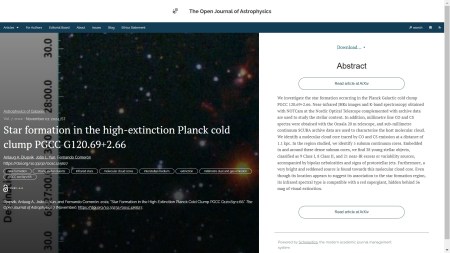
Last in this batch is “Star formation in the high-extinction Planck cold clump PGCC G120.69+2.66” by Anlaug Amanda Djupvik (Aarhus, Denmark), João L. Yun (Lisbon, Portugal), and Fernando Comerón (ESO, Garching, Germany). It was published on 7th November 2024 in the folder marked Astrophysics of Galaxies. The paper uses imaging and spectroscopy  information to identify sites of star formation in a molecular cloud. This is the overlay:
You can find the official accepted version on the arXiv here.

That’s all for now. I will post another update in a week.
Developmental Review

Posted in Biographical, Maynooth with tags , , on November 8, 2024 by telescoper

Today I attended a (mandatory) training workshop relating to the Developmental Review, a process which is aims to “help to align the objectives of the Reviewee with the goals of the Unit* and with those of the University” and “to develop the capability of all staff, by focussing on the employee’s current role and their future career plans”. In other words, it’s a Staff Appraisal scheme.

Basically the reviewee discusses goals for the next couple of years with the reviewer and identify any training or other needs that would help achieve those goals. The two meet again at the end of the review period to see whether the goals have been reached and agree aims for the next couple of years. And so on.

I have, in a previous existence, been involved with conducting appraisals as a reviewer as well as participating as a reviewee, and found the experience reasonably positive because it is reviewee-led and focussed on career development rather than being tied to pay. This time round, however, the only career development goal on the horizon for me is retirement so I’m not sure I’ll get much out of it unless someone can suggest a way of bringing the date forward…

*Don’t ask me what “the goals of the Unit” are. I have no idea.

Saving Money via Diamond Open Access

Posted in Open Access with tags , , , , , on November 7, 2024 by telescoper

This morning I published a paper at the Open Journal of Astrophysics that brought the total number of publications there to 217. That may not seem a very significant number but I’ve had it in the back of my mind for some time. Some time ago Monthly Notices of the Royal Astronomical Society (MNRAS) decided to go Gold Open Access, charging a baseline APC of £2310 per article. I know that cost is not paid directly by authors from institutions with Read and Publish agreements with Oxford University Press (the publisher ofn MNRAS) but that doesn’t mean that it’s free: funds are still siphoned off from library budgets.

Anyway, taking the indicative cost of an APC to be the £2310 charged by MNRAS – some journals charge a lot more – the fact that we have published 217 papers means we have now saved the astronomical community around 217 × £2310 which is over £500k (€600k) in APCs. The cost to us is just a few percent of that figure.

The issue of University funding is a very live one in England, in Ireland and in The Netherlands. None of the financial crises can be solved completely by moving away from APCs but there is no justification at all for continuing to hand millions per year out of a shrinking pot over to greedy publishers. Surely this is an excellent time for Higher Education Institutions collectively to make a decisive move in the direction of Diamond Open Access?