Archive for November, 2024

The Morning After

Posted in Politics with tags , on November 6, 2024 by telescoper

Before anyone asks, no I didn’t stay up all night to see the US electoral disaster unfold. I was fairly sure what would happen and was not pleased to be proven right. I will never understand why anyone could vote for an individual so obviously unsuitable for high office as Donald Trump. I could say that about a number of other prominent national leaders too, but Trump is far worse. At least in 2016 there was an argument that he was an unknown quantity. Now everyone knows that he is a convicted felon – at least until he issues himself a pardon – and serial sexual predator whose outspoken bigotry appeals to the basest instincts of the electorate and who tried to stage an insurrection when he lost the last election. I don’t believe that Trump fans can’t see what a monster their idol is: they do see, but don’t care. It was the same in the UK with Boris Johnson.

However depressing it is to wake up and hear yet more evidence of the relentless march of fascism, there is no point in self-pity.  If you yield to despair, the bastards have won. In order to resist it is first necessary to endure. Brace yourselves. Things are going to get very nasty.

I’m just glad that I’m no longer young.
Maynooth University Library Cat Update

Posted in Maynooth with tags , on November 5, 2024 by telescoper

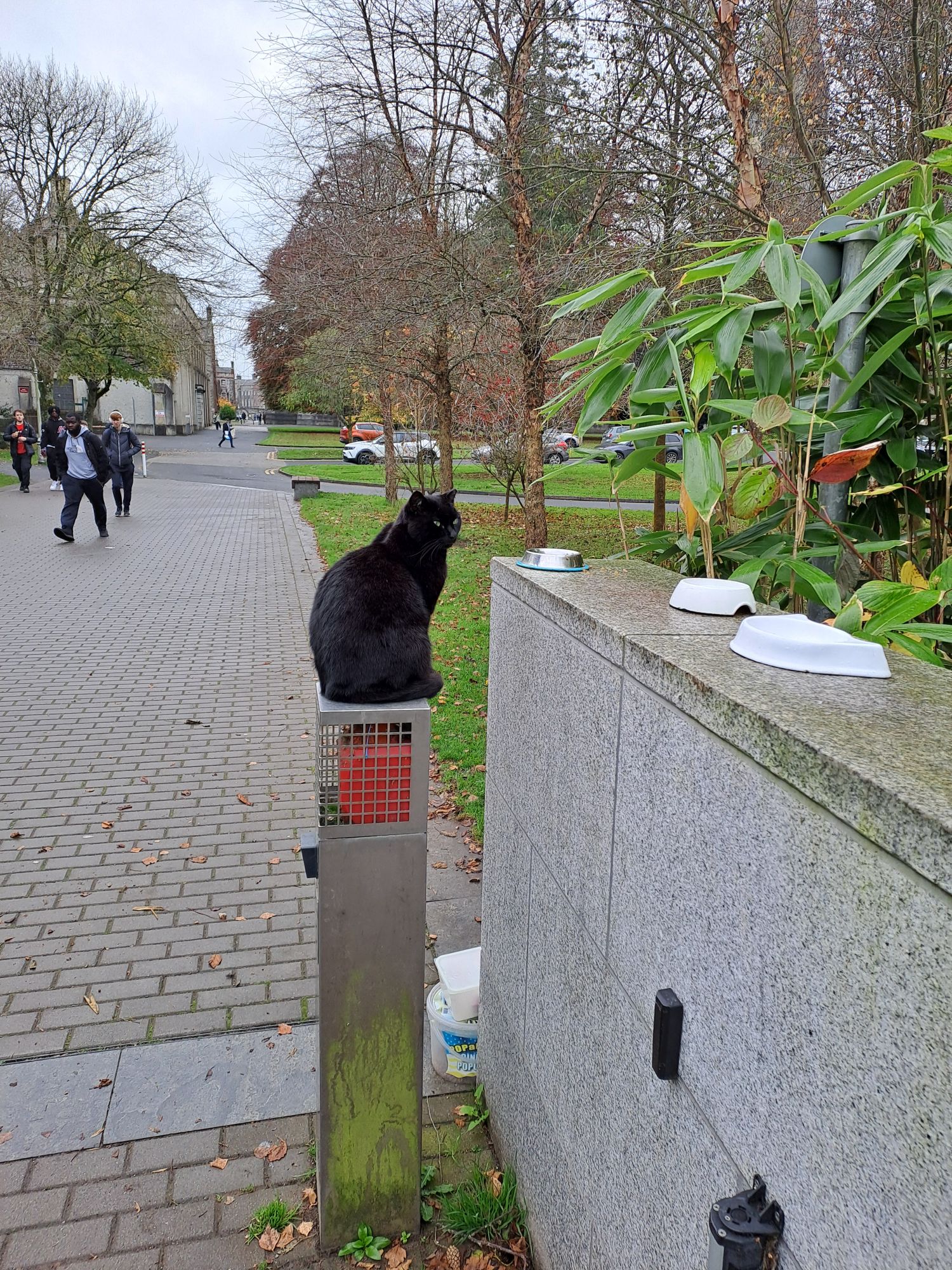
Maynooth University Library Cat was on post again today, staring at empty dishes to indicate that it was feeding time.

Blues Walk

Posted in Jazz with tags , , , , on November 4, 2024 by telescoper

I couldn’t resist sharing this piece I found on YouTube a while ago and have listened to many times. It’s amazing how many of my favourite jazz performances date from 1958, and here’s another. It’s the Dizzy Gillespie Quintet of that year featuring the great Sonny Stitt on tenor saxophone, given plenty of space by leader Dizzy Gillespie who takes the second solo on trumpet. The tune is called Blues Walk, although it is sometimes known by the alternative title Loose Walk and as such appeared on the classic film Jazz on a Summer’s Day which also featured Stitt on tenor, though with a quite different band. Note the presence of the great Ray Brown on bass and Lou Levy on piano. The drummer, Gus Johnson, is much less well known but plays very well on this.

If anyone could claim to be a direct musical descendant of Charlie Parker then it was Sonny Stitt, who demonstrates his amazing drive and technical ability in a tremendous solo on this tune, the last number performed at a concert in Belgium. Listen to the chorus that starts about 1:30. Wow! They don’t call this style “hard bop” for nothing!

Another Edgeworth Connection

Posted in History, The Universe and Stuff with tags , , , , , , , , , on November 3, 2024 by telescoper

A week or so ago I posted an item about the Edgeworth family that included a reference to Kenneth Edgeworth, an amateur astronomer of some note who first posited the existence of what is now known as the Kuiper belt. Here’s another interesting connection. Kenneth Edgeworth was born in 1880 in Daramona House in Street in County Westmeath. The owner of this house was Edgeworth’s uncle, another astronomer called William Edward Wilson who built an observatory next to Daramona House.

Here are pictures of (left) house and (right) the observatory, neither of look in particularly good condition!

After independence, many of the large houses owned by the rich Anglo-Irish families who had run Ireland until then fell into disrepair or were destroyed.

Anyway, on top of the two-storey observatory building there used to be a dome that housed a 24″ Grubb reflecting telescope. Here’s an old picture showing what it looked like in better times, around 1900:

The dome is no longer there, and neither is the telescope. The latter was donated to the University of London in 1925 eventually housed in the Observatory at Mill Hill, now run by University College London. Here is an excerpt from the history of the University of London Observatory:

W.E. Wilson established an observatory at Daramona, Street, County Westmeath, in 1871 and equipped it with a 12-inch equatorial reflector by Grubb. Wilson (born in 1851, elected FRS in 1896, an original member of the BAA, awarded an honorary DSc by the University of Dublin in 1901, High Sheriff of Co. Westmeath in 1894), observed the transit of Venus in 1882 and solar eclipses at Oran in 1870 and Spain in 1900, published many papers in Proc. R. Soc, Proc. R. Dublin Soc., Proc. R. Irish Acad., etc., and died in 1908) enlarged his observatory in 1881 and installed a 24-inch reflector by Grubb on the mounting previously used for the 12-inch reflector. Ten years later a new mounting was constructed. It is this mounting which was moved to Mill Hill in 1928. Dr. Wilson used his telescope to make some of the best photographs of his time of star clusters and nebulae, and he worked extensively on problems of solar physics and the solar constant. The telescope may be used in Newtonian and Cassegrain forms; the focal length of the mirror is 10 feet and the equivalent focal length at the Cassegrain focus is approximately 42 feet. The telescope was moved in 1928 from Ireland to University College, where minor modifications were made to the focussing arrangements and plate-holder, and an electric motor was added to rewind the driving clock automatically.

The Wilson telescope was retired from active service in 1974 and moved to the World Museum in Liverpool where, as far as I know, it remains on display to this day.

Tara Erraught at the National Concert Hall

Posted in Music with tags , , , , , , , , , , on November 2, 2024 by telescoper

Last night’s concert at the National Concert Hall featured star mezzo-soprano Tara Erraught (who is from Mullingar, in County Westmeath, and is artist-in-residence at the National Concert Hall for this season. She was accompanied by the National Symphony Orchestra directed by Laurence Cummings. You can tell how much I like Tara Erraught by the fact I went to the concert despite there being a harpsichord involved in some of the pieces; fortunately it was pointed away from the audience so we couldn’t hear it.

Before the concert, I was trying to remember when I heard her sing before. A look at my back catalogue revealed that it was this concert at which she sang a Mahler song-cycle. Last night’s performance comprised very different material, all from the 18th Century. There were three vocal pieces: a cantata in four sections by a name quite new to me, Marianna Martines, also known as Marianne von Martinez; a concert aria by Joseph Haydn; and by far the most exciting piece, Mozart’s wonderful Exsultate Jubilate. Tara Erraught was in fine voice throughout but I was particularly impressed with the precision of her articulation of the ornamented phrases in the last work. The audience loved it too.

The concert was all about Tara Erraught, however. The first half included Symphony No. 25 by Joseph Haydn, a funny little work only 13 minutes long and lacking the usual slow movement that seemed to me like it wasn’t really finished. It’s certainly not among Haydn’s best symphonies, anyway. It was a bit unfair on Haydn to have Mozart’s Symphony No. 41 “Jupiter” on the same menu as that it is one of the great symphonies by any composer. It did however demonstrate very powerfully how much the symphonic form had evolved in the twenty-odd years separating the two compositions (which incidentally are both in the same key of C Major). The Jupiter symphony is not only brim full of ideas, but the themes are woven into a much richer fabric. I might add that it was very well played by the NSO in a performance that was forceful and energetic without being too bombastic.

Three New Publications at the Open Journal of Astrophysics

Posted in OJAp Papers, Open Access, The Universe and Stuff with tags , , , , , , , , , , , on November 2, 2024 by telescoper

It’s Saturday, so it’s time once again for another summary of business at the  Open Journal of Astrophysics. This week I have three papers to announce, which brings the total we have published so far this year (Vol. 7) to 98 and the total published by OJAp to 213.

First one up, published on Tuesday 29th October 2024, is “Cosmology with shear ratios: a joint study of weak lensing and spectroscopic redshift datasets” by Ni Emas & Chris Blake (Swinburne U., Australia), Rossana Ruggeri (Queensland U, Australia) and Anna Porredon (Ruhr University, Bochum, Germany). This paper is in the folder marked Cosmology and NonGalactic Astrophysics. The paper investigates the use of shear ratios as a cosmological diagnostic, with applications to lensing surveys

Here is a screen grab of the overlay, which includes the abstract:

You can read the paper directly on arXiv here.

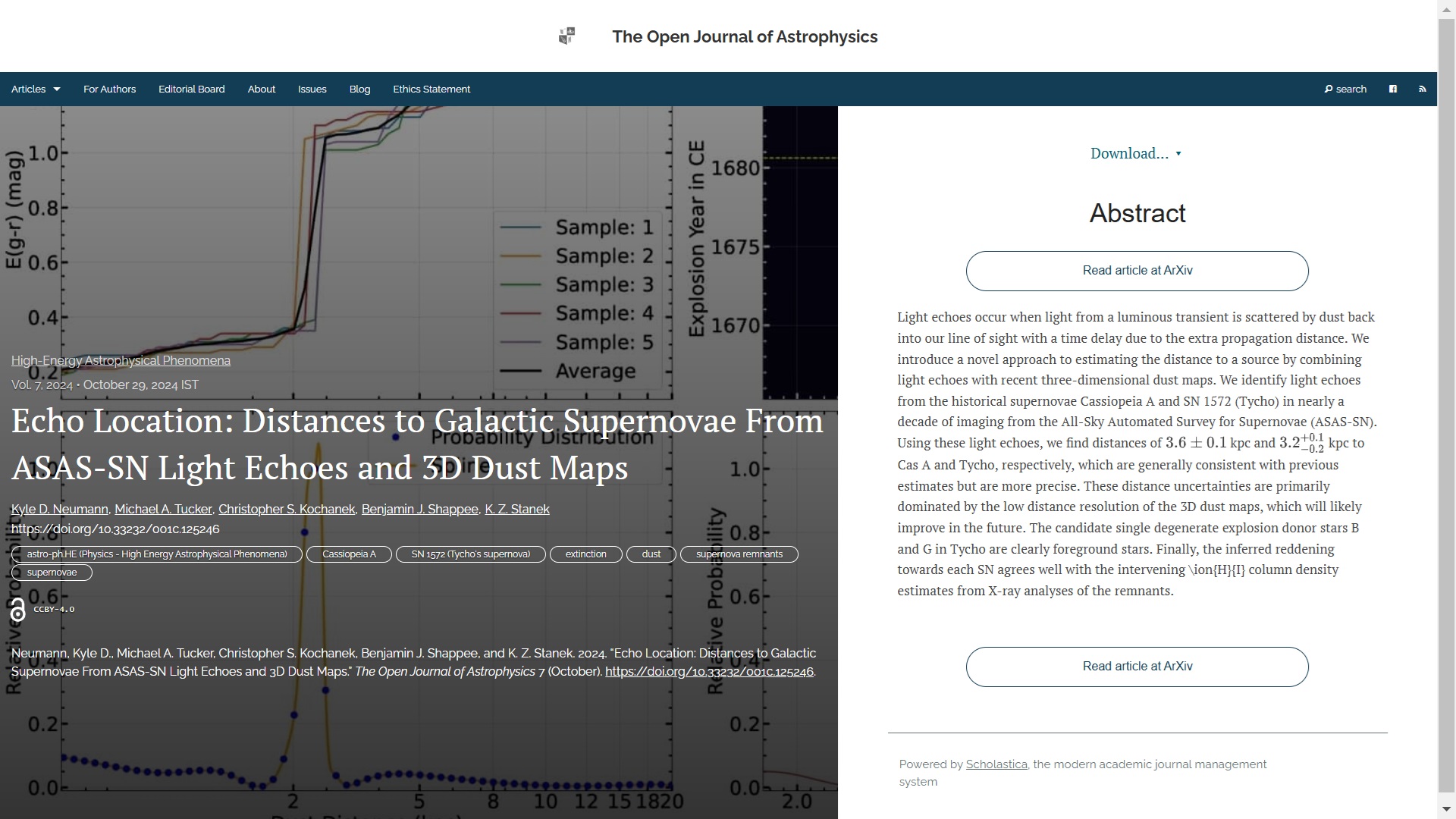
The second paper to present, also published on Tuesday 29th October 2024, is “Echo Location: Distances to Galactic Supernovae From ASAS-SN Light Echoes and 3D Dust Maps” by Kyle D. Neumann (Penn State), Michael A. Tucker & Christopher S. Kochanek (Ohio State), Benjamin J. Shappee (U. Hawaii), and K. Z. Stanek (Ohio State), all based in the USA. This paper is in the folder marked High-Energy Astrophysical Phenomena and it presents a new approach to estimating the distance to a source by combining light echoes with recent three-dimensional dust maps with application to supernova distances.

The overlay looks like this:


You can read this paper directly on the arXiv here.

Last, but by no means least, comes  “A deconstruction of methods to derive one-point lensing statistics” by Viviane Alfradique (Universidade Federal do Rio De Janeiro, Brazil), Tiago Castro (INAF Trieste, Italy), Valerio Marra (Trieste), Miguel Quartin (Rio de Janeiro), Carlo Giocoli (INAF Bologna, Italy), and Pierluigi Monaco (Trieste).  Published in the folder marked Cosmology and NonGalactic Astrophysics, it describes a comparative study of different methods of approximating the one-point probability density function (PDF) for use in the statistical analysis of gravitational lensing.

Here is a screengrab of the overlay:


To read the accepted version of this on the arXiv please go here.

That’s it for this week. I hope to post another update next weekend, by when we might well have reached a century for this year!

Trinity Talk

Posted in Biographical, LGBTQ+ on November 1, 2024 by telescoper

Today I gave the inaugural EDI Seminar at the Department of Physics of Trinity College, Dublin, in the Lecture Theatre formerly known as Schrödinger. I wasn’t sure what to expect ahead of the event, but it was nice to see a large and attentive audience. At the end I was given the above book and whisked off to a pleasant lunch followed by a chat with some of the PhD students.

I’m going to a concert at the National Concert Hall later this evening. It being a mild evening, and there being no point making a trip to Maynooth and back,  I decided to walk around Dublin for a bit.

Management Memes

Posted in Biographical, Maynooth on November 1, 2024 by telescoper

I’m out all day giving a talk at the College of the Holy and Undivided Trinity of Queen Elizabeth, near Dublin, so in lieu of a proper post here’s another Management Meme.