Archive for January, 2025

Marking Progress

Posted in Biographical, Education, mathematics, Maynooth with tags , on January 14, 2025 by telescoper

I’ve been at home marking examinations almost all day and have decided to knock off until tomorrow when hopefully I can finish the job. I say almost all day because I took a break this afternoon to back to campus to collect some papers that I didn’t get yesterday because they were from students sitting the examination for various reasons in alternative venues on campus rather than the main examination room.

What I do with examination scripts is mark one question at a time rather than one script at a time. What I mean by that is that I go through every script marking all the attempts at Question 1, then I start again and do all the Questions 2, etc. I find that this is much quicker and more efficient than marking all the questions in each script then moving onto the next script. The reason for this is that I can upload into my mind the model answer for Question 1 so that it stays there while I mark dozens of attempts at it so I don’t have to keep referring to the marking scheme. Other advantages are that it’s easier to be consistent in giving partial credit when you’re doing the same question over and over again, and that also you spot what the common mistakes are more easily.

It’s a fairly monotonous job and I find my concentration starts to wander if I try to do too many in one go. Fortunately the exam papers are organized in batches (separated by elastic bands as in the photograph) so I usuallly take a break – as a sort of self-reward- after each batch to break things up. Each batch usually takes a couple of hours or so, so the breaks often end up as times to have lunch and tea. In terms of the timing it’s rather like a game of cricket, actually.

Today I corrected Question 1 in two batches before lunch, then another between lunch and tea. At that point I took a walk into town to do a few errands and then collected the remaining scripts from campus, which I have now just finished correcting. Some people will accuse me of being lazy, taking breaks like this, but I think it’s more efficient to do it this way. Trying to mark examinations for hours on end inevitably leads to more errors, so in the long run it takes longer to complete the job. Slow and steady does it.

I remember using a similar approach when I wrote my thesis many years ago. That’s a much bigger job, of course, but I found what worked for me was to plan out each chapter in terms of sections of roughly equal length, write each in turn and take a break when I’d finished it. Writing a thesis of around 200 pages may seem a daunting task, but if you split it into 1000-word chunks spread over three months or so it’s quite manageable – and you can plan to take time out for relaxtion along the way to avoid getting too burned out by the process.

Anyway, I’ve now finished all the attempts at Question 1 in this examination, including those in the extra scripts I picked up today. Question 1 consists of a set of short problems and is altogether worth 50% of the examination mark, so I’m actually abouty halfway through the marking. There three questions left, each longer than the pieces of Question 1 and worth 25% of the overall mark. Students are supposed to answer two. I’ll start on Question 2 in the morning and hopefully by this time tomorrow evening I will have marked all three, and that will be that. Until the next one…
Marking Time Again

Posted in Education, mathematics, Maynooth with tags , on January 13, 2025 by telescoper

Lecturers at Maynooth University are supposed to be available on the telephone to deal with queries from students concerning their examinations. This morning I was “on call” for the first time in 2025 and indeed the first time since 2023. Since I live in Maynooth I decided to come into campus in case of a query so I could go to the examination hall to deal with it if required. In the event, however, the examination passed off without incident and nobody called.

I wasn’t twiddling my thumbs all morning though. It seemed a good opportunity to go through the accumulated coursework for this module applying various exemptions for medical or other reasons so that when I’ve marked the scripts I can immediately combine the results with the CA component.

So here I am again, with a stack of an examination scripts to mark. The picture shows about 50 papers, part of the collection from my module on Differential Equations and Transform Methods. I want to get them out of the way as quickly as possible as I have another paper coming up next week and have a lot of other things to do before term starts at the beginning of February. I plan to spend the next couple of days correcting these, adding up the marks, combining those with the coursework, and preparing everything for upload to the system. I want to get this task out of the way as quickly as possible as I have another paper coming up next week and have a lot of other things to do before term starts at the beginning of February.

A Dose of Salts

Posted in Biographical with tags , , , , , on January 12, 2025 by telescoper

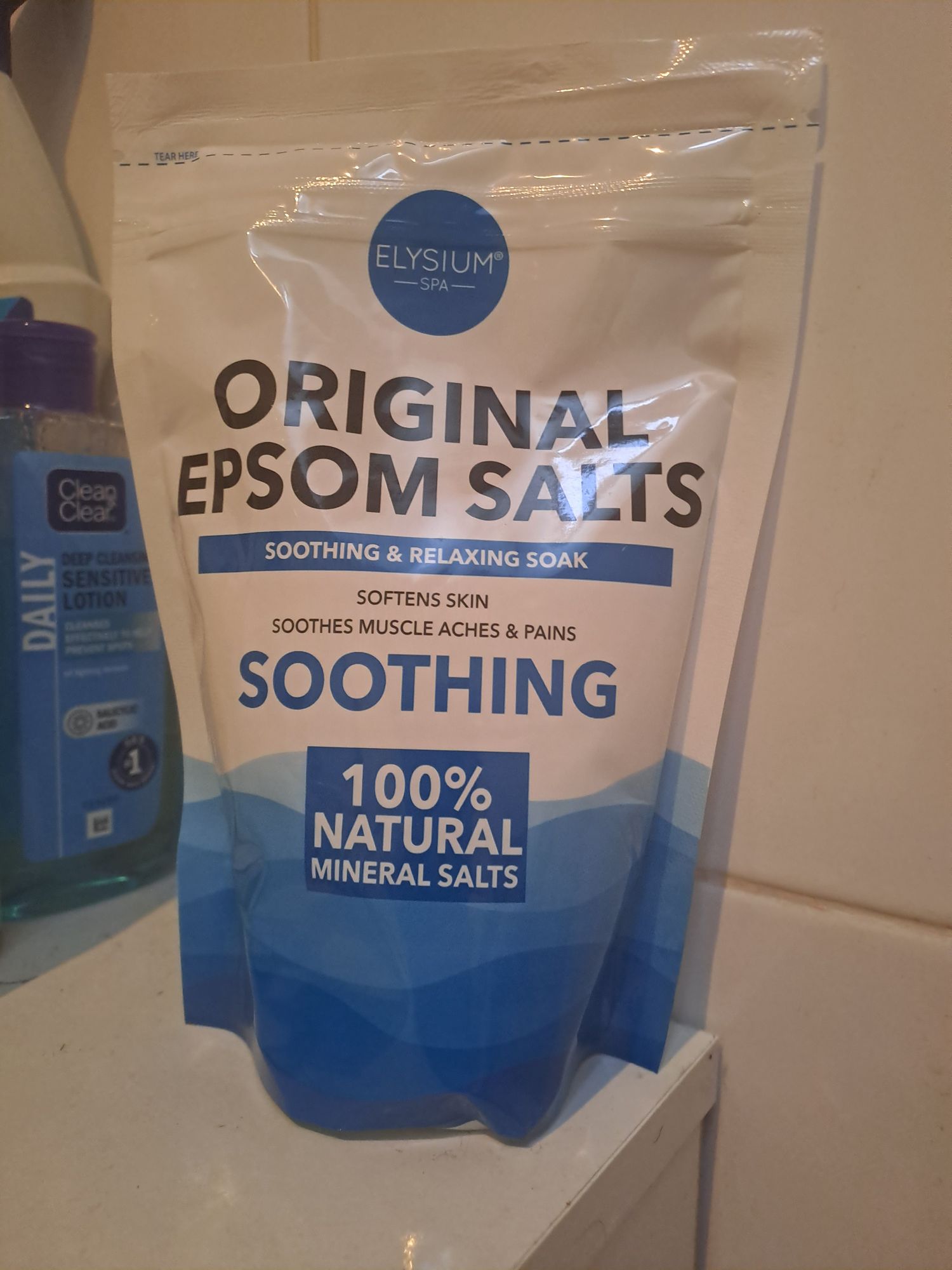
When I was a lad the most widespread use of Epsom Salts (Magnesium Sulphate Heptahydrate) was as a laxative (taken orally) and I believe it is still use for that purpose nowadays. Incidentally, the phrase “a dose of salts” (as in “it went through me like a dose of salts”) is a reference to this property.

It was recently suggested to me, however, that a warm bath with Epsom Salts may be of therapeutic value for arthritis. Although I have had fewer problems with my arthritic knees since I started on a regular course of injections, I did experience a few issues during the recent cold spell so when I saw Epsom Salts on sale in a local supermarket I thought I’d give them a go.

My main method of ablution these days is a shower – mine is of walk-in variety – but I do also have a bathtub so I’ve been experimenting with regular hot baths. Bathing in warm water definitely reduces arthritic discomfort, but the question is whether adding Epsom Salts (or any other kind of salt, e.g. Dead Sea salt) actually makes a positive difference. One can ask the same question about natural hot springs (such as in Bath) which have long been believed to have curative properties, but whether this is just because they are warm or because of the minerals presents is a question to which I do not know the answer. Most of the medical studies I’ve seen on this rely on tiny samples and are very unconvincing.

With specific reference to Epsom Salts, I’ve seen quite a few websites claiming that the absorption through the skin of magnesium ions has a beneficial effect. Others, however, argue that there’s no scientific evidence of any significant absorption via a salt bath. I don’t know how many ions would have to be absorbed to have an effect so I’ll have to remain agnostic on this possibility.

But adding Epsom Salts to bathwater definitely has some effects. For one thing, your skin (e.g. on your fingers) doesn’t wrinkle as in a normal bath, presumably due to some sort of osmotic process in the outer layers. Moreover, the addition of magnesium sulphate to water does change several bulk properties: the specific gravity increases significantly, as does the thermal conductivity, while the heat capacity goes down. The flow of heat away from inflamed areas may be a factor, and it may alter blood circulation. I’m not a medical expert but I would imagine that this is more likely to help with muscle pain than arthritis. Notice that the packaging only mentions “muscle aches and pains”.

I doubt if the specific gravity effect is important in a hot bath at home. It will make a person more buoyant in the water, but my bathtub isn’t big enough to float freely in. This does remind me, however, of the time when I was a graduate student and in response to a suggestion made by a friend I visited a place called the Floatarium, which offered a go in an isolation tank for £15 an hour. That was quite a lot of money in the 1980s! The tank was in a dark and quiet room, and the water was a strong solution of Epsom Salts (so the subject can float easily in it), and held approximately at body temperature, the idea being to deprive the brain of sensory input. The things I remember most about this experience were: (i) almost immediately losing track of the passage of time; and (ii) losing perception of where my hands and feet were. The latter was quite disconcerting – I felt my feet floating off into the distance. Overall it was quite an interesting experience, but not one that I was anxious to repeat (especially not at £15 a go).

Anyway the results of my experimental baths are, as you would probably expect, inconclusive. I have taken baths with Epsom Salts as well as with more commonly avalaible commercial bath salts; the latter contain other ingredients (such aromatic oils), while Epsom salts are odourless. I soaked for around 15-20 minutes (as recommended), but could see no difference over and above a standard bath.

That’s what they call a null result.

Weekly Update from the Open Journal of Astrophysics – 11/01/2025

Posted in OJAp Papers, Open Access, The Universe and Stuff with tags , , , , , , , , , , , , on January 11, 2025 by telescoper

Welcome to the first update of 2025 from the Open Journal of Astrophysics. For the new year we have started Volume 8. Since the last update of 2024 we have published four new papers which brings the total so far published by OJAp up to 239.

In chronological order of publication, the four papers published this week, with their overlays, are as follows. You can click on the images of the overlays to make them larger should you wish to do so.

First one up is “Weak-Lensing Shear-Selected Galaxy Clusters from the Hyper Suprime-Cam Subaru Strategic Program: I. Cluster Catalog, Selection Function and Mass–Observable Relation” by Kai-Feng Chen (MIT, USA), I-Non Chiu (National Cheng University, Taiwan), Masamune Oguri (Chiba University, Japan), Yen-Ting Lin (IAAAS, Taiwan), Hironao Miyatake (Nagoya, Japan), Satoshi Miyazaki (Nat. Astr. Obs. Japan), Surhud More (IUCAA, India), Takashi Hamana (Nat. Astr. Obs. Japan), Markus M. Rau Carnegie Mellon University, USA), Tomomi Sunayama (Steward Obs., USA), Sunao Sugiyama (U. Penn, USA), Masahiro Takada (U. Tokyo, Japan).

This paper, which was published on Monday 6th January 2025 is in the folder Cosmology and NonGalactic Astrophysics, discusses steps towards towards the extraction of cosmogical constraints from a sample of galaxy clusters selected via weak gravitational lensing

Here is a screen grab of the overlay, which includes the abstract:

You can find the officially accepted version of the paper on the arXiv here.

The second paper to announce, published on 7th January 2025 and also in the folder Cosmology and NonGalactic Astrophysics, is “Cosmology on point: modelling spectroscopic tracer one-point statistics” by Beth McCarthy Gould (Newcastle U., UK), Lina Castiblanco (Bielefeld, Germany), Cora Uhlemann (Bielefeld, Germany), and Oliver Friedrich (LMU, Germany).

You can see the overlay here:

The accepted version of this paper can be found on the arXiv here.

The third paper, published on 9th January 2025, also in the folder Cosmology and NonGalactic Astrophysics, is “Probing Environmental Dependence of High-Redshift Galaxy Properties with the Marked Correlation Function” by Emy Mons and Charles Jose (Cochin University of Science and Technology, India). This paper uses the marked two-point correlation function to measure the environmental dependence of galaxy clustering at high redshift.

Here is the overlay:

The final version accepted on arXiv is here.

Last of this quartet, also published on 9th January 2025, but in the folder Astrophysics of Galaxies is “The infrared luminosity of retired and post-starburst galaxies: A cautionary tale for star formation rate measurements” by Vivienne Wild (St Andrews, UK), Natalia Vale Asari (Universidade Federal de Santa Catarina, Brazil), Kate Rowlands (STScI, Sara L. Ellison (U. Victoria, Canada), Ho-Hin Leung (St Andrews), Christy Tremonti (U. Wisconsin-Madison, USA).

The paper proposes an extension of the semi-analytic formalism to weak lensing and thermal Sunyaev-Zeldovich (tSZ) fields directly on the full-sky, with an emphasis on higher-order correlations. The overlay is here:

You can find the official accepted version on the arXiv here.

That’s all for this week. I’ll do another update next Saturday.

The Fires of Los Angeles

Posted in Biographical, Euclid with tags , , , , on January 10, 2025 by telescoper

The wildfires that broke out on 7th January in various parts of Los Angeles have now been raging for three days and, initially driven by very high winds, have destroyed thousands of properties. Almost 200,000 people have been forced to evacuate their homes but so far it seems the loss of life has been limited. Let’s hope it stays that way, though realistically the death toll will probably rise.

The fire that broke out in the Eaton Canyon is still burning over a large area to the North-East of Los Angeles near Pasadena, which is the location of the California Institute of Technology (Caltech), NASA’s Jet Propulsion Laboratory (JPL) and the Carnegie Observatories. Through astrophysics and cosmology I know quite a few people working at these establishments, including members of the Euclid Consortium. As far as I know neither place has been directly affected by the fires, though they have been closed due to heavy smoke and wind damage. I found out today, however, that some colleagues working there and living nearby have lost their homes and all their possessions to the flames. At least they themselves – and their families – are safe and accounted for but it must be a very grim time for them.

When the smoke has cleared I hope they will get practical assistance needed to start that process. In that vein, I see that a Caltech and JPL Disaster Relief Fund has been set up. You might consider making a donation.

On a more personal note I have an old and dear friend – not an academic – who lives near Santa Monica in the area marked on the map as Palisades Fire. Looking at the satellite pictures it seems his home has been destroyed too. It was, however, placed under an evacuation order some time ago. I assume he complied and is safe and sound, though I have so far been unable to contact him.

My thoughts are with anyone affected by these terrible events.

Exam Time Again

Posted in Education, Maynooth with tags , , , on January 9, 2025 by telescoper

The January examination period starts tomorrow (10th January), so I thought I’d do a quick post on the topic of examinations. First of all let me wish the very best of luck everyone at Maynooth or elsewhere taking examinations in the next few weeks. I hope at least that the exam halls are nice and warm!

As the first examination for which I have responsibility is not until Monday 13th – unlucky for some! –  I’ll have to wait to find out how any of my students have done but let me take this opportunity to pass on a few quick tips.

  1. Try to get a good night’s sleep before the examination and arrive in plenty of time before the start. This is especially important when there’s bad weather that may disrupt travel. It is your responsibility to get to the examination on time!
  2. Read the entire paper before starting to answer any questions. In particular, make sure you are aware of any supplementary information, formulae, etc, given in the rubric or at the end.
  3. Start off by tackling the question you are most confident about answering, even if it’s not Question 1. This will help settle any nerves.
  4. Don’t rush! Students often lose marks by making careless errors. Check all your numerical results on your calculator at least twice and – PLEASE – remember to put the units!
  5. Don’t panic! You’re not expected to answer everything perfectly. A first-class mark is anything over 70%, so don’t worry if there are bits you can’t do. If you get stuck on a part of a question, don’t waste too much time on it (especially if it’s just a few marks). Just leave it and move on. You can always come back to it later.

Readers of this blog are welcome to add other tips through the comments box below!

A Google Remedy

Posted in Uncategorized with tags , , on January 8, 2025 by telescoper

A few days ago I posted an article moaning about the enshittification of Google Search. Usually posting a piece like that achieves nothing except letting off a bit of steam. This time, however, one of the comments suggested a way to decrapify Google Search. Thanks to Andy Newsam for the tip.

The remedy is udm14.com:

If you click on udm14.com you will find out more about this useful site including how to share it. It doesn’t solve all the problems with Google, which are many and various, but it’s a start…

Failing to Teach Particle Physics

Posted in Biographical, Education, The Universe and Stuff with tags , , , on January 7, 2025 by telescoper

As the Christmas holiday draws to a close and I begin thinking about the possibility that sooner or later, in due course, at some point in the future, in the fullness of time, all things considered, when all is said and done, in the end, I will have to start teaching again. Thinking about this is preferable to thinking about the stack of exam marking that I will have to contend with shortly.

One of the modules I am down to teach in the Spring Semester is particle physics, a subject I haven’t taught for well over a decade, so I have been looking through a box of old notes on the subject. Doing so I remembered that I had to explain neutrino oscillations, a process in which neutrinos (which have three distinct flavour states, associated with the electron, mu and tau leptons) can change flavour as they propagate. It’s quite a weird thing to spring on students who previously thought that lepton number was always conserved so I decided to start with an analogy based on more familiar physics.

A charged fermion such as an electron (or in fact anything that has a magnetic moment, which would include, e.g. the neutron)  has spin and, according to standard quantum mechanics, the component of this in any direction can  can be described in terms of two basis states, say “up” for the +z-direction and “down” for the opposite (-z) represented schematically like this:

In this example, as long as the particle is travelling through empty space, the probability of finding it with spin “up” is  50%, as is the probability of finding it in the spin “down” state, the probabilities defined by the square of the amplitudes. Once a measurement is made, however, the state collapses into a definite “up” or “down” wherein it remains until something else is done to it. In such a situation one of the coefficients goes to zero and the other is unity.

If, on the other hand, the particle  is travelling through a region where there is a magnetic field the “spin-up” and “spin-down” states can acquire different energies owing to the interaction between the magnetic moment of the particle and the magnetic field. This is important because it means the bits of the wave function describing the up and down states evolve at different rates, and this  has measurable consequences: measurements made at different positions yield different probabilities of finding the spin pointing in different directions. In effect, the spin vector of the  particle performs  a sort of oscillation, similar to the classical phenomenon called  precession.

The mathematical description of neutrino oscillations is very similar to this, except it’s not the spin part of the wavefunction being affected by an external field that breaks the symmetry between “up” and “down”. Instead the flavour part of the wavefunction is “precessing” because the flavour states don’t coincide with the eigenstates of the Hamiltonian that describes the neutrinoes. For this to happen, however, different neutrino types must have intrinsically different energies  (which, in turn, means that the neutrinos must have different masses), in quite  a similar way similar to the spin-precession example.

Although this isn’t a perfect analogy I thought it was a good way of getting across the basic idea. Unfortunately, however, when I subsequently asked an examination question about neutrino oscillations I got a significant number of answers that said “neutrino oscillations happen when a neutrino travels through a magnetic field….”.

Sigh.

Neutrinos have no magnetic moment so don’t interact with  magnetic fields, you see…

Anyhow, I’m sure there’s more than one reader out there who has had a similar experience with an analogy that wasn’t perhaps as instructive as hoped. Feel free to share through the comments box…

Twelfth Night – Louis MacNeice

Posted in Maynooth, Poetry with tags , , , on January 6, 2025 by telescoper
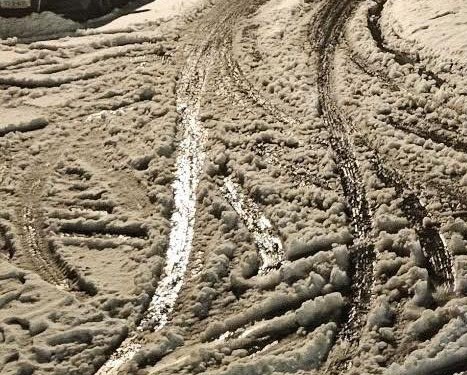
Snow-happy hicks of a boy’s world –
O crunch of bull’s-eyes in the mouth,
O crunch of frost beneath the foot –
If time would only remain furled
In white, and thaw were not for certain
And snow would but stay put, stay put!

When the pillar-box wore a white bonnet –
O harmony of roof and hedge,
O parity of sight and thought –
And each flake had your number on it
And lives were round for not a number
But equalled nought, but equalled nought!

But now the sphinx must change her shape –
O track that reappears through slush,
O broken riddle, burst grenade –
And lives must be pulled out like tape
To measure something not themselves,
Things not given but made, but made.

For now the time of gifts is gone –
O boys that grow, O snows that melt,
O bathos that the years must fill –
Here is dull earth to build upon
Undecorated; we have reached
Twelfth Night or what you will … you will.

by Louis MacNeice (1907-1963)

Google Garbage

Posted in History, mathematics with tags , on January 5, 2025 by telescoper

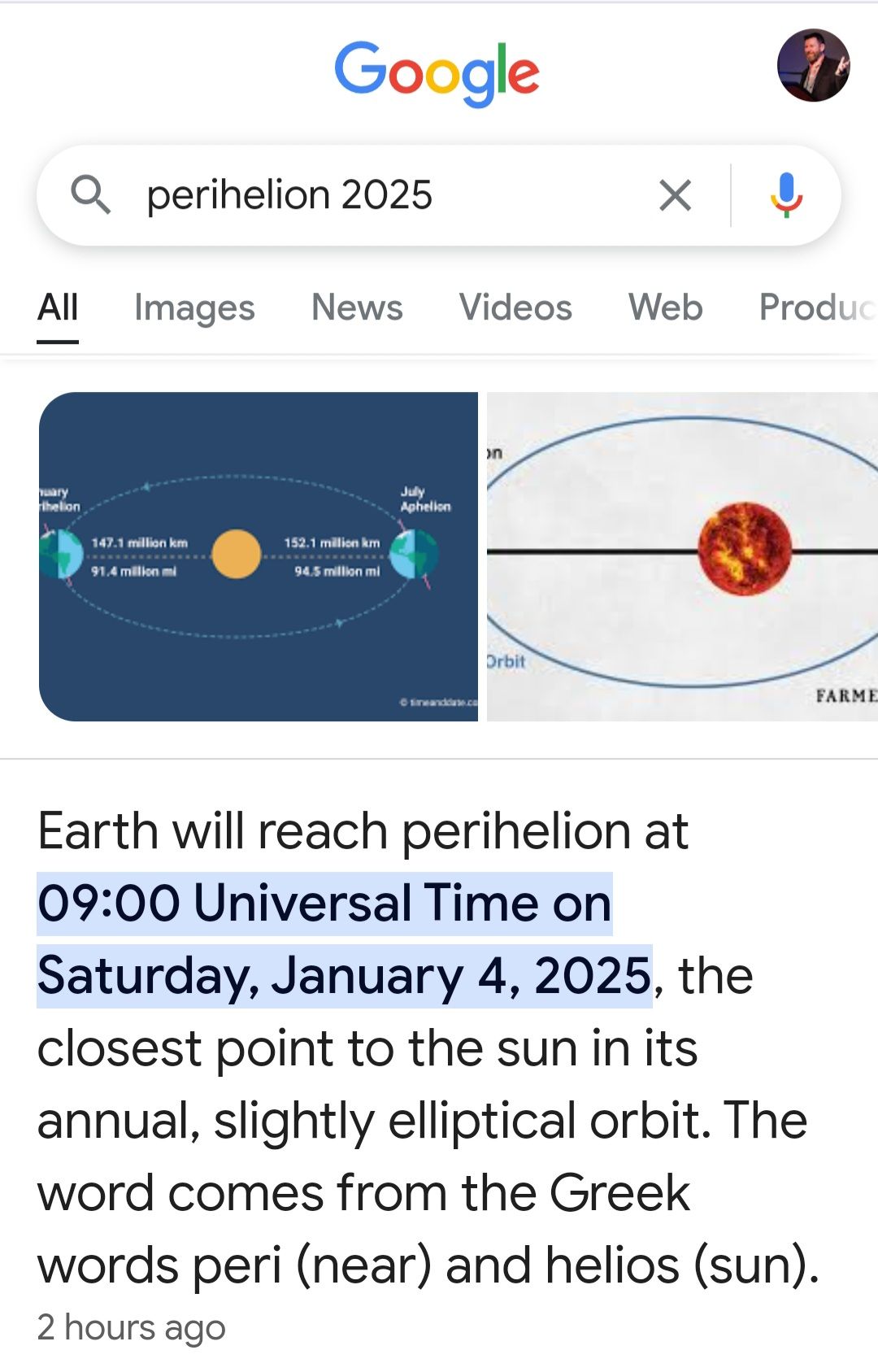
In the course of double-checking the time of perihelion for yesterday’s post I did a quick Google search. What came up first was this:

Google search results nowadays are prefaced by a short summary like this one, presumably generated by some sort of AI. This one – like many others I’ve seen recently – is just plain wrong. The time of perihelion was 13.28 Universal Time, not 09.00.

I am old enough to remember when Google Search first appeared in 1998. It was so much better than other search engines at that time, largely because of the PageRank algorithm; see this piece for a bit of the history and the reason it worked so well. Some years ago, however, Google Search underwent a transition from being a useful facility for web browsers to a piece of adtech useful only for marketing companies who pay to have their sites artificially boosted. Every time you do a search nowadays you have to scroll through a deluge of promoted pages that have very little to do with what you searched for. Google is now so corrupted as to be virtually useless. Adding garbled AI junk to the mixture is just making it worse. It’s not only frustrating but potentially dangerous. Information can be manipulated for purposes other than selling things; the systematic spread of misinformation by those in power has potentially catastrophic consequences.