
Archive for April, 2025
Caisearbhán
Posted in Irish Language, Maynooth on April 11, 2025 by telescoperSonnet No. 19
Posted in Poetry with tags Poem, Poetry, Sonnet, Sonnet 19, William Shakespeare on April 11, 2025 by telescoperDevouring time, blunt thou the lion's paws
And make the earth devour her own sweet brood,
Pluck the keen teeth from the fierce tiger's jaws
And burn the long-liv'd phoenix in her blood,
Make glad and sorry seasons as thou fleet'st,
And do what e'er thou wilt, swift-footed time,
To the wide world and all her fading sweets:
But I forbid thee one most heinous crime,
O carve not with thy hours my love's fair brow,
Nor draw no lines there with thine antique pen,
Him in thy course untainted do allow
For beauty's pattern to succeeding men.
Yet do thy worst, old time, despite thy wrong,
My love shall in my verse ever live young.
by William Shakespeare (1564-1616)
(I don’t know why it’s been such a long time since I last posted one of Shakespeare’s sonnets.)
Time Passes
Posted in Biographical, Education, Maynooth with tags Annual Appraisal, Developmental Review, Getting Old, Maynooth University on April 10, 2025 by telescoperI’ve been feeling very tired this week, probably as an after-effect my flying visit to Cardiff at the weekend. I need to learn to adjust the way I plan such trips in view of the fact that I’m getting on a bit. I tried to pack in a lot of visiting and walking about on Saturday which younger me would have managed fine, but I should have taken it easier. I was worn out when I returned to work on Monday and it has taken me several days to get back to normal. I definitely don’t have the energy I used to have. It’s not so much that I mind getting older, it’s just that I have to learn to accept that I need to be a bit less ambitious when I make plans, especially when that involves travelling. I don’t really understand what makes travelling so tiring, as it mostly involves sitting down, but I’ve always found it so, and it’s getting more and more noticeable as time passes.
Term time is passing too. This morning I gave my last 9am Computational Physics lecture of the Semester. This is only Week 9 of 12 teaching weeks, but lectures finish early for this module because for the last few weeks of term the students are working, in teams, on their projects which form an important part of the module. A week today we take a break for Easter (Good Friday being 18th April this year). There will then be a very welcome week off before we return for the last leg of term and, of course, the examinations followed by the marking thereof.
After this morning’s lecture, on the way back to the Department, I was talking to some students about the forthcoming May examinations. I was a bit taken aback to realize that I did my finals precisely 40 years ago. I went on from my undergraduate degree at Cambridge to a PhD DPhil at Sussex. It took me three years to complete that and become a postdoc. Now there’s only a three-year period between now and my retirement.
This week I had my Developmental Review, the first one I’ve ever had at Maynooth. In other places this is called an Annual Appraisal or some such name. I conducted quite a lot of these when I was at Sussex, and was on the receiving end at Cardiff a few times too, but the Developmental Review scheme has only just been implemented in Maynooth University and in any case I am now just an appraisee (reviewee), not an appraiser (reviewer). The idea of these reviews is that the reviewee agrees some goals in a meeting with the reviewer and in two years’ time we meet again and see how well I have managed. In my experience can be a useful process for people who want to advance their careers by getting promoted. In my case those I have neither the desire nor the possibly to get promoted so it’s all a bit futile. I’ll be retiring in the not-too-distant future anyway. There are one or two things I want to finish before I retire so I wrote them on the form. All staff have to go through the process, so that box is now ticked and I can now move on until my next review (which will definitely be the last!)
R.I.P. Jerry Ostriker (1937-2025)
Posted in R.I.P., The Universe and Stuff with tags Astrophysics, Cosmology, Dennis Overbye, galaxy formation, Jeremiah P. Ostriker, Jerry Ostriker, Princeton on April 9, 2025 by telescoper
Once again I find myself using this blog to pass on sad news. This time it is of the death of renowned astrophysicist Jerry Ostriker (pictured left in 2012), who passed away on Monday 6th April 2025 just a week before his 88th birthday.
Jeremiah Paul Ostriker (to give his full name) was an extremely energetic, versatile and influential theorist who worked on a wide range of problems in diverse areas of astrophysics and produced a number of classic papers. Close to my own specialism I would quote two in particular: one written with Jim Peebles in 1973 about the stability of galactic disks; and the other with Martin Rees in 1977 about the role of gas cooling and fragmentation in determining the size of galaxies and clusters. He also did much to establish the use of hydrodynamic simulations in cosmology and was an early adopter of the current standard cosmological model, including a cosmological constant. He worked on many other things too, including pulsars and galactic nuclei.
I only met Jerry Ostriker a few times, mainly at conferences – where he was never shy to contribute to discussions after talks – but also once back in the 1990s when I was a visitor Princeton (where he was Professor). I didn’t have much time to talk to him then as he always seemed to be on the go, so I never really got to know him personally. After spending most of his career in Princeton, including a spell as Provost, in 2001 Ostriker moved to Cambridge for a short stint as Plumian Professor, before returning to Princeton.
There is a very nice obituary of Jerry Ostriker by Dennis Overbye in the New York Times.
Rest in peace, Jerry Ostriker
A Master Class in Destroying Trust
Posted in Open Access with tags academic publishing, Clarivate on April 8, 2025 by telescoperFor (hopefully) obvious reasons, I’m taking the liberty of republishing, with permission, the following article, originally published here, about the egregious behaviour of the company Clarivate which, among other activities, is responsible for assigning Journal Impact Factors. Please read it if you want to understand why nothing Clarivate does should be trusted. The author, Sunshine Carter, is director of collection strategy and e-resource management at the University of Minnesota. The article represents the author’s personal views, not those of her employer.
–0–
Clarivate’s “transformative subscription-based strategy” caught the library world flat-footed. How did this happen? And where do we go from here?
On February 18, 2025, Clarivate announced that as part of its “transformative strategy and following changes in demand from libraries” it would “phase out one-time perpetual purchases of print books” and ebooks on ProQuest’s Ebook Central platform. It would also end new perpetual archive license purchases of digital collections.
The removal of perpetual purchases from Clarivate’s sales models runs counter to library values of long-term preservation and access to information. Subscriptions might work for some libraries, but perpetual purchases are important for the preservation of the written record, especially at research institutions.
In the weeks that followed the announcement, librarians (including Siobhan Haimé and Isaac Wink) lamented the end of ownership; the loss of stable access; and the loss of a primary supplier for shelf-ready print books. They shared concerns about their ability to afford new subscriptions, the need to shift collection development strategies, and Clarivate’s fast timeline. Many pointed to Clarivate’s February 19, 2025 earnings call for 2024 Q4, which clearly articulated their goal to increase the bottom line. This was the “value creation plan (VCP)” Clarivate announced in late 2024 coming to fruition. Library and higher education consortia sent letters to Clarivate; libraries met with Clarivate, and with each other. EBSCO, a direct competitor, quickly reaffirmed its commitment to offering a variety of purchase options for libraries.
On March 4, two weeks after the initial announcement, Clarivate’s CEO, Matti Shem Tov, and president for academia and government, Bar Veinstein, issued an open letter to the library community in which they apologized that “the absence of community consultation created frustration, during already challenging times for libraries and higher education.” They also announced that Clarivate would delay the implementation date for the planned changes and guarantee perpetual access for previously purchased materials.
This response—a delay in implementation that ignores the library community’s deeper critique of the plan—rings hollow.
As we plan our next steps, we should reflect on how we got here.
Building a Community
In June 2007, I found myself in Spearfish, South Dakota at my first Ex Libris Users of North American (ELUNA) conference.
Formed in 2006 from the merger of two previous user groups, ELUNA is a not-for-profit organization representing Ex Libris customers in the Americas. Ex Libris develops and sells library software and management solutions like Alma, an integrated library management system used by over 2,500 libraries worldwide.
ELUNA members test and advocate for improvements to the Ex Libris products and have created a community of support for each other. ELUNA has a steering committee, eighteen working groups, four advisory groups, and seven communities of practice composed of staff from subscribing institutions; they interact directly with staff from Ex Libris. Over the past 20 years, through my institutions’ involvement in ELUNA, I’ve improved, conceptualized, and developed features for Ex Libris products.
At my first ELUNA conference, I was awed by how many libraries and library staff were users of and experts in Ex Libris tools and systems. I was also struck by how closely ELUNA attendees and member institutions collaborated with Ex Libris staff. Ex Libris leaders, product managers, developers, and customer support and service staff attend the ELUNA conference, where they lead trainings and give presentations.
Over the years, Ex Libris executives (including, during their tenures there, Shem Tov and Veinstein) often used the conference to announce and explain the rationale for new products or other major business decisions. During Q&A sessions, ELUNA members shared opinions—sometimes passionate—directly with Ex Libris staff and executives. There was a high level of collaboration and information-sharing between ELUNA member institutions, their staff, and Ex Libris employees.
The process of collaboration was not always smooth and didn’t always work out as ELUNA members preferred, but we worked with Ex Libris to make things happen and felt like a valued community.
A Shifting Tide
In October 2015, ProQuest, which had its own long history as a key provider of digitized primary materials and aggregator of research databases, ebooks, and streaming videos, acquired Ex Libris. This was a seismic transition for academic libraries. But despite fretting about what the acquisition would mean for both companies and their lines of products, from the outside, things seemed okay: There was some consolidation—for example, of customer support desks—but the products themselves didn’t change. Ex Libris retained its moniker, adding “A ProQuest Company” to its logo and branding. Several Ex Libris executives—including Shem Tov and Veinstein—made their way into ProQuest leadership.
And then, in late 2021, ProQuest was acquired by Clarivate.
Though Clarivate’s current leadership—including Shem Tov and Veinstein—have a strong history of collaborating with their customers, they didn’t consult with libraries or publishers before their February 18 announcement. Clarivate’s failure to involve their customers in this decision, especially those in government and academia, shows that they prioritized profit over relationships.
The exclusion of libraries was intentional, not an oversight. In a moment when university budgets are facing profound and intense technological, financial, and governmental pressures, Clarivate’s fast and furious timeline—even with a slight reprieve—is out of touch.
Vendors and publishers seek to make money. Library professionals promote the freedom to read and unfettered access to content. Of course the goals of vendors and library professionals can be in conflict. And yet, in our work with vendors, as exemplified in my experience with ELUNA—a service provided by libraries and their employees to a corporation, in the form of a nonprofit, which we described as a community—it has at times been easy to feel as if we all share a commitment to libraries and librarianship.
We do not.
Where Do We Go From Here?
Clarivate is omnipresent on academic campuses, although it is not alone. And, like other large content and information services providers, it has shifted its focus. In an article about Elsevier and its parent company, RELX, Christien Boomsma writes, “Publishing is no longer the main focus for RELX and its competitors; instead, they have become data brokers. They sell data to insurance companies for risk analysis, to banks for fraud detection, to universities to assess their performance, and, especially egregious, to the US Immigration Service to target illegal immigrants.” In addition to a new focus on data, Clarivate is investing heavily in artificial intelligence, an indicator of expected market and revenue gains.
Clarivate’s dismissal of one-time purchases is alarming, but when you consider the company’s larger strategy, it makes sense. On the Q4 earnings call, Shem Tov refers to one-time purchases as “a drain.” He also says that Clarivate has “retained financial advisers to help us in evaluating strategic alternatives to unlock value. This may include divesting business units or an entire segment.” He goes on to say, “There is no guarantee that anything actionable will arise from this process,” but considering Clarivate will no longer sell books, Clarivate’s furthering its investment in data should make us wary.
Going forward, libraries and library staff should approach vendors with absolute clarity about the values governing our respective work and the nature of our relationships. We must:
Increase bibliodiversity in the market and our collections (Haimé) by:
- Purchasing materials directly from smaller and/or more diverse publishers
- Investing in academy-owned open access infrastructure and publishing that is sustainable, equitable, and diverse
- Investigating alternative software, tools, and content providers; consider developing options in-house (or in collaboration with other institutions)
- Divesting from resources that no longer serve our needs or align with our values
Speak up by:
- Sharing concerns with library leadership
- Pushing vendors on issues that conflict with our values
- Requesting meetings with vendor leadership
Use our collective voices to:
- Discuss issues with institutional, system, regional, consortia, or association groups
- Bring shared concerns to vendors, collectively
- Reclaim our space; insist on being at the table (especially concerning the development of AI-integrated tools and the use of data collected about our institutions or our users)
- Set guiding principles for interacting with publishers and vendors
Incorporate limitations into signed agreements. Make sure to:
- Get everything in writing, via a contract
- Limit vendors’ use of the data they collect from our users and institutions
Offer library staff training on:
- Current vendor issues and trends with vendors
- Ethics and conflicts of interest
We should remain open to collaboration but remember that profit drives many of the companies libraries rely on. Even in the face of great challenges and unbelievable changes, we can and should continue to advocate for our core values.
10.1146/katina–031925-1
Advice on the Proper Response to Trump’s Tariffs
Posted in Politics with tags Donald Trump, Reciprocal Tariffs, Tariffs on April 7, 2025 by telescoperWith the global financial markets falling steeply in response to Donald Trump’s tariff policy (as announced last week), world leaders will have to decide whether to introduce tariffs themselves or to try to bring the turmoil to an end through negotiation.

As regular readers of this blog will know, I have a considerable reputation for tact and diplomacy and am therefore in a good position to offer advice. My considered opinion is that, although Trump is undoubtedly a jerk, and deserves to receive a knee in a suitably painful place, a knee-jerk response should be avoided at this stage. A more effective approach would be to act in a more considered way that reflects an understanding of the views of the President of the United States.
For example, Trump has insisted that the EU imposes 39% tariffs on goods from the USA. Although in reality the figure is only 3%, I feel it would be impolite and undiplomatic to contradict such an eminent person as the President of the United States of America. Therefore, as a mark of respect and reconciliation, the EU should immediately sets its tariffs at a level of 39%. I am confident that this will lead to a speedy clarification of the economic situation.
It’s probably also best to avoid mentioning too often that Donald Trump is a convicted felon.
WNO Peter Grimes
Posted in Cardiff, Opera with tags Cardiff, David Kempster, Nicky Spence, Peter Grimes, Sally Matthews, Wales Millennium Centre, Welsh National Opera on April 6, 2025 by telescoper
The reason for my flying visit to Cardiff this weekend was to visit the Wales Millennium Centre to catch the opening night of Welsh National Opera’s new production of the Opera Peter Grimes by Benjamin Britten. It was a full house and, being a premiere, there was a fair sprinkling of media types among the crowd. There will no doubt be many reviews but I don’t mind adding to the verbage. I’ve seen this Opera several times and it is one of my favourites in the entire repertoire.
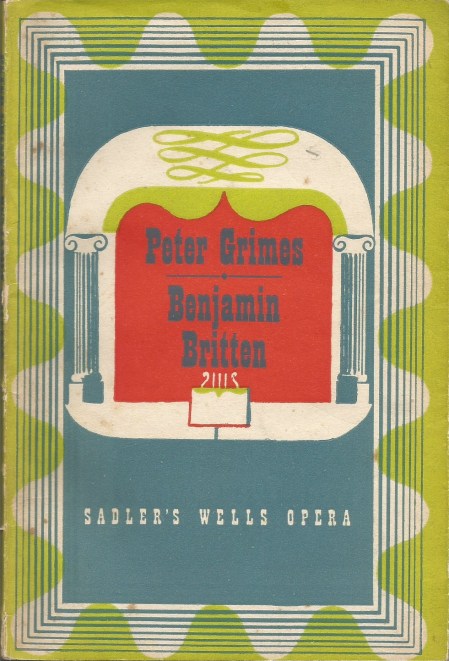
Peter Grimes premiered at Sadler’s Wells in London on 7th June 1945 almost 80 years ago. I wasn’t there – I’m not that old – but I do have an original programme from that season (left), bought in a second-hand bookshop. Perhaps surprisingly, given the grim subject matter and the intense music it was an immediate hit with audiences. Its popularity has not wained. Welsh National Opera gave its first performance in 1946, but is currently facing an uncertain future.
I’ve often heard Peter Grimes described as one of the greatest operas written in English. Well, as far as I’m concerned you can drop “written in English” from that sentence and it’s still true. I think it it’s a masterpiece, fit to rank alongside any by any composer. Searching through the back catalogue on this blog, however, I didn’t find any reviews of it, so the times I’ve seen it must have been before I started blogging back in 2008. I saw an excellent production by Opera North in Nottingham many moons ago, and also remember one at Covent Garden which stuck in my memory for its impressive staging.
Based on a character from the narrative poem The Borough by George Crabbe, the story revolves around the eponymous Peter Grimes, a fisherman, and the inhabitants of a small coastal village in Suffolk. Grimes is by no means a sympathetic character: he is an outcast with no social skills and is prone to fits of violent temper. The Opera begins witha Prologue in which Grimes is in court after the death of his apprentice; he is acquitted of any wrongdoing but the folk of the Borough – apart from the schoolteacher Ellen Orford and retired naval Captain Balstrode – still regard him as guilty. Against all advice, Grimes takes on another apprentice (John) whom he is subsequently suspected of mistreating. When the second boy dies (in accidental circumstances), Grimes flees with the crowd in pursuit. At the end he is given no choice but to take to his boat, sail it out to sea and sink it, taking his own life.
For me the key to the success of this Opera is its treatment of the character of Peter Grimes. In the original poem, Crabbe depicts Grimes is a monstrous figure rather like a pantomime villain. Britten is much more sympathetic: Grimes is misunderstood, a misft who as never been socialised; he just doesn’t know the rules that he should conform to. That’s his tragedy. Britten’s Grimes is not a villain. He’s not a hero either. At one point, shockingly, he even lashes out at Ellen Orford a lady who has shown him nothing but kindness. There’s good and bad in Grimes, like there is in all people. Who of us can say that we don’t share some of the faults of Peter Grimes? And if he’s bad what made him bad? Was he himself abused as a child? Could a little kindness along the way have made him better adjusted?
The Opera not just about Grimes, though. We get a vivid insight into the life of an isolated seaside community: the gossiping hypocrisy of the “good people” of the Borough, the debauchery of the landlady and her two “nieces” who cater to the needs of their male visitors, but above all the importance of the sea in their lives – stressed by Britten’s wonderful interludes describing dawn over the town, moonlight over the sea, and a raging storm. It also sheds light on the common practice of “buying” apprentices from the workhouse, essentially a means of slave labour, a systematic abuse far worse than anything Grimes ever does!
Anyway, to last night’s performance. In short, it was magnificent. The cast was very strong indeed: Nicky Spence shone in the role of Peter Grimes (tenor). Britten wrote the part to suit the characteristics of the voice of his partner, Peter Pears, and it doesn’t suit all tenor voices: the superb arioso When the Great Bear and Pleiades, for example, has dizzying head tones that challenges some singers. Ellen Orford was the excellent Sally Matthews (soprano) and Balstrode was the admirable baritone David Kempster.
I’ll mention three particularly memorable moments, near the end of the opera. The first is after the apprentice John has died; the gorgeous sea interlude Moonlight, which serves as a prelude to the third and final act, is played while the grieving Grimes cradles the lifeless corpse of the boy. The second is when Grimes is on the run, with the chorus calling his name and baying for blood. In fear of his life, he breaks down and is reduced to repeating his own name to himself. I’ve always found that scene unbearably moving and it was that way again last night. Finally, at the very end, the bodies of the two dead apprentices appear, one sprawled on a rock, the other standing eerily in the suspended boat which is tipped up vertically above the stage. When Grimes accepts Balstrode’s advice to drown himself, the two boys come to life; they exchange smiles, hold hands and walk off into the distance. It’s the only time Grimes looks happy in the whole performance. Only in death can he find his peace.
The staging is very spare but cleverly done. The basic set consists of a wet beach sloping up towards the rear above which from time to time a small fishing boat appears, suspended by wires, in a variety of attitudes. Otherwise there is little in the way of scenery. The clever part of this is the use of the dancers of Dance Ensemble Dawns. All the boys’ roles were in fact played by female dancers, including John the second apprentice, a non-speaking role played with great pathos by Maya Marsh whose use of body language was extraordinarily effective. Not only did they portray the boys of the village, often to be found generally misbehaving and taunting Peter Grimes, they also use their movements do evoke the storm in an extraordinarily compelling way. Not content with that they came on from time to time, in stylised fashion, to move scenery and props. The inn, for example, is conjured up by two simple props: a door frame and a window frame, held up by members of the ensemble for other members of the cast to walk or lean through. In all these contributions, the dancers were brilliant.
The simplicity of the staging probably reflects the financial crisis currently engulfing Welsh National Opera. They probably just didn’t have the money to pay for a elaborate sets, but it’s a testament to the skill and creativity of the designers that they were able to pull a triumph out of a financial disaster. I was sitting in the Circle so could see very well into the orchestra pit, where all the musicians of the Orchestra of Welsh National Opera were all wearing “SAVE OUR WNO” t-shirts. They played their hearts out. The WNO Chorus has always been excellent every time I’ve seen them, and last night was no exception.
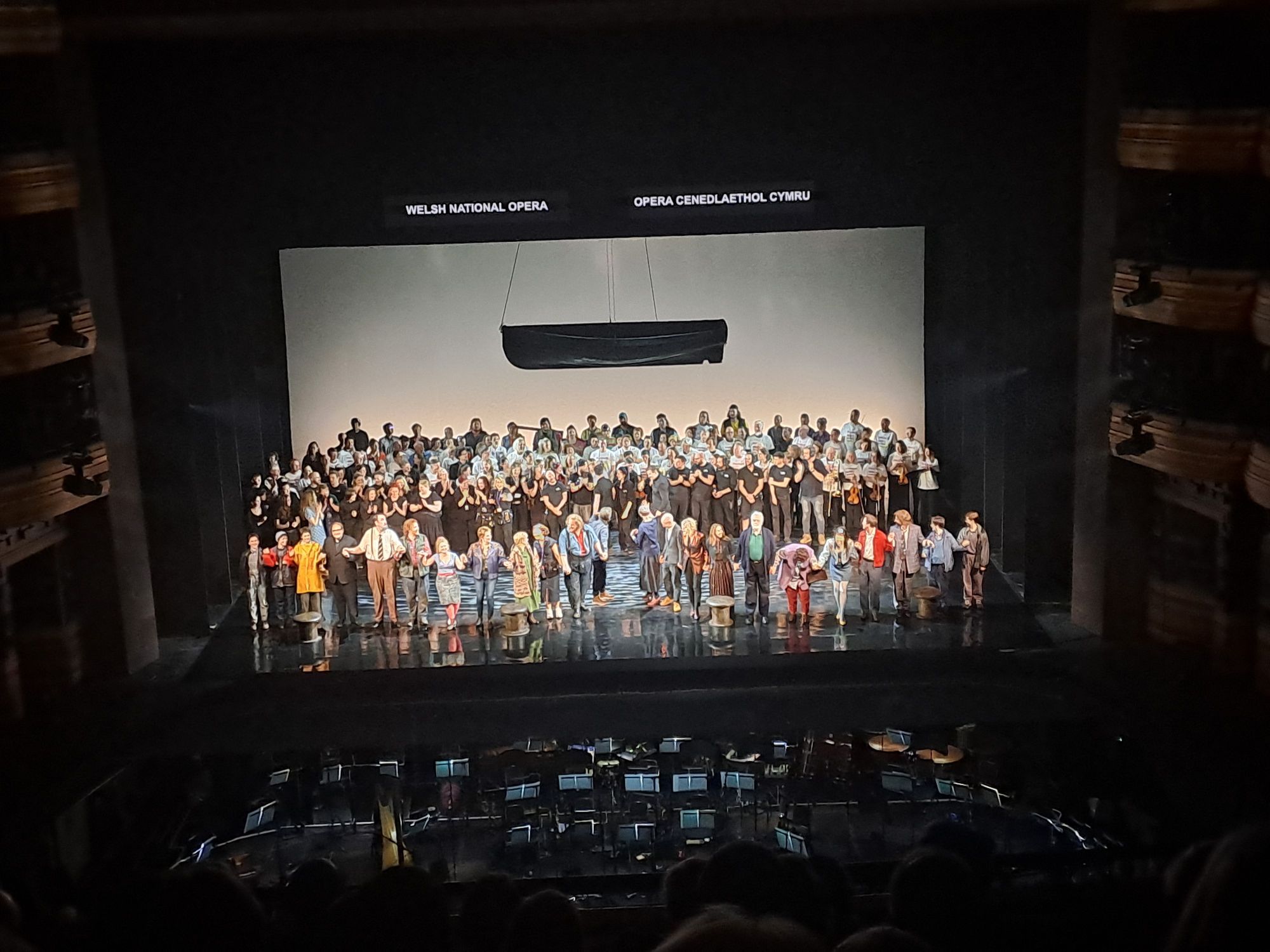
At the end of the opera, the cast, chorus and dancers were joined on stage not only by the entire orchestra (including instruments, where possible) and many members of the technical team. I’ve never seen that happen before! There were speeches by the co-directors of WNO expressing their determination to carry on through the financial turbulence that threatens to drown them. Welsh National Opera is a wonderful part of the artistic and cultural scene not only in Wales but across the rest of the UK and beyond. It just cannot be allowed to wither.
P.S. Last night’s performance was recorded for later broadcast on BBC Radio 3.
A Day in Cardiff
Posted in Art, Biographical, Cardiff, LGBTQ+, Opera, Politics with tags Art, Cardiff, Cardiff Bay, Miners' Strike, National Museum of Wales, Wales Millennium Centre on April 5, 2025 by telescoperI got up at Stupid O’Clock this morning to catch an early morning plane from Dublin to Cardiff. It was very cold when I arrived but it soon warmed up and turned into a lovely day.
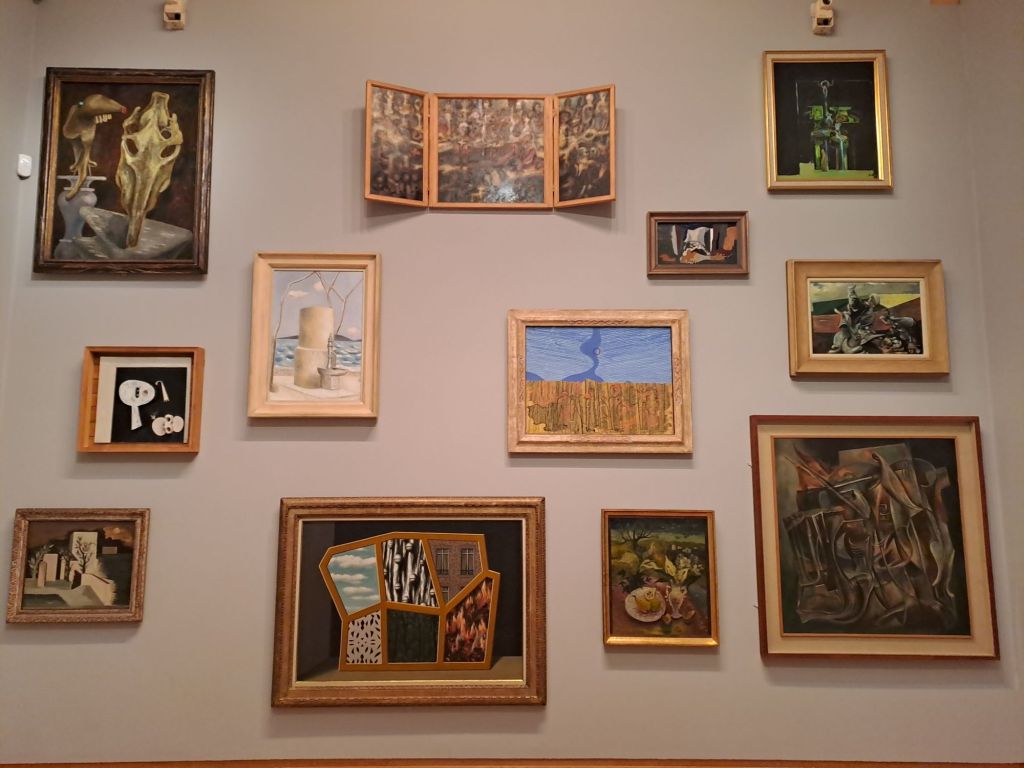
I had a nice breakfast at Bill’s when I arrived in the City then did tour of the National Museum of Wales where there is an exhibition about the Miners’ Strike of 1984/5, from which this display case caught my attention:

I also had time for a round of Name That Artist (scoring a miserable 3/12, for Sutherland, Ernst, and Magritte).
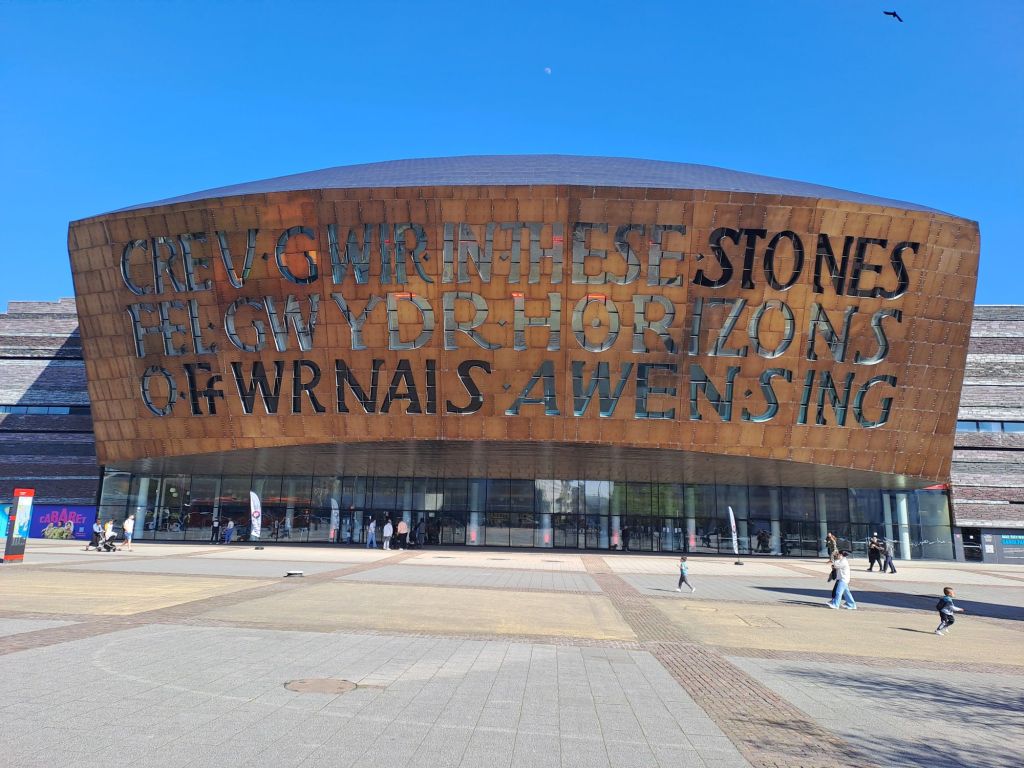
After that, I took a stroll around Bute Park before heading to my hotel in Cardiff Bay to check in and have a rest before the reason for my visit, an event which will take place here at 7pm:
I won’t be able to blog about that until I get back to Maynooth tomorrow afternoon.
Weekly Update from the Open Journal of Astrophysics – 05/04/2025
Posted in OJAp Papers, Open Access, The Universe and Stuff with tags arXiv:2409.06572v2, Astrophysics of Galaxies, Diamond Open Access, galaxy formation, molecular gas, The Open Journal of Astrophysics on April 5, 2025 by telescoperIt’s time once more for the regular Saturday morning update of papers published at the Open Journal of Astrophysics. Since the last update we have published one new paper. The number of articles in Volume 8 (2025) is now up to 33 and the total so far published by OJAp up to 268.
The paper concerned, published on 2nd April 2025, is “The molecular gas content throughout the low-z merger sequence” by Mark T. Sargent (ISSI, Bern), S. L. Ellison (U. Victoria, Canada), J. T. Mendel (ANU), A. Saintonge (UCL), D. Cs. Molnár & T. Schwandt (U. Sussex), J. M. Scudder (Oberlin College, USA) and G. Violino (U. Hertfordshire). It is published in the folder Astrophysics of Galaxies and it discusses the observed properties of molecular gas in post-merger galaxies and interacting pairs and the physical origin of these properties.
Here is the overlay:

You can read the officially accepted version of this paper on arXiv here.
That’s all for this week. I’ll do another update next Saturday.
The Market-Place – Walter de la Mare
Posted in Poetry with tags Poem, Poetry, The Market-Place, Walter de la Mare on April 4, 2025 by telescoperMy mind is like a clamorous market-place.
All day in wind, rain, sun, its babel wells;
Voice answering to voice in tumult swells.
Chaffering and laughing, pushing for a place,
My thoughts haste on, gay, strange, poor, simple, base;
This one buys dust, and that a bauble sells:
But none to any scrutiny hints or tells
The haunting secrets hidden in each sad face.
The clamour quietens when the dark draws near;
Strange looms the earth in twilight of the West,
Lonely with one sweet star serene and clear,
Dwelling, when all this place is hushed to rest,
On vacant stall, gold, refuse, worst and best,
Abandoned utterly in haste and fear.
by Walter de la Mare (1873-1956)

 In the Dark