Archive for June, 2025

Bloomsday 2025

Posted in Literature with tags , , , on June 16, 2025 by telescoper

So it’s 16th June, a very special day in Ireland – especially Dublin – because 16th June 1904 is the date on which the story takes place of Ulysses by James Joyce. Bloomsday – named after the character Leopold Bloom – is an annual celebration not only of all things Joycean but also of Ireland’s wider cultural and literary heritage.

If you haven’t read Ulysses yet then you definitely should. It’s one of the great works of modern literature. And don’t let people put you off by telling you that it’s a difficult read. It’s a long read,  that’s for sure -it’s over 900 pages – but the writing is full of colour and energy and it has a real sense of place. It’s a wonderful book. I’ve read it three times now, once as a teenager, once in my thirties, and again last year when I’d reached sixty.

Anyway, here’s an excerpt with an astromomical theme, which seems to me to fit this blog:

With what meditations did Bloom accompany his demonstration to his companion of various constellations?

Meditations of evolution increasingly vaster: of the moon invisible in incipient lunation, approaching perigee: of the infinite lattiginous scintillating uncondensed milky way, discernible by daylight by an observer placed at the lower end of a cylindrical vertical shaft 5000 ft deep sunk from the surface towards the centre of the earth: of Sirius (alpha in Canis Maior) 10 lightyears (57,000,000,000,000 miles) distant and in volume 900 times the dimension of our planet: of Arcturus: of the precession of equinoxes: of Orion with belt and sextuple sun theta and nebula in which 100 of our solar systems could be contained: of moribund and of nascent new stars such as Nova in 1901: of our system plunging towards the constellation of Hercules: of the parallax or parallactic drift of socalled fixed stars, in reality evermoving wanderers from immeasurably remote eons to infinitely remote futures in comparison with which the years, threescore and ten, of allotted human life formed a parenthesis of infinitesimal brevity.

I’ll also mention that, starting at 8am on  RTÉ Radio 1 Extra (but also available at other times on the RTÉ player), you  can listen to the classic radio broadcast of Ulysses from 1982.

He Asked About the Quality – C.P. Cavafy

Posted in LGBTQ+, Poetry with tags , , , on June 15, 2025 by telescoper
He left the office where he'd been given
a trivial, poorly paid job
(something like eight pounds a month, including bonuses)-
left at the end of the dreary work
that kept him bent all afternoon,
came out at seven and walked off slowly,
idling his way down the street. Good-looking,
and interesting: showing as he did that he'd reached
his full sensual capacity.
He'd turned twenty-nine the month before.

He idled his way down the main street
and the poor side-streets that led to his home.

Passing in front of a small shop that sold
cheap and flimsy merchandise for workers,
he saw a face inside, a figure
that compelled him to go in, and he pretended
he wanted to look at some coloured handkerchiefs.

He asked about the quality of the handkerchiefs
and how much they cost, his voice choking,
almost silenced by desire.
And the answers came back in the same mood,
distracted, the voice hushed,
offering hidden consent.

They kept on talking about the merchandise-
but the only purpose: that their hands might touch
over the handkerchiefs, that their faces, their lips,
might move close together as though by chance-
a moment's meeting of limb against limb.

Quickly, secretly, so the shop owner sitting at the back
wouldn't realize what was going on.

by C.P. Cavafy (1863-1933; from Collected Poems, translated by Edmund Heeley and Philip Sherrard)

Leinster – 2025 United Rugby Champions!

Posted in Rugby with tags , , , on June 14, 2025 by telescoper

Photo Credit ©INPHO/Ben Brady

The 2024/5 United Rugby Championship ended today with a convincing win by Leinster over the South African team Vodacom Bulls (who are based in Pretoria). The game was played this evening in torrential rain at Croke Park; Leinster emerged victorious in the inclement conditions by 32-7.

Leinster have had a habit of being front-runners in the league part of this competition, only to fall in the knockout stages. I was a bit concerned that this year might follow the same pattern, as the Bulls have had considerable success agains Leinster over the years and Leinster failed to perform against Northampton in the European Champions Cup in a game they were expected to win. It was also a blow that one of their best players, scrum-half Jameson Gibson-Park was withdrawn from the squad this morning owing to injury. In the end, however, it wasn’t even a very close game, Leinster’s defence proving so solid that the Bulls could penetrate it only once.

The last time Leinster won the United Rugby Championship – way back in 2021 – it wasn’t even called the United Rugby Championship: it was called the Pro14, although two teams were not able to play that year because of Covid-19 restrictions so there were only 12 teams in it. The incorporation of four South African teams (Bulls, Stormers, Sharks and Lions) increased the number of teams to 16 and made it a much more difficult competition. I still think it is too long, though. The games featuring the Irish teams in this competition (Leinster, Munster, Connacht and Ulster) are broadcast free-to-air on television here and I watch quite a few of them. There are 16 teams in this competition, divided into four pools of four: each side plays the 15 others once, and an additional game against the other three in their pool, meaning 18 games per team. After 18 rounds, all that happens is that the bottom eight in the league table are eliminated and the top eight go into the knockout stage. Eighteen games is a long slog when all it does is eliminate half the teams, and it means that there’s much less at stake in individual matches. Still, now the Six Nations is over I’ll be watching the URC for the rest of the season, starting next weekend.

Weekly Update from the Open Journal of Astrophysics – 14/06/2025

Posted in OJAp Papers, Open Access, The Universe and Stuff with tags , , , , , , , , , , , , on June 14, 2025 by telescoper

It’s Saturday so once again it’s time for the weekly update of papers published at the Open Journal of Astrophysics. Since the last update we have published two new papers, which brings the number in Volume 8 (2025) up to 71, and the total so far published by OJAp  is now up to 306.

The two papers published this week, with their overlays, are as follows. You can click on the images of the overlays to make them larger should you wish to do so.

The first paper to report is “Analysis of optical spectroscopy and photometry of the type I X-ray bursting system UW CrB2” by Mark Kennedy (University College Cork, Ireland) and 21 others based in Ireland, UK, USA, Finland, Netherlands and Australia. This one was published on Tuesday June 10th in the folder High-Energy Astrophysical Phenomena.  This describes optical photometry and spectroscopy of the low-mass X-ray binary UW Coronae Borealis taken over 2 years

The overlay is here:


You can read the final accepted version on arXiv here.

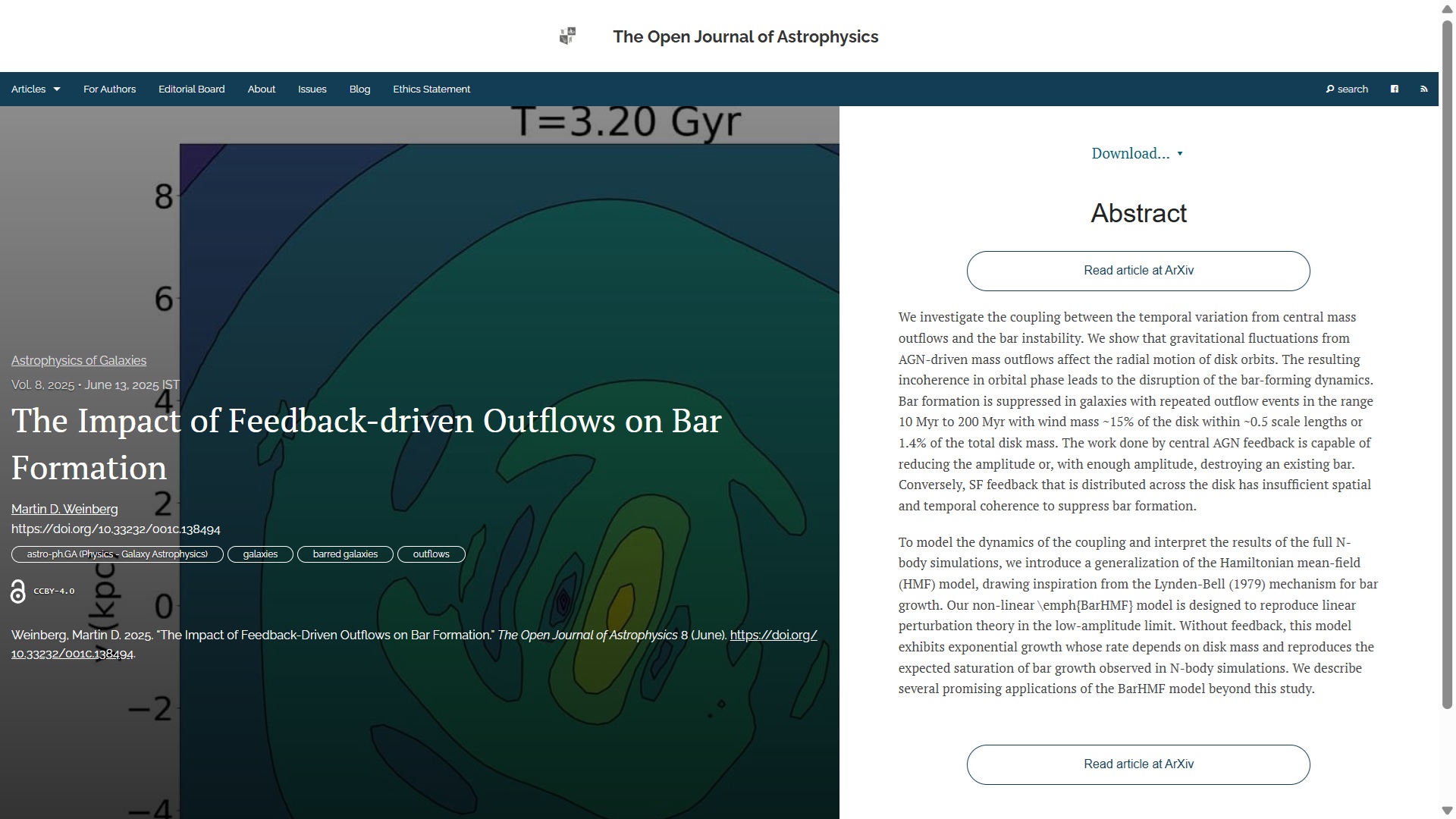
The second paper is “The Impact of Feedback-driven Outflows on Bar Formation” by Martin D. Weinberg (University of Massachusetts, Amherst, USA). This paper uses a generalization of the Hamiltonian Mean-Field model to of the disruption of bar formation in galaxies by stellar feedback. It was published on Friday 13th June 2025 in the folder marked Astrophysics of Galaxies.

The overlay is here:


You can find the officially-accepted version of the paper on arXiv here.

That’s all the papers for this week. I’ll post another update next weekend.


Pride 2025

Posted in History, LGBTQ+, Maynooth with tags , , , , , , , , on June 13, 2025 by telescoper

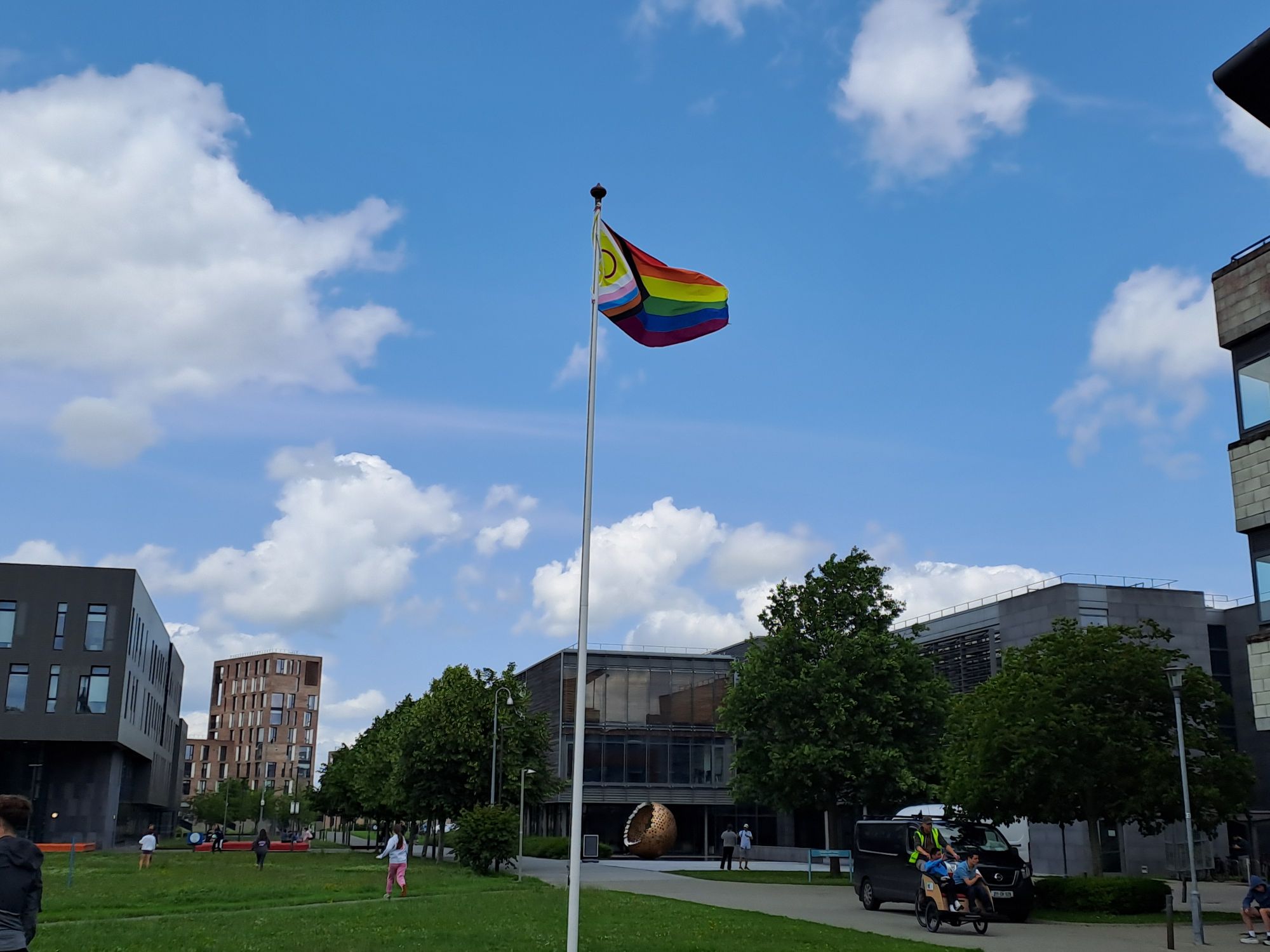
It’s 13th June, which means it’s almost halfway through this year’s Pride Month. I’ve been so busy that I am very late in posting about Pride 2025. I usually post something to mark Pride Month on 1st June (e.g. here). In fact I hadn’t even noticed the Pride Progress Flag flying on Maynooth Campus (between the Arts Block and John Hume Building) until today. I didn’t see anything on Maynooth’s social media about Pride either. I didn’t see the flag yesterday when I left the Science Building and assumed it wasn’t there. It was however raining heavily so my view may have been obscured by the rain on my spectacles, so I went back today to check. I am relieved it is there, as we need such symbols now more than ever.

With its origins as a commemoration of the Stonewall Riots of 1969, Pride remains both a celebration and protest. It’s more necessary than ever now because of the sustained abuse being aimed at trans people from all quarters, including those in political power and those sad losers who have nothing better to do that spend all day tweeting their bigotry on social media. Bigots will always be bigots, but the lowest of the low are those that masquerade as some sort of progressive while spouting their hate and prejudice.

Someone asked me the other day whether we still needed Pride. I replied that I think Pride will be necessary for as long as there are people who are annoyed by its existence. As well as a celebration and a protest, Pride is an opportunity for us all to show solidarity against those who seek to divide us. Though many LGBTQIA+ people in many countries – even those that claim to be more liberal – still face discrimination, hostility and violence, Pride Month always reminds me of how far we’ve come in the past 50 years but also serves as a reminder that the rights we have won could so easily be taken away. As I get older, I find I have become more and more protective towards younger LGBTQ+ people. I don’t want them to have to put up with the crap that I did when I was their age.

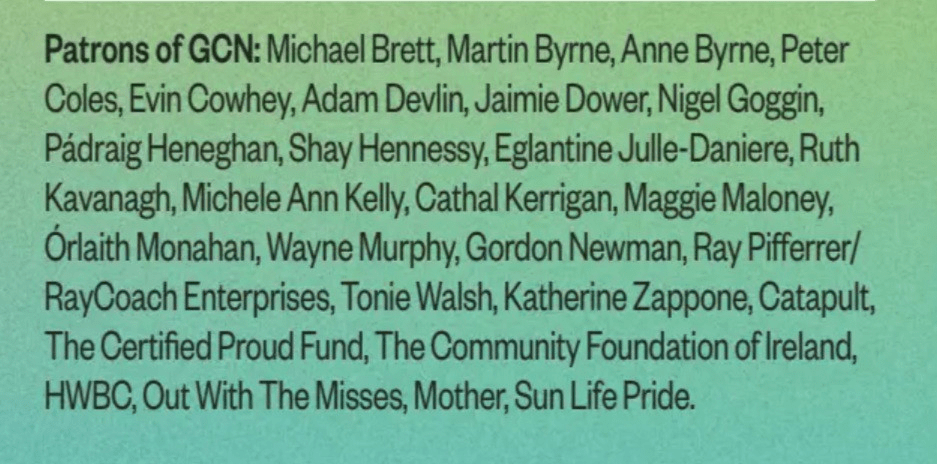
To mark this year’s Pride I decided to become a patron of Gay Community News, a free magazine that is, I hope, a vital resource to for the Irish LGBTQ+ community. I hope to take part in the Dublin Pride March on 28th June too. More generally, I would like to wish all LGBTQIA+ people around the world, but especially staff and students at Maynooth University, a very enjoyable and inspiring Pride 2025!

The Test Final and Final Examination Board

Posted in Cricket, Education, Maynooth with tags , , , , , , on June 12, 2025 by telescoper

Had I not been obliged to attend this morning’s final Examination Board for Theoretical Physics programmes at Maynooth University, I would have been at Lord’s today watching Day 2 of the World Test Cricket final between Australia and South Africam where it is now the Tea interval. There certainly wouldn’t have been any cricket in Maynooth this morning, as there has been torrential rain all day so far, but the Exam Board went ahead and finished even before South Africa were all out in their first innings for 138, after late-order collapse, in response to Australia’s first innings total of 212.

As I already mentioned, today’s Examination Board we went through the results in the presence of our External Examiner. Since this is the end of the academic year, we also looked at the final grades of those students who are completing their studies this year in order to consider the classification of their degrees. Another (pleasant) duty of our Examination Board was to award prizes for the best performance, not just for finalists but for students at every stage, including the first year. These will be announced in due course.

But that’s not quite the end of it – there is an overall University Examination Board that covers all courses in the University to formally bring an end to the examination process. It is not until after all the Boards have done their business that the students get their marks. If all goes to plan, students will receive their final marks on Friday 27th June.

Soon after that, on Tuesday 1st July, we have a Consultation Day, where

Staff will be available in all Departments to discuss results with students. Students are entitled to see their examination scripts if they wish, these will be generally available on this day or at another mutually convenient time.

If I had my way we would actually give all students their marked examination scripts back as a matter of routine. Obviously examination scripts have to go through a pretty strict quality assurance process involving the whole paraphernalia of examination boards (including External Examiners), so the scripts can’t be given back immediately but once that process is complete there doesn’t seem to me any reason why we shouldn’t give their work, together with any feedback written on it,  back to the students in its entirety. I have heard it argued that under the provisions of the Data Protection Act students have a legal right to see what’s written on the scripts – as that constitutes part of their student record – but I’m not making a legalistic point here. My point is purely educational, based on the benefit to the student’s learning experience.

That’s one set of examination duties done and dusted, but not everything. Next Tuesday I am Internal Examiner for a PhD at Maynooth and, about a month from now, I have to travel to a foreign land to be an External Examiner. It’s all go…

Ologies and Nouns of Agency

Posted in Pedantry with tags , , , , , , , on June 11, 2025 by telescoper

The other day I was wondering, for no particular reason, why it is that a person who does astrology is called an astrologer, whereas a person (such as myself) who specializes in cosmology is a cosmologist.

Before proceeding to bore you further I will point out: (i) that words such as astrologer or cosmologist are examples of “noun of agency” or “agentive nouns” as they denote the agent or doer of an action; and (ii) that the suffix “-ology” signifies the study of a particular subject of thing. The word “ology” itself has come to mean “a branch of study” (at least informally).

Most ologies have an agentive noun that ends in “ologist”. As well as cosmologist, we have biologist, geologist, anthropologist, sociologist, and so on. There’s even “apologist” although I don’t think “apology” is an ology in the usual sense. Astrology is an ology, but we don’t usually talk about astrologists. In fact I rarely talk about astrologers either, but that’s not the point.

Looking in various dictionaries, however, I do see that the “-ologer” ending is given for some of the ologies listed above, including “geologer” but in all cases that I’ve found these are marked as archaic. Perhaps “astrologer” has lingered because astrology is a subject that likes to present itself as having ancient credentials.

There is another exception to the “ology-ologist” rule. At least in English English, a person who studies theology is not a theologist, nor even a theologer, but a theologian. I don’t know how that came about. There are quite a few people who can’t resist mixing religion with science when they talk about the field of cosmology, so perhaps cosmologian might be an appropriate term for them?

The Borgias are having an orgy

Posted in History with tags , on June 10, 2025 by telescoper

And now for something completely different.

The magnetic moment of the muon revisited

Posted in The Universe and Stuff with tags , , , , on June 10, 2025 by telescoper

A couple of years ago I posted an item about a measurement of the anomalous magnetic moment of the muon, a quantity usually known as (g-2). At the time this appeared to be in conflict with the predictions of the standard model (SM)of particle physics but the general opinion among experts was that the problem was likely to lie with the calculations rather than the experiment.

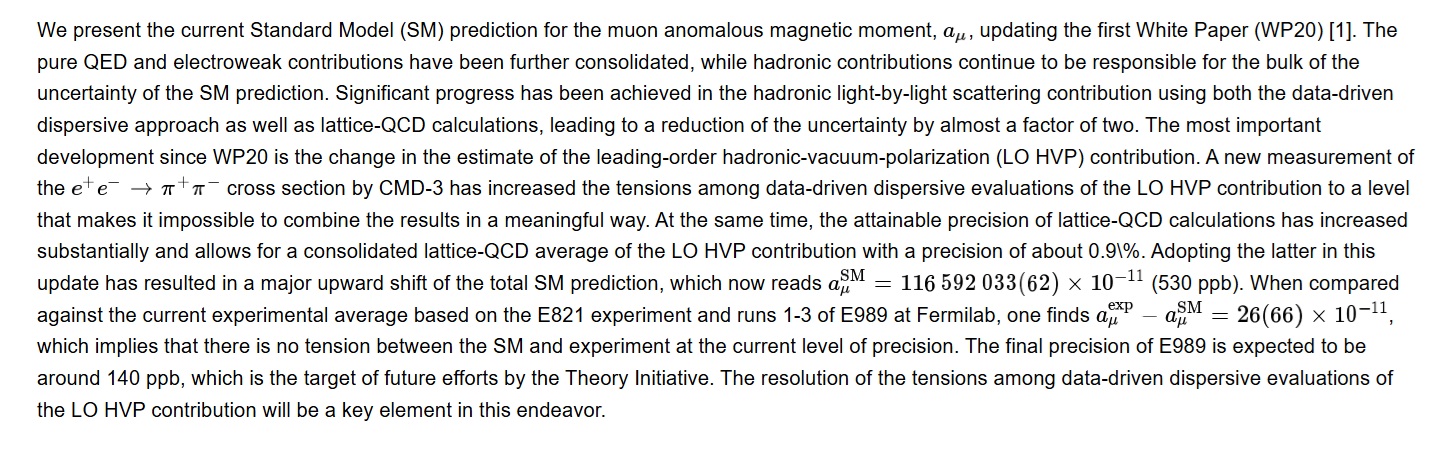
Well, catching up on things I missed during examination marking season, I refer you to a substantial paper (188 pages long) that appeared on arXiv on 27th May 2025, with the abstract:

If this is too small to read I direct yourself to the salient point, namely that “there is no tension between the SM and experiment at the current level of precision”.

It seems the Standard Model survives to fight another day…

On Scholarly Communication

Posted in Open Access with tags , , , , on June 9, 2025 by telescoper

My marking duties being over, it’s time once more to take up the cudgels against the academic publishing racket, at least in a small way, by sharing an article from the European University Association called Reclaiming academic ownership of the scholarly communication system. I recommend you read the entire piece, which is an extended briefing note. It can be downloaded as a PDF here. One of the points it makes very strongly is how much the Open Access movement has been hijacked by commercial publishers.

I will share a couple of sections with you here. First, some background information about Open Access Publishing:

Now I’ll cut to the chase and share the key points from the end.

  1. Accelerate the reform of research assessment. Most of the issues in the current publishing system are rooted in how academic staff are evaluated. Research assessment reform is essential to break the cycle of dependence on high-impact commercial journals and related metrics. Universities should consider broadening the criteria used in academic evaluation, to ensure that recognition goes beyond research to include teaching, innovation, leadership, open science practices, and societal outreach. While institutional, regulatory, and cultural factors can either facilitate or hinder reforms, many universities are already taking the initiative and implementing changes (even in countries with centrally regulated academic career assessment processes).
  2. Strengthen institutional publishing services and infrastructures. A robust, sustainable and interoperable scholarly publishing ecosystem requires each university to properly curate their research contributions and outputs, through institutional or shared infrastructure and services (e.g. repositories, publishing platforms, and CRIS systems). Strengthening these institutional capacities may require reallocating resources and cooperation (see points 3 and 4). This should also apply to the various institutional departments (libraries, research management, etc.) and staff needed to support academics and researchers.
  3. Cooperate and coordinate with other universities, research performing and funding organisations, as well as researchers’ associations and learned societies. The challenges of scholarly publishing are systemic, and no single institution can tackle them alone. Universities should align their efforts with other academic organisations, funders and research institutions. Cooperation and coordination can be valuable for advocacy, policy development and implementation, as well as for shared or “horizontal” services and infrastructures. Cooperation can also take place within regional, national, European and global frameworks.
  4. Critically evaluate expenditure on commercial research publishing and information products and services. As new not-for-profit publishing alternatives emerge and consolidate, universities should regularly evaluate their expenditure on commercial products and services, including journal publication costs and research databases. By promoting cost transparency and cost efficiency, institutions can make informed decisions that support innovation and reinvest funds into institutional publishing services and infrastructure (see point 2). Where feasible, preference should be given to not-for-profit solutions, ultimately reducing costs and ensuring sustainability.
  5. Support and promote the use of rights retention by the university community. Rights retention should be used to regain academic ownership of scholarly communication. Universities should actively advocate for legislative reforms that allow researchers to retain their rights and freely share their research. They should also educate and inform their faculty and researchers of the importance of rights retention and provide legal support. Where legally feasible, institutions should implement and enforce rights retention policies to ensure that publicly funded research remains publicly accessible.
  6. Ensure researcher engagement. Any transition toward a more equitable and sustainable scholarly communication system must involve the academic community. Universities should raise awareness of the systemic issues in scholarly publishing and create spaces for dialogue, reflection, and co-design to discuss how to address them at institutional level. Engaging researchers early and consistently can help shift perceptions, foster a sense of shared responsibility and build support for longterm cultural change.

I endorse all of these, and have written about some of them before (e.g. here) but I would add to the first that universities should actively lobby their governments to change research assessment methods which in many cases are causing an immense waste of public money by outsourcing research assessment to entities, such as Scopus, who are mere fronts for the academic publishing industry.