Archive for July, 2025

The Dead Month

Posted in History with tags , , on July 31, 2025 by telescoper

So we’ve reached the last day of July, and tomorrow is 1st August which is the modern date of the ancient festival of Lughnasadh, although we have to wait until next Monday (4th) for the corresponding Bank Holiday. Lughnasadh can be thought of as marking the onset of he harvest season, and is the pagan forerunner of the Christian harvest festivals I remember from when I was a kid.

As I learnt from this article, the last Sunday in July has been celebrated since ancient times as Garland Sunday, Bilberry Sunday or Reek Sunday. It was a day to mark the end of Hungry July (or in the article mentioned below, The Dead Month) and anticipate the harvest to come.

I hadn’t realized that July was a time of shortage in olden times. I’d always thought the summer months would be a time of plenty, but in July the stocks of food such as grain put aside at the last harvest would often be running low and people who usually depended on farmed produce would be forced to turn to berries, etc.

Anyway. here’s a blog post I stumbled across that says more about this

Avi Loeb is a Fraud Now

Posted in The Universe and Stuff with tags , , , on July 30, 2025 by telescoper

I saw this video on YouTube about Harvard’s answer to Erich von Däniken and thought I should share it. The introduction to it reads:

Avi Loeb is a Harvard astronomer turned pseudoscience-peddling fraud. Since 2017 he’s been spewing horseshit about how everything is aliens when it definitely isn’t, just to sell a bunch of books to credulous laypeople. Predictably, when the scientific community politely pushes back on his bullshit, he throws a toddler tantrum. I wonder what will happen if someone exposes him in a not so polite manner? Let’s find out.

Here is the video

For supplementary reading I suggest: Ethan Siegel’s Forbes article; Desch and Jackson about Avi’s spherule manuscript: https://arxiv.org/pdf/2311.07699; and the following blog piece by Josh Hedgepeth

Read these carefully. There will be a test next week.

Online Safety In The Dark

Posted in Politics with tags , on July 29, 2025 by telescoper

According to my blog analytics, some of my several readers are based in the United Kingdom, or use a VPN that makes that seem the case. For the reason that much of my content is inappropiate for adults, I am taking the opportunity to outline the measures I am introducing on this website, for the benefit of these readers, to ensure compliance with the new Online Safety Act. The principal requirement of the new legislation is that there be online age verification, to prevent adults accessing platforms designed for children. (Is this bit right?, Ed.)

On this website, age verification will be carried out by requiring potential readers based in the UK to submit all (not some) of the following through the comments box below this post:

  • Personal Information: Full name, mother’s maiden name, father’s maiden name, name of first school attended, pet’s name, pet’s mother’s name, any other memorable names that may be relevant.
  • Biometric Information: age, weight, height, hair colour, eye colour, hair size, eye size, shoe size, inside leg measurement and any other measurements likely to be of interest to a pervert.
  • Photo identification: all your private pics and videos (yes, those ones) or, preferably, those of someone more attractive than you.
  • Financial documents: credit card information, including card number, valid from date, expiry date, and CVV number, plus a photograph of the card of sufficiently high quality to make a copy.
  • Proof of Residence: 37 recent documents (dated no later than last month), such as bank statements, utlility bills, high court summonses, eviction notices, etc, showing evidence of home address, and postcode, plus photographs of your house and a list of dates and times when it is expected to be unoccupied.

The use of this information will be strictly limited to compliance with the Online Safety Act. I guarantee that I will not use any of this information for illegal or immoral purposes, though the companies I sell it do may well use it for either or both of those things.

I hope this clarifies the situation.

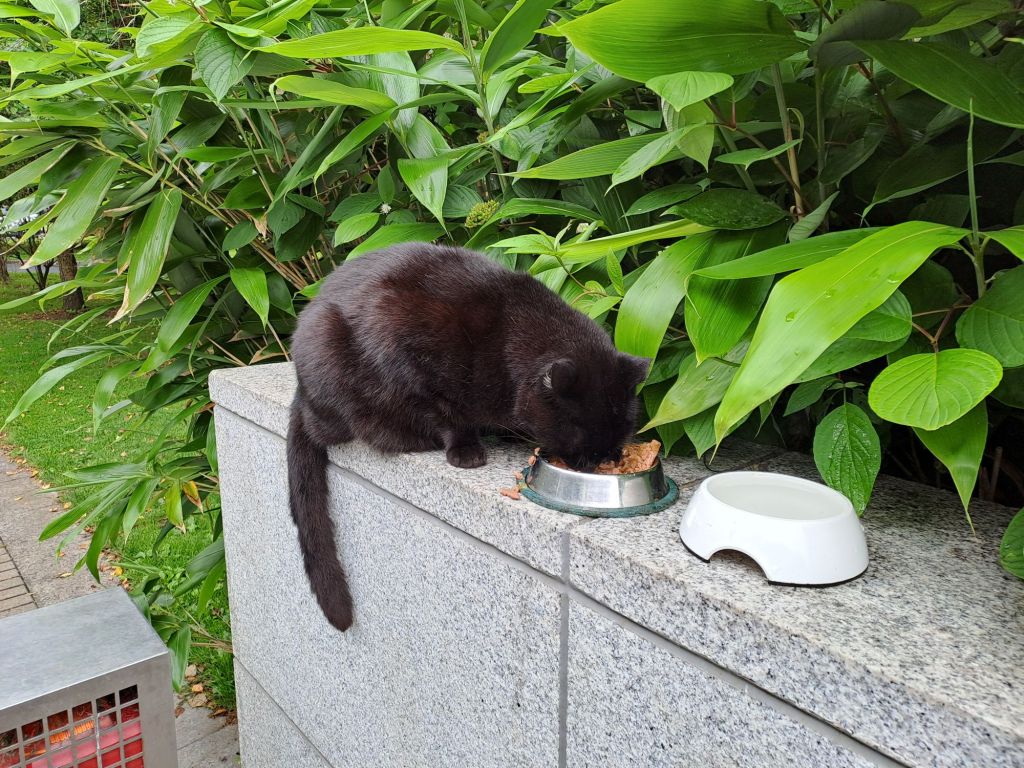
Maynooth University Library Cat Update

Posted in Maynooth with tags on July 29, 2025 by telescoper

On my way through South Campus this morning I saw Maynooth University Library Cat on his post, a sure indication that he wanted to be fed. I therefore took an item from his larder and did the honours…

The post concerned is just to the left…

Lehrer and Lobachevsky

Posted in mathematics, Music with tags , , , , , on July 28, 2025 by telescoper

I couldn’t resist adding a little anecdote by way of a postscript to yesterday’s item about the the late Tom Lehrer. I didn’t know anything about this story until yesterday when I saw it as a thread on Bluesky (credit to @opalescentopal). The whole thread can be read here, so I’ll just give you a short summary and add a bit of context.

Tom Lehrer’s debut album, Songs by Tom Lehrer, released in 1953, contained a number called Lobachevsky. At concerts he would introduce this song with the words “some of you may have had occasion to run into mathematicians and to wonder therefore how they got that way”. If you don’t know the song then you can listen to it, for example, here. This song contains this verse:

I am never forget the day
I am given first original paper to write
It was on "Analytic and Algebraic Topology
Of Locally Euclidean Metrizations
Of Infinitely Differentiable Riemannian Manifolds"
Bozhe moi!

That’s relevant to what follows.

In 1957, while he was still working as a mathematician, Lehrer co-wrote a paper for the U.S. National Security Agency, with R.E. Fagan, under the title Gambler’s Ruin With Soft-Hearted Adversary, the full text of which can be found here. For those of you unaware, the Gambler’s Ruin is an important problem in the theory of probability. The paper was an internal document but was unclassified. It was later published, in 1958, with some modifications under the title Random Walks with Restraining Barrier as Applied to the Biased Binary Counter.

The 1957 paper was filed away, attracting little attention until 2016 when the person who wrote the Bluesky thread looked at it and noticed something strange. The reference list contains six papers, indexed numerically. References [1], [2] and [4] are cited early on in the paper, and references [5] and [6] somewhat later. But nowhere in the text is there any mention of reference [3]. So what is reference [3]? Here it is:

(It’s a pity about the spelling mistake, but there you go.) Although the song Lobachevsky had been written a few years before the Gambler’s Ruin paper, and had proved very popular, nobody had spotted the prank until 2016. This is episode is testament to Lehrer’s mischievous sense of humour, and to his patience. He made a joke and then kept quiet about it for almost 60 years, waiting for the payoff!

P.S. The Lobachevsky reference was omitted from the modified paper published in 1958.

R.I.P. Tom Lehrer (1928-2025)

Posted in Music, R.I.P. with tags , on July 27, 2025 by telescoper

I just heard that the great musical satirist Tom Lehrer has passed away at the age of 97. I was trying to pick one of his songs to post as a tribute but I couldn’t decide which one to choose. I was going to go with “The Elements” but that would be lost on an audience of astronomers for whom there are only Hydrogen, Helium and Metals…

So instead of picking one tune I thought I’d share an entire concert of his, recorded in 1967 in Denmark, that contains no fewer than 17 of his songs including such favourites such “The Elements” and “The Vatican Rag” but also some less familiar numbers. There are even Danish subtitles to help you.

The Sixties were a hot time for satire, and it’s amazing how well some of Tom Lehrer’s songs stand up sixty years later, even today when satire is mostly impossible. Tom Lehrer”s irreverent, and sometimes rather dark, humour brought laughter into the lives of so many people.

It’s worth mentioning that, having decided  that he’d made quite enough money,  Tom Lehrer released all his songs into the public domain. Class.

R.I.P. Tom Lehrer (1928-2025)

Weekly Update from the Open Journal of Astrophysics – 26/07/2025

Posted in OJAp Papers, Open Access, The Universe and Stuff with tags , , , , , , , , , , , , , , , , , , , , , on July 26, 2025 by telescoper

It’s Saturday morning again, so it’s time again for an update of papers published at the Open Journal of Astrophysics. Since the last update we have published seven new papers, which brings the number in Volume 8 (2025) up to 105, and the total so far published by OJAp up to 340. I expect we’ll pass the century for this year sometime next week. I had expected a bit of a slowdown in July, but that doesn’t seem to have happened. Anyway, with the century for the year having been achieved, the next target is 120 (the total number we published last year). At the current rate I expect us to reach that sometime in August.

The papers published this week, with their overlays, are as follows. You can click on the images of the overlays to make them larger should you wish to do so.

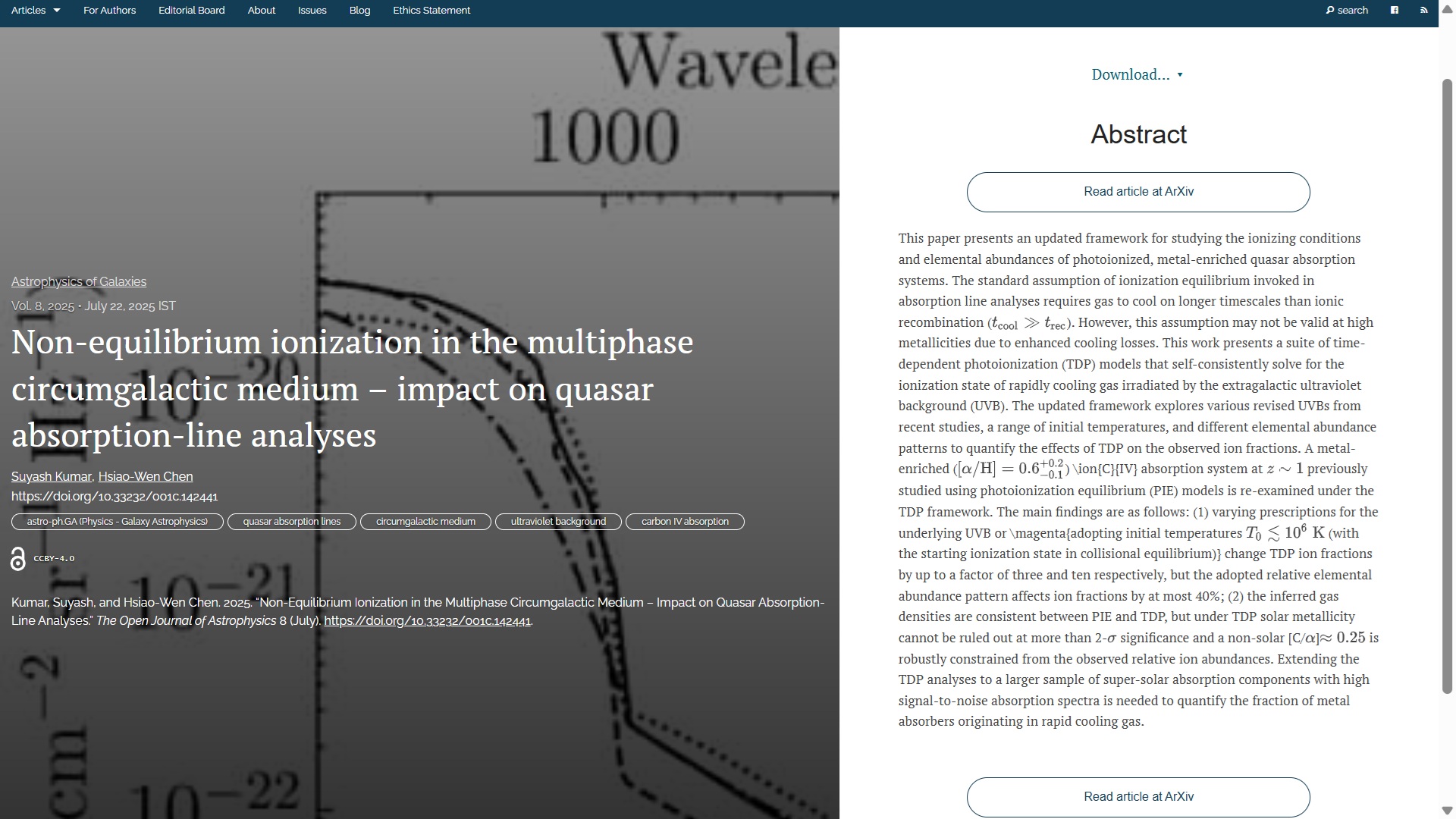
The first paper to report is “Non-equilibrium ionization in the multiphase circumgalactic medium – impact on quasar absorption-line analyses” by Suyash Kumar and Hsiao-Wen Chen (University of Chicago, USA). This was published on Tuesday 22nd July 2025 in the folder Astrophysics of Galaxies. It discusses time-dependent photoionization (TDP) models that self-consistently solve for the ionization state of rapidly cooling gas irradiated by the extragalactic ultraviolet background (UVB) and the application thereof to observed systems.

The overlay is here:
The officially-accepted version can be found on arXiv here.

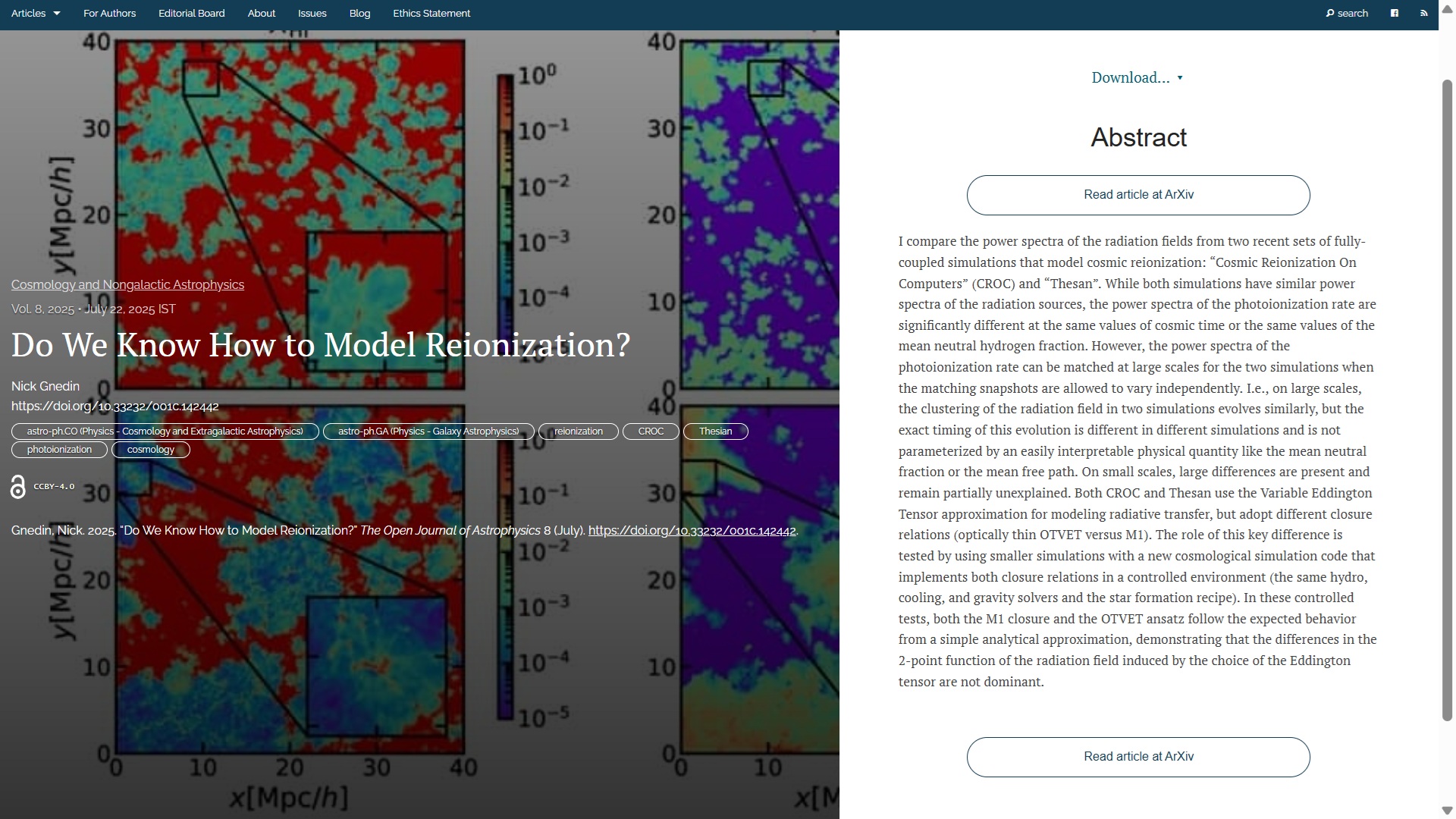
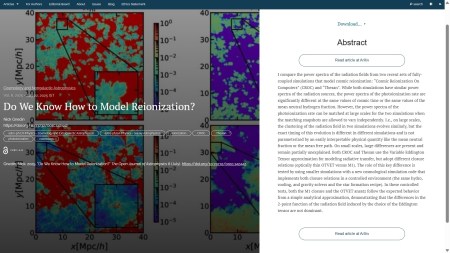
The second paper of the week, also published on Tuesday 22nd July but in the folder Cosmology and Nongalactic Astrophysics, is “Do We Know How to Model Reionization?” by Nick Gnedin (University of Chicago, USA). This paper discusses the similarities and differences between the radiation fields produced by different numerical simulations of cosmic reionization. The overlay is here:
You can find the officially accepted version of the paper on arXiv here.

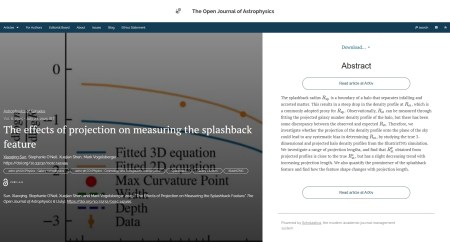
The third paper of the week is “The effects of projection on measuring the splashback feature” by Xiaoqing Sun (MIT), Stephanie O’Neil (U. Penn.), Xuejian Shen (MIT) and Mark Vogelsberger (MIT), all based in the USA. This paper describes an investigation whether projection effects could lead to any systematic bias in determining the position of the boundary between infalling and accreting matter around haloes. It was published on Wednesday 23rd July in the folder Astrophysics of Galaxies. The overlay is here:
The officially-accepted version can be found on arXiv here.

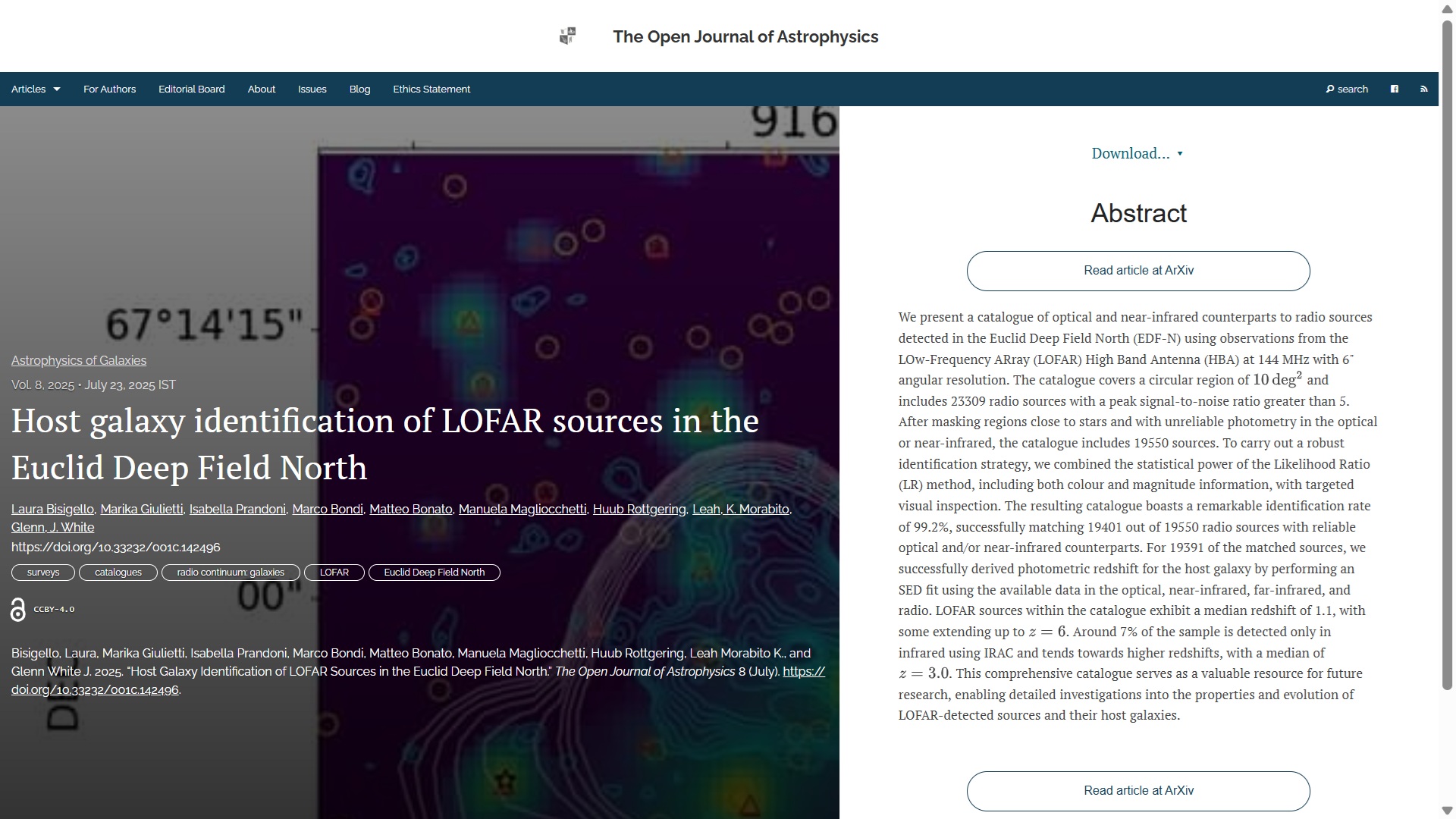
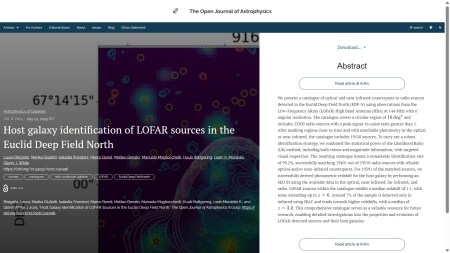
The fourth paper of the week, also published on Wednesday 22nd July in the folder Astrophysics of Galaxies, is “Host galaxy identification of LOFAR sources in the Euclid Deep Field North” by Laura Bisigello, Marika Giulietti, Isabella Prandoni, Marco Bondi, & Matteo Bonato (INAF, Bologna, Italy), Manuela Magliocchetti (INAF-IAPS Roma, Italy), Huub Rottgering (Leiden Observatory, Netherlands), Leah, K. Morabito (Durham University, UK) and Glenn, J. White (Open Universirty, UK). This presents a catalogue of optical and near-infrared counterparts to radio sources detected in the Euclid Deep Field North using observations from the LOw-Frequency ARray (LOFAR). The overlay is here:
The final, accepted version of the paper is on arXiv here.

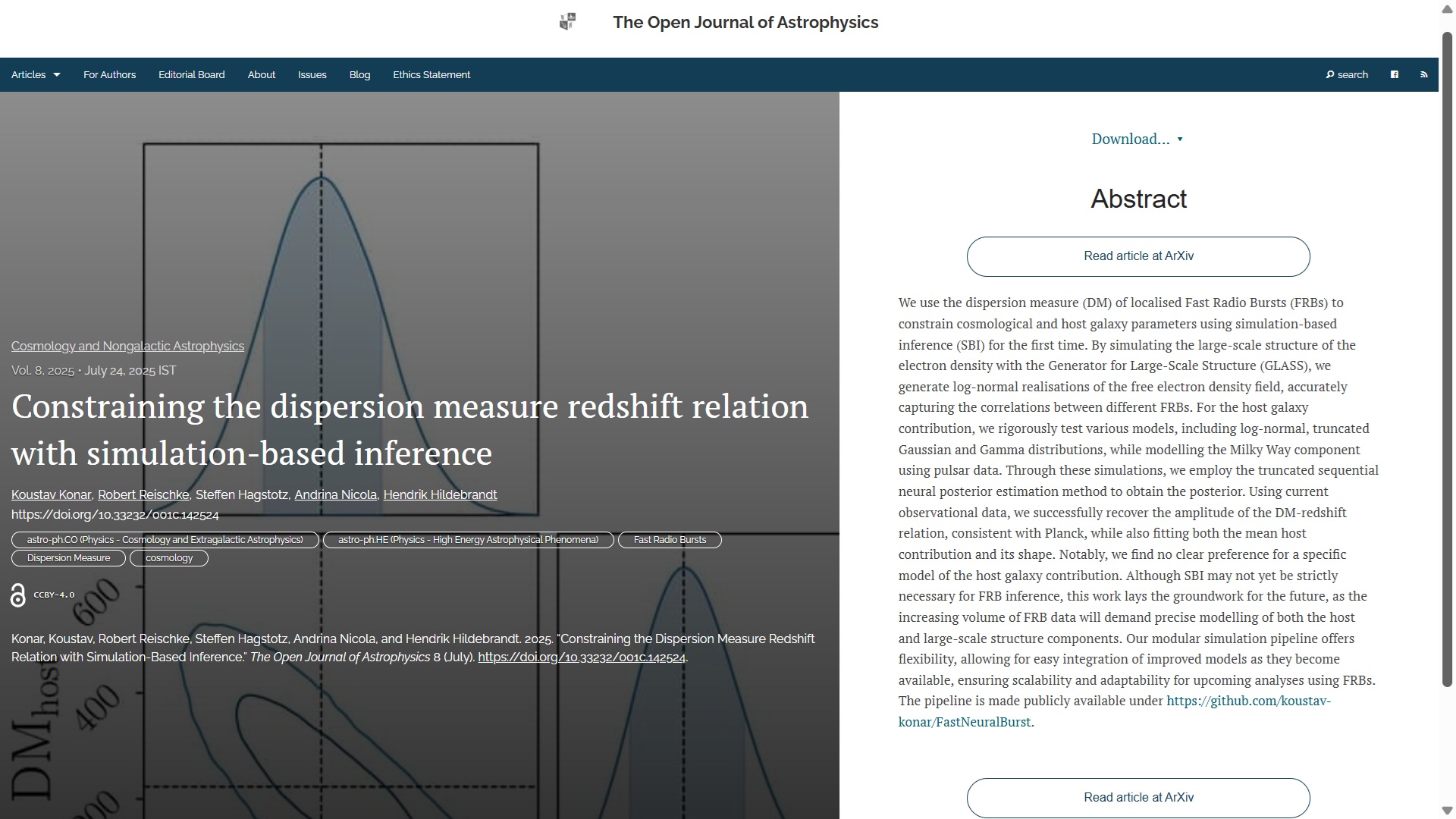
Fifth one up is “Constraining the dispersion measure redshift relation with simulation-based inference” by Koustav Konar (Ruhr University Bochum), Robert Reischke (Universität Bonn), Steffen Hagstotz (Ludwig-Maximilians Universität München), Andrina Nicola (Bonn) and Hendrik Hildebrandt (Bochum); all authors based in Germany. This was published on Thursday 24th July in the folder Cosmology and NonGalactic Astrophysics. It discusses using simulations to develop the use of Dispersion Measures of Fast Radio Bursts as cosmological probes. The overlay is here:

You can find the officially accepted version on arXiv here.

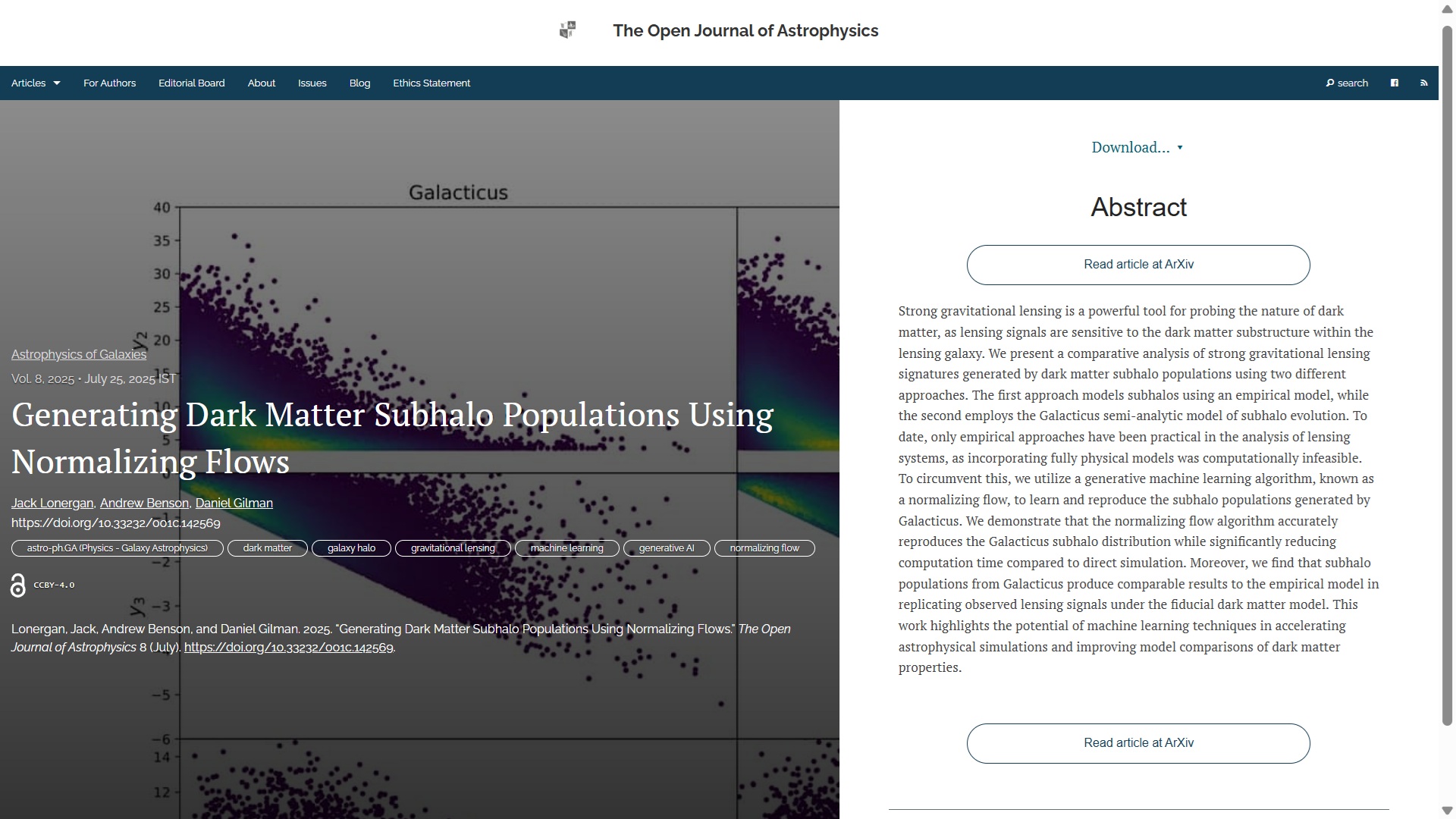
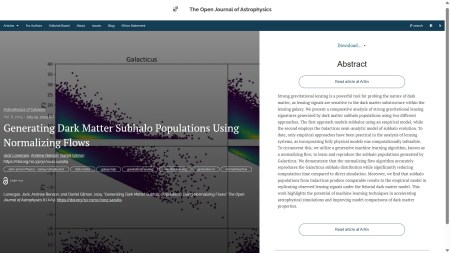
The penultimate (sixth) article published this week is “Generating Dark Matter Subhalo Populations Using Normalizing Flows” by Jack Lonergan (University of Southern California), Andrew Benson (Carnegie Observatories) and Daniel Gilman (University of Chicago), all based in the USA. This paper describes a generative AI approach to subhalo populations, trained using the semi-analytical model Galacticus. This paper was published yesterday (i.e. on Friday 25th July) in the folder Astrophysics of Galaxies.
You can find the final version on arXiv here.

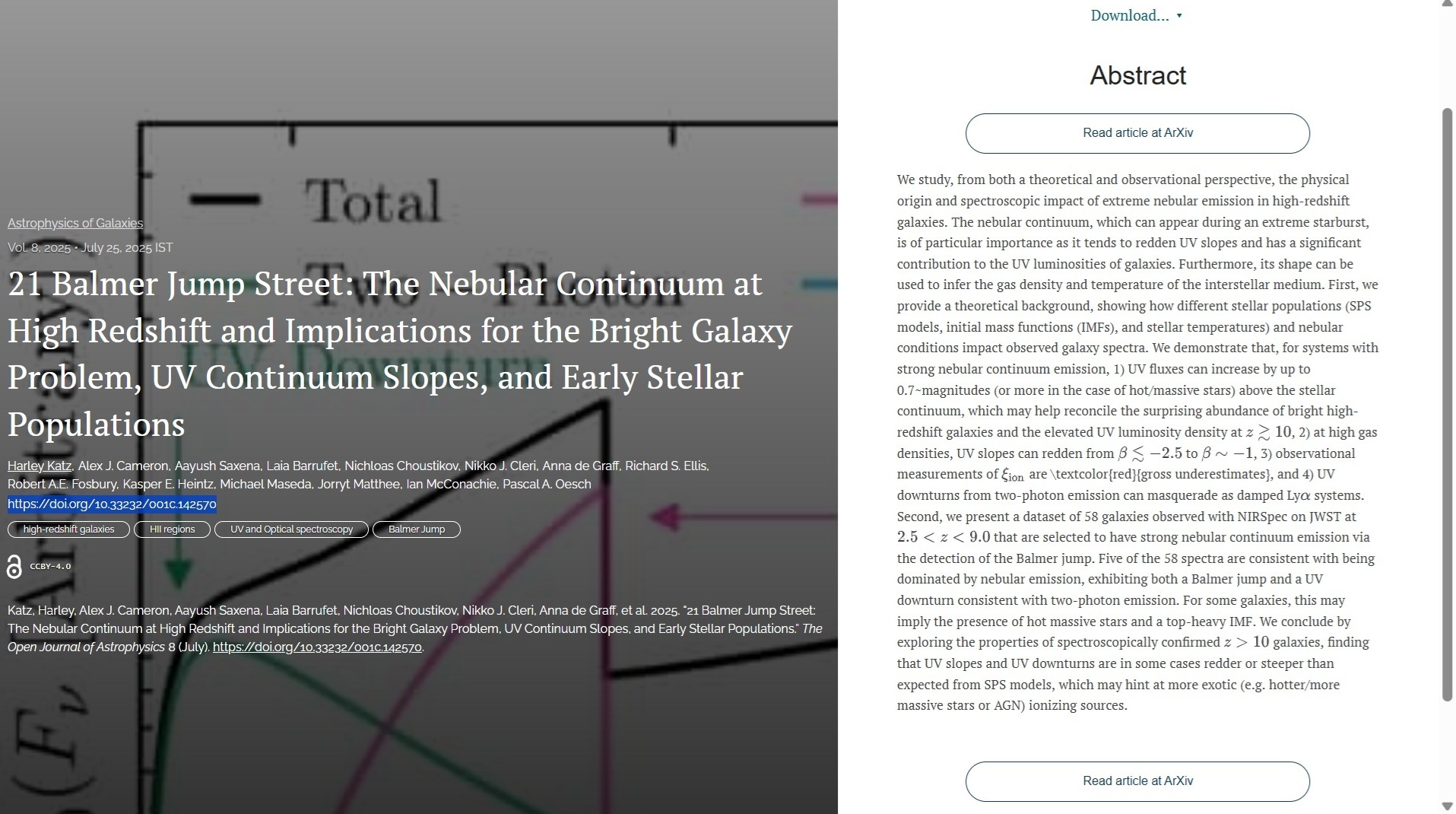
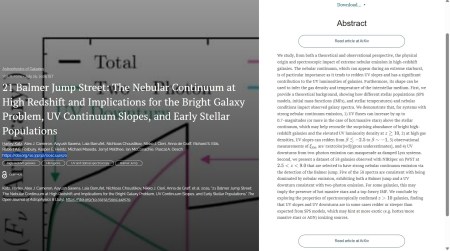
The last article published this week is “21 Balmer Jump Street: The Nebular Continuum at High Redshift and Implications for the Bright Galaxy Problem, UV Continuum Slopes, and Early Stellar Populations” by Harley Katz of the University of Chicago, and 13 others based in the USA, UK, Germany, Denmark and Austria. This discusses the implications of extreme nebular emission for the spectroscopic properties of galaxies, especially at high redshift. It was published on Friday 25th July in the folder Astrophysics of Galaxies.

The overlay is here:
You can find the officially-accepted version on arXiv here.

And that’s all the papers for this week. I’ll do another update next Saturday, when we’ll be into August.


R.I.P. Cleo Laine (1927-2025)

Posted in Jazz with tags , , , on July 25, 2025 by telescoper
Cleo Laine in concert in 1980.

I just heard the very sad news of the death at the age of 97 of that great jazz singer, Cleo Laine. Although stylistically related to Sarah Vaughan, her voice was instantly recognisable. It always struck me that most British jazz singers would adopt an American accent when performing, but Cleo Laine always kept a very crisp diction and sounded very English

I think it’s her musical and personal partnership with John Dankworth (who passed away in 2010) for which she will be known best. He hired Cleo Laine as a singer for his small band in 1951; they married in 1958 and remained together for over 50 years, until separated by John’s death.

I think it is appropriate to use this lovely version of George Gershwin’s great tune Lady be Good (with lyircs by his brother Ira) as a tribute. It’s always good to end on a high note. John Dankworth takes a back seat – as he often did when Cleo was singing – but the band is in great form. Unfortunately there is no personnel listing, apart from John Dankworth. The small band you see and hear here was drawn from his larger orchestra and many of the musicians therein doubled on different instruments. The vibes player, for example, could be Alan Branscombe, who also played piano. Or he could be the pianist. The trumpeter could very well be a young Kenny Wheeler.

Anyway, if you didn’t realise what a terrific vocalist Cleo Laine was, then pin back your lugholes around 2 minutes in where she demonstrates a range and level of vocal ontrol that would put many opera singers to shame.

Harvard Astronomer Latest!

Posted in The Universe and Stuff with tags , , , , on July 25, 2025 by telescoper

I couldn’t resist sharing the first abstract on today’s astro-ph announcement, one of the authors of which is Avi Loeb (the pseudonym of “Harvard Astronomer”). Here it is:

We examine the funding disparity in astronomical research priorities: the Habitable Worlds Observatory is planned to receive over $10 billion over the next two decades whereas extraterrestrial intelligence research receives nearly zero federal funding. This imbalance is in contrast to both scientific value and public interest, as 65% of Americans and 58.2% of surveyed astrobiologists believe extraterrestrial intelligence exists. Empirical psychological research demonstrates that humanity possesses greater resilience toward extraterrestrial contact than historically recognized. Contemporary studies reveal adaptive responses rather than mass panic, conflicting with the rationale for excluding extraterrestrial intelligence research from federal funding since 1993. The response to the recent interstellar object 3I/ATLAS exemplifies consequences of this underinvestment: despite discovery forecasts of a new interstellar object every few months for the coming decade, no funded missions exist to intercept or closely study these visitors from outside the Solar System. We propose establishing a comprehensive research program to explore both biosignatures and technosignatures on interstellar objects. This program would address profound public interest while advancing detection capabilities and enabling potentially transformative discoveries in the search for extraterrestrial life. The systematic exclusion of extraterrestrial intelligence research represents institutional bias rather than scientific limitation, requiring immediate reconsideration of funding priorities.

arXiv:2507.17790

You probably don’t need an AI summary (whether the A stands for “Artificial” or “Alien”), but it the gist of this new article is “Shut everything down and give me the money!”…

The Confirmation – Edwin Muir

Posted in Poetry with tags , on July 24, 2025 by telescoper
Yes, yours, my love, is the right human face.
I in my mind had waited for this long,
Seeing the false and searching for the true,
Then found you as a traveller finds a place
Of welcome suddenly amid the wrong
Valleys and rocks and twisting roads. But you,
What shall I call you? A fountain in a waste,
A well of water in a country dry,
Or anything that's honest and good, an eye
That makes the whole world seem bright. Your open heart,
Simple with giving, gives the primal deed,
The first good world, the blossom, the blowing seed,
The hearth, the steadfast land, the wandering sea.
Not beautiful or rare in every part.
But like yourself, as they were meant to be.

by Edwin Muir (1887-1959)