Archive for LOFAR

Weekly Update from the Open Journal of Astrophysics – 23/05/2026

Posted in OJAp Papers, Open Access, The Universe and Stuff with tags , , , , , , , , , , , , , , , , , , , , , , , , , , , , , , , , , , on May 23, 2026 by telescoper

It’s Saturday once again, so time for another update of activity at the Open Journal of Astrophysics. Since the last update we have published a further six papers, bringing the number in Volume 9 (2026) to 110 and the total so far published by OJAp up to 558.

I will continue to include the posts made on our Mastodon account (on Fediscience); these announcements also show the DOI for each paper.

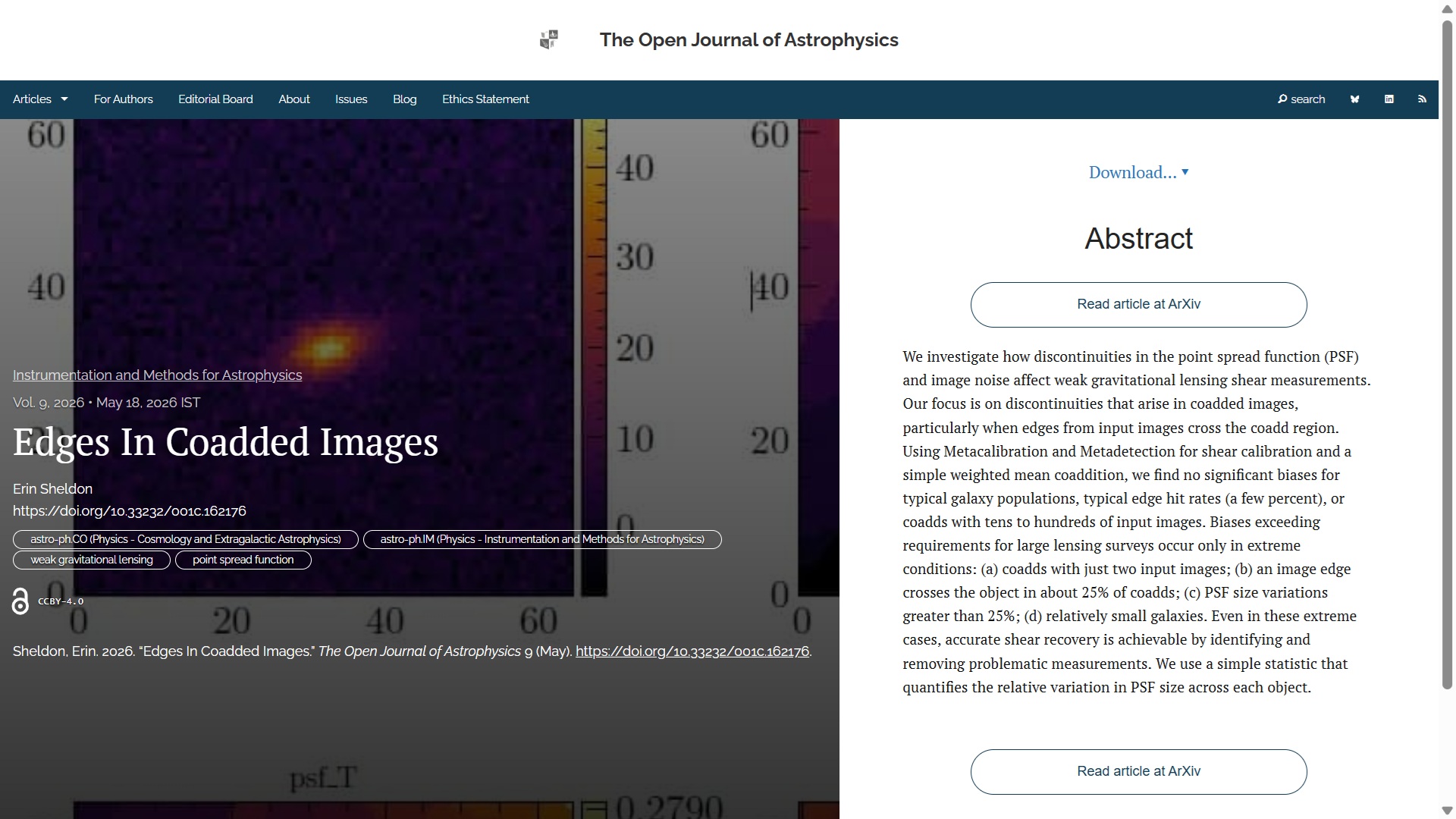
The first paper to report this week, published on Monday 18th May in the folder Instrumentation and Methods for Astrophysics is “Edges In Coadded Images” by Erin Sheldon (Brookhaven National Laboratory, USA). This paper describes a study exploring how image discontinuities and noise impact weak gravitational lensing measurements, finding no significant biases under typical conditions. Biases occur only in extreme cases, but can be mitigated.

The overlay for this paper is here
You can find the officially accepted version on arXiv here and the announcement on Fediverse here:

Open Journal of Astrophysics

New Publication at the Open Journal of Astrophysics: "Edges In Coadded Images" by Erin Sheldon (Brookhaven National Laboratory, USA)

doi.org/10.33232/001c.162176

May 18, 2026, 6:43 am 1 boosts 0 favorites

The second paper for this week, also published on Monday 18th May but in the folder Cosmology and Nongalactic Astrophysics, is “Joint cosmological fits to DESI-DR1 full-shape clustering and weak gravitational lensing in configuration space” by A. Semenaite (Swinburne Institute of Technology, Australia) and 72 other authors from all round the world. This paper presents a cosmological analysis of correlations between the DESI-DR1 Bright Galaxy Survey and Luminous Red Galaxy samples and overlapping shear measurements from various weak lensing surveys.

The overlay for this one is here:
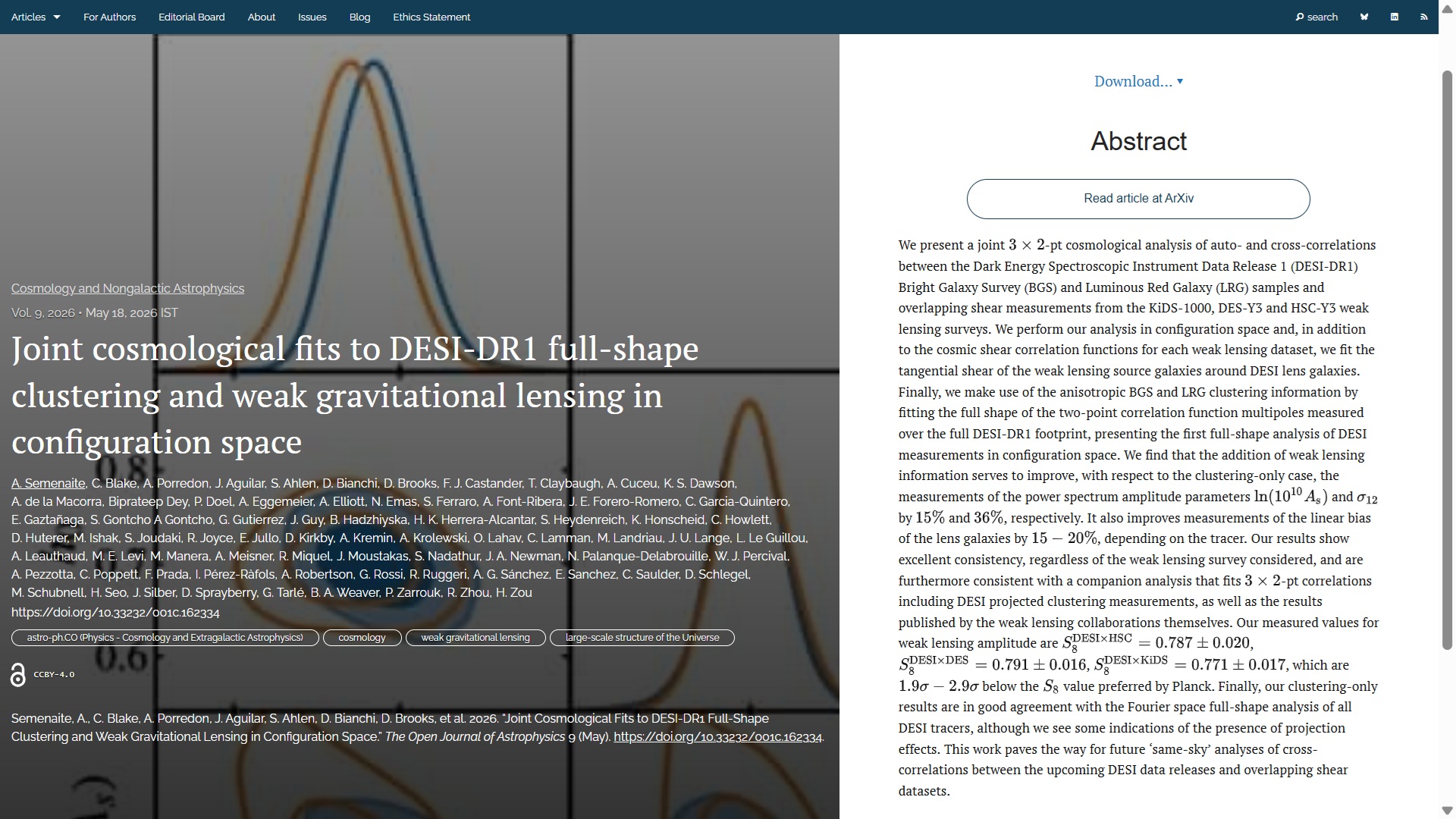
The official version of the paper can be found on arXiv here and the Fediverse announcement here:

Open Journal of Astrophysics

New Publication at the Open Journal of Astrophysics: "Joint cosmological fits to DESI-DR1 full-shape clustering and weak gravitational lensing in configuration space " by A. Semenaite (Swinburne Institute of Technology, Australia) and 72 others from all round the world.

doi.org/10.33232/001c.162334

May 18, 2026, 6:52 am 1 boosts 1 favorites

Next one up, the third paper of the week, and the third published on Monday 18th May, and in the folder Cosmology and Nongalactic Astrophysics is “Probing Dark Energy Microphysics with kSZ Tomography” by Julius Adolff, Selim Hotinli and Neal Dalal (all of the Perimeter Institute, Canada). This paper explores how kinetic Sunyaev-Zel’dovich tomography and galaxy clustering can enhance our understanding of dark energy and its effects, potentially revealing its microphysical properties in future surveys.

The overlay for this one is here:
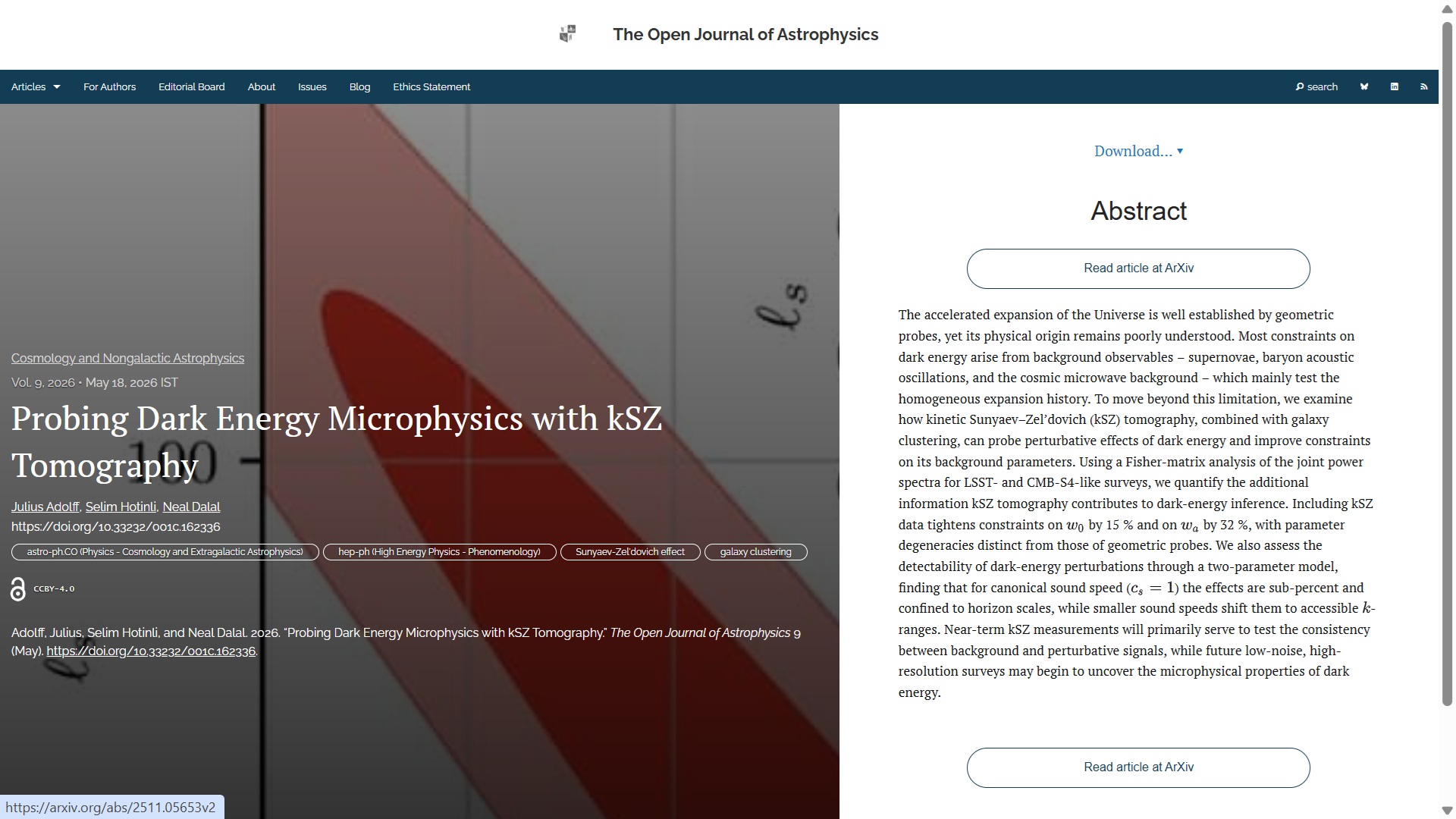
The final, accepted version can be found on arXiv here and the Mastodon announcement is here:

Open Journal of Astrophysics

New Publication at the Open Journal of Astrophysics: "Probing Dark Energy Microphysics with kSZ Tomography" by Julius Adolff, Selim Hotinli and Neal Dalal (Perimeter Institute, Canada)

doi.org/10.33232/001c.162336

May 18, 2026, 7:04 am 1 boosts 0 favorites

The fourth paper this week, published on Wednesday May 20th is “A Census of Variable Radio Sources at 3 GHz” by Yjan A. Gordon, Peter S. Ferguson, Michael N. Martinez and Eric J. Hooper (all of the University of Wisconsin, USA). This article, published in the folder Astrophysics of Galaxies, uses data from the Very Large Array Sky Survey to analyze variability in the radio sky, finding most changes consistent with blazars and quasars.

The overlay is here:
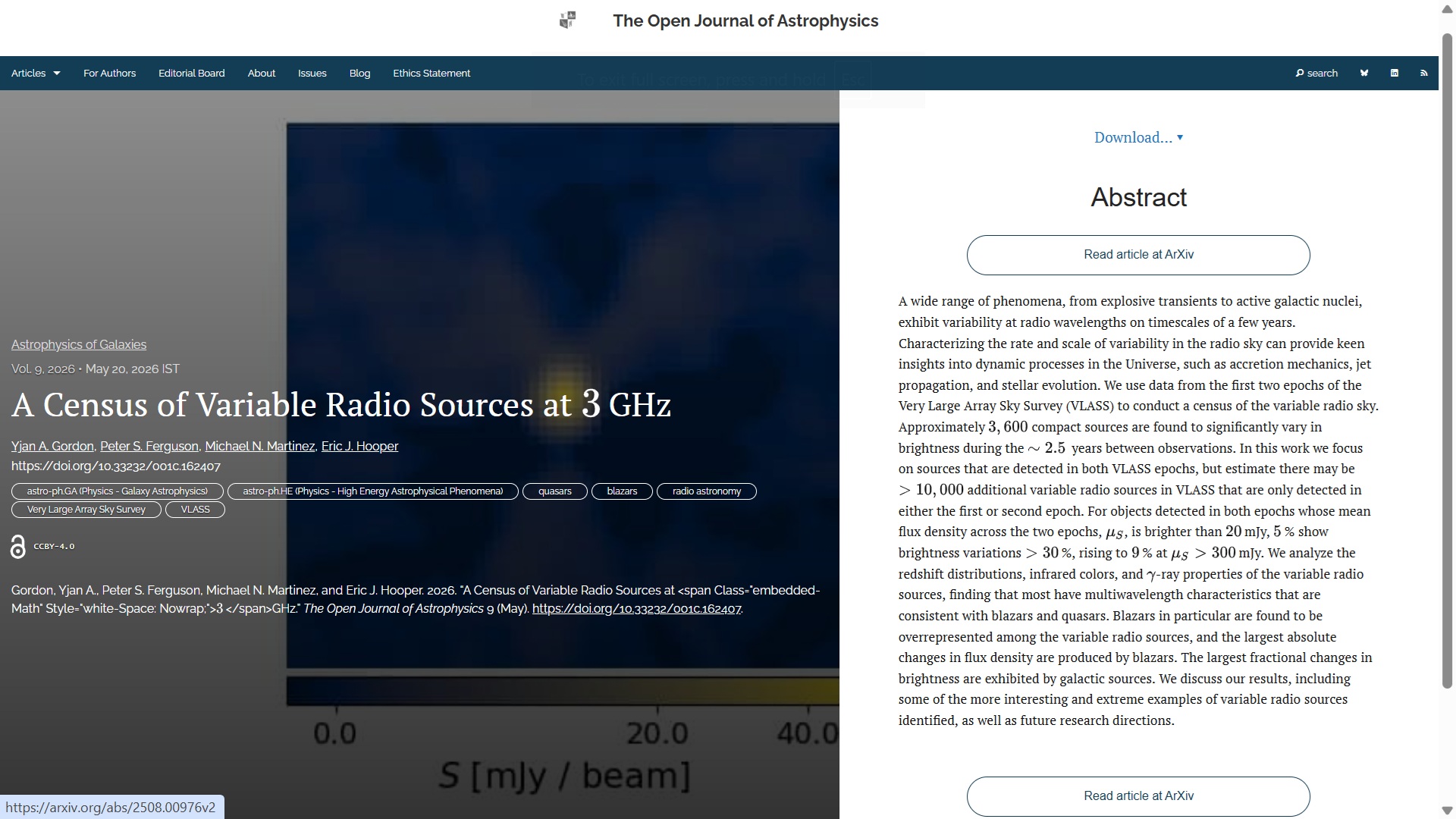
The officially accepted version can be found on arXiv here and here is the Mastodon announcement:

Open Journal of Astrophysics

New Publication at the Open Journal of Astrophysics: "A Census of Variable Radio Sources at 3 GHz" by Yjan A. Gordon, Peter S. Ferguson, Michael N. Martinez & Eric J. Hooper (U. Wisconsin, USA)

doi.org/10.33232/001c.162407

May 20, 2026, 2:52 pm 0 boosts 2 favorites

The fifth article of this week was published on Friday 22nd May in the folder Instrumentation and Methods for Astrophysics. The title is “Uncovering the Next Galactic Supernova with the Vera C. Rubin Observatory” by John Banovetz (Lawrence Berkeley Lab., USA), Claire-Alice Hebert & Peter B. Denton (Brookhaven National Lab., USA), Dan Scolnic (Duke University, USA), Anze Slosar (Brookhaven) and Chris Walter (Duke). The paper presents a study simulating how effectively the Vera C. Rubin Observatory can localize supernovae using neutrino triggers, finding a 57-97% success rate based on stellar mass density predictions.

The overlay is here:
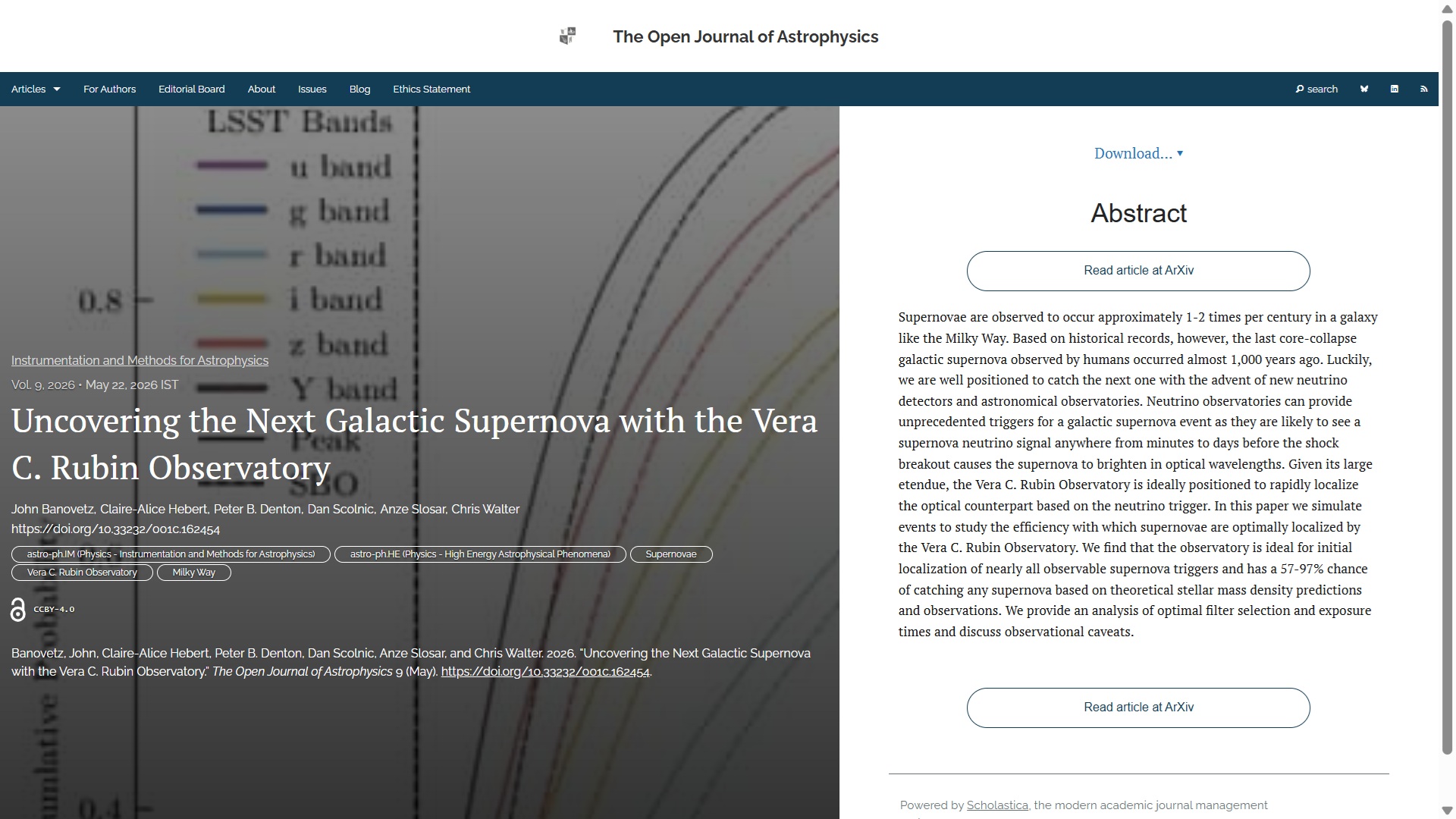
You can find the authorized version of this paper on arXiv here and the Fediverse announcement is here:

Open Journal of Astrophysics

New Publlication at the Open Journal of Astrophysics: "Uncovering the Next Galactic Supernova with the Vera C. Rubin Observatory" by John Banovetz (Lawrence Berkeley Lab., USA), Claire-Alice Hebert & Peter B. Denton (Brookhaven National Lab., USA) , Dan Scolnic (Duke U., USA) , Anze Slosar (Brookhaven), and Chris Walter (Duke)

doi.org/10.33232/001c.162454

May 22, 2026, 8:31 am 0 boosts 1 favorites

Last, but by no means least, this week we have “Pulsar timing solutions for 17 pulsars at 150 MHz from the Irish LOFAR station” by David J. McKenna (ASTRON, The Netherlands), Evan F. Keane (Trinity College Dublin, Ireland), Peter T. Gallagher (DIAS, Ireland) and Joe McCauley (Trinity). This was published on Friday 22nd May in the folder High-Energy Astrophysical Phenomena. It presents a demonstration of the use of international Low Frequency Array (LOFAR) stations in tracking and characterizing pulsars, providing new insights into these neutron stars’ emission properties.

The overlay for this one is here:
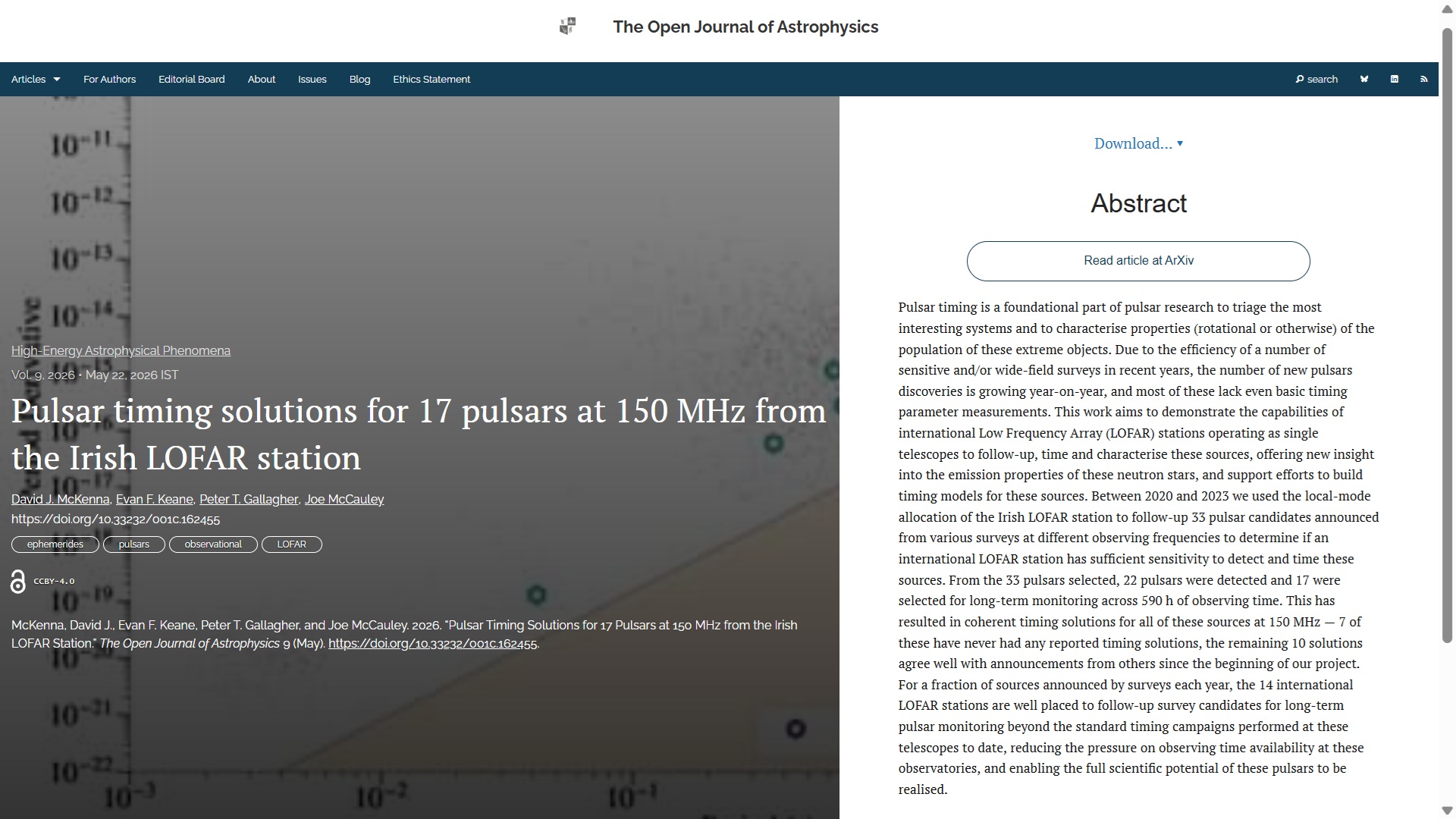
You can find the authorized version of this paper on arXiv here and the Fediverse announcement is here:

Open Journal of Astrophysics

New Publication at the Open Journal of Astrophysics: "Pulsar timing solutions for 17 pulsars at 150 MHz from the Irish LOFAR station" by David J. McKenna (ASTRON, The Netherlands), Evan F. Keane (Trinity College Dublin, Ireland), Peter T. Gallagher (DIAS, Ireland) and Joe McCauley (Trinity)

doi.org/10.33232/001c.162455

May 22, 2026, 8:59 am 0 boosts 0 favorites

And that concludes this week’s update. I’ll do another one next Saturday.
Weekly Update from the Open Journal of Astrophysics – 14/02/2026

Posted in OJAp Papers, Open Access, The Universe and Stuff with tags , , , , , , , , , , , , , , , , , , , , , , , , , , , , , , on February 14, 2026 by telescoper

It’s Saturday once more so time for another update of activity at the Open Journal of Astrophysics. Since the last update we have published a further six papers, bringing the number in Volume 9 (2026) to 30 and the total so far published by OJAp up to 478.

I will continue to include the posts made on our Mastodon account (on Fediscience) to encourage you to visit it. Mastodon is a really excellent service, and a more than adequate replacement for X/Twitter (which nobody should be using); these announcements also show the DOI for each paper.

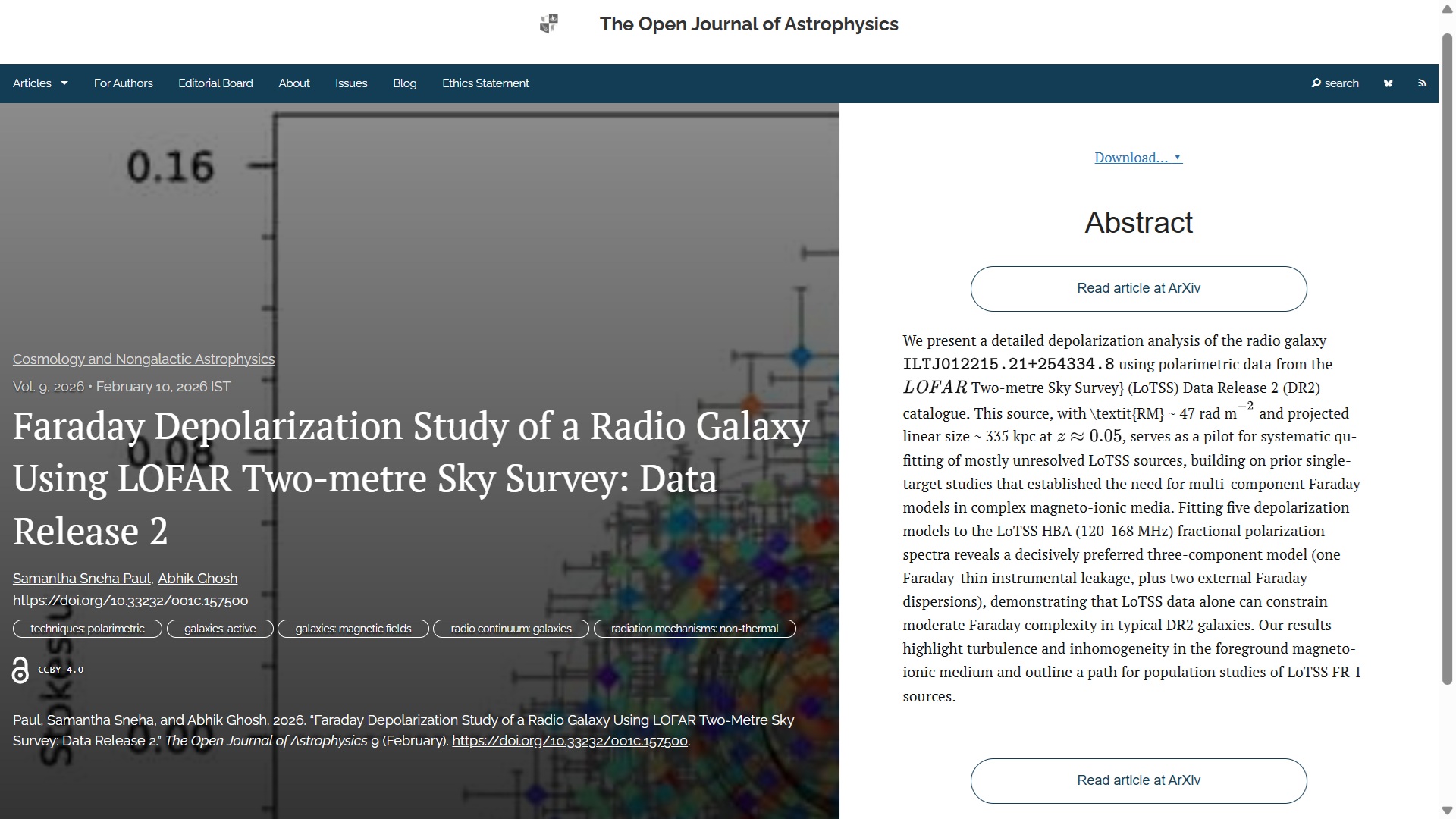
The first paper to report this week is “Faraday Depolarization Study of a Radio Galaxy Using LOFAR Two-metre Sky Survey: Data Release 2” by Samantha Sneha Paul and Abhik Ghosh (Banwarilal Bhalotia College, India). This was published on Tuesday February 10th in the folder Cosmology and Nongalactic Astrophysics. The paper analyzes the depolarization of radio galaxy ILTJ012215.21+254334.8 using LOFAR’s Sky Survey data, revealing a preferred three-component model and highlighting turbulence in the magneto-ionic medium.

The overlay is here:

You can find the officially accepted version on arXiv here and the announcement on Fediverse here:

Open Journal of Astrophysics

New Publication at the Open Journal of Astrophysics: "Faraday Depolarization Study of a Radio Galaxy Using LOFAR Two-metre Sky Survey: Data Release 2" by Samantha Sneha Paul and Abhik Ghosh (Banwarilal Bhalotia College, India)

doi.org/10.33232/001c.157500

February 10, 2026, 6:25 am 0 boosts 1 favorites

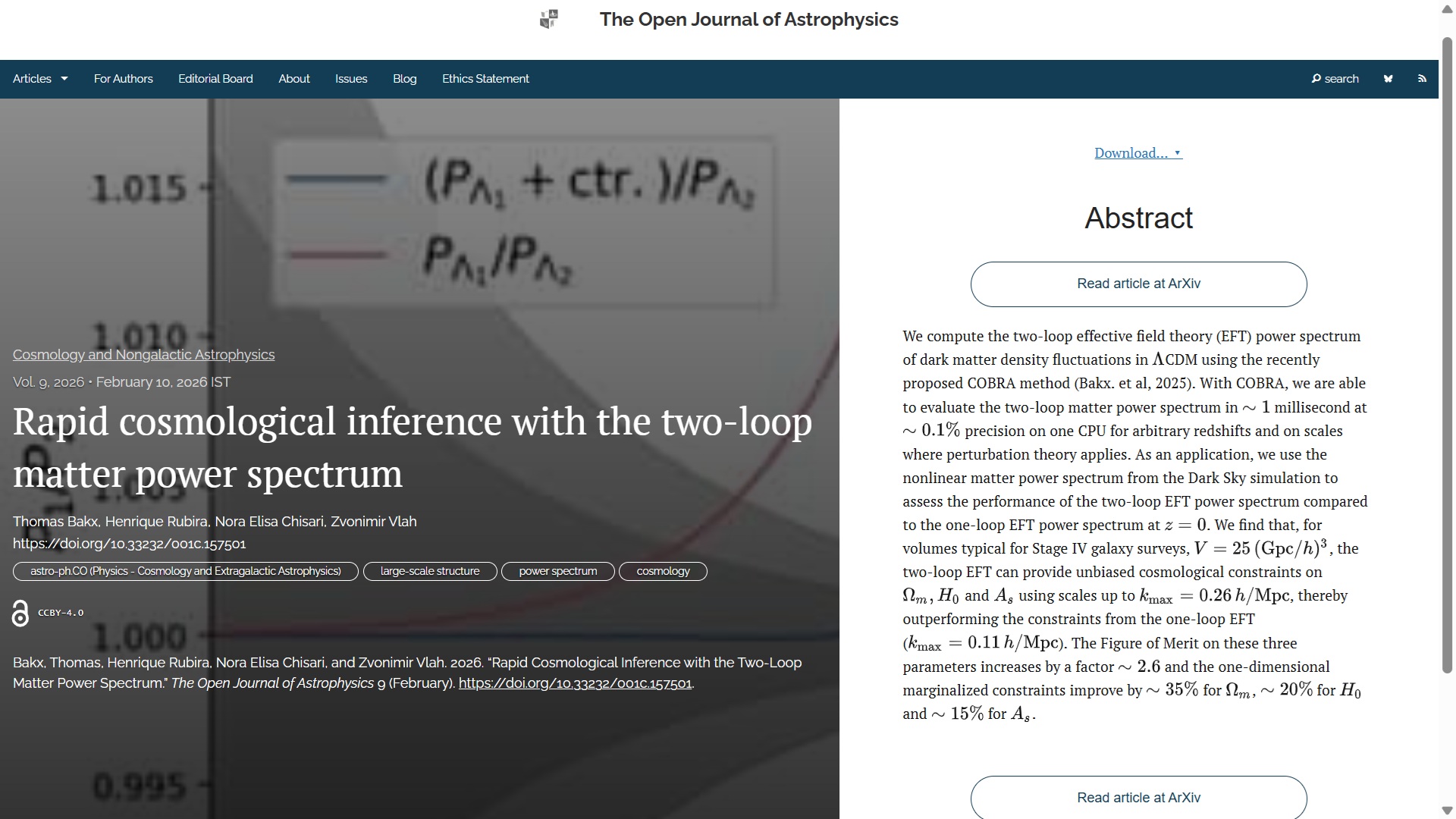
The second paper is “Rapid cosmological inference with the two-loop matter power spectrum” by Thomas Bakx (Utrecht U., NL), Henrique Rubira (Ludwig-Maximilians-Universität, DE), Nora Elisa Chisari (Utrecht) and Zvonimir Vlah (Ruđer Bošković Institute, Croatia). This was also published on Tuesday February 10th in the folder Cosmology and Nongalactic Astrophysics. This paper uses the COBRA method to compute the two-loop effective field theory power spectrum of dark matter density fluctuations, providing more precise cosmological constraints than the one-loop EFT.

The overlay for this one is here:

The official version of the paper can be found on arXiv here and the Fediverse announcement here:

Open Journal of Astrophysics

New Publication at the Open Journal of Astrophysics: "Rapid cosmological inference with the two-loop matter power spectrum" by Thomas Bakx (Utrecht U., NL), Henrique Rubira (Ludwig-Maximilians-Universität, DE), Nora Elisa Chisari (Utrecht) and Zvonimir Vlah (Ruđer Bošković Institute, Croatia)

doi.org/10.33232/001c.157501

February 10, 2026, 6:41 am 0 boosts 0 favorites

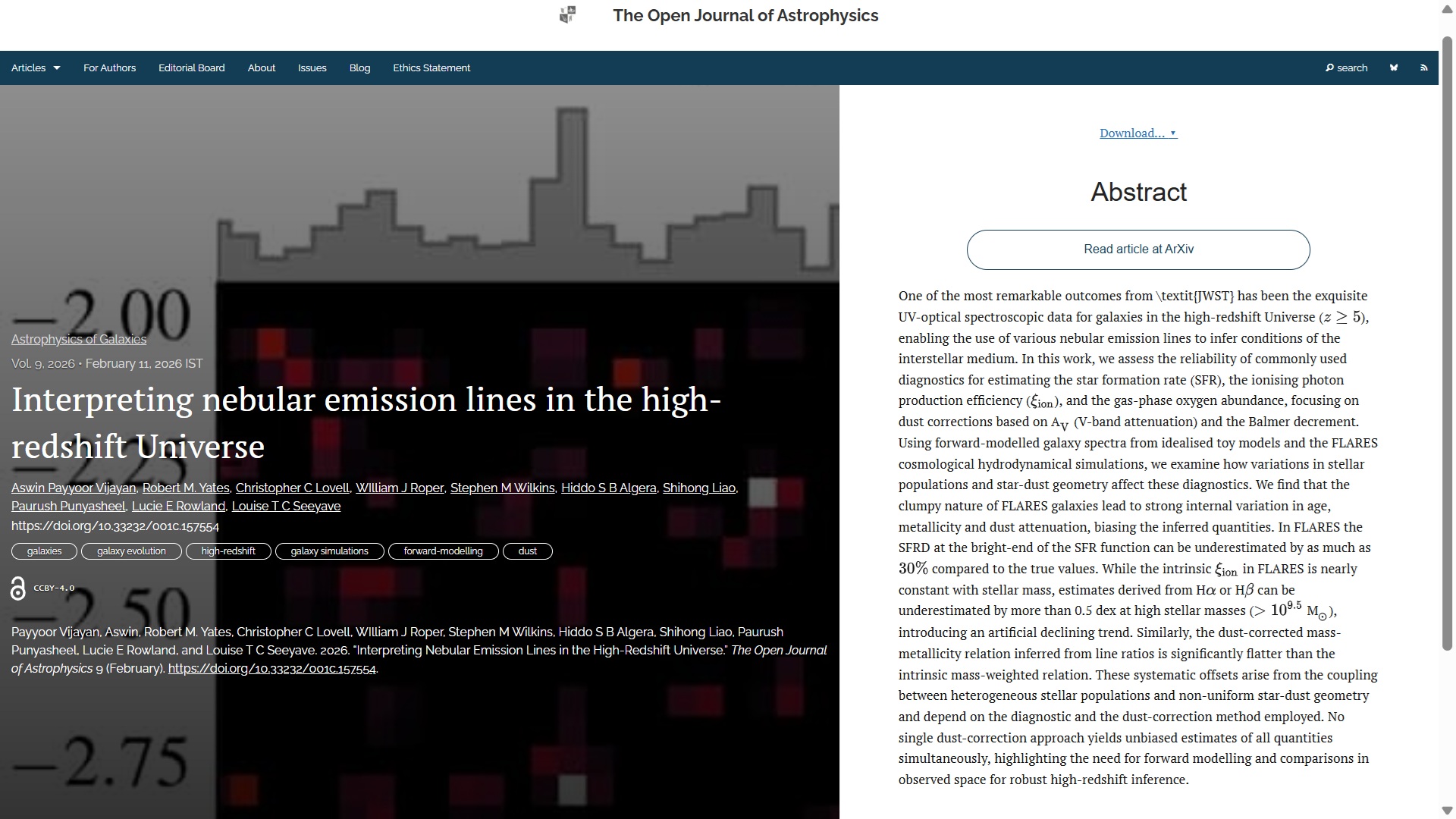
Next, published on Wednesday 11th February in the folder Astrophysics of Galaxies, is “Interpreting nebular emission lines in the high-redshift Universe” by Aswin P. Vijayan (U. Sussex, UK) and 9 others based in the UK, Taiwan, China and The Netherlands. This article examines the reliability of diagnostics used to estimate star formation rate and gas-phase oxygen abundance in high-redshift galaxies. It finds that variations in stellar populations and star-dust geometry. The overlay is here:

The official version can be found on arXiv here and the Fediverse announcement is here:

Open Journal of Astrophysics

New Publication at the Open Journal of Astrophysics: "Interpreting nebular emission lines in the high-redshift Universe" by Aswin P. Vijayan (U. Sussex, UK) and 9 others based in the UK, Taiwan, China and The Netherlands

doi.org/10.33232/001c.157554

February 11, 2026, 8:21 am 0 boosts 0 favorites

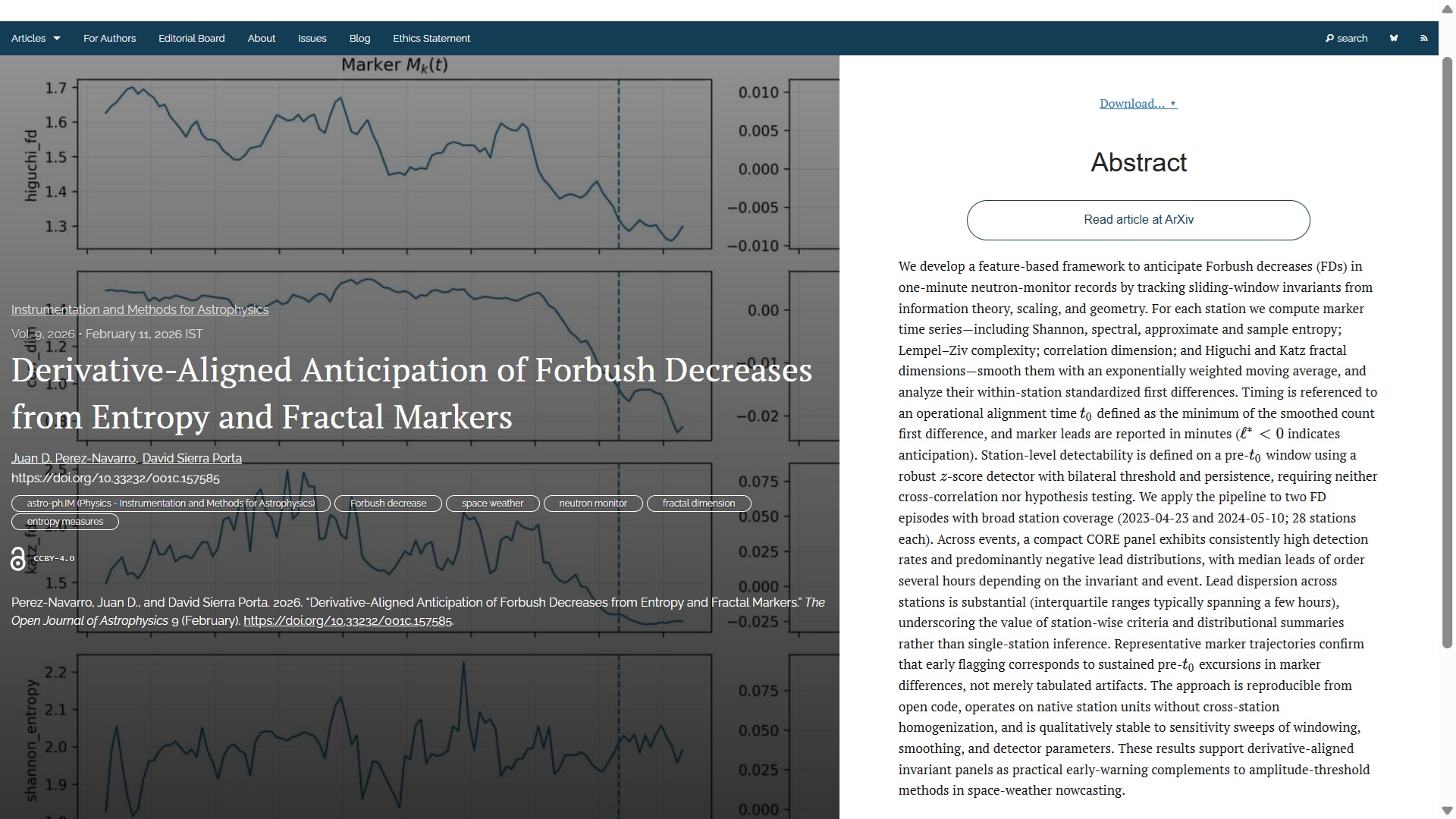
The fourth paper this week, also published on Wednesday 11th February, but in the folder Instrumentation and Methods for Astrophysics is “Derivative-Aligned Anticipation of Forbush Decreases from Entropy and Fractal Markers” by Juan D. Perez-Navarro & David Sierra Porta (Universidad Tecnológica de Bolívar, Colombia). The paper presents a feature-based framework for predicting Forbush decreases, i.e. rapid, temporary drops in galactic cosmic ray (GCR) intensity (up to tens of percent) caused by solar wind disturbances, typically Coronal Mass Ejections (CMEs) or high-speed streams from coronal holes, in neutron-monitor records using various computational methods. The approach is reproducible, operates on native station units, and is stable.

Here is the overlay:

The official version can be found on arXiv here and the Fediverse announcement is here:

Open Journal of Astrophysics

New Publication at the Open Journal of Astrophysics: "Derivative-Aligned Anticipation of Forbush Decreases from Entropy and Fractal Markers" by Juan D. Perez-Navarro & David Sierra Porta (Universidad Tecnológica de Bolívar, Colombia)

doi.org/10.33232/001c.157585

February 11, 2026, 5:19 pm 0 boosts 0 favorites

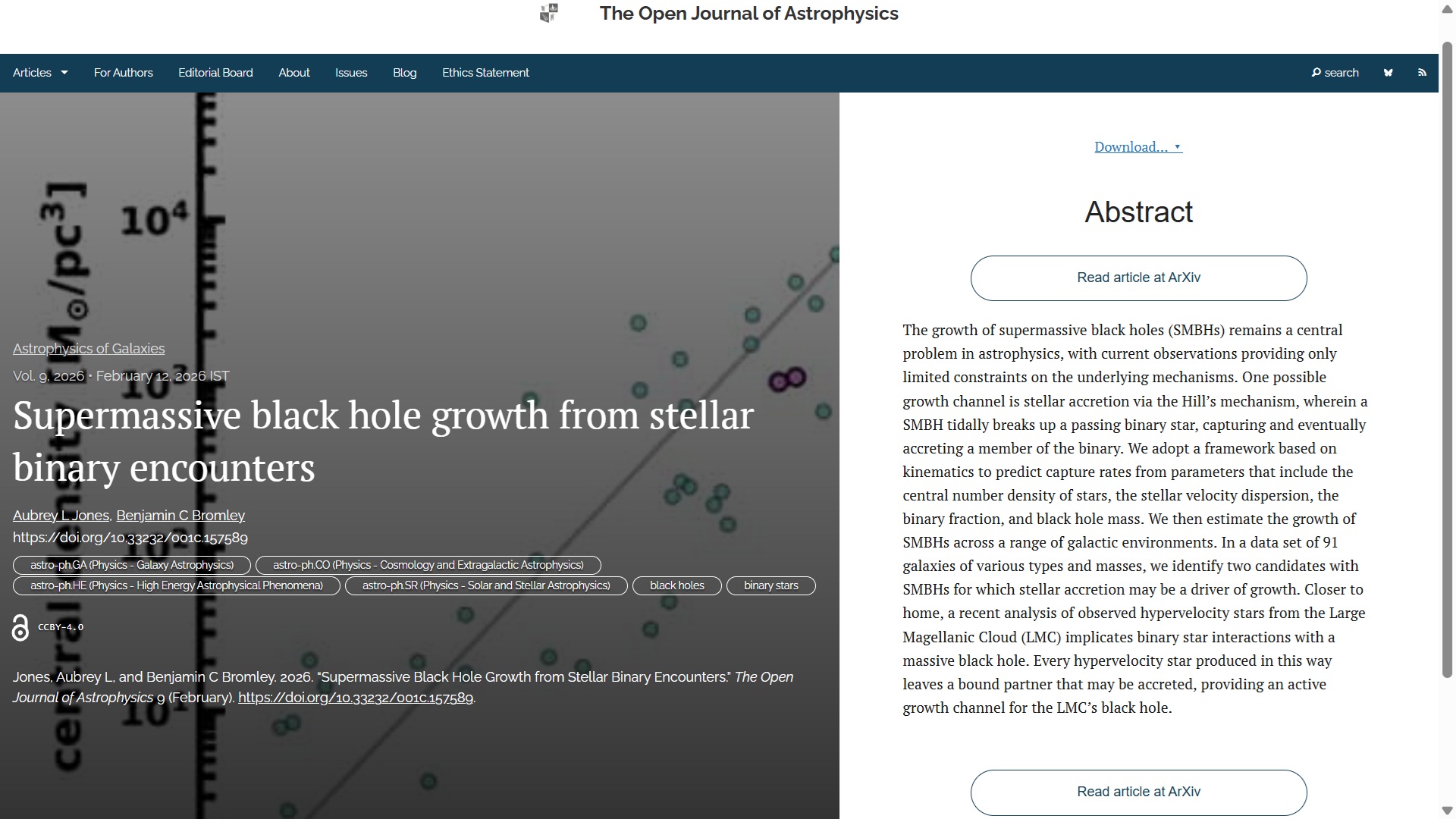
The fifth paper, the penultimate for this week, is “Supermassive black hole growth from stellar binary encounters” by Aubrey L Jones and Benjamin C Bromley (University of Utah, USA). This paper explores the growth of supermassive black holes (SMBHs) through stellar accretion via the Hill’s mechanism, predicting capture rates and identifying potential growth drivers in 91 galaxies. It was published on Thursday 11th February 2026 in the folder Astrophysics of Galaxies.

The overlay is here:

The accepted version can be found on arXiv here, and the fediverse announcement is here:

Open Journal of Astrophysics

New Publication at the Open Journal of Astrophysics: "Supermassive black hole growth from stellar binary encounters" by Aubrey L Jones and Benjamin C Bromley (University of Utah, USA)

doi.org/10.33232/001c.157589

February 12, 2026, 7:31 am 1 boosts 2 favorites

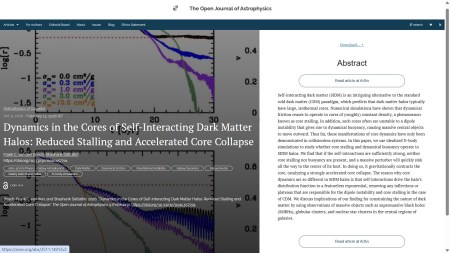
Finally for this week we have “Dynamics in the Cores of Self-Interacting Dark Matter Halos: Reduced Stalling and Accelerated Core Collapse” by Frank C. van den Bosch and Shashank Dattathri (Yale University, USA). This study uses simulations to explore core dynamics in self-interacting dark matter (SIDM) halos. Findings suggest strong self-interactions prevent core stalling and buoyancy, leading to accelerated core collapse. This was published yesterday, on Friday 13th February 2026, in the folder Astrophysics of Galaxies.

The overlay is here:

You can find the published version of the article here, and the Mastodon announcement is here:

Open Journal of Astrophysics

New Publication at the Open Journal of Astrophysics: "Dynamics in the Cores of Self-Interacting Dark Matter Halos: Reduced Stalling and Accelerated Core Collapse" by Frank C. van den Bosch and Shashank Dattathri (Yale University, USA)

doi.org/10.33232/001c.157701

February 13, 2026, 8:27 am 1 boosts 2 favorites

And that concludes this week’s update. I will do another next Saturday.

Weekly Update from the Open Journal of Astrophysics – 26/07/2025

Posted in OJAp Papers, Open Access, The Universe and Stuff with tags , , , , , , , , , , , , , , , , , , , , , on July 26, 2025 by telescoper

It’s Saturday morning again, so it’s time again for an update of papers published at the Open Journal of Astrophysics. Since the last update we have published seven new papers, which brings the number in Volume 8 (2025) up to 105, and the total so far published by OJAp up to 340. I expect we’ll pass the century for this year sometime next week. I had expected a bit of a slowdown in July, but that doesn’t seem to have happened. Anyway, with the century for the year having been achieved, the next target is 120 (the total number we published last year). At the current rate I expect us to reach that sometime in August.

The papers published this week, with their overlays, are as follows. You can click on the images of the overlays to make them larger should you wish to do so.

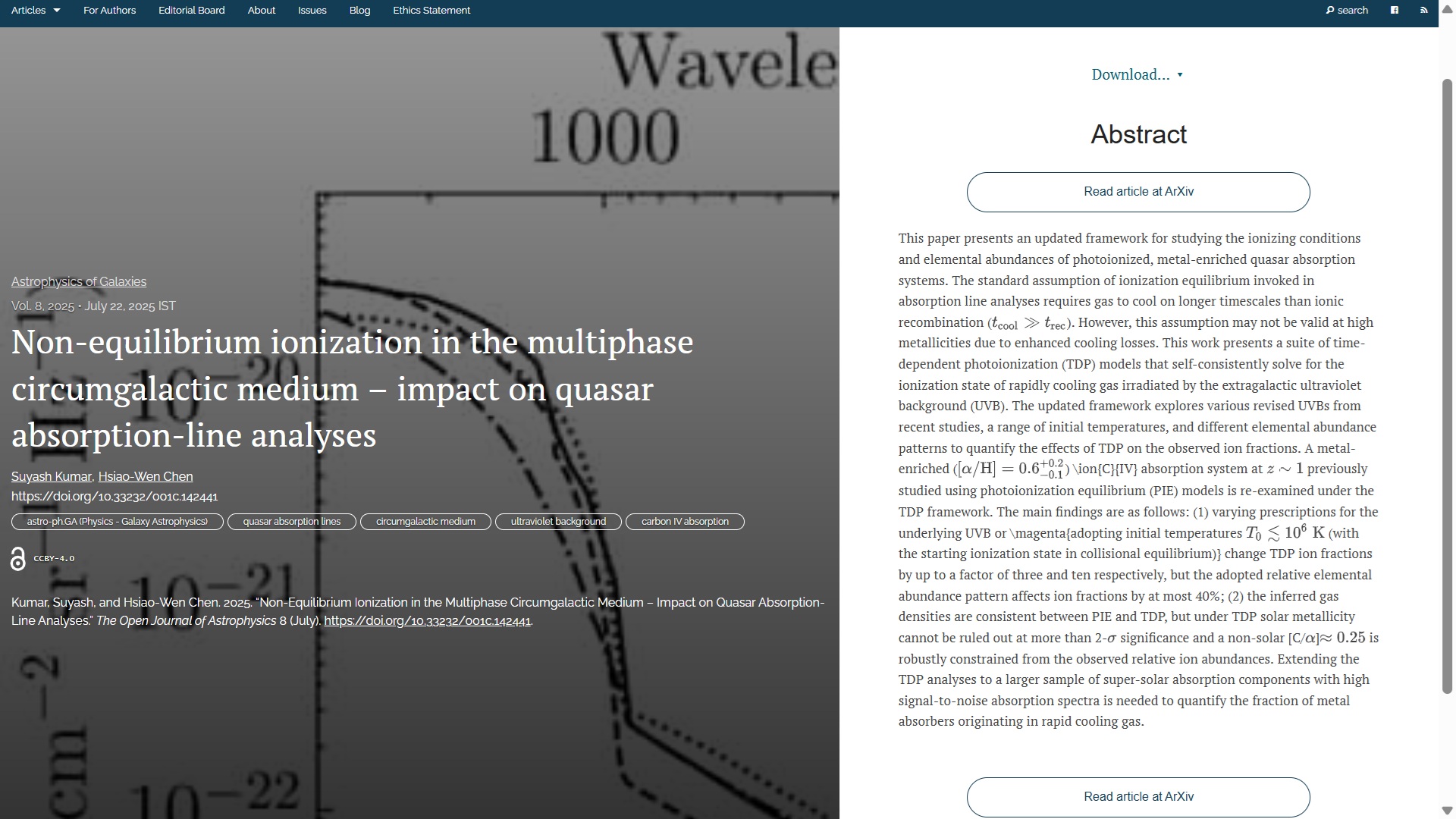
The first paper to report is “Non-equilibrium ionization in the multiphase circumgalactic medium – impact on quasar absorption-line analyses” by Suyash Kumar and Hsiao-Wen Chen (University of Chicago, USA). This was published on Tuesday 22nd July 2025 in the folder Astrophysics of Galaxies. It discusses time-dependent photoionization (TDP) models that self-consistently solve for the ionization state of rapidly cooling gas irradiated by the extragalactic ultraviolet background (UVB) and the application thereof to observed systems.

The overlay is here:

The officially-accepted version can be found on arXiv here.

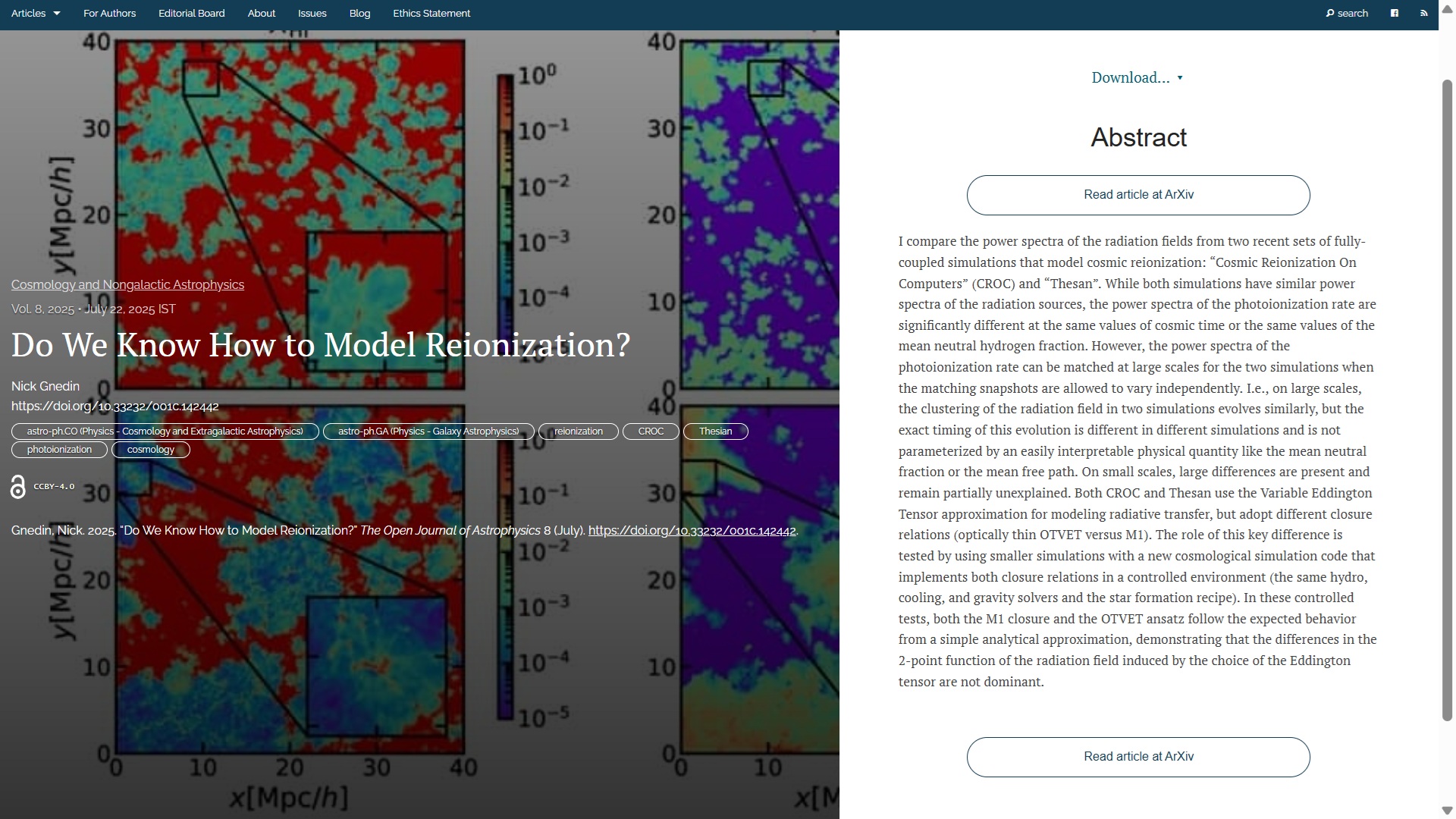
The second paper of the week, also published on Tuesday 22nd July but in the folder Cosmology and Nongalactic Astrophysics, is “Do We Know How to Model Reionization?” by Nick Gnedin (University of Chicago, USA). This paper discusses the similarities and differences between the radiation fields produced by different numerical simulations of cosmic reionization. The overlay is here:

You can find the officially accepted version of the paper on arXiv here.

The third paper of the week is “The effects of projection on measuring the splashback feature” by Xiaoqing Sun (MIT), Stephanie O’Neil (U. Penn.), Xuejian Shen (MIT) and Mark Vogelsberger (MIT), all based in the USA. This paper describes an investigation whether projection effects could lead to any systematic bias in determining the position of the boundary between infalling and accreting matter around haloes. It was published on Wednesday 23rd July in the folder Astrophysics of Galaxies. The overlay is here:

The officially-accepted version can be found on arXiv here.

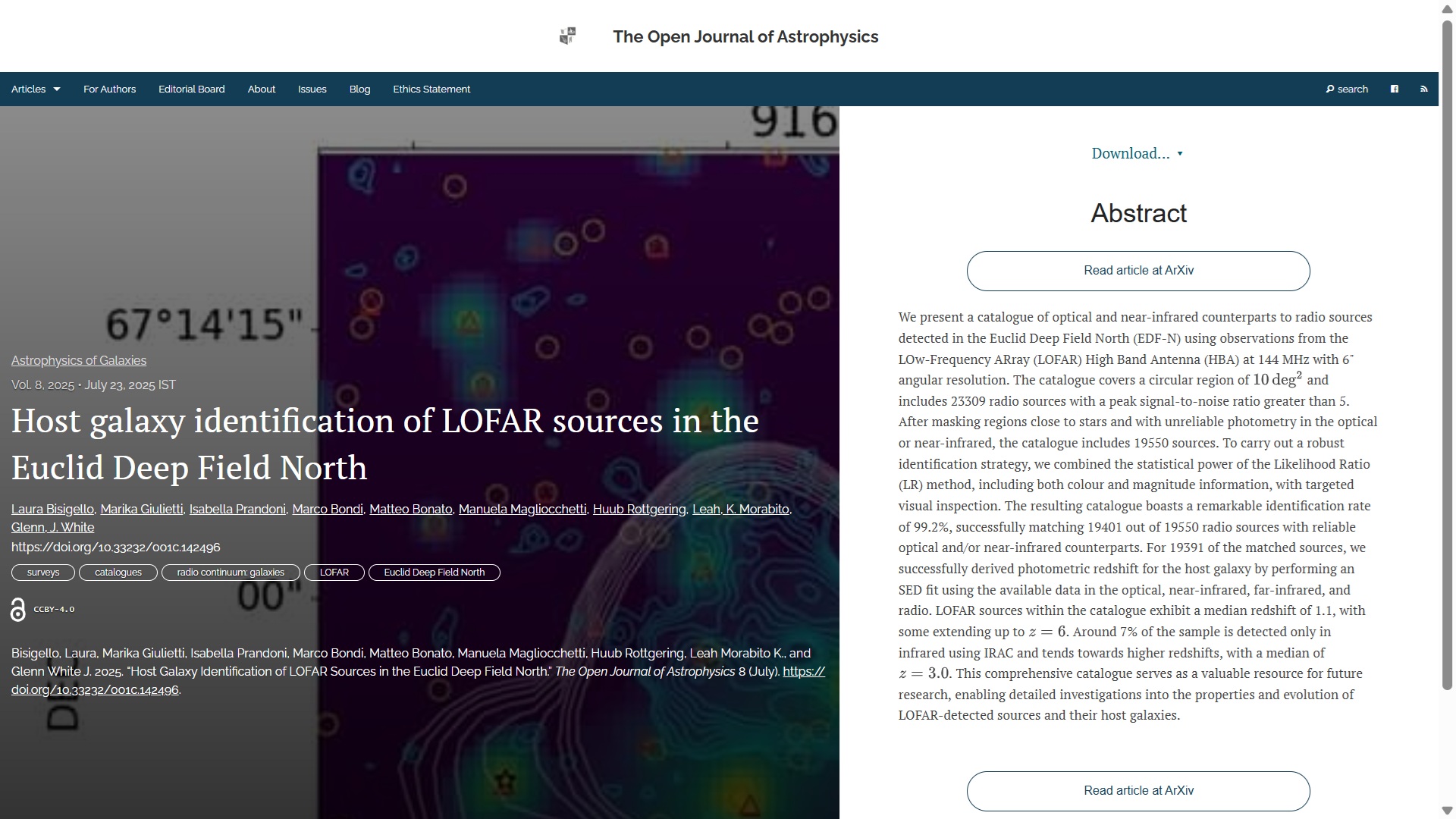
The fourth paper of the week, also published on Wednesday 22nd July in the folder Astrophysics of Galaxies, is “Host galaxy identification of LOFAR sources in the Euclid Deep Field North” by Laura Bisigello, Marika Giulietti, Isabella Prandoni, Marco Bondi, & Matteo Bonato (INAF, Bologna, Italy), Manuela Magliocchetti (INAF-IAPS Roma, Italy), Huub Rottgering (Leiden Observatory, Netherlands), Leah, K. Morabito (Durham University, UK) and Glenn, J. White (Open Universirty, UK). This presents a catalogue of optical and near-infrared counterparts to radio sources detected in the Euclid Deep Field North using observations from the LOw-Frequency ARray (LOFAR). The overlay is here:

The final, accepted version of the paper is on arXiv here.

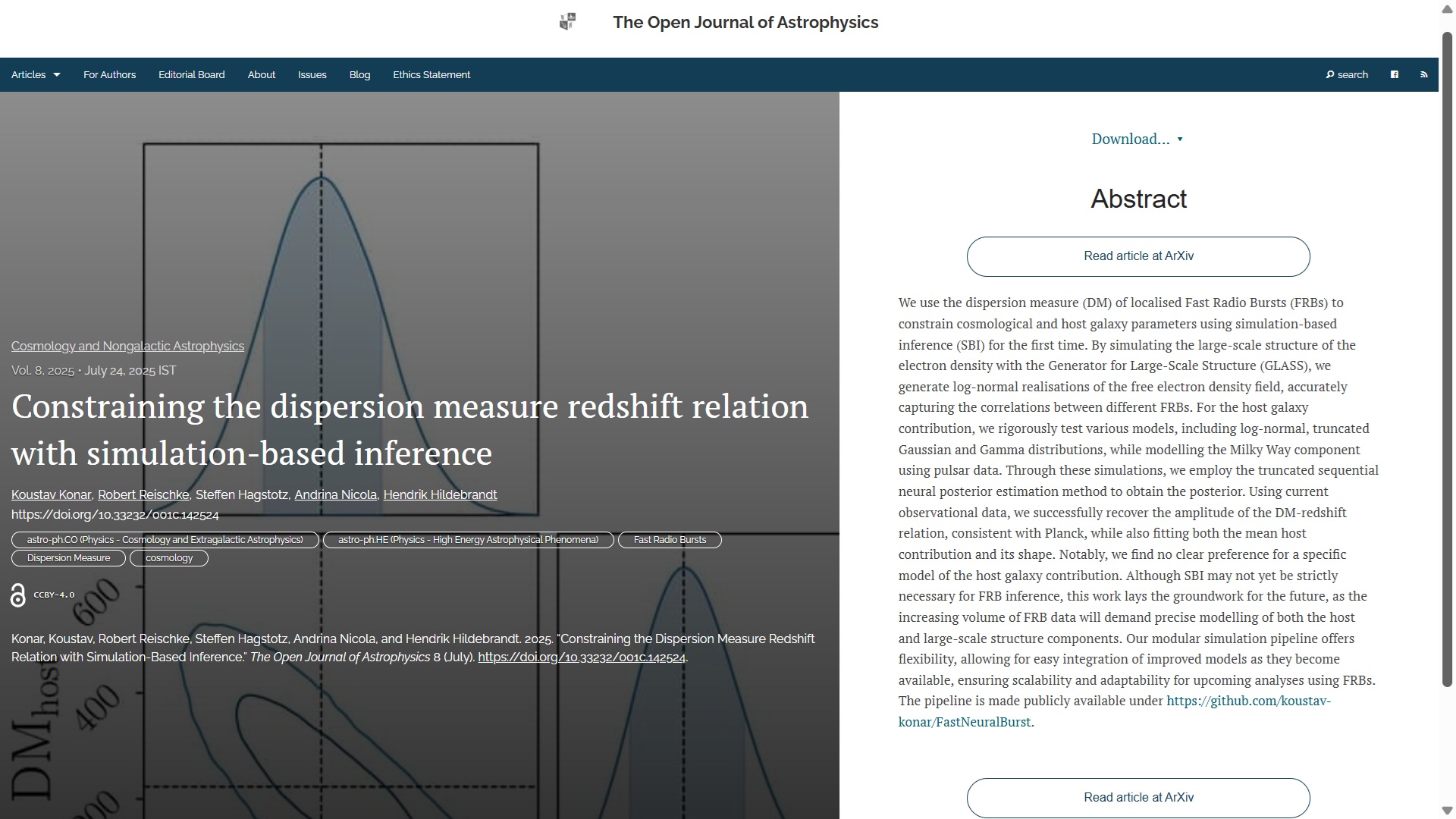
Fifth one up is “Constraining the dispersion measure redshift relation with simulation-based inference” by Koustav Konar (Ruhr University Bochum), Robert Reischke (Universität Bonn), Steffen Hagstotz (Ludwig-Maximilians Universität München), Andrina Nicola (Bonn) and Hendrik Hildebrandt (Bochum); all authors based in Germany. This was published on Thursday 24th July in the folder Cosmology and NonGalactic Astrophysics. It discusses using simulations to develop the use of Dispersion Measures of Fast Radio Bursts as cosmological probes. The overlay is here:

You can find the officially accepted version on arXiv here.

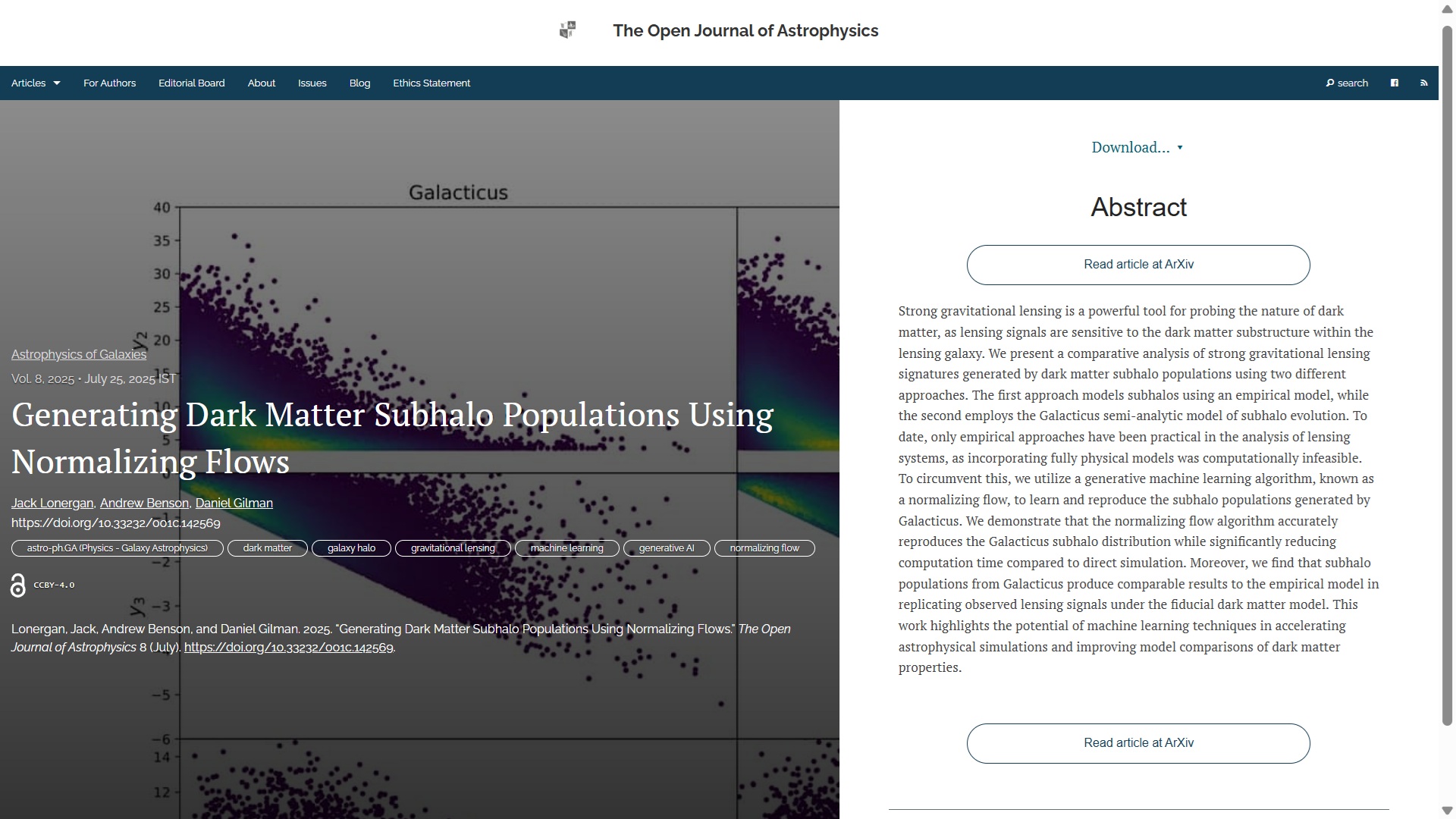
The penultimate (sixth) article published this week is “Generating Dark Matter Subhalo Populations Using Normalizing Flows” by Jack Lonergan (University of Southern California), Andrew Benson (Carnegie Observatories) and Daniel Gilman (University of Chicago), all based in the USA. This paper describes a generative AI approach to subhalo populations, trained using the semi-analytical model Galacticus. This paper was published yesterday (i.e. on Friday 25th July) in the folder Astrophysics of Galaxies.

You can find the final version on arXiv here.

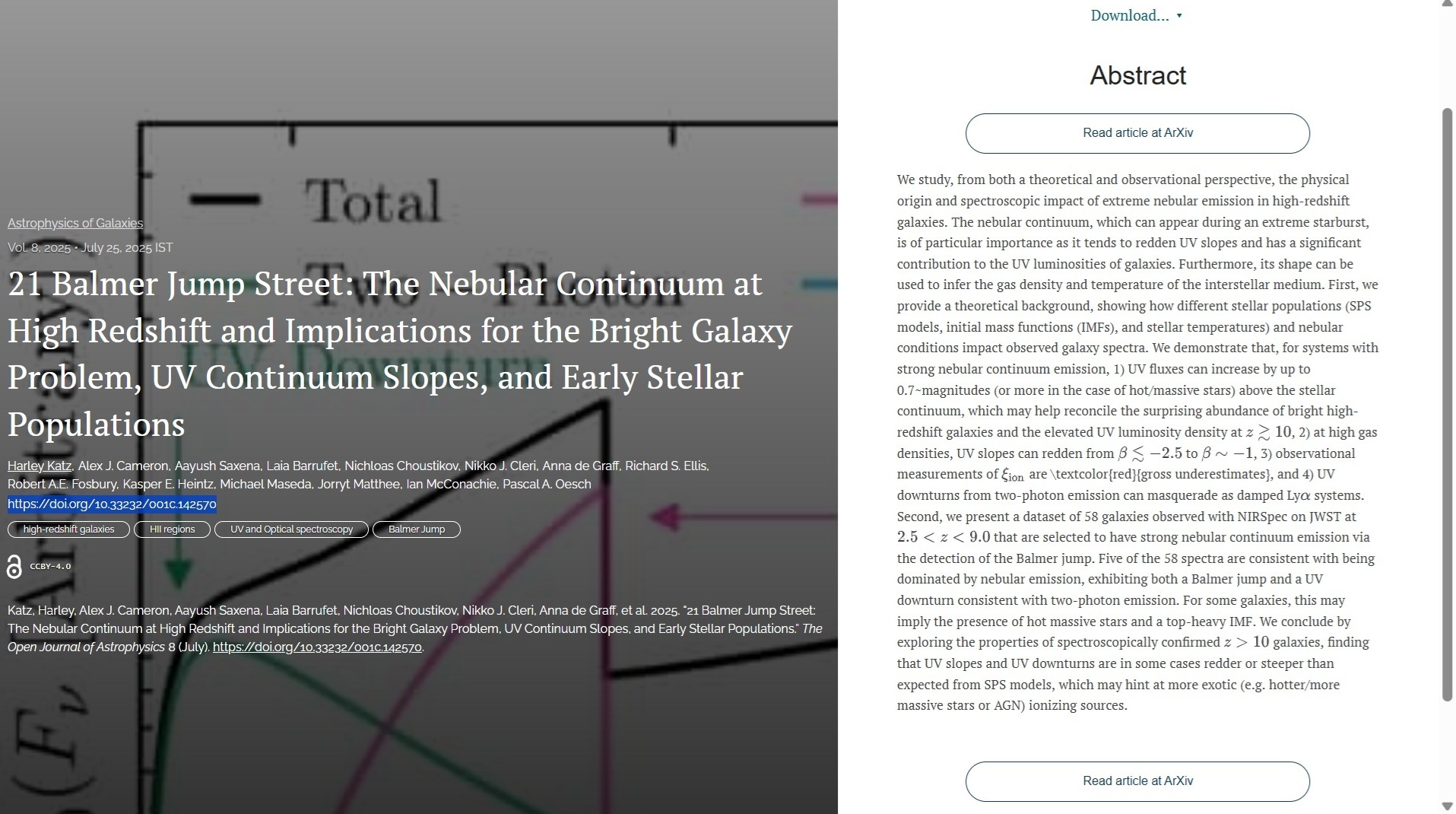
The last article published this week is “21 Balmer Jump Street: The Nebular Continuum at High Redshift and Implications for the Bright Galaxy Problem, UV Continuum Slopes, and Early Stellar Populations” by Harley Katz of the University of Chicago, and 13 others based in the USA, UK, Germany, Denmark and Austria. This discusses the implications of extreme nebular emission for the spectroscopic properties of galaxies, especially at high redshift. It was published on Friday 25th July in the folder Astrophysics of Galaxies.

The overlay is here:

You can find the officially-accepted version on arXiv here.

And that’s all the papers for this week. I’ll do another update next Saturday, when we’ll be into August.