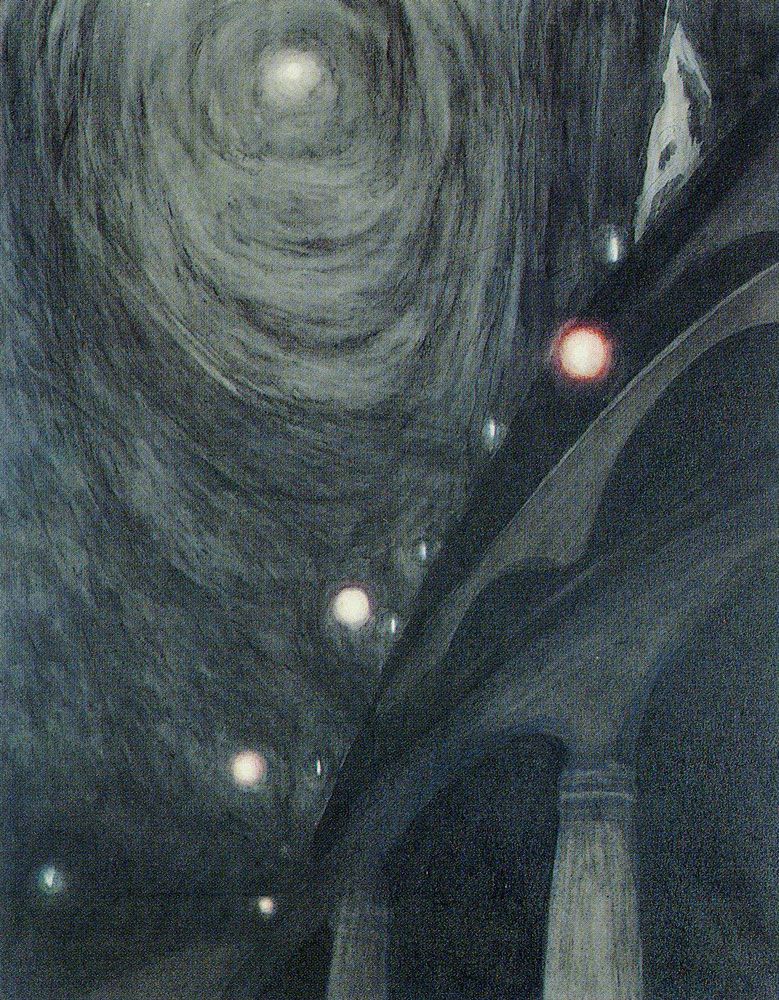
by Léon Spilliaert (1909, pastel and ink wash on paper, 65 x 50cm, Musée d’Orsay, Paris)
by Léon Spilliaert (1909, pastel and ink wash on paper, 65 x 50cm, Musée d’Orsay, Paris)
A while ago I went to a concert that featured a Mozart Piano concerto with soloist David Fray. I mentioned then that his encore was a piece by Johannn Sebastian Bach, arranged for piano. I thought I’d post a performance of the same piece today.
Originally the second movement “Air” from Johann Sebastian Bach’s Orchestral Suite No. 3, this piece became known as the Air on the G string when it was arranged for solo violin and orchestra, by August Wilhelmj, which involved transposing it down from D Major to C Major so that the violin part could be played entirely on the lowest of the four strings. It’s also sometimes called the (and sometimes “Celebrated Air”, which is more appropriate when it is played on anything other than a violin. The piano version performed by David Fray was arranged by Alexander Siloti and I think it’s very beautiful, based on a beautifully simple bass. Bach’s keyboard pieces often have a left-hand part which is interesting on its own. You can also see hear why jazz musician’s like Bach so much; the left hand provides such a steady but rich foundation for improvisation with the right hand.
Anyway, here is a nice performance of the same piece, at a gently swinging tempo, not unlike a slow blues, by Ukrainian pianist Valentina Lisitsa.
One of the Youtube commenters calls this version “melancholy”, which I don’t agree with at all! Whatever it is, it’s a nice way to spend 5 or 6 minutes relaxing in between lectures.
Regular readers of this blog know that I have a habit of reading the Times Literary Supplement which I buy not only for the book reviews, but also for its excellent crossword. I’ve even won the crossword competition prize a few times. You can find an assortment of posts related to the TLS here.
Recently the Times Literary Supplement underwent something of a makeover, changing the design and switching from a weekly to fortnightly publication. The first new-style issue was published on September 5th. Here is the cover:
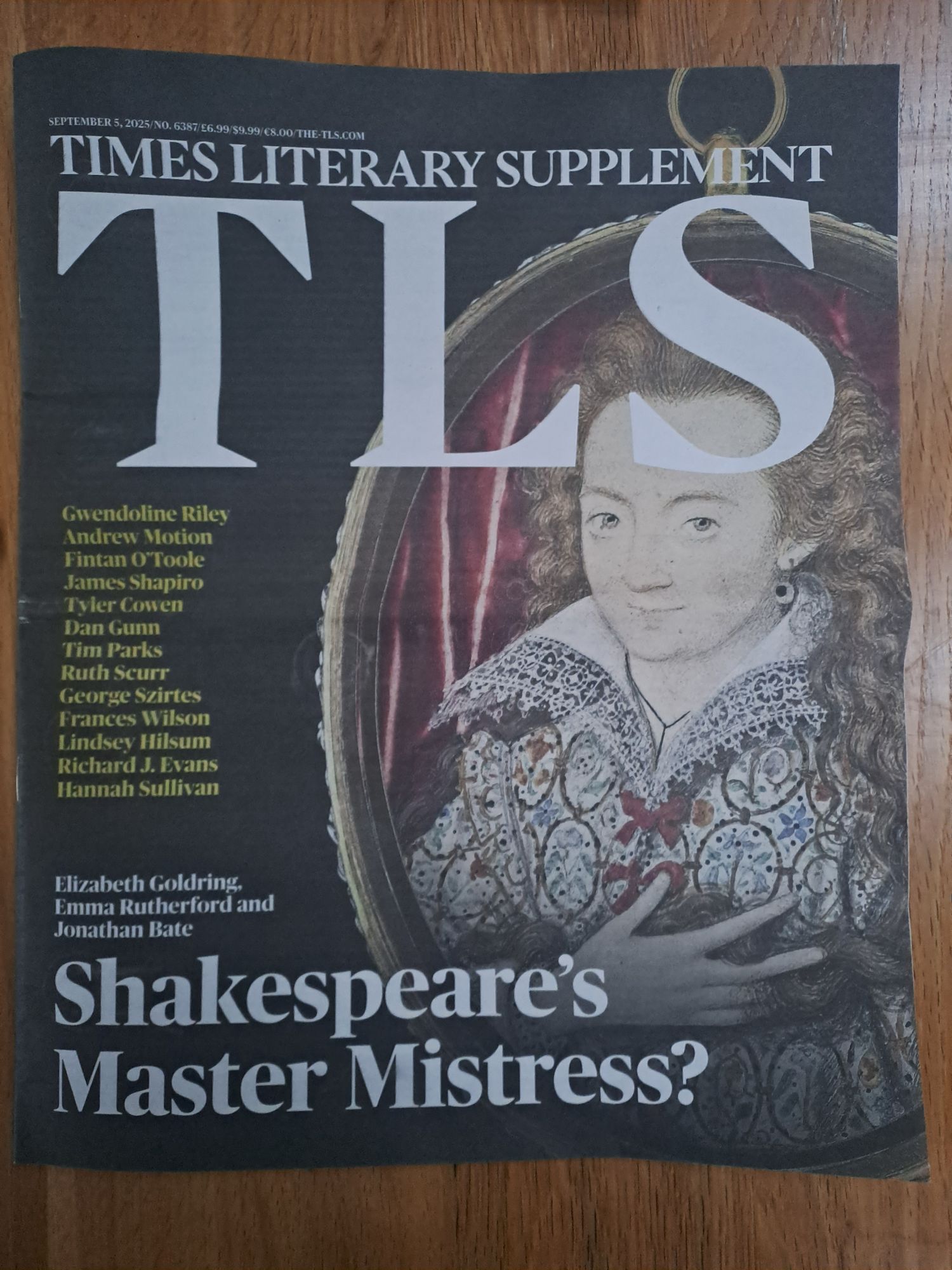
The cover article is about the possible identity of the “Mr W.H.” to whom William Shakespeare dedicated his collection of Sonnets; see here. I may write something about that in the not too distant future, as I’ve been reading these again recently.
Anyway, my subscription definitely specifies a “weekly print edition delivered to my door”, so that has gone out the window. I wasn’t best pleased to have the terms of my subscription changed unilaterally like that. Of course I could just read the online edition, but I don’t like reading too much on a screen. I’ve never adapted to reading books on a Kindle either. And crosswords are impossible that way. The old format TLS was rather like a tabloid newspaper, which I found easy to read and handle, and of 28 pages per edition. The new format has 48 pages (which is not 2 times 28) and is rather cramped and crowded and with heavier paper to make it look there’s more to it than there is.
The look and feel they seem to have gone for is “Generic Weekend Supplement”, as you can see if you compare it with last week’s Irish Times Weekend Magazine:

The latter supplement has 52 pages instead of 48 and has more advertisements inside but is otherwise similar.
So why mention this? Well one thing is that the number of crosswords provided by the TLS per year has now reduced by half, which to me reduces the value of the subscription significantly. Moreover, the first issue of the new style supplement was published on September 5th, but didn’t arrive through my letterbox until 24th September. That’s 19 days. The deadline for entries to the crossword competition was September 15th.
Now the old-style issues used to take about 10 days to cross the Irish Sea, which I thought was bad, but 19 days is just awful. One theory of this is that the TLS launches issues with the same momentum, so that the new edition, having about twice the mass, has half the speed and therefore takes roughly twice as long to reach the subscriber. Checking the envelope, incidentally, I see that it was postmarked Bratislava. There must be a very cheap – but slow – way of sending post from the UK to Ireland via Slovakia.
Anyway, I’ve decided not to renew my subscription to the TLS, as I did with Private Eye recently. I cancelled my subscription to the Eye not because I was offended by anything in it, but because it was taking a ridiculously long time to arrive. I can still pick up copies of both publications in the local newsagent. I’m sure Paddy will keep copies of both to one side if I ask him.
Alternatively, I might switch from the TLS to the London Review of Books or some similar. Does anyone have recommendations?
I’ve done quite a few posts recently about the ending of summer – the Autumnal Equinox, the resumption of teaching, the start of a new season at the National Concert Hall are three indicators – but now we really have reached which I regard as the definite conclusion. Yesterday saw the last day of the last round of matches in cricket’s County Championship.
I haven’t followed cricket very closely since I moved to Ireland, but I do look and see how Glamorgan are getting on. The County Championship started very poorly for them, with a thrashing by Middlesex, but they improved substantially and went into the last round of matches secure in 2nd place of Division 2. They lost their last match in Cardiff against a team from the Midlands, by 7 wickets – a game that actually ended on Friday – but they still finished second. That means that they get promoted to Division 1 for the first time in 21 years.
I wouldn’t bet against them being relegated straight away, though. Last time they got promoted (in 2004) they played just one season (2005) in the First Division, during which they lost 14 of their 16 matches, and dropped back down. They almost got promoted in 2010 but were pipped for second place by Worchestershire, who were the beneficiaries of an exceedingly generous – let’s put it that way – declaration by Sussex that allowed them to win their last match. Anyway, to avoid the drop next season Glamorgan need to improve their pace attack considerably. I wonder who, if anyone, they’ll sign?
Glamorgan plays an important role in the international cricket ecosystem, especially with the Ashes coming up. Many of Australia’s star players – including Marnus Labuschagne, Michael Neser, and Usman Khawaja – only came to prominence after stepping up to the big time to play for Glamorgan.
Knowing that the cricket season was almost over, on Friday I decided to give my front lawn one last mow too. The mower is now in the shed until next spring. Leaves have been falling for some time already, so I swept up what I could after cutting the grass. That reminds me to share this, which I found on Bluesky:
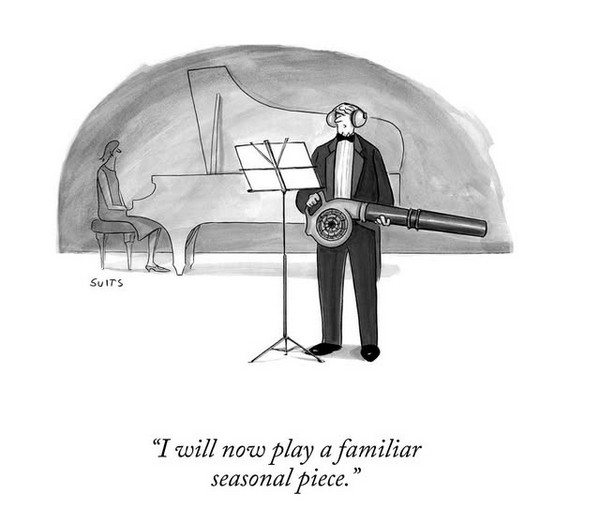
I really hate those things…
Anyway, we have completed one week of teaching at Maynooth University which passed off reasonably smoothly. I only had one timetabling glitch, but that was resolved trivially by just swapping two sessions. This year the Department of Physics has quite a lot of students in the final-year on the Physics with Astrophysics programme, run before the merger by the Department of Experimental Physics. Now we’re combined we can share the load and I’ll be supervising a couple of students on an astrophysics project, which will be a new experience. I haven’t really taught much astrophysics since coming here nearly eight years ago, so this will make a nice change.
It’s Saturday again, so it’s time for a summary of the week’s new papers at the Open Journal of Astrophysics. Since the last update we have published five new papers, which brings the number in Volume 8 (2025) up to 141, and the total so far published by OJAp up to 376.
The first paper to report this week is “The Bispectrum of Intrinsic Alignments: Theory Modelling and Forecasts for Stage IV Galaxy Surveys” by Thomas Bakx (Utrecht U., NL), Alexander Eggemeier (U. Bonn, DE), Toshiki Kurita (MPA Garching, DE), Nora Elisa Chisari (Leiden U., NL) and Zvonimir Vlah (Ruđer Bošković Institute, Croatia). This paper was published on Monday 22nd September 2025 in the folder Cosmology and NonGalactic Astrophysics. It studies the bispectrum of intrinsic galaxy alignments, a possible source of systematic errors in extracting cosmological information from the analysis of weak lensing surveys.
The overlay is here:

You can make this larger by clicking on it. The officially accepted version of this paper can be found on the arXiv here.
The second paper this week, published on Tuesday 23rd September 2025 is “Reanalysis of Stage-III cosmic shear surveys: A comprehensive study of shear diagnostic tests” by Jazmine Jefferson (University of Chicago, USA) and 13 others for the LSST Dark Energy Science Collaboration. It is also in the folder Cosmology and NonGalactic Astrophysics; it describes diagnostic tests on three public shear catalogs (KiDS-1000, Year 3 DES-Y3 s, and Year 3 HSC-Y3); not all the surveys pass all the tests.
The corresponding overlay is here:

You can find the officially accepted version on arXiv here.
The third one this week, published on Wednesday 24th September 2025 in the folder Astrophysics of Galaxies, is “Is feedback-free star formation possible?” by Andrea Ferrara, Daniele Manzoni, and Evangelia Ntormousi (all of the Scuola Normale Superiore, Pisa, Italy). This paper presents an argument that Lyman-alpha radiation pressure strongly limits star formation efficiency, even at solar metallicities, so that a feedback-free star formation phase is not possible without feedback. The overlay is here:

You can find the officially-accepted version on arXiv here.
Next we have “Microphysical Regulation of Non-Ideal MHD in Weakly-Ionized Systems: Does the Hall Effect Matter?” by Philip F. Hopkins (Caltech, USA), Jonathan Squire (U. Otago, New Zeland), Raphael Skalidis (Caltech) and Nadine H. Soliman (Caltech). This was also published on Wednesday 24th September 2025, but in the folder Earth and Planetary Astrophysics. It presents an improved treatment of non-ideal effects in magnetohydrodynamics, particularly the Hall effect, and a discussion of the implications for weakly-ionized astrophysical systems.
The corresponding overlay is here:

You can find the officially accepted version of this one on arXiv here.
The fifth, and last, one for this week is “The Local Volume Database: a library of the observed properties of nearby dwarf galaxies and star clusters” by Andrew B. Pace (University of Virginia, USA). This one was published on Friday 26th September (i.e. yesterday) in the folder Astrophysics of Galaxies. It presents a catalogue of positional, structural, kinematic, chemical, and dynamical parameters for dwarf galaxies and star clusters in the Local Volume. The overlay is here:
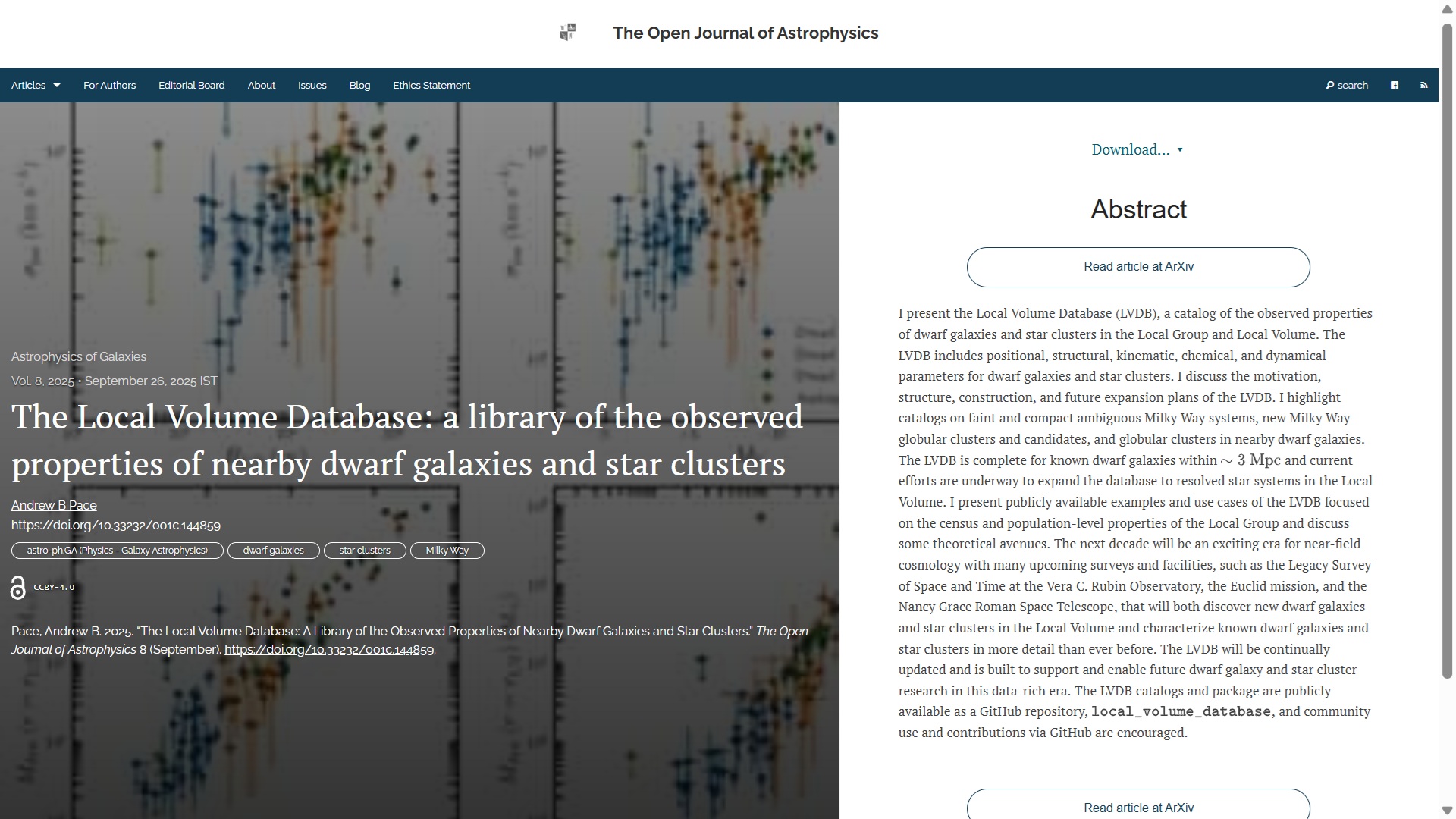
You can find the officially-accepted version of this paper on arxiv here.
And that concludes the report for this week. I’ll post another update next Saturday.
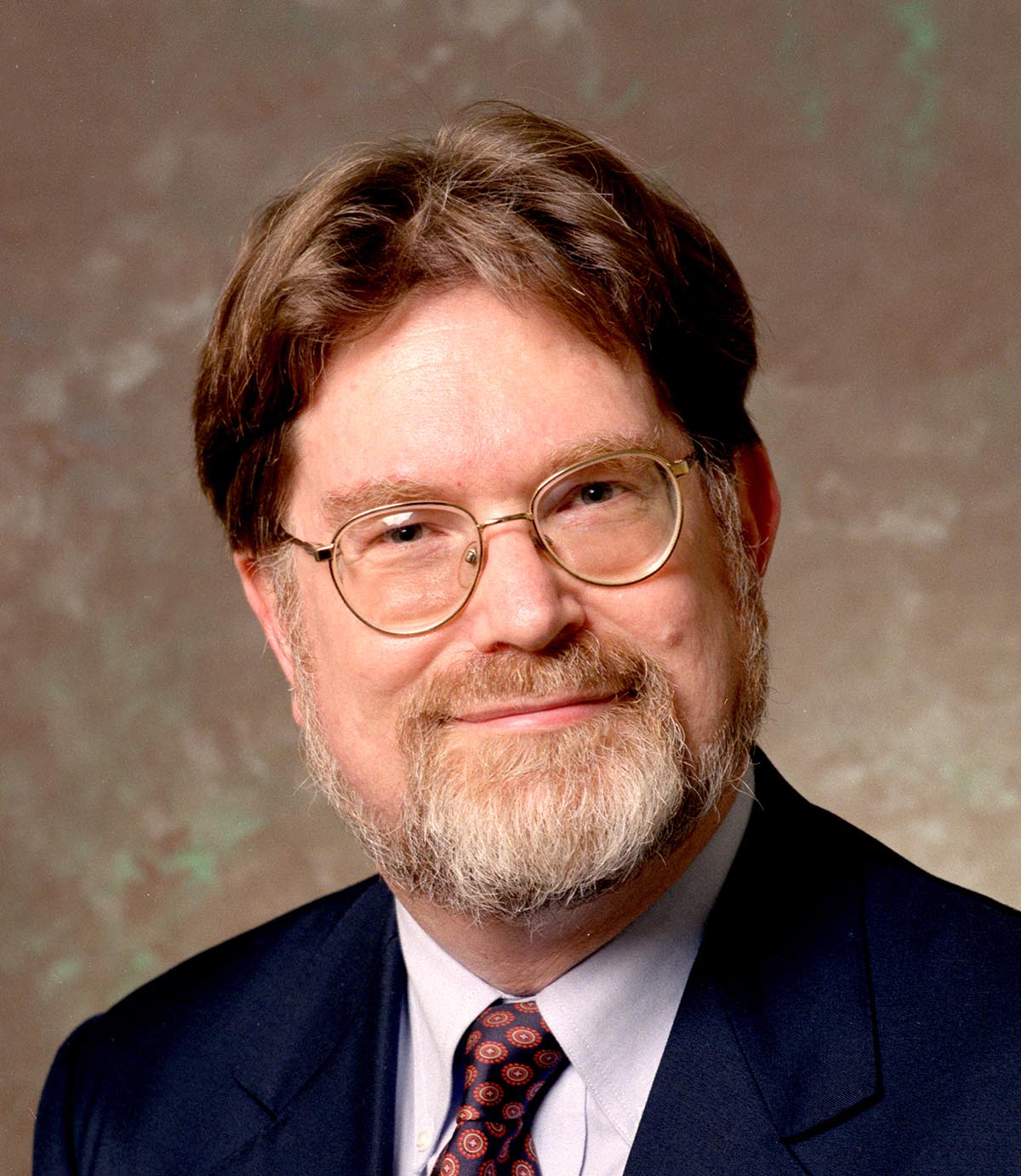
I’m very sad to have to report the death, at the age of 80, of eminent cosmologist George Smoot, who passed away at his home in Paris on 18th September. The news has been reported in France, where George had been living in recent years, but doesn’t seem to have been covered in the international media yet. I thought I would just record some personal relfections and reminiscences here, rather than try to pre-empt the official biographies.
George Smoot was an experimental astrophysicist who is best known for his research in observational cosmology, particularly on the cosmic microwave background. In 2006, jointly with John Mather, he was awarded the Nobel Prize for Physics for measurements made by the COBE satellite that, without exaggeration, ushered in a new era of cosmology. George led the paper Structure in the COBE Differential Microwave Radiometer First-Year Maps that reported the first detection of variations in temperature of the cosmic microwave background across the sky predicted by theories of cosmological structure formation.
I was fortunate enough to meet George many times over the years and to get to know him quite well. The first time was at a meeting in Durham for which this was the conference photo:
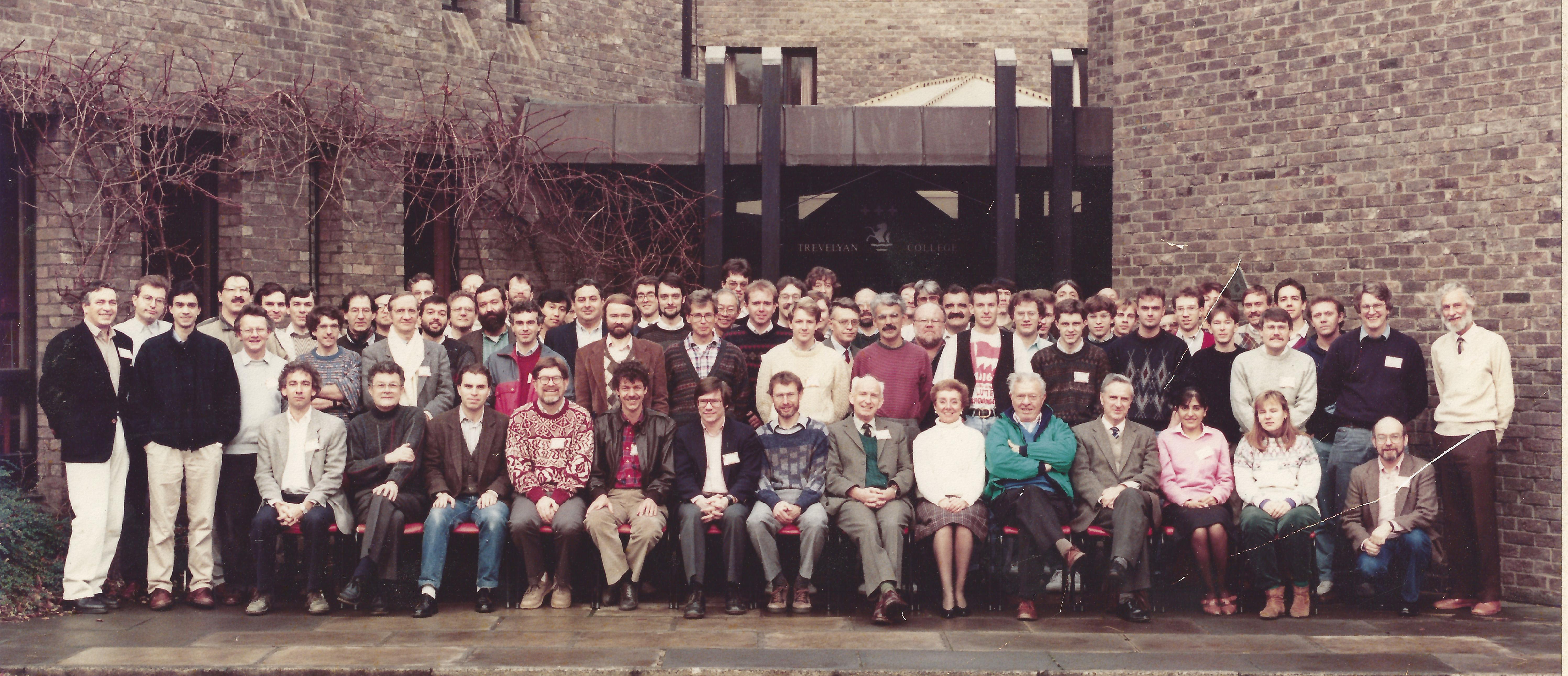
George is just to the left of centre in the front row with the red-and-white sweater.
What I remember about that meeting is that I gave a contributed talk there (a short one, because I was a mere postdoc at the time). Some time after that, George Smoot gave an invited talk during the course of which he mentioned (positively) the work I had spoken about. I was gobsmacked to have my little contribution recognized by someone so eminent, and it did wonders for my scientific self-confidence. I got the chance to have a conversation with George in person some time later at that meeting and found him very good value: he was both interesting and amusing to talk to. He was someone who took mentorship seriously, and didn’t confine it to those people he was working with directly.
Over the years I met George regularly at scientific meetings, including numerous times at the (then) Daniel Chalonge schools in Sicily and in Paris where we often chatted about science and other things over coffee breaks and dinner. I always found him hugely knowledgeable about many things, but he also had an almost child-like curiosity about things he didn’t previously know. He didn’t quite jump up and down with excitement when he learnt something interesting, but almost. He could also be very direct when disagreeing, which meant that some people found him a bit abrasive. He fell out with other members of the COBE time when he threw away the agreed protocol for the announcement of results in 1992. That caused a lot of bad feeling at the time, but it seems that by the time the Nobel Prize was awarded, some degree of reconciliation had been achieved. I was lucky enough to attend the Prize Ceremonies and at the ball afterwards chatted with both George and John Mather who seemed on very amiable terms then.
Anyway, in the early noughties George invited me to spend some time at the Lawrence Berkeley Laboratory, a visit that I enjoyed enormously. He was a very generous and thougtful host and I was looked after very well. One day at LBL he asked me if the hotel was OK. I replied that it was, but one thing I didn’t like about staying in a hotel was that I liked to cook and that was impossible in a hotel room. I thought nothing more of that conversation until the end of the day when George appeared and asked me if I wanted to “do dinner” at his house that evening. I answered in the affirmative so he drove me to his house, which was very fancy, set into the hillside overlooking Berkeley – like the sort of place I imagine a film star would live – and had a very large and well-provisioned kitchen.
It soon became clear that I’d misunderstood the invitation, in that “do dinner” didn’t mean “eat dinner” but “make dinner”. Although I was slightly taken aback I set about finding what he had in the refrigerator and on the shelves. There being a plentiful supply of spices, I decided to make a tandoori-style dish of chicken baked with yoghurt, with a couple of side dishes, none of which took long to cook. When everything was getting ready I wanted to add some lemon juice but couldn’t find any lemons in the fridge. I asked George if he had any lemons, at which point he showed me into the garden where he had several lemon trees in full fruit. I’ve never lived anywhere that this would be possible! I think he enjoyed the dinner because he paid me back a few days later with a dinner at Chez Panisse. He was quite the bon viveur.
(After that short visit, I was planning to spend a sabbatical year in Berkeley in 2005, but the United States Embassy in London put paid to that idea and I went to CITA in Toronto instead.)
The last encounters I had with George were online; he was in the audience when I gave talks in the Chalonge-de Vega series organized by Norma Sanchez in 2021 (here and here). I think he had already moved to Paris by that time. The first of these talks was about open access publishing in astrophysics; George subsequently co-authored a paper in the Open Journal of Astrophysics.
My favourite quote from George came during a discussion we had at Berkeley when I suggested that some methods used for studying the cosmic microwave background could be applied to the distribution of galaxies. His response was “Galaxies are shit”. To avoid offending my friends who work on galaxies, what he meant by that was that he thought galaxies were too messy for any statistical measurements to sufficiently reliable to compete with the CMB. I think he would have preferred a universe in which all galaxies were identical, like electrons.
I’m sure many others will have their own personal reflections on their interactions with George Smoot, but he also had a huge influence on many people who never met him personally, through his enormous contributions to astrophysics and cosmology. We will no doubt read many professionally-written official obituaries in days to come, but all I can say in a personal blog post is that he was a character, a very original thinker, a fine scientist, and a very nice man. Along with many others, I will miss him enormously.
Rest in Peace, George Fitzgerald Smoot III (1945-2025) .
Update: Here is an `In Memoriam’ piece from from the Berkeley Lab.
While writing yesterday’s post about the evolution of languages, and the importance of genetic information in reconstructing the story thereof, I was reminded of a post I wrote a while ago about the peculiarities of my own genome, a listing of which I have on a CD-ROM at home. There’s not as much data involved as you might think: it’s effectively only about 800 MB.
Anyway, to cut a long story short, it turns out that I have the CCR5-Δ32 genetic mutation. Not only that, I have it twice over, in that I have two copies (homozygotes). I must therefore have inherited it from both parents. This mutation confers virtually complete immunity from HIV-1 infection.

The above graphic shows that more than 10% of the population in Northern Europe has this mutation in just one allele (i.e. they are heterozygotic). To get an estimate of how many have the form on two alleles (i.e. homozygotic) form you can just square that number, so around 1% or more.
It is thought that the CCR5-Δ32 mutation occurred in a single individual in Scandinavia around 1,000 years ago. When I wrote that post I tacitly assumed that it had propagated passively, i.e. without any particular selection, to the modern era. That it reached 10% of the population starting from just one individual surprised me, but I let it pass.
More recently, I came across a paper about how advances in genetics have impacted epidemiological studies. In the abstract it shows that my assumption was probably incorrect.
Algorithms of molecular evolutionary theory suggested that the CCR5-Δ32 mutation occurred but once in the last millennium and rose by strong selective pressure relatively recently to a ~10% allele frequency in Europeans.
It goes on to say this:
Several lines of evidence support the hypothesis that CCR5-Δ32 was selected due to its protective influence to resist Yersinia pestis, the agent of the Black Death/bubonic plague of the 14th century.
I didn’t mention in yesterday’s post that evidence of the plague bacillus is found in a significant number of prehistoric human remains and this almost certainly played a role in the ebb and flow of populations. In the context of CCR5-∆32, however it seems that it may have been advantageous to carry it long before the arrival of HIV/AIDS. That might account for it reaching the relatively high level that it did.
Among the downsides, however, as the article explains, are an increased risk for encephalomyelitis and death when infected with the West Nile virus. Hopefully further cohort studies of people with this mutation will help elucidate its effect on other diseases.
By the way, in contrast to most people I know, I have still never had Covid-19…
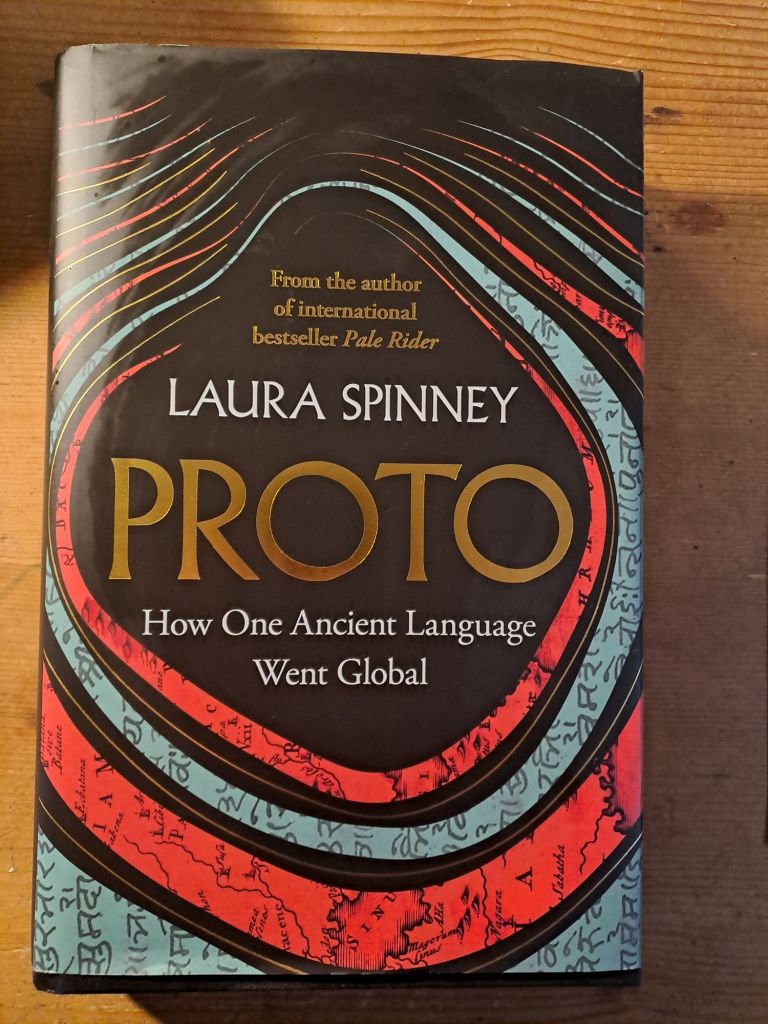
I interrupted the sequence of novels I’ve been reading recently to absorb a non-fiction book, Proto by Laura Spinney (left). I find linguistics a fascinating subject and when I saw a review of this recently and couldn’t resist. I’m glad I bought it because it’s absolutely fascinating. It is the story – or at least a very plausible account of the story of the lost ancestor of the Indo-European languages, the methods that have been used to reconstruct “Proto”, and why it was the spark that generated so many other languages across Europe, Eurasia and India.
The topic is very complex and I won’t attempt to describe it all in depth here; each chapter could be a book in itself because each family of languages within the Indo-European group – including lost ones such as Tocharian – has its own fascinating story. There are chapters focussing on the origins of language itself, the possibilities surround Proto (a language that was never written and probably exists in many dialects), Anatolian, Tocharian, Celtic, Germanic and Italic, the Indo-Iranian group (based on Sanskrit), Baltic and Slavic, and Albanian, Armenian and Greek. The last of these is fascinating because it used a method of writing borrowed from a non-Indo-European source that became the origin of the European alphabet.
The story of which all these are subplots begins around the Black Sea shortly after end of the last Ice Age. In this area there lived mesolithic hunter-gatherers who had survived the ice who interacted with farmers moving up from the direction of modern day Syria. Their languages would have merged in some way to allow them to describe things that their neighbours had that they didn’t. Hunter-gatherers would not have words for, e.g., ploughing or barley while farmers would have fewer words for spears and other hunting equipment. Into this mix, the argument goes, came a third group, a fully nomadic culture called the Yamnaya people. These people and their successors subsequently underwent vast migrations from the steppes across the continent and were responsible for spreading the Proto-Indo-European languages. That’s a hypothesis, not a proven fact, but it is plausible and has a reasonable amount of evidence in its favour.
Recent progress in this field has been driven not only by linguists but also by archaeologists and geneticists, with each aspect of this triangulation vital. It was reading about archaeology in this book that prompted me to write a post about the Nebra Sky Disc. There are some fascinating snippets from palaeogenetics, too. Full DNA sequences are now known for about 10,000 individuals who lived in prehistoric times.
One extraordinary find involves two burials of individuals who both lived about 5,000 years ago. Their DNA profiles match so well that they were probably second cousins or first cousins once removed. The thing is that one of them was buried in the Don Valley, north-east of Rostov in modern-day Russian, while the other was found 3,000 km away in the Altai mountains. Assuming they were both buried where they died, the implications for the distance over which people could move in a lifetime are remarkable.
Another fascinating genetic snippet applies to Irish, a Celtic language. The Celtic languages derive from a proto-Celtic source that probably arose about 1000 BC. Around 2450 BC one of the cultures preceding the Celts arrived in Britain and Ireland, now called the Bell Beaker People because of their taste in pottery. The genetic record shows that the DNA of the Beaker folk replaced about 90% of the previous local gene pool, and all of the Y chromosomes; for some reason men of the earlier culture stopped fathering children. A similar change happened in Ireland, about 200 years later.One possible inference is that there was a violent conquest involving the erasure of the male population, but we don’t know for sure that it was sudden and catastrophic.
Whatever language the Beaker people brought with them was not Celtic (though it may have been Indo-European). The fascinating conundrum is that when Celtic languages arrived in Ireland whoever brought them left not a trace in the genetic record. This is unlike any of the similar changes in language use throughout European pre-history. Either the population responsible has not been identified or the language was spread through communication (e.g. for trade) rather than settlement. Irish may be a Celtic language, but there is little evidence of significant numbers of Celts settling here and bringing it with them.
Some time ago I wrote a post about the Celtic languages, which you might want to look at if you’re interested in this topic. A lot of that post I now realize to be very simplistic, but to add one other snippet I should mention that the name of Turkish football team Galatasaray translates to “Palace of the Celts” after the Celtic-speaking people who settled in Anatolia; these were the Galatians to whom Paul addressed his Epistle.
I thoroughly recommend this fascinating book. It made me want to find out more about so many things. It also gacve me additional motivation to pursue an idea I had a while ago to do a Masters in Linguistics wehn I retire from physics…

Nominations of candidates for the next President of Ireland (Uachtarán na hÉireann) closed at 12 noon, and only three gathered enough support to be named on the ballot paper. These are Catherine Connolly (left), Jim Gavin (centre) and Heather Humphreys (right). The last time there were as few as three candidates was 1990, when Mary Robinson was elected. The last Presidential Election had six candidates.
A number of names were touted ahead of today’s deadline for nominations, some plausible and some bizarre, but most dropped out without ever getting started. That list includes Bob Geldof, Michael Flatley of Riverdance fame, Conor McGregor (a famous rapist), a man who runs a doggy-day-care business, and a lady, whose name escapes me, who used to read the weather forecast on the telly.
Last week businessperson Gareth Sheridan also dropped out, having failed to convince enought local authorities to nominate him. The threshold for this route to nomination is very low, just 4 out of 31 – 26 County Councils, three City Councils (Dublin, Galway and Cork) and two hybrids (Limerick and Waterford). Sheridan only secured two so dropped out. I never really understood why he was standing as his company is facing litigation in the USA for fraud and breach of contract, and that would have undergone relentless scrutiny during the election campaign, so I find it strange he was willing to risk that. Anyway, it doesn’t matter now; he’s a non-runner.
The last one to drop out was ultra-conservative Catholic anti-everything campaigner Maria Steen. She went for the route of nominations from members of the Oireachtas (TDs and Senators). After frantically scraping the bottom of the barrel she came up two short of the 20 needed and dropped out just before the deadline. My worry with this reactionary person was not that Ireland would end up with her as President, but that the election campaign (which will last a month) would be dominated by her airing her bigoted views.
The three remaining candidates are: Catherine Connolly (an independent TD standing as a unified leftist) who has the support of Sinn Féin, Labour, the Social Democrats and People Before Profit. Jim Gavin is a former GAA player and football manager for Dublin and flying instructor in the Air Corps who was picked up by Fianna Fáil as their candidate (although I don’t think he was a member before the campaign started); and last;y we have the Fine Gael candidate Heather Humphreys. I normally react with an instant “no” to FG drones, but she is a Presbyterian, whose father was a member of an Orange Order, which would be interesting for North-South politics on the island.
Maria Steen would probably have fragmented the right-wing vote and thus favoured Connolly on first preferences, but now it’s basically a choice between one left and two right. Since FF and FG are basically equivalent, they will probably mainly transfer to each other, so if Connolly is going to win she will have to do it on first preferences.
Election day (24th October) is exactly a month away. Deciding who to vote for will be as easy as one-two-three.
PS. The bookies’ odds via Oddschecker are: Humphreys 11/10 fav; Gavin 15/8; Connolly 5/2.

There’s a short article on arXiv with the title How to Fight Fraudulent Publishing in the Mathematical Sciences: Joint Recommendations of the IMU and the ICIAM which is well worth reading. The abstract is not useful but the prelude reads:
Prelude. In November 2023, Clarivate announced that it had excluded the entire field of mathematics from the latest edition of its influential list of ‘highly cited researchers’. This prompted the IMU and the ICIAM to conduct a more thorough investigation into the problem of fraudulent publishing in the mathematical sciences (see [1]). Understanding the problem is one thing; finding a way out and regaining control is another. With the recommendations given below, we would like to start the discussion on how, as a global community, we can achieve this. We are all concerned. It affects the very core of the science we love so much. I.A.
arXiv:2509.09877
The paper correctly identifies predatory journals and citation cartels as two consequences of the effort to quantify and rank the quality of research through scientific ‘performance indicators’, in the form of bibliometric measures and suggests some possible remedies.
Many of the recommendations are already included in the San Francisco Declaration on Research Assessment (SFDORA). Many also apply beyond the mathematical sciences (which is why I dropped the Mathematical Sciences bit in the title of the paper from the title of this blog post) and it’s not a long paper so I suggest you read it.
In my view one of the most important steps to take is to ditch the reliance on such companies as Scopus and Clarivate, who have deliberately constructed a system that is so easy to game. All higher education institutes should follow the examples of the Sorbonne University in Paris and, more recently, Utrecht University in the Netherlands. The academic publishing racket is inherently fraudulent. Too many universities, and indeed researchers employed by them, are willing participants in the system.

 In the Dark