Archive for October, 2025

Quarter-Term – Testing Time

Posted in Education, mathematics, Maynooth with tags , , , on October 13, 2025 by telescoper

I’ve just noticed that three teaching weeks have passed and we’re already into the fourth. Tempus fugit. Both the modules I am lecturing this semester are divided into four chunks of approximately equal size. For example, MP469 Differential Equations and Complex Analysis splits into: Ordinary Differential Equations; Partial Differential Equations; Complex Functions and Derivatives; and Complex Integration. Though technically not on the syllabus, I also do couple of lectures on Conformal Mappings because I think they’re cool.

As I mentioned a while ago,  I am concerned about the integrity of the coursework element of these modules in the light of improvements in Generative AI. Only a couple of years ago GenAI could not solve the sort of problems I set for homework, but now it generally can. I don’t altogether object to people applying artificial intelligence to solve mathematical problems, but the main issue is that it does make mistakes. Moreover, instead of saying “sorry I can’t solve that problem” it will generally present a superficially plausible but incorrect solution. Although students will probably use GenAI for problem-solving, I think it is important that they learn to do such problems themselves, otherwise they won’t know whether the solution coughed up by the algorithm is correct or not.

The only way to learn mathematics is by doing it. If students get GenAI to do the mathematics for them, then they won’t learn it. In the past we have given marks for coursework (usually 20% of the module mark) mainly to encourage students to do them. Students who don’t bother to do these exercises generally do badly in the final exam (80%).

For these reasons I am moving the assessment from weekly homework sheets – which could be tackled with AI – to supervised in-class tests for which students can use notes on paper, but not laptops or phones. I will of course give examples for the students to have a go at themselves, and I will give feedback on their attempts, but they will not contribute to the module score. Another advantage of this approach is that students won’t have to do so much work against deadlines outside of class.

What I’ve decided to do is have one class test for each of the four sections of each module. Given that we’re about a quarter of the way through the term, it’s time for the first ones. This week there will be a class test on Ordinary Differential Equations. I’ve never been enthusiastic about examinations being speed tests, so I’ve decided to set problems to be done in a 50-minute session which would be expected to take about 30 minutes in a formal end-of-term examination.

I have to make a short work-related trip that will keep me away on Wednesday, but I’ve already written the test questions, and will make arrangements for someone to supervise the tests if for some reason I don’t make it back to Maynooth on time…

Anyway, although we’ve been teaching for three weeks I still have to check my calendar to remember which room I’m supposed to go to before every lecture. Perhaps by Christmas I will have learned them off by heart…
When will the AI Bubble burst?

Posted in Artificial Intelligence, Finance, mathematics with tags , , , , on October 12, 2025 by telescoper

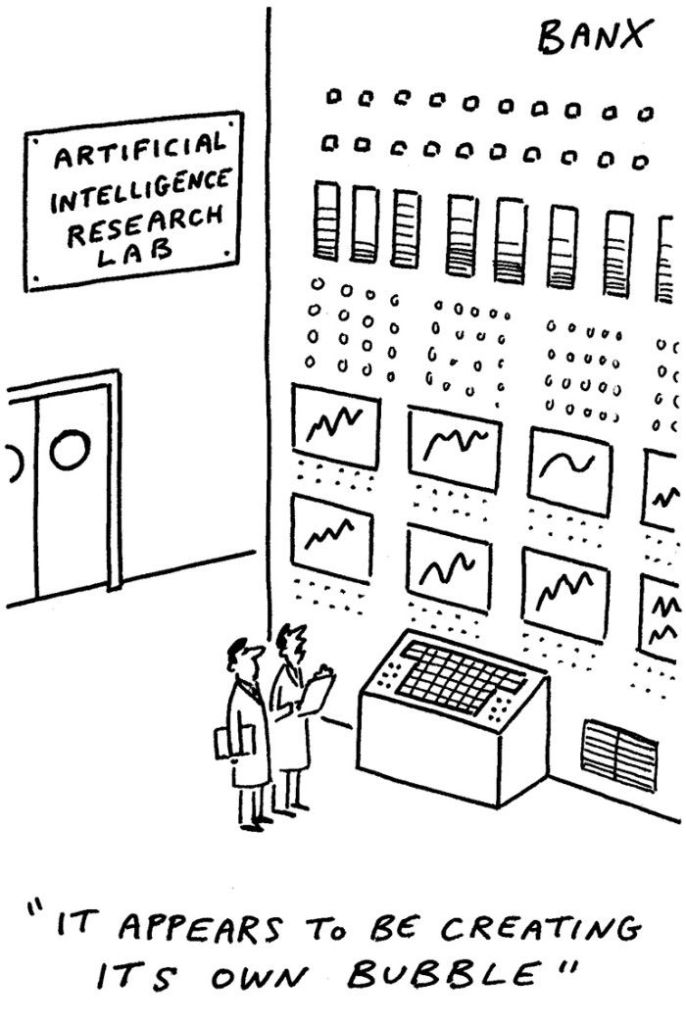
I’m not a financial expert, but I have noticed a significant number of articles in the media suggesting that the Generative AI industry is a bubble waiting to burst. There are recent pieces here on the BBC website, here in the Financial Times (from which I stole the cartoon), and here in the Irish Times, to name but a few.

These stories are based on reports by the Bank of England and the International Monetary Fund, warning of a stock market crash far worse than the dotcom boom-and-bust of 2000 and even the banking crisis of 2008. Over 30% of the valuation of the US stock market, for example, lies in five big technology companies that are investing heavily in the enormous infrastructure required for AI. Their extravagant capital expenditure is underpinned by a complex series of financial arrangements which could unravel very quickly if the investors get cold feet and consider it unlikely they will see a return on their money. It does look very much like a bubble to me.

My own view is that the claims made about the capabilities of AI by tech gurus are grossly overstated. Only the irredeemably gullible could think otherwise. I think a correction is inevitable. It’s not a question of “if” but “when” and “how much”. I am not competent to answer those questions.

P.S. Now there’s an RTÉ Brainstorm piece along the same lines…

Weekly Update from the Open Journal of Astrophysics – 11/10/2025

Posted in OJAp Papers, Open Access, The Universe and Stuff with tags , , , , , , , , , , , , , , , , , , , , , on October 11, 2025 by telescoper

It’s time once again for the usual Saturday update of the week’s new papers at the Open Journal of Astrophysics. Since the last update we have published six  more papers, which brings the number in Volume 8 (2025) up to 152, and the total so far published by OJAp up to 387. Not only have we passed the 150 mark for the year, but this week saw another record for the Journal, in that it was the first week in which we published at least one paper on every day.

Anyway, here are this week’s papers:

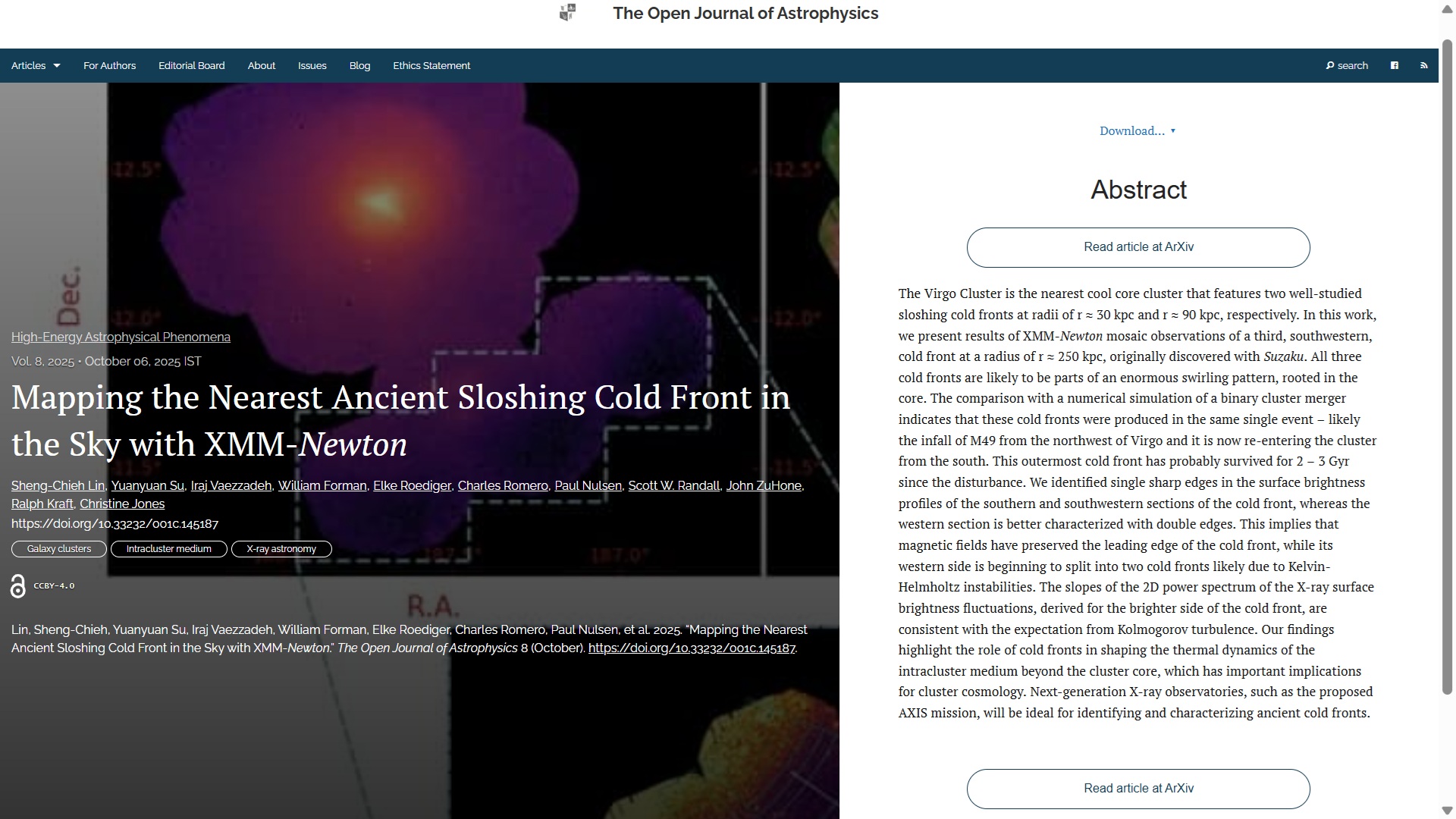
The first paper is “Mapping the Nearest Ancient Sloshing Cold Front in the Sky with XMM-Newton” by Sheng-Chieh Lin (University of Kentucky) and 10 others based in the USA, Spain and Germany. This article, published on Monday 6th October 2025, in the section High-Energy Astrophysical Phenomena discusses cold fronts in the Virgo Cluster, their importance in shaping the thermal dynamics of the intracluster medium beyond the cluster core, and their implications for cluster cosmology.

The overlay is here:


The officially accepted version of this paper can be found on the arXiv here.

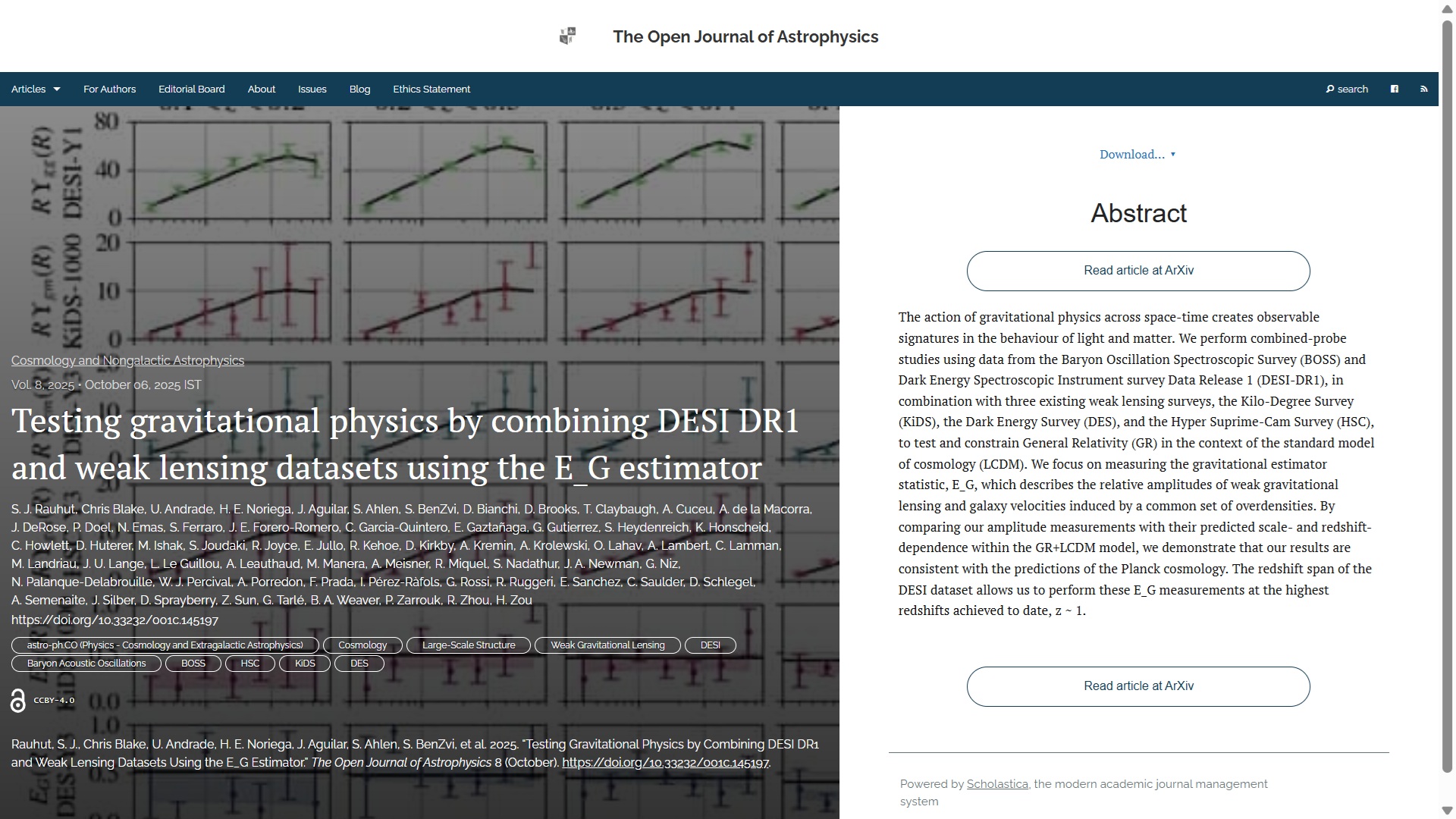
The second paper this week, also published on Monday 6th October, is “Testing gravitational physics by combining DESI DR1 and weak lensing datasets using the E_G estimator” by S.J. Rauhut (Swinburne University of Technology, Australia) and an international cast of 63 others. This one is in the folder Cosmology and NonGalactic Astrophysics, and it presents a comparison of  Baryon Acoustic Oscillation (BAO) measurements from BOSS, DESI with weak lensing from KiDS, DES and HSC showing that the results are altogether consistent with the standard cosmological model.

The overlay is here:

You can find the officially accepted version of this paper on arXiv here.

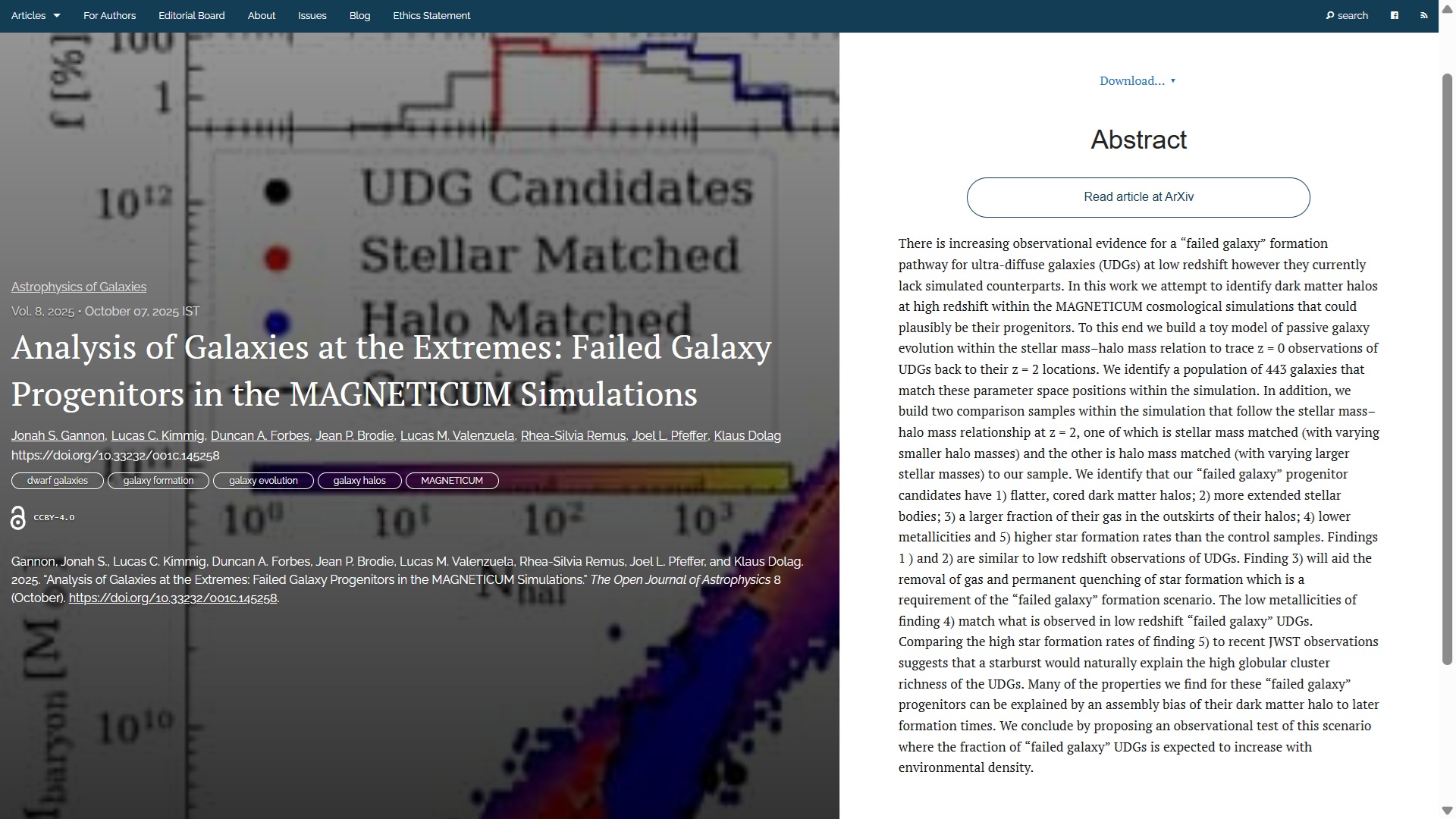
Next one up is “Analysis of Galaxies at the Extremes: Failed Galaxy Progenitors in the MAGNETICUM Simulations” by Jonah S. Gannon (Swinburne University, Australia), Lucas C. Kimmig (Ludwig-Maximilians-Universität, Germany; LMU), Duncan A. Forbes (Swinburne), Jean P. Brodie (Swinburne), Lucas M. Valenzuela (LMU), Rhea-Silvia Remus (LMU), Joel L. Pfeffer (Swinburne) and Klaus Dolag (LMU). This paper, published on Tuesday 7th October 2025, in the folder Astrophysics of Galaxies, discusses the business of identifying the possible high-redshift progenitors of low-redshift ultra-diffuse galaxies in cosmological simulations.

The corresponding overlay is here:

You can find the officially accepted version on arXiv here.

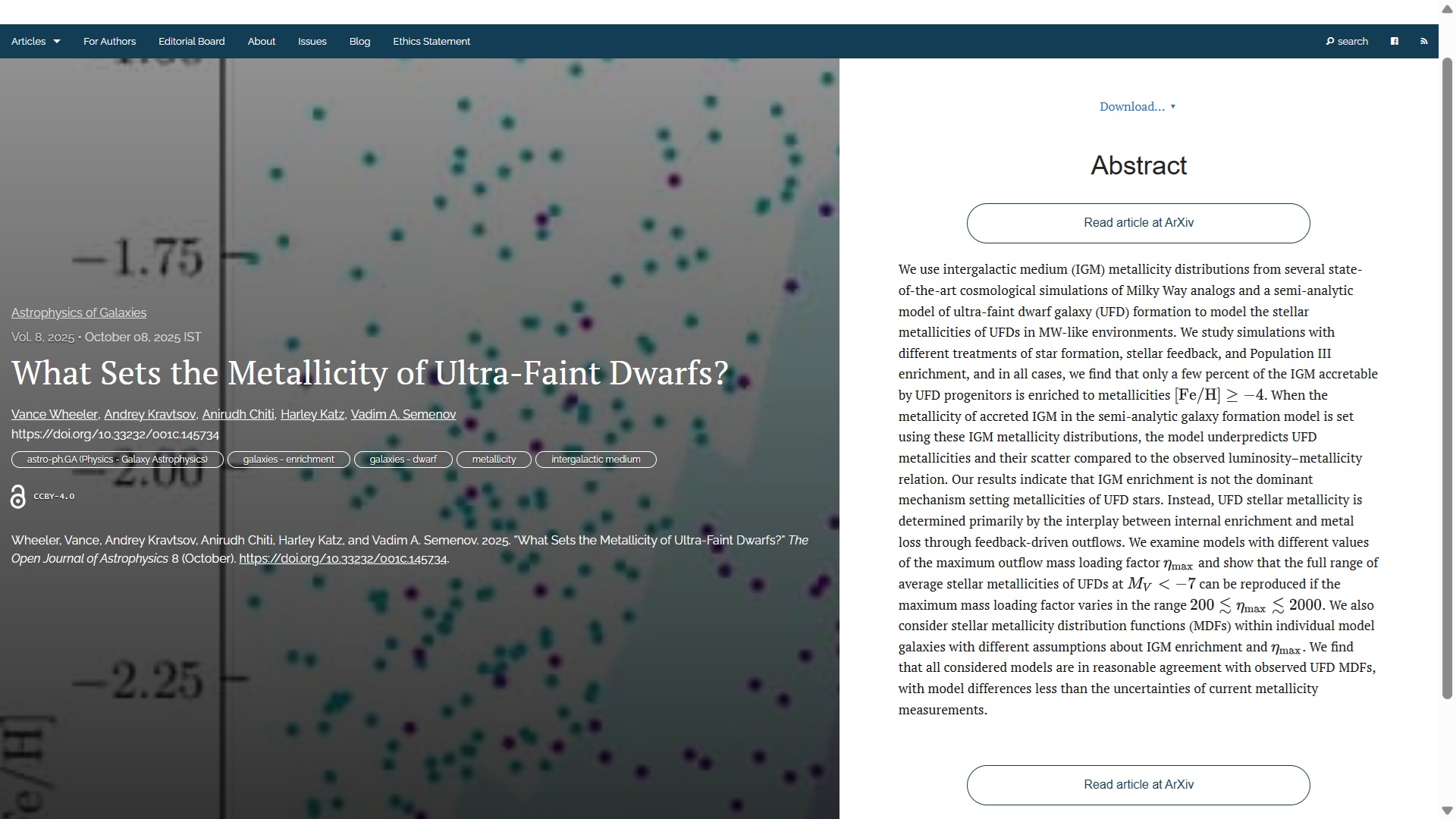
The fourth paper this week, published on Wednesday 8th October 2025 in the folder Astrophysics of Galaxies,  is
What Sets the Metallicity of Ultra-Faint Dwarfs?” by Vance Wheeler, Andrey Kravtsov, Anirudh Chiti & Harley Katz (U. Chicago) and Vadim A. Semenov (CfA Harvard), all based in the USA.

The overlay is here:

You can find the officially-accepted version on arXiv here.

Next, and fifth, we have our 150th publication of 2025, “Synthesizer: a Software Package for Synthetic Astronomical Observables” by Christopher C. Lovell (Cambridge, UK), William J. Roper, Aswin P. Vijayan & Stephen M. Wilkins (Sussex, UK), Sophie Newman (Portsmouth, UK) and Louise Seeyave (Sussex). This paper presents a suite of software tools for creating synthetic astrophysical observables for use in mock galaxy catalogues. It was published on Thursday 9th October 2025 in the folder Instrumentation and Methods for Astrophysics.

The overlay is here:

You can find the officially accepted version on arXiv here.

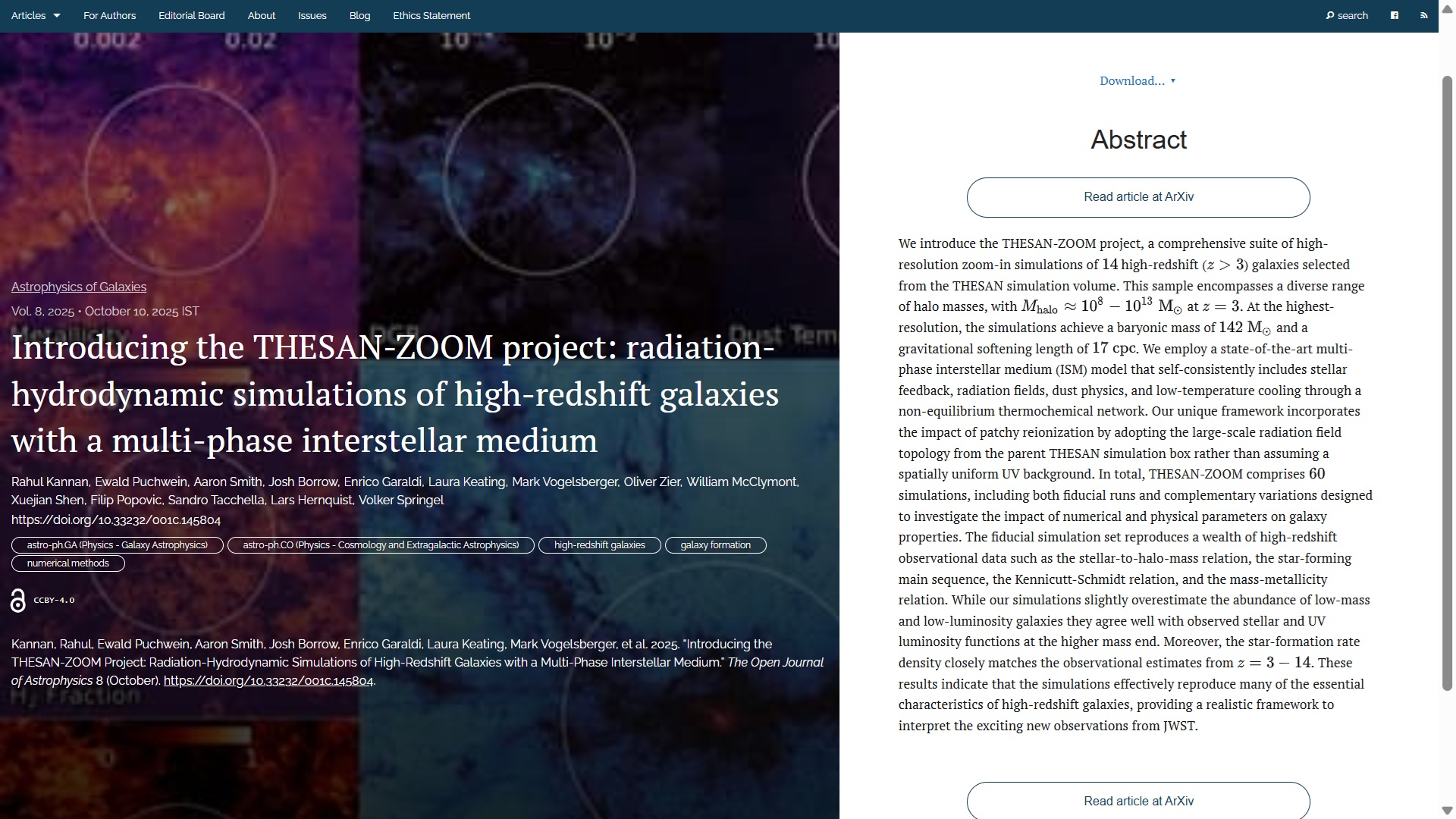
And finally for this week we have “Introducing the THESAN-ZOOM project: radiation-hydrodynamic simulations of high-redshift galaxies with a multi-phase interstellar medium” by Rahul Kannan (York University, Canada) and 13 others based in the USA, Germany, Japan, Italy and the UK. This one was published on Friday 10th October (i.e. yesterday) in the folder Astrophysics of Galaxies. It describes a comprehensive suite of high-resolution zoom-in simulations of high-redshift galaxies, encompassing a diverse range of halo masses, selected from the THESAN simulation volume.

The corresponding overlay is here:

You can find the officially accepted version of this one on arXiv here.

That concludes the papers for this week. I will, however, add a short postscript. This week saw the announcement of this year’s list of MacArthur Fellows. among them Kareem El-Badry who has published quite a few papers with the Open Journal of Astrophysics. His biography on the MacArthur Foundation page includes this:

He has published articles in Monthly Notices of the Royal Astronomical SocietyThe Astrophysical Journal, and The Open Journal of Astrophysics, among other leading scientific journals.

I’m pleased to see us listed with the established names. I mention this just in case there are still people out there who think it might damage their career if they publish with a non-mainstream journal. I guess we are mainstream now…

Shackleton: a Lesson in Leadership

Posted in History, Television with tags , , , , , , on October 10, 2025 by telescoper
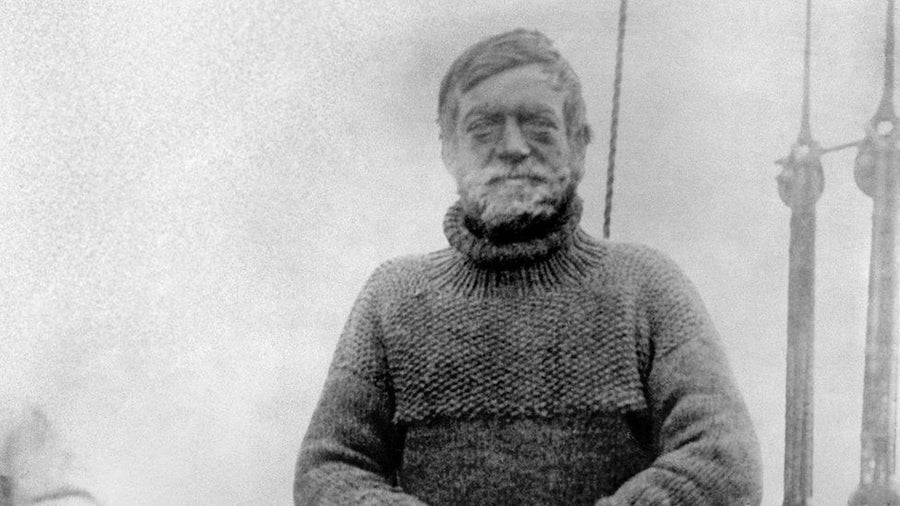
Ernest Shackleton (1874-1922)

I notice this morning a short item about a museum in Athy about explorer Ernest Shackleton, who was born in Kilkea which is near Athy. There was a museum there before, but it has been much expanded and renovated. I must make an expedition there one day to see it, as Athy is in County Kildare only about 60km to the south of Maynooth.

Seeing this article reminded me that some months ago I watched a documentary series called Shackleton: Death or Glory. It’s not a new series, but I hadn’t seen it before, and found it gripping and inspiring. You can see the entire series (3 episodes) on Youtube here. The idea was to reproduce the situation that Shackleton and his crew faced in 1916 when they had to abandon their expedition to cross Antarctica when their ship, Endurance, was trapped in the ice. The courage and leadership he showed in saving all their lives is awe-inspiring.

To cut a long and amazing story short, in 1914 Shackleton led an expedition to cross Antarctica on foot for the first time. But disaster struck before even reaching the continent. His ship Endurance was trapped in sea ice and he and his 27 men were marooned. Realising that the ship would be crushed, he ordered the crew to take everything they could, including the (three) lifeboats. They made a camp on the ice and stayed there several months, but it was clear they could not remain there indefinitely, so they set off with their provisions in the lifeboats towards Elephant Island, a perilous journey of almost 300 km, through freezing water thick with blocks of ice.

Elephant Island was safer that the ice shelf from which they had escaped but it was nowhere near any trade route so chance of being rescued by a passing ship was zero. The outlook was grim. A slow death from starvation and exposure seemed inevitable.

Shackleton could see only one (remote) possibility of rescue, which was to take one of the boats and try to find help. That meant travelling across the open sea to South Georgia, a journey of some 1500 km. Not just any sea, mind you: the notoriously stormy and treacherous South Atlantice. It was a very tall order but in his diary he calmy recorded his thought process, which was basically that if they all stayed put they would certainly die and if the rescue party perished those left behind would be no worse off. He had to take the chance.

Shackelton picked five men and set off in one of the lifeboats – a 22ft wooden vessel – across the merciless ocean, in an apparently desperate attempt to reach the only possible help at the Stromness Whaling station in South Georgia. The rest of the crew – 22 men – were left on Elephant Island.

Almost unbelievably, Shackleton and his five men survived 16 days at sea and made the crossing. But his gruelling mission didn’t end there, because they arrived on the wrong side of the island of South Georgia. The boat and two of the crew were in poor shape by then so they could not continue by sea. Shackleton, taking two men with him, had to traverse about 40km of an unchartered mountain range, without any mountaineering equipment in order to reach the safety of Stromness. Shackleton successfully raised the alarm, but the story was still far from over. The first thing Shackleton had to do was collect the two men he had left on the other side of South Georgia. All six were safe.

Now he had to think about the other 22 still at Elephant Island. In search of more appropriate ships, Shackleton went first to the Falkland Islands and then to Chile. Several rescue attempts failed, because of the pack ice and, once because of a fire onboard. Eventually he persuaded the Chilean Navy to lend him a steam tug, the Yelcho, which made it to Elephant Island. The men there were in poor shape, hungry and demoralised, almost but they were all alive. Against all the odds, Shackleton, saved every single one of his men from what must have seemed like certain death.

Aside from his physical courage and endurance, two characteristics exemplify the quality of  Ernest Shackleton’s leadership: one is that he would never ask any of his men to do anything he wouldn’t do himself, and the other is that he put the wellbeing of his men at the centre of all his decisions. Can you say those things about your “Leader”?

These days we hear a lot of talk, in various contexts, about leadership but most of the people who claim to show leadership don’t know the meaning of the word. Next time you hear some useless twit claiming to be a leader, think about Ernest Shackleton and judge them by his standards.

Caveman Physics

Posted in The Universe and Stuff with tags , , on October 9, 2025 by telescoper

A colleague sent me this, so I thought I’d share it:

Of course we can’t be sure whether there’s a singularity or not because of the presence of a horizon…

Everyone wants something better than ΛCDM

Posted in The Universe and Stuff with tags , , , , on October 8, 2025 by telescoper

There’s a nice short review article on arXiv today by Mike Turner. I wasn’t going to share it because it hasn’t got any pictures in it, but changed my mind.

Here is the abstract

The current cosmological paradigm, ΛCDM, is characterized (b) its expansive description of the history of the Universe, its deep connections to particle physics and the large amounts of data that support it. Nonetheless, ΛCDM’s critics argue that it has been falsified or must be discarded for various reasons. Critics and boosters alike do agree on one thing: it is the not the final cosmological theory and they are anxious to see it replaced by something better! I review the status of ΛCDM, provide my views of the path forward, and discuss the role that the “Hubble tension” might play.

arXiv:2510.05483

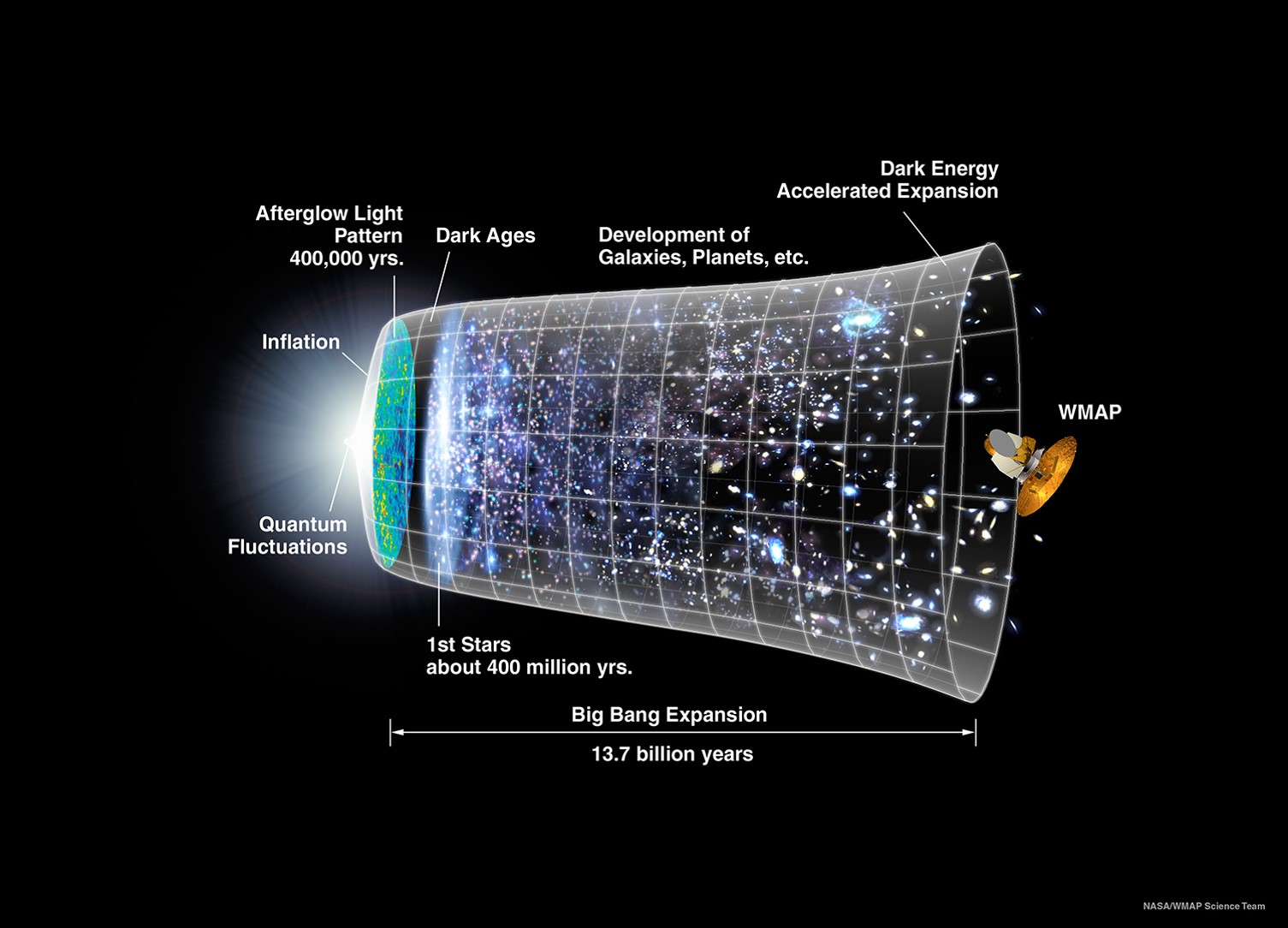
To make up for the lack of pictures in the article, here’s the first image that came up when I did a search for “ΛCDM”:

And then there were two…

Posted in Politics with tags , , , , , on October 7, 2025 by telescoper
Catherine Connolly (left) and Heather Humphreys (right)

Now that all the excitement about the Nobel Prize for Physics has died down I thought I would do a quick post to follow up my previous one about the election for the next President of Ireland (Uachtarán na hÉireann). Only three people gathered enough support by the deadline to be named on the ballot paper, namely: Catherine Connolly (an independent TD standing as a unified leftist who has the support of Sinn Féin, Labour, the Social Democrats and People Before Profit); Jim Gavin a former GAA player and football manager for Dublin, Civil Aviation Authority bigwig, and flying instructor in the Air Corps who was picked up by Fianna Fáil as their candidate; and Fine Gael candidate Heather Humphreys.

Sunday 5th October saw the withdrawal of Jim Gavin. It has to be said that he looked and sounded completely out of his depth in the TV debates, performing so badly that the bookies had put him at 16-1 by Sunday morning, but the final straw was a scandal over rent overpaid by a tenant to Gavin 16 years ago and never returned. I thought Gavin always looked like a potential banana skin for Fianna Fáil leader and Taoiseach Micheál Martin but in the event he turned into a hot potato that left Martin with egg on his face. In retrospect it seems a very serious error of judgement to back such a weak candidate.

Apparently Martin had pushed FF members very hard to select Gavin as their candidate, even though he wasn’t a member until recently, but now they are wondering why they had been asked to endorse a dodgy landlord from outside the party when there were so many of those already in it.

So now there are only two candidates, except that the relevant electoral law does not allow a candidate to withdraw after the deadline for nominations (which was 24th September) so Jim Gavin’s name will still be on the ballot paper. It will be interesting to see how many people vote for him despite his withdrawal, as a kind of protest. They might make a difference, as might those who transfer their first choice to Heather Humphreys. I suspect many ardent FF-ers will just not vote, though. In that case it will simply be down to who wins the most first preferences.

It wasn’t – and still isn’t – obvious to me which of the two remaining candidates is favoured by these shenanigans, but it is clear what the Bookies think: odds are currently Connnolly 1/3 favourite and Humphreys 11/4. At the start of the campaign Catherine Connolly was the outsider, but she’s now odds-on favourite. She’s the only candidate whose team has canvassed me (so far)

Election Day is Friday October 24th.

And as if all that excitement weren’t enough, today was Budget Day. The reaction to that might well influence the vote for President: if it is unpopular, the anti-establishment vote might increase.

Update: it is clear from here that Gavin’s votes will be treated as valid and if he finishes third on first preferences, his transfers will be counted in the usual way.

Nobel Prize for Physics Speculation

Posted in Biographical, Science Politics, The Universe and Stuff with tags , on October 6, 2025 by telescoper

Just to mention that tomorrow (Tuesday, October 7th 2025) will see the announcement of this year’s Nobel Prize for Physics. I must remember to make sure my mobile phone is fully charged so I can be easily reached, although I am likely to be lecturing when the announcement is made.

The announcement of the Nobel Prize for Physics on Tuesday is preceded today (Monday 6th) by the announcement of the Prize for Applications of Physics to Physiology or Medicine, and followed on Wednesday by the Prize for Applications of Physics to Chemistry. You can find links to all the announcements here.

I do, of course, already have a Nobel Prize Medal of my own already, dating from 2006, when I was lucky enough to attend the prize-giving ceremony and banquet.

I was, however, a guest of the Nobel Foundation rather than a prizewinner, so my medal is made of chocolate rather than gold. I think after 19 years the chocolate is now inedible, but it serves as a souvenir of a very nice weekend in Stockholm! Sadly one of the Laureates whose award we were celebrating passed away recently.

Regular readers of this blog may recall that I called it correctly in 2022 when Alain Aspect, John F. Clauser and Anton Zeilinger won the Nobel Prize for Physics that year. I had, however, predicted them every year for many years until they won, and they won’t win it again.

I drew a blank in 2023 when attosecond light pulses were the topic and was completely wrongfooted last when the 2024 Nobel Prize for Physics was awarded to John J. Hopfield and Geoffrey E. Hinton “for foundational discoveries and inventions that enable machine learning with artificial neural networks”. I didn’t see that one coming at all.

I really have no idea who will win it this year, but I’ll suggest that there’s still an outside chance for Michael Berry and Yakir Aharonov for their work on the geometric phase, although if they were going to win they probably would have done so by now.

To find out who the lucky winners you’ll have to wait for the announcement, around about 10.45 (UK/Irish time) on Tuesday morning. I’ll update this post when the wavefunction has collapsed.

Feel free to make your predictions through the comments box below!

Update: I’m not often right but I was wrong again: the 2025 Nobel Prize for Physics goes to John Clarke, Michel H. Devoret and John M. Martinis “for the discovery of macroscopic quantum mechanical tunnelling and energy quantisation in an electric circuit”…

https://www.nobelprize.org/prizes/physics/2025/press-release/

Introducing Science Explorer (SciX)

Posted in The Universe and Stuff with tags , , , , on October 5, 2025 by telescoper

I received an email about this over a week ago from Alberto Accomazzi (Director and Principal Investigator of the NASA Astrophysics Data System) and was going to post about it then but I was quite busy and it slipped my mind. I met Alberto at ENAM earlier this summer and he told me then this was in the pipeline so I should have remembered. Anyway, better late than never…

The email was to announce the formal launch of Science Explorer (SciX for short) on Monday 29th September 2025. SciX is meant to build on the excellence of ADS and expanding its coverage to accelerate astro-related research even further.

Here’s a screenshot of the home page set up in such a way as to take you, if you click on it, by a miracle of the internet, and at no extra charge, to the actual home page:

Feel free to go and check it out!

Here is some text from the email I mentioned:

So, what is the Science Explorer platform, or SciX? Think of it as your one-stop platform for exploring research across Earth, environmental and space sciences, including planetary science, heliophysics, geology, geophysics, atmospheric sciences and oceanography. From tracking solar storms, to uncovering the secrets of distant planets, to understanding the changing dynamics of our own Earth, SciX is designed to be your research co-pilot. You can find out more at scixplorer.org.

The people behind SciX would also love to know how NASA/ADS has supported your work so far and how SciX’s additional features will benefit the community. Your testimonial can be brief, in written or video form, and can be submitted via this form, or by email if easier. It is important to show your support in view of the challenges facing NASA these days. I think we tend to take services such as NASA/ADS for granted, but we’d all find our work much harder without them, so do please send a message of support.

P.S. You can find SciX on social media with the handle @SciXCommunity. Please give them a follow!

Storm Amy

Posted in Biographical, Maynooth with tags , , on October 4, 2025 by telescoper

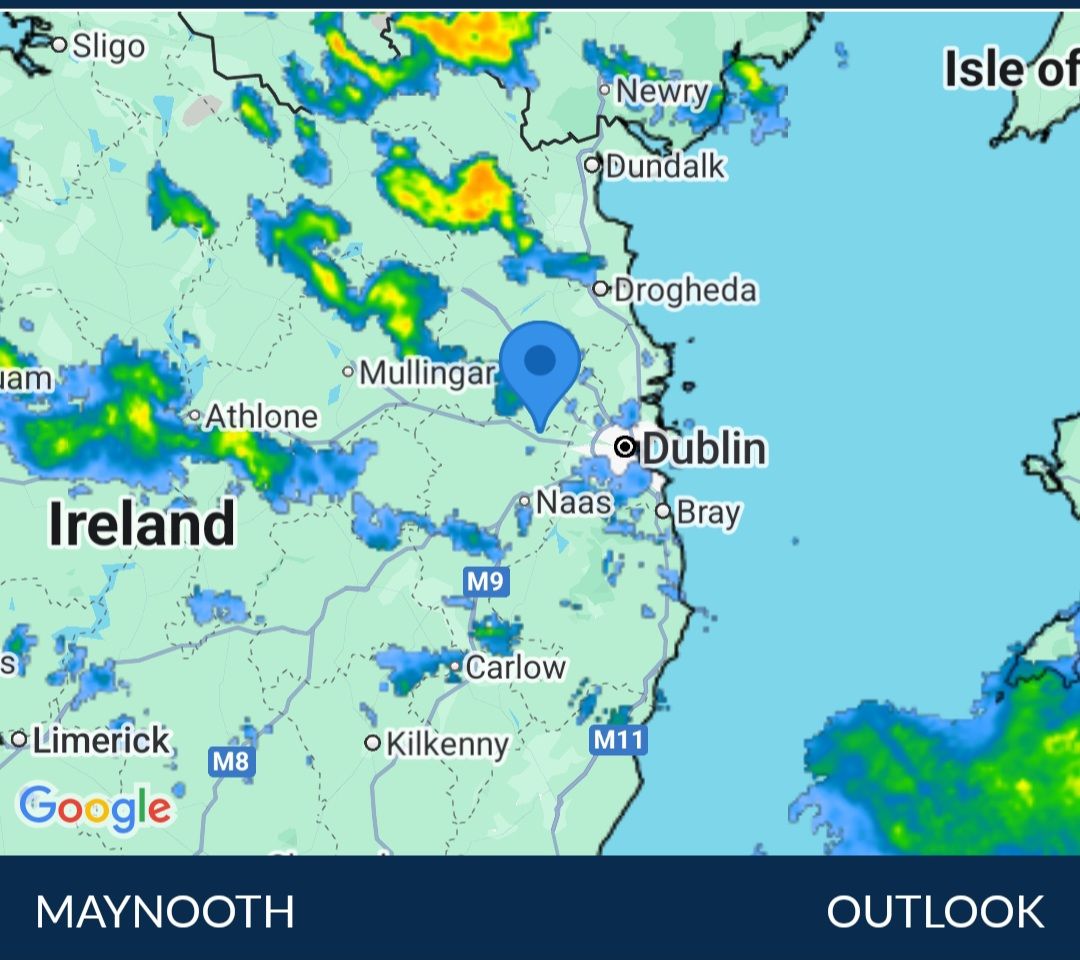
It’s been an interesting couple of days while Storm Amy worked its way over the island of Ireland and on to Scotland. The worst hit County in the Republic was Donegal but even here in the shelter of County Kidlare there were gusts over 100 hm/h on Friday, and quite a lot of rain as you can see from the first two radar* plots above. Quite a few people, quite reasonably if they were heading towards the weather, went home a bit early on Friday.

Initially the wind was southerly, and it felt surprisingly warm, despite the rain, but by this morning it had veered westerly, the rain had turned to showers, and the wind has now moderated substantially.

I spent some time this afternoon clearing up leaves and small branches that had fallen during the storm, as well as looking for signs of damage. But all’s well. No power cuts either. My big worry however is this tree just outside my house:

It is far too tall for its location, and has been leaning alarmingly for some time. If it topples in the direction it is leaning it will hit my house. I’ve been on to Kildare County Council a few times about it, actually. I don’t want them to chop it down, but I do think they should cut back the upper branches so that if it falls it won’t hit either mine or my neighbour’s house. Unfortunately, they’ve refused to do anything at all. Time for another go at them, I think. It will cost them a lot less to deal with it now than the sum they will have to pay me if serious damage is caused by their negligence.

*In case you’re interested, Met Éireann’s weather radars are located at Dublin and Shannon, and operate at 5.64 GHz (C-band).