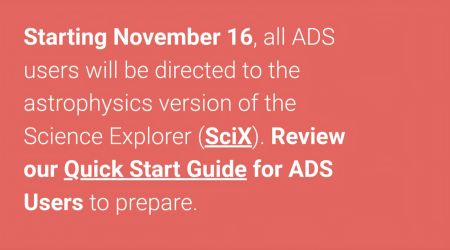
For some time now, user of the SAO/NASA Astrophysical Data System have been presented with the message on the left warning them that ADS – as it is known for short – is about to be replaced.
Well, today (16th November 2026) is the day we bid farewell to ADS, though when I looked just now it was still reachable at its old web address. The information contained in ADS is not being lost, of course, but subsumed within Science Explorer (SciX for short) to which users will be redirected. The only thing I object to about SciX is its name, which is to Muskian for my tastes. I have dabbled with SciX in the past and found it a bit slower than ADS, so I’ve deferred switching completely until I am forced to, which I assume will be later today when the USA wakes up.
The Astrophysics Data System came online in 1992. I don’t remember when I started using it, but it can’t have been long after that. For the uninitiated, it is/was a digital library portal for researchers in astronomy and physics, operated by the Smithsonian Astrophysical Observatory (SAO) under a NASA grant. The ADS maintains bibliographic databases containing more than 15.0 million records, covering publications in Astronomy and Astrophysics, Physics, and (of course) the arXiv e-prints. In addition to maintaining its bibliographic corpus, the ADS tracks citations and other information, which means that it is an important tool for evaluating publication impact in these fields. All that will continue in SciX, of course, but those of us of a certain age will feel some sadness at having to say goodbye to a thing that has served us so well for so long.
We astrophysicists have been fortunate to have such a resource, and I think one of the aims of SciX is to expand its functions to other areas of science. Many research fields are forced to rely on junk databases such as Scopus which is so incomplete and error-strewn that it shouldn’t be taken seriously by anyone.
ADS usually updates after about a week with papers published by the Open Journal of Astrophysics and I usually check it to see if everything is OK. For old times’ sake I report that as of today, OJAp has 708 papers on ADS with a total of 10,731 citations (last week’s papers have not arrived there yet).


